









In This Article (16 sections)
Goodfire Qwen3-32B Research: Why 90% of Neuron Poles May Have One Main Function
Goodfire’s research into Qwen3-32B suggests that many individual components inside large language models may be easier to understand than researchers previously believed. In a preliminary audit, the AI interpretability company estimated that approximately 90% of the model’s neuron poles have one main job, often accompanied by smaller, related responses. The finding challenges a longstanding concern in mechanistic interpretability that neural networks routinely combine unrelated concepts within individual neurons, making their internal operations difficult to explain.
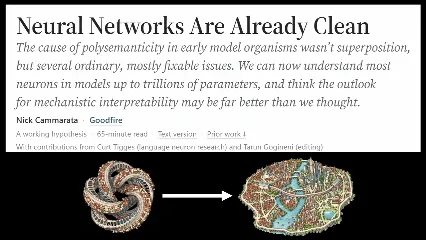
The claim comes from Neural Networks Are Already Clean, a research essay written by Goodfire founder Nick Cammarata, who argues that many neurons previously considered difficult to interpret may actually have coherent primary functions. According to Cammarata, apparent mixtures of unrelated concepts can sometimes be explained by connected patterns, architectural effects, or limitations in how researchers examine neural activity. However, he describes the central argument as a working hypothesis, and the Qwen3-32B estimate remains preliminary. The result depends on how researchers define a neuron’s function, which activations they examine, and how they classify weaker responses. It does not mean that researchers understand 90% of the model’s overall behavior or have completed a map of its internal computations.
Classifying Neuron Poles and Qwen3-32B Context
Goodfire’s preliminary examination divided neuron poles into three approximate categories:
- Around 90%: Neuron poles with one identifiable primary function, sometimes accompanied by smaller related responses.
- Approximately 7%: Neuron poles that appeared to perform two related functions.
- Around 2% to 4%: Neuron poles whose functions were not sufficiently understood under the audit’s approach.
These estimates depend on the classification criteria used. A neuron responding to several related concepts might be considered to have one broad function or multiple narrower functions, depending on how researchers describe its activity. Neural networks often contain components that respond to seemingly unrelated inputs, including particular names, topics, spelling patterns, or combinations of concepts. Traditionally, such responses have contributed to the view that individual neurons are unreliable units for understanding model behavior.
Goodfire argues that closer examination frequently reveals a more coherent explanation. A neuron may respond strongly to one central concept while also activating for related associations or variations, without those additional responses necessarily representing separate jobs. For example, a neuron associated with a particular location might also respond to its name in different scripts or to information closely connected with that place. Such responses could reflect a broader underlying concept rather than unrelated functions occupying the same neuron. The important distinction is that having one main function does not mean responding to only one specific word, phrase, or input. Instead, Goodfire proposes that most neuron poles have recognizable central patterns that explain much of their activity.
The research uses Qwen3-32B, a large language model from the Qwen3 family, as an important test case. According to its official specifications, Qwen3-32B contains approximately 32.8 billion parameters and 64 layers. It uses a dense Transformer architecture, meaning its main layers use their parameters during each forward pass rather than selecting a limited set of experts. The model also includes 64 query attention heads and eight key value heads through grouped query attention. Its native context length is 32,768 tokens, with longer context support available through YaRN. The Qwen3 family supports thinking and nonthinking modes, allowing different approaches to response generation.
Transformer Processing, Neuron Poles, and SwiGLU Echo
A Transformer processes sequences of tokens, which may represent complete words, portions of words, punctuation, or other units. As information moves through the model’s layers, internal representations are updated to support predictions and generated responses. Two important components are attention mechanisms and feedforward networks. Attention allows information from different token positions to influence processing, while feedforward components transform internal representations through mathematical operations involving neuron like units. Qwen3-32B’s size and complexity make it useful for examining whether patterns observed in smaller experimental networks also appear in larger models, although findings from one model cannot establish that every Transformer follows the same organization.
An important concept in Goodfire’s research is the neuron pole, which refers to one direction of a neuron’s signed activation or output. Researchers examine positive and negative directions separately because they may respond to different patterns. A neuron might produce strong positive responses to one category of inputs and strong negative responses to another, making its behavior appear more complicated if both directions are treated as a single collection. Separating the poles allows researchers to investigate whether each direction has a recognizable function. Artificial neurons are mathematical components rather than biological brain cells, and their activity depends on the model’s architecture, learned weights, and inputs rather than representing thoughts in the human sense.
Goodfire also identifies a complication involving the SwiGLU feedforward mechanism used in modern language models. In certain cases, negative values in both the gate and value components can produce a positive output that resembles activity associated with the negative pole. The researchers describe this effect as an echo, reporting that it can sometimes dominate the strongest activation examples and make a neuron appear to respond to a more varied collection of inputs than its underlying computation suggests. This illustrates why researchers must examine how activations are produced and how they influence subsequent computations instead of relying exclusively on lists of highly activating words or passages.
Researcher Background and Preliminary Conclusions
Goodfire’s argument is not that large language models are already completely understood, but that their original components may provide a more useful starting point for investigation than previously assumed. Nick Cammarata’s background is relevant to this change in perspective.
As Goodfire’s founder and an AI interpretability researcher, he has contributed to earlier research involving neurons and circuits in image models. He also worked on OpenAI’s automated interpretability efforts, which used language models to generate and evaluate explanations of neural network components. Cammarata explains that he previously accepted a stronger interpretation of superposition as the primary reason neurons were difficult to understand, but subsequent investigations involving image and language models led him to reconsider that position. The essay also credits Curt Tigges for contributions to language neuron research and Tarun Gogineni for editing.
Although Cammarata presents an optimistic interpretation, he distinguishes preliminary observations from broader conclusions that still require testing. If the hypothesis holds across additional models and evaluation methods, researchers may be able to investigate substantial portions of neural networks by studying their existing neurons and circuits directly. Nevertheless, independent replication remains necessary before the reported proportions can be considered established findings.

Neural Network Interpretability: Monosemantic Neurons, Superposition, and Recursive Generalization
Goodfire’s findings challenge several assumptions about how neural networks represent information, particularly the relationship between monosemantic neurons, polysemantic neurons, and superposition. A monosemantic neuron is generally associated with one coherent feature or concept, while a polysemantic neuron appears to respond to multiple distinct features or concepts.
However, applying these classifications to real neural networks can be complicated because the definition of a single concept depends on the level of description. A neuron responding to several types of birds might represent birds generally or several distinct bird related features. Similarly, a language model neuron might activate for a person’s name, an associated organization, and a slogan connected to their work. Whether these responses represent one broad function or several related functions depends on how they are interpreted. Goodfire proposes that many neurons have a dominant primary function without being perfectly restricted to one narrowly defined concept.
Smaller related responses may exist without making the neuron’s overall behavior arbitrary or impossible to interpret. However, a useful explanation must do more than group examples under a convenient label. It should predict responses to new inputs and help explain the neuron’s contribution to the network. For example, if a neuron is described as responding to a particular linguistic pattern, new examples containing that pattern should generally produce stronger responses than carefully selected examples that do not contain it. Researchers can then test whether changing the neuron’s activity influences model behavior in ways consistent with the explanation.
Superposition and Alternative Explanations
One of the main concepts challenged by Goodfire is superposition, which describes ways neural networks can represent more features than they have easily separable dimensions. Rather than assigning one concept to each neuron, a network may encode information across overlapping directions in its activation space. Individual neurons can therefore appear to respond to multiple concepts because different features share parts of the same representation. This idea has influenced research into why neural networks are difficult to interpret, since examining individual units may provide an incomplete picture when meaningful features are distributed across many components.
Goodfire does not establish that all forms of distributed representation are absent. Instead, Cammarata challenges a narrower interpretation in which unrelated concepts are routinely packed into the same mechanisms because they interfere relatively little with one another. He argues that many examples attributed to this form of superposition may have alternative explanations involving related concepts, generalization, or architectural behavior. Distributed representations can still exist when individual neurons have recognizable functions, and a particular feature might involve several neurons working together. The debate therefore concerns how frequently unrelated concepts are combined within the same components and whether researchers have sometimes interpreted understandable relationships as arbitrary mixtures.
Goodfire proposes recursive generalization as one explanation for apparently unrelated neuron responses. Under this hypothesis, a neuron begins by responding to a particular pattern and gradually extends into related patterns. Those new responses can become starting points for additional generalization, allowing the neuron’s eventual activity to include examples that appear distant from its original function. Cammarata illustrates this idea using a language model neuron associated with the letter sequence “iy.” The neuron also responds to “diy” and subsequently to the expression “do it yourself.” Although the original sequence and the complete phrase might initially seem unrelated, the abbreviation DIY provides an intermediate connection. The proposed progression can be understood as follows:
- The neuron initially responds to the letter sequence “iy.”
- Its activity extends to the related abbreviation “diy.”
- The abbreviation connects to the phrase “do it yourself.”
- The neuron consequently responds to an expression that does not contain the original letter sequence.
Recursive Generalization Examples and Open Questions
This example demonstrates how responses that appear disconnected when examined only at their endpoints may have understandable intermediate relationships. Goodfire also presents evidence from image models in which researchers could observe neurons changing during training. One example involves a neuron initially associated with yellow flowers that later expanded its responses into other visual patterns connected to its training examples.
Examining the training process allowed researchers to investigate how its behavior developed rather than relying exclusively on the final model. However, Goodfire acknowledges that it did not have the training checkpoints needed to directly observe recursive generalization unfolding inside Qwen3-32B. Relationships identified among the language model’s final responses therefore do not independently prove that those neurons developed through the proposed sequence. Recursive generalization remains a hypothesis that can be tested more directly when suitable training histories are available.
Another important consideration is how researchers interpret weak activations. Interpretability investigations often begin by collecting inputs that produce a neuron’s strongest responses because these examples can reveal a clear central theme. However, examining weaker responses may uncover additional patterns that complicate the explanation.
Weak Activations and Causal Significance
Goodfire argues that many of these responses represent related branches rather than entirely separate functions. For example, a neuron associated with a historical figure might respond less strongly to related people, symbols, or events, while a neuron associated with a famous ship could respond to broader themes involving voyages, historical periods, or related technology. Whether these responses should count as separate functions depends on their relationship to the central pattern and their influence on the model’s computations. A weak activation may have little practical effect, but it could also become important within a particular circuit or context. Researchers therefore need to examine several factors:
- Activation strength: How strongly the neuron responds compared with its usual activity.
- Frequency: How often the response occurs across different inputs.
- Conceptual relationship: Whether the response connects to the neuron’s primary function.
- Predictive reliability: Whether the explanation accurately predicts responses to new examples.
- Causal importance: Whether changing the neuron’s activity influences downstream behavior.
- Evaluation thresholds: Whether the response remains significant under different measurement criteria.
Goodfire acknowledges that threshold choices influence its 90% estimate because including increasingly weak responses can change how many neurons appear to have one function, multiple related functions, or unexplained behavior. The researchers also report that smaller offshoots generally appeared less frequent and less causally important in their own contexts than the principal response was in its context. This challenges the possibility that many neurons secretly contain rare but equally important unrelated functions, although it does not establish that such functions never exist. Goodfire reports not observing a neuron with approximately ten unrelated jobs during its investigations, but that observation does not prove such neurons are impossible.
A neuron could activate rarely for a particular input while still producing an important effect, making unusual contexts and low frequency responses relevant to safety research. These considerations explain why the reported estimate is not simply a count of neurons that activate for one concept. It reflects judgments about dominant functions, related responses, and causal significance. If recursive generalization accounts for many apparent mixtures, researchers may be able to reconstruct clearer explanations of neural network components, but the hypothesis still requires testing against competing explanations across different models.

Goodfire’s Qwen3-32B Experiments, Sparse Autoencoders, Research Limitations, and AI Safety Implications
Goodfire’s research combines neuron activation analysis, predictive testing, circuit investigations, and comparisons with existing interpretability methods to determine whether individual neurons can provide meaningful explanations of neural network computations. The essay presents investigations involving Qwen3-32B and a separate Qwen mixture of experts model, with a gallery containing 1,000 neuron investigations distributed between the two rather than 1,000 Qwen3-32B investigations alone. Researchers examined inputs that strongly activated particular neurons, developed explanations for the observed patterns, and tested whether those explanations could predict responses to new examples.
One demonstration involved 20 Qwen3-32B neurons, with an agent generating five examples expected to activate each neuron and five near misses expected to produce weaker responses. Goodfire reported that the intended activation examples produced stronger responses than the near misses across all 20 neurons. This supports the possibility that the explanations captured meaningful aspects of their behavior, although the limited selection does not independently validate the model wide 90% estimate. Results can also depend on how examples are generated, how near misses are selected, and how activation differences are measured.
Goodfire also investigated relationships between neurons and attention heads to determine whether particular components contribute to identifiable computations. In one example, researchers reported that removing a neuron associated with the word “might” substantially reduced an attention head’s tendency to look back at an earlier occurrence of “may.” This suggests that the neuron contributed to a specific circuit involving those expressions, providing stronger evidence than merely observing activation patterns because the intervention changed another component’s behavior.
However, the result does not establish every function of the neuron or attention head, since neural network components can participate in different computations depending on context. These experiments demonstrate the distinction between descriptive and causal interpretability. Descriptive analysis identifies patterns associated with a neuron’s activation, while causal analysis investigates what happens when its contribution is changed, suppressed, or removed. A convincing explanation should ideally support both by predicting when a neuron responds and helping explain how that response affects downstream computation.
Sparse Autoencoder Debate and Method Comparisons
Goodfire’s findings also contribute to the debate surrounding sparse autoencoders, commonly called SAEs. These tools learn alternative representations of a model’s internal activations by attempting to reconstruct them using a larger collection of features, with relatively few features active for each example. The motivation is that meaningful concepts may not align neatly with individual neurons, and alternative directions in activation space can sometimes reveal features that appear more interpretable than the model’s original components. Goodfire encourages researchers to reconsider whether such decompositions are necessary for every investigation. If many original neurons already have recognizable primary functions, studying them directly may provide useful explanations without first constructing a separate feature representation.
Cammarata also questions whether reconstruction quality alone establishes that an SAE preserves the important computations performed by the original model. A reconstructed representation might approximate internal activations while producing different behavior when inserted into the network, making it necessary to test whether relevant downstream effects are preserved. Nevertheless, this criticism does not mean sparse autoencoders are useless. Previous research has identified interpretable SAE features and demonstrated causal effects when those features are manipulated. Anthropic’s work involving Claude 3 Sonnet, for example, described features associated with various concepts and reported that manipulating some features influenced model outputs, while also acknowledging limitations involving incomplete coverage and rigorous evaluation.
The different interpretability methods can complement one another:
- Direct neuron analysis: Examines the model’s original components and their relationships.
- Sparse autoencoders: Identify alternative feature representations that may reveal distributed patterns.
- Circuit analysis: Investigates how multiple components interact to perform computations.
- Predictive testing: Determines whether an explanation accurately predicts responses to new inputs.
- Causal interventions: Tests whether changing a component produces effects consistent with the explanation.
Comparing these approaches under shared evaluation conditions could help establish which techniques are most useful for different tasks. Direct neuron analysis may work well when a component has a coherent dominant function, while sparse autoencoders may remain valuable when information is distributed across several directions. Strong comparisons would assess predictive accuracy, causal effects, coverage, computational requirements, and performance across different architectures rather than assuming that one technique is always preferable.
Limitations and Independent Testing Needs
Despite the encouraging findings, Goodfire’s research has several important limitations. The 90% figure remains preliminary, representing an estimate from the company’s audit rather than a measurement established through independent replication. Its reliability depends on how researchers define a neuron’s job, because a broad explanation may group related concepts together while a narrower interpretation could classify them separately. The evaluation also depends on which inputs are examined. Strong activation examples may reveal central patterns, but rare contexts or unusual inputs could expose responses missing from the initial sample.
Furthermore, an explanation matching observed activations does not necessarily describe the complete computation, since a neuron associated with a particular topic might participate in different circuits depending on the surrounding model activity. Goodfire’s evidence also comes from different types of networks, and directly observing neuron development during image model training does not establish the training history of Qwen3-32B neurons. Most importantly, understanding individual components does not automatically mean understanding the entire network. Researchers must still explain how attention heads, feedforward neurons, residual streams, and other components interact to produce behavior.
Independent testing using transparent methods will be necessary to determine how robust the findings are. Researchers would need sufficiently detailed information about neuron sampling, classification standards, activation thresholds, intervention procedures, and evaluation results to reproduce the audit reliably. Follow up investigations could examine several model sizes and architectures, including dense Transformers and mixture of experts systems, while testing whether neuron explanations remain accurate across languages, unfamiliar topics, adversarial prompts, and unusual contexts. These experiments would help determine whether the apparent clarity of neuron functions extends beyond the examples used to construct the explanations. They could also establish whether individual neuron descriptions contribute to more complete explanations of how models perform specific tasks.
Implications for Mechanistic Interpretability and Safety
Goodfire’s argument has potential implications for mechanistic interpretability, the field concerned with understanding neural network computations internally. If individual neurons frequently have coherent primary functions, researchers may be able to study original components more directly and trace how they interact. Identifying a neuron associated with a particular linguistic feature, for example, could provide a starting point for examining which earlier components influence it and which later components use its output.
A growing collection of tested explanations might eventually help researchers understand larger computational circuits rather than isolated activations. This could also improve interpretability evaluations by encouraging researchers to compare methods against actual model behavior using shared standards. Greater understanding of internal mechanisms could support investigations into misleading outputs, unwanted associations, failures to follow instructions, and other problematic behaviors. Causal interventions may help distinguish components that merely correlate with an unwanted behavior from those that contribute directly to it.
However, interpretability is not equivalent to safety. A model with many understandable neurons can still generate incorrect, unreliable, or harmful responses. Safety relevant behavior may depend on interactions among numerous components, including those that appear individually understandable, and an intervention that works in one context may fail in another. Goodfire’s findings therefore should not be interpreted as proof that large language models are already transparent or safe.
They suggest that some neural network complexity may be more structured than previously assumed and that direct neuron analysis could become a more useful part of interpretability research. The central question is whether clearer neuron descriptions can lead to reliable predictions, reproducible circuit explanations, and interventions that improve model behavior under realistic conditions. For now, the reported 90% estimate remains an encouraging but provisional result whose significance will depend on further experiments, independent replication, and evidence that understanding individual neurons leads to a deeper understanding of complete AI systems.

Frequently Asked Questions (FAQs)
- What did Goodfire say about Qwen3-32B neurons?
Goodfire reported a preliminary estimate suggesting that approximately 90% of Qwen3-32B neuron poles have one main function, sometimes accompanied by smaller related responses. The research also estimated that around 7% have two related functions, while approximately 2% to 4% were not sufficiently understood. These figures depend on how neuron functions are defined and evaluated, so they should not be treated as final measurements. - Does the 90% figure mean Goodfire understands 90% of Qwen3-32B?
No. The estimate refers to the apparent primary functions of individual neuron poles, not the percentage of the model’s complete behavior that researchers understand. Even when a neuron has a recognizable function, its interactions with attention heads, other neurons, and internal circuits may remain unclear. Understanding those relationships is necessary before researchers can explain how the entire model performs particular tasks. - What is a neuron pole?
A neuron pole refers to one direction of a neuron’s signed activation or output. Researchers can examine positive and negative responses separately because the two directions may correspond to different patterns. This distinction can make a neuron’s behavior easier to analyze, particularly when combining both directions would create the appearance of unrelated responses. - Is Qwen3-32B a mixture-of-experts model?
No. Qwen3-32B is a dense Transformer model containing approximately 32.8 billion parameters and 64 layers. Unlike a mixture of experts model, it does not rely on selecting a small subset of expert networks during processing. Goodfire’s essay also examines a separate Qwen mixture of experts model, but findings from that model should not automatically be treated as Qwen3-32B results. - What is recursive generalization?
Recursive generalization is Goodfire’s proposed process in which a neuron begins responding to one pattern and gradually extends into related patterns. Those new responses can lead to additional associations, making the neuron’s final behavior appear more varied than its original function. Goodfire illustrates this with a neuron associated with “iy” that also responds to “diy” and “do it yourself.” The concept remains a hypothesis requiring further testing in large language models. - Did Goodfire prove that superposition does not exist?
No. Goodfire challenges a particular interpretation of superposition in which unrelated concepts are routinely packed into the same neural mechanisms. The research suggests that some apparently unrelated responses may instead result from connected patterns or recursive generalization. However, it does not establish that distributed representations or overlapping features are absent from neural networks. - Why do weak activations matter?
Weak activations can reveal additional responses that are not visible when researchers examine only a neuron’s strongest examples. These responses may represent related branches, separate functions, or patterns with limited influence. Their significance depends on how frequently they occur, how strongly they activate the neuron, and whether they affect downstream computations. Including weaker responses can therefore change how researchers classify a neuron’s functions. - Are sparse autoencoders still useful?
Yes. Sparse autoencoders can identify interpretable features within a model’s internal representations, including patterns that may not align directly with individual neurons. Previous research has demonstrated that manipulating some of these features can affect model outputs. Goodfire argues that directly examining original neurons also deserves attention, particularly when those neurons already have coherent primary functions. Both approaches may provide complementary information. - Has the Qwen3-32B estimate been established as a final result?
No. Goodfire describes the 90% estimate as preliminary and acknowledges that it depends on methodological decisions, including activation thresholds and definitions of neuron functions. Further studies would need to reproduce the findings using clear evaluation procedures and examine whether similar patterns appear across other models. Independent replication would help determine how reliable and general the estimate is. - Does this research make AI systems safe?
No. Understanding individual neurons could help researchers investigate why AI models produce certain outputs and identify components involved in undesirable behavior. However, a model can still make mistakes or behave unpredictably even when many of its neurons have recognizable functions. Improving AI safety requires broader evaluation, reliable interventions, and an understanding of how multiple components interact, not simply assigning explanations to individual neurons.

Conclusion
Goodfire’s Qwen3-32B research suggests that approximately 90% of neuron poles in the large language model may have one recognizable primary function, challenging the assumption that individual neurons are generally too complex to interpret. However, the estimate remains preliminary, with its reliability depending on how researchers define neuron functions, evaluate weak activations, select samples, and measure causal effects. The study also introduces recursive generalization as a possible explanation for seemingly unrelated responses, although additional evidence is needed to establish how these patterns develop during training. Further research comparing direct neuron analysis with methods such as sparse autoencoders will help determine whether these findings can improve understanding of neural networks and contribute to more reliable AI systems.
Sources and Citations
- Goodfire — Nick Cammarata, “Neural Networks Are Already Clean,” October 15, 2026: This is the primary source for the article’s central claim. Cammarata presents the work as a working hypothesis and argues that many apparently polysemantic neurons may actually have coherent dominant functions, with recursive generalization and architectural effects explaining some apparent mixtures. The essay reports a preliminary Qwen3-32B audit in which roughly 90% of neuron poles appeared to have one main job, around 7% had two related functions, and roughly 2%–4% remained unexplained. Goodfire
Neural Networks Are Already Clean – Goodfire - Qwen — Official Qwen3-32B Model Card: The official Hugging Face model card identifies Qwen3-32B as a 32.8B-parameter dense causal language model with 64 layers, 64 query heads and eight key/value heads using GQA. It lists a native context length of 32,768 tokens and support for up to 131,072 tokens with YaRN. Hugging Face
Qwen3-32B Official Model Card – Hugging Face - Qwen Team — “Qwen3: Think Deeper, Act Faster,” April 29, 2025: Qwen’s official launch article introduces the Qwen3 family, including the dense Qwen3-32B model. It explains Qwen3’s hybrid thinking and non-thinking modes, the
/thinkand/no_thinkcontrols, its dense and MoE model lineup, multilingual training, and the broader training process used for the family. Qwen
Qwen3: Think Deeper, Act Faster – Qwen - Yang et al. — “Qwen3 Technical Report,” May 14, 2025: The official research paper provides technical details for the Qwen3 family, including its combination of dense and mixture-of-experts architectures, parameter scales from 0.6B to 235B, unified thinking/non-thinking framework, thinking-budget mechanism, multilingual expansion, training strategy, and benchmark evaluations. arXiv
Qwen3 Technical Report – arXiv - Anthropic — “Scaling Monosemanticity: Extracting Interpretable Features from Claude 3 Sonnet,” May 21, 2024: Anthropic trained sparse autoencoders on Claude 3 Sonnet to recover interpretable internal features. The work reports features associated with people, locations, code patterns, abstract concepts, and safety-relevant behavior, while also demonstrating that feature steering can causally alter model outputs. The authors emphasize that the research is preliminary and identify limitations around evaluation, feature splitting, and whether reconstructed features fully capture model computations. transformer-circuits.pub
Scaling Monosemanticity – Anthropic Transformer Circuits - Cunningham et al. — “Sparse Autoencoders Find Highly Interpretable Features in Language Models,” September 15, 2023: This paper investigates polysemanticity and superposition by training sparse autoencoders on language-model activations. The authors report that the learned sparse features are more interpretable and monosemantic than comparison directions and show causal relevance on the indirect-object-identification task, supporting sparse autoencoders as a scalable method for mechanistic interpretability. arXiv
Sparse Autoencoders Find Highly Interpretable Features in Language Models – arXiv
Recommendations
- Subnautica 2 Early Access Roadmap: Co-Op Updates, Sprinting, and More
- Virtua Fighter 6 Leak Explained
- Best Gaming Headsets for 2026: Top Wireless, Wired, PC, PS5, and Xbox Picks
- Take-Two CEO Comments on Roblox and GTA Explained
- All characters and color variations in Mario Tennis Fever: Full roster, unlocks, and alternate colors
- Assassin’s Creed Black Flag Remake
- How to Make a 3D VTuber Avatar: The Complete Guide for Beginners and Content Creators
- Farm to Table Grow Your Own Food & Make Fine Dishes in Cozy Restaurant Simulator: Complete Gameplay Guide
- Don’t Fret Hits All the Right Notes for a Frightening Survival-Horror Experience
- Assassin’s Creed Black Flag Resynced Post-Game Support Teased Ahead of GTA 6



































































































