










In This Article (9 sections)
Huawei Atlas 950 SuperPoD and the Shift to System-Scale AI
Artificial intelligence infrastructure is moving beyond competition between individual accelerators. Vendors are increasingly building complete computing environments that combine thousands of processors, high-speed networking, large memory pools, storage, software frameworks, and workload-management tools. These tightly integrated systems are designed to train and deploy increasingly large foundation models, including multimodal systems and models containing hundreds of billions or trillions of parameters.
Huawei is entering this system-scale competition with the Atlas 950 SuperPoD, a next-generation AI platform based on its upcoming Ascend 950 processors. Huawei claims the platform can deliver 6.7 times more total AI computing power than Nvidia’s planned NVL144 system. The comparison comes from Huawei rather than independent production benchmarks, but it demonstrates the company’s strategy of competing through the scale and integration of an entire cluster instead of claiming leadership for one processor.
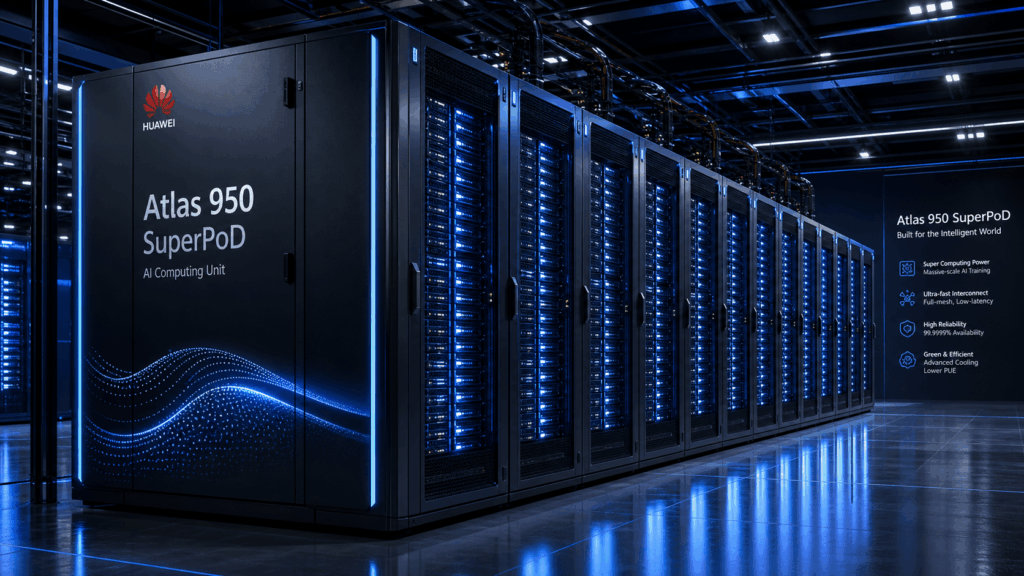
The Atlas 950 SuperPoD is not designed as a conventional standalone server. It combines thousands of Ascend AI processors through Huawei’s proprietary UnifiedBus architecture and all-optical interconnect technologies. Huawei describes the result as a single logical computer in which processors, memory, networking, and software operate as parts of one unified platform.
This architecture is intended for organizations developing foundation models, generative AI services, multimodal applications, scientific-computing workloads, and enterprise AI systems. It supports both large-scale model training and inference, allowing customers to run different stages of AI development without necessarily creating separate infrastructure for each workload.
Huawei also positions the Atlas 950 as a complete AI ecosystem rather than only a collection of processors. The platform incorporates Ascend chips, networking equipment, memory technologies, storage, software frameworks, communication libraries, and cluster-management systems. This full-stack approach reflects a wider industry shift in which networking efficiency, memory capacity, and software optimization can matter as much as the theoretical performance of an individual accelerator.
Huawei Atlas 950 Specifications and the 6.7X Nvidia NVL144 Claim
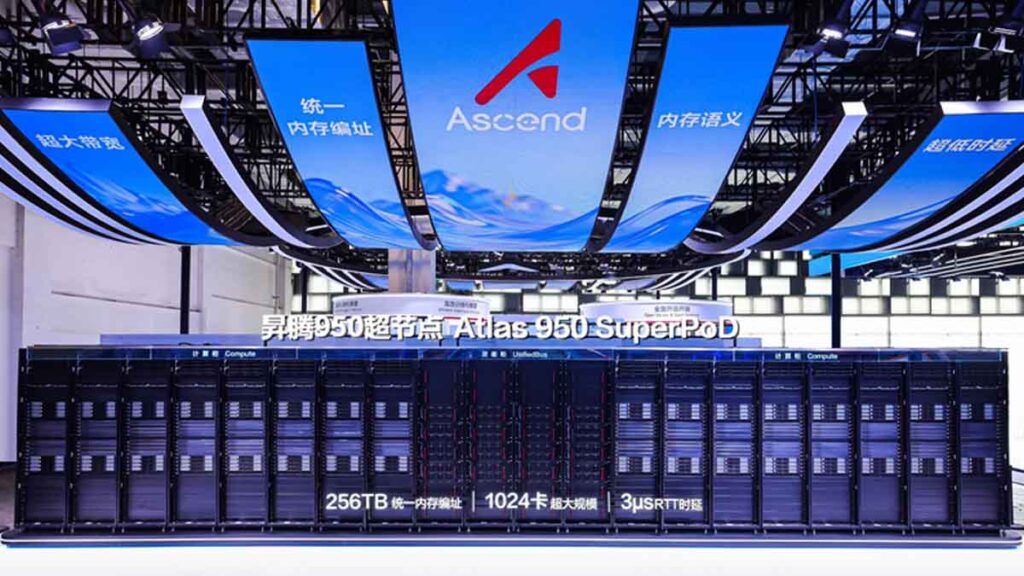
The maximum Atlas 950 SuperPoD configuration contains 8,192 Ascend 950DT processors distributed across 160 cabinets. These include 128 compute cabinets and 32 communication cabinets, with the complete installation occupying approximately 1,000 square meters. Huawei says this processor count represents a twenty-fold increase over the earlier Atlas 900 A3 SuperPoD platform.
Huawei has announced the following principal system specifications:
- Up to 8,192 Ascend 950DT AI processors
- 160 cabinets, including 128 compute and 32 communication cabinets
- Approximately 1,000 square meters of installation space
- 8 ExaFLOPS of FP8 performance
- 16 ExaFLOPS of FP4 performance
- More than one petabyte of total memory
- Multi-petabyte-per-second interconnect bandwidth
- An all-optical network connecting the cabinets
- Support for large-scale AI training and inference
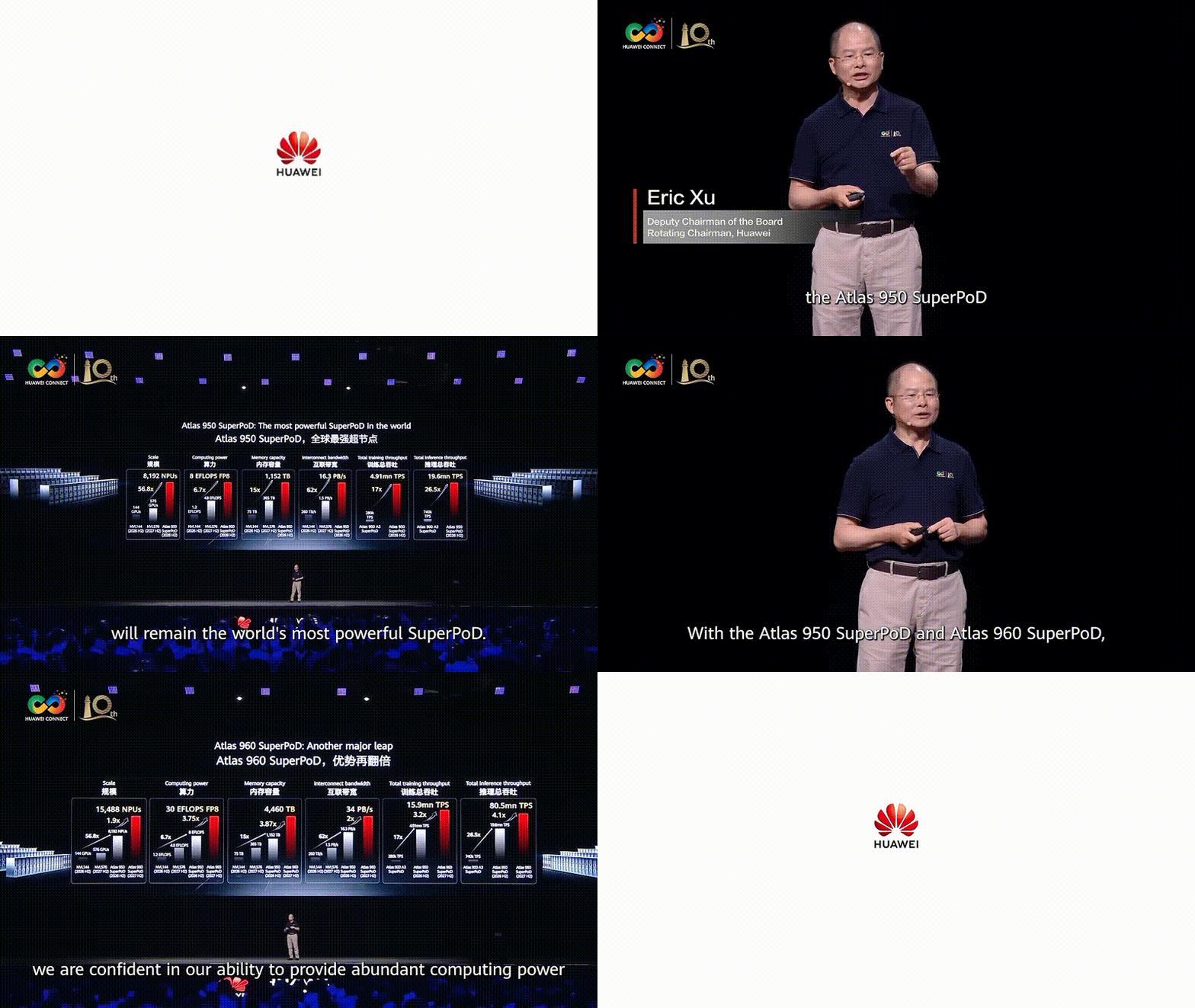
Huawei directly compares these specifications with Nvidia’s upcoming NVL144 platform. According to the company, the Atlas 950 contains approximately 56.8 times more AI processors than the number of GPUs in the NVL144 configuration. Huawei also claims 6.7 times more total AI computing power, about 15 times more memory capacity, and approximately 62 times greater interconnect bandwidth.
These figures are not a direct comparison between individual Ascend and Nvidia processors. The Atlas 950 reaches its headline performance through a much larger number of accelerators assembled into an extensive SuperPoD installation. Nvidia’s NVL144 represents a different deployment scale, packaging design, and system configuration, so the comparison does not establish that one Ascend 950DT processor is faster than one Nvidia GPU.
Huawei’s 6.7x claim is primarily based on scaling. Thousands of processors are connected through UnifiedBus and Huawei’s optical networking fabric, while optimized communication protocols, workload scheduling, and low-precision formats are intended to reduce the bottlenecks that often appear in very large clusters. If processors cannot exchange model parameters, gradients, and activations quickly enough, adding more chips may produce limited performance gains.
The 8,192-processor design is particularly relevant to trillion-parameter language models and large mixture-of-experts systems. These workloads must distribute model components across many devices while maintaining efficient communication between them. Huawei argues that its processor count, memory capacity, and interconnect architecture allow the Atlas 950 to maintain useful scaling at this size. Whether the claimed advantage appears consistently in real applications will depend on workload characteristics, software optimization, and independent testing after production hardware becomes available.

FP8, FP4, Memory, and UnifiedBus Interconnect Performance
Huawei reports that the Atlas 950 SuperPoD can deliver 8 ExaFLOPS of computing performance in FP8 precision and 16 ExaFLOPS in FP4 precision. FP8 is used in modern AI training because it can provide higher throughput and lower memory use while retaining sufficient numerical accuracy for many model-development workloads. FP4 reduces precision further and is intended primarily for next-generation inference workloads that prioritize token throughput and lower deployment costs.
The company is also developing proprietary low-precision formats alongside standard FP8 support. These include HiF4 for future processors, which Huawei says is intended to improve inference performance while preserving acceptable model accuracy. Such formats could become increasingly important as AI infrastructure shifts from model training toward the continuous deployment of models serving large numbers of users.
Memory capacity is another central part of Huawei’s strategy. The company states that a complete Atlas 950 SuperPoD provides approximately 1,152 TB of memory. Large memory pools are necessary because foundation models may require hundreds of gigabytes or several terabytes merely to hold their weights. Training adds further requirements for gradients, optimizer states, activation checkpoints, and communication buffers.
Huawei has also announced HiZQ 2.0 high-bandwidth memory technology for the Ascend 950DT. Each processor is expected to support as much as 144 GB of memory and 4 TB per second of memory bandwidth. Across thousands of processors, this creates the capacity needed to keep large portions of a model resident within the cluster and reduce the amount of time spent transferring information between memory, storage, and compute resources.
Huawei claims approximately 16 PB per second of aggregate interconnect bandwidth for the complete SuperPoD. Its architecture combines optical networking with UnifiedBus over Ethernet and other established networking protocols. The objective is to allow processors across different cabinets to communicate efficiently while behaving as parts of one logical computing platform.
Interconnect performance becomes more important as clusters grow. During distributed training, processors repeatedly exchange gradients, activations, parameters, and routing information. A cluster with high theoretical computing power can remain underused when communication is too slow. Huawei is therefore focusing on processor count, memory capacity, optical networking, communication libraries, and scheduling as one integrated performance problem.
This cluster-level strategy also allows Huawei to draw on its experience in telecommunications, optical networking, servers, and systems engineering. Rather than arguing that every Ascend processor individually outperforms Nvidia’s latest GPU, Huawei maintains that a sufficiently large and optimized platform can produce greater total throughput through effective scaling.

Ascend 950 vs Nvidia Rubin, Large-Model Support, and Huawei’s Roadmap
Huawei’s Ascend 950 family is intended to compete with Nvidia’s future Rubin generation. The planned lineup includes training-focused and inference-focused variants designed for different AI workloads. Huawei says the processors will provide expanded memory capacity, higher memory bandwidth, stronger interconnect capabilities, and support for FP8 and FP4 computation.
A complete comparison with Nvidia Rubin is not yet possible because neither future platform has been fully deployed commercially. Nvidia is generally expected to retain significant advantages in software maturity, CUDA compatibility, developer adoption, and support across a broad range of AI applications. Huawei is attempting to narrow that gap by expanding its CANN software stack and improving compatibility with widely used AI frameworks.
The Atlas 950 is specifically designed for extremely large AI models. Huawei says the platform can support current dense and sparse models containing hundreds of billions of parameters while preparing for future systems containing one trillion or even ten trillion parameters. The combination of thousands of processors, more than one petabyte of memory, and high-bandwidth communication is intended to distribute these models efficiently across the complete SuperPoD.
Huawei also claims that the Atlas 950 will improve token-generation throughput compared with its previous Atlas platforms. Real-world results will still depend on model architecture, workload distribution, communication efficiency, numerical precision, software libraries, and the maturity of Huawei’s broader development ecosystem.
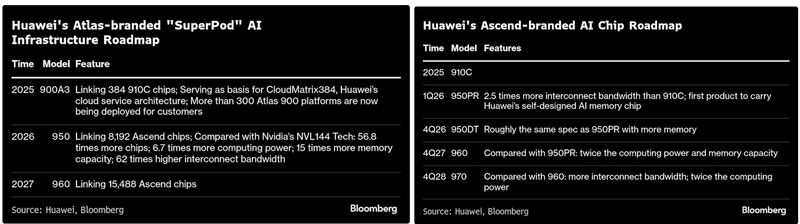
The Atlas 950 SuperPoD is scheduled for release during the fourth quarter of 2026. Different Ascend 950 processor variants are expected to become available in stages, with separate products targeting training and inference. Huawei introduced the platform globally during MWC Barcelona 2026 and later presented additional technical details through Huawei Connect and other AI industry events. Commercial deployments are expected to begin as hardware availability expands.
Huawei’s roadmap continues beyond the Ascend 950. The company plans an Ascend 960 family that is expected to offer approximately twice the computing performance, memory bandwidth, memory capacity, and interconnect capability of the 950 generation. Huawei has also outlined the Ascend 970 as part of its longer-term AI hardware strategy.
A future Atlas 960 SuperPoD is expected to scale beyond 15,000 processors and provide considerably higher FP8 and FP4 performance than the Atlas 950. This roadmap shows that Huawei is treating the SuperPoD as a continuing platform rather than a single product created only to answer one Nvidia system.
US Chip Restrictions and Huawei’s Challenge to Nvidia
US export restrictions have played a major role in shaping Huawei’s AI hardware strategy. Limits involving advanced semiconductor manufacturing, AI accelerators, and parts of the international technology supply chain have restricted the company’s access to some leading-edge foreign components.
Huawei has responded by increasing investment in domestic AI processors, memory technologies, networking equipment, communication architectures, and software frameworks. The company is building vertically integrated infrastructure around technologies that can be produced or supported within China’s semiconductor ecosystem. This reduces dependence on individual foreign suppliers, although manufacturing capacity and access to advanced fabrication processes remain important challenges.
The Atlas 950 SuperPoD demonstrates how Huawei is attempting to compensate for possible limitations in individual processor performance through scale. Its principal strengths include thousands of accelerators, large shared memory pools, proprietary interconnect technologies, optical networking, and integration across hardware and software. Instead of depending entirely on one exceptionally powerful processor, Huawei distributes the workload across a much larger cluster.
Nvidia continues to hold substantial advantages in CUDA compatibility, software maturity, developer familiarity, enterprise support, and worldwide ecosystem adoption. Customers have built applications, training pipelines, and operational tools around Nvidia hardware over many years, making software compatibility and switching costs as important as theoretical computing performance.
Huawei’s comparisons also rely on its own announced figures. Independent benchmarks using production Atlas 950 and Nvidia NVL144 hardware have not yet been published, so the 6.7x compute claim cannot be treated as a confirmed real-world advantage across every workload.
The Atlas 950 could still become a significant competitor, particularly in China and in markets seeking alternatives to Nvidia infrastructure. Its wider impact will depend on whether Huawei can deliver the announced systems at scale, support developers, maintain software compatibility, secure sufficient manufacturing capacity, and demonstrate strong performance through independent testing.
Frequently Asked Questions (FAQs)
- What is the Huawei Atlas 950 SuperPoD?
The Huawei Atlas 950 SuperPoD is a large-scale AI computing platform built around Huawei’s Ascend 950 processors. It can combine as many as 8,192 processors through UnifiedBus and optical interconnect technologies, allowing the complete cluster to function as one logical computing system. The platform is designed for foundation-model training, high-performance inference, multimodal applications, scientific computing, and other workloads that require extensive processing and memory resources. - When will the Huawei Atlas 950 SuperPoD be released?
Huawei plans to release the Atlas 950 SuperPoD during the fourth quarter of 2026. Ascend 950 processor variants are expected to become available in stages, with different products focused on training and inference. Commercial deployments will depend on the availability of the processors, complete SuperPoD installations, software support, and the infrastructure needed to operate a system containing thousands of accelerators. - What processors power the Atlas 950 SuperPoD?
The platform is powered by Huawei’s Ascend 950DT AI processors. These processors are designed for large-scale AI training and advanced inference, with support for low-precision formats such as FP8 and FP4. Huawei also says each Ascend 950DT can provide up to 144 GB of HiZQ 2.0 memory and 4 TB per second of memory bandwidth. - How much AI performance does Huawei claim for the Atlas 950?
Huawei claims that the Atlas 950 SuperPoD can deliver 8 ExaFLOPS of FP8 performance and 16 ExaFLOPS of FP4 performance. The FP8 figure is relevant to AI training workloads, while FP4 is aimed more heavily at high-throughput inference. These are announced system-level figures for the complete SuperPoD rather than measurements of one Ascend processor. - Why does Huawei compare the Atlas 950 with Nvidia NVL144?
Huawei uses the NVL144 as a reference point to demonstrate the scale of its complete SuperPoD. The company claims the Atlas 950 provides 6.7 times more total AI computing power, about 15 times more memory, and approximately 62 times greater interconnect bandwidth. However, the Atlas 950 is a much larger installation containing thousands of processors, so the comparison does not represent an equal processor-for-processor test. - How many AI chips can the Atlas 950 SuperPoD contain?
The maximum announced configuration contains 8,192 Ascend 950DT processors. They are distributed across 160 cabinets, including 128 compute cabinets and 32 communication cabinets. Huawei says this processor count is twenty times higher than the number used in its earlier Atlas 900 A3 SuperPoD platform. - Can the Atlas 950 train trillion-parameter AI models?
Huawei designed the Atlas 950 to support extremely large dense and sparse AI models. The company says it can handle existing models containing hundreds of billions of parameters while preparing for future systems with one trillion or even ten trillion parameters. Actual training efficiency will depend on software optimization, model architecture, interconnect performance, and how effectively the workload is divided across the processors. - How do US sanctions affect Huawei’s AI hardware?
Export restrictions limit Huawei’s access to some advanced semiconductor-manufacturing technologies, accelerators, and supply-chain components. In response, the company has expanded domestic development of Ascend processors, memory, networking equipment, software frameworks, and cluster technologies. These efforts reduce reliance on foreign components, although manufacturing limitations and access to advanced processes continue to create engineering challenges. - What comes after the Ascend 950?
Huawei’s roadmap includes the Ascend 960 and Ascend 970 generations. The Ascend 960 is expected to provide approximately twice the computing performance, memory capacity, memory bandwidth, and interconnect capability of the Ascend 950. Huawei also plans an Atlas 960 SuperPoD containing more than 15,000 processors, while the Ascend 970 forms part of its longer-term AI infrastructure strategy. - Could Huawei become a serious competitor to Nvidia?
Huawei is already becoming a significant AI infrastructure competitor, particularly in China and markets interested in alternatives to Nvidia. Its strengths include system scale, large memory capacity, optical networking, and full-stack integration. Challenging Nvidia globally will require Huawei to improve software compatibility, expand developer support, manufacture its systems at scale, attract enterprise customers, and demonstrate its performance claims through independent real-world benchmarks.
Conclusion
The Huawei Atlas 950 SuperPoD illustrates how AI infrastructure is shifting from individual chip competition toward complete computing systems. By integrating up to 8,192 Ascend 950 processors, massive memory capacity, optical interconnects, and optimized software into one unified platform, Huawei aims to compete through overall cluster performance rather than raw single-chip speed.
Huawei’s claim of 6.7 times more AI computing power than Nvidia’s NVL144 reflects this systems-level strategy, although the comparison is based on Huawei’s own measurements and has not yet been independently validated. Regardless of the final benchmark results, the Atlas 950 demonstrates that the future of AI computing will increasingly be defined by scalable architectures, efficient networking, and integrated infrastructure capable of supporting the next generation of trillion-parameter AI models.
Sources and Citations
- Huawei: Groundbreaking SuperPoD Interconnect: Leading a New Paradigm for AI Infrastructure
https://www.huawei.com/en/news/2025/9/hc-xu-keynote-speech - Huawei: Huawei Unveiled the Latest SuperPoD, Making an AI Infrastructure New Option to the World
https://www.huawei.com/en/news/2026/3/mwc-superpod-ai - Reuters: Key Products in Huawei’s AI Chips and Computing Power Roadmap
https://www.reuters.com/world/china/key-products-huaweis-ai-chips-computing-power-roadmap-2025-09-18/ - Pandaily: Huawei to Publicly Demonstrate Atlas 950 SuperPoD AI Computing Hardware at WAIC 2026
https://pandaily.com/huawei-atlas-950-superpod-waic-ai-computing-jul2026 - Tom’s Hardware: Huawei Unveils Atlas 950 SuperCluster
https://www.tomshardware.com/tech-industry/artificial-intelligence/huawei-unveils-atlas-950-supercluster-touting-1-fp4-zettaflops-performance-for-ai-inference-and-524-fp8-exaflops-for-ai-training-features-hundreds-of-thousands-of-950dt-apus - Tom’s Hardware: China’s Huawei to Enter South Korean AI Chip Market with New Atlas SuperPods
https://www.tomshardware.com/tech-industry/semiconductors/chinas-huawei-to-enter-south-korean-ai-chip-market-with-new-atlas-superpods-clusters-pack-8-192-ascend-950-accelerators-per-deployment-reportedly-challenges-nvidia-dominance-with-tripled-inference-performance-of-h20-at-one-quarter-the-cost
Recommendations
- Unturned Source Code Released to the Public: Everything You Need to Know
- Lanterns HBO TV Series Cast and Characters: Who’s Confirmed for the DC Show
- Project Hail Mary Theatrical Update: Release Date, Extended Run, IMAX Return & Streaming Delay Explained
- Astro Bot Reportedly Runs on PC via PS5 Emulator in Major Breakthrough
- Clive Barker’s Hellraiser: Revival Release Date, Platforms, and Gameplay Details
- 3D Grease Pencil Tutorial for Blender: How to Create 2D Art in 3D Space Step by Step
- Trailer for the Upcoming Anime Blade & Bastard Reveals 2027 Dark Fantasy Adaptation
- Upcoming Windows 11 Improvements: Less AI/Copilot Integration, More User Options, and a Cleaner Experience (2026 Roadmap)
- Game File: DICE Summit Keynote Honors Vince Zampella, Call of Duty Co‑Creator and Respawn Co‑Founder
- Dying Light: the Beast PS4 and Xbox One Versions Cancelled: Why Techland Dropped Last-Gen Support



































































































