










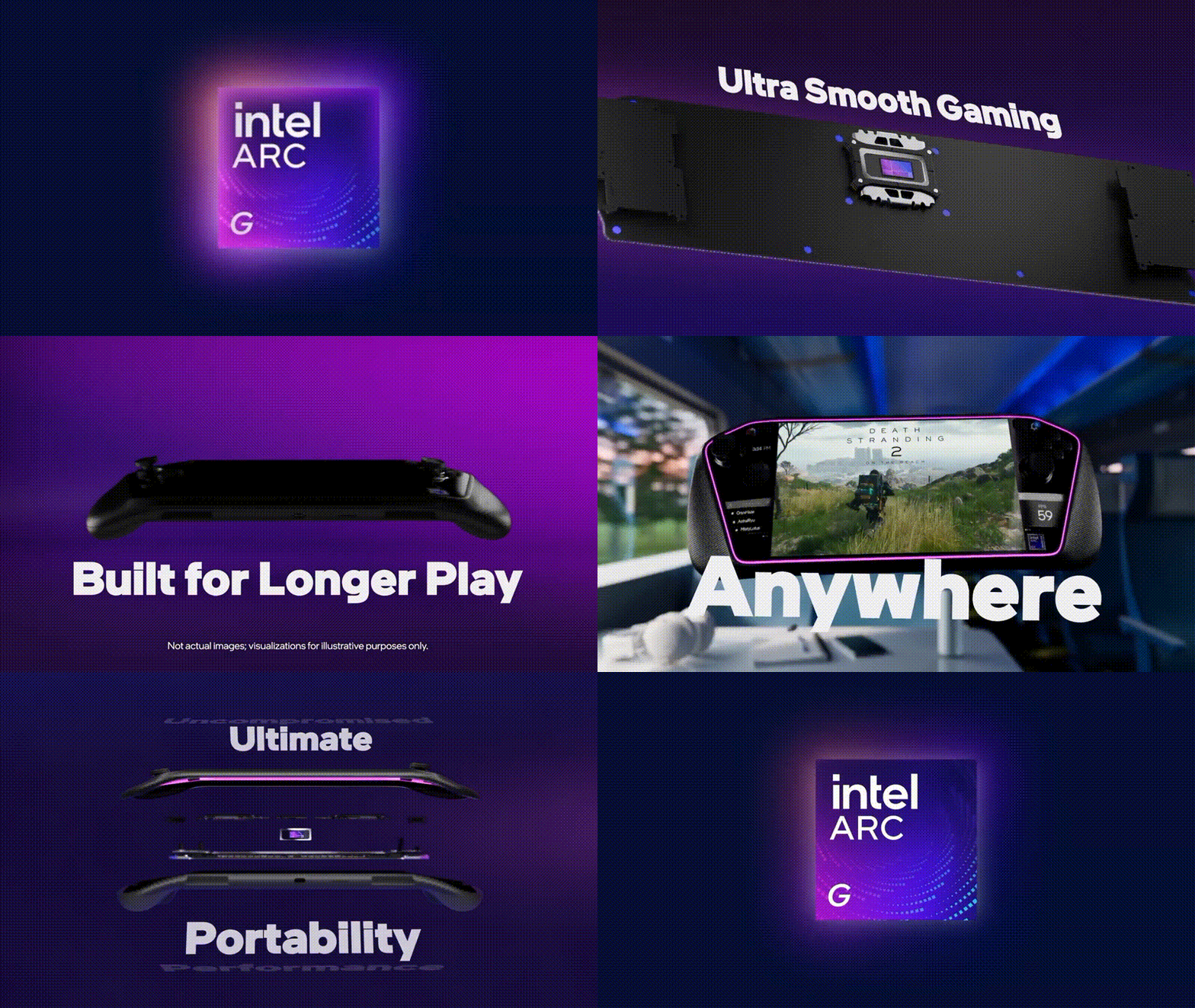
Intel is making a serious push into the handheld gaming PC market with its new Intel Arc G-Series processors, a chip family designed specifically for portable gaming systems rather than simply adapting laptop hardware for smaller devices. The announcement matters because handheld gaming PCs have become one of the fastest-growing categories in PC gaming, with devices such as the Steam Deck, ROG Ally, Lenovo Legion Go, MSI Claw, OneXPlayer, and Acer’s upcoming Predator Atlas 8 proving that players want console-like portability without giving up access to PC libraries.
The Intel Arc G-Series platform is aimed directly at this market. Intel says the chips are designed for handheld systems with optimized core counts, power management, software support, and Arc graphics features. Early partners include Acer, MSI, and OneXPlayer, with devices such as the Predator Atlas 8, MSI Claw 8 EX AI+, and OneXPlayer 3 expected to showcase how Intel plans to compete against AMD-powered handhelds. Intel’s official announcement says Arc G-Series devices will begin launching in the coming months, starting with those partner systems.
Intel Confirms Arc G-Series Processors for Portable Gaming Devices
Intel has confirmed the Arc G-Series as a new processor family created for handheld PC gaming devices. The lineup begins with the Intel Arc G3 and Intel Arc G3 Extreme, with the higher-end configuration offering integrated Intel Arc B390 graphics. These chips are built around Intel’s newer graphics architecture and are positioned as a direct response to the growing popularity of AMD-powered handheld gaming PCs.
This confirmation is important because Intel has not always been the leading name in handheld gaming performance. AMD’s Ryzen Z-series processors have dominated much of the Windows handheld market, especially through devices such as the ASUS ROG Ally and Lenovo Legion Go. Intel’s first wave of MSI Claw handhelds struggled to convince many players that Intel could match AMD’s efficiency and gaming consistency.
The Arc G-Series changes that conversation by giving Intel a dedicated handheld-focused platform. Instead of asking device makers to fit laptop-style processors into portable bodies, Intel is now presenting chips designed around the needs of handheld gaming from the beginning. That includes graphics performance, battery efficiency, upscaling support, connectivity, and software tuning.

What Are Intel Arc G-Series Processors
Intel Arc G-Series processors are handheld-focused chips designed to combine CPU performance, integrated Arc graphics, AI-enhanced gaming features, and efficient power management in portable gaming PCs.
The announced lineup includes Intel Arc G3 and Intel Arc G3 Extreme options. The highest-end configurations pair the processor with Intel Arc B390 graphics, while lower configurations can use Intel Arc B370 graphics. Acer’s Predator Atlas 8, for example, is listed with Arc G3 processor options up to the Arc G3 Extreme and Arc B390 graphics. Acer also confirms features such as XeSS 3 support, a Windows 11 handheld setup, and an 8-inch FHD+ 120Hz display.
The main idea behind the Arc G-Series is to give handheld gaming PCs better integrated graphics performance without requiring a separate GPU. Since portable consoles and handheld PCs must balance performance, battery life, heat, size, and cost, the integrated GPU is one of the most important parts of the system.
In This Article (17 sections)
How Arc G-Series Chips Could Change Handheld Gaming
The biggest way Arc G-Series chips could change handheld gaming is by increasing competition. Until now, AMD has been the safest choice for most Windows handheld manufacturers. Intel’s new platform gives companies another option, which could lead to more varied devices, better pricing pressure, stronger software competition, and faster innovation.
The Arc G-Series also brings Intel’s graphics features into handheld form. XeSS 3 support is especially important because upscaling and frame generation technologies can help handhelds produce smoother gameplay at lower internal resolutions. That matters on portable devices because native high-resolution rendering consumes more power and generates more heat.
If Intel can deliver strong real-world performance per watt, Arc G-Series handhelds could become serious alternatives to AMD-based systems. The challenge is that handheld gaming is not only about peak frame rates. Battery life, driver stability, sleep behavior, game compatibility, thermal control, and fan noise all matter just as much.
The potential is clear, but Intel must prove the chips in real shipping devices.
Acer OneXPlayer 3 and Predator Atlas 8 Hardware Details
Acer’s Predator Atlas 8 is one of the first major devices confirmed with Intel Arc G-Series hardware. The handheld features up to an Intel Arc G3 Extreme processor, Arc B390 graphics, an 8-inch 1920 x 1200 touchscreen, a 120Hz refresh rate, variable refresh rate support, 500 nits peak brightness, 100 percent sRGB coverage, and Gorilla Glass Victus protection. Acer also lists dual-mode triggers, Windows 11 Home, XeSS 3 support, and Xbox Game Pass integration.
Reports also indicate that the Predator Atlas 8 includes advanced cooling, with a dual-fan system and what Acer describes as a metal fan design for improved airflow. Battery options are expected to include large-capacity configurations, helping the system compete with premium handhelds.
OneXPlayer 3 is another major device expected to use Intel Arc G3 Extreme hardware. Early reports describe it as featuring an 8.8-inch OLED display with a 144Hz refresh rate, VRR, HDR support, an 85Wh battery, detachable controllers, Hall Effect joysticks, rear buttons, USB4, USB-A, mini SSD expansion, microSD support, and a 3.5mm headphone jack.

Intel Arc G-Series vs AMD Ryzen Z-Series Comparison
Intel Arc G-Series will inevitably be compared to AMD’s Ryzen Z-Series because AMD has become the dominant force in Windows handheld gaming PCs.
AMD’s Ryzen Z1, Z1 Extreme, and later Z-series chips built their reputation through strong integrated Radeon graphics, efficient performance, and wide game compatibility. Devices such as the ROG Ally and Legion Go helped establish AMD as the default choice for many handheld manufacturers.
Intel’s Arc G-Series aims to challenge that position through newer Arc graphics, XeSS 3, improved AI-enhanced scaling, strong connectivity, and handheld-specific design. The Arc G3 Extreme with Arc B390 graphics is positioned as Intel’s premium option for high-end handhelds, while the standard Arc G3 gives manufacturers a potentially more affordable configuration.
The key comparison will come down to performance per watt. A handheld chip must deliver playable frame rates at power levels that do not destroy battery life. If Intel can compete at 15W to 30W power ranges while maintaining strong driver support, it could become a credible rival to AMD.
Portable Gaming Console Trends in 2026
Portable gaming in 2026 is no longer limited to traditional consoles. The market now includes handheld PCs, cloud gaming devices, Android gaming handhelds, streaming-focused systems, and hybrid console-PC products.
The Steam Deck helped prove that PC gaming could work in handheld form. Windows handhelds expanded the market by giving players access to Game Pass, Epic Games Store, Steam, Battle.net, GOG, and other PC platforms without relying on Linux compatibility layers.
Premium handhelds are now competing through larger batteries, OLED screens, higher refresh rates, detachable controllers, Hall Effect sticks, better cooling, and faster storage options. The OneXPlayer 3 and Predator Atlas 8 show how quickly the category is evolving.
Intel’s arrival with Arc G-Series processors adds another major trend: chip makers are now designing directly for handheld gaming instead of treating it as a niche offshoot of laptops.
Why Handheld Gaming PCs Are Growing in Popularity
Handheld gaming PCs are growing because they give players flexibility. A modern handheld PC can run indie games, older PC titles, emulators, cloud gaming services, and many AAA games in one portable device.
Players also like the idea of continuing their PC libraries without buying separate console versions. Someone with hundreds of Steam games can immediately access many of them on a handheld PC.
Another major factor is lifestyle. Many players do not always want to sit at a desk or occupy a TV. Handheld systems allow gaming in bed, during travel, on a couch, or away from a full PC setup.
The rise of efficient APUs, high-quality portable displays, better cooling, and handheld-friendly software has made the category much more practical than it was several years ago.

Expected Performance of Intel Arc G-Series Graphics
Expected performance for Intel Arc G-Series graphics will depend heavily on power limits, cooling design, memory bandwidth, and driver maturity.
The Arc G3 Extreme with Arc B390 graphics is expected to target premium handheld gaming performance. Devices such as the Predator Atlas 8 and OneXPlayer 3 suggest that manufacturers believe the chip can compete in high-end portable systems.
Intel is also leaning on XeSS 3, ray tracing support, and graphics features designed to improve smoothness in supported games. Acer specifically highlights XeSS 3 with frame generation on the Predator Atlas 8, which could help improve perceived performance when games support the technology.
However, buyers should wait for independent benchmarks before assuming the Arc G-Series will outperform AMD in every game. Handheld gaming performance varies widely depending on drivers, game engine behavior, thermal limits, and battery settings.
Best Upcoming Handheld Gaming Devices
Several upcoming handhelds are expected to define the next wave of portable PC gaming.
The Acer Predator Atlas 8 is one of the most important because it is among the first major systems built around Intel Arc G-Series processors. Its 8-inch 120Hz screen, Arc G3 Extreme option, XeSS 3 support, and large-battery design make it a serious premium competitor.
The OneXPlayer 3 is another major device, especially because of its reported 8.8-inch OLED panel, 144Hz refresh rate, detachable controllers, and 85Wh battery. These features suggest it is targeting enthusiasts who want a high-end handheld with strong display quality and flexibility.
The MSI Claw 8 EX AI+ is also expected to use Intel’s new Arc G3 Extreme processor. Reports describe it as an 8-inch Windows handheld with a 1920 x 1200 120Hz display, up to 32GB of LPDDR5x memory support, Hall Effect triggers and sticks, and a redesigned chassis.
Intel’s Strategy for Portable Gaming Hardware
Intel’s strategy appears to focus on turning handheld gaming into a serious growth category rather than a side experiment.
The Arc G-Series allows Intel to compete in a market where AMD has built a strong lead. By working with Acer, MSI, and OneXPlayer, Intel can place its chips in multiple form factors and price tiers rather than relying on one showcase device.
The company also appears to be emphasizing platform features. Thunderbolt support, Wi-Fi advancements, Arc graphics, XeSS, and power management all contribute to the handheld experience. SteamDeckHQ reports that the chipset is expected to support Wi-Fi 7 R2, Bluetooth 6, and Thunderbolt 4 for fast transfers and external GPU options.
Intel must also improve trust among gamers. Earlier Intel-based handhelds faced criticism for efficiency and driver behavior. The Arc G-Series gives Intel a chance to reset that perception.

Arc G-Series Features Gamers Should Know About
Gamers should pay attention to several Arc G-Series features.
The first is integrated Arc graphics. The higher-end Arc B390 configuration is designed to deliver stronger gaming performance in handheld systems.
The second is XeSS 3. Upscaling and frame generation can help handhelds achieve smoother gameplay without rendering every frame at full native resolution.
The third is handheld-focused power management. Battery life is one of the biggest weaknesses of powerful Windows handhelds, so any improvement in efficiency matters.
The fourth is connectivity. Thunderbolt, fast wireless standards, and external display support can make handhelds more flexible as hybrid portable and docked gaming systems.
The fifth is manufacturer adoption. Intel’s first confirmed partners include Acer, MSI, and OneXPlayer, showing that the platform is not limited to a single device.
OneXPlayer 3 Specifications and Expectations
The OneXPlayer 3 is shaping up to be one of the most ambitious Arc G-Series handhelds.
Early specifications point to an 8.8-inch native landscape OLED display with a 144Hz refresh rate, VRR, HDR support, and an 85Wh battery. The system is also expected to include detachable controllers, Hall Effect joysticks, rear buttons, USB4, USB-A, mini SSD expansion, microSD support, and a headphone jack.
The use of Intel Arc G3 Extreme makes it particularly interesting because OneXPlayer often targets enthusiast buyers who care about performance, premium screens, and unusual form factors.
Expectations are high, but the final judgment will depend on price, thermals, battery life, and real-world game performance. A large OLED display and powerful chip can create an impressive experience, but only if the system can manage heat and power draw effectively.
Predator Atlas 8 Portable Gaming System Explained
The Predator Atlas 8 is Acer’s premium Windows gaming handheld built around Intel Arc G-Series hardware.
Acer positions the device as a full PC gaming system in handheld form. It uses Windows 11 Home and includes handheld-focused controls, an 8-inch FHD+ 120Hz touchscreen, VRR support, XeSS 3, dual-mode triggers, and configurations up to the Intel Arc G3 Extreme processor.
The device is especially important because it gives Intel a high-profile launch partner. Acer’s Predator brand already has gaming recognition, and a strong Predator Atlas 8 release could help normalize Intel-powered handhelds.
Cooling will be one of the most important factors. Reports describe a dual-fan setup and a metal fan design intended to improve airflow. If Acer can maintain strong performance without excessive noise or heat, the Atlas 8 could become one of the most important handhelds of 2026.

Future Competition in the Handheld Gaming Market
The handheld gaming market is becoming increasingly competitive.
AMD remains a major force through its Ryzen Z-Series and related APU technology. Valve continues to influence the market through the Steam Deck ecosystem. Lenovo, ASUS, MSI, Acer, OneXPlayer, Ayaneo, GPD, and other manufacturers are all competing for attention.
Intel’s Arc G-Series adds another major competitor, and that could benefit consumers. More competition usually leads to faster hardware improvements, more aggressive pricing, and better software optimization.
The market will likely split into several categories. Budget handhelds will target entry-level users. Premium systems will focus on OLED screens, large batteries, and higher performance. Compact systems will prioritize portability. Larger devices will compete with tablet-style displays and detachable controllers.
Intel’s success will depend on whether it can win across more than one of these segments.
What Intel Arc G-Series Means for PC Gaming
Intel Arc G-Series could have a major impact on PC gaming if it succeeds.
First, it could make handheld PCs more diverse. Instead of most manufacturers relying on AMD, companies could choose between multiple chip platforms depending on price, performance, and design goals.
Second, it could encourage more game developers to optimize for handheld play. As more portable gaming PCs enter the market, developers may pay closer attention to controller support, scalable graphics settings, UI readability, and power-efficient presets.
Third, it could strengthen Intel’s gaming reputation. Intel has long dominated many CPU markets, but gaming graphics have been a tougher field. A successful Arc G-Series platform would help prove that Intel can compete in integrated gaming graphics where efficiency matters most.
Finally, it could push the entire handheld category forward. If Intel and AMD continue competing aggressively, players will benefit from better hardware, better software, and more choice.
Frequently Asked Questions (FAQs)
- What are Intel Arc G-Series processors?
Intel Arc G-Series processors are handheld-focused chips designed for portable gaming PCs, with integrated Arc graphics and features such as XeSS support. - Which devices will use Intel Arc G-Series processors?
Confirmed and expected devices include Acer Predator Atlas 8, MSI Claw 8 EX AI+, and OneXPlayer 3. - What is Intel Arc G3 Extreme?
Intel Arc G3 Extreme is the higher-end Arc G-Series processor option aimed at premium handheld gaming systems. - What graphics does the Predator Atlas 8 use?
The Predator Atlas 8 uses Intel Arc G3 processor options, with configurations up to Arc G3 Extreme and Arc B390 graphics. - How does Intel Arc G-Series compare to AMD Ryzen Z-Series?
Intel Arc G-Series is designed to challenge AMD’s Ryzen Z-Series in handheld gaming PCs, but real-world comparisons will depend on independent benchmarks, battery life, drivers, and thermals. - Why is XeSS 3 important for handheld gaming?
XeSS 3 can improve smoothness in supported games by using upscaling and frame generation, helping handhelds deliver better performance at lower internal rendering loads. - What is the OneXPlayer 3 expected to include?
The OneXPlayer 3 is expected to feature Intel Arc G3 Extreme hardware, an 8.8-inch OLED display, 144Hz refresh rate, VRR, HDR, detachable controllers, and an 85Wh battery. - Is the Predator Atlas 8 a Windows handheld?
Yes. Acer describes the Predator Atlas 8 as a Windows 11 Home gaming handheld built for full PC gaming on the go. - Will Intel Arc G-Series improve battery life?
Intel says the chips are designed with handheld power management in mind, but final battery life will depend on each device’s battery size, cooling, screen, software, and performance settings. - What does Intel Arc G-Series mean for handheld gaming?
It means more competition, more hardware choice, and potentially stronger performance options for the next generation of handheld gaming PCs.

Conclusion
Intel Arc G-Series processors could become one of the most important developments in handheld PC gaming in 2026. By designing chips specifically for portable gaming devices, Intel is directly challenging AMD’s dominance in the category and giving manufacturers more options for building next-generation handheld consoles. Devices such as the Acer Predator Atlas 8, OneXPlayer 3, and MSI Claw 8 EX AI+ show that major hardware makers are already preparing to test Intel’s new platform in real products.
The promise is clear: stronger integrated Arc graphics, XeSS 3 support, modern connectivity, better power management, and more competition across the handheld market. The real test will come from independent benchmarks, battery-life results, pricing, and long-term driver support. If Intel delivers, the Arc G-Series could help define the next major phase of portable PC gaming.
Sources and Citations
- Intel Newsroom. Intel Arc G-Series Processors Set a New Standard for Handheld PC Gaming.
https://newsroom.intel.com/client-computing/intel-arc-g-series-processors-set-a-new-standard-for-handheld-pc-gaming - Acer. Predator Atlas 8 Official Product Page and Specifications.
https://www.acer.com/us-en/predator/handheld-gaming/predator-atlas/predator-atlas-8 - Tom’s Hardware. Acer Brings Intel Arc B390 Graphics to Predator Atlas 8 Gaming Handheld.
https://www.tomshardware.com/video-games/handheld-gaming/acer-brings-intel-arc-b390-graphics-to-predator-atlas-8-gaming-handheld-g3-extreme-cpu-paired-with-segment-first-metal-fan-for-increased-airflow - The Verge. This Is MSI’s New Claw 8 EX AI Plus Gaming Handheld.
https://www.theverge.com/entertainment/939758/msi-claw-8-ex-ai-plus-gaming-handheld-reveal-computex-2026 - VideoCardz. ONEXPLAYER 3 Gaming Handheld to Feature 8.8-Inch OLED and Intel Arc G3 Extreme.
https://videocardz.com/newz/onexplayer-3-gaming-handheld-to-feature-8-8-inch-oled-and-intel-arc-g3-extreme - GamingOnLinux. Intel Arc G-Series Processors Announced for Next-Gen Handheld Gaming PCs.
https://www.gamingonlinux.com/2026/05/intel-arc-g-series-processors-announced-for-handheld-gaming-pcs/
Recommendations
- BitSummit 2026 Breaks Attendance Record with 68,208 Visitors (+17% Growth): Full Breakdown of Japan’s Biggest Indie Game Festival Surge
- Path of Exile 2: Return of the Ancients Release Time, Countdown, and Full Launch Details
- Paranormal Activity IP Controversy Explained: Brian Clarke’s Statement About Paramount
- 13 Things I Wish I Knew Before I Started 3D Printing (Beginner Checklist to Avoid Failed Prints)
- Borderlands 4 Official Takedown and Bounty Pack 3 Teaser Trailer: Release Date, Hadron Abyss Raid, and a Zane to Kill for DLC
- GTA 6 $80 Price Debate: Why Ben Thompson Says Rockstar Should Have Charged $200
- 1080p at 30fps: Valve Finally Details the Steam Machine Verified Program Requirements
- The Dune 3 Trailer And There Is So Much Going On: Full Breakdown of Dune: Part Three Teaser, Story Clues, Cast, and Release Date
- Deep Rock Galactic: Rogue Core Complete Beginner Guide, Tips, Classes, Combat, Expenite & Survival Strategy
- Dragon Ball Xenoverse 3 Will Let You Summon Goku’s Spirit



































































































