







In This Article (10 sections)
Labyrinth Procedural Generator Structure, Rooms, and Seamless Dungeon Zones
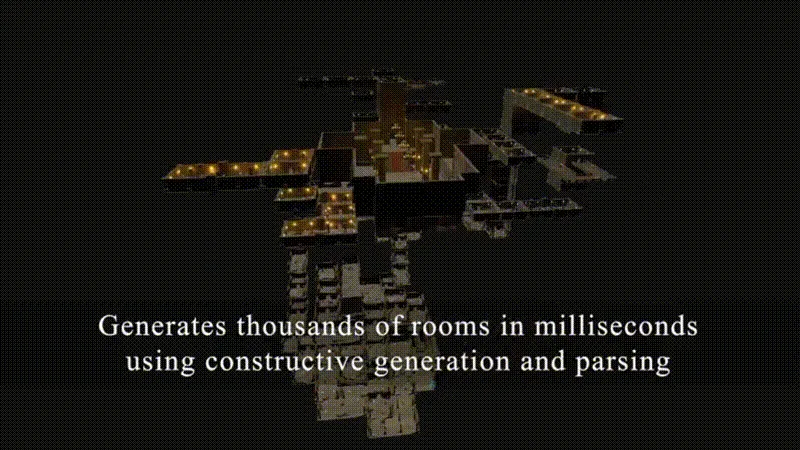
Labyrinth Procedural Generator is a Unity and C# dungeon generation project created by Ryan Carpenter, also known as dev_rygy. It began from work on procedural three dimensional dungeons for a university club project in 2023 before Carpenter resumed development in 2024. The project evolved from a Drunkard’s Walk approach into a broader generation pipeline involving graph construction, pathfinding, room parsing, zone configuration, and unique room placement. It is best understood as a technology demonstration and generation system rather than a complete dungeon crawling game.
Its main design goal is to create interconnected regions that can have different identities while still forming one traversable dungeon. Seamless movement comes from building continuous paths between areas rather than treating each region as an isolated level. This does not mean generation itself is instantaneous or that the project creates an infinite streamed world. Spatial continuity and runtime performance are separate concerns, particularly because Unity coroutines do not automatically move demanding calculations onto background threads.
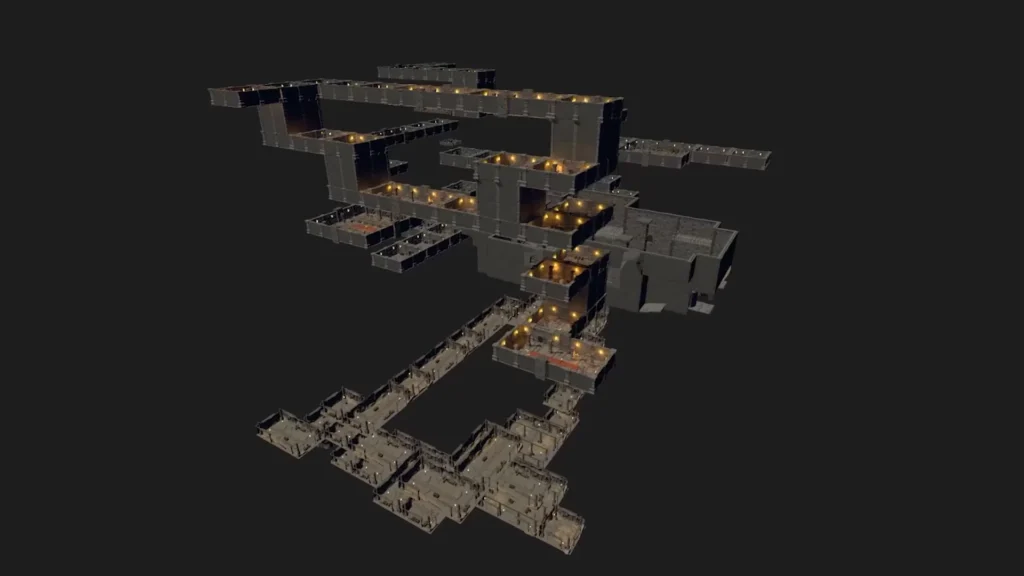
The foundation of the system is its blueprint structure. Blueprints are lightweight C# data objects representing possible room sized cells on an integer grid. Each stores information such as its identifier, position, availability, and six possible doorway directions: right, left, forward, backward, above, and below. These cells define the dungeon before finished room geometry is chosen, allowing the system to validate connections at a structural level before prefabs are introduced.
A single blueprint does not necessarily equal one final room. Larger room prefabs can occupy several compatible cells, which lets the parser combine portions of the grid into different room shapes. Current configurations include:
- Small rooms using 1 × 1 × 1 grid space
- Long rooms using 2 × 1 × 1
- Tall rooms using 1 × 2 × 1
- Large square rooms using 2 × 1 × 2
- L shaped rooms occupying three cells inside a 2 × 1 × 2 footprint
Room selection must respect available neighboring cells, enabled shape settings, and the relevant prefab pool. Rotation also requires doorway data to rotate with the geometry, ensuring that visible openings continue to correspond with the blueprint connections.
Zone Structure, Unique Rooms, and Design Goals
Zones provide another layer of organization. A zone can define its own bounds, main path, secondary paths, unique rooms, graph settings, and room prefab collections. This allows differently themed areas to share the same underlying generation system without requiring identical architecture. Connections between zones are represented structurally through connection regions and their placement bounds, letting a dungeon move naturally from one visual or gameplay theme into another.
Important rooms receive separate treatment from ordinary filler spaces. Labyrinth supports fixed, constrained, and free unique room placement. Reward paths also receive special handling, with the final blueprint of a prize path treated as a reward room location. This provides control over major destinations while still allowing the surrounding dungeon to vary between generations. Placement still requires validation, especially because the current source notes that some retry loops need stronger safeguards against impossible configurations.
The project’s stated ambition is to combine the directed progression of an RPG with the replayability of a roguelike. Main paths, optional branches, and unique rooms can therefore be controlled separately. The developer cites The Binding of Isaac, Enter the Gungeon, and Wizard of Legend as procedural influences, while Zelda and Dark Souls informed the goal of creating interconnected spaces that still feel intentionally arranged. The result is not unrestricted randomness, but a structure in which important relationships remain understandable while the routes between them can change.

How Labyrinth Uses A Star, Triangulation, Drunkard’s Walk, and Blueprint Operations
Labyrinth separates layout generation into several stages rather than relying on one random room placement algorithm. Delaunay triangulation first creates candidate connections between important positions. The project includes both two dimensional and three dimensional triangulation operations, with Bowyer Watson identified in the documentation as the underlying approach. These candidate edges form a graph rather than playable corridors.
Prim’s algorithm is then used to create a minimum spanning tree. This connects the graph while avoiding unnecessary cycles and keeping the combined edge weight low. Selected edges outside the tree can later be restored to introduce loops and alternate routes. This gives the generator control over how interconnected the resulting dungeon becomes instead of connecting every candidate edge automatically.
A Star pathfinding converts chosen graph connections into actual routes through blueprint cells. Each pathfinding operation works with start and destination cells, bounds, possible obstructions, and a heuristic. Labyrinth documents Euclidean, Manhattan, Chebyshev, and zero heuristic options, with the zero option producing Dijkstra style behavior under ordinary nonnegative movement costs.
The heuristic does not independently determine the visible shape of a corridor. Movement rules, obstacles, costs, and tie handling also influence the resulting path. A Star here is a construction tool for generating dungeon routes, not an automatic enemy navigation system or Unity NavMesh replacement.
Drunkard’s Walk is used for less rigid branches such as optional routes, rewards, trials, and secret paths. The operation extends a route through randomly selected neighboring cells while respecting bounds and existing occupancy. When vertical movement is enabled, it can choose among six directions; otherwise, it remains on the horizontal plane. Recursive backtracking allows the generator to return to earlier cells when it encounters a dead end and continue searching for valid growth.
Backtracking improves flexibility but does not guarantee that every requested path length can fit inside a constrained volume. Likewise, a randomly generated branch is not automatically interesting simply because it differs between runs. A finished game still needs encounter design, rewards, clues, locks, and other systems that give those spaces purpose.
Blueprint Operations Organize Generation Stages
These algorithms are organized through Blueprint Operations. Each operation accepts identifiers for its inputs and outputs and executes through the shared generation context. Intermediate data is stored in a shared cache, allowing later stages to retrieve results without every individual operation controlling the entire generation process.
The controller can combine operations such as graph creation, spanning tree generation, edge subtraction, edge selection, route creation, and room parsing into a larger pipeline. Branching and jump operations provide additional control over execution. This modular arrangement also makes debugging easier because a developer can inspect whether a problem began with the abstract graph, the generated blueprint routes, or the final prefab interpretation.
The current system remains code driven rather than a finished visual node editor. The roadmap discusses moving toward Unity graph tooling and more graphical authoring, while undo behavior is also identified as incomplete. The project architecture therefore already resembles a graph based workflow conceptually, but its public implementation should not be described as a completed drag and drop dungeon editor.
Labyrinth Demo, Unity Source, Dependencies, and Planned Development
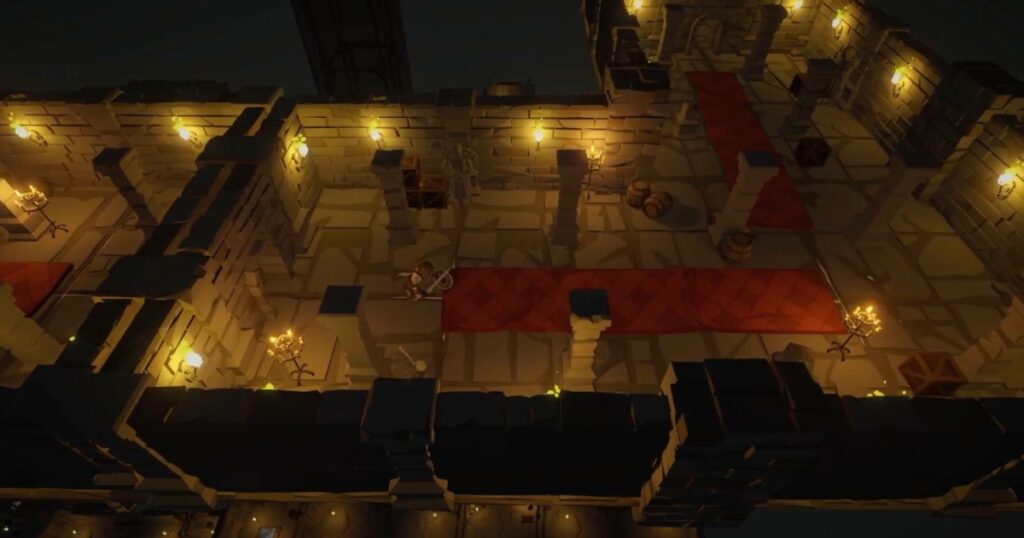
Labyrinth Procedural Generator is publicly available as a technology demonstration through a browser build and a Windows download. The itch.io page lists labyrinth_windows_v0.1.0 at approximately 62 MB, with an initial publication date of August 11, 2026 and an update on August 17. The Windows version of Labyrinth Procedural Generator is distributed as a ZIP archive containing Labyrinth Algorithm.exe, while the browser build runs directly through the Labyrinth Procedural Generator project page.
The browser version of Labyrinth Procedural Generator should be evaluated as a Unity web demonstration rather than proof that every browser and device has been tested. Unity’s web platform depends on technologies such as WebGL 2 and WebAssembly, and performance can vary by browser and hardware. A useful evaluation of Labyrinth Procedural Generator should examine doorway alignment, vertical connections, branch structure, navigation between regions, and how understandable the final dungeon remains after generation.
The Labyrinth Procedural Generator source repository is also publicly available under an Apache 2.0 license, but there is no confirmed separately packaged, ready to import Labyrinth Procedural Generator Unity release in the reviewed official material. The Labyrinth Procedural Generator GitHub Releases page contains no dedicated release package. The Labyrinth Procedural Generator repository also depends on Carpenter’s separate ryans-library Unity project, so using the Labyrinth Procedural Generator source requires more than copying a few scripts into another game.
This means the Labyrinth Procedural Generator project should currently be approached as evolving source code rather than a finished commercial Unity package. Labyrinth Procedural Generator prefab setup, configuration assets, dependencies, Unity version compatibility, and the particular repository revision all matter when attempting integration.
Planned Features and Future Roadmap
The Labyrinth Procedural Generator roadmap includes several substantial additions and reworks. Planned development for Labyrinth Procedural Generator includes a recursive descent room parser with broader grid rules, moving Unity dependencies toward a DLL oriented structure, replacing the hardcoded blueprint graph with Unity graph tooling, chunk loading, Perlin noise terrain generation, and a player map. These Labyrinth Procedural Generator additions should remain clearly identified as planned features rather than capabilities already demonstrated by the public build.
Labyrinth Procedural Generator repository activity after the demo release shows continuing work, including room editor tooling, movement of utility and player systems into packages, and package reference changes during August 2026. That Labyrinth Procedural Generator activity demonstrates ongoing development but does not mean every roadmap item has been completed.
Chunk loading is especially important to distinguish from the Labyrinth Procedural Generator project’s existing seamless layout goal. Current Labyrinth Procedural Generator seamless generation concerns creating connected regions without treating them as separate maps. Labyrinth Procedural Generator chunk loading would instead address how much generated content stays loaded or active while the player moves through a larger environment.
Future improvements to Labyrinth Procedural Generator room parsing could also expand beyond the current small, long, tall, square, and L shaped room categories. Better Labyrinth Procedural Generator authoring tools could make generation pipelines easier to visualize, while stronger placement safeguards could prevent impossible configurations from producing uncontrolled retry behavior.
For Labyrinth Procedural Generator production use, those improvements would need to be considered alongside measured performance, reliable dependency setup, repeatable tests, and validation of generated layouts. Labyrinth Procedural Generator already demonstrates a modular approach to procedural dungeon construction, but its strongest value at this stage is as an evolving framework for experimenting with structured randomness rather than a finished drop in solution for every Unity project.
Frequently Asked Questions (FAQs)
- Who created Labyrinth Procedural Generator?
Ryan Carpenter created Labyrinth and publishes the demo under the name dev_rygy. His portfolio describes it as a Unity and C# procedural generation project designed to connect thematically different three dimensional dungeon areas into one continuous environment. The project grew from his earlier experiments with procedural dungeon generation and remains focused on the underlying generation technology rather than a finished game. - Is Labyrinth a complete dungeon-crawling game?
No. The official itch.io page presents Labyrinth as a technology demonstration rather than a finished dungeon crawling game. Its purpose is to demonstrate systems for generating layouts, connecting zones, selecting rooms, and creating procedural paths. It does not currently provide the complete campaign, progression, combat, and other systems expected from a full commercial dungeon crawler. - Can Labyrinth generate vertical dungeon layouts?
Yes. Labyrinth supports three dimensional blueprint coordinates, and its Drunkard’s Walk settings can allow paths to grow vertically as well as horizontally. Tall room configurations are also supported by the room system. However, generating a vertical connection is only part of the process because the final room geometry must provide usable entrances, stairs, platforms, or another suitable way for the player to move between elevations. - Does “seamless” mean the dungeon is infinite?
No. Seamless refers to the ability to connect different dungeon regions into continuous traversable space without treating each area as an entirely separate level. The current generation system still works inside defined zone boundaries. It therefore supports connected environments, but that should not be confused with endlessly generating an infinite world around the player. - Can generation use a specific random seed?
Yes. The controller can use either a generated seed or a custom seed and initializes Unity’s random state from that value. This can help reproduce a particular generation result during development or testing. However, the same seed only remains reliably reproducible when the relevant code, assets, settings, operation order, and random calls are also unchanged. - Can important rooms stay in controlled locations?
Yes. Labyrinth provides several methods for controlling unique rooms. Fixed placement can assign a specific location, while constrained placement allows the room to appear randomly within a permitted region. Free placement offers greater flexibility inside the wider zone. In every case, the requested room still needs enough valid space and cannot simply overlap cells that are already occupied. - Does Drunkard’s Walk guarantee every requested branch length?
No. The algorithm attempts to extend the branch and can backtrack when it reaches a blocked route, allowing it to search for another valid direction. However, the available space, zone boundaries, and occupied blueprint cells still limit what can be generated. If the requested branch is too long for the available area, backtracking cannot create additional space that does not exist. - Does its A system automatically control enemies?
No. The documented A Star pathfinding system is used during dungeon construction to create routes between selected blueprint positions. It helps determine where corridors and connected cells should appear in the generated layout. Enemy navigation, movement behavior, combat decisions, and traversal through the finished geometry would require separate systems designed for those purposes. - What does Prim’s algorithm contribute?
Prim’s algorithm is used to create a minimum spanning tree from the candidate connection graph produced during generation. This provides a connected structure linking the required points without unnecessary cycles. Labyrinth can then restore selected additional connections afterward, creating loops and alternate routes while retaining the reliable connectivity supplied by the spanning tree. - Is Labyrinth ready for immediate production integration?
The available material does not present Labyrinth as a finished turnkey production package. The project remains under active development, its GitHub Releases page does not contain a packaged release, and parts of the source identify safeguards and planned features that are still unfinished. Developers interested in using it should therefore expect to review the source, configure dependencies, prepare compatible room assets, and thoroughly test generated layouts before relying on it in a production game.

Conclusion
Labyrinth Procedural Generator offers a useful approach to a difficult design problem: making randomized dungeons feel connected and intentional. Its blueprint system separates layout planning from room geometry, while its path, zone, and unique room structures provide different levels of control over the resulting environment.
Its significance lies in the combination of these techniques rather than in any single algorithm. Triangulation proposes connections, a spanning tree organizes them, pathfinding turns them into corridors, and room parsing gives the abstract structure a physical form.
The current project is best assessed as an evolving technology demonstration and source implementation. The public demo makes the concept accessible, while the repository exposes the engineering behind it. Claims about a finished Unity package, unlimited streaming, or production grade reliability should remain separate from what the official distribution and implementation currently establish.
Sources and Citation
- Ryan Carpenter’s Portfolio: Labyrinth Procedural Generator
This is the primary source for the project’s identity, history and overall design. Carpenter describes Labyrinth as a Unity and C# procedural dungeon generator intended to create seamlessly connected, thematically distinct areas within one contiguous map. The page links directly to the playable demo and public GitHub repository and explains the project’s Blueprints, operations, zones, pathfinding and room-parsing systems. It also documents the project’s beginnings in 2023, its return to active development in 2024 and its inspiration from The Binding of Isaac, Enter the Gungeon, Wizard of Legend, Zelda and Dark Souls. (Ryan Carpenter’s Portfolio)
Citation: Ryan Carpenter’s Labyrinth Procedural Generator Portfolio - Ryan Carpenter’s Developer Announcement on Reddit
Carpenter’s own announcement provides the clearest concise statement of his design target. He says the goal is to generate dungeons that feel “linear like an RPG” while remaining random and replayable like a roguelike. He also says the project had been in development for more than two years and that he planned to turn it into a downloadable Unity package. (Reddit)
Citation: After Two Years, I’m Finally Showing Off a Procedural Dungeon Generator I Built in Unity - 80 Level: Unity-Based Algorithm for Seamless Dungeon Generation
This secondary report independently identifies Ryan Carpenter as the developer and summarizes the project’s development history, influences, contiguous-world objective and balance between structured RPG-like progression and roguelike replayability. It also explains the distinctive Blueprint concept and links readers to the demonstration material. (80 Level)
Citation: Unity-Based Algorithm for Seamless Dungeon Generation - Labyrinth Public GitHub Source Tree
The public repository is the primary source for the implementation details and named C# scripts or assets cited in the article. Its source tree contains the Unity project’sAssets, packages and project settings, while the README identifies the major implementation systems, including Blueprints, Blueprint Operations, Blueprint Graph, Zones, unique and divergent placement, Delaunay triangulation, A* pathfinding, Drunkard’s Walk and Room Parsing. (GitHub)
Citation: Labyrinth Algorithm Public Source Tree - Labyrinth README: Blueprints
The README explains that Blueprints are individual cells placed on a grid to mark where rooms can eventually appear. Once Blueprint generation is complete, a second pass interprets their arrangement and selects rooms according to parsing rules. This supports explanations of why map structure and finished room geometry are generated in separate stages.
Citation: Labyrinth Blueprints Documentation - Labyrinth README: Blueprint Operations and Graph Execution
This section documents the operation-based architecture used to control map generation. Carpenter describes operations as nodes with inputs, outputs and an execution order, supporting set operations, random selection, branching, jumps and pathfinding. The included controller code processes a queue ofBlueprintOperationobjects and can pause throughyield return null, allowing generation to be advanced step by step for inspection and debugging. (GitHub)
Citation: Labyrinth Blueprint Graph Documentation - Labyrinth README: Zones and Connection Zones
The Zones section explains how the generator creates themed areas and connects them without requiring separate scenes or loading transitions. Zones currently act as containers for unique rooms, Blueprint bounds and branches, while intermediary Connection Zones overlap their bounds and connect them through Blueprint operations. (GitHub)
Citation: Labyrinth Zones Documentation - Labyrinth README: Unique and Divergent Blueprint Placement
The placement documentation distinguishes required rooms from additional procedural routing points. Unique placement handles predetermined spaces such as boss rooms, miniboss rooms and other unusually shaped locations. Divergent placement adds randomly positioned Blueprints of varying dimensions, giving the later pathfinding graph more points and producing less direct, more organic routes. (GitHub)
Citation: Labyrinth Blueprint Placement Documentation - Labyrinth README: Delaunay Triangulation, Prim’s Algorithm and A*
Carpenter explains that Blueprint positions become points for Delaunay triangulation, creating a graph that can be used for corridor generation. Prim’s algorithm is then used to obtain a minimum spanning tree and remove unnecessary edges, after which selected edges can be restored to create loops. The README also discusses switching to two-dimensional triangulation for flat zones and handling degenerate or coplanar configurations in three-dimensional generation. (GitHub)
Citation: Labyrinth Delaunay Triangulation and Pathfinding Documentation - Labyrinth README: Drunkard’s Walk and Backtracking
The project still uses Drunkard’s Walk for optional branches leading to rewards, trials and secrets. Its implementation places Blueprints in one of six directions and recursively backtracks when a route becomes blocked, allowing the generator to retry placement from an earlier point instead of abandoning the entire branch. (GitHub)
Citation: Labyrinth Drunkard’s Walk Documentation - Labyrinth README: Room Parsing
The room-parsing section documents the final stage of the pipeline. It examines the completed Blueprint arrangement and chooses compatible room prefabs. The currently documented parser supports small, long, tall and big room patterns, with Carpenter noting that more flexible recursive shape generation remains a future objective. (GitHub)
Citation: Labyrinth Room Parsing Documentation - Official Labyrinth Demo on itch.io
This is the project’s official public demo listing and the playable distribution point linked from Carpenter’s portfolio, Reddit announcement and repository README. It should be distinguished from a packaged Unity asset or formal GitHub release. (Ryan Carpenter’s Portfolio)
Citation: Labyrinth Demo by dev_rygy - GitHub Release History
The repository’s Releases page currently states that no releases have been published. As of September 21, 2026, the project is publicly available through its source repository and itch.io demo, but there is no packaged downloadable release listed through GitHub Releases. A version badge in the README should therefore not be interpreted as a formally published GitHub release. (GitHub)
Citation: Labyrinth Algorithm GitHub Releases - Princeton Algorithms, 4th Edition: Minimum Spanning Trees
Princeton’s official booksite defines a minimum spanning tree as a lowest-total-weight tree connecting all vertices in an edge-weighted graph. Its Prim’s algorithm section explains the process of growing one tree by repeatedly selecting the lightest edge connecting the existing tree to a new vertex. This supports the article’s general explanation of using Prim’s algorithm to reduce a densely connected graph while preserving connectivity. The project-specific use of Prim’s algorithm is documented separately in Carpenter’s README. (Algorithms 4th Edition)
Citation: Algorithms, 4th Edition: Minimum Spanning Trees and Prim’s Algorithm - Amit Patel and Red Blob Games: Introduction to A*
Patel explains that A* operates on a graph made of nodes and edges and returns a path through that graph. The material distinguishes A* from breadth-first search and Dijkstra’s algorithm and notes that graph-search techniques can be used in procedural map generation. This supports the article’s explanation of using A* to convert selected room-to-room graph connections into navigable corridor paths. (Red Blob Games)
Citation: Introduction to the A* Algorithm - Amit Patel: A* Heuristics
This reference explains how the heuristic function estimates the remaining cost to the goal and changes A*’s search behaviour. It covers the relationship between A*, Dijkstra’s algorithm and greedy best-first search, together with Manhattan, diagonal and Euclidean distance choices. This is the appropriate authority for the article’s discussion of different heuristics creating different corridor-search patterns or speed-versus-optimality trade-offs. (Theory at Stanford)
Citation: Amit Patel’s A* Heuristics Documentation - CGAL: 3D Triangulations User Manual
CGAL’s documentation explains three-dimensional Delaunay triangulation and its empty-sphere property. It also discusses lower-dimensional degeneracy and the special cases that occur when points are coplanar or co-spherical. This provides the mathematical background for the project’s use of tetrahedra in three-dimensional triangulation and its need to handle flat or degenerate point arrangements separately. (CGAL)
Citation: CGAL 3D Triangulations User Manual - Unity Documentation: Web Browser Compatibility
Unity’s official documentation states that supported desktop browsers must be WebGL 2 capable, HTML5 compliant, 64-bit and able to run WebAssembly. It lists current support for Chrome, Firefox, Safari and Edge while noting browser-specific restrictions, including older Safari versions and IndexedDB limitations for Safari content running inside an iframe. This supports browser-compatibility qualifications attached to the web demo.
Citation: Unity Web Browser Compatibility - Unity Documentation: Coroutines
Unity defines a coroutine as a method that can suspend execution and resume later, allowing work to be distributed across frames. Its documentation explains thatyield return nullsuspends the coroutine until the next frame. This directly supports the interpretation of Labyrinth’s operation controller, where generation pauses atyield return nulluntil the step budget permits execution to continue. Unity also cautions that coroutines are not separate threads and still execute synchronous work on the main thread.
Citation: Unity: Write and Run Coroutines - Unity Scripting API:
Random.state
Unity explains thatRandom.stateexposes the random-number generator’s full internal state and can be saved and restored. Because the state is serializable, deterministic behaviour can be preserved across sessions, reproducible simulations and tests. This supports discussion of temporarily preserving random state while individual generation operations perform randomized work.
Citation: Unity Scripting API: Random.state - Unity Scripting API:
Random.InitState
Unity’sRandom.InitStatedocumentation explains how an integer seed initializes the pseudo-random sequence. It specifically identifies procedural level generation as a use case, since reusing a seed can reproduce the same generated pattern while storing the level through a compact integer value. This is the appropriate source for claims about deterministic dungeon generation, reproducible seeds and the difference between a seed and the generator’s complete internal state.
Citation: Unity Scripting API: Random.InitState
Recommendations
- Echoes of Aincrad Crafting Guide: Recipes, Materials and Unlock Requirements
- Did Christopher Nolan’s Depiction of the Gods Pay Off in The Odyssey?
- Castlevania: Belmont’s Curse Runs at Only 30 FPS on Nintendo Switch
- EA Sports College Football 27 Preview: Defense Wins Championships
- Jurassic World Evolution 2 Complete Edition Comes to Nintendo Switch 2 on July 30, 2026
- Unity-Based Tool for JRPG Game Development: RetroGig’s Retro JRPG Template for SNES/PSX-Style RPG Systems
- Keanu Reeves & China Miéville BRZRKR: Light Draws Breath — Release Date, Story, Creative Team & Variant Covers
- CD Projekt Raises Profit Goals with Witcher 4, 5, and 6 Coming: 5 Billion PLN Target Explained
- Creepshow Official Announcement Trailer Reveals a New Anthology Horror Game Experience
- GTA 6 Leans Into Vice City’s Influencer Hustle Where Looks Matter



































































































