








In This Article (18 sections)
Last Pirates: Die Together Early Access Release, Price, Platforms, and PC Requirements
Last Pirates: Die Together entered Steam Early Access for Windows PC on August 18, 2026, delivering a cooperative pirate horror-comedy built around cursed expeditions, physics-based treasure hauling, elastic arms, unpredictable monsters, and frequent teamwork disasters. Developed by Ukrainian studio RetroStyle Games and published by RetroStyle Games, Judatone Studios, and Elegoose Games, the game supports solo play and online crews of up to four players. Steam lists both the release date and the Early Access release date as August 18, confirming that this was the first commercially available version rather than a separate full launch.
The developers announced the date before release and launched the game as scheduled. The accompanying Early Access update introduced two new locations, additional enemies, cart upgrades, and a broad visual overhaul. The launch announcement also stated that more than 220,000 Steam users had wishlisted the game by the time it became available.
No universal launch hour for every territory was published on the main store page. Steam releases can become accessible at different local times depending on when the developer activates the build and how Steam displays regional dates. As a result, August 18, 2026, is the verified launch date, but claims about a specific midnight release in every time zone should be treated cautiously unless supported by a regional Steam record.
Last Pirates: Die Together remains an Early Access game rather than a finished 1.0 product. This distinction matters because its content, balance, enemy behavior, progression systems, and technical performance are expected to change during development. RetroStyle Games says it is targeting an Early Access period of at least six months, although it does not intend to force the full release into a fixed date if additional work is necessary. The Early Access version already expands significantly on the pre-release demo with additional locations, enemies, cart upgrades, progression options, and a visual overhaul.
Pricing, Discounts, and PC Requirements
The standard US price of Last Pirates: Die Together is $7.99 on Steam. At Early Access launch, RetroStyle Games applied a 20 percent introductory discount, reducing the US price to $6.39. The launch announcement said the offer would run until September 1, 2026. Regional prices can differ because Steam applies regional currencies, taxes, and market-specific pricing, so players should check the store page attached to their own Steam account rather than assuming that the US dollar amount converts directly into their local price. The $7.99 figure represents the standalone game. Steam also lists themed bundles containing Last Pirates: Die Together and other co-op titles, but bundle prices vary according to the included games, existing account ownership, and active promotions.
RetroStyle Games has not guaranteed that the Early Access price will remain unchanged at version 1.0. The studio says it may increase the price when the full game launches, although no final decision has been made. It has promised that any price change will be announced in advance. All major updates released during Early Access are planned to be free for existing owners. This does not establish a permanent policy for every possible cosmetic item or post-launch expansion, but it does mean players are not expected to purchase each major Early Access content update separately.
The official minimum requirements call for a 64-bit processor and operating system. The Steam listing names Windows 7 or later, an Intel Core i5 processor or equivalent, 8 GB of RAM, an Nvidia GeForce GTX 1050 or equivalent graphics card, and 5 GB of available storage. The operating-system line requires context: although the game’s requirements mention Windows 7, Valve ended Steam client support for Windows 7, Windows 8, and Windows 8.1 on January 1, 2024. A currently supported Windows 10 or Windows 11 installation is therefore the safer practical requirement for accessing and maintaining the game through Steam.
Performance, Steam Deck, and Crossplay Status
The store page does not provide a complete recommended configuration. It only repeats the need for a 64-bit processor and operating system under the recommended section, with no official recommended CPU, graphics card, memory target, or performance resolution published there. Players using hardware close to the minimum specification should expect performance to vary as the Early Access build changes.
Physics calculations, several connected players, numerous movable objects, and multiple enemies can place additional pressure on the CPU and graphics hardware. Network stability also matters because the game depends on synchronized physics and online interactions. The game requires only 5 GB of listed storage at launch, making it comparatively small, although future locations, monsters, customization assets, and other planned additions could increase that footprint before version 1.0.
Steam Deck users can run the game, according to the developer’s official FAQ, but the title was not officially Steam Deck Verified when that guidance was published. Early patches have addressed Steam Deck keyboard and navigation issues, showing that handheld compatibility is still being refined. There is also no announced cross-platform support for Last Pirates: Die Together. The Early Access release is available on Windows PC through Steam, and no PlayStation, Xbox, or Nintendo version is listed on the official store page. Because all current players use the same Steam PC release, conventional console-to-PC crossplay is not presently applicable.
Steam users can invite other Steam users for online co-op, subject to compatible regions and network conditions. Steam Deck play does not constitute crossplay because the handheld runs the Steam version of the game. RetroStyle Games has not confirmed console editions or a future crossplay plan, so players should avoid assuming that purchases, progression, or multiplayer sessions will eventually carry across platforms without a separate announcement.

What Last Pirates: Die Together is About and How Its Co-Op Gameplay Works
Last Pirates: Die Together is an online cooperative horror experience in which a crew of unusual pirates visits cursed locations to steal treasure for its captain. Each expedition sends players away from the relative safety of their boat and into a hostile environment containing valuable objects, environmental hazards, and monsters that want to stop the crew from escaping with its haul. The central objective sounds simple: explore a dangerous location, gather valuable objects, and return enough treasure to satisfy the captain. In practice, stretchy limbs, fragile loot, hostile creatures, and unreliable crewmates turn every expedition into a combination of extraction horror and slapstick comedy.
The game belongs to the growing co-op extraction-horror genre. A typical run revolves around entering a dangerous location, searching for valuables, managing escalating threats, and extracting before the entire party dies. Last Pirates: Die Together distinguishes itself with its nautical setting, cartoon presentation, interactive environments, and emphasis on physically transporting treasure. It is not designed around a traditional single-player pirate campaign with a linear story. Its “stories” emerge from the events of individual expeditions: a player becoming separated from the cart, a creature stealing coins, a teammate sacrificing another crew member to create a distraction, or an expensive object breaking moments before it reaches the boat.
Its tone deliberately moves between fear and absurdity. Dark interiors, sudden pursuits, and sound-sensitive enemies create moments of genuine tension, while exaggerated characters, flexible arms, physical mishaps, and ridiculous methods of reviving teammates prevent the experience from becoming conventional survival horror. The pirates’ abnormally long, elastic arms are central to that identity. These limbs let players reach distant objects, drag furniture, dismantle doors, move large pieces of treasure, and interfere with almost anything that reacts to the game’s physics. The mechanic is functional, but it is also responsible for much of the comedy. Carrying a valuable object can become difficult when several players grab it at once, a monster interrupts the journey, or someone accidentally knocks the cart over.
Core Loop, Cart, and Combat Options
The gameplay loop begins with the crew selecting an available location or chapter and entering an expedition. Players search buildings, rooms, and outdoor areas for treasure while listening for approaching enemies. Small objects and loose coins can be carried directly, while heavier furniture and valuable items may require more careful handling or several crew members. Collected treasure must be transported to the extraction area rather than merely touched or added to an invisible inventory. This physical handling gives every object practical importance. A large item might be valuable, but moving it through narrow passages can take longer and attract more danger than collecting several smaller objects.
The crew has access to a cart that can hold multiple pieces of loot. Players can move it through the level, fill it with valuables, and return it to the boat. The cart reduces repeated journeys, although it creates its own problems when it tips over, becomes separated from the group, or blocks movement at the wrong moment. Loot can also be damaged. When an object breaks, it may leave behind coins that can still be recovered, making destruction less punishing than a total loss. Nevertheless, intact valuables can be easier to manage and may be worth protecting when the crew is trying to meet its target efficiently.
Players are not completely defenseless. Weapons can be acquired to fight monsters, and defeated enemies may provide recoverable resources. Weapons can wear out, however, and combat can consume time that might otherwise be spent collecting treasure. Hiding, running, and distracting enemies are therefore legitimate alternatives to direct confrontation. Between expedition days, players can spend their earnings on weapons, survival improvements, cosmetics, and unusual upgrades. Available effects can include increased health, greater stamina, improved strength, longer arms, or larger hands capable of holding more coins. This structure makes successful treasure recovery useful beyond simply completing the current run.
Co-Op, Voice Chat, and Team Dynamics
Last Pirates: Die Together supports online co-op for a maximum of four players. One person can host a session and invite up to three friends, allowing the full crew to explore, collect treasure, and escape together. It also includes in-game voice communication, which is important when players become separated or need to coordinate the movement of a large object. Official developer information confirms that voice chat is available, and subsequent updates expanded the feature with always-active, push-to-talk, and toggle-to-talk modes. Players experiencing connection problems are advised to ensure that everyone has selected the same network region before attempting to join.
The co-op design does not require every person to perform the same job. One player can scout ahead, another can protect the cart, and the remaining crew members can search rooms or transport valuables. These roles are informal rather than locked classes, so the team can change its approach whenever an expedition begins to collapse. Communication becomes especially important when several players need to manipulate the same piece of treasure. Elastic arms let crew members grab from unusual angles, but independent physics inputs can make an object swing, collide with a wall, or fall from the cart. Clear instructions can turn an awkward haul into an efficient extraction, while poor communication often produces the funniest accidents.
Players can also revive or assist incapacitated crewmates. Death is treated comically: a fallen pirate can become separated from part of their body, forcing the crew to retrieve what is missing or find another solution. Helping a teammate takes time and may expose the rescuer to the same enemy, so the crew must decide whether a rescue is worth risking the treasure already collected. The game encourages cooperation without preventing betrayal, teasing, or physical interference. Players can slap, shove, and manipulate one another, and a panicked pirate can abandon the team to save the loot. The important extraction condition is survival with the treasure, not perfect harmony.
Solo Play and Its Challenges
Yes, Last Pirates: Die Together supports single-player sessions as well as online co-op. Steam lists a single-player feature, and the developer’s FAQ says players can enter alone or form a crew of up to four. Solo play uses the same basic objective of entering a cursed location, collecting treasure, and returning it to the ship. Playing alone removes the risk of crewmates sabotaging the cart, but it also eliminates additional hands that could transport large objects, distract monsters, or perform rescues. The game is primarily designed around shared chaos, so a solo player may encounter a more demanding version of the core loop.
Every search, combat decision, and cart movement must be handled by one person, and incapacitation cannot be solved by a nearby teammate. A companion can help with some treasure transportation, but that does not make solo play identical to a coordinated four-player session. Solo support remains valuable for learning the controls, testing upgrades, and exploring maps without social pressure, but players interested mainly in improvised comedy, voice deception, and physical interactions will receive more of the intended experience with friends.

Treasure Collection, Elastic Arms, Maps, Monsters, Cart Upgrades, and Progression
A successful pirate expedition begins with disciplined searching. Valuables can be hidden in furniture, containers, rooms, and less obvious parts of the environment. Elastic arms allow players to reach items that would be inconvenient or impossible to collect with ordinary first-person controls. The crew must decide whether an object’s value justifies the difficulty of moving it. Large furniture may produce a worthwhile return but can slow the group, become stuck in a doorway, or attract danger while players struggle with it. Small objects and coins are easier to handle, although recovering enough of them may require more time inside the cursed location.
The cart functions as a mobile collection point. Bringing it close to a search area reduces the distance players must carry individual objects. The downside is that whoever moves the cart can take it away from teammates, lose track of the extraction route, or leave the entire haul exposed to an enemy. Protecting treasure is as important as finding it. Some monsters can interfere with the crew or steal valuables, and a careless player can spill the cart. If an object breaks, collecting the resulting coins can salvage some value. A crew should avoid leaving loose currency behind merely because the original treasure is gone.
Survival becomes more difficult as an expedition continues. The desire to search one more room creates a risk-versus-reward decision: deeper exploration can produce a more profitable haul, but every additional minute gives threats more opportunities to separate the crew. Returning early with enough treasure is often better than losing everything while pursuing a perfect run. At least one crew member must remain capable of bringing the gold out. Reviving friends can preserve the team’s carrying capacity, but a rescue attempt should not automatically take priority over extraction. Last Pirates: Die Together is designed to create uncomfortable decisions in which saving the treasure, saving a teammate, and saving oneself are not always compatible.
Elastic Arms and Physics-Based Interactions
Elastic arms are the defining mechanic in Last Pirates: Die Together. Players can extend their reach to grab treasure, interact with furniture, pull objects from a distance, and manipulate parts of the environment. The arms are governed by intentionally unruly physics rather than behaving like a conventional interaction cursor. This system gives players more freedom over how they approach a room. A pirate may reach through an opening, pull a valuable object over an obstacle, or grab something without walking directly into danger. Increased arm length can also appear as an upgrade, extending the range of future interactions.
The physics system creates complications as well as advantages. An object can collide with doors, walls, the cart, or another player. Two pirates pulling in different directions may lose control of valuable cargo. An extended arm can become awkwardly positioned when the player moves suddenly or when a monster interrupts the interaction. Physical comedy is therefore inseparable from mechanical skill. Experienced crews can become better at aligning the cart, assigning grab points, and moving in the same direction. New players are more likely to swing objects into the scenery or accidentally pull them away from the exit.
The environment is unusually permissive. The official description says players can dismantle doors, grab furniture, and damage parts of the island while hunting for valuables. This encourages experimentation and prevents treasure collection from becoming a simple sequence of fixed interaction prompts. Because the physics and networking systems are still being tuned, Early Access bugs should be expected. The developer has already issued fixes for cart behavior, grabbing from the side, items spilling after boat interactions, players becoming trapped under the cart, and network-related performance problems.
Chapter Maps and Level Progression
Last Pirates: Die Together structures its environments as chapters containing multiple expedition days or levels. The Early Access launch expanded the game with two additional locations and more content than the demo. Public launch-era materials identify the Mansion, Ship, and Castle as major locations. Progression normally begins with the earlier content before later areas become available.
A temporary post-launch event opened the first chapter of the Ship and Castle to everyone without requiring players to clear the Mansion first. Within the Ship and Castle event, days one and two of each location were available, with the second day opening after completion of the first. This confirms that a named location is not necessarily a single map; it can contain several stages or variations presented across consecutive days.
Pre-release impressions described approximately 25 playable levels in the beta build. That figure should not be confused with 25 completely separate named locations because individual days and chapter stages may count as levels within the larger map structure. The environments combine dark rooms, narrow routes, interactive furniture, and extraction paths leading back toward the boat. Their designs must accommodate both human movement and the transport of large physics objects, making route selection important.
A passage that is easy for one pirate may be inconvenient for a loaded cart. RetroStyle Games plans to add many more locations before or by version 1.0, but no final map count has been promised, and the order of additions can change in response to player feedback and development conditions.
Monsters, Threats, and Combat Risks
The Early Access build contains a broader collection of threats than the original public demo, but the developer has not published a permanent, exhaustive bestiary. Enemy names, behaviors, and availability can also change through updates. Any “all monsters” roster should therefore be understood as a record of publicly identified launch-era enemies rather than a guarantee that no hidden or later-added creature exists.
Known or referenced threats include:
- The cursed pirate and hungry shark, which were central threats in the demo.
- A ghostly shark capable of passing through the cart, preventing players from using it as a reliable wall.
- Pirate variants associated with pistols and bombs.
- Monkeys that can steal coins or treasure, directly attacking the expedition’s objective rather than only reducing player health.
- A gigantic floating captain’s head.
- Groups of rats.
- A large snake that can wrap itself around a player and requires an active response to escape.
- The Mimic, which introduces a social form of horror by imitating a friend’s voice.
- Enemies or variants referenced in official patch notes, including Ear, Sleeper, Man in Shadows, Rat Defender, Anchorman, Anchor, Pirate-Pistol, and Pirate-Bomb.
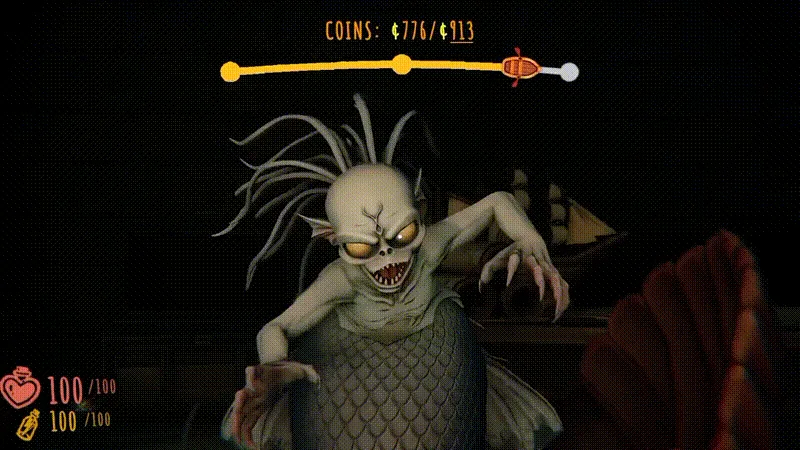
The exact relationship between certain names, variants, and broader enemy categories is not always explained publicly, so they should not automatically be treated as completely separate species. Environmental and mechanical dangers are equally important. Players can become isolated, lose stamina, drop their cargo, damage weapons, overturn the cart, or become incapacitated while trying to rescue another pirate. Noise can alert enemies, encouraging crews to hide or move carefully instead of fighting every creature. Defeating a monster can yield meat with monetary value, giving combat a possible reward. Rapid enemy respawns have nevertheless been criticized in Early Access impressions, and RetroStyle Games has explicitly identified enemy behavior and difficulty as systems it intends to tune with community feedback.
Cart Upgrades and Character Progression
The cart is a core logistical tool because it allows a crew to consolidate multiple pieces of treasure and move them together. Early Access added cart upgrades, expanding it from a basic container into part of the game’s progression system. A larger or improved cart can increase the potential value of a single return journey, but capacity is only useful if the team can protect the load. An overloaded cart may become difficult to control, and loose objects can spill when it tips or collides with the environment.
Post-launch patches addressed several cart-specific issues. RetroStyle Games fixed cases in which the cart fell into the boat beyond reach, teleported unexpectedly, bounced back after being unhitched, or trapped players in a ragdoll state. The large cart was also updated so that it retained its cargo during boat interactions instead of spilling everything. Progression extends beyond the cart. After an expedition, players can use earned money to select weapons, cosmetics, and upgrades.
Reported improvements include additional health, stamina, strength, hand size, and arm length. A stronger pirate can move difficult objects more effectively, while longer arms and larger hands improve treasure collection. Some purchases operate as run-based advantages rather than permanent account upgrades, so players should examine how long an item or effect lasts before spending their earnings. The system is still being developed, and RetroStyle Games plans a deeper progression structure for the full release.
Loot progression also depends on exploration. Expensive and rare objects can appear in different configurations, and patches have adjusted large-item spawns. This variation helps prevent a successful route from producing exactly the same treasure on every run. The game also includes deliberately frivolous interactive objects. Musical instruments, beach activities, and other toys give players opportunities to create chaos between dangerous encounters. These distractions reinforce the game’s party-oriented identity, although crews focused on progression must balance experimentation against the risk of losing their haul.

Early Access Roadmap, Full Release Plans, and Whether it is Worth Playing
RetroStyle Games expects the Early Access period to last at least six months. This is a development target rather than a guaranteed full-release window. The studio says the game will remain in Early Access until version 1.0 is ready, particularly because the team is working in Ukraine under difficult circumstances. The Early Access process will focus on tuning the core gameplay loop, difficulty, enemy behavior, physics interactions, co-op flow, and replayability. These are important areas because the game’s enjoyment depends on the relationship between chaotic physics and readable, controllable systems.
For version 1.0, the developers want to add many more locations, additional enemies and bosses, character customization, a deeper progression system, more weapons, and more cursed loot. Broad polish across the game is also planned. Major Early Access updates are intended to be free. The team has not committed to a rigid sequence or a final content count, and it describes the roadmap as expandable because new ideas continue to emerge during development.
Community feedback is central to the plan. The studio uses Steam discussions, Discord, videos, and an in-game survey to collect responses. It says feedback is reviewed regularly and that earlier playtests already resulted in system changes, new content, and bug fixes. The developers have demonstrated a relatively active patch cadence since launch, addressing tutorials, voice-chat options, cart problems, enemy interactions, network optimization, Steam Deck navigation, and performance issues. Continued responsiveness will be one of the most important indicators of whether the game can develop into a polished 1.0 release.
Is Early Access Worth Playing
Last Pirates: Die Together is most appealing to groups that enjoy inexpensive co-op games built around emergent comedy. Its elastic arms, physical treasure handling, bizarre enemies, and betrayal-friendly interactions can produce memorable situations without requiring an elaborate narrative campaign. The introductory price also lowers the barrier to organizing a four-person crew. At $7.99 before regional adjustments, it is positioned as a compact Early Access co-op experience rather than a full-priced release.
Its strengths are closely connected to its weaknesses. Unpredictable physics can be hilarious when an object swings out of control, but frustrating when a valuable weapon or piece of treasure falls unexpectedly. Aggressive enemies can create pressure, but frequent respawns can leave players without enough time to enjoy exploration. The game has already received fixes for cart behavior, network performance, tutorials, and specific enemy interactions, but prospective buyers should still expect bugs and balance changes. Anyone who wants a completely polished progression system, extensive customization, or a finalized bestiary may prefer to wait for later updates.
For players with two or three friends who enjoy extraction horror, physical comedy, and short stories created through failed plans, the current concept is compelling. Solo players can access the same content, but the experience loses some of its defining communication and teamwork chaos. The best reason to buy during Early Access is an interest in the game as it currently exists, combined with a willingness to see its systems evolve. Planned content should be treated as a development goal rather than the sole justification for a purchase.

Frequently Asked Questions (FAQs)
- When did Last Pirates: Die Together enter Early Access?
Last Pirates: Die Together entered Steam Early Access on August 18, 2026. This was its first commercial release on Steam for Windows PC, not a separate full 1.0 launch. The game is still in active development, meaning its content, balance, technical performance, enemies, progression, and overall structure may continue to change before the final version is released. - How much does Last Pirates: Die Together cost?
The standard US Steam price is $7.99. At launch, the game had a 20 percent introductory discount, which reduced the US price to $6.39 until the announced September 1, 2026 cutoff. Regional prices may differ because Steam adjusts pricing based on currency, taxes, and local market settings, so players should check the price shown on their own Steam account. - How many players can play Last Pirates: Die Together?
A session supports between one and four players. The game can be played solo, but its main focus is online co-op with a full crew of up to four people. Playing with others gives the game more of its intended chaos, since players can coordinate treasure hauling, rescue each other, distract monsters, or accidentally sabotage the expedition through the physics system. - Does Last Pirates: Die Together have in-game voice chat?
Yes. Last Pirates: Die Together includes in-game voice communication, which is important because players often need to coordinate while carrying large objects, escaping monsters, or searching separate parts of a location. Following an Early Access update, the game supports always-active voice chat, push-to-talk, and toggle-to-talk modes, giving players more control over how they communicate during expeditions. - What is the objective of Last Pirates: Die Together?
The main objective is to enter cursed locations, search for valuable objects, carry the treasure back to the boat, and survive long enough to satisfy the captain’s demand. Treasure is not simply collected through a menu or invisible inventory; players physically move coins, furniture, and other valuables through dangerous environments. Successful expeditions provide money that can be spent on weapons, upgrades, cosmetics, and other improvements. - Is Last Pirates: Die Together available on consoles?
No console version has been officially announced. The Early Access edition is currently available on PC through Steam, and there are no confirmed PlayStation, Xbox, or Nintendo Switch versions. Because of that, players should not assume console support or cross-platform multiplayer will be added unless RetroStyle Games announces it later. - Does Last Pirates: Die Together work on Steam Deck?
The developer says Last Pirates: Die Together can be played on Steam Deck, but it was not officially Steam Deck Verified when the official FAQ was updated. This means the game may run on the handheld, but some controls, interface elements, keyboard interactions, or performance details may still need improvement. Early Access patches have already addressed some Steam Deck-related issues, so compatibility may continue to improve over time. - How long will Last Pirates: Die Together remain in Early Access?
RetroStyle Games is aiming for an Early Access period of at least six months, but it has not guaranteed an exact version 1.0 release date. The studio has said it does not want to rush the full release before the game is ready. During Early Access, the developers plan to keep improving the gameplay loop, enemy behavior, physics, progression, difficulty, co-op flow, and overall polish based on development needs and player feedback. - Will the price increase at the full release?
A price increase is possible, but it has not been finalized. RetroStyle Games has said that the price may rise when Last Pirates: Die Together reaches version 1.0, but any change will be announced in advance. Major updates during Early Access are planned to be free for existing owners, so players who buy the game during Early Access are not expected to pay separately for each major development update. - What content is planned for Last Pirates: Die Together version 1.0?
The developers plan to add more locations, enemies, bosses, character customization, weapons, cursed loot, deeper progression, and general polish before or by version 1.0. These plans are not presented as a fixed final list, because the scope may expand or change according to community feedback and development priorities. The goal is to make the full release larger, more polished, and more replayable than the current Early Access build.
Conclusion
Last Pirates: Die Together entered Early Access on August 18, 2026 with a distinctive combination of pirate exploration, cooperative extraction horror and physics-based comedy. Its $7.99 standard price, four-player online support, solo option and modest PC requirements make it accessible to groups searching for a chaotic multiplayer experience.
The game’s elastic-arm mechanic gives treasure collection an identity beyond ordinary item looting. Every large object, overloaded cart and badly coordinated doorway becomes an opportunity for success or disaster. Monsters including cursed pirates, ghost sharks, treasure-stealing monkeys, rats, snakes and voice-imitating threats increase the pressure as crews explore the Mansion, Ship, Castle and their connected chapters.
Its Early Access condition remains important. Physics behavior, progression, matchmaking features, enemy balance and technical performance are still being refined. RetroStyle Games plans to continue development for at least six months and expand the game with new locations, bosses, customization, weapons and cursed loot before version 1.0.
Players interested in a finished, predictable horror campaign may want to wait. Crews that enjoy experimental co-op games, ridiculous physical interactions and unpredictable failures can already find a strong premise in Last Pirates: Die Together, especially when every expedition is approached as an opportunity to create a memorable story rather than execute a perfect plan.
Sources and Citations
- Steam: Last Pirates: Die Together Official Store Page confirms the August 18, 2026 Early Access release, RetroStyle Games as developer and RetroStyle Games, Judatone Studios and Elegoose Games as publishers. It lists a $7.99 US price, solo and four-player online co-op, minimum PC requirements, a target of at least six months in Early Access and plans for additional locations, enemies, bosses, customization, weapons and progression systems before version 1.0. (Steam Store)
- RetroStyle Games: Last Pirates: Die Together Is Now in Early Access is the official launch announcement. It documents the temporary 20% discount to $6.39, the new Ship and Castle locations, an expanded enemy roster, redesigned cart physics and upgrades, the Monkey Assistant, additional loot and the full lighting and visual overhaul. (SteamDB)
- RetroStyle Games: Official Last Pirates: Die Together FAQ confirms that the game supports solo play and crews of up to four players. It also covers in-game voice chat, the cursed-island treasure objective, 20 launch languages and Steam Deck compatibility, although the game was not officially Steam Deck Verified when the FAQ was updated. (Steam Community)
- RetroStyle Games: Official Community and Patch Feed collects the game’s post-launch updates. The feed documents changes involving the Mansion, Ship and Castle, three voice-chat modes, enemy balancing, cart fixes, daily saves, solo-specific balancing, visual improvements and network and performance optimization. (Steam Community)
- SteamDB: Last Pirates: Die Together Public Demo Update preserves the developer’s May 28, 2026 Steam announcement. It describes solo and four-player play, exploring a cursed island, hauling treasure back to the ship and avoiding threats such as the hungry shark and cursed pirate. SteamDB mirrors the official Steam Community update but is not itself an official developer website. (SteamDB)
- Analog Stick Gaming: Last Pirates: Die Together Early Access Impressions provides hands-on observations about the elastic-arm physics, treasure-extraction loop, monkey assistant, upgrades, cosmetics, weapons and enemies such as ghost sharks and the voice-copying Mimic. The article discusses a pre-release beta build, so its comments about level counts, bugs and balance should not automatically be treated as the current Early Access state. (Analog Stick Gaming)
- VR Kutak: Last Pirates: Die Together Early Access Impressions explains how players use the cart and stretchy arms to move loot, collect coins from damaged objects and purchase health, stamina, weapons, outfits and other upgrades between expeditions. It also covers chapter progression, enemy variety, breakable weapons and the game’s combination of dark horror settings with unpredictable multiplayer comedy. (vrkutak.com)
Recommendations
- The 15 Best Sci-Fi Anime Series of All Time (Ultimate Ranking for 2026 Fans & Beginners Guide)
- Which gadget tank should you pick in Splatoon Raiders?
- Sir, We Have an Orc Problem Sales Pass 100,000 Copies in Five Days
- Dragon Ball Xenoverse 3 Looks Like a Massive Upgrade Over the Previous Games
- Planet Zoo 2 Adds Aquariums & Aviaries Coming this Year: Full Details, Release Date & New Features Explained
- Palworld 1.0 Auri and Shaolong Tower Boss Guide: Location, Unlock Quest, Weaknesses, and Best Team
- Bizarre Lineage: What it Is, How to Play, Best Stands, Codes, Raids, and Beginner Progression Guide
- Nintendo Seeks Dismissal of Consumer Lawsuit Over Switch Tariff Refund
- Downloading 3D Models from Sketchfab: A Step-by-Step Guide
- Hell Let Loose: Vietnam Roles Guide: Which Role Should You Pick?



































































































