










In This Article (8 sections)
PokéPark: Fishing Rally’s 2005 Event Origins, Gameplay, and Temporary Distribution
PokéPark: Fishing Rally was a standalone Pokémon fishing minigame created for Nintendo DS event distribution. It debuted at the temporary PokéPark in Nagoya, Japan, on May 16, 2005, under the Japanese title ポケパーク釣り大会DS, romanized as PokéPark: Tsuri Taikai DS. “Fishing Rally” and “Fishing Contest” are English renderings of the same title, while Japanese store and festival promotions also used Pokémon Fishing Contest DS. Those naming differences explain why historical records can appear to describe several games when they actually refer to versions of the same promotion. The minigame later appeared at Japanese Pokémon Center stores, Pokémon Festa 2005, and in a Traditional Chinese version at PokéPark in Taiwan in 2006 under the title PokéPark Fishing Contest DS.
The game was built around short fishing sessions suitable for a busy physical event. Players cast into changing fishing areas, watched for a bite, and repeatedly pressed the A button to reel in a Pokémon. Weight, level, and rarity affected the score, so catching a species once did not necessarily produce the best possible result. Players could keep up to five catches and continue fishing in search of stronger results.
The Nintendo DS screens displayed the catch and its points clearly, allowing someone to learn the mechanics quickly and return to the game while waiting in line or taking a break at the event. Nintendo’s Pokémon Festa promotion specifically presented the game as something visitors could play during those gaps in the day.
The documented roster includes Pokémon such as Magikarp, Goldeen, Horsea, Dratini, Feebas, Relicanth, and Gyarados. Daniel Quadri later recalled catching a Gyarados while playing the resurfaced build, confirming that the Pokémon can be caught directly rather than requiring a Magikarp evolution. Claire Shelton of PSA also recalled catching a Relicanth during her roughly two-hour session with the surviving cartridge. Background Pokémon were not always catchable, with Shelton describing appearances by Psyduck, Politoed, and Slowbro as cameos rather than fishing encounters. The available evidence confirms these species and mechanics but does not establish reliable appearance rates, the best fishing locations, or a guaranteed strategy for achieving high scores.
Fishing Rally also had a competitive structure. Scores were calculated from factors including weight, level, and rarity, and players could submit results to the venue’s ranking system. Contemporary launch coverage says players could view the top 50, while archived instructions describe a ranking screen showing the player’s position and allowing movement through the list. At the park and Pokémon Festa, results could also appear on venue displays, while Pokémon Center promotions included rankings for individual stores and across the wider store network. This meant the same catch existed both as a private result on a visitor’s handheld and as part of a shared event competition.
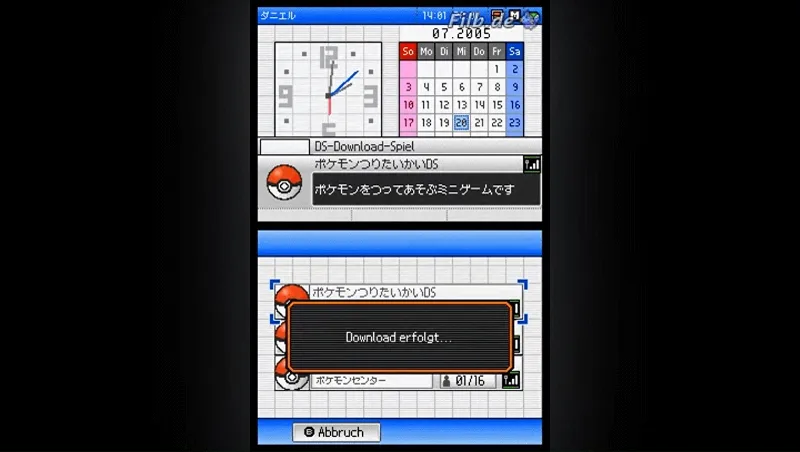
The temporary nature of the download made the game unusual even by event-software standards. Visitors received Fishing Rally through Nintendo DS Download Play, and the downloaded copy could remain active for up to 12 hours. Turning off the handheld caused the game to disappear sooner, after which the player would need to download it again. The software existed in the receiving DS’s memory for temporary play rather than as a permanent installation that could be reopened later. This is why the game is often described as self-deleting, although the surviving source cartridge that transmitted the software was a separate object capable of retaining the playable build.
Nagoya’s PokéPark itself ran from March 18 to September 25, 2005, as part of the Sasashima satellite development connected to the 2005 World Exposition in Aichi. Fishing Rally began distribution during that run on May 16 rather than at the park’s March opening. Historical sources disagree about the precise final date of the ordinary Nagoya download, with some distribution records listing August 31 while a surviving official event page promoted the minigame through September 25.
The July 16 to August 31 Summer Holiday Challenge Cup is more clearly documented, including a promotion in which visitors could receive an original scratch guard by catching a designated Pokémon. The evidence therefore firmly establishes the May launch and summer challenge period while leaving some uncertainty about the full duration of standard park distribution.
The Japanese Pokémon Center promotion ran from July 17 to August 31, 2005, under the Pokémon Fishing Contest DS name. Contemporary material describes it as an all-store promotion covering the Pokémon Center locations operating at the time: Tokyo, Osaka, Nagoya, Fukuoka, and Yokohama. The store setup allowed results to be compared both locally and across the wider Pokémon Center network. Pokémon Festa 2005 provided another distribution opportunity from July 17 through August 21, overlapping with the store campaign and further explaining why old references to the same software use different promotional names. The Traditional Chinese Taiwan version in 2006 extended the event beyond Japan and shows that the game’s history was broader than a single Nagoya attraction.

How Nintendo DS Download Play, Wireless Rankings, and Surviving Event Hardware Worked
Fishing Rally depended on two separate wireless activities. The first sent the game from event hardware to a visitor’s Nintendo DS using DS Download Play. The visitor selected the available title from the handheld’s menu, received the software locally, and then played it without needing to own a retail cartridge. Event materials specifically distinguished the Nintendo DS from Game Boy Advance hardware, which could not receive the game. This distribution method allowed large numbers of visitors to experience Fishing Rally without producing permanent retail copies for them to take home.
The second wireless function handled scores. After fishing, players could send their results to venue equipment used for rankings, allowing scores to appear on shared displays or within the event’s ranking system. Official Pokémon Festa material described results being transmitted to an on-site wireless hotspot and shown on a plasma display as well as the player’s handheld. Archived instructions also refer to a transmission option and ranking interface. These functions explain why a cartridge associated with high-score communication can be a genuine part of Fishing Rally’s event infrastructure without necessarily containing the playable fishing game itself.
The distinction became especially important in 2026. A Nintendo DS development or test cartridge appeared on eBay in July and booted to a Japanese screen associated with Fishing Rally’s high-score communication. The seller’s demonstration connected the cartridge to the event but did not establish that it could launch the fishing minigame itself. Later reporting described its contents as associated with attendees’ score rankings rather than the playable game. PocketMonsters.Net records that the cartridge was listed on July 26 for €7,999 and sold on July 31 for €9,505, explaining why coverage reported different opening and closing prices.
That ranking cartridge remains historically significant because it helps document how the event collected and managed results. A player’s local copy could disappear when the DS was turned off while the submitted score remained part of the venue’s competition. The game software, ranking hardware, and surviving records of player results therefore preserve different parts of the original experience. One explains how Fishing Rally played, another shows how the event communicated with visitors’ consoles, and the final category records what players actually achieved. Treating every surviving PokéPark cartridge as the same object would obscure those distinctions.
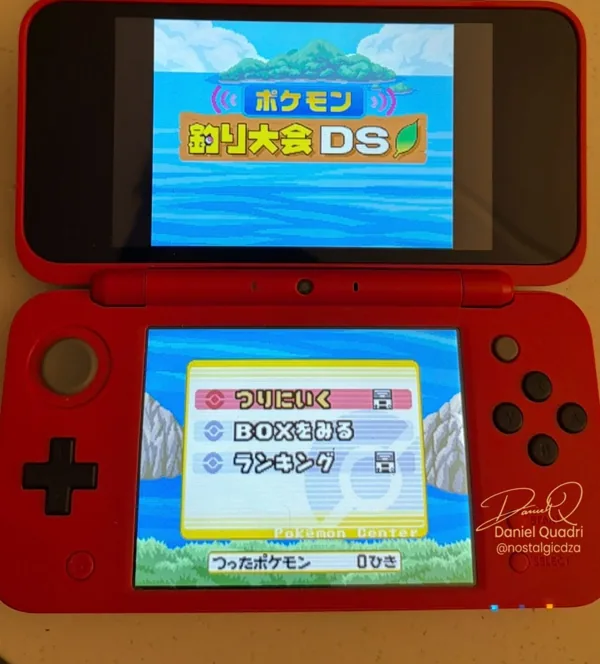
The later discovery of Daniel Quadri’s cartridge answered a different question by demonstrating that a playable source still exists. Quadri supplied photographs and video showing PokéPark: Fishing Rally running on a Nintendo DS and then transmitting the game to additional DS systems through local wireless Download Play. Starting the software on one handheld established that the cartridge contained the playable fishing build. Sending it to another DS and having the recipient play it established that the cartridge could also perform the distribution role that visitors would have experienced at the event. The demonstration therefore recreated an important part of the original 2005 delivery process on original hardware without requiring the original park infrastructure.
This capability matters because the receiving copies were designed to vanish. Thousands of visitors may have encountered Fishing Rally across its various promotions, yet the normal distribution method left no permanent copy behind on their handhelds. A source cartridge capable of both launching and transmitting the software is therefore fundamentally different from a photograph, title screen, ranking cartridge, or historical score record. It preserves executable behavior that temporary Download Play sessions were never intended to leave with ordinary players. That makes Quadri’s cartridge particularly important for understanding how the attraction actually worked.
Daniel Quadri’s Playable Cartridge, PSA Authentication, and the Evidence Behind the Discovery
Pokémon collector Daniel Quadri owns the cartridge identified in November 2026 as the only publicly documented fully playable copy of PokéPark: Fishing Rally. He approached IGN with evidence showing the game running and being transmitted to other Nintendo DS handhelds. Reporting on the discovery says Quadri kept the details of how he acquired the cartridge private, so the publicly documented provenance begins with the item in his possession and the subsequent demonstrations and authentication.
The phrase “only known” therefore describes the state of available public evidence rather than proving that no other playable source exists anywhere. Another cartridge could survive privately, in an archive, or among development materials, but no second fully playable copy had been documented publicly as of November 18.
The significance of Quadri’s cartridge comes from what was shown rather than from its label alone. Photographs and video demonstrated the fishing minigame operating on original hardware, while the successful Download Play transfer showed that another DS could receive and run it. Earlier screenshots, videos, and descriptions of Fishing Rally had already preserved information about its controls and score screens, so the November evidence was not needed to prove that the event game once existed. Instead, it linked a specific surviving physical cartridge to working gameplay and distribution behavior. That is a much stronger preservation claim than identifying an object by artwork or event association.
A separate firsthand account came from PSA’s Claire Shelton. She said she met Quadri in early September 2026 and played Fishing Rally for roughly two hours before the cartridge was authenticated and encapsulated. Shelton described moving between fishing areas, catching Pokémon, experimenting with the scoring system, landing a Relicanth, and reaching a best score of roughly 25,000 points. Her account demonstrates sustained interaction with several parts of the game rather than a short boot sequence or title-screen demonstration. PSA later published the account under Shelton’s name on November 13.
PSA authenticated and encapsulated the cartridge after that hands-on session. News reports sometimes describe the submission as grading, but PSA’s own account specifically emphasizes authentication and encapsulation. The process created a formal record of the physical object while protecting it inside a holder. The important preservation detail is that Shelton documented the cartridge’s behavior before it was enclosed, leaving a firsthand account of the software alongside the authenticated object.
PSA had also handled the separate high-score cartridge submitted by another person. That detail reinforces the distinction between two surviving pieces of Fishing Rally’s infrastructure. One cartridge relates to ranking communication, while Quadri’s item contains the fishing game itself and can transmit it to other DS systems. Both are valuable historical artifacts, but they answer different questions about the original attraction. The existence of the ranking hardware does not reduce the significance of finding a playable source, and the playable cartridge does not make the competition infrastructure irrelevant.
Quadri’s November disclosure followed the renewed interest created by the July eBay sale. The earlier auction showed that rare event hardware connected with Fishing Rally had survived, but its demonstration centered on high-score communication. Quadri’s cartridge provided evidence of the minigame itself and its local wireless distribution. The two discoveries became linked in coverage because they surfaced within months of each other and concerned the same temporary Pokémon event. Their demonstrated functions, however, should remain separate when describing what has actually been preserved.

Public Availability and What the Discovery Means for Nintendo DS Game Preservation
As of November 18, 2026, the fully playable PokéPark: Fishing Rally build demonstrated by Quadri had not been released as a verified public download. GBAtemp reported that Quadri did not intend to publish the ROM because of concerns about distributing the software. That means the discovery established the existence of a surviving playable source and demonstrated its local wireless capabilities without making the game generally available to players or researchers. There had also been no announcement of a public event where visitors could bring Nintendo DS handhelds and receive the game through Download Play. The cartridge’s ability to transmit the title is documented, while public access to that capability remains a separate issue.
Researchers can still study Fishing Rally through contemporary event instructions, promotional materials, historical reporting, photographs, gameplay footage, and the November 2026 accounts. Those records preserve different aspects of the experience. Video can show how casting, bites, and scoring appear in motion, while promotional material explains how visitors were expected to download the software and submit results. Historical venue information establishes when and where the game was offered, and the surviving ranking hardware helps reconstruct the wider event infrastructure. These sources cannot replace access to the executable software, but they preserve substantial information about how it functioned.
Claims about additional private copies remain difficult to evaluate because public evidence is limited. Quadri’s demonstrations show that his cartridge can run the minigame and send it locally to other DS systems. They do not reveal how many archival copies may exist elsewhere, whether different event venues used distinct builds, or whether the Japanese and Traditional Chinese releases differ internally. Establishing those questions would require access to additional verified software or hardware. For anyone simply hoping to play Fishing Rally today, the practical situation remains that no verified public release of the demonstrated build was available as of November 18.
The discovery highlights a broader preservation problem with temporary event software. Fishing Rally may have been experienced by large numbers of visitors while leaving almost no durable copies in ordinary players’ hands. The same Download Play system that made it easy for organizers to distribute a minigame for a few hours also ensured that players could not simply revisit it years later. Memories, photographs, printed instructions, and rankings could survive even when the executable software disappeared at power-off. The survival of a source cartridge therefore carries unusual importance because it preserves something the ordinary distribution model was specifically designed not to leave behind.
Preserving Fishing Rally also involves more than finding a single game file. The original experience included selecting the download on a DS, fishing for Pokémon, sending results, viewing shared rankings, participating in venue-specific challenges, and encountering different promotions across PokéPark, Pokémon Center stores, Pokémon Festa, and Taiwan. Quadri’s playable cartridge preserves controls, timing, audiovisual presentation, scoring, and wireless distribution, while the separate ranking cartridge helps explain how the competitive side operated. Contemporary material adds the locations, dates, prizes, and rules needed to understand those artifacts in context. Together, they reconstruct far more of the event than any one object could provide alone.
Authentication adds another layer to that record. PSA’s encapsulation preserves the physical cartridge, while Shelton’s account documents how it behaved before being enclosed. Existing footage can continue to show features that researchers cannot inspect directly while the item remains privately held. Wider technical study would depend on what material becomes accessible in the future and how its provenance can be verified. For now, the November 2026 discovery answers the central preservation question: a playable physical source of PokéPark: Fishing Rally survives, and the evidence shows that it can still perform the function for which it was originally built by sending the temporary Pokémon fishing game from one Nintendo DS to another.
Frequently Asked Questions (FAQs)
- When did PokéPark: Fishing Rally first come out?
PokéPark: Fishing Rally debuted at PokéPark in Nagoya, Japan, on May 16, 2005. Contemporary Japanese coverage reported that wireless distribution of the Nintendo DS minigame began that day. The date refers specifically to the start of the game’s event distribution, not the opening of PokéPark itself, which had already been operating earlier in 2005. Visitors could bring a Nintendo DS to the attraction and receive the game locally through Download Play. - Are PokéPark: Fishing Rally and PokéPark Fishing Contest DS the same game?
Yes. Both names refer to the same Nintendo DS fishing minigame commonly identified as PokéPark: Tsuri Taikai DS. “Fishing Rally” and “Fishing Contest” are different English renderings of the Japanese title, while later Japanese Pokémon Center and festival promotions used the related name Pokémon Fishing Contest DS. The naming differences can make historical references look like separate releases even though they concern the same basic game and event concept. - Was PokéPark: Fishing Rally sold as a retail DS cartridge?
No. Ordinary players did not buy the game as a commercial Nintendo DS cartridge. Instead, visitors received it temporarily through Nintendo DS Download Play at events and participating locations. The authenticated cartridge owned by Daniel Quadri is important because it is a surviving physical source capable of running and transmitting the software, not evidence of a normal retail release. The public version of the experience was therefore temporary even though source hardware existed behind the distribution system. - How long could visitors keep the game on their DS?
A downloaded session could remain available for up to 12 hours. However, turning off the Nintendo DS caused the temporary copy to disappear sooner, meaning the player would need to return to a distribution point and download the game again to continue. The game was not installed permanently in the way a retail cartridge or later digital purchase would be. That temporary design is one of the main reasons surviving playable source hardware is so significant today. - Was PokéPark: Fishing Rally ever available outside Japan?
Yes. A Traditional Chinese version was distributed at PokéPark in Taiwan from June 23 to September 24, 2006. That release shows that Fishing Rally was not limited exclusively to the original Japanese PokéPark and later Japanese store and festival promotions. The Taiwanese event used the English title PokéPark Fishing Contest DS. This wider distribution also raises the possibility that different event builds or localized versions existed, although the available material does not establish all of their technical differences. - How many Pokémon could players keep in one session?
Players could keep records of up to five catches during a session. Each catch contributed to the player’s competitive result, and the game allowed players to review information about those Pokémon while the temporary session remained active. Players could continue fishing in an attempt to replace weaker catches with better ones before submitting their score. Results could then be transmitted to the event’s ranking system for comparison with other participants. - What determined the points for a catch?
The documented scoring factors were the Pokémon’s weight, level, and rarity. This meant that simply catching a particular species did not determine the entire value of the result. Two examples of the same Pokémon could potentially be worth different amounts if their other characteristics differed. The scoring system encouraged players to keep casting even after catching a species they already had because another specimen might improve their overall score. - Did the July 2026 eBay listing prove the full fishing game had survived?
No. The July 2026 eBay listing showed a Nintendo DS cartridge booting software associated with Fishing Rally’s high-score or ranking communication system. That made it an important surviving piece of the event infrastructure, but the public demonstration did not establish that it contained the playable fishing minigame itself. The November 2026 evidence from Daniel Quadri’s cartridge went further by showing actual fishing gameplay and successful transmission of the game to another Nintendo DS. The two cartridges therefore appear to preserve different parts of the original attraction. - Did anyone besides Daniel Quadri play the recovered game?
Yes. PSA’s Claire Shelton reported playing PokéPark: Fishing Rally for roughly two hours before Quadri’s cartridge was authenticated and encapsulated. She described moving between fishing areas, catching Pokémon, including a Relicanth, and experimenting with the scoring system. Shelton also reported a best score of approximately 25,000 points during the session. Her account provides a separate firsthand description of sustained gameplay rather than relying only on Quadri’s own demonstration. - Can the public play PokéPark: Fishing Rally on an emulator in 2026?
No verified public copy of the fully playable build demonstrated by Quadri was available as of November 18, 2026. Quadri showed that his cartridge can send the game locally to other Nintendo DS handhelds through Download Play, proving that the software remains playable under those conditions. However, GBAtemp reported that he did not intend to release the ROM publicly. That means researchers can study footage, photographs, historical instructions, and other records, but the demonstrated build itself is not publicly available for emulator use.

Conclusion
PokéPark: Fishing Rally was designed to be temporary. Visitors received it wirelessly at Pokémon events, spent a short session catching Pokémon and competing for scores, and then lost access when the Nintendo DS was turned off or the download expired. That distribution model made the game easy to experience in 2005 but unusually difficult to preserve once the events ended and the original hardware disappeared from public use. Daniel Quadri’s cartridge changes that record substantially because it demonstrates that the fishing minigame still runs on original hardware and can still be transmitted through Nintendo DS Download Play more than two decades after its Nagoya debut.
The preservation story is stronger because several different pieces of evidence now support different parts of the original experience. The July 2026 eBay cartridge preserved evidence of the ranking and communication system, while Quadri’s cartridge demonstrated the playable fishing build and its wireless distribution capability. PSA’s Claire Shelton added an independent hands-on account after spending roughly two hours with the game before the cartridge was authenticated and encapsulated.
Together with contemporary release coverage, surviving event instructions, photographs, and gameplay footage, those records provide a much clearer reconstruction of how Fishing Rally worked than collectors had before 2026. The playable cartridge remains privately held and no verified public ROM has been released, so access is still extremely limited, but the central preservation question has been answered: PokéPark: Fishing Rally did survive, and its original Nintendo DS distribution functionality still works.
Sources and Citations
- Inside, May 16, 2005 : Contemporary Japanese reporting on the game’s distribution at PokéPark, explaining fishing controls, catch scoring, the top 50 rankings and disappearance after powering off the DS. インサイド
Citation: PokéPark Fishing Contest DS Distribution Begins at PokéPark - GAME Watch, March 13, 2005 : Documents the temporary Nagoya park’s operating dates, location near Nagoya Station, attractions and admission arrangements, providing historical context for the fishing game’s original venue. game.watch.impress.co.jp
Citation: PokéPark Opens for a Limited Run on March 18 - Bulbapedia, PokéPark Fishing Contest DS : Summarizes the game’s temporary Download Play distribution, fishing mechanics, scoring system, available Pokémon and historical releases at events in Japan and Taiwan. bulbapedia.bulbagarden.net
Citation: PokéPark Fishing Contest DS - ChainSwordCS, Pokémon Website Translations : Collects archived official Pokémon website material and fan translations covering event distribution, Download Play instructions, scoring, rankings and the downloaded game’s temporary availability. Pokémon Website Translations
Citation: Pokémon Website Translations - Serebii, Pokémon Center Reference : Provides background on Pokémon Center stores, including permanent and temporary locations, opening dates and their role as retail spaces and venues for Pokémon events. Serebii.net
Citation: Pokémon Center - PocketMonsters.Net, July 30, 2026 : Documents a development cartridge’s eBay listing and subsequent sale, alongside background on the fishing game’s original event distribution, Download Play access and competitive scoring features. PocketMonsters.Net
Citation: PokéPark Fishing Contest DS: Nintendo DS Development/Test Cartridge - Kotaku, July 30, 2026 : Covers an eBay listing and uncertainty about whether the cartridge contains the playable game. Kotaku
Citation: July discovery report - PSA, November 13, 2026 : Documents Claire Shelton’s firsthand testing of the playable cartridge, its authentication and encapsulation, and a separate cartridge used to transfer scores to the event leaderboard. psacard.com
Citation: PSA Plays, Researches, and Authenticates Lost Pokémon Game - Tilt, November 17, 2026 : Explains PSA’s authentication and protective encapsulation, the cartridge’s reported Download Play functionality, and concerns about preserving the physical object while enabling access to its software. Tilt
Citation: Lost PokéPark Fishing Rally DS Found Playable and Sealed by PSA - Kotaku, November 14, 2026 : Reports Daniel Quadri’s playable cartridge discovery and preservation interest, drawing on IGN’s interview. kotaku.com
Citation: Pokémon fishing game rediscovery - NQ Brief, November 14, 2026 : Summarizes reporting about Daniel Quadri’s playable cartridge, its submission to PSA and his stated ability to transmit the game to other Nintendo DS systems. NQ Brief
Citation: Collector Reports Only Playable Copy of Lost DS Game PokéPark: Tsuri Taikai - GBAtemp, PokéPark Fishing Rally Preservation Coverage : Reports the collector’s stated refusal to release the ROM publicly, alongside community concerns about access to what is reportedly the only known playable cartridge. GBAtemp.net
Citation: Collector Won’t Dump the Only Playable Copy of PokéPark: Fishing Rally
Recommendations
- Nvidia Export Controls: NYT Reports Trump and Lutnick Ties Influenced Oversight
- Pokémon Go Summer Marathon Arctic Embers Event Guide
- How Game Discovery Actually Works and Fails in 2026: Why Gamers Can’t Find the Right Games
- Lara Croft and Tomb Raider Celebrate 30 Years in October 2026
- Warhammer 40,000: Dark Heresy Surpasses 800,000 Steam Wishlists Ahead of Release
- Asus ROG Ally X 2TB Drops $200 in Huge Handheld Deal
- PS5 FlexStrike Fight Stick Release Date Confirmed for August 6, 2026
- Maseylia: Echoes of the Past Preview: 3D Metroidvania Platformer With Ancient Tech Exploration
- James Gunn’s DCU Reportedly Safe After Paramount Warner Merger



































































































