







In This Article (7 sections)
Mega Man Legends ACTRA Toronto Listing, Production Dates, Casting Details, and Removal
Mega Man Volnutt’s series appeared on ACTRA Toronto’s public production directory with a scheduled start date of September 14, 2026, an end date of December 1, 2026, and an indication that casting would be handled internally. The discovery attracted considerable attention from fans of Capcom’s long-dormant franchise, particularly those hoping for a modern collection, remake, or continuation of the unfinished adventure. By November 11, reporters were already describing the listing as deleted. However, December 1 was identified as the scheduled production end date rather than a release date, and Capcom had not publicly confirmed the identity of the project as of November 24, 2026.
The entry appeared on the Ontario performers’ union’s What’s Shooting directory under the production name “MEGA MAN LEGENDS – NEW MEDIA.” Its casting field contained the words “IN-HOUSE,” but the listing supplied no additional subtitle, numbered sequel designation, publisher information, or description of the finished product. The surviving screenshot and reports published while the entry remained visible consistently documented these details. ACTRA Toronto’s directory is primarily intended to provide information relevant to performers, with fields covering casting, background performers, stunts, production dates, and union representatives. Its purpose differs considerably from an official video game announcement, which would ordinarily identify the product, supported platforms, release plans, and other information relevant to customers.
The publicly documented information from the listing included:
- Production name: MEGA MAN LEGENDS – NEW MEDIA.
- Scheduled production start: September 14, 2026.
- Scheduled production end: December 1, 2026.
- Casting arrangement: IN-HOUSE.
- Production directory: ACTRA Toronto’s What’s Shooting page.
- Named performers: None disclosed.
- Confirmed platforms: None disclosed.
- Release date: None announced.
- Production format: Unconfirmed.
An early public discovery can be traced to Reddit user u/hoodrathankmccoy, who posted a screenshot and referenced the second page of ACTRA Toronto’s directory in a discussion titled “Mega Man show or movie?” on the Mega Man subreddit. The user was asking whether anyone recognized the production rather than claiming insider knowledge of Capcom’s plans. Another traceable post came from u/MCUAvenger1992 in the GamingLeaksAndRumours community, where the possibility of a remaster was raised.
Gematsu credited the fan community in its November 10 report, while Rockman Corner referenced the gaming leaks community. Nintendo Life subsequently credited Rockman Corner for drawing attention to the entry. These accounts establish several early sources responsible for circulating the discovery, although they do not identify who originally noticed the production on ACTRA’s website.
The classification of the project as New Media does not establish whether it is a video game, television series, film, or animated production. Article A428 of ACTRA’s 2025 to 2027 Independent Production Agreement identifies examples of new media distribution that include subscription streaming, advertising-supported video on demand, digital rentals, and permanent downloads. These classifications concern how productions reach audiences rather than their narrative format or production methods. ACTRA Toronto also represents voice actors, motion capture performers, stunt performers, and individuals combining voice and physical performances for video games. The directory entry did not identify which agreement governed the production or what kind of performance work was involved, leaving several possibilities open.
The scheduled production period extended from September 14 through December 1, covering approximately eleven weeks. Gematsu published these dates on November 10 at 8:44 p.m. Eastern Time, by which point the scheduled start date was already approximately eight weeks in the past. However, neither the screenshot nor the associated reporting established when the project was originally entered into ACTRA’s directory. The production window also supplied no information about individual recording schedules, the number of performers involved, or how much work each participant was expected to complete. Consequently, the length of the listed period cannot establish the size of the project, the amount of dialogue involved, or how close it might be to commercial release.
December 1, 2026, was specifically identified within the directory’s End Date column rather than as a consumer release date. This distinction becomes particularly important when comparing the listing with Capcom’s previous announcements involving the franchise. In September 2015, Capcom announced that the original game would become available through the North American PlayStation Store on September 29. That announcement identified the purchasing platform, price, and compatible PlayStation systems. The ACTRA listing contained none of those consumer details. Its scheduled production end date therefore does not establish that a game, film, collection, or other project will become available on December 1, nor does it establish that Capcom intends to announce anything on that date.
The listing remained publicly visible when gaming publications reported it on November 10. By November 11, 2026, IGN reporter Virginia Glaze described the entry as deleted in an article published at 10:45 p.m. UTC. Nintendo Life subsequently updated its coverage at 2:30 a.m. on November 12, crediting Rockman Corner for the removal information. The different dates reflect when individual publications documented the disappearance rather than separate removal events. The precise time and reason remain unknown. Although the surviving screenshots establish that the entry previously existed, no cited public statement attributes its removal to Capcom, an early completion of production, or cancellation of the project.
Casting information was similarly limited. The indication that casting was handled internally did not identify a casting director, recording studio, production company, or individual performer. It also did not establish that Capcom employees personally conducted auditions or selected the cast. Fans discussed the possibility of newly recorded dialogue for a remaster, replacement recordings for older games, and additional dialogue associated with a collection’s menus. However, these were interpretations raised in community discussions rather than information contained in ACTRA’s original entry.
Whether the production involved voice recording exclusively, motion capture, or another form of performance remains unresolved.master, replacement recordings for older games, and additional dialogue associated with a collection’s menus. However, these were interpretations raised in community discussions rather than information contained in ACTRA’s original entry. Whether the production involved voice recording exclusively, motion capture, or another form of performance remains unresolved.

Potential Mega Man Legends Collection, Capcom’s Official Comments, and Film or Television Possibilities
TThe Canadian location of the production has particular significance for longtime fans because the original game’s English dialogue was recorded in Canada. Corey Sevier voiced Mega Man Volnutt, Tracy Ryan portrayed Roll Caskett, and Caroly Larson played Tron Bonne. Their performances helped establish the relationships central to the series, particularly the partnership between Mega Man and Roll and the complicated rivalry involving the Bonne family. The appearance of the franchise’s name within a Canadian performers’ union directory consequently attracted attention from fans familiar with the original localization and its cast.
George Masswohl, who voiced Barrell Caskett, provided additional insight into the recording process during a 2004 interview with Mega Man Legends Station. He recalled auditioning using the script, viewing game footage during recording, and working alongside several other performers in the booth. Recording together allowed actors to respond directly to one another. When Masswohl returned to portray Barrell approximately two years later, the production team played his previous recordings to help him reproduce the character’s voice.
The English cast also changed between the two numbered games, with Susan Roman replacing Corey Sevier as Mega Man Volnutt in the sequel, while Tracy Ryan and Caroly Larson returned as Roll and Tron. The 2026 listing did not identify any returning performers from either production.
As of November 24, 2026, Capcom had not publicly announced a new game, remake, or collection associated with the ACTRA Toronto entry. However, Mega Man Star Force Legacy Collection producer Shingo Izumi previously addressed the possibility during an interview published by RPG Site on March 5, 2026. When asked whether Capcom had plans for a collection featuring the Legends adventures, Izumi explained that none existed at the time, while acknowledging that the series could be considered for future collections. His comments establish that Capcom recognizes the property as a possible candidate, but they do not confirm that development subsequently began or that the Toronto production is connected to such a release.
The possibility of a collection is supported primarily by Capcom’s established publishing history. The company has already released compilations covering several major branches of the Mega Man franchise, including the classic series, Mega Man X, Mega Man Zero, Mega Man ZX, and Mega Man Battle Network. On March 27, 2026, Mega Man Star Force Legacy Collection brought another group of older adventures to modern gaming platforms. As more parts of the franchise become accessible through dedicated collections, the absence of an equivalent release for Volnutt’s adventures becomes increasingly noticeable. Fans have therefore interpreted the listing against an existing pattern of Capcom revisiting its older properties.
A potential compilation could draw from three original PlayStation adventures that Capcom has previously grouped together:
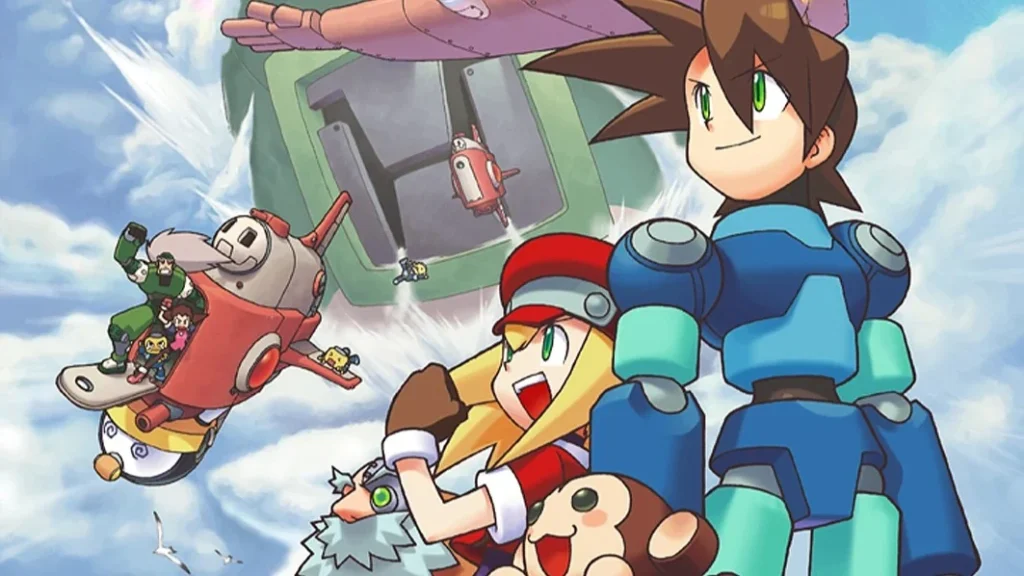
Mega Man Legends: The original adventure featuring Mega Man Volnutt, Roll Caskett, and their exploration of Kattelox Island.
The Misadventures of Tron Bonne: A prequel focusing on Tron, her family, and the management of her Servbots.
Mega Man Legends 2: The numbered sequel expanding the franchise’s setting and leaving Volnutt’s return from Elysium unresolved.
Capcom previously made all three titles available through the North American PlayStation Network. The original adventure arrived in September 2015, while its numbered sequel became available in April 2016. When announcing the sequel’s digital release, Capcom specifically noted that players could now purchase all three PlayStation adventures, including The Misadventures of Tron Bonne. Although these were individual digital purchases rather than a dedicated compilation, the announcement established a precedent for treating the three titles as a recognizable collection. A hypothetical modern release containing the same games would therefore follow a grouping Capcom itself previously acknowledged.
A casting production could potentially relate to such a collection without requiring a completely new game. Newly recorded menu dialogue, introductions, additional content, or replacement performances could all involve professional actors. However, these possibilities represent substantially different production requirements. Recording a few additional lines would not necessarily indicate that Capcom intends to replace the original English voice tracks, while a complete redub would involve considerably more work across the existing games. Because the ACTRA entry supplied no dialogue descriptions or character names, it cannot establish which approach, if any, is associated with the production.
A television or film adaptation remains another possible interpretation of the New Media classification. Digitally distributed productions can fall under ACTRA’s definition, and an animated adaptation could involve professional performers without requiring recognizable filming locations. However, the Toronto listing identified no director, streaming service, television network, episode count, production studio, or narrative description. It provides no basis for distinguishing a film from a television series or determining whether a possible adaptation would use animation or live action.
Capcom has previously explored adaptations of the wider Mega Man franchise. Mega Man: Fully Charged debuted on Cartoon Network in 2018, featuring Aki Light as its central character. In October of that year, Capcom also announced plans for a Hollywood live-action feature tentatively titled Mega Man, with Henry Joost and Ariel Schulman identified as its intended writers and directors. Unlike the ACTRA entry, those announcements supplied creative information that helped establish their identities. Neither announcement specifically connected its project to Mega Man Volnutt, Roll Caskett, Tron Bonne, or the Legends universe. The franchise’s adaptation history therefore establishes that another screen production is possible without confirming that the Toronto listing concerns one.
Capcom also has an officially announced Mega Man game scheduled for 2027. Mega Man: Dual Override belongs to the classic action platforming series and has its own PlayStation Store listing. Although the franchise’s approaching 40th anniversary has increased interest in both announced and rumored projects, Dual Override remains separate from Volnutt’s adventures. Neither its announcement nor the ACTRA entry establishes a relationship between the two productions. Until Capcom provides further information, the listing cannot reliably be identified as a collection, remake, sequel, adaptation, or another type of media project.

Mega Man Legends Series History, The Misadventures of Tron Bonne, and the Cancelled Mega Man Legends 3
The original series consists of three principal PlayStation releases, beginning with Mega Man Legends, followed by The Misadventures of Tron Bonne and Mega Man Legends 2. The first adventure debuted in Japan in December 1997 under the title Rockman DASH before reaching North America in 1998. The Misadventures of Tron Bonne followed in Japan in 1999, while the numbered sequel arrived in 2000. The first game also received a Nintendo 64 version known as Mega Man 64. Although that title forms part of the franchise’s release history, it does not represent an additional original adventure.
The original adventure introduced players to Mega Man Volnutt and the Caskett family through a story centered on Kattelox Island. Volnutt explores buried ruins containing ancient machinery and valuable resources, while Roll Caskett provides guidance and technical support. Their activities bring them into conflict with the Bonne family, whose pursuit of treasure frequently places them on opposing sides. The game combines exploration, combat, and interactions with the island’s inhabitants, giving its setting a recognizable community beyond the underground ruins. The sequel expanded the adventure across additional islands and introduced the search for the legendary Mother Lode, ultimately leaving Volnutt stranded on Elysium without resolving his return home.
The franchise also includes a less widely accessible mobile adventure. Rockman DASH: Great Adventure on 5 Islands was released in Japan for i-mode mobile phones in 2008 and takes place between the two numbered games. Preservation efforts eventually recovered the title, with a fan English translation following in 2025. Its existence complicates descriptions of a hypothetical complete collection. While the three PlayStation releases form the franchise’s most recognizable group, a comprehensive compilation could potentially include additional material. Without an official contents announcement, however, fans cannot establish whether any future collection would contain the mobile adventure.
The Misadventures of Tron Bonne occupies a particularly important position within the franchise because it takes place before the original adventure. Rather than following Volnutt, the game places players in control of Tron as she attempts to rescue her brothers, Teisel and Bon Bonne, and resolve the family’s financial difficulties. The adventure offers a different perspective on characters who originally appeared as antagonists, allowing players to experience the Bonne family’s operations from aboard its airship. Tron’s engineering abilities and relationships with her Servbots become central gameplay elements rather than obstacles encountered by Mega Man.
Tron commands forty Servbots, each possessing individual characteristics, skills, and personalities. Managing these small robots and selecting suitable companions for different assignments forms an important part of the experience. Missions involve operating the Gustaff mechanical vehicle, stealing cargo by maneuvering crates around docks, and sending Servbots into mines to search for treasure. These activities distinguish the game from the numbered adventures while expanding the personalities and relationships of the Bonne family. Its inclusion in a hypothetical collection would preserve a substantial part of the franchise that would otherwise be missing from a package containing only the first game and its sequel.
Players approaching the three original adventures can follow either their release order or their chronological narrative order. Beginning with the first game introduces Tron and her family through Volnutt’s perspective before the prequel explores their circumstances in greater detail. Beginning with The Misadventures of Tron Bonne instead allows players to understand the Bonnes before encountering their conflict with Volnutt. Both approaches eventually lead to the second numbered adventure, whose unresolved ending continues to fuel interest in another installment.
Capcom originally announced Mega Man Legends 3 for Nintendo 3DS in September 2010, offering fans renewed hope that the story would continue. Its development involved an unusually public process through the Developer Room, where fans could contribute ideas and participate in selected design discussions. Community involvement extended to elements such as the appearance of Reaverbots, the mechanical enemies associated with the franchise’s ancient ruins. Capcom subsequently announced a downloadable Prototype Version in April 2011, introducing Barrett, the leader of a group of sky bikers, and allowing players to experience part of the developing adventure through the Nintendo eShop.
Development had progressed beyond preliminary illustrations and written concepts. In February 2011, Siliconera reported that dialogue for Aero had already been recorded in Japanese and English. Nevertheless, Capcom announced in July 2011 that the third installment had failed to satisfy its internal requirements for entering full production. The cancellation also covered the announced Prototype Version, preventing it from reaching the Nintendo eShop. Capcom referred to several evaluation criteria and contributions from different parts of the company without publicly identifying a specific budget threshold or failed sales target. Because the prototype was never commercially released, its retail performance could not have determined the cancellation.
Capcom also stated that the cancellation was unrelated to Keiji Inafune’s departure from the company and accepted responsibility for the decision despite the extensive involvement of fans. That history provides important context for interpreting the 2026 ACTRA listing. In 2011, the third game had an officially announced platform, recorded dialogue, publicly discussed development features, and plans for a playable prototype, yet it still failed to reach release. The newer Toronto entry contains considerably less information and provides no evidence that the cancelled Nintendo 3DS project has been revived.
The ACTRA Toronto listing has renewed interest in a franchise whose original adventures remain important to longtime fans. Capcom’s history of releasing legacy collections and its previous comments about the series provide understandable reasons for speculation about a modern rerelease.
However, the production’s identity remains unconfirmed. Whether it represents a collection, new game, or adaptation, further information from Capcom is necessary to establish what the project means for Mega Man Volnutt and the future of the series.

Frequently Asked Questions (FAQs)
- Was the Mega Man Legends ACTRA listing real?
Yes. Early Reddit discussions preserved a screenshot and referenced the original ACTRA Toronto production directory. Gematsu and Noisy Pixel subsequently reported the listing on November 10, 2026, while it remained visible. Although its existence is documented, the listing did not establish the identity or format of the production. - What was the exact production name?
The production was listed as “MEGA MAN LEGENDS – NEW MEDIA.” No additional subtitle, numbered sequel designation, or reference to a Legacy Collection appeared in the entry. Descriptions identifying it as Mega Man Legends 3, a remaster, or a collection originated from speculation rather than the production’s documented name. - Was Mega Man Legends scheduled to release on December 1, 2026?
No. December 1, 2026, appeared in the production End Date field, alongside the September 14 start date. It represented the scheduled conclusion of the listed production period rather than a commercial release date. Capcom had not announced a corresponding game launch, preorder period, or product reveal for that day. - How soon did the entry disappear after fans found it?
Gaming publications reported the visible entry on November 10, 2026, and IGN described it as deleted by the evening of November 11. Nintendo Life updated its coverage early on November 12. The exact removal time and reason remain undisclosed, with no official statement establishing whether the disappearance affected the production itself. - Did ACTRA identify any returning English voice actors?
No. The listing indicated only that casting was handled internally. Corey Sevier originally voiced Mega Man Volnutt, while Susan Roman portrayed him in Mega Man Legends 2. Neither performer was identified in the 2026 entry, and there was no confirmation that actors associated with Roll Caskett, Tron Bonne, or other characters would return. - What has Capcom actually said about a Mega Man Legends Legacy Collection?
In March 2026, Mega Man Star Force Legacy Collection producer Shingo Izumi told RPG Site that Capcom had no plans for a Legends collection at that time. However, he acknowledged that the series could be considered for a future compilation. His comments establish that the possibility remains open without confirming an active development project. - Is Mega Man: Dual Override the rumored Legends game?
No connection has been established between the two projects. Mega Man: Dual Override is an officially announced entry in Capcom’s classic action platforming series, scheduled for 2027. The ACTRA production instead used the Mega Man Legends name, which belongs to a separate branch of the franchise featuring Mega Man Volnutt. - Which Legends game comes first in story order?
Among the three original PlayStation adventures, The Misadventures of Tron Bonne takes place first. It explores Tron’s efforts to rescue her brothers before the events of Mega Man Legends. Players following release order should begin with Mega Man Legends, continue with The Misadventures of Tron Bonne, and finish with Mega Man Legends 2. - Did Capcom ever rerelease all three PlayStation adventures?
Yes. By April 2016, Mega Man Legends, The Misadventures of Tron Bonne, and Mega Man Legends 2 were all available through the North American PlayStation Network as individual digital purchases. Capcom acknowledged the availability of all three when announcing the sequel’s release, although they were not packaged together as a dedicated Legacy Collection. - Did players ever get the official Mega Man Legends 3 prototype on the 3DS eShop?
No. Capcom announced a downloadable Prototype Version featuring Barrett and elements of the developing adventure, but cancelled it alongside the full game in July 2011. Although development had progressed to recorded dialogue and planned playable content, the prototype never received its proposed official Nintendo eShop release.
Conclusion
The Mega Man Legends revival rumor gained credibility through ACTRA Toronto’s documented production listing, which identified the franchise, scheduled production dates, and internal casting arrangements. However, the entry’s removal and lack of specific production details leave its connection to a potential game, collection, or adaptation unresolved.
Capcom’s previous rereleases and comments about future collections provide a reasonable basis for renewed interest in the series. As of November 24, 2026, no revival had been officially confirmed, and December 1 remained a scheduled production end date rather than a release date.
Sources and Citations
- ACTRA Toronto and the 2025–2027 Independent Production Agreement: Official industry and union resources covering production directory classifications, New Media categories, casting arrangements, and performance services for video games.
- Reddit, Gematsu, Noisy Pixel, IGN, and Nintendo Life, November 2026: Community discussions and gaming news coverage documenting the reported production listing, scheduled dates, casting designation, fan speculation, and subsequent removal.
- Citation: Reddit · Gematsu · Noisy Pixel · IGN · Nintendo Life
- RPG Site, March 5, 2026, and Mega Man Legends Station: Interviews and archival resources covering Shingo Izumi’s comments about a potential Mega Man Legends Legacy Collection and George Masswohl’s experiences recording the original English dialogue.
- Citation: RPG Site · Mega Man Legends Station
- Capcom, April 5, 2016, and October 4, 2018: Official announcements concerning the digital rereleases of the three original PlayStation adventures and the planned Mega Man film adaptation.
- Citation: Capcom News · Capcom
- GameSpot and Time Extension, March 2025: Retrospective coverage of The Misadventures of Tron Bonne, its gameplay mechanics, preservation of Great Adventure on 5 Islands, and the English fan translation.
- Citation: GameSpot · Time Extension
- Capcom, Mega Man Legends 3 Prototype Announcement and July 2011 Cancellation Statement: Official historical information about the planned Nintendo 3DS prototype, Barrett’s introduction, development decisions, and cancellation of both the prototype and full game.
- Citation: Capcom · Capcom Investor Relations
Recommendations
- Smart Remesh 2 for Blender Adds Smarter Organic and Hard-Surface Retopology
- Attack on Titan 3: Reported Switch 2 Trailer and December 2026 Launch
- Physics Based Fish Animation Tutorial in 3ds Max: Shirzad Bahrami Script Guide
- Star Trek: Strange New Worlds Season 4 Trailer Teases Bold Final Adventures Ahead of July 23 Paramount Plus Premiere
- Persona 4 Revival: Everything We Know About the Persona 4 Remake
- Mario Tennis Fever review: Is it worth buying on Nintendo Switch 2?
- Phantom Blade Zero Climbs to #1 on Steam Bestsellers With Pre-Orders Alone
- 007 First Light Trophy & Achievement Guide 100% Walkthrough
- Crimson Desert Looks A Lot More Ordinary Running On A Regular PS5 – Full Performance Breakdown vs PS5 Pro
- Payday Movie and TV Show Deal Announced, Again: Starbreeze Partners with Vice Studios for Live-Action Adaptation



































































































