





In This Article (7 sections)
Minneapolis Spider Man Protest: William Love, Jake Lang and the Rally’s Background
A protester wearing a Spider-Man costume became the focus of a Minneapolis confrontation after video showed him fighting with far-right activist Jake Lang and members of Lang’s group. The incident occurred outside Minneapolis City Hall on August 22, 2026, and police subsequently identified the costumed counter-protester as William Nicholas Love. His arrest generated widespread attention, but the footage left important questions about the confrontation unanswered.
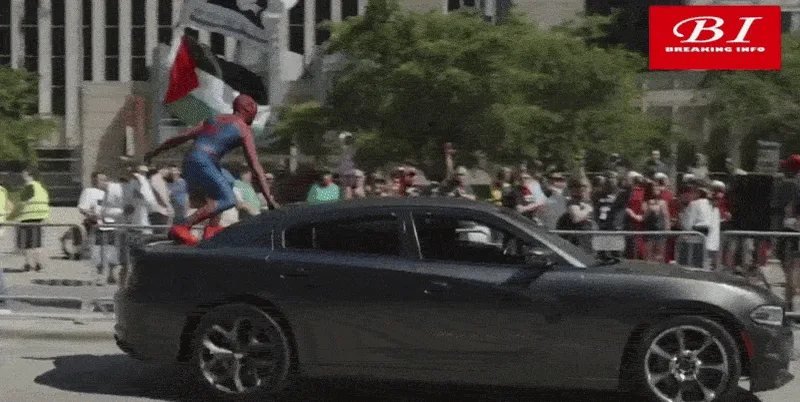
The footage is only one part of a dispute involving vehicle movements, competing accounts of danger, and separate charging decisions. The confrontation developed around a rally organized by Jake Lang outside Minneapolis City Hall. Counter protesters had gathered nearby when vehicles carrying Lang and his associates entered the sidewalk. Fighting followed, chemical irritants were deployed, and officers moved to separate people and remove the vehicles from the immediate area. A man wearing a Spider Man suit was filmed climbing onto a pickup and striking people associated with Lang’s group.
Police reported 11 arrests connected to the incident. That total should not be confused with 11 identical charges. Seven vehicle occupants were arrested on probable cause of riot, while four additional arrests occurred outside City Hall for different alleged offenses. Love was identified among those arrested at City Hall for assault. He pleaded not guilty to misdemeanor fifth degree assault on September 4. His attorney argues that he acted to protect himself and other protesters when pickup trucks entered the sidewalk. The next hearing identified in the reporting is a November 19, 2026, pretrial conference, not a trial or sentencing date.
The central dispute is therefore more specific than whether someone dressed as Spider Man threw punches. Love’s defense does not depend on denying that a physical confrontation occurred. Instead, it argues that the surrounding circumstances made intervention necessary. That distinction matters because evidence of physical contact and evidence of legally unjustified force are not necessarily the same thing. Minnesota law separately addresses assault and circumstances in which reasonable force may be authorized. Understanding the Minneapolis Spider Man case therefore requires distinguishing what witnesses and cameras recorded, what police initially alleged, what prosecutors concluded, and what remains for the court to decide.
The confrontation happened on Saturday, August 22, 2026, outside Minneapolis City Hall. According to the police department’s contemporaneous bulletin, Jake Lang arrived at approximately 11:50 a.m. near South Fourth Street and Third Avenue with six other people traveling in two vehicles. Bring Me The News, which had a reporter at the scene, described the confrontation involving Lang’s group as brief, with the group leaving the immediate City Hall area within roughly ten minutes, although the wider police response and dispersal continued afterward. The legal developments came later.
The county’s felony charging decision was announced on August 25, while William Nicholas Love entered a not guilty plea on September 4. Keeping those dates separate prevents the arrest, charging decision, and court appearance from being presented as though they were one event. The location is also important to the defense argument because the dispute concerns vehicles entering a sidewalk occupied by people, rather than protesters approaching vehicles moving normally along a roadway.
Police identified the costumed protester as William Nicholas Love, who was 33 at the time of the incident and was identified in court reporting as a resident of Inver Grove Heights, Minnesota. The descriptions “Minneapolis Spider Man” and “Minnesota Spider Man” refer to the costume and public nickname associated with him in coverage of the confrontation. Bring Me The News reported, citing jail records, that Love was released from custody on the evening of the incident after receiving a misdemeanor assault citation, but his release did not mean the accusation had been dismissed.
Jake Lang, whose legal name is Edward Jacob Lang, is a far right activist whose public activities have included anti Muslim demonstrations. He was also a defendant in the federal prosecution arising from the January 6, 2021, attack on the United States Capitol, where federal authorities accused him of violence against law enforcement officers and other offenses. An important distinction is that Lang was not tried and convicted in that case before receiving clemency in January 2025. WVIA reported that he was never tried, so describing his years in custody as though they were necessarily a completed prison sentence would blur the difference between pretrial detention and punishment following conviction.
His August 2026 Minneapolis rally was organized in support of Shiloh Hendrix, the Rochester woman whose use of racial slurs at a playground had generated public outrage and criminal proceedings. Lang promoted his planned return to City Hall as a peaceful free speech event, according to contemporaneous reporting, while counter protesters viewed the gathering as support for racist behavior and assembled in opposition.
The connection to Hendrix was central to why anti racism counter protesters appeared. In April 2025, Hendrix used racial slurs during an encounter involving a Black child and a Black adult who recorded the incident at a Rochester playground. The child, who was eight at the time, was described in reporting as autistic. The outcome of Hendrix’s criminal case requires precise wording: a jury found her guilty of disorderly conduct connected to her behavior toward the adult who recorded the confrontation, but not guilty on the count involving the child. Her sentence included a fine, probation, and community service.
MPR News reported that video from the Minneapolis rally showed Lang standing in the bed of a pickup with a sign containing a racial slur. Opponents differed over how to respond to the gathering. Minneapolis Mayor Jacob Frey condemned the rally beforehand and encouraged people to ignore it, while others chose visible counter protest. Opposition to the rally therefore did not automatically mean agreement over whether direct confrontation was the right response.

Viral Spider Man Footage, Public Support and the Police Response
Contemporaneous reporting describes footage showing the costumed protester climbing onto the back of a pickup carrying Lang and throwing punches before being pulled away. Separate footage documented Love’s detention in Minneapolis. These clips show different moments within a larger sequence and do not necessarily establish everything that happened before or afterward. The visible punching is relevant evidence, but it does not by itself resolve every question about justification. Assessing the sequence would require considering the truck’s position, where other people were standing, what movements immediately preceded the punches, and whether any apparent danger continued during the physical encounter. Those are factual questions rather than conclusions that can be settled by a viral caption or isolated clip.
The visual record also includes genuine photographs that should not be confused with fabricated images circulating around the same story. In an August 25 fact check, Lead Stories confirmed that a photograph showing the costumed protester preparing to punch Lang was taken by photojournalist Chris Juhn during the August 22 confrontation. Juhn published several photographs from the sequence through his social media accounts. The image was therefore not merely an anonymous picture attached to a dramatic caption; it had an identifiable photographer and accompanying photographs documenting the encounter.
A separate August 25 investigation by Lead Stories reached the opposite conclusion about another widely shared picture purporting to show Spider-Man punching Lang. The outlet identified that particular image as AI-generated and contrasted it with recordings of the actual confrontation. Its finding did not mean the protest, the costume, or the fighting had been invented. It meant that one image claiming to depict a real event was not an authentic record of that event. Treating the fake picture and Juhn’s genuine photograph as interchangeable would obscure an important distinction within the coverage.
People documenting the Minneapolis confrontation also described being affected by the violence. The Beat reported that Juhn said he was pepper-sprayed while photographing the incident and later requested support. That was the photographer’s account, not a finding establishing who sprayed him. It adds another perspective to a scene otherwise often reduced to the costumed protester and Lang: journalists and other people recording events were close enough to experience the confrontation themselves, rather than observing it from an entirely separate vantage point.
Minnesota’s evidence rules require a sufficient foundation supporting that evidence offered in court is what its proponent claims it to be. For video, that makes identification, context, and an adequate foundation important. A widely circulated repost does not become complete or decisive simply because many people have watched it. One recording may clearly show physical contact while giving a poor view of the sidewalk ahead of a vehicle, while a wider recording may better show the surroundings but fail to capture every interaction. Neither type of footage should be treated as a final finding in Love’s case without considering the larger evidentiary record.
The Minneapolis police department’s initial account said both vehicles illegally entered the sidewalk and moved eastbound at a very slow speed toward the assembled crowd. Both parts of that description matter. Saying the vehicles merely arrived would understate the fact that they entered the sidewalk, while saying they raced into demonstrators would add a claim not supported by the official account. The defense treats the vehicles’ movement toward people as a threat, while the county’s later charging assessment focused on what criminal intent could be proved. Reporting also places Lang in the bed of a pickup rather than identifying him as its driver, so responsibility for the driver’s actions cannot automatically be assigned to Lang or every other passenger.
The most useful questions therefore concern the physical circumstances of the confrontation: where people were standing, how close the vehicles came, what the drivers and occupants could see, what happened immediately before Love climbed onto the pickup, and how the situation changed as the encounter unfolded. The available descriptions make those issues important, but they do not provide a final judicial answer about whether Love’s use of force was legally justified.
A fundraising page organized on his behalf later described expenses related to injury recovery, medical bills, and family safety. Those statements reflect the account of his supporters rather than an independent assessment of his injuries or a judicial finding about responsibility. The costume also pushed the story beyond conventional local news, with comics publication The Beat reporting on the confrontation and the public support that followed. The superhero imagery contributed to the case’s visibility, but it does not determine how Love’s conduct should be assessed.
Public support also developed through more than one fundraising campaign. In its August 26 report, The Beat identified two pages, organized separately by Keyssy Ayala Castro Figueroa and writer Ash Chudgar, with a combined total of $110,852 at the time of publication. That figure describes a dated fundraising snapshot, not a current balance or an accounting of money spent. An organizer update quoted by the publication said Love would receive legal representation without charge and identified relocation, security, recovery, and future difficulties among the intended uses of donations. Describing all contributions simply as bail money or attorney fees would therefore misrepresent the broader purposes the organizers outlined.
The arrests also unfolded across several locations rather than in one simultaneous police operation outside City Hall. According to MPD, officers circulated the vehicles’ direction of travel after moving them away from the crowd. The Minnesota State Patrol stopped one near Washington Avenue and southbound Interstate 35W, while Bloomington police stopped the other near Lindau Lane and IKEA Way. Minneapolis officers then arrested the seven occupants across the two vehicles. This sequence helps explain why footage showing Lang’s group departing does not establish that its members escaped arrest, and why Love’s detention outside City Hall was only one part of the response.
MPD said it had known about the planned Minneapolis demonstration for several weeks and prepared an Incident Action Plan, including barriers and resources positioned for rapid deployment. The department also reported that the remaining crowds had cleared the area by approximately 2 p.m. These details extend the timeline beyond the brief physical confrontation and distinguish advance preparations from the decisions officers made once the vehicles entered the pedestrian area.
The source of the chemical irritants requires similarly careful attribution. In MPR News’s August 22 coverage, interim police chief Bill Petersen said he had no evidence that officers had used irritants, while describing their deployment by the opposing groups. The same report said three officers were injured and one was taken to a hospital before being released. Those were official statements made during the initial response, not a completed independent reconstruction of every injury or use of spray. They should therefore remain separate from Love’s allegations about his treatment and from the photographer’s account of being pepper-sprayed.

William Love’s Assault Charge, Self Defense Claim and Prosecutors’ Decisions
The reported basis for William Nicholas Love’s arrest in Minneapolis was alleged assault arising from the physical confrontation, not the fact that he wore a Spider Man costume or participated in an anti racism protest. Subsequent coverage identified the accusation as misdemeanor fifth degree assault, with the conduct under scrutiny involving the alleged striking of people during the encounter. That distinction matters because the right to oppose a rally’s message and the legality of using physical force are separate questions. A person can lawfully express opposition while still facing scrutiny over particular physical actions, just as an assault accusation does not eliminate the possibility of a legally valid defense.
The prosecuting authority in Love’s case is also different from the office that reviewed potential felony allegations involving Jake Lang and others. Minneapolis’s City Attorney’s Office handles adult misdemeanor and gross misdemeanor prosecutions within the city, while the Hennepin County Attorney’s Office handles felony cases. The city identifies simple assault among the types of misdemeanor matters it prosecutes. As a result, the county’s decision not to bring felony charges against Lang did not automatically determine what would happen in Love’s misdemeanor case. Comparing the outcomes requires considering the specific alleged acts, the available evidence, and the separate authority responsible for each prosecution.
The charge reported against Love is misdemeanor assault in the fifth degree. Minnesota Statutes section 609.224 describes misdemeanor conduct that can include acting with intent to cause fear of immediate bodily harm or death, as well as intentionally inflicting or attempting to inflict bodily harm on another person. A fifth degree assault allegation therefore does not necessarily require proof of a severe physical injury, because attempted bodily harm and certain fear causing conduct can also fall within the statute. At the same time, identifying the relevant law does not establish that prosecutors have proved every required element against Love.
One additional detail in FOX 9’s August 25 coverage concerns the wording of the accusation. The station described the charge as fifth degree assault involving fear of bodily harm or death and reported that a detailed complaint had not been filed at that point. That makes it important not to reconstruct the entire prosecution solely from the most widely shared punching clip. The wording reported at the charging stage, the evidence eventually disclosed, and any later court filings are distinct sources of information. The report’s publication date also limits what it establishes about the availability of a complaint afterward.
Minnesota defines a misdemeanor as an offense punishable by up to 90 days in jail, a fine of $1,000, or both. Those figures are statutory maximums rather than a prediction of what Love would receive if convicted. The fifth degree assault statute also contains enhanced classifications in specified circumstances, so it would be inaccurate to describe every fifth degree assault case as automatically remaining a misdemeanor. The narrower and more accurate description is that the charge publicly reported in Love’s prosecution is a misdemeanor. Neither the statutory classification nor his arrest amounts to a finding of guilt.
Love’s attorney, Jack Rice, argues that his client acted in self defense and in defense of other people because pickup trucks entered a Minneapolis pedestrian area and moved toward protesters. The defense therefore presents the movement of the vehicles as the immediate reason for Love’s intervention rather than suggesting that disagreement with Lang’s politics alone justified physical force.
A statement attributed to Love on his fundraising page gives a similar account. He says he first tried to block the trucks with a police barricade and then jumped onto a moving vehicle because he believed people needed protection. The same statement alleges that he was later injured and mistreated, but those claims represent Love’s own account and should not be treated as independently established findings.
Minnesota’s authorized force statute permits reasonable force in specified circumstances, including resisting, or helping another person resist, an offense against the person. It also addresses circumstances the actor reasonably believes to exist. That means both the situation Love believed he was facing and the reasonableness of his response could be relevant to his defense. The legal issue is therefore not simply whether Love says he was afraid. It also concerns what caused that perception, whether the danger he describes was reasonable to perceive, and how his actions related to that perceived threat. His account remains a defense position awaiting evaluation by the court rather than an accepted judicial conclusion.
Love entered a not guilty plea on September 4, 2026, and attended the court appearance wearing the Spider Man costume. Courthouse News reported that the next scheduled proceeding was a November 19 pretrial conference. A not guilty plea means he is contesting the prosecution; it is neither an acquittal nor an admission that his conduct was unlawful. As of September 15, 2026, the sources reviewed for the article had not verified a later dismissal, conviction, acquittal, or revised hearing date, making the September 4 report the latest verified court update presented here rather than a claim based on direct access to a complete current docket.
The period before trial can also expand the evidentiary record beyond what the public has seen in viral clips from Minneapolis. Minnesota Rule of Criminal Procedure 9.04 addresses misdemeanor discovery and requires prosecutors, upon request, to permit inspection of police investigative reports and disclose information within their possession and control that tends to negate or reduce guilt. After arraignment, requested copies of investigative reports must also be provided, while other discovery can require agreement or a court motion. These rules help explain why the evidence available to the parties may become more extensive than the material initially circulated online, although they do not establish which specific requests or disclosures have already occurred in Love’s case.
On August 25, Hennepin County prosecutors declined felony charges arising from the Minneapolis City Hall confrontation. The decision was tied to evidence of prior communication and logistical coordination between Minneapolis police and Lang’s security detail. County Attorney Mary Moriarty said that this evidence prevented her office from proving the required criminal intent beyond a reasonable doubt. The assessment also addressed an officer who was struck by one of the trucks. According to FOX 9’s account of the county’s explanation, the officer said he did not believe the driver saw what was happening, leading prosecutors to distinguish the fact that an injury occurred from the separate question of whether the intent required for an assault charge could be proved.
Moriarty also condemned Lang’s conduct while explaining the charging decision. The absence of felony charges was therefore not presented as an endorsement of the rally or its messaging. Nor did the county’s decision prevent the Minneapolis City Attorney’s Office from considering misdemeanor or gross misdemeanor allegations arising from the same broader incident. The most precise description is that county prosecutors declined felony prosecution based on the evidence they reviewed. Saying that every person involved was cleared of every possible offense would go beyond what the charging announcement established.
That decision also does not resolve Love’s self defense claim. A prosecutor’s conclusion that another person’s criminal intent cannot be proved beyond a reasonable doubt is legally different from determining what a defendant reasonably perceived during a fast moving confrontation. The two issues can depend on some of the same evidence without asking exactly the same legal question.

Frequently Asked Questions (FAQs)
- Is the next hearing a trial?
No. The reported November 19 proceeding is a pretrial conference rather than the trial itself. A pretrial conference can be used to address evidence, scheduling, legal issues, possible agreements, and other matters that need to be resolved before a case reaches trial. It should therefore not be described as a sentencing hearing or as a guaranteed point at which the court will decide whether Love is guilty. - Was a person dressed as Spider-Man really arrested in Minneapolis?
Yes. Contemporaneous reporting and a MinnPost fact brief identified a counter protester wearing a Spider Man costume who became involved in the confrontation with Jake Lang’s group and was detained by police. Authorities later identified him as William Nicholas Love. The incident was therefore a real protest related confrontation involving an actual arrest, not a fictional scene, staged superhero event, or promotional performance. - When did the Minneapolis Spider-Man confrontation happen?
The confrontation occurred on August 22, 2026, outside Minneapolis City Hall. Later developments, including charging decisions and Love’s September court appearance, all relate back to that incident. Separating the confrontation date from later court and publication dates helps avoid making it seem as though the arrest, charging decisions, and plea happened on the same day. - Who is the Minneapolis Spider-Man cosplayer?
The person identified in the case is William Nicholas Love, a Minnesota resident who court coverage described as being from Inver Grove Heights. The name “Minneapolis Spider Man” is not a separate identity or official title. It is simply the nickname used in news coverage because Love was wearing a Spider Man costume during the confrontation outside City Hall. - What charge does William Nicholas Love face?
The publicly reported charge is misdemeanor fifth degree assault. Under Minnesota law, fifth degree assault can involve intentionally causing or attempting to cause bodily harm, as well as certain conduct intended to make another person fear immediate bodily harm or death. The charge describes what prosecutors allege occurred, but it does not mean those allegations have already been proved in court. - Could a misdemeanor assault conviction lead to jail time?
Yes. Minnesota defines a misdemeanor as an offense carrying a maximum possible punishment of 90 days in jail, a $1,000 fine, or both. Those are the statutory limits for the offense category, not a prediction of what would happen in Love’s case. Any actual sentence would first require a conviction and would depend on the circumstances considered by the court. - Why does Love say he acted in self-defense?
Love says he believed the trucks moving onto the sidewalk and toward protesters created an immediate danger that required him to intervene. His attorney has also argued that Love was trying to protect other people, making defense of others part of the legal argument. These explanations are positions advanced by Love and his defense team, and they have not yet been confirmed as legally justified by a final court ruling. - Did Jake Lang personally drive a truck onto the sidewalk?
The reporting reviewed does not establish that Lang was driving the truck. Instead, he was described as being in the bed of a pickup during the confrontation. That distinction is important because the actions of a driver cannot automatically be attributed to every passenger or person traveling with the same group without evidence showing their individual role. - Why were felony charges against Lang declined?
Hennepin County prosecutors said they could not prove the required criminal intent beyond a reasonable doubt after reviewing evidence that included communications and coordination between police and Lang’s security detail. The decision specifically concerned potential felony charges. It did not amount to a declaration that every person involved had committed no offense, and it did not prevent Minneapolis authorities from considering separate misdemeanor or gross misdemeanor allegations. - Has the Minneapolis Spider-Man been convicted or had his case dismissed?
Neither outcome was verified in the reporting reviewed through September 15, 2026. The latest confirmed court development was Love’s September 4 not guilty plea, meaning he was formally contesting the assault charge. A conviction, acquittal, dismissal, or other final resolution would require a later court development supported by reliable reporting or official records.

Conclusion
The Minneapolis Spider-Man story involves more than an unusual costume and a widely shared punching video. Its unresolved question is whether the circumstances surrounding the encounter justified Love’s use of force. His defense emphasizes the trucks approaching protesters, while the prosecution concerns his conduct during the resulting confrontation.
The different charging decisions also require careful separation. County prosecutors’ decision not to pursue felony allegations involving Lang did not decide every possible charge or automatically settle Love’s case. Minneapolis and Hennepin County exercise different prosecutorial responsibilities.
A reliable account can acknowledge the rally’s documented racist messaging without celebrating violence or presuming guilt. It can also take the defense seriously without presenting it as proven. The case’s outcome must be established through the legal proceedings, with close attention to the complete sequence rather than the most memorable fragment.
Sources and Citation
- Minneapolis Police Department / City of Minneapolis. Official Police News and Public Safety Bulletins.
https://www.minneapolismn.gov/government/departments/police/news/ - Courthouse News Service. Minneapolis Protest Case Court Coverage and September 4, 2026 Appearance.
https://www.courthousenews.com/ - KARE 11. Minneapolis Protest Arrest, Charges and September 4 Court Appearance Coverage.
https://www.kare11.com/ - Minnesota Public Radio. Minneapolis Protest Case Reporting and Verdict Coverage.
https://www.mprnews.org/ - Minnesota Legislature. Minnesota Statutes Chapter 609 — Criminal Code, Including Assault and Authorized Use of Force.
https://www.revisor.mn.gov/statutes/cite/609/full - Minnesota Legislature. Section 609.06 — Authorized Use of Force.
https://www.revisor.mn.gov/statutes/cite/609.06 - Minnesota Judicial Branch / Revisor of Statutes. Minnesota Rules of Criminal Procedure, Rule 9 — Discovery in Felony, Gross Misdemeanor and Misdemeanor Cases.
https://www.revisor.mn.gov/court_rules/cr/id/9/ - Minnesota Judicial Branch / Revisor of Statutes. Rule 12 — Pretrial Conference and Evidentiary Hearing in Misdemeanor Cases.
https://www.revisor.mn.gov/court_rules/rule/cr-12/
Recommendations
- Spyder Games Files Lawsuit over Fortnite Creative “Stealing Brainrots” Copying Roblox Hit “Steal a Brainrot”
- Spider-Man: Brand New Day Boosts Marvel’s Spider-Man 2 Sales
- Star Wars: Galactic Racer Shows What People Do for Fun After Return of the Jedi
- Freelance and Indie Commercial License
- Bluey’s Happy Snaps Trailer Reveals Fall 2026 Launch, Platforms, Gameplay, and Co-Op Details
- Diablo 4: Lord of Hatred Gameplay Reaction – Everything Revealed About Mephisto, New Features, and Release Date
- Devil May Cry Season 2 Review: Story, Action, Release Updates, and Everything You Need to Know
- PlayStation Wireless FlexStrike Fight Stick Preorders, Release Date & PS5/PC Features Explained
- Palworld Version 1.0 is Here: Massive Changelog, New Features, and Full Update Breakdown
- Smart Remesh 2 for Blender Adds Smarter Organic and Hard-Surface Retopology



































































































