











A new generation of gaming displays is emerging, led by innovations from MSI that aim to eliminate the traditional trade-off between resolution and refresh rate. The MSI next-gen monitor concept, centered around a “Triple Mode” system, introduces the ability to dynamically switch between 4K, 1440p, and 1080p output modes, each paired with progressively higher refresh rates. This design represents a shift in display engineering, targeting gamers who demand both cinematic visual fidelity and ultra-competitive responsiveness in a single device.
At the core of this innovation is flexibility: instead of forcing users to choose between high resolution or high speed, MSI’s system attempts to unify both under one adaptive panel architecture.
In This Article (19 sections)
MSI MPG OLED 322URDX36 Release Date and Announcement Details
The MSI MPG OLED 322URDX36 is positioned as a conceptual flagship within MSI’s next-generation OLED lineup. While MSI has not finalized a universal global release date at the time of writing, industry leaks and showcase previews suggest that the monitor is part of MSI’s 2025–2026 advanced OLED rollout strategy.
The monitor has been showcased in prototype form at gaming hardware exhibitions, where MSI emphasized its focus on multi-mode resolution switching, ultra-high refresh rate scaling, and next-generation OLED durability improvements.
MSI’s official communications indicate that this class of display is designed to sit at the top tier of competitive gaming monitors, alongside future QD-OLED and tandem OLED innovations.
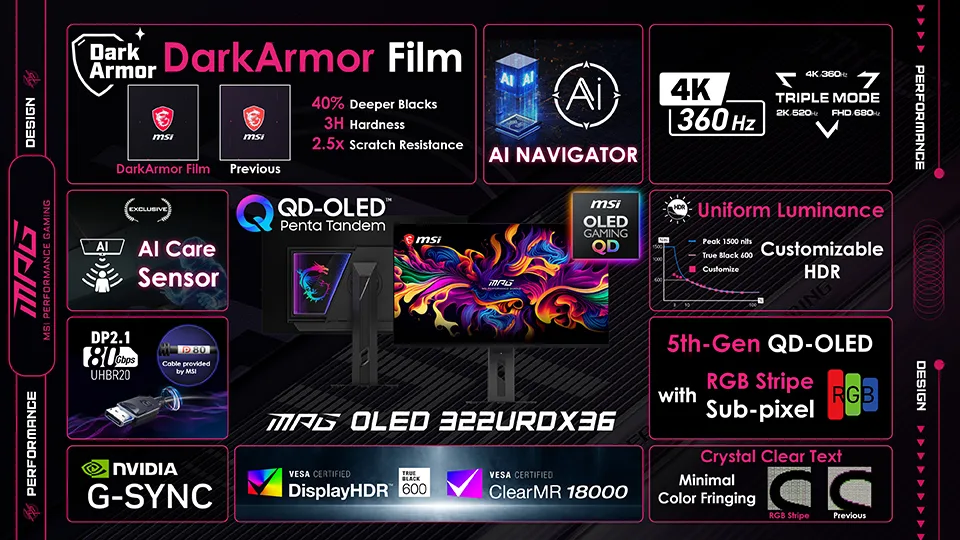
What is MSI’s Triple Mode Monitor Technology?
MSI’s “Triple Mode” monitor technology refers to a dynamic display system that allows a single panel to operate in three distinct performance configurations:
- 4K UHD mode for cinematic gaming and content creation
- 1440p mode for balanced performance and clarity
- 1080p mode for maximum refresh rate and esports responsiveness
Instead of relying on multiple physical monitors or manual scaling hacks, the display uses internal processing and pixel mapping adjustments to reconfigure rendering priorities in real time.
This approach reduces input lag associated with traditional scaling and ensures each mode is optimized at the hardware level rather than through software interpolation alone.
In essence, Triple Mode technology is designed to make one monitor behave like three specialized gaming displays.
How MSI Monitor Switches Between 4K, 1440P, and 1080P
The switching mechanism in MSI’s next-gen monitor relies on a combination of panel-level scaling logic, GPU handshake protocols, and firmware-controlled display modes.
When a user selects a resolution mode, the monitor adjusts:
- Pixel rendering density allocation
- Refresh cycle prioritization
- Internal upscaling/downscaling filters
- Frame buffer segmentation
In 4K mode, the system prioritizes resolution fidelity, using full pixel density for maximum detail. In 1440p mode, it balances sharpness with speed, reducing GPU load. In 1080p mode, the system bypasses high-density rendering pipelines, allowing the panel to push significantly higher refresh rates.
This is not a simple resolution stretch; it is a structured reconfiguration of how the panel interprets incoming frames.
MSI Next-Gen Monitor 360Hz 520Hz 680Hz Refresh Rate Breakdown
One of the most discussed features of the MSI MPG OLED 322URDX36 concept is its tiered refresh rate system:
- 4K Mode: up to 360Hz
- 1440p Mode: up to 520Hz
- 1080p Mode: up to 680Hz
These values represent theoretical maximums based on MSI’s reported panel engineering targets and OLED response optimizations.
At 360Hz in 4K, the monitor delivers ultra-smooth UHD gaming, which is already beyond most current competitive standards. At 520Hz in 1440p, it targets high-level esports performance with significantly reduced motion blur. At 680Hz in 1080p, the system pushes into experimental ultra-high refresh territory, where motion clarity becomes nearly instantaneous to the human eye under ideal conditions.
The trade-off is clear: lower resolution equals higher temporal resolution (refresh rate), giving players a strategic choice based on genre and preference.

Full Specifications of MSI MPG OLED 322URDX36 Gaming Monitor
While final consumer specifications may vary, the expected configuration includes:
- 32-inch OLED panel
- 4K UHD native resolution support
- Triple Mode resolution switching (4K / 1440p / 1080p)
- Adaptive refresh rate scaling up to 680Hz (1080p mode)
- OLED self-emissive pixel structure
- HDR support (HDR10+ class targeting)
- Ultra-low response time (sub-0.1ms class)
- DisplayPort 2.1 connectivity
- HDMI 2.1 support
- Advanced anti-burn-in protection algorithms
- Gaming-focused firmware profiles
The monitor is designed to serve both professional esports players and high-end creators who require color accuracy alongside speed.
Why MSI’s 3-Resolution Switching Monitor is a World First
The significance of MSI’s approach lies in its integration of resolution scaling and refresh scaling into a single unified system.
Traditionally:
- Monitors are fixed-resolution
- Refresh rate is tied to resolution capability
- Performance trade-offs are permanent
MSI’s Triple Mode concept breaks this structure by allowing real-time mode switching without physically changing hardware.
If fully realized, this would represent one of the first consumer displays capable of dynamically redefining its performance class on demand, essentially functioning as multiple monitors in one chassis.
This positions MSI at the forefront of adaptive display engineering.
MSI OLED Monitor Penta Tandem Panel Technology Explained
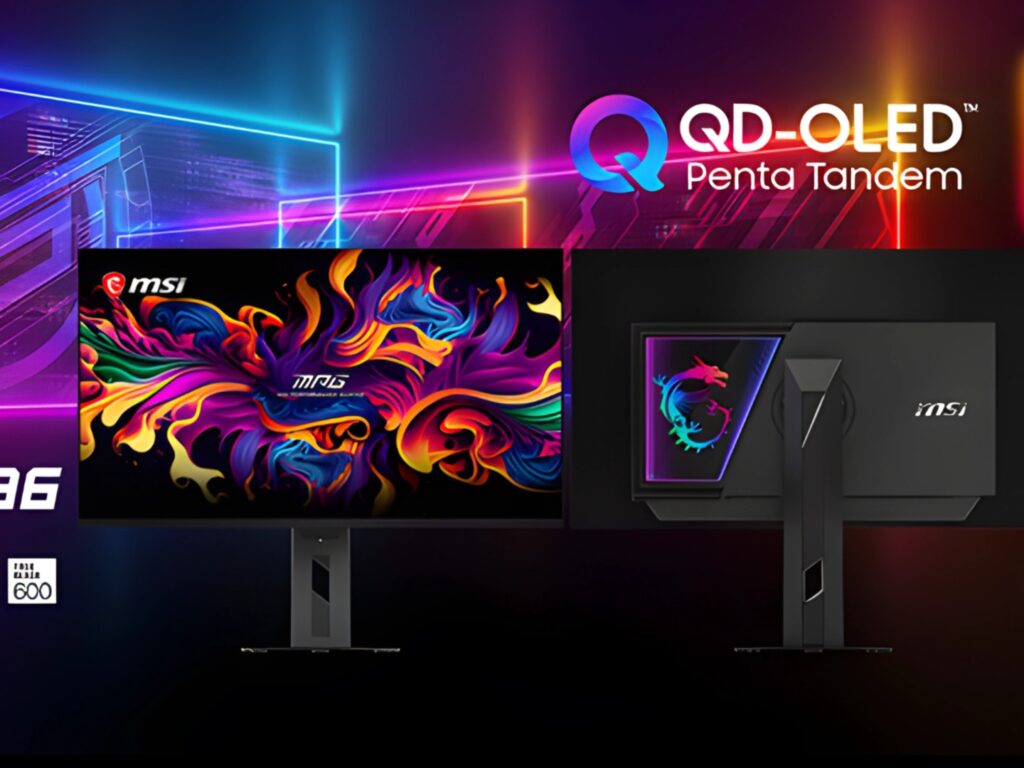
The MSI MPG OLED 322URDX36 is also associated with next-generation “Penta Tandem” OLED panel architecture.
This structure improves on conventional OLED layers by stacking multiple emission and efficiency layers to enhance:
- Peak brightness stability
- Color volume retention
- Burn-in resistance
- Energy efficiency
- Longevity of organic materials
By using a multi-layer tandem emission system, MSI aims to reduce one of OLED’s traditional weaknesses: long-term degradation under high brightness or static UI conditions.
This makes it more suitable for both gaming and productivity workloads.

Difference Between 4K 360Hz vs 1440P 520Hz vs 1080P 680Hz Modes
Each mode serves a distinct purpose:
- 4K 360Hz Mode
Focuses on visual fidelity. Ideal for RPGs, cinematic titles, and content creation where detail matters more than absolute reaction speed. - 1440p 520Hz Mode
The balanced competitive mode. Offers strong clarity with significantly improved responsiveness, suitable for FPS and MOBA games. - 1080p 680Hz Mode
Maximum performance mode. Designed for esports professionals where every millisecond matters, prioritizing motion clarity over resolution.
The key difference is perceptual: higher resolution improves image detail, while higher refresh rate improves temporal smoothness.
Is MSI’s Triple Mode Monitor Good for Competitive Gaming?
Yes: at least in theory, MSI’s Triple Mode system is highly advantageous for competitive gaming because it allows players to tailor performance per game type.
Esports titles like Valorant, CS-style shooters, and Overwatch benefit heavily from high refresh rate modes, while story-driven games benefit from 4K immersion.
The ability to switch modes without changing monitors reduces friction and improves adaptability during tournament scenarios.
However, real-world performance will depend on GPU capability, game optimization, and driver support.
MSI Monitor DisplayPort 2.1 and Connectivity Features Explained
The inclusion of DisplayPort 2.1 is critical to enabling the monitor’s extreme bandwidth requirements.
DisplayPort 2.1 supports significantly higher data throughput compared to previous standards, allowing:
- 4K high refresh transmission without compression artifacts
- High frame-rate 1440p and 1080p modes
- Reduced latency signal transmission
HDMI 2.1 is also expected for console compatibility, though full refresh rate limits may depend on console hardware restrictions.
This makes the monitor suitable for next-gen PCs and high-performance GPUs.

How MSI Improves Image Clarity with DarkArmor Film Technology
MSI’s “DarkArmor” film technology is designed to enhance perceived contrast and reduce ambient light reflections.
Key benefits include:
- Reduced glare in bright environments
- Improved black level perception
- Increased contrast ratio stability
- Better visibility in HDR scenes
This layer works in tandem with OLED’s natural deep blacks, making dark scenes more detailed without washing out highlights.
It is especially useful in competitive environments with strong lighting conditions.
MSI MPG OLED 322URDX36 Brightness and HDR Performance Details
OLED panels traditionally struggle with sustained full-screen brightness, but MSI’s tandem architecture aims to mitigate this.
Expected improvements include:
- Higher peak brightness in HDR highlights
- Better sustained brightness stability
- Reduced ABL (Auto Brightness Limiting) aggression
- Improved HDR highlight retention
HDR gaming benefits significantly from these improvements, particularly in open-world titles with dynamic lighting.
The result is a more consistent HDR experience across different gameplay scenarios.
Will MSI Triple Mode Monitor Replace Dual Mode Gaming Displays?
Triple Mode monitors could eventually reduce the need for separate gaming and esports displays.
However, they may not fully replace dual-monitor setups immediately because:
- Some users prefer dedicated physical monitors
- GPU limitations may restrict full mode usage
- Cost of advanced OLED panels remains high
Instead, the likely outcome is hybrid adoption: users will treat Triple Mode monitors as premium all-in-one solutions rather than complete replacements.
Over time, as production scales, they may become the new standard.
Pixelhair Integration and Visual Optimization in Next-Gen MSI Monitors
“Pixelhair” refers to MSI’s advanced sub-pixel refinement system designed to enhance edge clarity and reduce perceived blur during motion.
In high refresh rate modes, Pixelhair processing:
- Sharpens object boundaries during fast motion
- Reduces color fringing at edges
- Enhances perceived resolution without increasing load
This is especially useful in 1080p high-refresh modes where pixel density is lower but motion speed is extreme.
Pixelhair acts as a perceptual enhancer, improving clarity without changing native resolution.
View Keeper Gaming Advantage in High Refresh Rate OLED Displays
“View Keeper” is MSI’s motion stabilization and persistence management system designed to reduce visual fatigue during ultra-high refresh gameplay.
Its functions include:
- Stabilizing frame transitions
- Reducing motion tearing artifacts
- Maintaining consistent frame pacing
- Enhancing long-session visual comfort
At refresh rates above 500Hz, even minor inconsistencies become noticeable, so View Keeper helps maintain smoothness and reduces eye strain.
This is particularly important in esports environments where players train for long durations.
Frequently Asked Questions (FAQs)
- What is MSI’s Triple Mode monitor?
It is a display system that supports switching between 4K, 1440p, and 1080p with different refresh rates. - Does MSI MPG OLED 322URDX36 really reach 680Hz?
It is a reported target for 1080p mode in prototype configurations. - Is this monitor good for esports?
Yes, especially in 1440p and 1080p modes. - Can it run 4K at high refresh rates?
Yes, up to 360Hz depending on system support. - What GPU is needed?
A high-end modern GPU with DisplayPort 2.1 support is recommended. - Does OLED suffer burn-in?
MSI includes mitigation technologies to reduce burn-in risk. - Is DisplayPort 2.1 necessary?
Yes, for full performance potential. - Can consoles use Triple Mode?
Yes, but likely with limited refresh rates. - Is it better than dual monitors?
It can replace dual setups for many users but not all. - When will it release?
Official timing has not been confirmed.

Conclusion
The MSI MPG OLED 322URDX36 represents a forward-looking vision of gaming display technology where resolution and refresh rate are no longer fixed trade-offs. Through its Triple Mode system, OLED tandem architecture, and advanced motion optimization technologies like Pixelhair and View Keeper, MSI is positioning itself at the frontier of adaptive display engineering.
If fully realized, this monitor could redefine expectations for competitive gaming, content creation, and immersive entertainment by merging multiple performance tiers into a single dynamic display platform.
Sources and Citations
- MSI Official Website
https://www.msi.com - OLED Display Technology Overview (General Industry Reference)
https://www.oled-info.com - DisplayPort 2.1 Specification Overview (VESA)
https://www.vesa.org - HDR Display Standards Overview (HDMI Forum / Industry Docs)
https://www.hdmi.org
Recommended
- Nova Roma – Official Early Access Launch Trailer Reveals Roman City Builder Gameplay, Features, and Early Access Details
- Killing Floor Dev Tripwire Interactive Lays Off 23 Employees: What Happened, Why It Matters, and What’s Next
- After Johnny Cage, Karl Urban Wants To Play Red Dead’s John Marston What It Means for a Red Dead Redemption Movie
- How to Animate in Blender: The Ultimate Step-by-Step Guide to Bringing Your 3D Scenes to Life
- Mobile Suit Gundam Hathaway: the Sorcery of Nymph Circe Review: a Bigger, Darker Sequel that Doubles Down on Politics, Memory, and Mecha Warfare
- The Death of Robin Hood: Official First Look Featurette Breakdown, Cast, Trailer Details & Release Date Explained
- Chinese Esports Host Accused of Blackface Following On-Stream Stunt at Naraka: Bladepoint NBPL 2026
- Idris Elba Says He Was Never in the Race to Play James Bond
- Toy Story 5 Everything We Know: Release Date, Cast, Plot, Trailer Updates & Pixar Sequel Details
- Why Tomodachi Life Doesn’t Support Switch 2 Handheld Mode Boost Despite 1080p Handheld Resolution



































































































