







In This Article (19 sections)
My Hero Academia Watch Order 2026 (Seasons, Movies, Specials)
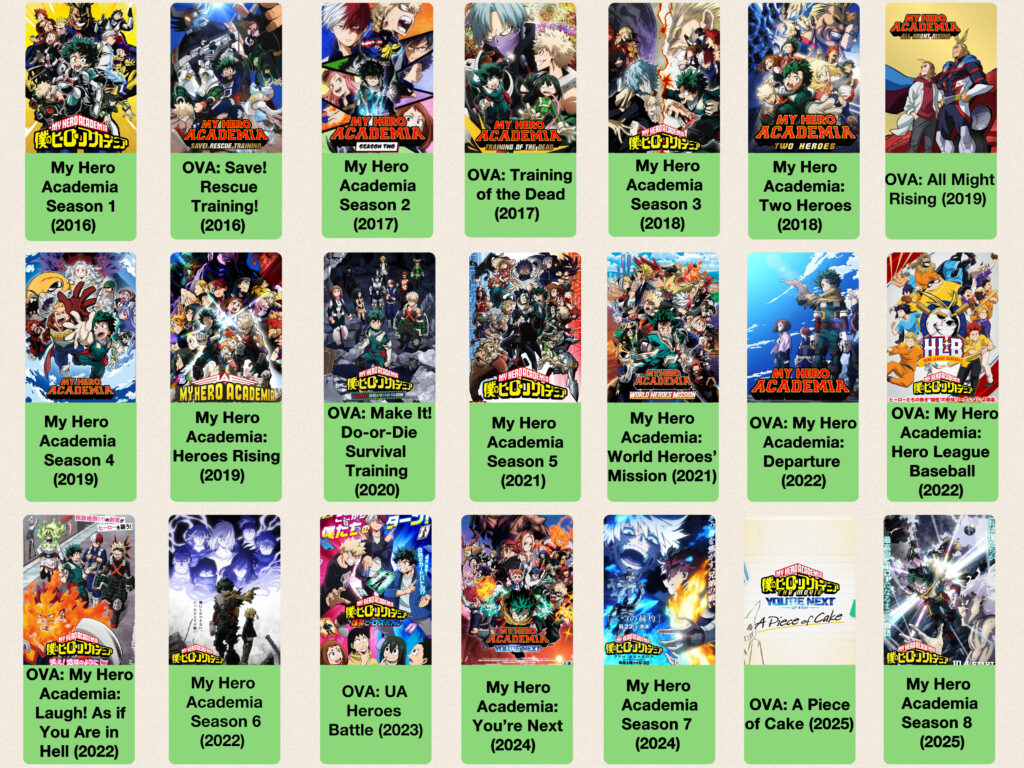
The best My Hero Academia watch order 2026 is:
- My Hero Academia Season 1
- My Hero Academia Season 2
- My Hero Academia: Two Heroes
- My Hero Academia Season 3
- My Hero Academia Season 4
- My Hero Academia: Heroes Rising
- My Hero Academia Season 5
- My Hero Academia: World Heroes’ Mission
- My Hero Academia Season 6
- My Hero Academia Season 7 Episodes 1–4
- My Hero Academia: You’re Next
- My Hero Academia Season 7 Episodes 5–21
- My Hero Academia Final Season / Season 8
- My Hero Academia “More” special episode
This order gives viewers the cleanest and most complete version of the anime timeline because it keeps the main seasons, major story arcs, theatrical films, and special episodes in the most logical story position. While some fans prefer release order, chronological order provides a smoother narrative experience and helps the emotional progression of the characters feel more natural.
The My Hero Academia anime spans multiple years inside the story’s universe. Izuku Midoriya begins as a Quirkless middle-school student and gradually becomes one of the most important heroes in the world. Throughout the series, viewers watch U.A. students evolve from inexperienced trainees into frontline fighters participating in a global-scale war.
The movies are especially important in 2026 because many new viewers are discovering the franchise through streaming platforms and often want a single complete viewing guide. Each movie reflects a different stage of Class 1-A’s development, and watching them in the proper order makes character relationships, combat growth, and emotional moments much stronger.
Special episodes, OVAs, and the 2026 “More” episode also fit more naturally into the franchise when watched chronologically. Instead of interrupting major war arcs or emotional story climaxes, this order allows the pacing to feel balanced and cinematic.
For longtime anime fans and first-time viewers alike, this is currently the most complete My Hero Academia watch order available in 2026.
My Hero Academia Timeline Explained: Chronological Order vs Release Order
The My Hero Academia timeline is mostly easy to follow because the anime seasons adapt the manga in a fairly direct order. Unlike some long-running anime series that heavily rearrange story material, My Hero Academia generally keeps the manga’s progression intact. However, confusion begins when movies, OVAs, recap specials, and post-finale episodes are added into the mix.
Release order means watching every anime season, movie, and special in the order they originally premiered. Chronological order means watching events based on where they happen inside the story timeline.
The difference becomes important once the films are introduced. Movies like Two Heroes, Heroes Rising, World Heroes’ Mission, and You’re Next are technically side stories, but they clearly take place during specific periods of the anime. The students use abilities and costumes tied to certain arcs, and the emotional dynamics between characters match particular points in the series.
For example, Heroes Rising works best after Season 4 because Class 1-A has matured enough to function independently as heroes. Watching it too early would make some power developments feel confusing.
The chronological timeline also helps explain the evolution of hero society itself. Early seasons focus heavily on school training and superhero celebrity culture. Later seasons gradually reveal corruption, fear, political instability, and public distrust toward heroes. Watching in timeline order makes this transition feel much more impactful.
Another reason fans prefer chronological order is pacing. Some release-order placements can interrupt major emotional arcs. Chronological order keeps the tension, buildup, and emotional payoffs flowing more naturally from one arc to another.
The timeline itself can be divided into several major phases:
- U.A. Beginnings Era
- Sports Festival and Internship Era
- League of Villains Expansion Era
- Pro Hero and Intern Era
- Paranormal Liberation War Era
- Dark Hero Era
- Final War Era
- Epilogue Era
Each season and movie contributes to one of these stages.
My Hero Academia Season 1 Arc Order (U.A. Beginnings and USJ)
My Hero Academia Season 1 introduces Izuku Midoriya, All Might, One For All, U.A. High School, Class 1-A, and the League of Villains.
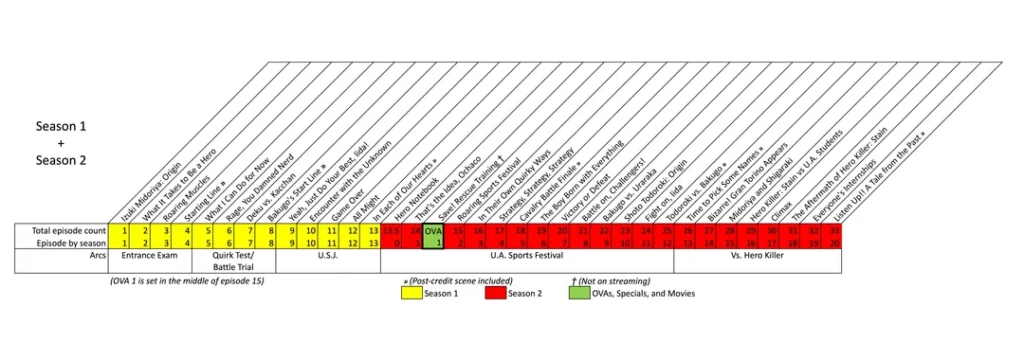
The Season 1 arc order is:
- Entrance Exam Arc
- Quirk Apprehension Test Arc
- Battle Trial Arc
- U.S.J. Arc
Season 1 is the foundation of the entire franchise and establishes nearly every major concept that becomes important later in the story. The season begins with Midoriya living in a society where superpowers called Quirks are normal. Despite being born Quirkless, he still dreams of becoming a professional hero like his idol, All Might.
The emotional core of Season 1 revolves around Midoriya’s determination. Even before receiving One For All, he repeatedly risks himself to save others. This is what convinces All Might that Midoriya deserves to inherit his power.
The Entrance Exam Arc introduces U.A. High School and many future Class 1-A students, including Bakugo, Uraraka, Iida, Todoroki, Tsuyu, Kirishima, Yaoyorozu, Kaminari, and Tokoyami. Even though the class begins as a group of strangers, the season slowly builds the friendships and rivalries that define the rest of the anime.
The Quirk Apprehension Test Arc demonstrates Aizawa’s harsh teaching philosophy and shows that hero training is far more dangerous than Midoriya expected. The Battle Trial Arc then introduces tactical combat and teamwork inside U.A.’s training system.
The U.S.J. Arc completely changes the tone of the series. Up until this point, the anime mostly feels like a superhero school story. Once the League of Villains attacks the U.S.J., the students are forced into real life-and-death combat for the first time.
This arc also introduces Shigaraki and Nomu while establishing the threat of All For One in the background. The All Might vs Nomu battle becomes one of the first iconic fights in the series and symbolizes the beginning of the larger hero-villain war.
My Hero Academia Season 2 Arc Order (Sports Festival to Hero Killer Stain)
My Hero Academia Season 2 expands the world beyond U.A. and introduces major rivalries, internships, and the darker consequences of hero society.
The Season 2 arc order is:
- U.A. Sports Festival Arc
- Vs. Hero Killer Arc
- Final Exams Arc
Season 2 is where the anime evolves from a school-based superhero series into a much larger world with political tension, ideological conflict, and public hero culture.
The U.A. Sports Festival Arc is one of the most popular arcs in the franchise because it gives almost every student a chance to shine. The obstacle race, cavalry battle, and tournament matches all reveal new powers, strategies, and personal motivations.
This arc is especially important for Shoto Todoroki. His struggle with his father Endeavor becomes one of the central emotional storylines in the entire anime. Midoriya helping Todoroki accept his fire powers is one of the defining moments of Season 2.
Bakugo also receives major development here. Even though he wins the tournament, his anger and insecurity become more obvious. The series begins showing that Bakugo’s aggression comes from fear of weakness and failure rather than simple arrogance.
The Hero Killer Stain Arc shifts the tone dramatically. Stain is one of the first villains in the anime whose ideology influences society on a large scale. Instead of seeking destruction for its own sake, he believes fake heroes have corrupted the profession.
His influence reaches Shigaraki, Spinner, and future villains throughout the story. This arc is also important because it begins connecting the students directly to real hero work outside school.
The Final Exams Arc closes the season by emphasizing teamwork and emotional growth. Midoriya and Bakugo being forced to cooperate against All Might becomes one of the earliest major steps in repairing their toxic rivalry.
My Hero Academia Season 3 Arc Order (Training Camp and Provisional License Exam)
My Hero Academia Season 3 raises the stakes with one of the biggest early turning points in the anime.
The Season 3 arc order is:
- Forest Training Camp Arc
- Hideout Raid Arc
- Provisional Hero License Exam Arc
- Shie Hassaikai introduction / early setup
Season 3 is where the series begins transitioning from “hero students learning” into “young heroes surviving a dangerous world.” The villains become more organized, more aggressive, and far more personal.
The Forest Training Camp Arc pushes Class 1-A and Class 1-B through intense Quirk training exercises while also introducing the Vanguard Action Squad. Characters like Muscular, Toga, Dabi, and Twice begin playing much larger roles in the story.
Bakugo’s kidnapping becomes one of the defining moments of the early anime. The event causes massive public criticism toward U.A. High and forces hero society to confront how dangerous the League of Villains has become.
The Hideout Raid Arc then delivers one of the greatest battles in modern shonen anime: All Might vs All For One. This fight represents the symbolic end of the old generation of heroes.
All Might’s final punch and his “You’re next” message toward Midoriya become legendary moments in anime history. After this battle, hero society loses its greatest symbol of peace.
The Provisional Hero License Exam Arc changes the tone again by focusing on the next generation of heroes. Students are no longer simply training for the future they are preparing to protect civilians during national emergencies.— ×1
This arc also introduces many rival schools and expands the scale of the hero world beyond U.A.
Where to Watch My Hero Academia: Two Heroes in the Timeline
My Hero Academia: Two Heroes fits best after Season 2 and before Season 3.
The movie takes Midoriya and All Might to I-Island, a high-tech artificial island focused on hero support technology. It also introduces Melissa Shield and David Shield, characters connected to All Might’s past.
The best placement is:
Watch My Hero Academia: Two Heroes after Season 2 and before Season 3.
This placement works because Midoriya already knows Full Cowling, Class 1-A has completed key Season 2 development, and the story still fits before the heavier events of Season 3.
Two Heroes is also important because it explores All Might’s history in ways the anime had not yet fully explored at the time. David Shield represents All Might’s life in America before becoming Japan’s Symbol of Peace.
Melissa Shield also serves as an emotional parallel to Midoriya because she is Quirkless but still wants to support heroes. Her relationship with Midoriya reinforces one of the series’ recurring themes: heroism is not limited to combat ability.
The movie also gives many Class 1-A students larger action sequences than they sometimes receive in the main anime. Characters like Yaoyorozu, Kaminari, Kirishima, and Tsuyu all receive spotlight moments during the island crisis.
Visually, Two Heroes feels lighter and more optimistic than later films because it takes place before the collapse of hero society. It works well as a transition point between the early-school era and the darker conflicts of Season 3.
My Hero Academia Season 4 Arc Order (Shie Hassaikai and U.A. School Festival)
My Hero Academia Season 4 shifts the anime into more emotional and mature territory, especially through the Shie Hassaikai storyline.
The Season 4 arc order is:
- Shie Hassaikai Arc
- Remedial Course Arc
- U.A. School Festival Arc
- Pro Hero Arc
The Shie Hassaikai Arc introduces Overhaul, one of the most dangerous and psychologically disturbing villains in the series. Unlike earlier villains driven mainly by ideology or chaos, Overhaul is cold, methodical, and obsessed with controlling Quirks themselves.
Eri becomes the emotional center of the season. Her relationship with Midoriya and Lemillion adds emotional weight to the rescue mission and gives the arc much higher personal stakes than previous conflicts.
Sir Nighteye’s role also expands the mythology around All Might and One For All. His ability to foresee the future creates constant tension around Midoriya’s destiny.
Lemillion receives major development during this arc and becomes one of the franchise’s most beloved heroes. His sacrifice during the battle against Overhaul is one of the strongest emotional moments in Season 4.
The Remedial Course Arc acts as a cooldown period while still developing Todoroki and Bakugo’s understanding of heroism.
The U.A. School Festival Arc then changes the atmosphere entirely. After several dark arcs, the school festival gives the students a chance to restore joy and normalcy. The Class 1-A concert becomes one of the most memorable feel-good moments in the anime.
The Pro Hero Arc finally shifts focus toward Endeavor. Following All Might’s retirement, Endeavor struggles with the pressure of becoming the new No. 1 Hero while also confronting the damage he caused his family.
This arc lays the emotional groundwork for many of the Todoroki family storylines that become critical later.

Where to Watch My Hero Academia: Heroes Rising in the Timeline
My Hero Academia: Heroes Rising is best watched after Season 4.
The movie follows Class 1-A on Nabu Island, where they face Nine, a powerful villain connected to dangerous Quirk experimentation. It features one of the most famous Midoriya and Bakugo team-up moments in the franchise.
The best placement is:
Watch My Hero Academia: Heroes Rising after Season 4 and before Season 5.
This placement works because Class 1-A has already developed enough to operate more independently, and the movie fits before the major villain-side developments of Season 5.
Heroes Rising is often considered the most emotionally intense My Hero Academia movie because it pushes Midoriya and Bakugo to their absolute limits. The film also showcases how much Class 1-A has matured since Season 1.
Instead of functioning as inexperienced students, the class works together like a professional hero team. Nearly every student receives an action moment that demonstrates their growth.
The island setting also gives the movie a unique atmosphere compared to the darker urban conflicts in the anime. At first, the mission feels peaceful and optimistic before transforming into a full-scale survival battle.
Nine’s obsession with power and Quirk superiority also mirrors some of the larger themes surrounding All For One and Shigaraki.
The final battle between Midoriya, Bakugo, and Nine is considered one of the best animated sequences in the franchise.
My Hero Academia Season 5 Arc Order (Joint Training, Meta Liberation Army, Endeavor Agency)
My Hero Academia Season 5 is one of the most important seasons for understanding the villain side of the timeline.
The Season 5 arc order is:
- Joint Training Arc
- Endeavor Agency Arc
- Meta Liberation Army Arc / My Villain Academia
The Joint Training Arc focuses heavily on Class 1-A vs Class 1-B exercises and expands the abilities of many side characters. Shinso also receives major development as he trains toward becoming a hero-course student.
One For All itself begins changing during this arc. Midoriya discovers that the Quirk contains remnants of previous users and hidden abilities beyond simple strength enhancement.
The Endeavor Agency Arc continues building the relationship between Midoriya, Bakugo, and Todoroki while also exploring Endeavor’s complicated role as a father and hero.
Season 5 becomes especially important during the Meta Liberation Army Arc. This storyline shifts the perspective toward the villains and transforms Shigaraki from a chaotic criminal into a terrifying revolutionary leader.
Twice, Toga, Spinner, Dabi, and the League of Villains all receive far deeper characterization here than in previous seasons.
The creation of the Paranormal Liberation Front changes the scale of the story permanently. The heroes are no longer facing isolated villains, they are preparing for war against a massive organized movement.— ×1
Where to Watch My Hero Academia: World Heroes’ Mission in the Timeline
My Hero Academia: World Heroes’ Mission fits best during the Endeavor Agency period of Season 5.
The movie follows Midoriya, Bakugo, and Todoroki during a global mission involving Humarise, an anti-Quirk terrorist organization. It also introduces Rody Soul, one of the most memorable movie-original characters.
The best placement is:
Watch My Hero Academia: World Heroes’ Mission after the Endeavor Agency Arc in Season 5.
For a simpler watch order, viewers can watch it after finishing all of Season 5. That keeps the pacing clean and avoids interrupting the season.
World Heroes’ Mission greatly expands the international side of the My Hero Academia universe. Instead of focusing mainly on Japan, the movie shows how Quirk-related politics affect the entire world.
Humarise represents extremist fear surrounding Quirks and mutation theory. This connects closely to several ideological themes explored later in the manga and anime.
Rody Soul becomes a fan-favorite character because of his chemistry with Midoriya and his role as an ordinary person caught inside a global disaster.
The film also contains some of the franchise’s most polished action animation and showcases the “stealth suit” costumes worn by the main trio.
Because the movie takes place during internship-era hero work, it fits naturally into the growing transition from student life to professional hero responsibilities.
My Hero Academia Season 6 Arc Order (Paranormal Liberation War and Dark Hero)
My Hero Academia Season 6 is one of the biggest turning points in the entire anime.
The Season 6 arc order is:
- Paranormal Liberation War Arc
- Dark Hero Arc
The Paranormal Liberation War Arc is essentially the point where the series fully transforms into a war story. Heroes launch a coordinated attack against the Paranormal Liberation Front, but the operation quickly spirals into chaos.
Shigaraki’s awakening changes everything. His new power level, combined with All For One’s influence, makes him one of the most dangerous anime villains in modern shonen storytelling.
Season 6 contains enormous consequences:
- Massive hero casualties
- Civilian panic
- Public distrust of heroes
- Prison escapes
- Collapse of social stability
- Increased fear surrounding Quirks
Many heroes retire after the war, and Japan begins descending into chaos.
The Dark Hero Arc then shifts focus entirely toward Midoriya’s psychological state. Burdened by One For All and pressured by responsibility, he isolates himself from Class 1-A.
This version of Midoriya looks dramatically different from the optimistic student seen in earlier seasons. Exhausted, injured, and emotionally overwhelmed, he becomes a symbol of how destructive the war has become.
The emotional reunion between Midoriya and Class 1-A is one of the most important scenes in the anime because it reminds viewers that heroism is not something carried alone.
My Hero Academia Season 7 Arc Order (Star and Stripe, U.A. Traitor, Final War Lead-In)
My Hero Academia Season 7 moves the anime directly toward the final battle.
The Season 7 arc order is:
- Star and Stripe Arc
- U.A. Traitor Arc
- Final War lead-in
- Early Final War battles
The Star and Stripe Arc immediately establishes how dangerous Shigaraki has become after Season 6. America’s No. 1 Hero enters the story with one of the strongest Quirks in the franchise, and even she struggles against him.
This arc also demonstrates the international consequences of Japan’s collapsing hero society.
The U.A. Traitor Arc finally resolves one of the series’ longest-running mysteries. The reveal changes how viewers interpret several earlier events and adds emotional complexity to the story.
The Final War buildup then begins organizing heroes and villains into separate battle zones for the ultimate confrontation.
Season 7 balances emotional payoff with large-scale war preparation. Nearly every major character receives important development as alliances are formed and strategies are finalized.
This season feels less like a traditional school anime and more like the opening act of an enormous superhero war film.
Where to Watch My Hero Academia: You’re Next in the Timeline
My Hero Academia: You’re Next fits during the Season 7 period, after the beginning of Season 7 and before the full final-war escalation.
The best placement is:
Watch My Hero Academia: You’re Next after Season 7 Episode 4, then continue Season 7.
This placement works because the movie reflects the broken state of society after Season 6 while still fitting before the anime fully commits to the final battlefield structure.
For viewers who do not want to split a season, the easier option is to watch You’re Next after finishing Season 7, but the tighter timeline placement is after the early Season 7 setup.
You’re Next has a darker atmosphere than earlier films because it takes place after hero society has already begun collapsing. Public fear, instability, and uncertainty define the movie’s setting.
The film also heavily references All Might’s legacy and asks what it truly means to become a symbol of peace after society loses faith in heroes.
Visually, the movie reflects the later-war aesthetic of the anime with larger destruction, heavier emotional tension, and more intense combat choreography.
Because the movie takes place so close to the final storyline, it works best when viewers are already familiar with Season 6’s consequences and the beginning of Season 7’s war preparation.
My Hero Academia Final Season (Season 8) Arc Order: Final War and Epilogue
My Hero Academia Final Season, also known as Season 8, adapts the closing stretch of the story.
The Season 8 arc order is:
- Final War Arc continuation
- Final battles against All For One and Shigaraki
- Resolution of One For All and hero society
- Series ending / epilogue setup
Season 8 represents the climax of every storyline introduced since the beginning of the anime.
The central conflicts include:
- Midoriya vs Shigaraki
- One For All vs All For One
- Bakugo’s final growth as a hero
- Todoroki family resolution
- The future of hero society
- The meaning of legacy and sacrifice
The Final War Arc brings together nearly every major character from across the series. Former students, pro heroes, civilians, and international allies all play roles in the battle.
Emotionally, Season 8 focuses heavily on hope, forgiveness, sacrifice, and the next generation inheriting responsibility from the old one.
The ending also emphasizes that hero society itself must change. The anime’s conclusion is not simply about defeating villains, it is about creating a better future than the flawed world that produced them.— ×1
The epilogue sections slow the pacing down after the war and allow viewers to see how the surviving characters move forward after years of trauma and conflict.
My Hero Academia “More” Special Episode (2026) Watch Order and Timeline Placement
My Hero Academia “More” is the final special episode and should be watched after Season 8.
The special adapts the manga’s epilogue material, including Chapter 431, and takes place after the main ending. It functions as a post-finale chapter rather than a mid-series side story.
The correct placement is:
Watch My Hero Academia “More” after My Hero Academia Final Season / Season 8.
This makes it the final stop in the complete My Hero Academia anime timeline.
Unlike earlier OVAs and bonus episodes, “More” carries emotional significance because it acts as the final goodbye to the characters and world.
The special focuses on life after the war, showing how hero society continues rebuilding itself after the massive destruction caused by the Final War.
For longtime fans, the episode serves as a reflective epilogue that revisits the themes of heroism, friendship, perseverance, and legacy that defined the series from the beginning.
Watching “More” last gives the franchise a much stronger emotional ending because it allows the audience to spend one final moment with Midoriya, Class 1-A, and the future they fought to protect.
Frequently Asked Questions (FAQs)
- What is the correct My Hero Academia watch order in 2026?
The best 2026 watch order is Season 1, Season 2, Two Heroes, Season 3, Season 4, Heroes Rising, Season 5, World Heroes’ Mission, Season 6, Season 7 Episodes 1–4, You’re Next, the rest of Season 7, Season 8, and the “More” special. - Should I watch My Hero Academia in release order or chronological order?
New viewers can watch in release order, but chronological order is better for a complete rewatch because it places the movies and specials in the best story positions. - Where does My Hero Academia: Two Heroes fit?
Two Heroes fits after Season 2 and before Season 3. - Where does My Hero Academia: Heroes Rising fit?
Heroes Rising fits best after Season 4 and before Season 5. - Where does My Hero Academia: World Heroes’ Mission fit?
World Heroes’ Mission fits during the Endeavor Agency period of Season 5, but it can safely be watched after Season 5. - Where does My Hero Academia: You’re Next fit?
You’re Next fits best after Season 7 Episode 4, before the rest of Season 7’s final-war buildup. - Is My Hero Academia Final Season the same as Season 8?
Yes. My Hero Academia Final Season is Season 8, and it adapts the end of the main anime story. - Is the My Hero Academia “More” episode part of the main timeline?
Yes. “More” is an epilogue special and should be watched after Season 8. - Are the My Hero Academia movies important to the main timeline?
The movies are not required to understand every main anime event, but they are important for a complete watch order and feature major Class 1-A moments. - What is the final thing to watch in the My Hero Academia timeline?
The final thing to watch is My Hero Academia “More,” the 2026 special episode
Conclusion
The Full Timeline of My Hero Academia: Chronological Order of Seasons, Arcs, Movies, and the Final Season becomes much easier to follow once the story is viewed as a continuous evolution of hero society rather than separate school arcs and movies.
Season 1 begins Midoriya’s journey from Quirkless fanboy to U.A. student. Seasons 2 and 3 expand the world, develop rivalries, and establish the first major ideological conflicts between heroes and villains. Season 4 deepens the emotional stakes through Overhaul, Eri, and Endeavor’s rise as the new Symbol of Peace.
Season 5 completely changes the direction of the series by developing the League of Villains and setting up the Paranormal Liberation Front. Season 6 then destroys the stability of hero society through the Paranormal Liberation War and the Dark Hero storyline. Season 7 prepares the battlefield for the endgame while resolving long-running mysteries. Season 8 completes the final war and concludes the story of One For All, All For One, Midoriya, and Shigaraki.
The movies also become more important when viewed in chronological order. Two Heroes reflects the hopeful early-school era. Heroes Rising showcases Class 1-A’s growth as a hero team. World Heroes’ Mission expands the world internationally. You’re Next captures the darker atmosphere of a collapsing society preparing for war.
Finally, the 2026 “More” special acts as the emotional epilogue to the entire franchise, giving viewers one last look at the future the heroes fought to protect.
For the cleanest complete 2026 watch order, follow the chronological order with the movies included: Two Heroes after Season 2, Heroes Rising after Season 4, World Heroes’ Mission around Season 5, You’re Next during Season 7, and “More” after the Final Season.
Sources and Citations
- Crunchyroll: My Hero Academia Watch Order Including Movies
https://www.crunchyroll.com/news/guides/2023/1/14/guide-all-my-hero-academia-arcs-in-order - Crunchyroll: Watch My Hero Academia
https://www.crunchyroll.com/series/G6NQ5DWZ6/my-hero-academia - Crunchyroll: My Hero Academia “More” extra episode trailer and release details
https://www.crunchyroll.com/news/latest/2026/4/25/my-hero-academia-anime-extra-episode-more-trailer - GamesRadar: My Hero Academia “More” special episode and 2026 epilogue coverage
https://www.gamesradar.com/entertainment/anime-shows/my-hero-academia-special-epilogue-trailer-proves-you-can-have-nostalgia-for-something-that-ended-only-a-year-ago/ - CBR: My Hero Academia movie timeline placement
https://www.cbr.com/mha-where-movies-fit-series-timeline/ - Radio Times: How to watch My Hero Academia in order
https://www.radiotimes.com/tv/sci-fi/how-to-watch-my-hero-academia-in-order/
Recommended
- Fallout: New Vegas designer says don’t hold your breath for an Oblivion-style remaster (Bethesda “engineering knowhow” claim)
- How to Make a Character Follow a Path in Blender: A Complete Beginner’s Guide
- TexturingXYZ’s SKAP Now Available: Generate 16K Skin Displacement, Cavity, and Advanced Maps From Your Input
- Clarkson’s Farm Season 5 Release Date Confirmed: Full Schedule, Episodes, and What to Expect in 2026
- How to Make Stylized Anime Hair Naturally in Blender
- Epic CEO Tim Sweeney Pisses Everyone Off With ‘Out of Touch’ Response After 1,000 Game Developers Lose Jobs—Calls for Resignation Grow
- Every Marvel & DC Copycat Explained in Detail: the Biggest Character & Team Parallels (Who Came First?)
- Activision Launches New Way To Talk With Call Of Duty Fans Through the Call of Duty CM Account
- Witch Hat Atelier Premiere Review: Episode 1–2 Impressions, Animation Quality, and Crunchyroll Release Details
- tinyBuild on the Success of Hozy: How the Cozy Renovation Game Caught Attention Fast



































































































