










In This Article (9 sections)
Needle in a Haystack Simulator Turns a Familiar Saying Into a Five-Million-Piece Challenge
Studio BitDot’s Needle in a Haystack Simulator turns a familiar expression into an unusually literal challenge: locate one needle hidden among five million pieces of hay. Developer Nas Nakarus introduced the concept publicly in August 2026, presenting a task that could sound satisfying, ridiculous, or unbearable depending on the player. The Needle in a Haystack Simulator project has since moved beyond its initial reveal. As of September 16, 2026, its Steam listing was live, with Studio Bitdot credited as developer, Polden Publishing as publisher, and a planned release window of Q4 2026.
Instead of offering a long campaign or multiple competing objectives, the game builds its premise around the contrast between a simple instruction and an overwhelming amount of material to examine. Its original announcement made that imbalance unmistakable: five million pieces, one target, and no obvious shortcut. However, the announced design of Needle in a Haystack Simulator involves more than repeating the same action indefinitely. Recoverable valuables, increasingly capable tools, and eventual automation introduce ways to make the search more manageable, while a separate no-upgrades option preserves the deliberately unreasonable version of the challenge.
That combination gives the game two distinct forms of appeal. It can function as an extreme patience test for players who want to confront the haystack manually, or as an efficiency challenge focused on improving the search process. The needle supplies a clear destination, while smaller discoveries and equipment improvements could provide achievements along the way. Whether that becomes engaging in Needle in a Haystack Simulator depends less on the novelty of the joke than on how satisfying the repeated actions remain once players settle into the task.

Needle in a Haystack Simulator Gameplay, Valuables, Tools and Automation
The advertised five million pieces of hay in Needle in a Haystack Simulator describe the size of the search problem, not a guaranteed number of actions every player must complete. An illustrative calculation shows why the scale attracted attention: removing five million pieces at exactly one piece per second would require approximately 1,389 hours, or almost 58 continuous days. That is arithmetic based on an assumed rate, not a measured completion time. A player might expose the needle early, move material in larger quantities, or overlook something that has already been uncovered. Reducing the pile and successfully recognizing the target are related tasks, but they are not identical.
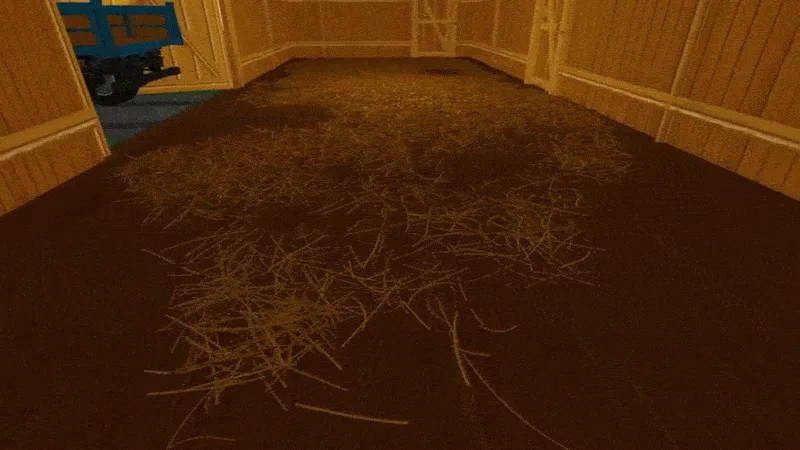
Early footage of Needle in a Haystack Simulator showed the player removing individual pieces of hay and throwing them aside. The visible activity was direct and physical, rather than a conventional hidden-object screen where players select items from a static illustration. Players were changing the material obscuring the target, making movement, visibility, and organization potentially important to the search. However, the headline object count is not a complete technical explanation. Advertising five million pieces does not establish how every object is rendered, simulated, or updated internally. What the number clearly communicates is the intended imbalance between one tiny success condition and an enormous amount of irrelevant material.
A sensible provisional approach in Needle in a Haystack Simulator would be to work through a recognizable section rather than repeatedly switching between unrelated areas. A consistent pattern should make it easier to remember what has been examined, while keeping handled material distinguishable from untouched hay could help preserve the value of earlier work.
These are general search principles, not tested instructions for a particular build. The practical experience will depend on details that a short viral clip cannot settle: repeated interactions need to remain comfortable, the needle needs to be identifiable, and players need some way to judge whether their method is helping. A compelling search game does not require constant success, but failure should feel understandable enough to make another attempt worthwhile.
Valuables in Needle in a Haystack Simulator introduce a secondary reason to keep searching when the needle remains undiscovered. September coverage of the game’s Japanese-language announcement described finding valuable objects among the hay, selling them, and purchasing equipment to improve efficiency or support automation. That establishes a progression loop: search the pile, recover something useful, convert the discovery into spending power, and reinvest in the operation. Because the main objective is a single, distant success condition, smaller finds could make an otherwise unsuccessful session feel productive. A player might fail to finish the search but still gain the means to approach it differently next time.
The economy’s quality will depend on the relationship between effort and reward. If useful discoveries arrive too rarely, upgrades in Needle in a Haystack Simulator could feel disconnected from ordinary play. If money becomes abundant immediately, the early manual stage might lose its purpose. Once actual prices and equipment performance can be measured, a reasonable approach would be to compare an upgrade’s cost with the work it saves. Purchasing the next available item is not necessarily more efficient than saving for a substantially better improvement. Exact treasure values, optimal purchases, reliable farming routes, and precise earning estimates require information beyond the broad announced loop.
Tools were part of the early development conversation rather than an idea introduced only by later coverage. In response to a suggestion about progressing from small digging implements toward larger equipment and a leaf blower, Nakarus indicated that this was the intended direction for Needle in a Haystack Simulator. That exchange supports the broad upgrade concept, but it should not be treated as a finalized equipment catalogue or purchase order. The important distinction is between confirming that equipment progression is planned and assuming that every suggested tool will appear in a particular form or sequence.
The most useful way to understand tools in Needle in a Haystack Simulator is through the different problems they might solve. One could improve how much hay can be moved, another could make searching more controlled, and a more advanced system could reduce repeated manual work. Those functions are not automatically interchangeable improvements. Clearing a large area quickly is not necessarily better than examining a smaller area accurately, particularly if rapid movement makes the target harder to notice. Definitive “best tool” guides would therefore be premature without reliable information about costs, effectiveness, and how the finished mechanics behave. An impressive demonstration is not the same as a tested comparison.
The underlying design question for Needle in a Haystack Simulator is whether equipment changes decisions or merely accelerates clicking. Meaningful upgrades would let players rethink their approach, while weaker ones would make an unchanged task slightly faster without adding much control over the process. The announced progression creates room for the former, but its final balance still needs to demonstrate that value. Equipment should be considered in relation to the search as a whole, rather than judged only by how dramatically it moves material in a short clip.
Nakarus’s development explanation for Needle in a Haystack Simulator specifically included eventually building automation to process the haystack, extending progression beyond increasingly powerful handheld equipment. Automation changes the nature of the problem: manual searching asks how effectively the player can perform an action, while automated searching asks how effectively they can arrange a process. A system might move hay rapidly without making valuable objects easy to notice, whereas another might handle less material but present it more clearly. In a hypothetical setup, improving the fastest stage would accomplish little if a slower stage continued to limit the overall search, making processing rate alone an incomplete measure of usefulness.
Automation could also provide a satisfying change of pace in Needle in a Haystack Simulator. The early game would establish the inconvenience of the task, while later systems would let players apply what they have learned to reduce it. However, the term should not be expanded into unannounced features such as offline earnings, permanent unattended operation, a particular construction system, or specific machinery. The central promise is narrower: players should be able to develop a better method for confronting the same original problem, rather than simply exchange one repetitive interaction for another.

Needle in a Haystack Simulator No-Upgrades Mode and Eight-Player Co-Op
The announced no-upgrades option in Needle in a Haystack Simulator preserves the intentionally unreasonable version of the challenge. Nakarus described a mode without tools or automation, leaving players to search manually. Rather than simply slowing normal progression, it removes the progression-based escape route altogether and lets players accept the central joke on its own terms. That could appeal to those interested in self-imposed challenges, endurance attempts, or repetition for its own sake, while being less suitable for players who need frequent rewards or changing mechanics. Making this version optional allows the game to preserve its original identity without requiring everyone to enjoy its harshest interpretation.
The terminology still needs care. “No-upgrades mode” describes the announced experience in Needle in a Haystack Simulator, not a confirmed final menu label, separate achievement category, or specific set of leaderboard rules. Those details would matter when comparing challenge runs because two attempts are not directly comparable unless their equipment restrictions, settings, and starting conditions are understood. Until such rules are documented, impressive completion claims should be considered in context rather than treated as universal records. The broad challenge is established, but its final presentation and any formal competitive structure remain separate questions.
Players will not necessarily have to confront the haystack alone. Nakarus’s August 29 announcement for Needle in a Haystack Simulator advertised eight players searching the same enormous pile, and online co-op is listed among the game’s Steam features. Multiplayer is therefore more than an unanswered request from the original reveal discussion. It could change the experience even without dramatically shortening the search, turning an absurdly repetitive job into a shared activity where conversation and collective discoveries provide entertainment alongside the objective.
Cooperation in Needle in a Haystack Simulator also creates opportunities for organization. A group could divide the pile into areas, agree on where examined material belongs, or assign different responsibilities as equipment becomes available. These are possible approaches rather than confirmed built-in roles, and players would not need formal character classes to coordinate their efforts. More participants would not automatically make the search eight times faster, since overlapping work, missed objects, and disorganized movement could reduce the benefits. An orderly small group might accomplish more than a larger one repeatedly interfering with itself.
The advertised player count for Needle in a Haystack Simulator should also be distinguished from other multiplayer specifications. It does not establish split-screen play, console cross-play, dedicated servers, or how shared progress will persist. The strongest confirmed attraction remains the simplest one: the original challenge is being developed as something friends can tackle together. How effectively those groups can organize their work will depend on the finished interactions and progression systems, rather than the number of participants alone.
Whether either approach feels relaxing or frustrating will depend on what players want from the experience. The opposing reactions to Needle in a Haystack Simulator were present almost immediately. In an August 23 article, Paula Vaynshteyn discussed the project as an extreme example of sorting-game appeal and questioned whether it crossed the boundary of enjoyable repetition. Her account also recorded Nakarus treating that boundary as part of the intention. Someone who enjoys a consistent physical action and an uncomplicated objective may find the narrow task appealing, while someone who values rapid variation or frequent completion may find the same clarity oppressive.
The visibility of progress in Needle in a Haystack Simulator may prove decisive. Removing material can feel productive when its effects are understandable, but empty when the remaining task looks effectively unchanged. There is also a difference between choosing repetition and feeling trapped by it: a player deliberately selecting a difficult challenge may welcome conditions another person would consider poor pacing. Needle in a Haystack Simulator could therefore become a satisfying methodical activity for one audience and an entertaining shared ordeal for another. Its execution will determine whether either group remains engaged beyond the initial joke.
Nas Nakarus, Studio BitDot and Needle in a Haystack Simulator’s Viral Rise
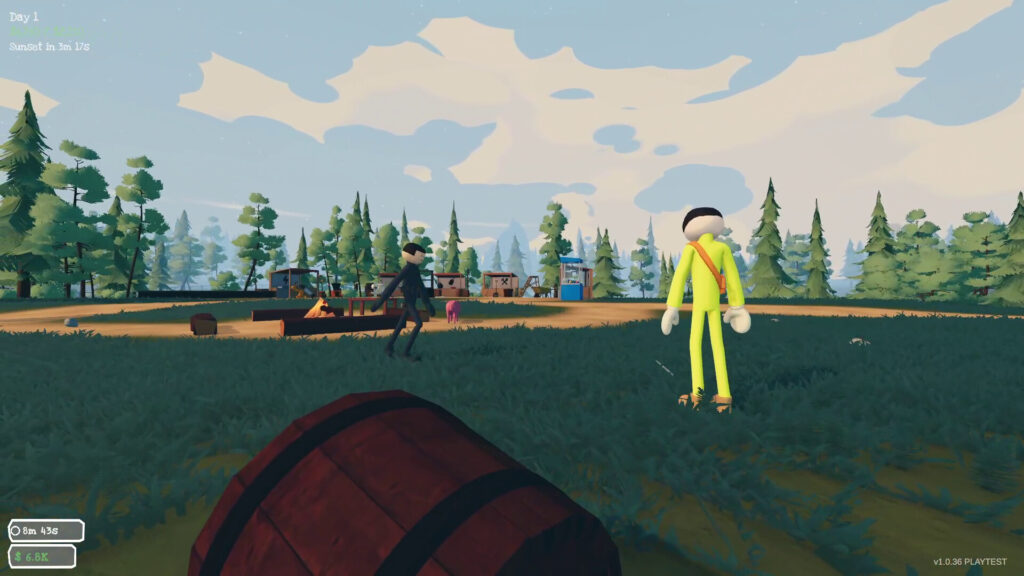
Nakarus identifies himself professionally as the developer behind the haystack project and CEO of Studio BitDot, a London-based independent game studio whose public profile emphasizes using audience information to inform development. The studio also has a released game to its name: Nano Neighbors launched on Steam on November 27, 2025.
Its official description presents an online incremental idle game that occupies the bottom of the player’s screen, with customizable characters, activities, and social features. That experience is relevant to recurring interactions and gradual progression in Needle in a Haystack Simulator, although it does not make the haystack project another version of Nano Neighbors. A desktop companion needs to coexist with other activities, whereas a search game must make sustained attention worthwhile.
Nakarus reported more than 40 million views and 170,000 likes on X during the initial weekend of attention for Needle in a Haystack Simulator. Those figures represent a historical snapshot reported by the developer, not a current audience total or a count of buyers. The concept has an unusually efficient pitch because viewers do not need background information, an explanation of a fictional world, or familiarity with a genre. The title supplies the objective, and the scale supplies the punchline. It also invites immediate disagreement: one person imagines a relaxing repetitive task, while another imagines hours of pointless frustration. Both reactions can sustain discussion without either person having played.
There was also a deliberate testing process behind the studio’s work, according to Robbie Ferguson. In a September 3 account of supporting the Needle in a Haystack Simulator project, he described Studio BitDot testing small game concepts publicly and committing more resources to those that attracted interest. He also reported helping the team establish a landing page after the haystack concept gained attention. That account distinguishes being surprised by the scale of a response from having no strategy at all. The official announcement of more than 23,000 playtest applicants provides another signal of interest beyond passive viewing, although applications are not completed play sessions or sales. The commercial question remains whether that curiosity survives contact with the actual task.
Nakarus’s public role also matters when following development news about Needle in a Haystack Simulator. His posts provide a direct record of what was proposed and when, making them more useful for establishing the project’s intentions than reposted clips whose captions may combine announcements with jokes, community suggestions, or outdated information. For a game that spread through a highly shareable concept, distinguishing those sources helps separate the developer’s stated plans from assumptions that accumulated around the viral footage.

Needle in a Haystack Simulator Release Window, Steam Access and PC Requirements
The planned release window listed for Needle in a Haystack Simulator as of September 16 was Q4 2026, meaning October through December 2026, without an exact launch day. Earlier expectations were more immediate: in his August development update, Nakarus expressed an ambition to carry the project’s momentum toward launch within the following few weeks. That was an early intention, not a dated release commitment. Repeating that relative timeframe as though it begins again whenever someone reads the article would be misleading, as would treating the broad ambition as proof of a formally announced delay. The quarterly window is the more useful planning information until Studio BitDot or its publisher announces a specific date.
The frequently repeated claim that the unnamed game is “getting a Steam page this week” also requires its original date. That wording comes from Nakarus’s August 24 development update for Needle in a Haystack Simulator, rather than a new announcement about the current week. By August 29, he was publicly directing players to the available listing and pairing that announcement with the multiplayer pitch. Older posts saying the page was still coming should therefore not be treated as current instructions. The original project can be identified by Steam app ID 5159870, which SteamDB associates with Needle In A Haystack Simulator, Studio Bitdot, and Polden Publishing.
Finding the correct entry for Needle in a Haystack Simulator is particularly important because the title describes such a familiar concept. GamesRadar+ reported on September 14 that eight other Steam titles had similar concepts or names, and that Studio BitDot’s game was using an “Original” label in its listing artwork. The developer’s August 31 Steam announcement had already warned that lookalike projects were making it easier to reach the wrong game. Matching the application identifier, developer, and publisher is more reliable than relying on artwork, search-result position, release timing, or superficial branding.
A familiar screenshot in a social-media post does not establish that every attached reference leads to the same project, and a similar title alone does not prove the history of another game’s development. The practical task is to locate the specific Studio BitDot project associated with Nakarus’s announcement, rather than assume that every similarly named release has the same origin. Checking the developer and application identifier for Needle in a Haystack Simulator keeps that distinction useful without turning a storefront comparison into an unsupported accusation.
To wishlist the game, sign into Steam, open the correct listing for Needle in a Haystack Simulator, and use its wishlist control. Wishlisting records interest in the main release, and Valve’s documentation explains that wishlisted games can generate release notifications, subject to account settings and notification conditions. Email delivery also depends on having a verified address and suitable preferences. These notifications can help players follow the release, but wishlisting should not be confused with obtaining access to a playable build.
Playtest access for Needle in a Haystack Simulator is separate. An official August 31 announcement said signups had closed after more than 23,000 applications and that additional access keys would be distributed when the first playable build was ready. It did not make wishlisting a guarantee of entry. A Steam Playtest is also not the commercial launch: Valve documents playtests as separate applications whose access developers can control, pause, or end while the main game remains unreleased. Tracking the game, applying to test it, receiving access, and purchasing the eventual release are therefore different actions.
The published PC requirements for Needle in a Haystack Simulator identify minimum and recommended hardware configurations. Both specify 5 GB of available storage, but the listing does not state system RAM requirements or a target resolution and frame rate. Those omissions matter when comparing a computer against the listed specifications, since meeting a hardware target is not the same as receiving a specific performance guarantee.
- Minimum requirements: Windows 10 64-bit; an Intel Core i5-8400 or AMD Ryzen 5 2600 processor; an NVIDIA GTX 1060 with 6 GB of video memory or AMD RX 580 with 8 GB; and 5 GB of available storage.
- Recommended requirements: Windows 10 or Windows 11 64-bit; an Intel Core i5-10400 or AMD Ryzen 5 3600 processor; an NVIDIA RTX 2060 or AMD RX 6600 graphics card; and 5 GB of available storage.
These specifications identify published hardware targets for Needle in a Haystack Simulator, not measured performance, and do not promise that every listed configuration will produce a particular frame rate under every gameplay condition. The unusual object count also makes simplistic assumptions unhelpful. A visually straightforward scene is not automatically computationally trivial, but an enormous advertised number does not prove that the game requires extreme hardware either. Useful testing would need to cover representative situations, including ordinary searching and more complicated multiplayer or processing scenarios. Until those measurements are available, the listed requirements provide a reference point without resolving how the game will perform across every stage of its haystack-clearing challenge.

Frequently Asked Questions(FAQs)
- What is Needle in a Haystack Simulator?
It is Studio BitDot’s game about locating one needle among five million pieces of hay. Its central appeal is the contrast between a very simple objective and an exceptionally large search space. - Who is developing the viral needle-in-a-haystack game?
Nas Nakarus is the developer publicly associated with the project and identifies himself as Studio BitDot’s CEO. The studio is based in London and has previously released Nano Neighbors. - Is the Needle in a Haystack Simulator Steam page available?
Yes. Nakarus was announcing that players could wishlist it by August 29, 2026. References to the page arriving “this week” belong to the earlier announcement period, not the current status. - When is Needle in a Haystack Simulator coming out?
The planned release window is Q4 2026. That means October through December, rather than a confirmed individual launch day. - How many people can play together?
The developer has advertised eight-player multiplayer. That establishes the announced group size, but it does not independently confirm every detail of hosting, matchmaking, or persistent shared progress. - Can the game be played without upgrades?
Yes, the announced design includes a no-upgrades approach without tools or automation. It preserves the manual search rather than requiring players to participate in the equipment progression. - How do players earn money for equipment?
The described progression involves discovering valuables among the hay and selling them to fund more efficient equipment. Detailed item prices and optimal earning strategies are not established by that broad description. - Is automation part of the game?
Automation is part of the announced progression, allowing the search operation to develop beyond manual handling. That should not be interpreted as confirmation of offline progress or a fully documented machinery system. - Can anyone join the playtest now?
The official August 31 announcement said public signups had closed. It discussed additional access keys later, but applicants and interested players should distinguish that statement from a guarantee of immediate admission. - Is Needle in a Haystack Simulator free?
The Steam listing does not currently display a purchase price. That absence does not establish a free-to-play release. Wishlisting and participation in a free Steam Playtest should not be confused with the eventual game’s business model.

Conclusion
Needle in a Haystack Simulator has a memorable premise, but its lasting appeal will depend on the decisions surrounding that premise. Searching must feel understandable, improvements must make a meaningful difference, and cooperation must offer more than additional people confronting the same frustration.
The most interesting possibility is that its apparently restrictive concept could support several distinct experiences: a methodical search, an efficiency problem, a social activity, and an optional endurance challenge. Those experiences would share an objective without necessarily appealing to the same players.
The project has already demonstrated that people will pay attention to an absurdly clear idea. Attention, however, is the beginning of the evaluation rather than its conclusion.
The real test is not whether finding a needle in a haystack makes an amusing announcement. It is whether the process remains compelling when the player has been searching for a while and the needle is still missing.
Sources and Citations
- Steam, official Needle In A Haystack Simulator listing: Identifies Studio Bitdot as developer and Polden Publishing as publisher, with a planned Q4 2026 release. Provides the published Windows, processor, graphics and 5 GB storage requirements, alongside single-player, online co-op, Family Sharing and language support. It also describes searching five million individual pieces of hay, selling valuables and purchasing tools. The currently readable requirements do not specify system RAM; the memory figures attached to graphics cards refer to VRAM. (Steam Store)
Citation: Needle In A Haystack Simulator on Steam - Studio Bitdot and Polden Publishing, official Steam Community announcement: Dated August 31, 2026. Announces that playtest registrations had closed after more than 23,000 signups, discusses additional access-key giveaways once the first playable build is ready, and warns readers about similarly named projects described by the developer as clones. This establishes the registration status, not a completed playtest or commercial launch. The announcement is readable in the official news feed linked below. (Steam Community)
Citation: “Playtest Signups Are Closed”: Official Steam Community Announcement - Nas Nakarus, first-person development update on LinkedIn: Explains that the project began as an experiment taking mundane simulation games to an extreme. Describes manual searching, valuables, upgrades, automation and an optional approach without tools. It also establishes that the initial viral clip appeared before the Steam page was ready, with multiplayer subsequently being added. The post’s proposed launch within weeks was an early development intention, while its 40-million-plus views and 170,000-plus likes are the developer’s reported figures. (LinkedIn)
Citation: Nas Nakarus: “So my needle in a haystack game went viral over the weekend” - Nas Nakarus, multiplayer announcement on X: The developer’s indexed announcement explicitly advertises eight players, five million pieces of hay and one needle. This is the direct reference for the advertised multiplayer size, whereas the Steam listing confirms online co-op without displaying a numerical maximum. The original X page did not reopen during verification, so the eight-player wording was checked through its indexed text rather than by independently replaying the accompanying footage. (X)
Citation: Nas Nakarus: Eight-Player Needle In A Haystack Simulator Announcement - Nas Nakarus, public professional profile: Identifies Nakarus as CEO of Studio BitDot, described as a London-based independent game studio, and supplies background on his game-development work. This supports the developer and studio context rather than confirming individual gameplay features. The profile information was verified through indexed public text because the full LinkedIn profile could not be opened. (LinkedIn)
Citation: Nas Nakarus: Needle In A Haystack Developer and Studio BitDot CEO - Steam, official Nano Neighbors listing: Confirms Studio BitDot as the developer of Nano Neighbors, an online incremental desktop game released on November 27, 2025. This provides a separate product reference for the studio’s background. Its publishers are UNIKAT Label and Gamersky Games, so its publishing arrangements should not be conflated with Polden Publishing’s role on Needle In A Haystack Simulator. (Steam Store)
Citation: Nano Neighbors on Steam - Valve, Steamworks wishlist documentation: Explains how players express interest in a game through wishlisting and when Steam can send notifications, including releases and qualifying discounts. It also describes notification conditions and user preferences. This supports discussing wishlists as a way to track availability, not as a promise to receive every development announcement or automatic admission to testing. (Steamworks)
Citation: Steamworks Documentation: Wishlists - Valve, Steamworks Playtest documentation: Explains the separate Steam Playtest application, access requests, developer-controlled admission, key distribution and the ability to activate or deactivate testing. It distinguishes participation from wishlisting the main game and from purchasing the eventual release. A wishlist entry is not a playtest application, and applying does not necessarily guarantee admission. This documents Steam’s general system rather than proving which registration method this particular developer used at every stage. (Steamworks)
Citation: Steamworks Documentation: Steam Playtest - SteamDB, application metadata: Cross-checks application ID 5159870, the developer and publisher identities, and the Q4 2026 release listing. SteamDB is an independent metadata reference rather than the publisher’s own announcement. Its page also warns that it has only partial information because an access token is missing, so it should not be treated as a complete record of unreleased builds or internal development plans. (SteamDB)
Citation: Needle In A Haystack Simulator: SteamDB Application Record - The Nerdy Type, Paula Vaynshteyn: Published August 23, 2026. Covers the initial social-media response, the five-million-piece premise, planned progression and early multiplayer hints. Vaynshteyn also describes reactions to her own post about the project. Importantly, the article records a point when the Steam page was not yet available and specific tools were not confirmed, making it useful for the early timeline rather than the final feature list. (The Nerdy Type)
Citation: Developer Nas Has Created the Final Boss of Sorting Games - SQOOL.NET, editorial team: Published September 7, 2026. Reports on Polden Publishing and Studio Bitdot’s September 4 announcement, including Japanese-language support, the Steam page, selling valuables, purchasing tools, automation and online cooperative play. This provides regional announcement coverage rather than independent hands-on testing. For the precise scale of the search, the official Steam wording is five million pieces of hay, not five million separate haystacks. (SQOOL.NETゲーム研究室)
Citation: Needle In A Haystack Simulator: Steam Page and Japanese-Language Support Announcement - Fix Gaming Channel, Aidan Minter: Published September 14, 2026, with an update dated September 16. Discusses the project’s viral reception, its origins in the mundane-simulator trend, manual searching, upgrades, automation and online co-op. The article draws on Nakarus’s LinkedIn account and identifies the Steam release window as Q4 2026. Its audience figures repeat the developer’s claims; the article is commentary and development coverage, not a review of a finished game. (Fix Gaming Channel)
Citation: How One Ridiculous Simulator Idea Turned Into a Viral Hit - Robbie Ferguson, first-person LinkedIn account: Describes Studio BitDot’s approach of creating multiple concepts, testing small playable or demonstrable slices on social media, discontinuing weaker ideas and concentrating resources on those attracting interest. He also discusses landing-page support and the Polden Publishing agreement. Ferguson identifies the project as an Audience customer, so this is an involved participant’s account, not independent validation of the strategy or its commercial results. His reported 40 million impressions in 48 hours should remain attributed to him. (LinkedIn)
Citation: Robbie Ferguson on Needle In A Haystack Simulator’s Audience-Testing Strategy - gamesradar.com
Recommendations
- Mortal Kombat 2 Box Office Forecast: How Much It’s Expected to Make in Theaters (Opening Weekend, Domestic vs Worldwide)
- Unveils LightWave 2026: Advanced Placement, MotoRig Vehicle Auto-Rigging, RIPR 2, and New VFX Tools
- Good News Preview: The Newspaper Editor Simulation Game Every Journalism Fan Should Watch
- Deep Rock Galactic: Rogue Core Early Access Guide, Expenite, Void Gates, and How the Roguelite Works
- MetaHuman Creatures: Crafting Non-Human Characters with Unreal Engine’s MetaHuman Framework
- How to Build an RPG Character Creator Using MetaHuman in Unreal Engine 5
- A New Lord of the Rings Game From Kingdom Come Studio? How the Dev Responded to the Rumor (2026 Rumor Update)
- Sega’s Stranger Than Heaven Will Headline Xbox Partner Event This Week – Date, Time, Games, and What to Expect
- Digger Trailer Reveals Tom Cruise in His Least Recognizable Role Ever
- Magic: The Gathering – Marvel Super Heroes Draft Guide (Archetypes, Bombs, Removal, and Pick Orders)



































































































