






In This Article (23 sections)
NVIDIA path tracing fork of Godot Engine explained
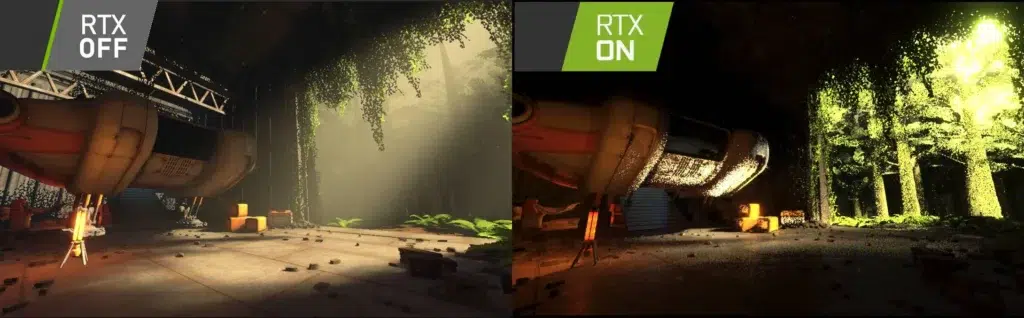
In March 2026, NVIDIA quietly released a modified version of the Godot game engine that implements real-time path tracing. This “fork” of Godot, available on GitHub, adds Monte Carlo path-traced global illumination to Godot’s renderer. As 80.lv reported, “NVIDIA released a fork of Godot that adds path tracing, ready for you to explore right now”. The release was timed with GDC 2026, and credit goes to community developer StayAtHomeDev for publicizing it along with images from NVIDIA’s presentation. In essence, the fork is an experimental build of Godot 4.x that integrates NVIDIA’s RTX path-tracing technology.
It uses the Vulkan API and GPU hardware (RTX) to produce physically accurate lighting, reflections, and shadows in Godot scenes. Unlike Godot’s usual real-time lighting (which relies on screen-space effects and approximations), this fork performs full path tracing, providing much higher visual fidelity at the cost of performance. The source code is publicly available under an open-source license, so developers can download and test it today.
What is NVIDIA-RTX Godot fork on GitHub
The NVIDIA-RTX/godot repository is the official NVIDIA-hosted fork of the Godot engine, made public on March 9, 2026. It contains Godot 4.x source code plus integrations for NVIDIA’s path-tracing and DLSS 4.5 (Frame Generation) within a specific nvidia-pt-dlss branch. This is an official, open-source project licensed under MIT, though it is currently in an early stage requiring manual building.
How to download NVIDIA Godot path tracing fork
To obtain the fork, visit the NVIDIA-RTX/godot GitHub page, switch to the nvidia-pt-dlss branch, and either clone the repo or download the ZIP file. There are no pre-built executables or official “Releases” provided; you must acquire the raw source code to access the path-tracing modifications.
How to build NVIDIA Godot fork from source
The fork is compiled using SCons and requires Python, Godot build dependencies, platform-specific SDKs (like MSVC for Windows), and the Vulkan SDK. On Windows, use the x64 Native Tools Command Prompt and run SCons with desired arguments (e.g., scons platform=windows target=editor arch=x86_64 d3d12=no). To enable DLSS support, you must manually download NVIDIA’s Streamline SDK and copy the sl.* DLLs into the resulting bin/ folder.
What is path tracing in Godot and why it matters
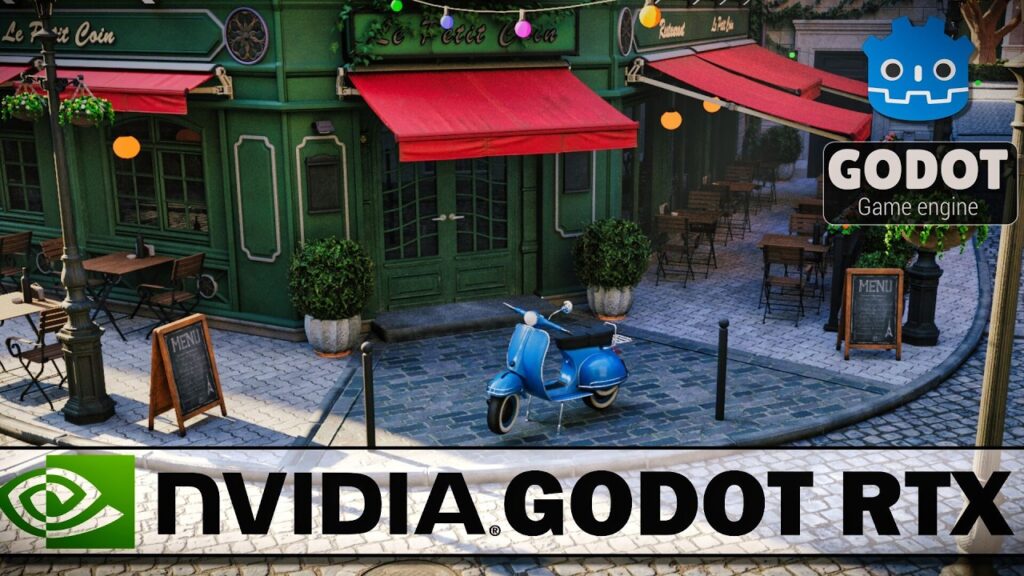
Path tracing simulates global illumination by tracing many light paths, offering superior visual quality over Godot’s traditional screen-space techniques. It captures physically correct indirect lighting, soft shadows, and reflections. While it requires more computational power, it allows Godot to achieve photorealism comparable to offline movie renders, making it ideal for high-end visuals and cinematics.
NVIDIA Godot path tracing vs real-time ray tracing differences
Unlike standard real-time ray tracing, which often uses limited bounces and rasterization for the first pass, NVIDIA’s path tracer evaluates all light transport in a single ray-tracing pass. This “pure” approach provides higher accuracy and full global illumination but results in much lower frame rates. It functions more like a game-ready offline renderer accelerated by RTX hardware than a typical hybrid renderer.
What renderer does NVIDIA use in the Godot path tracing fork
The fork utilizes Godot’s existing Vulkan renderer, extending it with Vulkan ray-tracing extensions. It is not a separate engine but a modification of the Vulkan backend to include RTX path-tracing logic and libraries like NRD for GPU calls. This cross-platform API approach allows the path tracer to function on any hardware supporting the necessary Vulkan extensions.

Godot Vulkan renderer path tracing requirements
Running the fork requires Godot 4.7 or later source code and a system supporting Vulkan 1.2 with ray-tracing extensions. Hardware-wise, a GPU capable of real-time ray tracing (NVIDIA RTX, AMD RDNA2/3, or Intel Arc) is necessary. For development, the Vulkan SDK and standard Godot build tools (Python, SCons, and a C++ compiler) must be installed.
What GPUs support NVIDIA Godot path tracing fork
While optimized for NVIDIA RTX 20, 30, and 40-series GPUs, any card supporting Vulkan Ray Tracing (DXR) can technically run the fork, including AMD Radeon RX 6000/7000 and Intel Arc. However, DLSS features are exclusive to NVIDIA hardware, and high-end GPUs like the RTX 4090 are recommended to achieve usable performance.
NVIDIA Godot path tracing performance expectations
The fork is currently very performance-intensive and intended primarily as a tech demo. Early tests show low frame rates, with high-end cards like the RTX 4080 achieving roughly 25–30 FPS at 1080p in simple scenes. Users should expect single or low double-digit frame rates and will likely need to utilize upscalers like DLSS or FSR to maintain stability.

NVIDIA RTX Path Tracing (RTXPT) and how it relates to Godot
The Godot fork is closely related to NVIDIA’s RTXPT reference library. Both share technologies like Vulkan support, NRD denoising, and Monte Carlo sampling. The Godot implementation benefits from NVIDIA’s research in RTXPT, integrating battle-tested path-tracing techniques and neural graphics research directly into the Godot pipeline.
NVIDIA Real-Time Denoisers (NRD) and path traced rendering
Path tracing often produces grainy images when using low ray counts. To solve this, NVIDIA developed NRD (NVIDIA Real-time Denoisers), a cross-platform, API-agnostic library designed to clean up noisy signals, specifically for 1 path/pixel path tracing. NRD includes filters like ReBLUR and RELAX, which are used in AAA titles to provide high-quality lighting data. The Godot fork relies on NRD or similar technology, such as DLSS Ray Reconstruction, to make path-traced images smooth and usable at real-time rates. Without these denoisers, raw path-traced renders at 1 ray/pixel would be too noisy for practical use.
Is the NVIDIA Godot path tracing fork open source and what license is it
The NVIDIA-RTX/godot repository is fully open source and is released under the MIT license. This is the same permissive license used by the main Godot Engine, ensuring compatibility between the two. Under this license, developers are free to use, modify, and distribute the fork in any project, including commercial games, without paying royalties, provided they include the required copyright and license text.
Will NVIDIA’s Godot fork be merged into mainline Godot
Currently, there is no official merge between the NVIDIA fork and the mainline Godot engine. NVIDIA published the fork independently, and it exists in a separate repository rather than as a pull request to the main project. While the Godot community hopes for future integration, and baseline Vulkan ray tracing has already been merged into Godot 4.7 dev builds, some features like DLSS may remain separate due to their proprietary nature. For now, the fork is considered a side branch and a preview technology.
Godot path tracing fork features and limitations
The fork implements full Monte Carlo global illumination and multiple light bounces, providing realistic lighting, shadows, and reflections. It also integrates NVIDIA DLSS Ray Reconstruction for boosted performance. However, there are significant limitations: the path tracer does not currently support volumetric lighting (fog) or decals. Additionally, because it is based on a 4.7-dev codebase, it may have compatibility issues with certain Godot features or plugins. The path tracer is also extremely hardware-intensive, leading to significant framerate drops compared to the standard renderer.
How to test path tracing in NVIDIA Godot fork demos
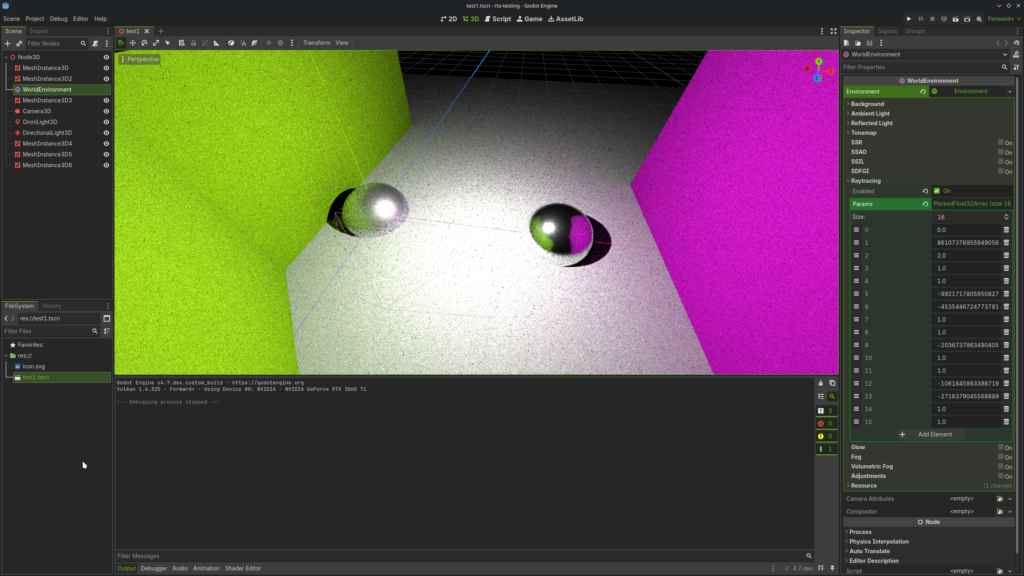
To test the fork, you must run the built executable and enable specific settings within a 3D project. In Project Settings, set the Scaling 3D mode to DLSS to improve performance. In a WorldEnvironment node, enable SSAO, SSR, and the RayTracing option. You must then manually configure the RayTracing property array: Slot 1 for samples per pixel (e.g., 1.0), Slot 2 for max light bounces (e.g., 2.0 or 3.0), Slot 3 to enable DLSS Ray Reconstruction (1.0), and Slot 4 for the number of lights in the scene. Finally, ensure the Streamline DLLs are in the executable’s folder for DLSS to function.
Best settings for path tracing in NVIDIA Godot fork
Optimal results require balancing quality and performance. It is recommended to use DLSS with a scale of 0.5 or 0.67 and enable DLSS-RR (Slot 3 = 1.0). For interactive use, keep samples (Slot 1) at 1.0 or 2.0 and light bounces (Slot 2) between 2 and 4. Denoising is essential at these low sample counts. While higher quality can be achieved by increasing samples and bounces, this will drastically lower the frame rate. A balanced starting point involves 1 sample, 2-3 bounces, and DLSS enabled with 0.5 scale.
Common build errors for NVIDIA Godot fork and fixes
Common issues include building from the wrong branch; ensure you have checked out nvidia-pt-dlss. On Windows, you must use the x64 Native Tools Command Prompt for VS to ensure the compiler is available. Other errors involve missing the Vulkan SDK or failing to copy the NVIDIA Streamline DLLs (sl.*) into the bin/ folder, which prevents DLSS from working. Additionally, users must enable “Advanced Settings” in the editor to see all necessary rendering options. Finally, ensure you are building for a 64-bit architecture (arch=x86_64), as the fork is not intended for 32-bit systems.
NVIDIA Godot fork roadmap and updates from GDC 2026
NVIDIA’s path tracing work for Godot was a major highlight of GDC 2026. The timeline of development is as follows:
- February 2026: Godot 4.7 Dev 1 was released, incorporating the initial Vulkan ray tracing foundation created by Antonio Caggiano. This provided basic ray capabilities rather than a full path tracer.
- March 9, 2026: On the opening day of GDC, NVIDIA publicly released the
NVIDIA-RTX/godotfork. This surprise announcement included thenvidia-pt-dlssbranch, featuring both path tracing and DLSS support. - March 11, 2026: NVIDIA engineer Leroy Sikkes presented a session on implementing the path tracer quickly using AI coding tools. Final updates were pushed to the GitHub repository on this day.
- Post-GDC 2026: The project remains in an experimental stage. While NVIDIA is collaborating with Godot lead developers, there is no official timeline for merging these specific features into the mainline engine.
The official Godot roadmap aims to integrate real-time ray tracing in version 4.8 or later. For now, the NVIDIA fork serves as a separate preview of advanced rendering technology.
Frequently Asked Questions (FAQs)
- What is the NVIDIA Godot path tracing fork?
It is a modified version of the Godot Engine that adds GPU-accelerated path tracing. It replaces or augments the standard hybrid renderer with a full Monte Carlo path tracer using Vulkan and RTX technologies for realistic lighting. - Where can I download the NVIDIA Godot path tracing fork?
The source code is available on GitHub at NVIDIA-RTX/godot. Users must switch to the nvidia-pt-dlss branch to access the relevant code. - How do I build the NVIDIA Godot fork from source?
The process requires Python, SCons, and platform-specific SDKs like Visual Studio. Use the command scons platform=windows target=editor arch=x86_64. You must also have the Vulkan SDK installed and copy NVIDIA Streamline DLLs into the resulting bin folder for DLSS support. - What GPU and system do I need to run this path tracer?
A GPU with Vulkan Ray Tracing support is required. While NVIDIA RTX cards (30 and 40 series) are optimized for it, AMD RDNA2/3 and Intel Arc GPUs can run the path tracer without DLSS features. Updated drivers on Windows 10/11 or Linux are necessary. - How is this different from Godot’s normal ray tracing?
Standard Godot ray tracing is often hybrid, using rasterization with specific ray-traced effects. NVIDIA’s fork is a pure path tracer where all light transport is evaluated in a single pass, resulting in higher quality but significantly lower performance. - Is the NVIDIA path tracing fork free to use?
Yes, it is released under the MIT license, which is the same permissive license used by Godot. It can be used for both personal and commercial projects without fees. - Will NVIDIA’s changes be merged into official Godot?
There is no official confirmation of a merge. It currently exists as an independent project, though it may influence the official Godot roadmap for future versions like 4.8. - What is NVIDIA RTXPT and does it apply to Godot?
RTXPT is NVIDIA’s real-time path tracing library. The Godot fork essentially integrates this technology directly into the engine’s renderer to handle complex light sampling and denoising. - What is NRD and how does it help?
NRD (NVIDIA Real-Time Denoisers) is a library that removes noise from ray-traced images. It allows the engine to produce clean visuals even when shooting only one ray per pixel, which is crucial for maintaining usable performance. - How can I try the path tracer in a demo scene?
After building the fork, add a WorldEnvironment node to a 3D scene and enable the RayTracing option. Configure the settings (e.g., 1 ray per pixel, 2-3 bounces) and ensure DLSS is enabled for better performance.
Conclusion
NVIDIA’s Godot fork represents a significant step for the open-source engine, proving it can handle high-end, production-quality rendering. Although the fork is currently experimental—lacking support for volumetrics and decals while requiring immense hardware power—it demonstrates Godot’s potential for full global illumination and DLSS 4.5. This involvement from a major technology player highlights Godot’s growing importance in the industry.
While the engine pushes visual boundaries, developers can also look to complementary tools like the PixelHair collection for character assets. These resources help streamline content creation in pipelines involving Blender or Unreal. Ultimately, NVIDIA’s contribution invites the community to explore the next level of visual fidelity in real-time rendering.
Sources and Citations
- NVIDIA Developer News / GitHub – NVIDIA Launches Path Tracing Fork of Godot Engine (via 80 Level)
- CG Channel – Get NVIDIA’s New Path Tracing Fork of the Godot Game Engine
- Phoronix – Godot 4.7 Making Progress on Vulkan Ray-Tracing
- GDC 2026 – NVIDIA Path Tracing for Godot (Session Schedule)
- Gamemakers.jp – NVIDIA, Godot Official Fork Published on GitHub (Japanese)
- NVIDIA GitHub – RTX Path Tracing (RTXPT) README
- NVIDIA GitHub – NVIDIA Real-Time Denoisers (NRD) README
- NVIDIA GitHub – Godot RTX / Path Tracing Fork
- Godot Documentation – Building from Source
- Reddit (r/godot) – Testing Out the NVIDIA RTX Fork in Godot (by u/HaeBunYeok)
Recommendations
- Reforged Studios Has Acquired Headup Games: What the Super Meat Boy 3D Publisher Deal Means
- The Expanse: Osiris Reborn is Recasting Its Protagonist After Negative Fan Feedback
- Starfield Comes to PS5 with PS5 Pro Enhancements and New DLC: April 7 Release Date, Free Lanes Update, and Terran Armada Explained
- UK Social Restrictions on Kids’ Games: What New Regulations Could Mean for Roblox and Fortnite
- Latest Daredevil: Born Again Viewing Figures Show Dramatic Drop From Season 1: What the Data Says and Why It Matters
- Ghost of Yōtei Legends Last Major Update Confirmed
- Marvel Heroes Omega 1.0: What It Is, How It Works, and How Players Are Bringing the Game Back
- Control Resonant PC Requirements: Minimum and Recommended Specs Explained
- Stranger than Heaven Combat Explained: Why it Plays Nothing Like Yakuza (Full Breakdown of RGG’s New Fighting System)
- Shannon Elizabeth Reveals ‘Difficult’ American Pie Audition: Dancing for Jason Biggs Was “Opposite of the Movie”



































































































