







In This Article (8 sections)
Perceptum Overview, Release Window, Platforms, and Gamescom Reveal
Perceptum by Duck Reaction is a first-person psychological horror game scheduled for spring 2027 on PC, PlayStation 5, and Xbox Series X|S. Published by Perp Games, it follows a medium investigating a family’s disappearance inside a house where ordinary observation is not enough. The investigation revolves around a handheld mirror and an ability that reveals supernatural sounds when the protagonist closes her eyes. Its central idea is a deliberate contradiction: understanding the house requires using abilities that make the investigator feel less secure. Looking into a reflection can expose something invisible, while listening closely means temporarily surrendering sight. Rather than presenting supernatural perception as a straightforward advantage, Perceptum makes it part of the danger.
As of September 18, 2026, the spring 2027 window is officially announced, but a specific launch day remains unconfirmed. Several details also require careful distinction, particularly the full game’s estimated length, the availability of its early demo, and an inconsistency in Xbox platform metadata. Perceptum is an independent horror adventure built around a paranormal investigation. A family has disappeared, and the player enters its former home as a medium capable of perceiving things that an ordinary investigator cannot. The developer describes a linear experience involving exploration, clues, puzzles, and uncertainty about what the senses reveal.
Duck Reaction is a small studio run by brothers Matt and Simon. Its official website identifies Simon as a game designer and Matthieu as a programmer, with a broader portfolio that includes Meaningless, Turbo Live, and the developing clay-building game Bloom Buddy. Perceptum therefore comes from a team whose interests extend beyond horror rather than from an established horror-only studio. What makes the premise interesting is not simply the presence of ghosts, but the possibility that collecting information can increase anxiety instead of resolving it.
A reflection might answer one question while creating another, and a sound might suggest where to investigate without explaining whether approaching it is safe. That distinction helps define the intended audience: Perceptum’s appeal lies in carefully examining an uncomfortable space and deciding what to trust. Its premise is better understood as a concentrated supernatural mystery than as a promise of extensive combat systems or a large, freely explorable world.
The official Perceptum release window is spring 2027. Perp Games announced it on August 25, 2026, alongside the game’s appearance at Gamescom Opening Night Live. The announcement gives a season rather than a calendar date, so a particular March, April, or May launch day should not be treated as confirmed. The announcement also needs to be distinguished from the broader year shown on storefronts. Steam currently displays 2027, while the PlayStation Store says the release date remains to be determined. Those less-specific labels do not, by themselves, contradict the publisher’s spring window; they simply provide less scheduling detail.
Perceptum’s console plans were already public before Gamescom. In a May 27, 2026 Steam community announcement, Duck Reaction explained that its partnership with Perp Games would bring the project to PlayStation 5 and Xbox Series consoles alongside PC. August’s announcement narrowed the schedule rather than introducing the entire project for the first time. For release planning, the useful distinction is between an announced target and a finalized launch appointment. Spring 2027 is the target to follow; an exact date, regional unlock schedule, and any platform-specific timing still require a more detailed announcement.
The announced platform lineup comprises PC, PlayStation 5, and Xbox Series X|S. PC distribution includes Steam and the Epic Games Store, and Perp Games’ console announcement and release-window reporting both support that lineup. There is one important qualification for Xbox owners: the Xbox Store page inspected for this article lists both Xbox One and Xbox Series X|S under its compatibility information, but Duck Reaction’s console announcement specifically names Xbox Series consoles.
This is a discrepancy between storefront metadata and the public announcement, not a sound basis for declaring either that Xbox One support is impossible or that a separate last-generation release has been fully detailed. Players considering an Xbox One purchase should therefore wait for explicit clarification about that version. The Xbox Series release is the clearly announced console plan.
On PC, the Epic listing identifies Windows as the operating-system platform. The reviewed announcements do not establish native macOS or Linux versions, nor do they announce editions for PS4 or Nintendo systems. A Windows release should not be expanded into a promise of support for every device capable of running PC games. Similarly, confirmation of a console edition does not establish a particular resolution, frame-rate mode, or feature set. Those questions should be answered through platform-specific technical information rather than assumptions drawn from the existence of a store page.
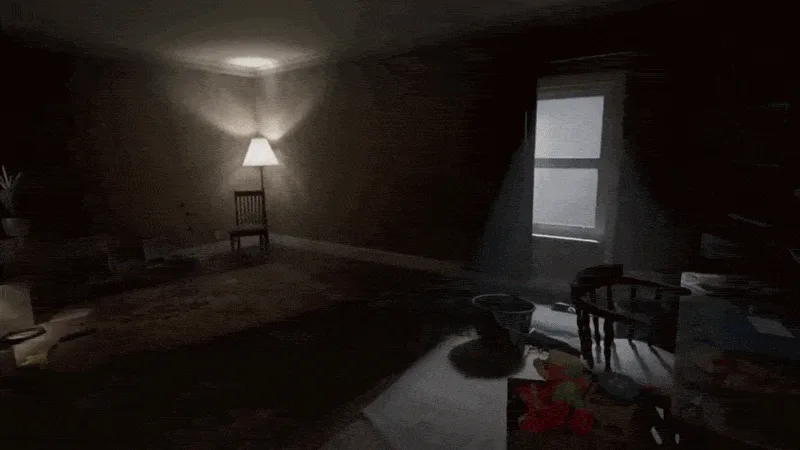
The Gamescom 2026 presentation’s most concrete announcement was Perceptum’s spring 2027 release window. Perp Games confirmed that it debuted a new trailer during Opening Night Live on August 25, making the showcase a significant scheduling milestone for the project. Contemporaneous coverage describes a trailer focused on the house and the protagonist’s vulnerability. Output Lag reported an older woman visible through a compact mirror, a sparsely furnished room with writing across its walls, a dark basement containing boxes and a ladder, and a figure appearing in red-lit shadows. These details establish the trailer’s imagery without requiring speculation about the identities or narrative roles of the figures shown.
GamesRadar’s live coverage likewise described first-person movement through a dark house and threatening noises at a door. The presentation emphasized immediate atmosphere rather than offering a comprehensive demonstration of progression or puzzle solutions. The showcase was followed by a measurable audience milestone: on September 2, Perp Games reported that Perceptum had passed 125,000 wishlists after its Opening Night Live appearance. That is an indicator of interest, not a sales total or proof of the finished game’s quality. The trailer is consequently most useful as an introduction to the game’s mood. Evaluating how its central abilities actually feel requires the playable preview rather than promotional editing alone.

Story, Exploration, Perception Mechanics, Puzzles, Combat, and Player Count
Perceptum begins with an unresolved disappearance. An entire family vanished shortly after moving into a new home, and the police eventually abandoned the investigation. The medium enters the house to reconstruct what happened through clues and supernatural perception. That is the established narrative premise; the explanation behind the disappearance remains part of the mystery. The protagonist is presented as an older woman in trailer coverage, but that visible characterization does not establish her name, personal history, or a family relationship with the missing people. Describing her as an older investigator is more securely supported than inventing a detailed biography from her appearance.
The setup gives the player a reason to remain in an obviously threatening place. Leaving might be the sensible response to danger, but it would also mean abandoning the case. That tension between self-preservation and responsibility is a useful foundation for an investigative horror story. It also changes what an apparition can mean. A supernatural encounter might be an immediate threat, a fragment of evidence, or something that deliberately confuses the investigation. Until the complete story is available, these possibilities should remain questions rather than asserted plot twists. The most productive expectation is therefore a mystery about interpretation: not simply discovering what occupies the house, but understanding how the available evidence relates to the missing family.
Perceptum uses a first-person perspective and a linear investigative structure. Its official descriptions emphasize moving through the house, examining the environment, locating clues, and solving puzzles. They also describe tension that alternates between quieter stretches and more intense frightening encounters. “Linear” is important here, but it should not be confused with “non-interactive.” A directed narrative can still require close observation and deliberate experimentation. The relevant question is how much attention the player must give each space before understanding what to do next.
The first-person viewpoint also supports the game’s perceptual theme. There is no detached camera offering a reassuring overview of the room. Information arrives through the investigator’s immediate perspective, making the decision to inspect a reflection or shut out vision more consequential. A sensible approach to the preview is to prioritize comprehension over speed: examine a room before reacting to every sound, compare what appears consistent with what seems altered, and consider whether a supernatural cue might be meaningful rather than decorative.
This is an interpretation of the announced design, not a claim that every unusual object hides a puzzle. Perceptum’s descriptions encourage attention, but they do not establish that all background details are interactive or necessary for progression. The distinction matters in a game where uncertainty is itself part of the experience.
The mirror is Perceptum’s defining visual tool. Perp Games describes it as revealing traces and reflections that cannot be seen directly. It is not simply a cosmetic object carried by the protagonist: it changes the information available during exploration. Developer comments add a useful complication. Duck Reaction has explained that objects can be presented differently between the ordinary view and the reflection, including appearing in one but not the other.
The developer also highlighted the appeal of a pocket mirror that players can orient themselves, making the act of looking a deliberate choice. That does not make the mirror an infallible truth detector. In a Steam discussion about contradictory visual details, Simon explicitly reinforced the idea that the game can mislead the player. The reflection is part of the uncertainty rather than a universal answer to it.
The resulting design tension is straightforward: a tool that reveals hidden information can also expose something the player would rather not confront. Looking becomes both an investigative action and an act of psychological risk. A practical reading of this mechanic is to compare, rather than automatically prioritize, the two views. What changed? Is something missing from the reflection? Does the difference suggest a clue, a threat, or a deliberate contradiction? Those questions fit the stated concept more closely than assuming every reflection provides a safe and complete explanation.
The second central ability requires the protagonist to close her eyes and listen. Official descriptions explain that altered sounds and distant whispers can guide movement or investigation, while the loss of sight leaves the player vulnerable. The mechanic therefore exchanges one source of information for another. Duck Reaction has discussed broader uses for the ability, including ghostly clues, warnings, unsettling sounds, and information connected to the story. The developer also acknowledged that the early demo did not yet explore the mechanic’s full potential and expressed an intention to create additional situations and puzzles around it. Those comments describe development goals, not a finalized catalogue of encounters.
The most interesting aspect is the voluntary loss of reassurance. Ordinarily, a player might respond to a frightening sound by looking toward it. Here, learning more may require doing the opposite. That gives the ability a clear thematic relationship with the mirror: both make perception useful without making it comfortable. For the playable preview, a quiet listening environment is worth considering.
The relevant test is whether the player can distinguish and interpret the cues, not whether the volume can be made as loud as possible. The mechanic also raises an accessibility question. A system built around directional or subtle audio needs to communicate important information clearly. The available descriptions establish the role of sound, but they should not be mistaken for a complete account of the final game’s audio-accessibility options.
Perceptum’s announced objective is to search the house, solve puzzles, and piece together the missing family’s fate. The publisher’s overview connects those activities to the protagonist’s limited supernatural abilities rather than to an extensive collection of conventional investigative equipment. The available information supports an evidence-led structure, but it does not provide a complete puzzle walkthrough. There is no reliable basis for inventing a fixed number of puzzles, a mandatory sequence of solutions, or an elaborate inventory-combination system.
The most useful distinction is between perceiving a clue and understanding it. Noticing a strange reflection may only be the beginning. Its significance could depend on the surrounding room, another observation, or something heard elsewhere. That is a design interpretation of the announced systems rather than a description of a specific unreleased puzzle. For players approaching the demo, a measured method is preferable to random interaction.
Establish what a space looks like normally, investigate meaningful differences, and reconsider earlier assumptions when new information appears. The aim is not to search every surface mechanically, but to learn how the game communicates. The final release will need to balance uncertainty with readability. A mystery can withhold answers while still teaching players what kinds of observations matter. Whether Perceptum sustains that balance throughout the complete campaign remains an important question beyond the early preview.
Perceptum is explicitly presented as a horror game without traditional weapons or a conventional way to fight back. Perp Games identifies the mirror as a survival tool and states that the player cannot retaliate when danger reveals itself. Some descriptions metaphorically call the mirror and eye-closing ability the player’s only weapons. That wording should not be interpreted as confirmation that the mirror damages enemies or that listening unlocks offensive powers. The published gameplay explanation consistently stresses vulnerability. This changes the meaning of success. Instead of asking which attack is most effective, the player is encouraged to think about awareness, interpretation, and the next necessary action.
However, the absence of combat does not automatically confirm every other survival mechanic. It would be premature to promise a detailed hiding system, stamina management, a particular chase structure, or specific rules governing death and checkpoints without additional documentation. The reliable expectation is narrower and clearer: Perceptum does not advertise combat as the solution to its supernatural encounters. Its tension depends on understanding and enduring the situation rather than becoming powerful enough to overpower it.
Perceptum is a single-player game. The PlayStation Store lists one player, and the Xbox Store identifies single-player functionality. These listings align with the announced premise of one medium investigating the house. The reviewed official materials do not advertise cooperative investigation, competitive multiplayer, or a shared online campaign. Perceptum should therefore not be approached as a team-based ghost-hunting game. That distinction is especially relevant to the sound mechanic. A solitary experience makes it easier for uncertainty to remain personal: there is no second in-game investigator available to verify what was seen or heard. Whether that feels compelling or overwhelming will depend on the player’s tolerance for isolation.
Playing while friends watch or broadcasting a session does not change the software into a multiplayer game. Those are social ways to experience a single-player title, not separate supported modes. Single-player status also should not be used to infer unrelated technical promises. It does not, by itself, answer every question about authentication, platform services, or final offline behavior. Those details require their own specifications rather than assumptions based on the player count.

Demo Access, Playtest Signups, Wishlisting, and Expected Length
The clearest verified ways to investigate Perceptum before release are its Steam Playtest signup and Duck Reaction’s itch.io demo page. These are distinct access routes, and neither should be confused with the complete spring 2027 release. On Steam, the game page contains a Perceptum Playtest section with a request-access option. Submitting a request expresses interest in participating; it does not guarantee immediate admission or permanent availability. Valve’s documentation explains that developers can admit participants in batches and control when a playtest is playable.
The itch.io page identifies the preview as an early Windows demo. It provides a download option and an external entry named Perceptum Win64. Duck Reaction describes this version as intentionally short while representative of the intended visuals, sound atmosphere, and gameplay. A useful demo evaluation should focus on more than the strongest scare.
Consider whether the mirror is comfortable to operate, whether important sounds are understandable, and whether the environmental cues make sense without outside explanation. Those observations are more informative than treating a short sample as proof of the full campaign’s quality. The Steam content notice also warns about intense horror, disturbing imagery, sudden scares, unexpected loud sounds, and flashing or high-contrast visual effects. The psychological-horror label should not be taken to mean that the game avoids abrupt audiovisual shocks.
The best-supported current estimate for the complete game is approximately four to five hours. That figure appears in Perp Games’ release-window announcement and current console-store descriptions. It is an advertised expectation, not an independently measured completion average from the finished release. Some official material still gives a shorter estimate. Duck Reaction’s own game page and the itch.io description refer to roughly three hours. Rather than presenting both figures as simultaneously precise, the sensible interpretation is that the public descriptions have not all been synchronized. The newer publisher messaging supports using four to five hours as the main expectation while acknowledging the discrepancy.
The early itch.io demo is described as lasting around 20 minutes. That is a separate figure and should not be mistaken for the full game’s duration. Actual playtime will depend on how thoroughly someone investigates, how quickly the puzzle logic becomes clear, and how often they pause. A short advertised campaign is not necessarily a problem for this type of premise; the more meaningful question is whether each encounter contributes something new. Likewise, replaying a demo to notice missed details does not establish a branching campaign or multiple endings. Replay value and narrative length are related considerations, but they are not interchangeable measurements.
To wishlist Perceptum on Steam, sign into the intended account, locate the game’s store page, and use its wishlist control. The developer should be Duck Reaction, helping distinguish the correct title from similarly named products. The same page also contains the playtest-access request. Wishlisting and requesting access are separate actions. A wishlist follows interest in the main game; the playtest request asks to participate in a testing build. Completing one should not be assumed to complete the other.
For playtest participation, use the request-access button in the Perceptum Playtest section. When an account is admitted, Valve says Steam sends an email and updates the participation status on the main game’s store page. Access timing depends on the developer’s current signup configuration and testing arrangements. Steam Playtest is free for participants. Valve also makes clear that playtests can be deactivated, so admission is not a purchase of the full game or a guarantee that the test will remain accessible indefinitely. There is no reason to treat a paid third-party “playtest access” offer as necessary for this official signup process.
PlayStation players can use the wishlist option on Perceptum’s store listing. Duck Reaction’s website also links to the official PC storefronts, offering a straightforward starting point for following the project through its own channels.
PC System Requirements and Hardware Expectations
Perceptum already has published PC requirements, although the processor descriptions are unusually broad. Both Steam and the Epic Games Store provide minimum and recommended configurations. These should be treated as the currently listed requirements rather than as proof of performance in the final release.
The currently listed requirements are:
- Minimum requirements:
- Operating system: 64-bit Windows 10
- Memory: 8 GB RAM
- DirectX: DirectX 11
- Graphics: NVIDIA GTX 1060 or AMD Radeon RX 580
- Processor: Intel i5 or AMD Ryzen 5, with the storefront wording “from 2016”
- Storage: 5 GB of available space on Steam
- Recommended requirements:
- Operating system: 64-bit Windows 11
- Memory: 16 GB RAM
- DirectX: DirectX 12
- Graphics: NVIDIA GeForce RTX 3060 or AMD Radeon RX 6700 XT
- Processor: Intel i5 or AMD Ryzen 7, with the storefront wording “from 2018”
- Storage: 5 GB of available space on Steam
Those CPU fields should not be silently converted into specific model recommendations. The published wording lacks the precision needed to identify a definitive processor-by-processor compatibility boundary. The year labels are reproduced as storefront wording, not as a corrected hardware-generation chart. The specifications also do not establish a target resolution, graphics preset, or frame rate. Meeting the recommended requirements is therefore not sufficient evidence to promise 1440p at 60 frames per second, maximum settings, or any other particular result.
Testing the available preview on the intended computer can provide useful practical information, but it remains a test of that build. It cannot guarantee identical performance throughout an unreleased campaign.

Frequently Asked Questions (FAQs)
- When is Perceptum coming out?
Perceptum is scheduled for spring 2027. Perp Games announced that window during Gamescom Opening Night Live on August 25, 2026. A specific release day has not been established in the reviewed announcement. - Which platforms will Perceptum support?
The announced platforms are PC, PlayStation 5, and Xbox Series X|S. The PC release is planned for Steam and the Epic Games Store. Xbox One appears in Xbox Store metadata, but that differs from the explicitly announced console lineup. - Who is developing and publishing Perceptum?
Duck Reaction is developing Perceptum, with Perp Games handling publishing. Duck Reaction is run by brothers Matt and Simon, whose official studio website identifies programming and game-design roles respectively. - What is Perceptum about?
The player investigates a family’s disappearance as a medium. After the police abandon the case, the protagonist searches the family’s home for evidence using supernatural perception alongside ordinary exploration. - How does the mirror work in Perceptum?
The mirror exposes visual information that may not appear in the ordinary view. However, developer comments indicate that differences between direct sight and reflections are also used to create uncertainty, so the mirror should not be treated as universally trustworthy. - Why does the protagonist close her eyes?
Closing her eyes allows the medium to focus on supernatural sounds that can help guide investigation. The trade-off is vulnerability: information becomes audible while the player loses the reassurance of seeing the surrounding space. - Can players fight enemies in Perceptum?
The announced design has no traditional weapons or conventional combat response. Perp Games explicitly describes encounters in which the player cannot fight back, making perception and judgment more important than offensive power. - Is Perceptum multiplayer?
No multiplayer mode is announced. The official console listings identify a single-player experience, with the PlayStation Store specifying one player. - Is a Perceptum demo available?
An early Windows demo is listed on Duck Reaction’s itch.io page, and Steam provides a playtest-access request. The itch.io demo is described as approximately 20 minutes long; Steam participation depends on the active testing arrangements. - How long is the complete Perceptum game expected to be?
Current publisher and console-store descriptions estimate four to five hours. Some other official descriptions still say approximately three hours, so the longer figure is best understood as the current advertised estimate rather than a guaranteed completion time.

Conclusion
Perceptum by Duck Reaction has a clear release target and a distinctive investigative premise: spring 2027 on PC, PS5, and Xbox Series X|S, with the player confronting a missing-family mystery through a mirror and supernatural listening rather than conventional combat.
Its most promising idea is the relationship between knowledge and vulnerability. The player must seek information through actions that can make the situation feel less controllable. Whether that concept remains effective across the complete campaign will depend on puzzle clarity, sound design, pacing, and how creatively the two central abilities develop.
The early preview offers a practical introduction, but several details still deserve caution. The exact release date remains open, runtime descriptions differ, and Xbox One metadata needs clarification against the announced platform lineup. Those qualifications do not diminish the confirmed premise; they separate what has been announced from what still needs to be demonstrated.
Sources and Citations
- Perp Games: Perceptum Launch Window Announcement, August 25, 2026
This is the strongest primary source for the release schedule. Perp Games states that Perceptum was presented during Gamescom Opening Night Live 2026 and will launch in spring 2027. The announcement also identifies the protagonist as a medium investigating a missing family, describes the mirror and eye-closing mechanics, estimates a four-to-five-hour experience and links the PlayStation, Xbox and Steam wishlist pages. (perpgames.com)Citation: Perceptum Launch Window Announced at Gamescom - Perp Games: Official Perceptum Game Page
Perp’s dedicated game page is the clearest primary source for the central gameplay loop. It says there are no traditional weapons, with the visionary mirror serving as the player’s principal survival tool by revealing hidden traces and reflections. Closing the protagonist’s eyes exposes altered sounds and whispers but leaves her defenceless, while direct confrontation is not an option when danger appears. (perpgames.com)The page currently retains the older statement that there is no release date, but its own news section links to the later August 25 announcement confirming spring 2027. The dated release-window announcement should therefore take priority over the outdated line on the general game page. (perpgames.com)Citation: Perceptum Official Game Page - Perp Games: Perceptum Passes 125,000 Wishlists, September 2, 2026
Perp Games reported that Perceptum crossed 125,000 wishlists following its Gamescom Opening Night Live appearance. The page links to the PlayStation, Xbox and Steam listings, but it does not provide a platform-by-platform breakdown or describe an external method used to verify the total. The figure should therefore be presented as a publisher-reported milestone rather than an independently audited number or a Steam-only total. (perpgames.com)Citation: Perceptum: 125,000 Wishlists - Duck Reaction: Official Studio Website
Duck Reaction describes itself as a small independent studio operated by two brothers, Matt and Simon. Its team section identifies Simon as the game designer and Matthieu as the programmer. The site’s Perceptum summary establishes the narrative premise of a medium entering an oppressive house to investigate a family’s disappearance while using a mirror and altered hearing to perceive supernatural information. (duckreaction.com)Citation: Duck Reaction Official Website - Duck Reaction: Official Perceptum Page
The developer’s dedicated page expands the premise. Police have abandoned the missing-family case, leaving the medium to search the house, collect clues and solve puzzles. It describes a linear psychological-horror experience in which the mirror reveals material invisible to the naked eye, closing the protagonist’s eyes changes how she hears the environment, and enemies cannot be fought conventionally. (duckreaction.com)This page still estimates a runtime of approximately three hours, whereas Perp Games, Steam, PlayStation and Xbox now describe the game as lasting approximately four to five hours. The discrepancy probably reflects changing development estimates, so any runtime claim should identify its source rather than present one figure as permanently settled. (perpgames.com)Citation: Duck Reaction: Perceptum - itch.io: Perceptum Early Windows Demo
Duck Reaction’s itch.io listing documents a separate public early demo for Windows. The developer describes it as an intentionally short build lasting around 20 minutes that represents the planned visuals, sound, atmosphere and core gameplay. The listing records a January 22, 2026 upload date, Unreal Engine development, English and French support, keyboard, mouse and Xbox-controller inputs and a downloadable Win64 file. (itch.io)This public itch.io demo should not be confused with the Steam Playtest. The itch.io build can be downloaded directly, while Steam Playtest access operates through a separate request-and-selection system controlled by the developer. (itch.io)Citation: Perceptum Demo on itch.io - Steam: Official Perceptum Store Page
Steam identifies Duck Reaction as developer and Perp Games as publisher, lists a general 2027 release and classifies the game as single-player. The page currently includes a Request Access option for the Perceptum Playtest, with successful applicants notified when the developer is ready to admit more participants. It also lists 11 interface languages and describes the final game as a four-to-five-hour psychological-horror experience. (Steam Store)Steam’s minimum PC specifications are Windows 10 64-bit, an Intel i5 or AMD Ryzen 5 from approximately 2016, 8 GB RAM, a GTX 1060 or Radeon RX 580, DirectX 11 and 5 GB of available storage. These are prerelease requirements and can still be revised before spring 2027. (Steam Store)Citation: Perceptum on Steam - Valve Steamworks: Steam Playtest Documentation
Valve explains that Steam Playtest uses a separate child application associated with the main game. Players request access through the main store page, but developers decide how many testers to admit and can deactivate or reopen the Playtest as needed. Under the standard limited-access process, Steam selects users randomly from the signup pool when the developer releases a new group. (Steamworks)Consequently, pressing Request Access on Perceptum’s Steam page does not guarantee immediate entry, does not function as a preorder and is separate from wishlisting the full game. (Steam Store)Citation: Valve Steamworks: Steam Playtest Documentation - PlayStation Store: Perceptum
The official PlayStation listing identifies the game as a one-player horror title and allows users to add it to their wishlist. It reproduces the four-to-five-hour estimate, the missing-family narrative and the mirror and eye-closing mechanics. The store page still says that the release date is to be determined, while Perp’s newer dated announcement establishes the broader spring 2027 window. (PlayStation Store)Citation: Perceptum on PlayStation Store - Xbox Store: Perceptum
Microsoft’s listing identifies Perp Games as publisher and Duck Reaction as developer. It lists single-player support, Xbox achievements and cloud saves, and repeats the four-to-five-hour estimate and non-combat gameplay description. (xbox.com)The storefront currently lists both Xbox One and Xbox Series X|S under playable devices. However, Perp’s Gamescom material and Gematsu’s contemporary report specifically name Xbox Series X|S, not Xbox One. Until Perp Games directly confirms the older-console edition, Xbox One availability should be described as appearing on Microsoft’s store listing rather than treated as an uncontested announced platform. (xbox.com)Citation: Perceptum on Xbox Store - Epic Games Store: Perceptum
Epic’s listing confirms a coming-soon Windows version with single-player and controller support. It currently gives a broad 2027 availability date and publishes both minimum and recommended PC requirements. The recommended configuration lists Windows 11 64-bit, a 2018-era Intel i5 or AMD Ryzen 7, 16 GB RAM, an RTX 3060 or Radeon RX 6700 XT, DirectX 12 and approximately 5 GB of storage. (Epic Games Store)Two metadata differences should be noted. Epic still uses the older three-hour runtime estimate, and it credits Duck Reaction as publisher, while Perp’s official material, Steam, Xbox and Gematsu identify Perp Games as publisher. Perp Games is therefore the better-supported current publisher attribution. (Epic Games Store)Citation: Perceptum on Epic Games Store - Steam Community: Duck Reaction on Misleading Reflections
A player described seeing blood directly on a crucifix while the same blood was absent from its reflection, creating the impression that the game was deceiving the player. Duck Reaction confirmed that this contradiction was deliberate and that players are expected to rely on their instincts rather than assuming the mirror always presents objective truth. This developer comment is useful support for discussions of unreliable perception and misleading reflections. (Steam Community)Because this is a developer response to a specific playtest scene, it should support analysis of the intended perception mechanic rather than be expanded into a claim that every reflected object follows different rules.Citation: Steam Discussion: This Game Is So Damn Good - Steam Community: Duck Reaction on Field of View, Perception and Mirror Performance
In another developer response, Simon explained that widening the field of view could alter player perception and change the mirror’s distance from the camera, potentially affecting the intended experience. He also said the mirror was computationally expensive and required further optimization before release. This is useful context for the technical challenge of rendering the mirror and for why seemingly conventional camera settings can affect the game’s design. (Steam Community)Citation: Steam Discussion: I Can’t Wait for the Full Version - Reddit: Duck Reaction’s Explanation of Perception, Puzzles and the Mirror
In a developer-posted discussion, Duck Reaction said the mirror and eye-closing abilities were designed to create discomfort and paranoia. Simon explained that game elements can be displayed normally, appear only in the mirror, appear only in the player’s direct view or remain absent, meaning the mirror itself may not always be trustworthy. (Reddit)The developer also said closing the protagonist’s eyes would be used for more situations and puzzles than were present in the early demo. Other comments describe the mechanic as a source of ghostly clues, danger warnings, unsettling sounds and story-related audio. These comments provide valuable design context, but they come from an evolving prerelease build and should not be treated as a final catalogue of every puzzle or encounter. (Reddit)Citation: Duck Reaction’s Perceptum Developer Discussion on Reddit - Gematsu: Perceptum Launches in Spring 2027
Gematsu’s August 25 report independently records the Gamescom announcement and lists PlayStation 5, Xbox Series X|S and PC through Steam and the Epic Games Store for spring 2027. It also identifies Duck Reaction as developer and Perp Games as publisher and reproduces the publisher-supplied overview of the mirror, closed-eye listening and missing-family premise. (Gematsu)Gematsu’s copied overview uses the earlier three-hour estimate. Newer Perp, Steam, PlayStation and Xbox text instead says four to five hours, so Gematsu is strongest for contemporaneous release-announcement reporting rather than the latest runtime estimate. (Gematsu)Citation: Gematsu: Perceptum Launches in Spring 2027 - Output Lag: Gamescom Announcement and Trailer Presentation
Output Lag reported that Perceptum appeared during the Gamescom Opening Night Live 2026 pre-show and was announced for spring 2027 on Steam, Epic Games Store, Xbox Series X|S and PlayStation 5. Its article also describes imagery shown in the trailer, including the dimly lit house, pocket mirror, marked walls, basement and shadowy figure. (Output Lag)Output Lag’s headline calls the protagonist a grandmother, but the official publisher, developer and storefront descriptions confirm only that she is a medium. The article itself more cautiously describes her as an older woman. Unless later official character information confirms her family status, “grandmother” should remain attributed to Output Lag rather than presented as an established narrative fact. (Output Lag)Citation: Output Lag: Perceptum Is a First-Person Horror Game Due Spring 2027
Recommendations
- Echoes of Aincrad Crafting Guide: Recipes, Materials and Unlock Requirements
- Did Christopher Nolan’s Depiction of the Gods Pay Off in The Odyssey?
- Castlevania: Belmont’s Curse Runs at Only 30 FPS on Nintendo Switch
- EA Sports College Football 27 Preview: Defense Wins Championships
- Jurassic World Evolution 2 Complete Edition Comes to Nintendo Switch 2 on July 30, 2026
- Unity-Based Tool for JRPG Game Development: RetroGig’s Retro JRPG Template for SNES/PSX-Style RPG Systems
- Keanu Reeves & China Miéville BRZRKR: Light Draws Breath — Release Date, Story, Creative Team & Variant Covers
- CD Projekt Raises Profit Goals with Witcher 4, 5, and 6 Coming: 5 Billion PLN Target Explained
- Creepshow Official Announcement Trailer Reveals a New Anthology Horror Game Experience
- GTA 6 Leans Into Vice City’s Influencer Hustle Where Looks Matter



































































































