





In This Article (7 sections)
Planet Zoo 2 Launches October 13, 2026, on PS5, Xbox Series X|S and PC
Planet Zoo 2 officially launched on October 13, 2026, for PlayStation 5, Xbox Series X|S, and Windows PC, introducing major improvements to Frontier Developments’ wildlife management simulation franchise. The sequel expands the original game’s features with fully aquatic animals, flying birds, customizable aquariums, interactive aviaries, Wildlife Reserves, improved animal behavior, and more detailed construction tools. With more than 130 animals and an expanded focus on conservation, the game offers new opportunities for players to build, manage, and develop their own zoological parks.
The release represents an important milestone for the franchise, which began with the original Planet Zoo in November 2019. After years of updates, downloadable content, and community creations, Frontier has developed a sequel that builds upon its established zoo management systems while introducing entirely new habitat categories and conservation activities. Unlike its predecessor, which launched on PC before arriving on consoles in March 2024, Planet Zoo 2 became available across its major supported platforms simultaneously.
Frontier originally announced the sequel on May 28, 2026, before confirming its October 13 release. Digital storefronts listed a launch time of 2:00 PM UTC, corresponding to 3:00 PM British Summer Time, 10:00 AM Eastern Daylight Time, 7:00 AM Pacific Daylight Time, and 3:00 PM West Africa Time. Digital versions launched on the confirmed date, while physical console editions were listed for October 20, 2026.
The game is available on PlayStation 5, Xbox Series X, Xbox Series S, and Windows PC. The PlayStation Store identifies it as PS5 Pro Enhanced, while Microsoft’s Xbox listing includes support for 4K Ultra HD, HDR10, ray tracing, and console keyboard and mouse input. These capabilities do not guarantee identical graphical settings or frame rates across every console. The PC version is distributed through Steam and the Epic Games Store, with availability also indicated through Microsoft’s PC ecosystem.
The simultaneous release allows console and PC players to experience the same core wildlife management systems without the extended platform delays associated with the original game. However, there are no announced native PlayStation 4 or Xbox One editions. Players should therefore confirm that their hardware belongs to the supported console generation before purchasing.
Frontier’s official launch trailer highlights the sequel’s expanded animal collection, improved animations, additional habitat types, and global conservation systems. Early footage showcased species such as the Sumatran tiger, Western chimpanzee, and plains zebra, demonstrating improvements to fur rendering, environmental interactions, and animal movement. The trailers also introduced fully aquatic wildlife and flying birds, two of the most requested additions from the original game’s community.
Another important development is the introduction of the Fauna and Ecosystems Network, also called FEN. Players take on the role of a Conservation Coordinator, managing zoos while participating in projects intended to protect animals and restore natural habitats. This creates a broader purpose for the management experience, connecting animal welfare and successful breeding programs to conservation activities beyond conventional zoo boundaries.
Planet Zoo 2 is available in Standard and Deluxe Editions, with different content packages and regional prices.
- Standard Edition: $49.99 in the United States, £39.99 in the United Kingdom, and €49.99 in supported European markets.
- Deluxe Edition: $64.99 in the United States, £54.99 in the United Kingdom, and €64.99 in supported European markets.
- Price difference: The Deluxe Edition costs an additional $15 in the United States.
- Standard Edition content: Includes the complete core simulation experience, with aquariums, aviaries, Wildlife Reserves, animal management, construction tools, and the principal gameplay modes.
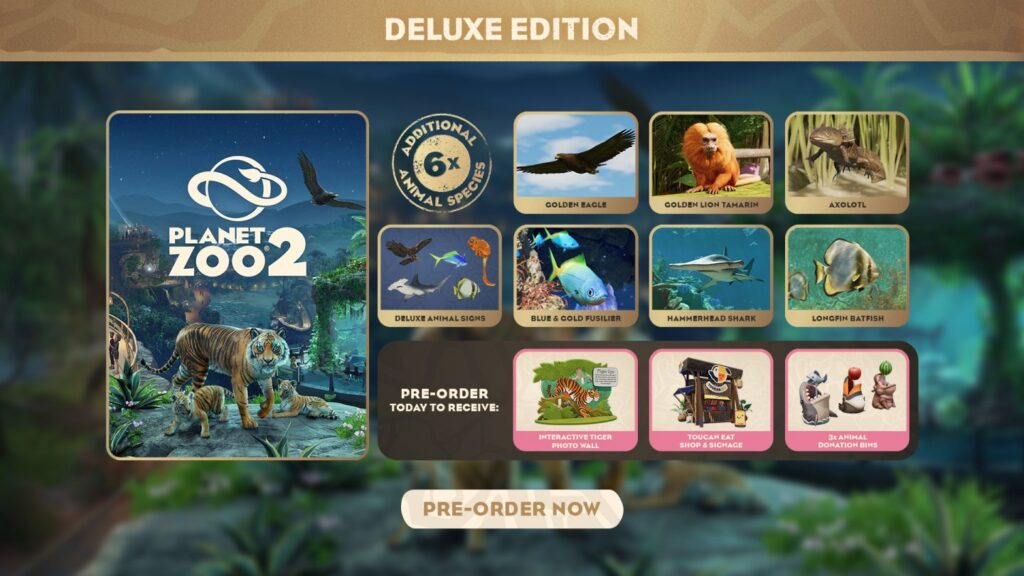
- Deluxe Edition content: Adds six animal species and exclusive decorative animal signs.
The six Deluxe Edition species are the axolotl, blue and gold fusilier, golden eagle, golden lion tamarin, great hammerhead, and longfin batfish. These animals expand the game’s aquatic, flying, and terrestrial categories, providing additional options for players interested in developing varied habitats.
The great hammerhead is particularly relevant to players constructing large marine attractions, while the golden eagle expands aviary possibilities. The axolotl introduces another distinctive freshwater species, and the remaining animals provide additional variety across different habitats.
Frontier also announced a preorder Bonus Content Pack containing a Toucan Eat Shop with matching signage, three unique animal donation bins, and a Tiger Photo Stand In Wall. These items are primarily decorative rather than essential gameplay features. Players purchasing after launch should check their storefront listings to determine whether the bonus content remains available.
The Standard Edition includes the major features that distinguish Planet Zoo 2 from its predecessor. Players do not need the Deluxe Edition to construct aquariums, create aviaries, manage Wildlife Reserves, or access the principal simulation modes. The more expensive version is mainly intended for players who want its additional species and decorative content.
One of the sequel’s biggest attractions is its animal collection, which contains more than 130 species across terrestrial, aquatic, flying, and exhibit categories. Frontier’s official Zoopedia provides information about their classifications, geographical distribution, habitat requirements, and conservation status.
The collection includes familiar terrestrial wildlife such as African savannah elephants, Asian elephants, Sumatran tigers, giraffes, zebras, hippopotamuses, chimpanzees, and several antelope species. These animals remain central to conventional zoo management, requiring suitable environments, enrichment, social arrangements, and appropriate facilities.
Predators require secure enclosures and feeding systems, while large herbivores often need extensive habitats that provide sufficient space for movement. Smaller reptiles, amphibians, insects, and other exhibit animals support more compact educational attractions.
The newly introduced aquatic collection includes Pacific bluefin tuna, blacktip reef sharks, Indo Pacific leopard sharks, rays, and several smaller fish species. Deluxe Edition animals such as the great hammerhead and longfin batfish add further variety.
Flying species also expand the roster, with birds such as the white backed vulture and Deluxe Edition golden eagle designed for the new aviary systems. These animals introduce different environmental requirements because their habitats must accommodate movement through three dimensional spaces.
The animal collection is significant not simply because of its size but because the new categories fundamentally expand the environments players can construct. Combining terrestrial mammals, fully aquatic species, flying birds, and smaller exhibit animals enables more varied zoological attractions than the original game’s launch version.
Animal totals should also be interpreted carefully because some species can appear in multiple classifications. Adding category totals together may result in double counting, making Frontier’s official Zoopedia the most appropriate reference for the complete roster.
Overall, Planet Zoo 2’s launch provides players with a substantial expansion of the franchise’s creative and management possibilities. Its new animal categories, conservation systems, and simultaneous console and PC release establish the foundation for a broader wildlife simulation experience.
Planet Zoo 2 Aquariums, Aviaries, Wildlife Reserves and Zoo Management Features
Planet Zoo 2 introduces several major gameplay systems that expand the original game’s emphasis on animal welfare, zoo construction, and conservation. The most significant additions include customizable aquariums for fully aquatic animals, dedicated aviaries for flying birds, and Wildlife Reserves that allow players to participate in ecological restoration beyond traditional zoo boundaries.
Aquariums represent one of the sequel’s biggest improvements, introducing marine and freshwater habitats that were not available through the same dedicated construction systems in the original game. Although the first Planet Zoo included animals capable of swimming and diving, the sequel supports fully aquatic species that require environments specifically designed around underwater movement and appropriate water conditions.
Players can develop freshwater and saltwater attractions, selecting suitable species and creating habitats that accommodate their biological and spatial requirements. Water environment selection is important because animals adapted to freshwater cannot automatically share the same conditions as marine species.
Large aquatic animals, including sharks and other substantial marine wildlife, require sufficient swimming space and appropriate habitat layouts. Smaller fish can support more compact displays, allowing players to create different combinations of aquatic attractions depending on their available space and design preferences.
Aquarium construction also introduces opportunities for underwater viewing areas and themed marine exhibits. Players can integrate these attractions into their wider zoo layouts, connecting aquatic habitats with visitor pathways, educational displays, and other facilities.
The system is intended to emphasize animal welfare rather than treating marine species as decorative additions. Players must consider habitat suitability, available space, and environmental requirements when deciding which animals to introduce.
Aquariums also broaden the game’s conservation themes by introducing marine biodiversity. Although the simulation does not reproduce every complexity of real conservation, it provides opportunities to explore the importance of aquatic environments and the welfare of species affected by habitat degradation, pollution, overfishing, and other ecological pressures.
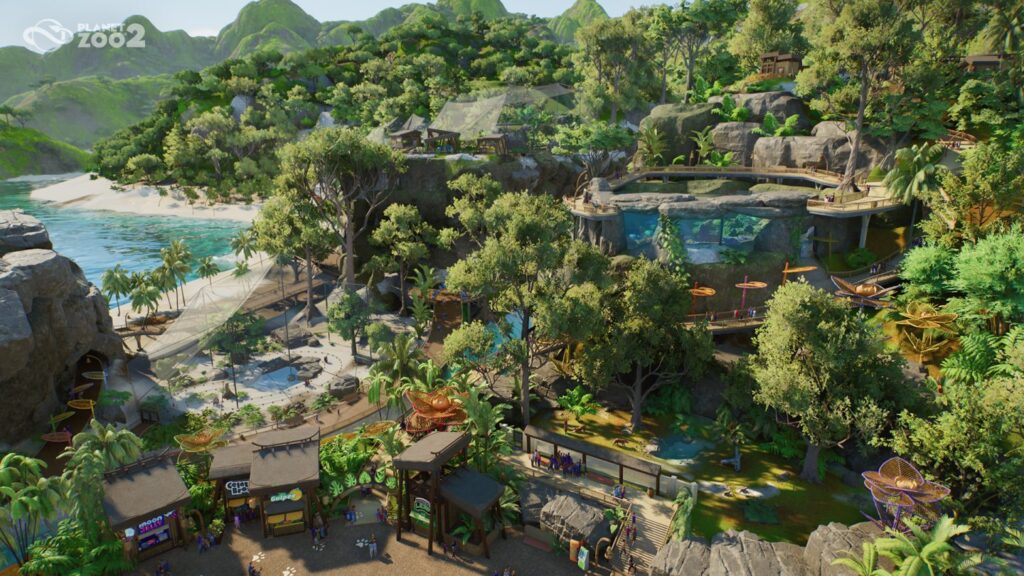
Aviaries introduce another substantial change by allowing players to construct environments designed for freely flying birds. Unlike conventional terrestrial enclosures, these habitats must accommodate aerial movement, vertical space, and interactions with elevated structures.
Players can customize aviaries using vegetation, architectural features, and suitable environmental elements. The objective is to create spaces that support the needs of the species while providing visually engaging attractions for visitors.
Frontier has also confirmed that selected aviaries can function as walkthrough experiences when appropriate for the animals involved. This allows players to design environments where guests can move through designated bird habitats rather than observing every species from outside an enclosure.
Such attractions can be incorporated into tropical, woodland, or other themed zoo sections, complementing nearby mammal habitats and educational displays.
Aviaries also increase the importance of animal animation. Birds must transition between different movements, interact with elevated structures, and navigate their surroundings through flight. These requirements differ substantially from the movement systems used by terrestrial animals.
Animal welfare remains central to aviary management. An attractive enclosure is not necessarily suitable if the birds lack sufficient space or appropriate environmental resources. Players must therefore balance construction creativity with the practical needs of their animals.
Wildlife Reserves expand the franchise’s conservation systems even further. While the original Planet Zoo emphasized breeding, education, welfare, and conservation through zoo management, the sequel introduces a more direct connection between successful animal care and environmental restoration.
As a Conservation Coordinator within the Fauna and Ecosystems Network, players can develop Wildlife Reserves across different locations, restore natural environments, and release suitable animals into ecosystems beyond their zoos.
The system introduces a different management objective. Traditional zoo construction focuses on creating safe habitats that satisfy animal welfare requirements while providing enjoyable visitor experiences. Wildlife Reserves place greater emphasis on restoring appropriate environments and supporting wildlife populations.
Successful reserve development requires attention to habitat suitability, ecological conditions, and the needs of the animals being introduced. Rather than measuring progress exclusively through income or visitor satisfaction, players can pursue conservation objectives associated with environmental restoration.
Frontier also introduced the Research Vehicle during its August 2026 presentation. This feature allows players to explore Wildlife Reserves and observe the landscapes and wildlife associated with their conservation projects.
The Planet Hub provides an overview of the player’s growing network of zoos and reserves, reinforcing the connection between individual facilities and broader conservation activities.
These systems create additional responsibilities and opportunities:
- Habitat restoration: Develop environments intended to support animals within suitable ecosystems.
- Animal releases: Introduce appropriate wildlife into reserves as part of conservation activities.
- Environmental management: Consider habitat conditions and the needs of different species.
- Research Vehicle exploration: Travel through Wildlife Reserves to observe animals and landscapes.
- Conservation network management: Use the Planet Hub to oversee connected zoos and reserves.
- Long term objectives: Balance traditional animal management with conservation projects extending beyond visitor attractions.
Wildlife Reserves distinguish the sequel from conventional construction focused management games. They provide another reason to develop successful animal welfare and breeding programs while encouraging players to think beyond the financial performance of individual parks.
Planet Zoo 2 retains three principal gameplay modes: Career Mode, Franchise Mode, and Sandbox Mode. Each offers a different balance between guided progression, management responsibilities, and creative freedom.
Career Mode provides structured objectives through the Fauna and Ecosystems Network. Players assume the role of a Conservation Coordinator and complete projects involving zoo development, animal welfare, and wildlife protection. The guided progression makes it suitable for newcomers learning how the game’s interconnected systems operate.
Rather than introducing every management responsibility immediately, Career Mode allows players to develop their understanding of habitat construction, staff management, conservation, and financial planning through successive objectives.
Franchise Mode focuses on developing a connected network of zoos within a broader economic environment. Players can trade animals with other users and participate in shared community goals, introducing additional considerations involving breeding programs, resource allocation, and long term management.
Financial planning remains important because expanding a network of facilities requires sustainable operations. Players must manage animal populations, habitat requirements, and ongoing costs rather than concentrating exclusively on immediate construction.
Sandbox Mode provides the greatest creative freedom. Players can experiment with architectural designs, elaborate habitats, visitor attractions, and themed environments without following the same progression requirements as Career Mode.
The addition of aquariums, aviaries, and Wildlife Reserves substantially increases Sandbox Mode’s possibilities. Players can create marine attractions, bird habitats, conventional zoological parks, and conservation landscapes within their creative projects.
Sandbox Mode is also useful for testing unfamiliar construction tools and layouts before applying those ideas to more demanding management experiences.
Creative construction remains one of the franchise’s defining features. Planet Zoo 2 expands Frontier’s detailed construction system, allowing players to customize individual objects, buildings, habitats, pathways, and visitor facilities.
Terrain editing is especially important because realistic habitats require more than flat surfaces enclosed by barriers. Players can shape landscapes, introduce elevation changes, incorporate natural features, and develop environments appropriate for different species.
A mountainous enclosure may use elevation and vegetation to create a convincing natural setting, while a tropical habitat can include dense plant life and environmental features associated with its ecosystem.
The new habitat types introduce additional construction requirements. Aquariums need appropriate underwater environments, while aviaries require vertical spaces designed for flying animals. Wildlife Reserves expand these possibilities to larger natural landscapes.
Visitor infrastructure remains another major consideration. Guests require accessible pathways, viewing areas, facilities, and attractions. Poorly designed routes can reduce the effectiveness of an otherwise impressive zoo, making functionality as important as appearance.
The sequel also provides additional decorative themes and scenery options, allowing different sections of a park to develop recognizable architectural identities. Players can create attractions inspired by continents, ecosystems, and conservation themes while connecting them through detailed visitor routes.
Frontier Workshop extends these construction possibilities by allowing players to discover, download, and share community creations. Instead of building every structure individually, players can incorporate suitable blueprints created by other members of the community.
Workshop content can be shared across supported platforms, broadening access to community designs. A PlayStation player, for example, may be able to use eligible creations developed on another platform.
However, downloaded structures still require appropriate placement. A detailed blueprint may need adjustments to fit existing pathways, terrain, habitats, or guest facilities.
The Workshop also includes discovery and subscription features that help users locate creations and follow preferred builders. These functions encourage collaboration through shared designs without requiring players to manage the same zoo simultaneously.
Franchise Mode provides further community interaction through animal trading and shared objectives. Nevertheless, these features should not be confused with conventional cooperative multiplayer.
Planet Zoo 2 remains primarily a single player management experience. The confirmed online features involve sharing creations, trading animals, and participating in connected community activities rather than multiple players directly controlling the same zoo in real time.
The game also introduces substantial improvements to graphics and animal behavior. Frontier has emphasized more detailed fur, feathers, scales, facial expressions, and movement, alongside environmental improvements involving vegetation, terrain, scenery, and architecture.
More importantly, animal behavior now provides visible feedback about welfare conditions. Instead of relying entirely on management menus, players can observe animals to identify possible problems.
For example, an unhappy tiger may appear less active, indicating that its environment requires attention. Tiger cubs can demonstrate more natural social interactions, while chimpanzees benefit from improved jumping, climbing, and brachiation animations.
The introduction of aquatic animals and flying birds requires additional movement systems because swimming and flight involve different environmental interactions from terrestrial movement.
Animal compatibility and cohabitation also remain important. Suitable species may share environments under appropriate conditions, but players must consider their welfare requirements rather than assuming that different animals can be combined freely.
These improvements strengthen the connection between construction and management. A detailed habitat is more meaningful when animals respond visibly to its design, allowing players to recognize the consequences of their decisions through natural behavior.
The most important development is therefore not simply improved graphics. It is the broader relationship between animal simulation, environmental design, and conservation, which allows Planet Zoo 2 to offer more varied and interconnected management experiences.

Planet Zoo 2 PC Requirements, Console Performance and Comparison With the Original Game
Planet Zoo 2 introduces more detailed environments, additional animal behavior systems, and expanded construction features, making hardware performance an important consideration. Large zoos can place substantial demands on both processors and graphics cards because the game must simulate animals, visitors, staff, finances, and numerous environmental interactions while rendering detailed habitats.
Frontier Developments has published minimum and recommended PC specifications to help players assess hardware compatibility.
The minimum PC requirements include:
- Operating system: Windows 10 or Windows 11.
- Processor: Intel Core i7 8700K or AMD Ryzen 5 3600.
- Memory: 16GB RAM.
- Graphics: NVIDIA GeForce RTX 2060 with 6GB, AMD Radeon RX 5600 XT with 6GB, or Intel Arc A750 with 8GB.
- DirectX: Version 12.
- Storage: Approximately 40GB of available space.
- Storage recommendation: An SSD is recommended.
The recommended PC requirements include:
- Operating system: Windows 11.
- Processor: Intel Core i7 10700K or AMD Ryzen 7 5800X.
- Memory: 16GB RAM.
- Graphics: NVIDIA GeForce RTX 3070 with 8GB, AMD Radeon RX 6700 XT with 12GB, or Intel Arc A770 with 16GB.
- DirectX: Version 12.
- Storage: Approximately 40GB of available space.
Windows 10 appears in the minimum specifications, although Frontier notes that continued compatibility cannot be guaranteed indefinitely following the end of Microsoft’s standard support for the operating system.
These specifications establish hardware requirements but do not guarantee identical performance across every zoo. A small park containing relatively few animals and visitors may perform differently from an extensive attraction with numerous habitats, detailed architecture, and large guest populations.
The graphics card handles rendering tasks involving animal models, lighting, scenery, and environmental effects. The processor must also manage calculations involving wildlife behavior, visitors, staff, and other simulation systems.
As a park expands, the combined workload may increase. Players using hardware close to the minimum requirements should therefore consider how performance could change as their zoos become larger and more complex.
Recommended hardware provides additional capacity for demanding settings, although actual results still depend on resolution, graphical options, and the complexity of the environment being simulated.
On consoles, Planet Zoo 2 supports PlayStation 5, PlayStation 5 Pro, Xbox Series X, and Xbox Series S. The PlayStation Store identifies the game as PS5 Pro Enhanced, while the Xbox Store lists features including 4K Ultra HD, HDR10, and ray tracing.
These capabilities should not be interpreted as confirmation that every console version delivers identical graphical quality or frame rates. Xbox Series S, for example, has different hardware capabilities from Xbox Series X.
Detailed testing is necessary to determine performance during particularly large or complex zoo simulations. Launch announcements and storefront feature lists establish supported capabilities but do not provide comprehensive performance measurements across every platform.
Input preferences are another consideration. PC players may prefer mouse and keyboard controls for precise construction, terrain editing, and object placement. Console players can use controller oriented interfaces, while the Xbox version also lists keyboard and mouse support.
Comparing Planet Zoo 2 with the original game reveals several major improvements. The first Planet Zoo launched in November 2019 and established a detailed management system built around habitat construction, staff management, animal welfare, breeding, conservation, and visitor satisfaction.
Its popularity was supported by years of additional animal packs, scenery collections, updates, and community creations. Planet Zoo 2 retains these foundations while introducing systems that substantially expand the types of environments players can manage.
The biggest differences include:
- Fully aquatic animals: The sequel introduces dedicated aquariums supporting marine and freshwater species.
- Flying birds: Customizable aviaries provide environments designed around aerial movement and bird welfare.
- Wildlife Reserves: Players can restore natural habitats and release animals into conservation environments beyond traditional zoos.
- Improved animal behavior: More sophisticated animations and visible welfare responses strengthen animal simulation.
- Enhanced graphics: Detailed fur, feathers, scales, expressions, vegetation, and environmental rendering improve presentation.
- Expanded construction: New habitat systems provide additional architectural and environmental design possibilities.
- Simultaneous platform release: PC, PS5, and Xbox Series X|S received the game together rather than through staggered launches.
- Broader conservation management: The Fauna and Ecosystems Network and Planet Hub connect zoos with larger conservation objectives.
These additions are more substantial than simply introducing another selection of animals. Aquariums and aviaries create new habitat categories, while Wildlife Reserves introduce conservation activities with objectives extending beyond traditional zoo management.
The improvements to animal behavior could also make the experience more engaging. Animals that respond visibly to habitat conditions provide additional feedback, helping players understand the relationship between their construction choices and welfare outcomes.
However, the original Planet Zoo remains a substantial management simulation, particularly for players who own several expansions. Existing animals, scenery packs, and other purchased content should not automatically be assumed to transfer into the sequel.
Planet Zoo 2 is a separate game, and owning the original does not grant access to its successor. The decision to upgrade therefore depends on how much value players place on the new habitat systems and broader conservation mechanics.
For newcomers, the Standard Edition offers the complete core experience at $49.99. It includes the main animal collection, creative construction systems, aquariums, aviaries, Wildlife Reserves, and principal management modes.
The variety of activities makes the game suitable for players who enjoy long term creative projects. Rather than following one fixed storyline, players can expand zoos, redesign habitats, improve animal welfare, develop visitor attractions, and experiment with different management approaches.
Returning players may find the sequel especially appealing if they previously wanted dedicated aquatic habitats or environments for flying birds. These features introduce new construction and animal management requirements that were not available through the original game’s equivalent systems.
Wildlife Reserves provide another reason to consider the sequel, particularly for players interested in conservation. The system expands management objectives beyond conventional park operations and connects animal care to environmental restoration.
The Deluxe Edition offers additional value primarily for players who want its six exclusive animals and decorative signs. The Standard Edition remains the more economical option because it contains the principal gameplay improvements.
Players interested in cooperative gameplay should also understand that the confirmed online features focus on community sharing and animal trading rather than real time cooperative zoo management.
Hardware and control preferences can influence the purchasing decision. PC players interested in elaborate construction may value precise mouse and keyboard input, while console players may prefer the convenience of controller based management.
Planet Zoo 2’s strongest advantages are its expanded animal roster, dedicated aquariums, flying bird habitats, Wildlife Reserves, improved animations, and more flexible construction tools. Together, these features provide meaningful new gameplay opportunities while retaining the established appeal of the franchise.
Nevertheless, launch features alone do not establish flawless performance or long term technical stability. Independent testing across different hardware configurations is necessary to evaluate frame rates, loading times, interface responsiveness, and performance in particularly large zoos.
For players primarily interested in animal care, creative construction, and conservation management, Planet Zoo 2 offers a broader experience than its predecessor in several important areas. Whether it represents a worthwhile upgrade depends on the player’s preferred activities, existing content, available hardware, and interest in the sequel’s new systems.
Frequently Asked Questions (FAQs)
- When was Planet Zoo 2 released?
Planet Zoo 2 officially launched on October 13, 2026, for PlayStation 5, Xbox Series X|S, and Windows PC. Frontier Developments originally announced the sequel in May 2026 and confirmed its availability through an official launch announcement. The game arrived simultaneously across its supported platforms, unlike the original Planet Zoo, which initially launched on PC before receiving a console edition. - Is Planet Zoo 2 available on PS5 and Xbox Series X|S?
Yes. Planet Zoo 2 is available on PlayStation 5, Xbox Series X, Xbox Series S, and Windows PC. The PlayStation Store also identifies the game as PS5 Pro Enhanced, while the Xbox listing includes capabilities such as 4K Ultra HD, HDR10, ray tracing, and keyboard and mouse input. However, graphical performance and available settings may differ between consoles. - How much does Planet Zoo 2 cost?
The Standard Edition costs $49.99 in the United States, £39.99 in the United Kingdom, and €49.99 in supported European markets. The Deluxe Edition costs $64.99, £54.99, or €64.99, depending on the region. The Deluxe Edition includes six additional animal species and decorative content, while the Standard Edition provides access to the complete core gameplay experience. - How many animals are available in Planet Zoo 2?
Planet Zoo 2 features more than 130 animals, according to Frontier Developments’ official launch announcement. The collection includes terrestrial mammals, aquatic wildlife, flying birds, reptiles, amphibians, and smaller exhibit species. Familiar animals such as elephants, tigers, giraffes, and chimpanzees return alongside new marine and flying species. The Deluxe Edition adds six additional animals to the available collection. - Can players build aquariums in Planet Zoo 2?
Yes. Planet Zoo 2 introduces customizable aquariums designed for fully aquatic species, including sharks, rays, tuna, and smaller fish. Players can create freshwater and saltwater environments while considering the needs and habitat requirements of different animals. Aquariums also provide opportunities for underwater viewing attractions and marine themed zoo sections, making them one of the sequel’s most significant additions. - Does Planet Zoo 2 include flying birds and aviaries?
Yes. The sequel introduces freely flying birds and dedicated aviaries, allowing players to construct habitats designed around aerial movement. Aviaries can include vegetation, elevated structures, and appropriate environmental features. Certain species also support walkthrough attractions where visitors can move through designated habitats. Players must still consider bird welfare, available space, and environmental suitability when designing these enclosures. - What are Wildlife Reserves in Planet Zoo 2?
Wildlife Reserves are conservation environments that allow players to restore natural habitats and release suitable animals into ecosystems beyond traditional zoos. They form part of the Fauna and Ecosystems Network, which connects the player’s conservation activities across different locations. The system also introduces the Research Vehicle, allowing players to explore reserve environments and observe wildlife as part of their broader conservation projects. - Does Planet Zoo 2 have multiplayer or cross platform features?
Planet Zoo 2 includes online community features such as animal trading in Franchise Mode and sharing creations through Frontier Workshop. Workshop content can be accessed across supported platforms, allowing players to discover and use suitable community blueprints. However, the confirmed features do not establish traditional cooperative multiplayer where several players simultaneously manage the same zoo. The principal management experience remains single player. - What are the minimum PC requirements for Planet Zoo 2?
The minimum requirements include Windows 10 or Windows 11, an Intel Core i7 8700K or AMD Ryzen 5 3600 processor, 16GB of RAM, and a compatible graphics card such as the NVIDIA RTX 2060, AMD RX 5600 XT, or Intel Arc A750. The game also requires DirectX 12 and approximately 40GB of storage. An SSD is recommended, and performance may vary depending on zoo size and graphical settings. - Is Planet Zoo 2 better than the original Planet Zoo?
Planet Zoo 2 expands the original game with fully aquatic animals, flying birds, customizable aquariums, aviaries, Wildlife Reserves, improved graphics, and more advanced animal behavior. These features introduce new habitat categories and broader conservation activities. However, the original Planet Zoo remains a substantial simulation with years of additional content. Whether the sequel is better depends on the player’s interest in its new systems, existing purchases, preferred gameplay, and available hardware.

Conclusion
Planet Zoo 2 launched on October 13, 2026, for PlayStation 5, Xbox Series X|S, and PC, introducing major improvements to Frontier Developments’ wildlife management franchise. The sequel expands the original game’s construction and conservation systems with fully aquatic animals, customizable aquariums, flying birds, interactive aviaries, and Wildlife Reserves.
With more than 130 animals, improved animations, and more realistic behavior, the game offers greater variety in habitat design and wildlife management. Career Mode, Franchise Mode, and Sandbox Mode provide different approaches to gameplay, while Frontier Workshop allows players to share creations across supported platforms.
The Standard Edition costs $49.99, while the Deluxe Edition costs $64.99 and includes six additional species. For returning players, the new animal categories and conservation systems provide substantial reasons to explore the sequel. Newcomers can also enjoy its combination of creative construction, animal care, and management. Although technical performance will vary by platform and zoo complexity, Planet Zoo 2 represents a significant expansion of the original game’s features.
Sources and Citations
- Frontier Developments. Official Planet Zoo 2 Launch Announcement, October 13, 2026.
https://www.investegate.co.uk/index.php/announcement/rns/frontier-developments–fdev/planet-zoo-2-is-out-now-/9820924 - Frontier Developments. Planet Zoo 2 Announced, May 28, 2026.
https://www.investegate.co.uk/announcement/rns/frontier-developments–fdev/planet-zoo-2-announced/9590496 - Xbox Wire. A Deeper Look Inside Planet Zoo 2’s Announce Trailer, May 28, 2026.
https://news.xbox.com/en-us/2026/05/28/planet-zoo-2-trailer-breakdown/ - Steam. Planet Zoo 2 Official Store Listing, Gameplay Features, Editions, and System Requirements.
https://store.steampowered.com/app/3219030/Planet_Zoo_2/ - PlayStation Store. Planet Zoo 2 PS5 Store Listing, Editions, and Console Features.
https://store.playstation.com/en-us/product/EP2377-PPSA29934_00-PLANETZOO2000000/ - Xbox Store. Planet Zoo 2 Editions, Pricing, and Xbox Series X|S Platform Capabilities.
https://www.xbox.com/en-US/games/store/planet-zoo-2/9nb4jf6b6vsf - Epic Games Store. Planet Zoo 2 Official PC Store Listing and System Requirements.
https://store.epicgames.com/p/planet-zoo-2-cbdaa7 - Frontier Developments. Planet Zoo 2 Wildlife Reserves and Research Vehicle Presentation, August 27, 2026.
https://steamcommunity.com/app/3219030/announcements/ - Frontier Developments. Planet Zoo 2 Zoopedia Updates, Animal Reveals, and Official Developer News.
https://steamcommunity.com/app/3219030/allnews/ - Planet Zoo 2 Animals. Zoopedia Based Animal Database, Habitat Categories, Species Classifications, and Deluxe Edition Animals.
https://planetzoo2animals.com/
Recommendations
- Metahuman Facial Motion with Faceware: Complete Workflow for Realistic Face Animation in Unreal Engine 5
- 007 First Light Release is “Just the Beginning” as IO Interactive Confirms Massive Post-Launch Content Roadmap and TacSim Updates
- Why Pixar Canceled a Female-Led Movie Similar to KPop Demon Hunters, The Untold Story of ‘Be Fri’
- Blood Message Becomes First Confirmed Game for Summer Game Fest 2026: Full Details, Story, and What to Expect
- Hair Cards vs Strands: Performance, Quality, and Workflow for 3D Hair in Unreal Engine 5, Unity HDRP, and Blender
- Best Playbooks In College Football 27 For Offense And Defense: Top Formations, Teams, And Meta Picks
- Kat Dennings Recalls Brutal 6-Hour Mad Max Audition With Tom Hardy
- The Witcher 3: Songs of the Past Expansion Explained, Prologue Theory, Story Details, Release Window, and Geralt’s Return
- Mastering the Arcane Art Style in Blender: A Comprehensive Workflow Guide to Replicating Arcane’s Visual Aesthetics
- How to Create a Metahuman from a Photo: The Ultimate Guide to Digital Character Creation



































































































