







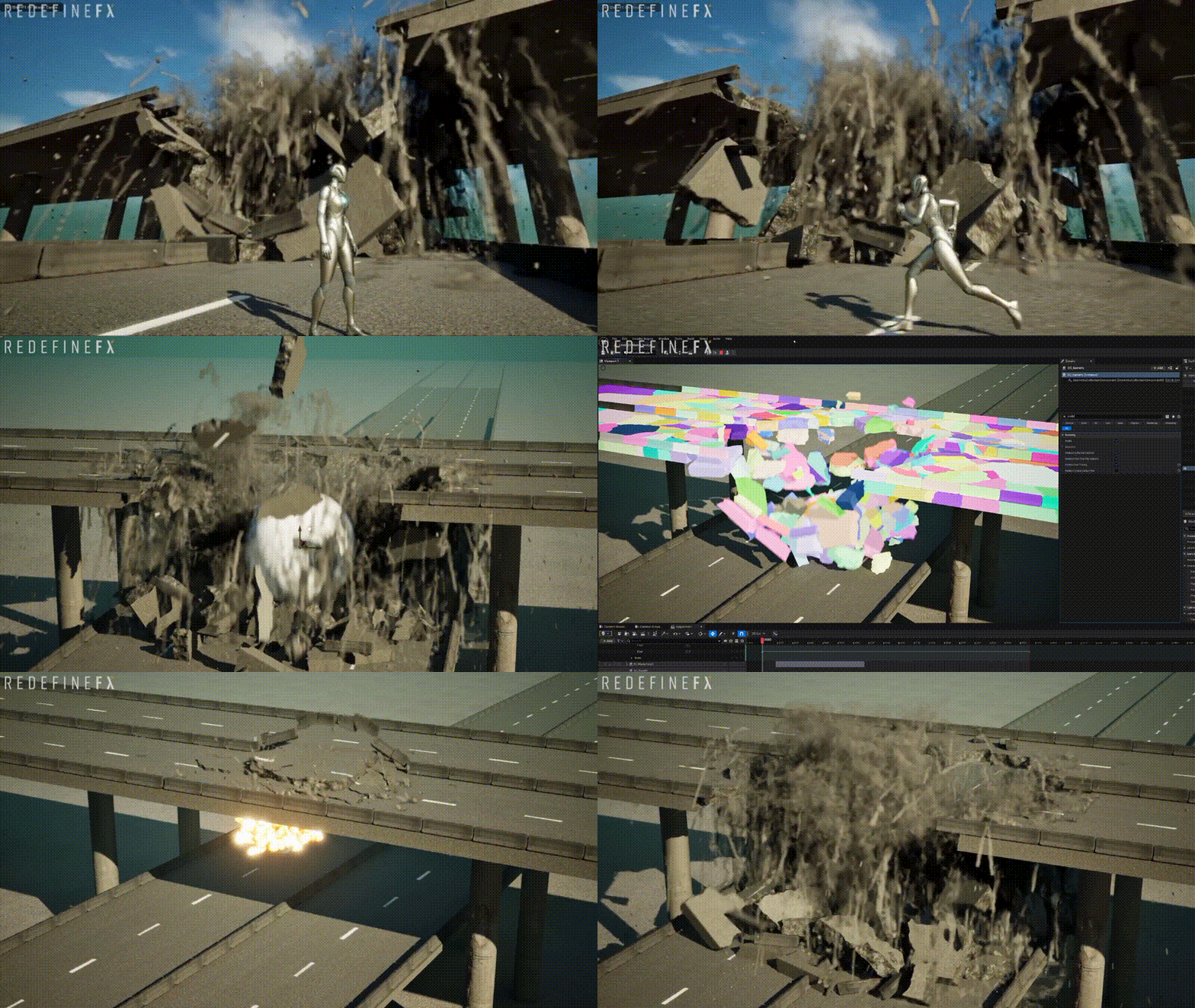
A Procedural Destruction Pipeline with Houdini and Unreal Engine 5 is a modern VFX and game development workflow that combines procedural content generation with real-time physics simulation. It allows artists and technical designers to create highly realistic destruction systems that can be reused, parameterized, and dynamically controlled inside a game engine.
In this pipeline, Houdini is used as the primary destruction authoring tool, while Unreal Engine 5 is used as the real-time runtime environment. The integration enables destruction systems that are not pre-baked only, but also interactive, scalable, and physics-driven using Chaos Physics.
The core idea is proceduralism: instead of manually modeling every fractured state, artists define rules that generate destruction dynamically.
Why Houdini and Unreal Engine 5 Are the Industry Standard for Procedural Destruction
The combination of Houdini and Unreal Engine 5 has become the industry standard because it balances offline simulation power with real-time rendering performance.
Houdini provides:
- Advanced procedural modeling tools
- High-end RBD (Rigid Body Dynamics) simulation
- Procedural fracturing systems
- Deep control over destruction attributes
Unreal Engine 5 provides:
- Real-time rendering with Nanite and Lumen
- Chaos Physics destruction system
- Niagara particle integration
- High-performance game-ready execution
Together, they form a scalable pipeline used in AAA games, cinematic production, and virtual production environments.
Setting up the Houdini Engine Plugin for Unreal Engine 5 Workflow Integration
To connect Houdini with Unreal Engine 5, developers use the Houdini Engine plugin.
Key setup steps include:
- Installing the Houdini Engine plugin inside Unreal Engine 5
- Linking Houdini installation path
- Enabling procedural asset support (HDA workflows)
- Configuring cook settings for real-time updates
This integration allows Houdini Digital Assets (HDAs) to be imported directly into Unreal Engine, where they can be adjusted dynamically without leaving the engine.
This is critical for iterative destruction design workflows.

Understanding Procedural Fracturing Techniques in Houdini for Realistic Destruction
Procedural fracturing is the foundation of destruction simulation.
Common techniques include:
- Voronoi fracturing for organic break patterns
- Boolean-based slicing for structured destruction
- Noise-driven fracture variation for realism
- Attribute-based control for material-specific break behavior
These techniques allow artists to simulate how real-world materials such as concrete, wood, or glass break under force.
Houdini’s procedural system ensures that no two destruction events need to look identical.
How to Create High-Detail Rigid Body Destruction (RBD) Simulations in Houdini
Rigid Body Dynamics (RBD) simulations define how fractured pieces move after breaking.
Steps include:
- Fracturing geometry into packed pieces
- Assigning mass and constraint attributes
- Applying force fields or impact drivers
- Running simulation using Bullet solver
The result is physically accurate destruction that reacts to environmental forces such as explosions, collisions, or gravity.
These simulations can then be cached or exported for use in Unreal Engine 5.
Exporting Houdini Destruction Assets to Unreal Engine 5 Using HDA and FBX Workflows
There are two primary export methods:
Houdini Digital Assets (HDA)
HDAs allow real-time procedural control inside Unreal Engine 5. Artists can adjust parameters like:
- Fracture density
- Impact strength
- Debris size distribution
FBX Export
FBX workflows are used for static or baked destruction sequences where performance optimization is required.
HDAs are preferred for interactive workflows, while FBX is used for finalized assets.

Using Chaos Physics in Unreal Engine 5 for Real-Time Destruction Systems
Chaos Physics is the built-in physics engine for destruction in Unreal Engine 5.
It enables:
- Real-time rigid body simulation
- Mesh breaking at runtime
- Constraint-based fracture systems
- Environmental interaction with dynamic objects
Chaos Physics is essential for bridging Houdini-generated assets with gameplay-driven destruction events.
Building Game-Ready Destruction Assets with Optimized Geometry and LODs
Game-ready destruction assets must be optimized for performance.
Key techniques include:
- Reducing unnecessary polygon density
- Creating Level of Detail (LOD) versions
- Merging small debris into clusters
- Using instanced geometry for repeated fragments
This ensures that destruction systems do not overload GPU or CPU performance during gameplay.
Procedural Destruction with Vellum and RBD Hybrid Simulation Techniques
Houdini’s Vellum system introduces soft-body and secondary physics effects.
Hybrid workflows combine:
- RBD for rigid structural breakage
- Vellum for cloth, debris dust, and flexible elements
This allows for more cinematic realism, especially in environments like collapsing buildings or organic destruction sequences.

How to Use Packed Primitives and Clustering for Large-Scale Destruction Effects
Packed primitives are essential for optimizing large destruction scenes.
Benefits include:
- Reduced memory usage
- Faster simulation performance
- Efficient instancing of fractured pieces
Clustering techniques group fragments into hierarchical structures, allowing multi-stage destruction such as:
- Wall cracking
- Chunk separation
- Final debris scattering
This approach is widely used in AAA destruction systems.
Integrating Niagara Particle Systems with Procedural Destruction in Unreal Engine 5
Niagara is used to enhance destruction realism with visual effects.
Integration includes:
- Dust and debris simulation
- Smoke trails from fractures
- Spark and fire effects during explosions
- Secondary motion particles
Niagara responds dynamically to Chaos Physics events, creating fully reactive destruction environments.
Baking Simulation Data for Real-Time Performance in Unreal Engine 5 Environments
Simulation baking is used to convert complex procedural motion into optimized data.
Benefits:
- Lower runtime computation
- Consistent visual playback
- Reduced CPU overhead
Baked data can be stored as:
- Cache sequences
- Vertex animation clips
- Precomputed rigid body states
This is critical for large-scale destruction scenes in real-time games.
Using Vertex Animation Textures (VAT) for Optimized Destruction Performance
Vertex Animation Textures (VAT) store animation data in texture form rather than skeletal rigs.
Advantages include:
- Extremely high performance
- GPU-driven animation playback
- Scalable destruction systems
VAT is commonly used for:
- Pre-fractured object animations
- Large-scale collapsing environments
- Reusable destruction assets
Common Optimization Techniques for Houdini to Unreal Engine 5 Destruction Pipelines
Optimization is essential for production-ready pipelines.
Key methods include:
- Reducing fracture complexity
- Using instancing instead of unique meshes
- Limiting simulation frame ranges
- Compressing geometry caches
- Using GPU-driven simulation where possible
These techniques ensure stability in real-time environments.
Real-World Use Cases: Film, AAA Games, and Cinematic Destruction Pipelines Explained
Procedural destruction pipelines are widely used across industries:
Film Production
Used for large-scale simulations in blockbuster visual effects sequences.
AAA Game Development
Used in open-world destruction systems, combat environments, and physics-driven gameplay.
Cinematic Production
Used in virtual production and real-time film rendering pipelines.
This workflow has become essential for modern digital content creation.

Frequently Asked Questions (FAQs)
- What is a procedural destruction pipeline?
It is a system that generates destruction effects dynamically using procedural rules instead of manual modeling. - Why is Houdini used for destruction?
Because it offers advanced procedural fracturing and simulation control. - Why use Unreal Engine 5 for destruction?
It provides real-time rendering and physics with Chaos Physics. - What is Chaos Physics?
A real-time destruction and physics simulation system in Unreal Engine 5. - What is an HDA in Houdini?
A Houdini Digital Asset that allows procedural tools to be used inside Unreal Engine. - What are RBD simulations?
Rigid Body Dynamics simulations used for realistic object breaking and movement. - What is Vertex Animation Texture (VAT)?
A performance optimization method that stores animations in textures. - Can Houdini destruction be used in games?
Yes, it is widely used in AAA game development pipelines. - What is Niagara in Unreal Engine 5?
A particle system used for visual effects like dust, smoke, and debris. - How is large-scale destruction optimized?
Through clustering, LOD systems, packed primitives, and baking simulations.

Conclusion
The Procedural Destruction Pipeline with Houdini and Unreal Engine 5 represents a state-of-the-art workflow for creating scalable, realistic, and interactive destruction systems. By combining procedural generation in Houdini with real-time physics and rendering in Unreal Engine 5, developers can achieve production-quality destruction for games, films, and virtual environments. The integration of Chaos Physics, Niagara, VAT, and RBD systems ensures that destruction is not only visually impressive but also highly optimized for performance.
Sources and Citations
- SideFX Houdini Documentation
https://www.sidefx.com/docs/houdini/ - Unreal Engine 5 Official Documentation (Epic Games)
https://docs.unrealengine.com/ - Chaos Physics System Overview: Unreal Engine
https://docs.unrealengine.com/en-US/physics/chaos-physics/ - Niagara VFX System Documentation: Unreal Engine
https://docs.unrealengine.com/en-US/RenderingAndGraphics/Niagara/ - Vertex Animation Textures (VAT) Technical Overview SideFX
https://www.sidefx.com/docs/houdini/vat/
Recommended
- Mortal Shell 2 Gameplay Debut Reveals New Ways To Survive The Nightmare
- Devil May Cry Characters Guide: Meet the Heroes, Villains, and Icons of the Series
- The Last of Us Part 2’s Major Death Was “Controversial Internally Too,” Former Naughty Dog Dev Says
- The First Berserker: Khazan: Neople Announces Restructure of Dev Teams — What It Means for Updates and Nexon’s Plans
- How to Build an RPG Character Creator Using MetaHuman in Unreal Engine 5
- tinyBuild on the Success of Hozy: How the Cozy Renovation Game Caught Attention Fast
- s&box Open-Source Game Creation Platform: How to Build, Mod, and Publish Games with Source 2 + C#
- 28 Years Later: The Bone Temple Is Coming to Netflix on March 31, 2026 in the US: Release Date, Cast, Plot, and Streaming Details
- Poxel.io: Complete Guide to the Pixel FPS .io Game (How to Play, Weapons, Modes, Maps, Skins, and Settings)
- Walton Goggins Shares Unexpected Inspiration Behind The Ghoul In Fallout 76 & Fallout Season 2: Behind the Voice, Character, and Gaming Legacy