






As of 1 April 2026, Russia is discussing a targeted change that could let game developers whose intellectual property is held by a foreign legal entity still place certain games into the national software registry—provided Russian users are served from domestic infrastructure. The policy rationale centres on aligning game-industry realities (global payments and foreign IP holding structures) with existing IT incentives—most notably the VAT exemption available to registry-listed software.
What is the Russian software registry and why game studios want access to it
The “Russian software registry” is the Unified Register of Russian computer programs and databases created within the framework of a government procurement regime that restricts the admission of foreign software for state and municipal needs; the same legal framework also establishes rules for maintaining the register and determining “Russian” origin for listed software.
For game studios, the commercial value of registry inclusion is less about public procurement and more about tax positioning and eligibility signalling. One concrete benefit is the VAT exemption that applies to the transfer of rights (including licences and remote access) to software and databases included in the registry. In 2026, that exemption is materially larger in absolute terms because the standard VAT rate is 22%, increasing the spread between taxable and exempt supplies where the exemption applies.
Differences between “Russian software” criteria and proposed rules for games
Under the current baseline, registry eligibility is tightly connected to the identity and control of the rights holder: the exclusive right must belong (for the worldwide scope of the exclusive right and its full term) to a Russian citizen, a Russian commercial organisation with majority Russian participation (as defined in the registry rules), or certain public/non-profit Russian entities meeting specified governance constraints. The rules also include a quantitative limitation on certain payments to foreign persons (including via controlled structures) as a share of the rights holder’s revenue, which matters for business models involving foreign royalties or licensing stacks.
The proposal discussed publicly in early 2026 is different in its axis: rather than rewriting the “Russian rights holder” test across all software, it indicates a game-specific regime that would tolerate foreign IP holding structures if Russian users are supported and served from domestic IT infrastructure (including server placement). In other words, the proposed direction appears to shift part of the “Russian-ness” proof from ownership/control to operational localisation for the Russian user base.
What “foreign rights holder” means for games entering the Russian software registry
In strict registry terms today, a “foreign rights holder” problem arises whenever the exclusive rights to the software are held by an entity that is not eligible under the register’s rights-holder criteria (for example, a foreign corporation, or a Russian company that does not meet the ownership/control conditions).
In the game-industry context described by policymakers, “foreign rights holder” often refers to a practical structuring choice: studios may register rights to a foreign legal entity to accept payments from foreign users and to operate on global platforms. The proposed approach implicitly treats that situation as compatible with domestic support goals, as long as the Russian market is operationally served from inside the country.
Can a developer with a foreign legal entity add games to the Russian software registry
Under the current, generally applicable registry rules, direct inclusion is typically not available if the exclusive rights are held by a foreign legal entity (or by a rights holder outside the permitted categories), because registry inclusion requires the exclusive right to belong to specified Russian persons/entities for the full term and worldwide scope.
However, public statements in 2026 indicate that a carve-out may be introduced for games, allowing inclusion where rights are registered to foreign legal entities—explicitly to reflect the need to receive foreign payments—provided that Russian users are supported and hosted on domestic infrastructure. As of 1 April 2026, this appears to be a policy proposal and not yet a fully published final legal text with detailed eligibility language and enforcement mechanics.

Key conditions for registry inclusion: hosting game servers in Russia for Russian users
The core condition described publicly is operational: for Russian users, games must be supported and placed on IT infrastructure within Russia, including hosting (servers) inside the country. This is framed as a specific response to the mismatch between globally monetised games and domestic support tools designed for “Russian software” defined mainly by rights-holder nationality/control.
Practically, “servers in Russia for Russian users” can be read as covering the critical path of gameplay and service continuity for the Russian audience—such as authentication, matchmaking, persistence, and patch/update delivery—because those are typically the elements that determine whether a game is truly “supported” in a market rather than merely sold there.
Eligibility checklist for foreign-owned game IP in the Russian software registry
As of 1 April 2026, any “checklist” for foreign-owned game IP must be split into (a) what the current registry rules require and (b) what the announced game-specific regime suggests.
Under current rules, registry inclusion hinges on the rights-holder eligibility test (Russian citizen / qualifying Russian organisation / certain Russian public or governance-constrained non-profit entities), plus additional constraints and supporting documentation.
Under the announced direction for games, the following items emerge as the likely load-bearing conditions to watch for in the eventual legal text (because they are explicitly stated as the reason foreign-held rights might still be admitted):
- Domestic support and domestic placement of infrastructure for Russian users, including hosting game servers in Russia.
- A delineation between Russian-facing operations and global monetisation structures, reflecting the stated motivation (foreign payment acceptance).
- Compatibility with general registry lifecycle controls (evidence of rights, documentation of technical and operational characteristics, and ongoing reporting/updates where required).
Separately, games that process personal data of Russian users should anticipate that Russian localisation expectations for personal data storage and related processing operations will remain relevant in any “servers in Russia” compliance narrative.

Timeline: when the 2026 game registry changes could take effect
Public reporting indicates the proposal was presented as part of a broader package of measures for the domestic game industry in early 2026, with the registry-access element tied to enabling existing IT tax benefits (including VAT treatment) for game developers in structures that currently fail the rights-holder test.
As of 1 April 2026, the most defensible timeline statement is conditional: implementation depends on formal amendments to the registry rules and/or related tax-administration guidance, which have not been fully published in the open sources referenced here as a complete “final form” for the game-specific regime.
In parallel (and important for context), the registry framework itself is experiencing other 2026-era regulatory change. For example, the government adopted amendments with an effective date of 1 March 2026 for broader registry/procurement-related rules, and staged implementation of certain compatibility-related requirements is described in the associated regulatory materials. Any eventual “game carve-out” may need to reconcile with these broader evolving baseline requirements.
VAT exemption for games in the Russian software registry: how the benefit works
Russian VAT law exempts the transfer of exclusive rights and rights to use (including updates and additional functionality, and including remote access via telecom networks such as the internet) to software and databases that are included in the Unified Register of Russian programs and databases. The same provision explicitly limits the exemption where the transferred rights essentially provide the ability to distribute or access advertising, place offers for buying/selling, search for potential buyers/sellers, and/or conclude deals online—an exclusion aimed at advertising and marketplace-type software.
If games become registrable under the proposed regime, the VAT relevance is straightforward in principle: transactions structured as licensing or granting access to the game software (including remote access) could fall under the exemption, subject to meeting the “in registry” condition and not falling into the statutory exclusions. This is especially salient in 2026 given the standard VAT rate increase to 22%, which increases the tax wedge where exemption is available.
For free-to-play monetisation, VAT outcomes can hinge on legal characterisation. Federal Tax Service of Russia has previously explained that where paid in-game elements are framed and executed as part of a licence grant to use elements of the computer programme (for example, “unactivated data and commands” of an online game, including audiovisual display outputs) under a licence agreement accepted by the user, the VAT exemption logic can apply to that transfer of rights. The same letter also acknowledges that earlier court practice had viewed certain paid additional functionality as paid services in substance; the tax treatment turned on how the legal relationship was structured and documented.
This history is relevant because a “registry + VAT exemption” strategy for games may require careful alignment between EULA/licensing language, technical delivery, and the tax-law concepts of transferring rights to use software.
Finally, foreign suppliers of online access to games must consider Russia’s “electronic services” VAT regime, which expressly includes providing rights to use computer programmes (including computer games) via the internet, including via remote access. Depending on transaction design and whether a Russian intermediary is involved as a tax agent, foreign suppliers can face registration/filing and VAT payment obligations in Russia for electronic services supplied into the Russian market.
How to apply to the Russian software registry for a video game: steps and documents
The registry application process is implemented through the state information system for the software registries and relies on authenticated access and electronic signing.
The documented workflow includes: completing identity/authentication (commonly through the unified identification system used for state e-services), collecting the required documents/materials, installing tooling needed to sign documents, and submitting the electronic application form. Applications and notifications are signed using an enhanced qualified electronic signature of the rights holder (or authorised representative), and the system workflow includes generating a statement for signature after completing the electronic forms.
The documentation package described in methodological guidance includes (among other items):
- A software instance (a copy) without technical copyright protection measures, or with lawful means of removing usage restrictions in the cases specified in the guidance.
- Proof of authority for the signatory where needed, charter documents in specified ownership scenarios, and documents confirming compliance with the rights-holder eligibility requirements referenced in the registry rules.
- Documentation describing functional characteristics and information needed for installation and operation; documentation explaining lifecycle support processes (including fixing issues, improving the product, and staffing for support); documentation describing storage/handling of source and object code and the technical means of compilation; and documentation describing licence-key activation, release, distribution, and licence-key management where applicable.
If games receive a special regime for foreign-held rights, the required documentary evidence would likely expand to cover proof of “Russian users served from Russian infrastructure” (for example, technical architecture diagrams, hosting contracts, operational SLAs, or similar evidence), because that is the newly announced core criterion.
Russian infrastructure requirements for games: data localization, hosting providers, and compliance
A “servers in Russia” condition aligns with existing Russian legal expectations in at least three practical areas: service continuity, personal data localisation, and platform-facing compliance in a tightening regulatory environment.
First, personal data localisation (for Russian citizens’ data) remains a foundational compliance constraint for any online game collecting user information. Russian law requires that, when collecting personal data (including via the internet), the recording, systematisation, accumulation, storage, updating, and retrieval of Russian citizens’ personal data be ensured using databases located in Russia, subject to enumerated exceptions. This requirement is widely treated as a “data localisation” rule and is directly implicated by the announced “domestic infrastructure for Russian users” approach.
Second, regulatory proposals for the video game sector have been moving toward explicit obligations on platforms and rights holders/distributors, including personal data localisation for Russian users and user identification mechanisms. A major legal analysis of the draft game-focused law notes that it is designed less as industry support and more as a framework for mandatory requirements and restrictions on game distribution in Russia, applicable regardless of the jurisdiction of registration. This broader regulatory context raises the operational bar for any developer (especially foreign) considering registry inclusion as a market strategy.
Third, for games delivered online, the “electronic services” classification in the tax code explicitly includes remote-access rights to computer games as a formal category—reinforcing that technical architecture and service delivery are not merely engineering decisions but can drive tax and compliance classification.
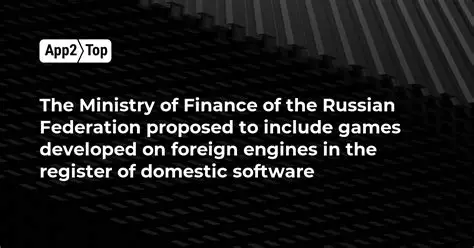
MinTsifra proposal to include games in the Russian software registry: what’s known so far
Public reporting indicates that the ministry’s package is intended to create a special regime that lets game developers benefit from existing IT incentives despite “non-standard” rights-holding structures, because studios often register rights to foreign legal entities to accept payments from foreign users.
The specific registry element is described as allowing games to be added to the Russian software registry when (for Russian users) the game is supported and hosted on domestic IT infrastructure. The stated consequence is eligibility for the VAT benefit associated with registry-listed software.

What the policy means for publishers vs developers with foreign legal entities
The proposal is particularly relevant where “developer”, “publisher”, and “rights holder” are not the same legal person—common in games due to global distribution, platform relationships, and financing structures.
If the eventual regime is keyed to “foreign legal entity holds rights because of global payments” rather than “foreign publisher controls the asset”, then implementation details will matter: a carve-out designed for a Russian development team using a foreign rights-ho
lding vehicle could behave very differently from a carve-out used by a foreign publisher to register a largely foreign-controlled title while merely localising servers for Russian users. The announced condition (domestic Russian-user infrastructure) is necessary but may not be sufficient in the eventual legal text; a likely policy design question is whether there will be additional safeguards to prevent the carve-out from becoming a general backdoor for foreign-controlled software into a registry historically tied to procurement sovereignty and domestic industry support.
Will games on foreign engines qualify for the Russian software registry
At the baseline legal level, the registry rules include a quantitative constraint on certain “foreign” payments (including to foreign persons and controlled structures) as a share of the rights holder’s revenue from software sales, which can make ongoing foreign-engine royalties or licence stacks a structural risk for eligibility.
In practice, market commentary has reported that registry evaluators have sometimes been willing to include software built on foreign engines (including popular commercial engines) when the specific ownership/licensing/payment facts do not trigger disqualifying foreign payment flows at the time of application, but such statements are not a substitute for the registry rules and the concrete evidence demanded in an application.
A further complication arises from broader 2026-era changes around registry and “trusted” software requirements in adjacent regulation: if compatibility-with-trusted-OS requirements become relevant to listed classes of software on a phased schedule, games primarily targeting mainstream consumer platforms could face additional friction—unless games are explicitly exempted or treated through a tailored standard.

Risks for foreign developers entering the Russian software registry: legal and operational issues
The risk profile is multi-layered. The first layer is legal eligibility volatility: registry inclusion depends on meeting documentary and substantive conditions, and removal can occur where requirements cease to be met or where false/incomplete information is discovered. A model that relies on a game-specific carve-out must anticipate ongoing audits and future tightening of interpretation, particularly because the registry’s original policy design is rooted in national procurement restrictions and domestic-software definitions.
The second layer is data and platform compliance. Even apart from registry rules, personal data localisation mandates remain enforceable, and game-sector regulation proposals describe obligations such as localisation of personal data, user identification, and content restrictions for “distributors” and “service organisers” operating in Russia, regardless of their foreign jurisdiction. These obligations can increase operational burden and create conflicts with global compliance postures.
The third layer is VAT and tax administration complexity. Online distribution frequently triggers the electronic services VAT regime for foreign suppliers; obligations can fall on foreign suppliers or intermediaries as tax agents depending on transaction structure. Even where a VAT exemption is available for registry-listed software, game monetisation often involves mixed streams (licensing, subscriptions, in-game functionality, virtual items), and the VAT treatment can depend on the legal characterisation of each stream—illustrated by past disputes and subsequent tax authority clarifications.
How registry inclusion could impact Russian game market growth and exports
If implemented with workable compliance mechanics, the proposed policy could reduce the tax friction of supplying games in Russia by making VAT exemption accessible to more studios whose rights are held through foreign entities for global monetisation reasons. That could improve unit economics for certain sales models (particularly where the transaction is best characterised as a licence/right to use the software) and strengthen the investment case for Russian-market support operations (servers, customer support, compliance staffing).
At the same time, tying eligibility to Russian infrastructure can raise fixed costs, concentrate operational dependencies on domestic providers, and increase compliance exposure (data localisation, identification, and other platform obligations discussed in the draft game-law context). The net market effect would therefore depend on where the final rules set the balance between (a) tax and status benefits and (b) localisation and compliance burdens, especially for globally oriented studios.

Frequently Asked Questions (FAQs)
- Is the inclusion of foreign-held game IP in the registry already in force (as of 1 April 2026)?
Public reporting describes it as a proposal with stated conditions (domestic hosting and support for Russian users), not as a fully published final rule set. - Why is “foreign legal entity” ownership common for game IP in the first place?
The stated reason is payment practicality: developers may register rights to foreign legal entities to accept payments from foreign users. - What is the single most important condition mentioned for admitting such games to the registry?
Hosting and supporting the game for Russian users on IT infrastructure inside Russia, including server placement in Russia. - What VAT benefit is tied to registry inclusion?
VAT law exempts the transfer of rights (including remote access) to software and databases that are included in the Unified Register, subject to statutory exclusions. - Does the VAT exemption apply to everything a game sells (including virtual items)?
Not automatically. VAT outcomes can depend on whether paid elements are structured and documented as granting rights to use part of the computer programme (licence-style) versus being treated as paid services; tax authority guidance illustrates the importance of the underlying legal structure. - How does the higher 2026 VAT rate change the stakes?
In 2026, Russia’s standard VAT rate is 22%, which increases the potential tax difference between taxable and exempt supplies where the exemption is applicable. - Do foreign companies supplying games online to Russian users face separate VAT obligations?
Yes. The tax code’s electronic services VAT regime explicitly includes providing rights to use computer programmes (including computer games) via the internet, and the rules allocate VAT obligations to foreign suppliers and/or intermediaries depending on transaction design. - What are the most important “infrastructure compliance” issues likely to sit behind “servers in Russia”?
Personal data localisation for Russian citizens’ data is a central compliance constraint: specified personal data operations during collection must be carried out using databases located in Russia, subject to exceptions. - What does the application process to the registry generally require (before any game-specific carve-out details)?
Authenticated access, collection of a defined set of documents/materials, and submission through the registry system with signing by an enhanced qualified electronic signature; documentation commonly includes software copies and detailed technical/lifecycle documentation. - Could broader 2026 registry reforms affect games indirectly?
Yes. Separate from the gaming proposal, 2026-era changes to registry and “trusted software” requirements (including compatibility-related conditions on staged timelines) may influence what is practical for certain categories of software unless games are explicitly treated via tailored rules.
conclusion
As of 1 April 2026, the discussed policy direction is to reconcile the reality that game IP is often held through foreign legal entities (for global monetisation and payments) with Russia’s domestic support instruments by allowing registry inclusion where Russian users are served from domestic infrastructure—especially domestic servers and support.
If the proposal is implemented through clear legal amendments and workable compliance standards, registry access could expand VAT-exempt distribution options for qualifying games, a benefit that is more financially significant under the 22% VAT rate in 2026. The major trade-off is that operational localisation (hosting, data localisation, and broader platform obligations described in draft sector regulation) can increase compliance and operational cost, potentially limiting adoption to studios for whom the Russian market and the VAT effect justify that burden.
sources and citation
- Government Framework for the Software Registry
- Primary Law:Federal Law No. 149-FZ “On Information, Information Technologies and Information Protection” (specifically Article 12.1).
- Regulatory Decree:Government Decree No. 1236 (Nov 16, 2015).
- VAT Exemption and Electronic Services Regime
- VAT Exemption for Software:Tax Code of the Russian Federation, Article 149, Paragraph 2, Sub-clause 26.
- Electronic Services (including Games):Tax Code of the Russian Federation, Article 174.2.
- 2026 VAT Rate Increase
- Official Guidance:Federal Law No. 176-FZ (July 12, 2024), Federal Tax Service (FNS) Official Portal.
- Domestic Infrastructure for Games
- Policy Statement:Ministry of Digital Development (Mintsifry) Official News
- Related Proposal: Refer to the Draft Law on the Regulation of Video Games (search for “реестр компьютерных игр” or “registry of computer games”), which mandates local server presence for games distributed within the RF.
- Registry Application Mechanics
- Methodological Guidance:Official Guidelines for Entry into the Unified Register
- Personal Data Localization
- Interpretations:Roskomnadzor (RKN) Clarifications on Localization.
- Primary Law:Federal Law No. 152-FZ “On Personal Data,” Article 18, Part 5.
Recommended
- Moosa Dirty Fate – World Premiere Trailer | Xbox Partner Preview Showcase 2026: Gameplay, Story, Release Date & Everything We Know
- Venom Animated Movie From Final Destination: What Fans Mean, Rumors Explained, and What Could Actually Happen
- The Witcher Comics Comes to WEBTOON: Release Date, Where to Read, and What to Expect
- Can I Improve My Metahuman in Blender? A Comprehensive Guide
- Fortnite’s Original Save the World Mode Finally Going Free-to-Play, Launching on Switch 2 April 16
- Blender Restore Curve Segment Length Geometry Nodes Preset: Complete Guide
- Stylized Water Shader in UE5: Complete Guide to Creating Real-Time Cartoon Water Effects
- AAA Game Budgets in the US and Canada Now Exceed $300 Million: Why Development Costs Are Skyrocketing in 2026
- Devil May Cry: Complete Guide to the Iconic Action Franchise, Characters, and Latest Updates
- Resident Evil Requiem is likely the series’ biggest launch ever — 5 million units sold in under a week