








SAND: Raiders of Sophie Earned $1 Million in 12 Hours and What the Revenue Figure Means
SAND: Raiders of Sophie generated $1 million in gross revenue during its first 12 hours on Steam, giving publisher tinyBuild and developers Hologryph and TowerHaus a commercially impressive Early Access opening. tinyBuild CEO Alex Nichiporchik shared the milestone while acknowledging that launch day was disrupted by server instability and a distributed denial-of-service attack. Crossing seven figures under those conditions showed that the game’s unusual premise had already created substantial demand before players knew whether its technical problems would be resolved quickly.
The amount represents gross revenue, not net profit. It describes the money generated through sales before deductions such as regional taxes, refunds, Valve’s platform share, marketing expenditure, development costs, infrastructure spending, and other operating expenses. Nichiporchik did not disclose a verified unit-sales total, so the revenue announcement cannot be converted into an exact number of copies sold.
The Steam edition normally cost $24.99 but launched with a 21% introductory discount that reduced the listed United States price to $19.74 until July 6. Dividing $1 million by that discounted price would produce a rough figure of slightly more than 50,000 full-price-equivalent purchases. The actual number of buyers could be higher or lower because Steam uses regional pricing, some transactions may be refunded, taxes differ by location, and not every purchase necessarily used the same price.
The speed of the revenue matters more than an uncertain unit estimate. A new premium Early Access game generating $1 million in half a day indicates that a large group of players was prepared to purchase immediately rather than wait for patches, detailed reviews, or a later discount. It also shows that the game’s 1.1 million Steam wishlists were not merely passive expressions of interest. Part of that audience converted into paying customers as soon as the game became available.
Three factors supported the opening: visibility, conversion, and urgency. Visibility came from trailers, public tests, Steam discovery, creator coverage, Summer Game Fest exposure, and the attention surrounding the game’s changing release plans. Conversion came from the enormous wishlist base. Urgency came from the introductory discount and the curiosity surrounding a delayed online game whose walking-fortress concept looked substantially different from other survival releases.
The milestone is especially notable because unstable online launches often encourage prospective buyers to wait. SAND relies on working servers for exploration, multiplayer conflict, extraction, progression, and the preservation of valuable loot. Reports of connection problems could easily have stopped cautious players from purchasing during the opening hours, yet the game still reached the announced figure.
That commercial performance validated the central fantasy before it validated the complete product. Players were demonstrably interested in building enormous mechanical bases, travelling across a hostile desert world, gathering resources, confronting artificial-intelligence enemies, fighting other crews, and escaping with valuable equipment. The first 12 hours proved the marketability of that concept, while the weeks following launch would determine whether the game could retain the people attracted by it.

How SAND Reached 1.1 Million Wishlists, Entered Early Access, and Survived a Ddos-Hit Launch
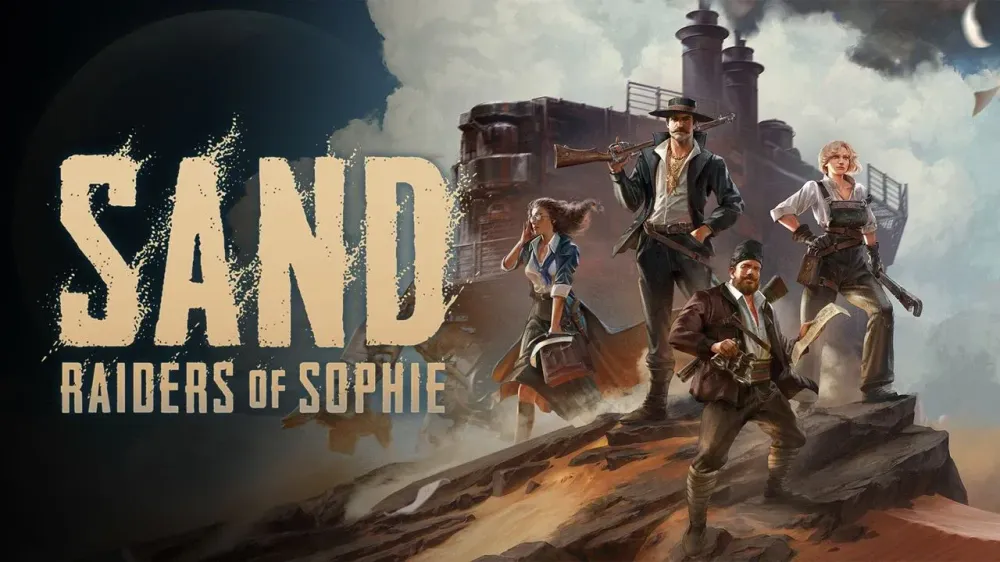
SAND: Raiders of Sophie reached more than 1.1 million Steam wishlists because its central premise could be communicated almost immediately. Players do not merely construct a stationary shelter and use a separate vehicle to explore. They build a giant walking machine called a Trampler that functions simultaneously as a base, transport system, weapon platform, workshop, storage area, and visible statement of the crew’s progress.
That hook gave SAND a recognizable identity in a market filled with extraction shooters, open-world survival games, and multiplayer PvP sandboxes. Its first-person looting and combat are familiar genre elements, but attaching them to a customizable mobile fortress changes the scale of exploration and conflict. A distant Trampler moving across the dunes can represent a possible ally, a valuable target, or a heavily armed crew capable of destroying everything the player has collected.
The setting helped distinguish the game further. SAND takes place in an alternate version of 1910 in which the Austro-Hungarian Empire expanded into space and colonized the planet Sophie. An ecological catastrophe later left the colony abandoned, creating a world of desert landscapes, industrial machinery, ruined cities, imperial remnants, weapons, and forgotten resources. This mixture of historical imagery, science fiction, and mechanical construction gave the project a different visual language from a conventional futuristic survival game.
Genre timing also worked in its favor. Steam players continue to show strong interest in survival, extraction, crafting, and open-world PvP experiences, but new projects need a clear identity to avoid blending into a crowded field. SAND offered familiar risk-and-reward systems while making the vehicle itself part of the player’s home, inventory, progression, and vulnerability.
Its delays created a more complicated effect. Repeated postponements can reduce confidence, but they can also keep a distinctive game in public discussion. SAND moved through several plans, including an earlier March 2026 window, a June 10 target, and the eventual June 22, 2026 Early Access launch. Each test, announcement, revised date, and server discussion returned the game to players’ attention.
The most consequential change was the decision to enter Early Access. Pre-launch stress testing revealed server and client-side problems serious enough to prevent the developers from presenting the release as a finished product. The team used feedback and technical information from its Server Slam to analyze logs, improve the backend, address bugs, and reshape the immediate development plan.
Moving to Early Access shortly before release carried a reputational risk. Some players could interpret the change as evidence that the project was launching prematurely. The developers instead framed it as the beginning of a community-driven development period in which Discord discussions, Steam forums, surveys, social media responses, and public testing would help determine the route toward Version 1.0.
The $1 million opening showed that many prospective players accepted that arrangement. They were willing to buy access to an unfinished but distinctive multiplayer framework, trusting that the developers would use launch revenue and community feedback to improve stability, performance, progression, balance, and content. Commercial success gave the project more room to develop, but it also increased expectations for how quickly meaningful improvements would arrive.
The launch became one of Steam’s most visible releases of its week because the basic fantasy was easy to imagine. A crew could build a walking fortress, save its design as a blueprint, travel through a ruined desert, raid another machine, survive a battle at an extraction point, or lose valuable resources during an unexpected encounter. These possibilities gave SAND the emergent “story generator” quality that often helps multiplayer sandboxes spread through livestreams and personal recommendations.
The same complexity placed enormous pressure on the online infrastructure. Nichiporchik said the launch was affected by a DDoS attack, adding an external problem to backend weaknesses already identified through stress testing. For an extraction game, disrupted access is more serious than a delayed menu or a temporary inconvenience. A disconnect can interrupt progression, waste a long session, prevent an extraction, or create concern that valuable loot has been lost through circumstances outside the player’s control.
Not every complaint could be attributed to malicious traffic. Players also reported bugs, optimization problems, delays, and technical roughness. The DDoS incident explained part of the unstable opening, but restoring server access alone could not resolve all the concerns visible in early reviews. Recovery required dependable connections, better performance, clearer communication, balance work, and evidence that Early Access was producing continued development rather than excusing an unfinished state.

Steam Reviews, Trampler Gameplay, Open-World PvP, and TinyBuild’s Role
The Steam response to SAND: Raiders of Sophie was divided during its opening period. One captured German Steam listing showed 1,563 reviews with 58% rated positively, while other reports placed the game’s reception around 60% positive and within Steam’s Mixed category. The result reflected a sharp separation between reactions to the underlying concept and reactions to the state in which players encountered it.
Negative reviews concentrated on practical launch problems. Some customers could not connect reliably, while others reported unstable sessions, bugs, poor optimization, shifting launch timing, and frustration with the communication surrounding repeated delays. These issues were especially damaging because SAND is built around persistent risk. Players are more likely to tolerate a visual problem than a disconnection that threatens loot or prevents them from completing an extraction.
Positive reactions focused on what happened when the systems worked. Players found the combination of a mobile base, desert exploration, PvE encounters, player conflict, scavenging, and extraction pressure compelling. Even some people who criticized the launch acknowledged that the Trampler created memorable situations not commonly found in other survival games.
The Trampler editor is central to that appeal. Players can assemble machines using functional compartments such as engines, reactors, storage spaces, spawn points, defensive sections, and weapon platforms. The machine is not simply a cosmetic vehicle selected from a menu. Its layout affects how a crew moves through it, distributes responsibilities, protects important systems, stores equipment, and responds when another group attacks.
Blueprint saving makes experimentation less punishing. A destroyed machine can represent a significant loss, but preserving its design allows a crew to rebuild a successful layout rather than recreate every decision from memory. This supports repeated improvement as players reconsider weapon placement, armor, access routes, power systems, storage, and the positions from which crew members defend the interior.
The Trampler changes the meaning of open-world PvP because a player’s home travels into danger with them. In many survival games, the fortified base remains in one location while players leave with disposable vehicles or limited equipment. In SAND, the moving structure contains transport, supplies, weapons, and accumulated progress. A defeat can therefore cost more than the items carried by one character.
This creates visible tension before combat begins. Two large machines approaching across an open desert can study one another before firing. Their crews may attack, retreat, hide, change direction, search for a better angle, or attempt to reach an extraction point before the situation becomes worse. The scale of the machines makes approaching danger readable from a distance while preserving uncertainty about the intentions and equipment of the opposing crew.
The wider PvPvE loop supports those encounters. Players explore a large open environment, complete contracts, fight hostile mobs, search cities, collect weapons and resources, manage changing conditions, and attempt to extract their findings. Procedural layouts and a day-and-night system add variation, while the world’s claimed scale encourages crews to travel rather than remain around one predictable combat zone.
Teamwork is one of the game’s largest attractions. One crew member can pilot while another makes repairs, manages machinery, controls a cannon, watches for threats, or prepares to board another structure. Dividing these responsibilities gives the game a cooperative fantasy comparable to operating a ship, but the land-based mechanical fortress creates a separate visual and strategic identity.
Solo play is supported, although it is considerably more demanding. One person must explore, navigate, fight, repair, operate Trampler systems, manage loot, and respond to extraction threats without assigning tasks to a crew. The resulting sessions can be memorable, but the difference in efficiency between one player and an organized group creates legitimate balance concerns.
A coordinated crew can drive, repair, shoot, and defend at the same time, while a solo player must stop doing one task to begin another. This has led to discussion about squad limits, cannon control, and whether separate matchmaking or other balancing systems may eventually be needed. The game’s multiplayer focus gives it much of its personality, but that focus must not make independent players feel that they exist primarily as easy targets.
tinyBuild played a major role in turning the concept into a prominent Steam release. Hologryph and TowerHaus developed the game, while tinyBuild contributed publishing resources, marketing reach, creator outreach, community communication, playtest organization, pricing strategy, platform coordination, and the infrastructure planning required by an online release.
The 1.1 million wishlists demonstrate that the pre-release campaign successfully converted an unusual design into measurable audience interest. The publisher now faces a different responsibility. After helping create a commercially powerful launch, tinyBuild must help manage the consequences of the unstable opening through clear communication, technical support, realistic expectations, and visible updates.
The launch therefore created a mixed but understandable verdict. SAND was not rejected because players found its premise uninteresting. Its Mixed reception emerged because a strong premise arrived with technical barriers that prevented some customers from experiencing it properly. The developers and publisher have something valuable to preserve, but doing so requires improving the product around the Trampler fantasy rather than relying on that fantasy to excuse every weakness.

Wishlist Conversion, Launch Problems, Roadmap Priorities, and Whether Momentum Can Last
Any comparison between SAND: Raiders of Sophie sales and its 1.1 million wishlists must begin with the absence of a confirmed unit total. The $1 million gross figure establishes that early monetization was strong, but it does not reveal precisely how many wishlisted users purchased the game. Regional prices, refunds, bundles, taxes, and the launch discount make a dependable conversion percentage impossible to calculate from the disclosed information.
The available figures nevertheless show that only a relatively small part of the wishlist audience needed to buy during the first 12 hours for the game to cross seven figures. This is one reason a large Steam wishlist base can be commercially valuable. It places the game in front of people who have already expressed interest and can receive launch, update, and discount notifications.
Several positive forces encouraged conversion. The Trampler premise was visually distinct, the launch discount reduced the immediate price, Steam visibility placed the release in front of more users, and the game’s unpredictable encounters made it suitable for livestreams and short gameplay clips. The delays may also have increased curiosity among players who wanted to determine whether the long-awaited build justified the extended development period.
Negative forces worked against those advantages. The move to Early Access signaled that major development remained unfinished, stress-test results had already raised infrastructure concerns, early reviews highlighted technical problems, and prospective buyers had limited assurance about optimization. Some users who had wishlisted the game were likely to wait for patches rather than purchase during the initial surge.
That remaining wishlist audience is still important. Conversion does not end after launch day. A major patch, review recovery, free weekend, roadmap milestone, new content release, or later discount can bring back players who decided against purchasing during the unstable opening. The unconverted wishlist base gives SAND a large audience to re-engage when the product improves.
The launch problems can be divided into timing, infrastructure, expectations, and polish. Timing was already sensitive because the project had passed through several delays before arriving on June 22. Additional launch-day uncertainty made the release feel less dependable to customers who had followed those changing plans.
Infrastructure was the most visible failure. The Server Slam had shown that demand could place heavy pressure on the backend, and the June 10 target was abandoned so the developers could study logs and correct server-side issues. The reported DDoS attack then placed further pressure on an environment that was already being strengthened.
Expectations created another difficulty. The large wishlist count, extensive promotion, and long development period encouraged players to anticipate an important release. Changing to Early Access attempted to reset that standard by acknowledging that the project required further work, but not every customer accepted the new framing. Some viewed Early Access as a legitimate collaborative phase, while others believed the game was being sold before it was ready.
Polish was the fourth concern. Reports of bugs and optimization problems demonstrated that the launch conversation was not solely about servers. A player who connects successfully can still have a poor experience when performance is inconsistent, onboarding is unclear, balance favors organized groups too heavily, or basic systems feel unfinished.
The roadmap must address the most damaging barriers before emphasizing ambitious content expansion. Server stability, DDoS protection, performance optimization, bug fixing, onboarding, matchmaking, progression clarity, and PvP balance are immediate priorities. New weapons, Trampler components, contracts, locations, enemies, and quality-of-life features will be easier to appreciate once players can enter and complete sessions reliably.
Community feedback is intended to guide that process through Discord, Steam discussions, surveys, and social media. Collecting feedback is only the beginning. The developers must identify repeated problems, explain which changes are being prioritized, publish understandable patch notes, avoid unrealistic dates, and show how the Early Access build is progressing toward Version 1.0.
The $1 million opening means SAND has passed its first commercial test. Players are willing to spend money on a PvPvE survival game about customizable walking fortresses in an alternate-history desert. The harder test is retention: keeping early customers engaged, improving the review rating, converting people still waiting on their wishlists, and making each major update feel like meaningful progress.
The game has several advantages. Its premise is easy to explain, its machines are visually memorable, its multiplayer roles support social play, and its systems can accommodate additional content over time. It also has a publisher capable of continuing promotion and production support.
Its risks are equally significant. Extraction and survival communities depend heavily on trust because one technical failure can erase the result of a long session. Players who repeatedly lose access, progress, or loot may leave before the roadmap reaches its most ambitious stages. Solo users may also abandon the game when group combat feels structurally unfair.
Maintaining momentum will depend on the speed and quality of the response rather than on the launch number alone. SAND does not need to become a finished product immediately, but every substantial update must demonstrate direction. The opening proved that people want the game’s central fantasy. Continued success depends on whether Hologryph, TowerHaus, and tinyBuild can deliver a stable and rewarding version of it.
Frequently Asked Questions (FAQs)
- Did SAND: Raiders of Sophie earn $1 million in its first 12 hours?
Yes. tinyBuild CEO Alex Nichiporchik said SAND: Raiders of Sophie generated $1 million in gross revenue within 12 hours of its Steam Early Access launch. The figure does not represent confirmed profit or an official unit-sales total, but it demonstrates that the game converted part of its 1.1 million-wishlist audience extremely quickly. The milestone validates the commercial appeal of its walking-fortress concept. It also places greater pressure on tinyBuild, Hologryph, and TowerHaus to turn the strong opening into sustained player retention through stable servers, better performance, and continued updates. - When did SAND: Raiders of Sophie launch?
SAND: Raiders of Sophie launched in Steam Early Access on June 22, 2026. It had previously been associated with earlier plans, including a June 10 target, but technical information collected through server stress testing led the developers to postpone the release. The final launch also followed a decision to use Early Access as a community-driven development period. The developers intend to continue improving the game on the route toward Version 1.0 rather than treating the June build as a finished product. - Who developed SAND: Raiders of Sophie?
The game was developed by Hologryph and TowerHaus. tinyBuild serves as its publisher and has handled important parts of its promotion, launch communication, pricing, community reach, and commercial strategy. The partnership helped the project reach more than 1.1 million Steam wishlists before release. After launch, the same companies became responsible for responding to server problems, optimization concerns, bugs, balance discussions, and demand for clearer roadmap communication. - Why were SAND: Raiders of Sophie reviews Mixed at launch?
Many negative reviews focused on server access, DDoS-related disruption, repeated delays, bugs, poor optimization, and the belief that the Early Access build needed more polish. One captured Steam listing showed 1,563 reviews with 58% positive, while other launch reporting placed the game near 60% positive. Positive reviewers generally praised the concept, particularly the mobile-base construction, crew roles, desert exploration, and unpredictable PvPvE encounters. The Mixed rating therefore reflected a promising game whose technical condition prevented some players from enjoying its strongest systems. - What are Tramplers in SAND: Raiders of Sophie?
Tramplers are enormous walking mechanical bases that function as transport, storage, shelter, machinery platforms, and weapons systems. Players can construct them from compartments including engines, reactors, storage areas, spawn points, defensive sections, and mounted weapons. Their designs can be saved as blueprints, allowing players to rebuild or improve a machine after it is destroyed. Because the base moves into the open world with the crew, every journey carries the possibility of losing more than the loot held by an individual character. - Is SAND: Raiders of Sophie an extraction shooter or a survival game?
It combines elements of both. Players explore an open environment, gather resources, complete contracts, fight PvE enemies, encounter rival crews, construct Tramplers, manage equipment, and attempt to extract valuable loot. Its survival and base-building systems create long-term preparation, while its PvPvE encounters and extraction pressure make individual expeditions risky. The result is a multiplayer sandbox rather than a narrowly defined conventional shooter. - Why was SAND: Raiders of Sophie delayed before launch?
The developers delayed the game after server stress testing exposed substantial technical problems. They said they needed additional time to examine logs, optimize server-side systems, address client-side bugs, and incorporate findings from the Server Slam. The delay moved the launch from June 10 to June 22 and accompanied the decision to release through Early Access. Although the added time allowed more work to be completed, server instability and a reported DDoS attack still affected the opening. - Can SAND: Raiders of Sophie be played solo?
Yes, but solo play is more difficult because one person must manage exploration, piloting, combat, repairs, Trampler systems, loot, and extraction threats without help. A crew can distribute those responsibilities across several players and perform multiple tasks simultaneously. Solo sessions can still create memorable survival stories, but organized groups possess a clear operational advantage. Concerns about squad balance and the treatment of solo players may therefore remain important during Early Access development. - Why did SAND: Raiders of Sophie sell so quickly?
The strongest factors were its 1.1 million Steam wishlists, easily understood Trampler premise, introductory discount, high storefront visibility, creator-friendly encounters, and the appeal of an open-world PvPvE game built around mobile fortresses. The alternate-history setting also helped it stand apart visually from other science-fiction survival releases. The commercial opening shows that players were interested in the concept even after multiple delays and the move to Early Access. A substantial part of the audience was prepared to purchase immediately rather than wait for the technical picture to improve. - Will SAND: Raiders of Sophie improve after its Early Access launch?
The developers say Early Access will be used to expand and improve the game through player feedback, roadmap updates, new content, performance work, and bug fixes. Feedback is expected to come through Steam, Discord, surveys, social media, and other community channels. Improvement is planned, but its effectiveness will depend on execution. Stable servers, DDoS protection, better optimization, clearer onboarding, dependable progression, PvP balance, and transparent communication need to accompany new Tramplers, weapons, contracts, locations, and PvE threats if the game is to convert its impressive opening into lasting success.

Conclusion
SAND: Raiders of Sophie earned $1 million in the first 12 hours because it launched with rare pre-release demand, a huge wishlist base, and a concept that immediately stood out on Steam. Its walking Trampler fortresses, open world PvP, extraction tension, and alternate-history desert setting gave players a strong reason to pay attention.
However, the launch also exposed the danger of releasing an ambitious online game before stability is fully proven. DDoS attacks, server issues, bugs, optimization complaints, and mixed Steam reviews shaped the first impression almost as much as the revenue milestone. That makes SAND both a success story and a recovery story.
The future of SAND: Raiders of Sophie depends on execution. If tinyBuild, Hologryph, and TowerHaus can stabilize servers, improve performance, communicate clearly, and deliver meaningful roadmap updates, the $1 million opening could become the foundation for a long-running Early Access success. If not, the game risks becoming another strong concept weakened by launch problems. For now, the first 12 hours prove that players want what SAND is offering. The next few months will decide whether they stay.
Sources and Citations
- SAND Raiders of Sophie Official Steam Store Page
https://store.steampowered.com/app/1431300/SAND_Raiders_of_Sophie/ - SAND Official Website
https://sandthegame.com/ - Steam Community SAND Announcements
https://steamcommunity.com/app/1431300/announcements/ - PC Gamer One Day Before Launch Extraction Shooter SAND Gets Delayed Again and Becomes an Early Access Game
https://www.pcgamer.com/games/fps/one-day-before-launch-extraction-shooter-sand-gets-delayed-again-oh-and-its-an-early-access-game-now-too/ - PC Gamer SAND Publisher Celebrates 300000 Copies Sold
https://www.pcgamer.com/games/survival-crafting/sand-publisher-celebrates-300-000-copies-sold-we-getting-a-half-hour-of-air-conditioning-tonight/ - GamesRadar SAND Grosses 1 Million Dollars in Its First 12 Hours While Battling DDoS Attacks
https://www.gamesradar.com/games/fps/cant-lose-if-you-never-give-up-after-a-last-minute-delay-and-pivot-into-early-access-new-extraction-shooter-grosses-usd1-million-in-its-first-12-hours-as-devs-battle-ddos-attacks/ - App2Top SAND Raiders of Sophie Reaches 1.1 Million Wishlists
https://app2top.com/ - WNHub SAND Raiders of Sophie Wishlist Growth and Early Access Launch
https://wnhub.io/ - Instant Gaming News The Launch of SAND Raiders of Sophie Has Been Hampered by DDoS Attacks
https://news.instant-gaming.com/en/articles/20361-the-launch-of-sand-raiders-of-sophie-has-been-hampered-by-ddos-attacks - Alex Nichiporchik Official X Account
https://x.com/aNichiporchik
Recommended
- Outward 2 Early Access Launches July 7: Nine Dots Confirms “Potato Mode” for Low-End PCs
- Gen V Canceled After 2 Seasons, But The Boys Prequel Vought Rising Gets a 2027 Release Date
- Final Fantasy VII Rebirth Adds Streamlined Progression and New Game “Head Start” Mode: Full Feature Breakdown Explained
- Battlefield 6 Season 2 New Maps, More Guns, And LTMs: Release Date, Roadmap, Contaminated & Hagental Base, VL-7 Modes
- Silver Palace, Official Beta Test Gameplay Showcase Trailer: Everything You Need to Know About the New Victorian Open-World RPG
- Classic Cartoon Network Flash Games Return as Powerpuff Girls and Samurai Jack Become Playable Again
- Freelance and Indie Commercial License
- Avatar: the Last Airbender Season 2 Ratings Drop 59% After Divisive Reviews: What Went Wrong?
- Disney and Make-A-Wish “Wishes Assemble” at Disneyland: MrBeast, Dude Perfect, Clix, Mark Rober, and More Surprise Wish Kids
- The View Keeper Add-on: Why Every Blender Artist Needs It for Optimized Rendering Workflows



































































































