










In This Article (9 sections)
Sega’s Sonic Infinite Blue Anniversary Sculpture: Design and Specifications
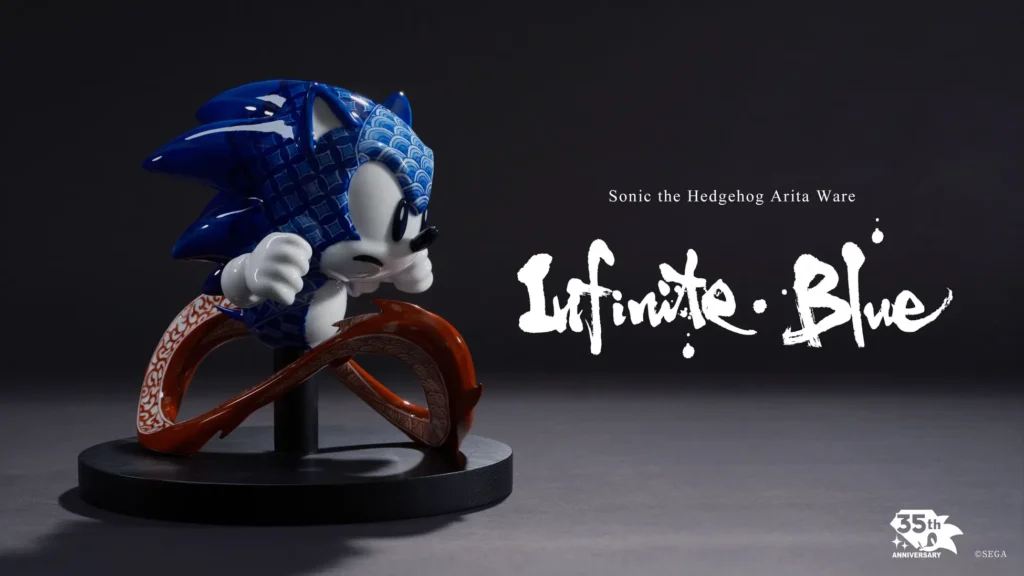
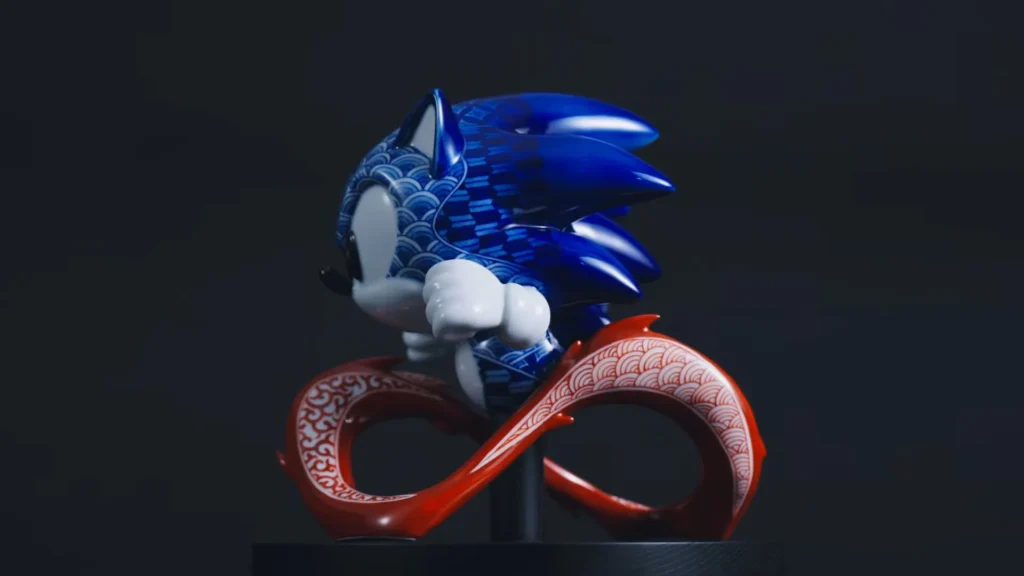
Sega’s $7,000 Sonic the Hedgehog Arita Ware “Infinite Blue” sculpture brings traditional Japanese porcelain craftsmanship into the character’s 35th-anniversary celebrations. Announced through Sonic Channel on October 2, 2026, the officially licensed artwork is limited to 50 individually numbered pieces worldwide. Its sales opening on October 9 coincided with SONIC the Exhibition, ACROSS GENERATIONS, at Tokyo’s Ikebukuro PARCO. Developed through YOYOYO’s collaboration with specialist ceramic workshops, the sculpture combines contemporary digital design, hand-painted decoration, and a complex porcelain structure. It is positioned as a luxury collectible artwork rather than a conventional Sonic action figure.
The anniversary commemorates Sonic’s debut on the Sega Genesis and Mega Drive in 1991, with the character celebrating 35 years on June 23, 2026. During that period, Sonic expanded from Sega’s signature platform-game character into a franchise encompassing games, animation, feature films, merchandise, and creative collaborations. Infinite Blue approaches that history through an unfamiliar medium instead of simply reproducing a recognizable game scene. Its composition presents Sonic moving through flowing, intersecting trails intended to capture extraordinary speed. The design connects a character associated with technological entertainment to Japanese ceramic traditions that developed centuries before video games.
The name Infinite Blue reflects both the sculpture’s shape and its decoration. “Infinite” refers to the looping, infinity-shaped trails surrounding Sonic, suggesting continuous movement and possibility. “Blue” connects the character’s appearance with Gosu, the traditional cobalt-based pigment used in Japanese porcelain decoration. Sonic’s recognizable silhouette remains central, while suspended-looking legs, sweeping curves, and intersecting forms create a more abstract composition than a conventional standing or running pose. The artwork’s appeal comes partly from making rigid porcelain appear fluid and weightless. Its official specifications and package contents are:
- Material:
Arita porcelain with hand-painted decoration. - Dimensions:
15.6 centimeters wide, 22.8 centimeters deep, and 21.3 centimeters high, approximately 6.14 inches wide, 8.98 inches deep, and 8.39 inches tall. - Edition:
50 individually numbered pieces worldwide. - Included items:
The sculpture, a display pedestal, a certificate, and a wooden storage box.
Although relatively compact, Infinite Blue incorporates a demanding arrangement of projecting elements, decorative surfaces, and structural connections. Its dimensions therefore do not fully communicate the work required to produce it. The pedestal supports its presentation as a display object, while the certificate and numbered edition document its collectible identity. The wooden box provides a designated container and forms part of the overall presentation. Together, these elements reinforce the project’s intention to reinterpret Sonic through specialist craftsmanship rather than compete with mass-market figures on size or affordability.
YOYOYO, Arita Porcelain Craftsmanship, and the $7,000 Price
YOYOYO is a porcelain brand that connects traditional Japanese craftsmanship with contemporary entertainment properties, including video games and animation. Its approach treats porcelain as a medium for collectible art rather than restricting it to tableware or conventional decorative objects. Infinite Blue applies that philosophy to Sonic, combining a character associated with speed and technology with the specialist knowledge of Japanese ceramic workshops. Arita, in Saga Prefecture, has a porcelain tradition dating back approximately four centuries and is recognized for refined ceramics, detailed decoration, and blue-and-white designs. The collaboration gives gaming audiences an opportunity to encounter that craftsmanship through a familiar character.
Two workshops contribute different production skills. 224porcelain handles the sculpture’s complex forming process, combining knowledge associated with Hizen Yoshida ware in Saga Prefecture with digital design and three-dimensional production methods. Riso Kiln, also known as Rishō Kiln or Li-Sho Kiln, is responsible for painting and finishing. Located at a site connected with the history of Japanese porcelain production, the kiln is led by fourth-generation artisan Shinji Terauchi, whose work emphasizes the refinement of traditional blue-and-white decoration. According to the manufacturer, the workshop’s ceramics have been used by restaurants including Gaggan in Bangkok and Mugaritz in Spain. Infinite Blue brings together 224porcelain’s approach to difficult forms and Riso Kiln’s decorative expertise.
Porcelain presents challenges that differ substantially from those involved in producing PVC, ABS plastic, resin, or polystone figures. Ceramic materials change during firing, creating risks of shrinkage, warping, and cracking. These problems become especially important when a design contains thin sections, unsupported-looking forms, and intersecting curves. Sonic’s slender limbs, pointed quills, and surrounding trails require careful control of thickness, curvature, and connection points. A section that is too thin may fail during production, while a thicker section can compromise the intended appearance or behave differently in the kiln. The designers therefore had to balance visual lightness with the material’s structural requirements.
According to the manufacturer, development took approximately eight months and involved repeated adjustments to digital models, molds, and firing tests. Digital tools helped refine the curves and relationships between different parts, but a workable computer model did not automatically produce a successful ceramic object. Practical experience was needed to understand how the design would respond during forming, drying, and firing. This makes the project a collaboration between digital experimentation and hands-on craft knowledge rather than an example of technology replacing artisans. The final sculpture was developed around porcelain’s physical limitations instead of simply transferring an existing character model into a different material.
Production remains slow even after the design has been established. A skilled artisan can reportedly form only one or two sculptures per day, and some pieces do not pass the initial forming stage because they fail to meet structural or quality requirements. That figure refers only to forming, not the complete sequence of drying, firing, decorating, inspecting, and finishing. A large production run would therefore require a substantially different manufacturing approach. These constraints help explain the suitability of a small edition, although Sega and YOYOYO have not disclosed why they selected exactly 50 pieces rather than another quantity. The confirmed limit defines the edition without providing a complete account of the commercial decision behind it.
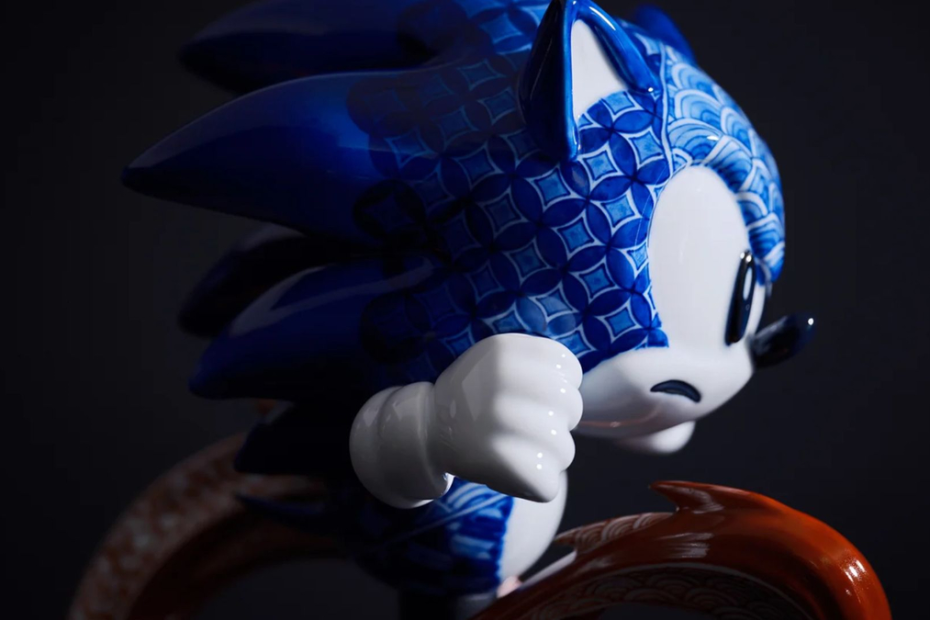
The hand-painted finish introduces another layer of specialist work. Gosu uses cobalt-based pigment to produce the blue tones associated with Japanese blue-and-white porcelain, making it particularly appropriate for Sonic’s visual identity. Unlike ordinary paint applied to a finished plastic figure, its appearance depends on ceramic materials, glaze interactions, and firing conditions. Riso Kiln’s artisans must maintain the intended effect across surfaces with different curves and orientations, from rounded body sections to narrow trails and pointed details. The appearance before firing may differ from the final result, making experience and controlled brushwork important. Subtle differences between individual pieces can reflect manual craftsmanship rather than defects, provided the finished work meets the manufacturer’s standards.
Red decoration associated with Akae, a Japanese overglaze technique, provides contrast against the dominant blue and requires an additional decorative firing process. The manufacturer connects these red elements with energy and movement, reinforcing Sonic’s dynamic character. Traditional patterns also appear in the design, including Seigaiha, a repeating wave motif; Shippo, formed from interlocking circles; and Yagasuri, inspired by arrow feathers. Their use connects the modern character with established decorative traditions. The project associates these motifs with adventure, energy, and forward movement, although those meanings belong to its artistic interpretation rather than measurable product features. Together, the pigment, patterns, and brushwork make the finish an integral part of the artwork rather than a simple color coating.
The $7,000 price reflects this combination of design development, skilled labor, specialist materials, limited output, and luxury positioning. Research, digital modeling, mold development, repeated firing experiments, rejected pieces, decoration, packaging, licensing, and distribution all contribute to the commercial process. However, neither Sega nor YOYOYO has published a detailed cost breakdown, so specific portions of the price cannot accurately be assigned to labor, materials, licensing, or profit. The documented manufacturing difficulties explain why the sculpture occupies a different category from mass-produced merchandise, but they do not independently establish that it represents good financial value. That judgment depends on whether a collector values the particular combination of Sonic history, porcelain craftsmanship, and extreme scarcity.
Official Prices, Lottery Applications, and International Delivery
Infinite Blue’s official sales opening was Friday, October 9, 2026, but its published price differs by market. Japanese customers pay ¥1,000,000, including consumption tax and domestic shipping, with a listed pre-tax price of ¥909,091. The official international price is $7,000, excluding overseas shipping, customs duties, and destination-specific taxes. Some international coverage reported figures closer to $6,000 or $6,300 by converting the Japanese price into US dollars, but those calculations are not the stated overseas selling price. International buyers should therefore use $7,000 as the starting amount, then account for shipping, import duties, taxes, and any applicable customs-processing charges. Because those costs vary by destination, there is no single final international price.
The primary international purchasing route is YOYOYO’s online lottery rather than an ordinary retail order. The first registration period opened at 10:00 a.m. Japan Standard Time on October 9 and closes at 11:59 p.m. on October 18, 2026. Entering creates an opportunity to purchase an allocation, not a guarantee of receiving one. Applicants need to provide accurate details and understand the retailer’s purchase conditions before submitting an entry. The announced process is:
- Submit one entry per person:
Apply through the dedicated Sonic Infinite Blue lottery page in the YOYOYO Official Store and review the relevant requirements. - Wait for selection by email:
Results are expected to be communicated progressively from late October 2026 onward. - Complete the purchase within seven days:
Selected applicants must follow the purchase procedure within seven days of receiving their notification. Missing the deadline could forfeit the allocation under the retailer’s terms. - Monitor the registered email account:
Check spam and promotional folders as well as the main inbox so that purchase instructions are not overlooked. - Remain eligible for the second drawing:
Unsuccessful first-round applicants automatically enter a second drawing, whose timing will be announced separately. This does not indicate additional production beyond the worldwide edition of 50.
The online process is separate from the five pieces allocated to the Tokyo exhibition’s first-come, first-served sales arrangement. Both channels draw from the same worldwide edition, and the event allocation is not an additional production run. As of October 13, the published information did not establish that all 50 pieces had been sold or identify every remaining allocation. Likewise, an open registration period does not confirm that every applicant will receive a purchase opportunity. Claims about current stock, completed sales, or availability need to be distinguished from the originally announced allocation rules.
The manufacturer’s listed delivery destinations include Japan, South Korea, Taiwan, Hong Kong, Singapore, Australia, the United States, Canada, the United Kingdom, European Union member states, Switzerland, and Norway. Customers outside those locations are instructed to contact the manufacturer before arranging delivery. The international release should therefore not be interpreted as an unconditional promise of shipping to every country. Exhibition purchases also have their own domestic Japanese delivery arrangements, so overseas visitors should not assume those purchases automatically include international fulfillment. Shipping eligibility and the applicable delivery conditions need to be established before payment.
The October release date marks the beginning of the purchasing process, not immediate delivery of completed sculptures. Online orders are manufactured to order, with fulfillment beginning after the relevant order period and a published estimate allowing up to approximately ten months for delivery. The exhibition allocation follows a separate event-related fulfillment schedule, which should not be assumed to match the online estimate. This distinction matters because the announcement date, sales opening, lottery results, and delivery are separate milestones. Buyers should be comfortable with an extended production period rather than expect their sculpture to arrive during October 2026.
Payment and delivery terms deserve close attention given the price and the nature of the product. Buyers should review cancellation conditions, shipping arrangements, and the procedures for reporting damage, defects, or delivery problems. Limited allocations may also encourage unofficial offers claiming guaranteed lottery access, preferential treatment, or immediate delivery without verifiable ownership. Those claims should be approached cautiously rather than treated as substitutes for the announced process. Using the manufacturer’s official sales channels, checking payment instructions, and obtaining written confirmation of the purchase terms provides a clearer record of what has been agreed.
Tokyo Exhibition, In-Person Sales, and Sculpture Care
SONIC the Exhibition, ACROSS GENERATIONS, opened on October 9, 2026, at PARCO FACTORY on the seventh floor of the Ikebukuro PARCO Main Building in Tokyo and is scheduled to continue until November 1. The exhibition examines Sonic through games, character design, music, archival materials, and artistic interpretations. It includes material connected to game development, historical artwork, and creative decisions across different periods of the franchise. Rather than celebrating popularity alone, the event considers how Sonic’s presentation evolved alongside gaming technology and entertainment culture. Infinite Blue fits this setting as an interpretation that connects the character’s modern identity with a much older artistic medium.
Seeing the sculpture in person offers a different perspective from viewing promotional photographs. Its intersecting curves, painted surfaces, projecting details, and compact dimensions contribute to an overall composition that may not be fully apparent in a flat image. The exhibition allows visitors to examine how Sonic’s silhouette relates to the surrounding trails and traditional decorative elements. Other anniversary merchandise and artist collaborations place Infinite Blue within a broader celebration of the franchise’s 35-year history. This context presents the piece as both a commemorative product and an example of collaboration between character design, digital modeling, and ceramic craftsmanship.
Five sculptures were allocated to a first-come, first-served purchasing opportunity at the exhibition. That allocation does not establish that five pieces remain available throughout the event, and attendance does not guarantee a purchase. Buyers should also distinguish securing an order from taking the artwork home immediately, since delivery occurs later under the venue’s arrangements. Those arrangements concern domestic Japanese delivery rather than an automatic worldwide shipping service. For collectors unable to attend Tokyo, the online lottery provides a separate route into the same limited edition.
Once delivered, the sculpture requires careful placement and handling. Properly manufactured and preserved porcelain can remain stable for long periods, but hardness should not be confused with resistance to impact. The material is brittle, and Infinite Blue’s thin trails, extended limbs, and other projecting features create vulnerable points. A stable display surface with sufficient space around the artwork is preferable to a crowded shelf where nearby objects could make contact. A cabinet may reduce dust and accidental handling, provided it gives the sculpture enough clearance. Owners should avoid lifting it by delicate projections and follow the manufacturer’s handling instructions rather than assume those elements can support its weight.
Cleaning and storage need similar care. Harsh abrasives, aggressive chemicals, unnecessary pressure, or unsuitable handling could damage decorative surfaces or delicate sections, so the manufacturer’s recommendations should take priority before water or cleaning products are used. The original certificate, wooden box, pedestal, edition information, and purchase records should also be retained. These materials document the collectible’s presentation and ownership history and may be relevant to authenticity or a later transfer. The box and paperwork should be stored in conditions that limit moisture damage and deterioration. Preserving the sculpture therefore involves both protecting the porcelain itself and maintaining the accompanying materials.
Collector Value and the Place of Luxury Gaming Artwork
Infinite Blue’s appeal depends on what a buyer wants from a collection. A dedicated Sonic enthusiast may value its official licensing, 35th-anniversary connection, individual edition number, and exceptionally small production run. A collector of Japanese ceramics may be more interested in the workshops, traditional pigments, complex forming methods, and the interaction between digital design and manual decoration. These qualities distinguish it from an ordinary character figure, but they do not make the purchase equally compelling for every fan. Someone primarily seeking an attractive Sonic display piece may not consider the price justified, while a specialist interested in both gaming history and contemporary craft may place greater value on the combination.
Its rarity must also be separated from expectations about resale. A worldwide edition of 50 establishes scarcity, but demand, condition, authenticity, provenance, and broader market conditions determine what future buyers may be willing to pay. Even strong initial interest would not guarantee that resale prices consistently exceed the original retail amount. As of October 2026, Infinite Blue remained within its initial purchasing and allocation period, with no established long-term transaction history from which to judge appreciation. Changes in collecting preferences, economic conditions, or franchise interest could affect later demand. Its edition number is therefore an ownership characteristic, not a financial promise.
Condition is particularly important for an intricate porcelain object. Accidental damage could affect both its appearance and its desirability to another collector, while complete documentation may help establish a clear ownership history. The substantial initial expense also needs to be considered alongside additional international charges and the potential ten-month fulfillment period. Buyers should understand the manufacturer’s delivery and damage-reporting procedures rather than assume handmade production or careful packaging removes every practical risk. The strongest established reasons to collect Infinite Blue are appreciation of its design, craftsmanship, anniversary significance, and limited availability. Future resale performance remains uncertain.
The collaboration also follows an existing direction for YOYOYO rather than representing its first entertainment-related porcelain project. In January 2026, the brand introduced a Ghost in the Shell Tachikoma collectible as another worldwide edition of 50. According to its published background information, a video documenting that production process surpassed one million YouTube views. That release demonstrated an interest in translating futuristic entertainment designs into traditional ceramic forms, while Sonic introduced a different set of structural and visual challenges. Together, the projects show how recognizable fictional properties can bring specialist workshops to the attention of audiences outside conventional ceramics collecting.
Infinite Blue does not establish that gaming merchandise as a whole is moving toward extreme luxury pricing. Mass-market figures and other accessible products remain important because they allow a much wider audience to participate in fandom. Instead, the sculpture demonstrates how established characters can also support specialist markets built around unusual materials, limited quantities, and skilled production. Such projects require cooperation between licensing companies, designers, craft workshops, and brands capable of presenting the resulting work to collectors. Their long-term viability depends on continued appreciation of that combination rather than exclusivity alone.
The project’s broader significance lies in how it brings digital entertainment and traditional craft together without treating either as a replacement for the other. Digital tools helped develop the shape, while ceramic expertise determined how that shape could survive physical production and receive its hand-painted finish. Sonic may draw a collector’s attention first, but the artwork also introduces the techniques and workshops behind it. For Sega, Infinite Blue adds an unusual dimension to the anniversary; for YOYOYO and its collaborators, it provides an international showcase for Japanese porcelain. Its lasting appeal will rest less on the headline price than on whether collectors continue to value that meeting of gaming history, artistic interpretation, and specialist craftsmanship.

Frequently Asked Questions (FAQs)
- What is Sega’s $7,000 Sonic 35th-anniversary porcelain sculpture?
The sculpture is officially titled Sonic the Hedgehog Arita Ware “Infinite Blue,” a limited-edition porcelain artwork created by YOYOYO with Japanese ceramic specialists to commemorate Sonic’s 35th anniversary. It depicts Sonic surrounded by flowing, infinity-shaped trails that suggest continuous movement and extraordinary speed. Unlike a conventional plastic figure, the piece combines complex ceramic construction with hand-painted Gosu blue and Akae red decoration. Its design connects Sonic’s recognizable appearance with traditional Japanese craftsmanship, positioning it as a specialist display artwork. Only 50 individually numbered examples are being produced worldwide. - How much does the Sonic Infinite Blue porcelain statue cost?
The official international price is $7,000, excluding shipping, customs duties, and applicable destination taxes. Japanese customers pay ¥1,000,000, including Japanese consumption tax and domestic shipping. Lower dollar figures appearing in some coverage reflect conversions of the Japanese price rather than the manufacturer’s stated international selling price. Overseas buyers should therefore use $7,000 as the starting cost, not the final delivered total. Transportation, import charges, and any customs-processing fees can increase the amount payable, with the final cost depending on the destination and delivery arrangements. - When was the Sonic Infinite Blue sculpture released?
Sega announced Infinite Blue through Sonic Channel on October 2, 2026, and sales opened on October 9 alongside SONIC the Exhibition, ACROSS GENERATIONS, in Tokyo. That date marks the beginning of the purchasing process rather than immediate delivery of finished sculptures. Online purchases are manufactured to order, with fulfillment beginning after the relevant ordering period and delivery potentially taking up to approximately ten months. Collectors should distinguish the announcement, sales opening, lottery selection, and delivery stages, since receiving a purchase allocation does not mean the artwork is ready to ship. - How many Sonic Infinite Blue sculptures are being made?
The worldwide edition consists of 50 individually numbered sculptures. Five were allocated to a first-come, first-served purchasing opportunity at the Tokyo anniversary exhibition, and those pieces are included within the total rather than added to it. Other purchasing opportunities follow YOYOYO’s official sales arrangements, including its online lottery. The edition size establishes the maximum announced production run, but it does not indicate how many allocations remain available at any particular time. A later lottery drawing also should not be interpreted as a separate edition or confirmation of additional production. - How can I buy the Sonic Infinite Blue statue?
International buyers can apply through the lottery in the YOYOYO Official Store. The first registration period runs from October 9 through October 18, 2026, Japan Standard Time, with one entry permitted per person. Successful applicants are notified by email, with results expected progressively from late October, and must complete their purchase within seven days of notification. Entering the lottery does not guarantee an allocation or award a free sculpture. Five pieces were also allocated to the Ikebukuro PARCO exhibition’s sales process. Buyers should review the applicable payment, shipping, and cancellation terms before committing. - What materials are used to make the Sonic Infinite Blue sculpture?
Infinite Blue is made from Arita porcelain, with 224porcelain responsible for forming its complex shape and Riso Kiln handling painting and finishing. Its blue decoration uses Gosu, a traditional cobalt-based ceramic pigment whose finished appearance develops through the ceramic firing process. Red details use Akae overglaze decoration, adding another specialist decorative stage. The design also incorporates Seigaiha wave patterns, Shippo interlocking circles, and Yagasuri arrow-feather motifs. These materials and techniques distinguish the sculpture from a plastic or resin figure with an ordinary painted surface. - Why is the Sonic Infinite Blue statue limited to only 50 pieces?
Sega and YOYOYO have confirmed the 50-piece edition but have not explained why they selected that exact number. The demanding production process nevertheless helps explain why a small run is appropriate. Thin curves and intersecting porcelain elements must withstand forming, drying, and firing without unacceptable cracking or distortion, and development reportedly required approximately eight months of testing. An artisan can form only one or two pieces per day, which describes the forming stage rather than completed production. Decoration, further firing, inspection, and rejected attempts add to the work required for each finished sculpture. - What are the dimensions of the Sonic Infinite Blue porcelain sculpture?
The official dimensions are 15.6 centimeters wide, 22.8 centimeters deep, and 21.3 centimeters high, approximately 6.14 inches wide, 8.98 inches deep, and 8.39 inches tall. Each purchase includes the sculpture, a display pedestal, a certificate, and a wooden storage box. Although compact, its projecting trails and delicate details require enough surrounding space to avoid accidental contact. Porcelain is hard but brittle, so the artwork should be placed securely and handled according to the manufacturer’s guidance rather than lifted by thin decorative elements. The accompanying documentation and packaging should also be preserved. - Can the Sonic Infinite Blue sculpture be shipped internationally?
Yes. Listed destinations include the United States, Canada, the United Kingdom, European Union countries, Australia, Singapore, South Korea, Taiwan, Hong Kong, Switzerland, and Norway. International orders start at $7,000 before shipping and import charges. However, an international release does not guarantee delivery to every country, so customers outside the published list must contact the manufacturer before arranging a purchase. Buyers should also distinguish online international orders from exhibition purchases, which have domestic Japanese delivery arrangements. The applicable shipping terms should be confirmed for the specific purchasing channel being used. - Is the Sonic Infinite Blue statue a good investment?
Infinite Blue has distinctive collectible appeal because it combines official anniversary licensing, specialist Japanese porcelain craftsmanship, and a numbered edition of only 50 pieces. However, those qualities do not establish that its resale price will increase, and there is no reliable long-term transaction history demonstrating appreciation. Future value will depend on demand, condition, authenticity, provenance, and market conditions rather than rarity alone. Damage could reduce its desirability, while complete documentation may help establish its ownership history. It is therefore best evaluated as an artwork to appreciate and preserve, not as a guaranteed source of financial returns.
Conclusion
Sega’s $7,000 Sonic 35th-anniversary porcelain sculpture captures the character’s defining speed through an unexpected combination of traditional Japanese craftsmanship and modern digital design. Officially titled Sonic the Hedgehog Arita Ware “Infinite Blue,” the artwork is limited to 50 numbered pieces worldwide, with sales beginning on October 9, 2026. Priced at ¥1,000,000 in Japan and $7,000 internationally, before overseas shipping and import expenses, it occupies a specialist category far removed from conventional gaming merchandise.
The collaboration between YOYOYO, 224porcelain, and Riso Kiln translates Sonic’s movement into flowing, infinity-shaped trails, hand-painted Gosu blue decoration, red ceramic details, and traditional patterns. Approximately eight months of development went into creating that intricate composition, reflecting the challenges of making delicate porcelain convey energy and motion.
For collectors, Infinite Blue’s appeal combines its official anniversary connection, individually numbered edition, specialist craftsmanship, and accompanying presentation materials. Those qualities give it a distinctive collectible identity, but they do not establish that its substantial purchase price will translate into future financial returns. Its rarity is confirmed; its long-term resale performance remains uncertain, making personal appreciation a more dependable basis for collecting than speculation.
Beyond that commercial distinction, the project demonstrates how gaming culture and traditional artistry can give each other new expression. Sonic’s enduring popularity provides a contemporary platform for Japanese ceramics, while those techniques offer a different interpretation of a familiar character. Infinite Blue stands as both an anniversary tribute and an ambitious piece of luxury design, with a lasting significance that may lie less in its price or exclusivity than in its connection between 35 years of gaming history and centuries of Japanese craftsmanship.
Sources and Citations
- Sega Sonic Channel, October 2, 2026: Official Sega product announcement confirming the sculpture’s release date, ¥1,000,000 Japanese retail price, dimensions, 50-piece worldwide edition, and included accessories.
Citation: Sonic the Hedgehog Arita Ware “Infinite Blue” - YOYOYO: Official manufacturer product information covering the sculpture’s concept, decorative techniques, craftsmanship, and luxury collectible positioning.
Citation: Sonic the Hedgehog Arita Ware “Infinite Blue” - YOYOYO Official Store: Official lottery registration and purchasing information, including the October 9 to 18, 2026 application period, eligibility requirements, and selection process.
Citation: Sonic Infinite Blue Lottery - PR TIMES: Original manufacturer announcement from Marukyu describing the 50-piece limited edition, eight-month development process, collaboration between 224porcelain and Riso Kiln, pricing, and international delivery arrangements.
Citation: Marukyu Official Press Release - Sega: Official event announcement detailing the exhibition’s Tokyo location, October 9 opening, historical exhibits, and Sonic anniversary merchandise.
Citation: SONIC the Exhibition -ACROSS GENERATIONS- - Sega Sonic Channel: Official exhibition coverage confirming the inclusion of Infinite Blue, the five-piece exhibition sales allocation, and anniversary merchandise activities.
Citation: SONIC the Exhibition -ACROSS GENERATIONS- - Gamer: Japanese gaming coverage of the porcelain sculpture’s announcement, production methods, official pricing, and collaboration between specialist workshops.
Citation: Sonic Infinite Blue Limited Edition Announcement - RAW JAPAN: Coverage of the Japanese craft collaboration, international pricing, exhibition details, lottery arrangements, and production schedule.
Citation: Sonic in Japanese Arita Porcelain: Infinite Blue on Sale - Dtimes: Japanese reporting documenting the artwork’s Gosu blue pigment, red decorative elements, production specifications, and traditional ceramic techniques.
Citation: YOYOYO Sonic Infinite Blue Porcelain Sculpture
Recommended
- Blizzard Apologizes, Admits World of Warcraft Patch 12.0.5 “Not Up to Our Standards”: What Broke, What’s Fixed, and What’s Next
- Unreal Engine 5.8 Official Feature Highlights Trailer: New Features, Mesh Terrain, Lumen Lite, MetaHuman Crowds, and More
- Mixtape: Official Launch Trailer and Everything We Know About the Coming-of-Age Adventure Game (Release Date, Gameplay, Story, and Soundtrack Details)
- Google Play will let you try a game before you buy it: Game Trials explained (release, supported games, and how it works)
- How To Upgrade Workbench Levels In Windrose (Level 2 & 3 Guide + Materials & Unlocks)
- Canva Releases First Major Update to Its Free Affinity Software: New Features, Changes, and What It Means for Designers
- Autodesk Arnold 7.5.2 with 3D Gaussian Splatting: Features, Performance, and Workflow Improvements
- Elden Ring Tarnished Edition Switch 2 Off-Screen Gameplay Revealed Before August 28 Launch
- Nacon Subsidiaries File for Insolvency: What Happened



































































































