








In This Article (7 sections)
SignSplit Launches With $400 Million From W Group at $1 Billion Valuation
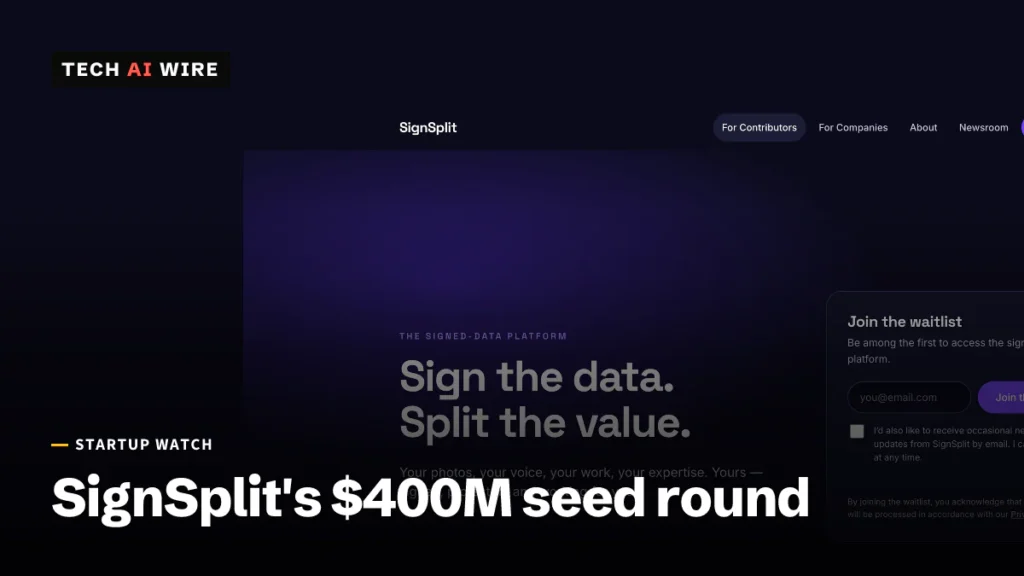
SignSplit launches with $400 million from W Group at a $1 billion valuation, marking one of the most significant early funding announcements in the emerging market for artificial intelligence data provenance, licensing, and digital rights protection. On October 5, 2026, SignSplit PBC announced that it had emerged from stealth with a strategic seed financing commitment intended to support its development of infrastructure for authorized AI data transactions.
The Delaware technology company, founded in 2024, aims to establish what it calls a signed data economy, connecting individuals and institutions with AI developers, robotics companies, researchers, and media organizations. Its proposed platform associates contributed information with records of origin, consent, and permitted uses, allowing participants to establish licensing relationships while maintaining greater visibility into how their materials may be used.
The announcement comes as AI developers face increasing questions about the ownership of training data, permission to use creative works, and compensation for valuable human contributions. SignSplit believes these challenges create opportunities for infrastructure that makes authorized data easier to obtain while helping creators protect and potentially monetize their work.
The $400 million financing commitment includes both capital and a multiyear package of strategic resources. Although announced as a seed investment, the arrangement differs from a conventional funding round because the companies have not disclosed how much represents direct cash investment or how the noncash resources are valued. It would therefore be inaccurate to conclude that SignSplit has already received $400 million in unrestricted operating capital.
The reported $1 billion valuation also requires context. Startup valuations reflect the value assigned to company equity during investment transactions, not annual revenue, profitability, or available cash. While the announcement places SignSplit within the commonly used unicorn category, it does not establish that the company has already achieved substantial commercial scale.
W Group was identified as the sole investor and anchor strategic partner. The investment represents a commitment to the potential development of commercial markets where data ownership, contributor authorization, and compensation become important parts of AI infrastructure.
The central details of the announcement include:
- Company: SignSplit PBC, a Delaware Public Benefit Corporation.
- Founded: 2024.
- Public launch: October 5, 2026.
- Strategic financing commitment: $400 million.
- Reported valuation: $1 billion.
- Investor: W Group.
- Investment structure: Capital combined with multiyear strategic resources.
- Primary business: AI data provenance, licensing, consent management, and verification.
- Target markets: Artificial intelligence, robotics, research, entertainment, and digital platforms.
SignSplit was founded by Glib Denisov and Alessandro Monterosso, who were identified in the company’s October 2026 announcement. Denisov serves as Executive Chairman and Chief Product Officer, while Monterosso is the Chief Executive Officer. Their leadership combines product development, strategic direction, and commercial management as the company enters an emerging technology market.
Denisov has explained that SignSplit’s founding vision focused on the future requirements of artificial intelligence rather than simply responding to existing data collection practices. The company anticipated increasing demand for authenticated human knowledge, experience, creative material, and other contributions accompanied by clear rights information. Monterosso has similarly emphasized the importance of real human contributions to the development of AI, robotics, and related technologies.
SignSplit’s Public Benefit Corporation structure is another notable aspect of its identity. This corporate form requires directors to balance shareholder interests with the public benefit identified in the company’s governing documents and the interests of those materially affected by its activities. The structure is relevant because SignSplit intends to serve both commercial data buyers and individual contributors seeking greater control and compensation.
However, incorporation as a Public Benefit Corporation does not automatically guarantee fair payments, effective rights protection, or particular commercial outcomes. These results will depend on how SignSplit designs and operates its platform.
W Group’s investment provides a potentially important foundation for SignSplit’s expansion. Founded and led by Volodymyr Nosov, W Group describes itself as a global technology and financial services ecosystem containing 11 businesses, more than 1,500 employees, and operations across 15 locations. The group reports serving over 40 million clients in approximately 150 countries.
These figures describe W Group’s broader operations rather than SignSplit’s existing customer base. The investment does not mean that all W Group users will automatically become contributors to SignSplit or participate in its licensing platform.
W Group’s financial technology experience is relevant because authorized data markets involve challenges similar to those found in digital finance. Participants need reliable identity verification, transaction records, contractual authorization, payment systems, and mechanisms for resolving disputes.
Nosov has presented the investment as an opportunity to support infrastructure that could become important across industries dependent on human information. The underlying idea is that AI development increasingly requires not only access to data but also dependable methods for establishing its origin, confirming permissions, and determining compensation.
The strategic partnership could provide SignSplit with access to commercial expertise, international relationships, and resources needed for development. However, these advantages do not automatically establish widespread platform adoption or commercial success.
SignSplit must still demonstrate that contributors trust its licensing arrangements and that AI developers see sufficient value in purchasing properly authorized data through its infrastructure.
Ultimately, the $1 billion valuation represents investor expectations about the future of AI data licensing rather than proof of established market dominance. The company’s next challenge is to transform its strategic financing commitment into a functioning platform with reliable technology, identifiable customers, and sustainable commercial activity.
How SignSplit AI Data Provenance, Signed Data, and Creator Licensing Work
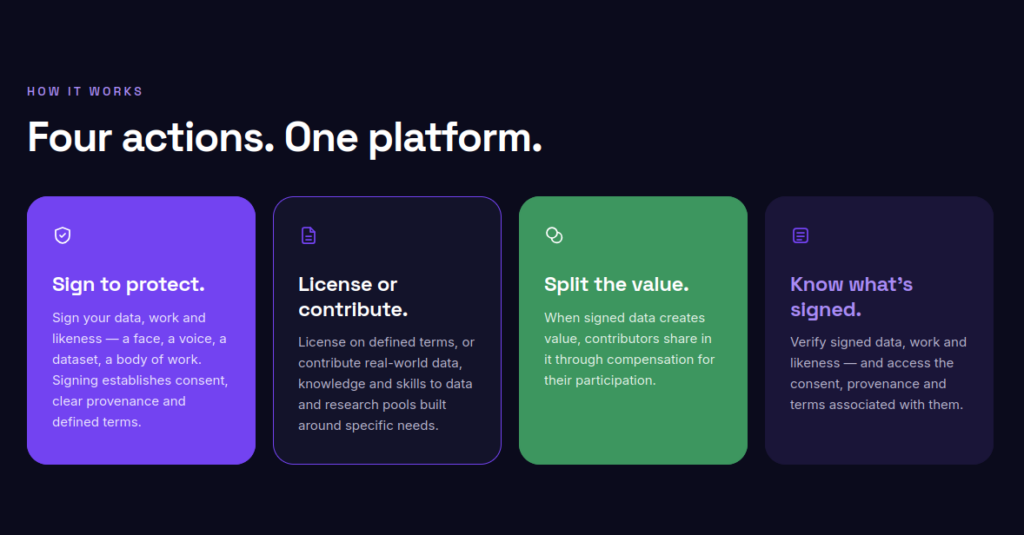
SignSplit’s proposed AI data provenance platform is designed to connect valuable information with its original contributors, authorized uses, and licensing conditions. The company wants to make it easier for individuals and organizations to protect, license, contribute, and potentially monetize creative work, professional knowledge, personal likeness, and other materials used in artificial intelligence development.
Traditional AI training systems may use large datasets collected from websites, commercial providers, research databases, and other sources. As information passes through different organizations and technical processes, identifying its original creator and determining which permissions apply can become complicated.
SignSplit proposes addressing this problem by incorporating provenance and licensing records into the process of acquiring data. Instead of treating a dataset as an isolated collection of information, the platform aims to associate it with records describing its origin and authorized uses.
AI data provenance refers to the history and source of information used in artificial intelligence systems. It can document where material originated, who contributed it, how it was collected or modified, and which permissions were established before further processing.
For example, an image collection might begin with individual photographers, enter a commercial archive, undergo filtering, and eventually become part of an AI training dataset. Without consistent records, reconstructing the history of those images and determining the applicable rights can become difficult.
Reliable provenance information can help organizations review licensing arrangements, investigate ownership disputes, identify questionable datasets, and improve accountability.
SignSplit’s planned platform connects two principal groups:
- Data contributors: Individuals, creators, researchers, professionals, businesses, and institutions possessing valuable information or intellectual property.
- Commercial buyers: AI developers, robotics companies, research organizations, entertainment businesses, and digital platforms seeking authorized data.
The company intends to make licensing relationships easier to establish by associating contributions with information about consent and permitted use. This could be particularly useful when commercial customers need specialized materials that cannot easily be obtained through ordinary internet collection.
Potential applications include:
- Photography and visual content: Creators could license image collections for authorized computer vision research.
- Voice recordings: Performers could contribute recordings for speech technology under agreed usage conditions.
- Professional knowledge: Specialists could provide expertise or demonstrations relevant to AI development.
- Robotics: Developers could obtain demonstrations of physical tasks performed by skilled individuals.
- Scientific research: Institutions could license appropriate datasets under defined contractual and governance arrangements.
- Entertainment: Media companies could obtain authorized creative performances, voices, or likenesses for digital production.
These examples illustrate the intended licensing model rather than confirmed transactions completed through SignSplit.
Signed data is the central concept behind the company’s proposed infrastructure. According to SignSplit, the term describes information associated with verifiable records concerning its origin, consent, and authorized uses. The objective is to make those records accessible to organizations processing the material, allowing them to understand the applicable conditions before using it.
For instance, a photographer might authorize an image collection for a particular research project while withholding permission for unrestricted commercial redistribution. A rights management system could document those restrictions and make them available when a buyer evaluates the material.
However, provenance records and digital signatures do not automatically establish legal ownership. A person may digitally sign a document while making an inaccurate claim about the rights they possess. Similarly, the owner of a photograph may not control every privacy or publicity right associated with a person appearing in the image.
Reliable data licensing therefore requires identity verification, clear contracts, accurate ownership information, and appropriate legal review.
Digital signatures can support the technical side of verification. In a typical cryptographic system, a signer uses a private key to produce a signature associated with information, while another party uses the corresponding public key to verify it. When correctly implemented, this can provide evidence that the signed information has not been altered.
However, a valid signature verifies the integrity of a signed record rather than guaranteeing that every statement within it is true.
SignSplit has announced a verification layer intended to help AI systems and other digital platforms identify signed content and examine associated provenance, consent, and licensing conditions. Its public launch materials do not provide a complete technical description of the underlying implementation.
The company has not established that its platform uses a particular blockchain network, cryptographic algorithm, or digital provenance standard.
The wider industry already includes initiatives addressing similar technical challenges. The Coalition for Content Provenance and Authenticity, known as C2PA, maintains specifications supporting cryptographically verifiable information about digital assets through Content Credentials.
Although SignSplit shares the general objective of preserving reliable provenance information, its public announcement does not confirm that the platform uses C2PA or is technically compatible with that standard.
The effectiveness of signed data also depends on preserving rights information as content moves through AI development pipelines. Training materials may be cleaned, divided into smaller sections, transformed into numerical representations, or combined with other datasets. Maintaining useful provenance records across these changes requires technical systems and governance procedures beyond attaching a signature to the original file.
Another challenge involves permissions that expire, are disputed, or are withdrawn. A complete licensing platform must establish how these situations are handled and what responsibilities apply to organizations that have already obtained or used the information.
SignSplit’s planned creator compensation model adds an economic dimension to these technical requirements.
The company intends to help individuals and institutions receive payment when their contributions are licensed for authorized commercial activities. A photographer might license an image collection, while a voice actor could enter an agreement concerning recordings used in speech technology.
However, SignSplit has not published a comprehensive creator payment schedule. It has not established universal rates for photographs, written materials, recordings, professional datasets, or personal likenesses.
The company has also not fully disclosed whether compensation will involve fixed fees, recurring payments, negotiated contracts, usage royalties, or combinations of these arrangements.
A training license does not necessarily create an automatic right to receive payment whenever a completed AI model produces an output. The terms of the underlying contract determine which uses are authorized and when compensation becomes payable.
Important licensing considerations for contributors include:
- Ownership and authorization: Whether the contributor possesses the rights required to license the material.
- Permitted uses: Which research, training, commercial, or distribution activities are authorized.
- Compensation: How payments are calculated and when they become due.
- Sublicensing: Whether commercial buyers can transfer usage rights to other organizations.
- Consent withdrawal: What happens when a contributor seeks to end future use.
- Data retention: How long materials and associated information may be stored.
- Dispute resolution: How disagreements about ownership, payment, or unauthorized use are handled.
Privacy and intellectual property requirements are especially important when the licensed materials contain sensitive personal information, biometric identifiers, or copyrighted expression.
Consent, privacy, and intellectual property are related but distinct legal concepts. Permission to process personal information does not necessarily grant copyright ownership, while copyright ownership does not automatically eliminate privacy obligations.
International transactions introduce further complications because contributors and buyers may operate under different legal systems.
The European Union’s AI Act includes requirements concerning copyright policies and summaries of training content for general purpose AI providers, while privacy laws impose separate obligations on certain forms of personal data processing.
SignSplit’s provenance and consent records could support better documentation, but their existence does not automatically guarantee compliance with applicable regulations.
SignSplit also differs from conventional AI data acquisition methods through its emphasis on contributor participation and documented authorization. Traditional approaches include collecting publicly available information, purchasing datasets from commercial providers, or negotiating directly with publishers and institutions.
SignSplit proposes combining these established licensing principles with infrastructure designed for human contributions to AI and robotics.
The concept could make specialized data procurement more accessible to smaller contributors while providing commercial customers with clearer records of permitted use.
However, the company is not the first organization to offer licensed content or provenance technology. Stock media agencies, research data providers, commercial dataset businesses, and digital rights management systems have existed for years.
Its competitive position will depend on whether combining these capabilities creates a more useful, reliable, and economically attractive platform.
As of October 2026, independently verified information about SignSplit’s production deployments, completed licensing transactions, creator earnings, supported formats, and verification performance remains limited.
The company’s announced capabilities represent a potentially valuable approach, but their effectiveness will become clearer as the platform develops and begins supporting documented commercial activity.
SignSplit’s $400 Million Investment, AI Data Economy Impact, and Future Growth Challenges
SignSplit’s $400 million strategic financing commitment reflects growing commercial interest in verified, permission based data for artificial intelligence. As AI systems expand into robotics, scientific research, media production, and other specialized applications, developers may increasingly require information that cannot be obtained reliably through general internet collection.
Robotics companies, for example, may need demonstrations of physical tasks performed by experienced workers. Healthcare researchers may require carefully governed datasets collected under appropriate consent and institutional requirements. Entertainment businesses may need licensed voices, performances, or personal likenesses for synthetic media.
In these situations, the challenge involves more than finding suitable information. Buyers must also determine whether the material can be used legally, whether contributors possess the necessary rights, and whether the data meets technical quality requirements.
SignSplit wants to establish infrastructure that makes these transactions easier to organize.
If successful, its approach could help create commercial opportunities for people with valuable professional skills, specialized knowledge, or creative assets. Institutions might also benefit from licensing carefully managed datasets through transparent agreements.
However, the emerging market faces several important obstacles.
Contributor trust will be essential. Individuals must understand which permissions they are granting, how their materials may be used, and whether the compensation justifies participation.
Commercial buyers must also determine whether the platform offers sufficient value compared with established dataset suppliers, direct licensing agreements, or other authorized acquisition methods.
The company’s success will depend on balancing these interests while maintaining effective verification and governance.
Key challenges include:
- Commercial adoption: Attracting enough contributors and buyers to support regular transactions.
- Rights verification: Establishing that contributors possess the permissions required for licensing.
- Privacy protection: Managing sensitive information and complying with applicable data regulations.
- Creator compensation: Developing payment arrangements that contributors consider worthwhile.
- Technical reliability: Maintaining useful provenance records across complex AI processing pipelines.
- Fraud prevention: Identifying inaccurate ownership claims and unauthorized submissions.
- Contract enforcement: Ensuring licensing conditions remain meaningful after information is transferred.
- International operations: Addressing different legal requirements across countries.
- Platform economics: Generating sustainable revenue while maintaining affordable transaction costs.
- Market competition: Demonstrating advantages over established data licensing and provenance providers.
One major concern involves the unequal bargaining power between individual contributors and large AI developers. Formal licensing agreements do not automatically produce fair compensation if commercial buyers possess substantially greater negotiating influence.
Conversely, contributors with specialized expertise or difficult to obtain information may have greater opportunities to negotiate favorable terms.
SignSplit will need to establish an environment where both sides consider participation commercially worthwhile.
Another consideration is the administrative complexity of rights management. Extensive documentation and verification may improve accountability, but complicated procedures could discourage smaller contributors or businesses.
Successful infrastructure must balance reliable safeguards with practical usability.
W Group’s involvement may provide strategic advantages through financial technology experience and international relationships. Its existing operations could help SignSplit develop payment infrastructure, commercial partnerships, and processes for managing transactions across different jurisdictions.
However, W Group’s reported 40 million clients should not be treated as SignSplit’s active user base. The investment also does not establish that SignSplit will issue a cryptocurrency, operate a token, or use a particular blockchain platform.
The company’s future development must be evaluated through its actual products and commercial results rather than assumptions based on its investor’s background.
SignSplit’s immediate priorities are likely to include improving its licensing infrastructure, attracting contributors, establishing relationships with AI developers, and expanding its commercial operations.
These are reasonable expectations based on the company’s announced objectives rather than a confirmed detailed public roadmap.
Several developments will help determine whether SignSplit can justify its $1 billion valuation:
- Product availability: Clear evidence that contributors and commercial buyers can use the licensing platform effectively.
- Completed transactions: Documented examples of authorized data licensing between participants.
- Verified compensation: Reliable information demonstrating that contributors receive payments under established agreements.
- Enterprise customers: Identifiable commercial organizations using the platform for data acquisition.
- Verification performance: Technical evidence showing that provenance and authorization records remain reliable.
- Financing transparency: Additional details about the cash portion and strategic resources included in the $400 million commitment.
- International expansion: Progress establishing operations and partnerships across relevant markets.
- Sustainable revenue: Evidence that the business can generate recurring commercial activity sufficient to support its operations.
The future regulatory environment could also influence demand for services such as SignSplit. Rules concerning copyrighted material, AI training transparency, personal data processing, and synthetic media may increase interest in documented licensing arrangements.
However, the company must continue adapting to changing technical standards and legal requirements. A rights management platform operating across several jurisdictions cannot depend on one universal interpretation of consent or ownership.
SignSplit’s potential economic impact extends beyond its own business.
If permission based data licensing becomes more common, AI developers may increasingly consider provenance and authorization during the earliest stages of collecting training materials.
Creators and institutions could gain new opportunities to negotiate the commercial use of their contributions, while organizations developing advanced AI systems might benefit from clearer licensing procedures and more specialized datasets.
Such changes could encourage a broader market in which human knowledge, experience, and creative expression are treated as commercially valuable resources accompanied by identifiable usage rights.
Nevertheless, the $400 million commitment does not prove that SignSplit has already established a large international marketplace. Nor does the reported valuation demonstrate that its proposed verification system has become an industry standard.
Its long term influence will depend on whether the technology works reliably, contributors receive meaningful benefits, and commercial customers continue using the platform.
Ultimately, SignSplit represents an ambitious attempt to develop infrastructure for a changing artificial intelligence economy. As AI systems become more dependent on specialized human information, the demand for reliable provenance, consent management, and licensing may increase.
The company’s strategic financing and partnership with W Group provide a potentially substantial starting point, but commercial success will require practical implementation, legal clarity, technical credibility, and sustainable economic relationships.
SignSplit’s most important challenge is turning its vision of a signed data economy into a functioning marketplace that both contributors and AI developers trust.
Frequently Asked Questions (FAQs)
- What is SignSplit, and what does the company do?
SignSplit is a technology startup developing infrastructure for licensing human generated data, creative work, professional knowledge, and personal likeness. Founded in 2024, the company aims to connect individuals and institutions with AI developers, robotics businesses, researchers, and media organizations. Its platform is designed to associate contributions with provenance records, consent information, and authorized usage conditions. This could help buyers obtain properly licensed materials while giving contributors greater visibility into how their information is used and opportunities to receive compensation. - How much funding did SignSplit announce in October 2026?
SignSplit announced a $400 million strategic seed financing commitment on October 5, 2026. W Group was identified as the sole investor and strategic partner. The arrangement combines direct capital with a multiyear package of resources intended to support the company’s development and expansion. However, the announcement did not specify how much of the commitment represents cash or how the remaining resources are valued. Therefore, the full $400 million should not automatically be interpreted as unrestricted cash already transferred to SignSplit. - What is SignSplit’s valuation after the W Group investment?
The announced W Group investment assigns SignSplit a $1 billion valuation, placing it within the commonly used unicorn category for privately held startups. This valuation reflects the value assigned to the company during its financing arrangement and expectations surrounding its future commercial potential. It does not mean SignSplit has generated $1 billion in revenue, earned that amount in profit, or holds equivalent cash reserves. Its long term value will depend on customer adoption, platform reliability, completed licensing transactions, and sustainable business performance. - Who invested $400 million in SignSplit?
W Group was identified as the sole investor and anchor strategic partner in SignSplit’s October 2026 financing announcement. The global financial technology and technology ecosystem was founded and is led by Volodymyr Nosov. According to its published information, W Group includes 11 businesses, employs more than 1,500 people, and serves over 40 million clients in approximately 150 countries. Its experience with financial technology, transactions, and digital infrastructure could support SignSplit’s expansion, although W Group’s existing customer base should not be confused with SignSplit’s active users. - Who founded SignSplit?
SignSplit was founded in 2024 by Glib Denisov and Alessandro Monterosso, both identified in the company’s October 2026 announcement. Denisov serves as Executive Chairman and Chief Product Officer, focusing on product strategy and the company’s broader vision. Monterosso is the Chief Executive Officer, responsible for executive leadership and commercial development. The founders established SignSplit around the idea that human knowledge, creative work, and other valuable contributions should retain identifiable rights information when used in artificial intelligence and related technologies. - What does signed data mean in artificial intelligence?
Signed data, as described by SignSplit, refers to information associated with verifiable records identifying its origin, relevant consent, and permitted uses. The concept aims to help AI developers and other organizations determine where information came from and what licensing conditions apply. Technical verification may support the integrity of associated records, but it does not automatically establish that every ownership claim is legally valid. Reliable signed data therefore requires appropriate identity checks, contractual authorization, and governance alongside any digital verification mechanism. - Can creators earn money by contributing data to SignSplit?
SignSplit intends to develop a platform through which individuals and institutions can receive compensation when their data, creative work, knowledge, or likeness is licensed for authorized purposes. Potential contributors include photographers, voice actors, researchers, and professionals with specialized information. However, the company has not published a comprehensive earnings schedule or guaranteed payment rates. Compensation may depend on the material, permitted uses, commercial demand, and negotiated licensing terms. Contributors should understand that licensing data for model training does not necessarily create automatic royalties from every future AI generated output. - Does SignSplit use blockchain technology to verify ownership?
SignSplit has announced a verification system intended to associate digital content with information about provenance, consent, and licensing conditions. However, its public launch materials do not confirm that the platform uses a particular blockchain network or technical standard. W Group’s experience with blockchain related financial technology does not establish SignSplit’s underlying architecture. Digital signatures can help verify that records have not been altered, but determining legitimate ownership also requires reliable identity verification and contractual evidence. Additional technical documentation would be needed to confirm exactly how SignSplit’s verification system operates. - How is SignSplit different from conventional AI data collection?
SignSplit emphasizes permission based contributions accompanied by documented provenance and licensing conditions. Conventional AI data acquisition may involve collecting publicly accessible material, purchasing datasets from commercial vendors, or negotiating directly with publishers and other rights holders. SignSplit aims to combine contributor participation, licensing, consent management, and verification within a dedicated platform. This could simplify access to specialized information while improving rights documentation. However, established licensing businesses already offer some similar services, and SignSplit’s advantages will depend on how effectively its platform operates commercially. - What happens next for SignSplit after its $1 billion valuation?
Following its October 2026 public launch, SignSplit must demonstrate that its proposed licensing infrastructure can support reliable commercial activity. Important developments will include attracting contributors, establishing customer relationships, completing documented licensing transactions, and showing that participants can receive compensation under clear agreements. The company will also need to demonstrate effective provenance verification, privacy safeguards, and international compliance. Greater transparency about the $400 million financing structure would help clarify its available resources. Ultimately, its success will depend on whether it develops a trustworthy and sustainable market for authorized AI data.
Conclusion
SignSplit’s $400 million strategic seed financing commitment and $1 billion valuation, announced on October 5, 2026, represent a significant development in the emerging market for AI data provenance, licensing, and digital rights protection. Backed by W Group, the company aims to create infrastructure connecting creators, researchers, and institutions with AI developers seeking authorized human data.
SignSplit’s proposed platform emphasizes consent, verifiable provenance, licensing conditions, and contributor compensation. If successful, this approach could help creators retain greater control over their work while providing AI companies with clearer documentation of data origins and usage permissions.
However, important details remain undisclosed, including the cash portion of the financing, contributor payment arrangements, customer adoption figures, and independently verified platform performance. These uncertainties mean SignSplit’s valuation should be distinguished from demonstrated commercial success.
Ultimately, SignSplit’s long term impact will depend on its ability to establish a reliable and scalable AI data licensing marketplace. Its greatest opportunity lies in making consent, provenance, and compensation standard considerations in how artificial intelligence systems acquire and use human contributions.
Sources and Citations
- PR Newswire: SignSplit Secures $400 Million Strategic Seed Round at $1 Billion Valuation, October 5, 2026
https://www.prnewswire.com/news-releases/signsplit-secures-400-million-strategic-seed-round-at-1-billion-valuation-302897779.html - WhiteBIT Blog: W Group Invests $400 Million in SignSplit at $1 Billion Valuation, October 5, 2026
https://blog.whitebit.com/en/w-group-invests-400-million-in-signsplit-at-1-billion-valuation/ - SiliconANGLE: Signed Data Pioneer SignSplit Launches With $400M to Help Everyone Get Paid for Their AI Contributions, October 5, 2026
https://siliconangle.com/2026/10/05/signed-data-pioneer-signsplit-launches-with-400m-to-help-everyone-get-paid-for-their-ai-contributions/ - dev.ua: Ukrainian Investor Volodymyr Nosov and W Group’s $400 Million Investment in SignSplit, October 6, 2026
https://dev.ua/ - iTechGuides: SignSplit Raises $400M Strategic Seed From W Group at a $1B Valuation, What It Does and What Isn’t Disclosed, October 7, 2026
https://www.itechguides.com/signsplit-raises-400m-strategic-seed-from-w-group-at-a-1b-valuation-what-it-does-and-what-isnt-disclosed/ - European Commission: General Purpose AI Obligations Under the EU AI Act, Copyright Policies, Training Data Transparency and Technical Documentation
https://digital-strategy.ec.europa.eu/en/factpages/general-purpose-ai-obligations-under-ai-act - Coalition for Content Provenance and Authenticity: C2PA Technical Specifications, Digital Content Provenance and Content Credentials
https://spec.c2pa.org/specifications/
Recommendations
- Gears of War: E-Day Open Beta Begins August 6: Dates, Modes, and Rewards
- Dinoblade is Set to Hit Half a Million Wishlists Soon as Steam Hype Surges
- Pokemon Champions: the Beginner’s Guide to Competitive Pokemon Battles
- Gravity Circuit 2 Announced: Original Mega Man-Like Game Goes Free to Celebrate Sequel Reveal
- Cairn Review, Fan Reaction and Feedback: What Players and Critics Are Saying About the Game Bakers’ Survival-Climbing Hit
- Bravely Default: Flying Fairy HD Remaster Gets Surprise Launch and 20% Discount on PC
- The Duskbloods Online Network Test Confirmed for Summer 2026, But FromSoftware Still Has No Release Date
- Splatoon Raiders Tank Types Explained: Speed, Power, and Tactical Tanks Guide
- Gears of War: E-Day Beta Takes Over 62 GB of Storage: Download Size, Dates and What Players Need to Know
- Ratatan Marches to Its Own Beat as a Spiritual Successor to Patapon



































































































