









In This Article (8 sections)
PlayStation’s Social Media Silence Turns a Physical Games Policy into a Trust Crisis
PlayStation has remained silent on its main social media channels since announcing a major change to physical game distribution, and that silence has become a central part of the backlash. The controversy began after Sony Interactive Entertainment announced that physical game disc production for new PlayStation releases will be discontinued starting January 2028. According to PlayStation’s announcement, new games released after that point will be sold through the PlayStation Store and at retailers in digital formats only, while games already released or scheduled for disc release before January 2028 will not be affected.
The reaction is not only about discs as a format. For many players, physical games represent resale, lending, collecting, offline access, retail price competition, and a stronger sense of ownership than digital libraries often provide. Sony’s explanation focuses on changing consumer habits and the growing dominance of digital software sales, and the company’s own financial data supports that trend. Sony’s FY2025 supplemental information shows that the full-game digital download ratio for PS4 and PS5 software reached 78% for the full fiscal year and 85% in Q4 FY2025.
The communication problem has intensified the response. Push Square reported on July 2, 2026, that more than 24 hours had passed since Sony posted on its main social media accounts, including X, Facebook, Bluesky, and Instagram, after the physical games announcement. The report noted that YouTube had received some third-party trailer updates, but PlayStation’s central social channels had not resumed normal public engagement. That has created a perception that PlayStation is avoiding criticism rather than addressing it directly.
The clearest reason for the silence is likely risk management. When a platform holder announces a decision that removes a long-standing consumer choice, every routine post can become a target for frustration. A trailer, promotion, or unrelated update could quickly fill with replies about discs, ownership, and digital access. From that perspective, pausing social activity may be a deliberate attempt to avoid inflaming the conversation.
That strategy also has a cost. Social media is where modern gaming brands build hype, clarify confusion, support live-service updates, distribute trailers, and maintain community trust. When PlayStation stops posting after a controversial announcement, players are left to interpret the decision without follow-up context. The absence of detailed answers makes the move feel less like a managed transition and more like a corporate retreat.
The announcement itself was brief. The PlayStation Blog post laid out the core policy, cited consumer preference, and said Sony would continue prioritizing innovation and purchasing choice. However, it did not give detailed answers about pricing, preservation, retail transition plans, licensing, account access, offline play, or how the change will affect regions with weaker internet infrastructure. Those unanswered questions are now driving discussion across comment sections, forums, YouTube replies, and gaming news coverage.
PlayStation’s silence is therefore not just a lack of posting. It has become part of the story. Sony announced a major change to how players buy games, then allowed the community conversation to move forward without a clear second-stage response. In communication terms, the gap between the announcement and the explanation is where much of the backlash has grown.

What Sony’s 2028 Physical Games Decision Means for PlayStation Players
Sony Interactive Entertainment announced on July 1, 2026, that physical game disc production for all new games released on PlayStation consoles will be discontinued starting January 2028. After that date, newly released PlayStation games will be available through the PlayStation Store and at retailers in digital formats only. Sony also stated that the transition has no impact on games that already released, or that will release before January 2028, in disc format.
That distinction is important. The announcement does not say that existing PS5 discs will stop working in January 2028. It does not say that physical games already released will be deactivated. It says that new PlayStation games released after the cutoff will no longer receive physical disc production. Existing disc libraries, pre-2028 releases, and already planned physical releases are separate from the post-2028 release pipeline.
The phrase “at retailers in digital formats only” also matters. Retailers may still sell PlayStation games after the cutoff, but the product sold for new releases will be a digital entitlement, download code, or another digital purchase format rather than a playable game disc. Sony’s PS5 disc drive product page includes a notice stating that newly released games from January 2028 will be available in digital format only, while discs for games released before January 2028 can continue to be played on the console.
In practical terms, PlayStation is not immediately removing every physical game from the market. It is ending production of physical discs for new PlayStation games from a specific date. Even so, that is a major break from decades of console gaming tradition.
Sony’s public reasoning is based on consumer behavior. The company said consumer preferences and the broader entertainment industry continue shifting away from physical discs and toward digital media, with digital preference significantly outpacing physical discs. Sony described the transition as a natural direction for the company and said it would align PlayStation more closely with how most of its community accesses and plays games today.
The financial context supports that explanation. Sony’s FY2025 data shows that full-game software digital downloads accounted for 78% of PS4 and PS5 full-game software units for the year and 85% in Q4 FY2025. The same report shows PS4 and PS5 full-game software sales of 317.9 million units for FY2025, with PlayStation monthly active users at 125 million at the end of Q4. Sony Interactive Entertainment’s public business data also lists more than 93 million PS5 hardware units sold in as of March 31, 2026, showing the scale of the platform affected by the decision.
There is also a business-margin argument. Reuters reported that digital downloads accounted for about 80% of Sony’s full-game software sales in fiscal 2025 and cited analyst commentary that removing discs can improve margins, although it may increase pressure on storage needs. Digital distribution reduces manufacturing, packaging, shipping, inventory, returns, and shelf-space complexity. It also gives the platform holder more direct control over pricing, discovery, storefront placement, and licensing.
For players, that economic logic does not automatically make the decision acceptable. Many consumers see the shift as a transfer of control from the buyer to the platform. For Sony, it reflects the dominant purchasing pattern. For critics, it removes the last mainstream alternative to digital licensing.
The reaction has been especially negative among physical media advocates, collectors, used-game buyers, preservationists, and players who distrust digital licensing. The official PlayStation Blog post displayed thousands of comments when retrieved, showing that the announcement became one of the most heavily discussed PlayStation updates of the moment. Push Square also reported that PlayStation’s most recent Instagram update before the announcement was filled with users asking the company to reconsider, while YouTube comments were dominated by discussion of the disc decision.
The concern is not simply nostalgia. Physical discs let players sell a game, lend it, display it, preserve it, or buy it used at a lower price. Digital games are convenient, but they are usually attached to an account, storefront, license, and platform rules. Sony’s own software terms state that PlayStation software is licensed, not sold, and that the license is limited, personal, non-exclusive, and non-transferable.
The timing also amplified the backlash. On the same day as the disc announcement, Sony announced changes to the PlayStation Store on PS3 and PS Vita, including store closures beginning in select markets in 2026 and broader closures in 2027. Sony said previously purchased content would remain downloadable for the foreseeable future, but the timing reinforced concerns about long-term digital access.
For current PS5 owners, the immediate effect is limited but the long-term effect is substantial. Physical PS5 games already released, and titles scheduled to receive disc releases before January 2028, remain unaffected under Sony’s stated policy. A PS5 owner with a disc-capable console should still be able to use eligible PS5 and supported PS4 discs after the cutoff, assuming the console, disc drive, account requirements, software updates, and any game-specific online requirements continue to function.
The bigger change is future purchasing. After January 2028, new PlayStation titles will not be produced as physical discs. Players who prefer boxed games can still build libraries from pre-2028 releases, but new releases will be digital only. The disc drive on a PS5 or PS5 Pro will become more of a legacy-access feature than a gateway to new physical releases.
The decision also affects storage. Digital-only games must be downloaded and stored, which can increase pressure on internal storage or expansion drives. Reuters highlighted the possibility that removing discs improves margins while increasing the need for storage capacity, which can be expensive for players.
Based on Sony’s current language, PS5 physical games released before January 2028 should still work after the cutoff. PlayStation’s announcement states that the transition has no impact on games already released, or games that will release before January 2028, in disc format. Sony’s PS5 disc drive product page also says discs for games released before January 2028 can continue to be played on the console.
There are practical caveats. Some physical games require patches, online activation, server access, account linking, or ongoing online services. A disc may contain a playable build, but modern games often rely on updates to fix bugs, add content, or complete the version most players expect. Sony’s software terms also state that online and network features may end, and that offline modes are not guaranteed and may change or end at Sony’s discretion.
That means a disc is not a universal guarantee of permanent access to every feature. A physical copy gives players a tangible copy and often preserves at least some version of the game, but it cannot preserve multiplayer servers, live-service content, account-linked progression, or every patch-dependent feature. Still, Sony is not announcing that pre-2028 PS5 discs will be blocked. It is ending production of new physical discs after January 2028.
Why a Digital-First PlayStation Future Raises Ownership and Used-Game Concerns
Sony has not publicly announced every detail of future PlayStation console hardware in the sources reviewed here, so it would be inaccurate to state as fact that every future PlayStation console will be digital-only forever. What can be said is that the company’s current direction points strongly toward a digital-first ecosystem. The 2028 policy ends physical disc production for new PlayStation games, and the PS5 Pro is already sold as an all-digital console with no built-in disc drive. Sony’s product page says PS5 Pro users can add a separate disc drive if they want to play PS5 or PS4 games on Blu-ray Disc.
The separate disc drive model is an important transitional signal. It allows Sony to support existing disc libraries while reducing the role of discs in future purchasing. The disc drive remains useful for older physical games, supported PS4 discs, Blu-ray movies, and 4K Ultra HD Blu-ray media. However, Sony’s 2028 notice means that the add-on will not support new physical PlayStation releases after the cutoff because those releases will not be manufactured on disc.
A fully digital PlayStation future is therefore not only speculation. It is the direction implied by official policy, hardware design, and sales data. Still, the exact form of future consoles, including whether any optional disc accessory remains available, depends on future announcements.
The social media silence is fueling backlash because it makes the announcement feel final, underexplained, and disconnected from player concerns. A controversial platform decision can be softened by a detailed FAQ, a follow-up video, a regional clarification, a preservation plan, or direct acknowledgement of concern. Without that, the audience often assumes the company has no satisfying answers.
Push Square reported that Sony’s main social accounts had gone more than 24 hours without updates after the announcement, while YouTube received some third-party trailer activity. That distinction matters because it suggests the brand did not completely stop all content distribution, but it avoided the channels where direct fan response would be most visible.
The silence gives critics a simple narrative: PlayStation made a decision that benefits the company, then withdrew from the conversation when players objected. Whether that interpretation is fully fair is less important than the fact that it feels plausible to frustrated fans. In crisis communication, perception can become reality quickly.
The most damaging part is uncertainty. Players want to know whether digital pricing will become less competitive without used copies, whether retailers will be protected, whether preservation groups will receive legal or technical support, whether digital licenses will be strengthened, and whether offline access will be guaranteed for single-player games. Until PlayStation answers those questions, silence will continue to function as negative messaging.
The end of new physical PlayStation discs also changes the ownership model for future releases. Physical discs do not give players ownership of the intellectual property in a game, but they do provide control over a particular physical copy. A player can resell it, lend it, give it away, display it, or keep it independently of a digital storefront. Digital games usually work differently because access is governed by account status, platform licensing terms, and availability of the relevant service.
Sony’s software terms state that the software is licensed, not sold, and that users receive a limited, non-exclusive, non-transferable, personal license. The same terms say online services may end with advance notice, and that offline modes are not guaranteed and may change or end. These terms do not mean digital games vanish randomly, but they do explain why many players feel a digital-only future weakens traditional ownership expectations.
The issue becomes sharper when there is no physical alternative. If a player dislikes digital licensing today, they can still buy many PlayStation games on disc. After January 2028, that choice disappears for new titles. The buyer’s relationship shifts further from possession of a copy toward access through a platform-managed license.
The used PlayStation game market will not disappear immediately. Existing PS5 and PS4 discs will still circulate, and pre-2028 physical releases can still be bought, sold, traded, and collected. Sony’s policy says existing disc-format releases and disc releases scheduled before January 2028 are not affected.
The long-term issue is supply. Once new releases stop arriving on disc, the used market becomes a market for legacy inventory. The Verge reported that independent retailers and preservation advocates see the decision as harmful to resale, ownership, and access. Pink Gorilla Games co-owner Cody Spencer told The Verge that physical sales of new PS5 games had already been declining, but expected increased prices and stronger niche demand for pre-2028 physical titles over the next five to ten years.
Used-game pricing may become more uneven. Common sports titles and mass-market games could remain inexpensive, while limited-run releases, complete editions, collector’s editions, and late-era PS5 discs could become more valuable. Retailers that rely heavily on trade-ins may also lose a crucial pipeline because there will be no used copies of post-2028 PlayStation releases if those games never exist on disc.
Digital games do not replace that market because digital PlayStation licenses are generally non-transferable. Sony’s software terms describe the license as personal and non-transferable, which means the traditional used-game model does not carry over to digital purchases.

How the Physical Games Backlash Affects Retailers, Preservation, and Sony’s Next Response
PlayStation fans are divided because digital and physical formats solve different problems. Digital games are convenient. They can be bought instantly, preloaded, updated automatically, and accessed without swapping discs. Sony’s data shows that most PS4 and PS5 full-game software unit sales are already digital, with the FY2025 digital download ratio at 78% and Q4 FY2025 at 85%. For many players, digital is already the normal way to buy games.
Physical games offer a different set of benefits. They can be collected, shared, traded, resold, gifted, and sometimes played without relying as heavily on account access. They also support price competition through used copies and retail discounts. These benefits matter most to collectors, families, preservationists, budget-conscious players, rural players with slower internet, and anyone who dislikes putting an entire library under one account system.
The divide is not simply old versus new. Many players use both formats. They buy digital indie games and physical collector editions. They download multiplayer games but buy single-player releases on disc. They use PlayStation Store sales but also trade in games to reduce costs. The backlash comes from losing flexibility, not from rejecting digital convenience entirely.
Sony’s business argument is based on the majority trend. Fan criticism is based on the minority use cases that physical discs still protect. A platform can be statistically correct about digital dominance while still alienating players who depend on physical media.
Sony could reverse or modify the decision, but there is no evidence in the cited official announcements that it plans to do so. The current policy is specific, dated, and repeated beyond the blog post. The PlayStation Blog announcement sets January 2028 as the cutoff for physical disc production for new games. Sony’s PS5 disc drive product page also includes the January 2028 digital-only notice, reinforcing that the change has already been integrated into product messaging.
A reversal would likely require more than a social post. Sony would need to clarify whether disc production contracts, retailer plans, publisher requirements, manufacturing capacity, and platform policies are being revised. It would also need to explain whether any reversal applies globally, to first-party games only, to all third-party releases, or to limited collector editions.
The most plausible modification would be a compromise rather than a full reversal. Sony could allow limited physical collector editions, extend the cutoff date, support physical releases for first-party tentpole games, or create a preservation-focused disc program. None of those alternatives has been announced in the sources reviewed. The backlash may pressure Sony to speak more clearly, but the company’s digital sales data gives it a strong business reason to continue, and the 2028 date gives it time to prepare publishers, retailers, and consumers for the change.
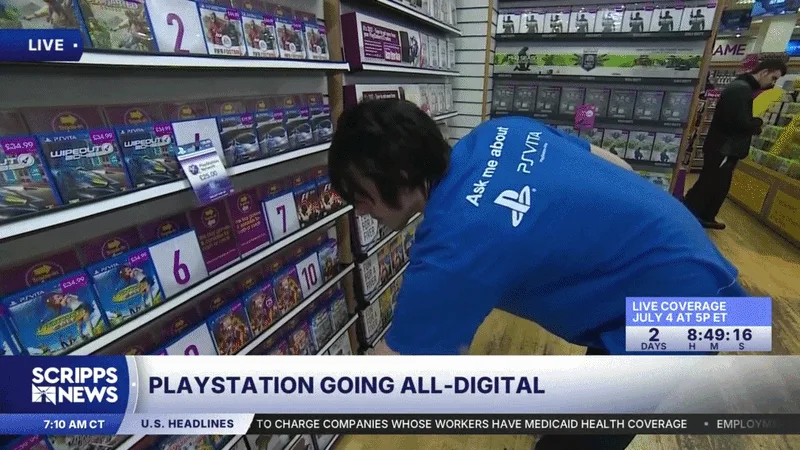
Retailers face one of the most direct business impacts. After January 2028, stores can still sell PlayStation products, consoles, accessories, digital cards, and digital game formats, but they will no longer receive new PlayStation game discs for post-cutoff releases. That reduces foot traffic from players who visit stores to buy new boxed games, trade in older games, or browse physical shelves.
TechRadar reported that multiple video game retailers reacted negatively to the announcement. The report cited concern from retailers including GAME, Loot Box Gaming, and VGP Video Game Plus, and noted that businesses such as GAME, CeX, and GameStop could be affected because physical game ownership and trade-in activity remain central to parts of the retail model.
The Verge also reported concern from independent retail and preservation groups. Retailers may continue to serve collectors, retro buyers, accessory shoppers, and used-game customers, but their role in new PlayStation software sales will be reduced if new releases become digital entitlements rather than boxed discs.
Large retailers may adapt by selling download codes, gift cards, consoles, storage devices, controllers, headsets, and subscriptions. Smaller specialty stores may face a harder transition. The used-game ecosystem depends on a flow of new physical products becoming used inventory. Ending that flow changes the economics of trade-ins, shelf space, and customer visits.
Digital-only games also raise preservation concerns because long-term access depends on more than a file existing on a server. It depends on licenses, authentication systems, storefront availability, patches, operating systems, hardware compatibility, and legal permission for museums, archives, and researchers to preserve and study games.
The Verge reported that preservationists and boutique physical publishers criticized Sony’s decision, with Video Game History Foundation executive director Frank Cifaldi describing the move as a hit to consumer rights, resale, and creators who rely on physical markets. The same report quoted Andrew Borman of The Strong National Museum of Play explaining that digital preservation challenges include online connectivity, frequent patches, and development processes that are already heavily digital.
Sony’s PS3 and PS Vita store closure announcement sharpened those concerns. Sony said new purchases on those legacy stores will end in stages, with previously purchased content remaining downloadable for the foreseeable future. That phrase is meant to reassure users, but preservation advocates often read it as temporary rather than permanent.
Digital-only distribution does not make preservation impossible. Archives can preserve digital builds, metadata, documentation, patches, and emulation environments. The problem is that the legal and technical framework is harder when public access is controlled by platform accounts and closed storefronts. Without stronger preservation commitments, a digital-only PlayStation future could make future game history more dependent on corporate continuity.
PlayStation’s next response needs to answer practical questions rather than repeat broad language about consumer trends. Sony has already said digital preference significantly outpaces physical discs and that the transition aligns with how most players access games. The unresolved issue is what Sony will do for players who are not served well by that transition.
A stronger follow-up should clarify whether any exceptions will exist after January 2028, including collector editions, limited-run physical releases, accessibility cases, or regions with weaker broadband access. It should also explain how retailers will participate in “digital formats only” sales, whether download codes will remain available, and whether physical retail partners will receive meaningful replacement products.
Sony also needs to address ownership. A credible response should explain whether PlayStation will strengthen long-term digital access guarantees, improve offline play clarity, support better account recovery, and provide stronger commitments for delisted games. The company’s software terms already make clear that PlayStation software is licensed rather than sold, which is exactly why players want reassurance.
Finally, Sony needs to speak about preservation. A preservation plan would not satisfy every collector, but it would show that PlayStation understands the difference between convenience and cultural memory. The worst response would be treating the backlash as temporary noise, because the reaction is rooted in long-term concerns that will become more visible as January 2028 approaches.

Frequently Asked Questions (FAQs)
- What did PlayStation announce about physical games?
PlayStation announced that physical game disc production for all new games released on PlayStation consoles will be discontinued starting January 2028. After that date, new PlayStation games will be available through the PlayStation Store and retailers in digital formats only. Games already released, or scheduled to release before January 2028 in disc format, are not affected by the policy. - Why are PlayStation fans angry about the announcement?
Many fans are angry because physical discs support resale, lending, collecting, gift-giving, offline access, and long-term preservation. Digital games are convenient, but they are tied to accounts, licenses, storefront rules, and platform access. Sony’s software terms state that PlayStation software is licensed rather than sold, which reinforces concerns about the difference between owning a physical copy and accessing a digital license. - Will PS5 discs stop working in January 2028?
Sony’s current language says no. The announcement states that the change has no impact on games already released, or games scheduled to release before January 2028, in disc format. Sony’s disc drive product page also says discs for games released before January 2028 can continue to be played on compatible consoles. - Does this mean PlayStation is ending all physical media immediately?
No. The policy applies to new PlayStation games released from January 2028 onward. Existing physical games, upcoming pre-2028 disc releases, supported PS4 discs, Blu-ray movies, and 4K Ultra HD Blu-ray playback on compatible hardware are separate issues and are not described as being immediately ended by this announcement. - Why is Sony making this change now?
Sony says the industry and consumer preferences are shifting from discs to digital media. Its financial data supports that trend, showing a 78% full-year digital download ratio for PS4 and PS5 full-game software in FY2025 and an 85% ratio in Q4 FY2025. From Sony’s perspective, the decision follows how most PlayStation players now buy and access games. - Can players still buy PlayStation games from retailers after January 2028?
Yes, according to Sony’s announcement, new games will still be available at retailers, but in digital formats only. That likely means retailers will sell digital entitlements, codes, cards, or other digital purchase products rather than discs for new post-2028 releases. - What happens to used PlayStation games?
Used PlayStation discs released before January 2028 can continue to circulate through resale, trade-ins, and collector markets. The used market for future new releases will be limited because post-2028 PlayStation games will not be produced on disc. Retailers and preservation advocates told The Verge that the move could hurt resale, consumer choice, and long-term access. - Is the PS5 Pro affected by the physical games decision?
The PS5 Pro is already an all-digital console with no built-in disc drive. Sony says users can add a separate disc drive to play PS5 and supported PS4 games on Blu-ray Disc, but the January 2028 policy means newly released PlayStation games after the cutoff will be digital only. - Could Sony still reverse the decision?
Sony could change the policy in theory, but there is no official evidence in the cited announcements that a reversal is planned. The January 2028 notice appears in both the PlayStation Blog announcement and Sony’s disc drive product messaging, suggesting the policy is already being incorporated into public-facing product information. - Why is PlayStation’s social media silence part of the controversy?
The silence matters because fans expected clarification after a major and unpopular announcement. Push Square reported that more than 24 hours had passed since Sony posted on its main social accounts after the physical games news, while those accounts had not resumed normal updates. That gap made many players feel that PlayStation was avoiding the backlash rather than addressing it.

Conclusion
PlayStation’s decision to end physical disc production for new games in January 2028 is one of the most consequential distribution shifts in modern console gaming. Sony’s reasoning is clear: digital games dominate PlayStation software sales, and the company wants to align with how most players now buy and access games. Sony’s FY2025 data supports that direction, with digital downloads representing 78% of PS4 and PS5 full-game software units for the fiscal year and 85% in Q4.
The controversy exists because the majority trend does not erase the value of physical media. Discs protect resale, lending, collecting, retail competition, and certain forms of preservation. Digital distribution offers convenience, but it also shifts more control to the platform holder. Sony’s own software terms describe PlayStation software as licensed rather than sold, which explains why many fans see the end of discs as a change in consumer power, not just a change in format.
The social media silence has made the situation worse. A clear follow-up could separate facts from fears, explain the retailer transition, address preservation, and reassure PS5 owners about existing discs. Instead, the lack of public engagement has allowed the backlash to define the story.
The decision may still stand. The digital direction may be commercially logical. But PlayStation now faces a trust problem. If Sony wants players to accept a digital-only future, it must explain how that future protects access, value, ownership expectations, and the history of the medium.
Sources and Citations
- Sony Interactive Entertainment PlayStation Blog announcement on ending physical game disc production from January 2028.
https://blog.playstation.com/2026/07/01/physical-disc-production-ending-in-january-2028-for-new-games-releasing-on-playstation-consoles/ - Sony FY25 Q4 Supplemental Financial Information.
https://www.sony.com/en/SonyInfo/IR/library/presen/er/archive.html - Sony Interactive Entertainment business data (PS5 hardware sales, software sales, MAUs).
https://www.sony.com/en/SonyInfo/IR/library/presen/business_segment_games.pdf - Reuters report on Sony’s transition away from physical discs.
https://www.reuters.com/world/japan/sony-end-physical-playstation-game-discs-2028-2026-07-01/ - Push Square coverage of Sony’s social media response following the announcement.
https://www.pushsquare.com/news/2026/07/playstation-goes-quiet-on-social-media-after-physical-games-announcement - Sony official PS5 Disc Drive product page.
https://direct.playstation.com/en-us/buy-accessories/disc-drive-for-ps5-digital-edition-consoles - Sony official PS5 Pro product page.
https://www.playstation.com/ps5/ps5-pro/ - PlayStation Store update for PS3 and PS Vita.
https://blog.playstation.com/2026/07/01/important-updates-to-playstation-store-on-ps3-and-ps-vita/ - Sony PlayStation Software License Agreement (EULA).
https://www.playstation.com/legal/software-license-agreement/ - The Verge coverage of Sony’s digital-only transition.
https://www.theverge.com/news/playstation-physical-games-ending-2028 - TechRadar coverage of retailer reactions and concerns.
https://www.techradar.com/gaming/playstation/sony-ending-physical-playstation-games-retailer-reaction
Recommendations
- Deep Rock Galactic: Rogue Core Best Team Composition Guide 2026
- Oblivion Remastered Switch 2: Release Date Rumors, Rating News, and Platform Details
- Classic Cartoon Network Flash Games Return as Powerpuff Girls and Samurai Jack Become Playable Again
- Stupid Never Dies Preview: Why This Outrageous Action RPG With Heart Could Be a 2026 Sleeper Hit
- How do I create a bird’s-eye camera view in Blender?
- What Is Rigging in Animation? A Complete Guide for Beginners and Professionals
- The Sinking City 2 Preview: Frogwares’ Lovecraft Horror Sequel Looks Bigger, Darker, and More Brutal
- Palmer Luckey’s N64 Clone Release Date: Everything We Know About the New Retro Console
- Artemis II Crew Watched Project Hail Mary in Quarantine Before Launch Astronaut Jeremy Hansen Gives Ryan Gosling a Thumbs Up Halfway to the Moon
- Resurrection of the Insomnia Gaming Festival cancelled: Insomnia 74 (i74) called off — reasons, refunds, and what’s next



































































































