











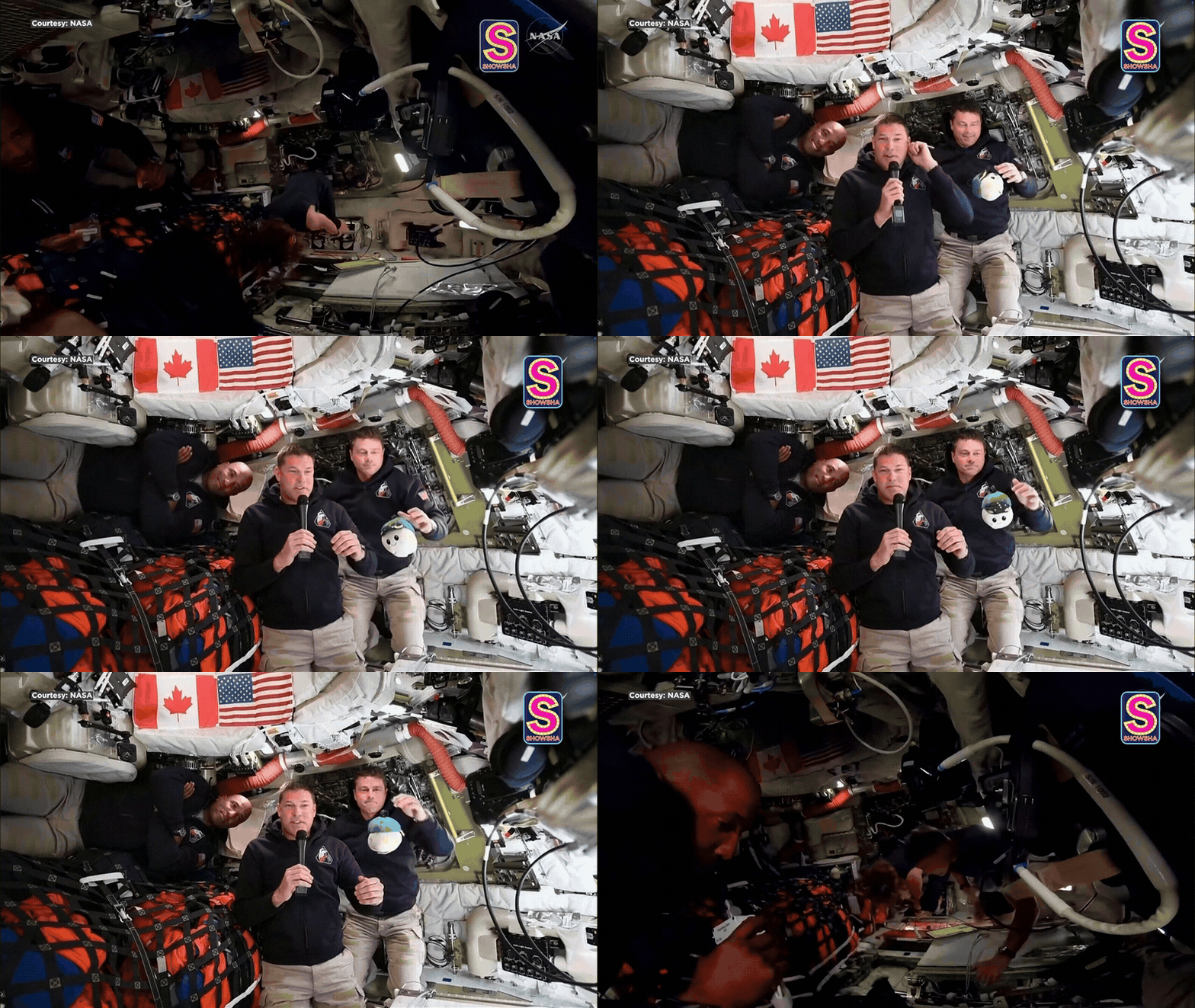
The NASA Kennedy Space Center launch of Artemis II on 1 April 2026 marked humanity’s first crewed lunar journey in more than half a century an approximately 10‑day flight designed to test deep-space systems, procedures, and astronaut operations on a free‑return path around the Moon and back to Earth.
In a pop‑culture overlap that quickly became part of the mission’s public story, astronaut Jeremy Hansen said the Artemis II crew watched Project Hail Mary during pre‑launch quarantine and later praised the film in-flight while more than halfway to the Moon after Ryan Gosling sent them well wishes during the launch countdown.

What the Artemis II mission is and why it matters
Artemis II is the first crewed test flight in NASA’s Artemis campaign and is intended to validate the integrated performance of the Space Launch System and Orion human spacecraft with astronauts aboard in the deep-space environment. In NASA’s mission framing, Artemis II follows the uncrewed Artemis I flight test by demonstrating a broad range of capabilities and proving Orion’s life-support systems are ready to sustain crews on future missions.
This matters because Artemis II is explicitly designed as an operational bridge between “can we fly this spacecraft safely around the Moon?” and “can we execute the mission-critical behaviours—manual piloting, navigation, communications, habitability, and deep-space procedures—that underpin later Artemis missions?” NASA describes Artemis II as enabling the crew and the agency’s teams to practise operations essential to Artemis III and beyond.
Artemis II launch date and mission timeline (April 2026)
NASA reports Artemis II lifted off from Launch Complex 39B at Kennedy Space Center at 6:35 p.m. EDT on Wednesday, 1 April 2026, sending the crew toward a roughly 10‑day “around the Moon and back” test flight.
NASA’s published mission Q&A describes the mission architecture as a lunar flyby followed by a splashdown off the coast of San Diego, with schedule updates refined as milestones are achieved. NASA’s current schedule (as published during the flight) lists splashdown at approximately 8:07 p.m. EDT (5:07 p.m. PDT) on Friday, 10 April 2026.
Operationally, the lunar flyby period is also a central public milestone: NASA’s mission Q&A lays out a sequence including surpassing the Apollo-era distance record, entering a planned communications blackout behind the Moon, achieving closest approach (about 4,067 miles from the lunar surface), reaching peak distance from Earth (about 252,760 miles), and witnessing a solar eclipse from deep space during the same observation window.
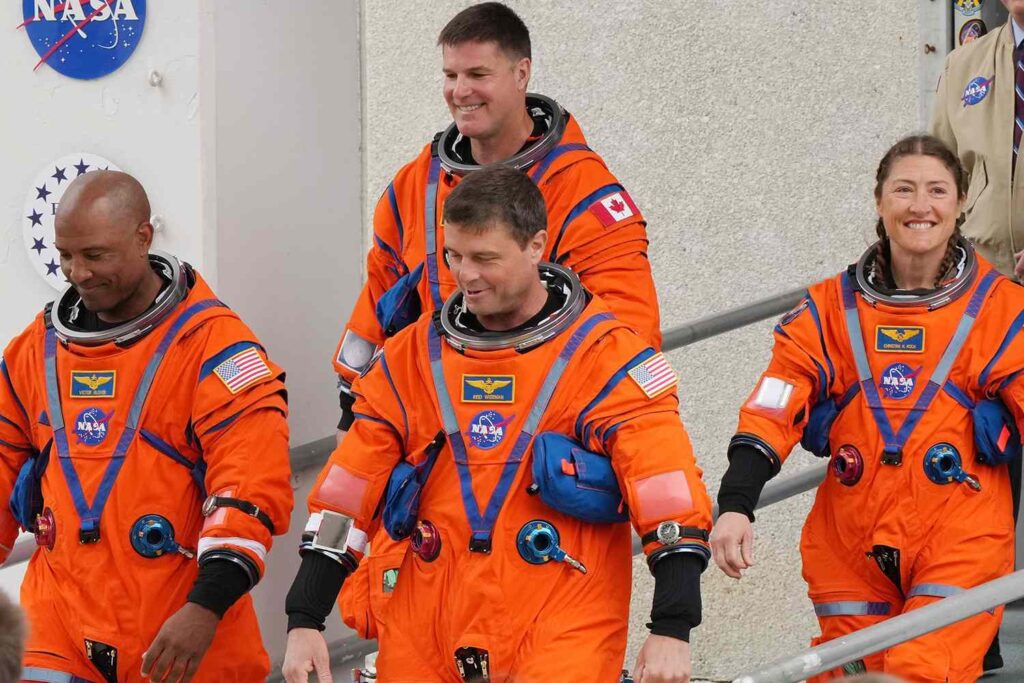
Artemis II crew members Reid Wiseman Victor Glover Christina Koch Jeremy Hansen
NASA identifies the four Artemis II astronauts and their roles as: commander Reid Wiseman, pilot Victor Glover, and mission specialists Christina Koch and Jeremy Hansen.
NASA’s Artemis II press kit summarises key background points that frame why this crew was chosen for a first‑of‑its-kind deep-space shakedown. Wiseman previously served aboard the International Space Station (ISS) as a flight engineer for Expedition 41 (2014) and later served as Chief of the Astronaut Office (2020–2022).
The same press kit lists Glover as having served as pilot of Crew‑1 and as a flight engineer aboard the ISS (Expedition 64/65), while also highlighting his military aviation and test pilot background.
For Koch, NASA emphasises her long-duration ISS experience—328 consecutive days in space—and her participation in the first all-female spacewalks, alongside a technical background that includes scientific field engineering in polar environments.
For Hansen, NASA’s press kit notes he was selected as a Canadian astronaut in 2009, worked as capcom in NASA Mission Control in Houston, and has participated in international training missions such as ESA’s CAVES and NASA’s NEEMO. NASA also flags the symbolic milestone that this assignment makes him the first Canadian to fly around the Moon.
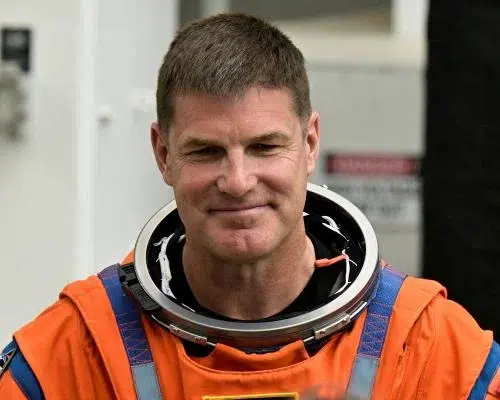
Canadian astronaut Jeremy Hansen first non-American to fly to the Moon
Beyond the “first Canadian” milestone emphasised in NASA’s press kit, a broader historical first is widely noted in contemporary reporting: Hansen is the mission’s non‑American crewmember, making him the first non‑American astronaut to fly to the Moon on a crewed lunar mission.
That milestone is significant in the Artemis programme’s “international partnership” posture: Artemis II includes a Canadian astronaut as a visible expression of multinational participation in lunar exploration, aligned with later architecture that relies on partner contributions (including European hardware support for Orion’s service module).
How far Artemis II travels compared to Apollo missions
NASA states the Artemis II crew surpassed Apollo 13’s distance record on 6 April 2026 by exceeding 248,655 miles from Earth—Apollo 13’s farthest distance in 1970—and that Orion’s farthest point for Artemis II is about 252,756 miles (NASA’s release) to 252,760 miles (NASA’s mission Q&A).
NASA’s mission Q&A further adds a full-mission travel estimate: a total of 695,081 miles from launch to splashdown, underscoring that “how far” involves not only maximum Earth-distance but also the cumulative path length as Orion arcs out and back.
The comparison to Apollo is more than symbolic. NASA and science coverage highlight Artemis II’s use of a “free return” trajectory—an orbital mechanics approach historically associated with Apollo 13’s safe return after an in-flight emergency—where lunar gravity helps bend Orion’s path back toward Earth.
Artemis II Orion spacecraft and SLS rocket explained
NASA’s Artemis II press kit describes the Space Launch System (SLS) as a “super heavy-lift rocket” that provides the foundation for human exploration beyond Earth orbit, emphasising that SLS is the only rocket that can send Orion, four astronauts, and large cargo directly to the Moon on a single launch on future missions—reducing mission complexity by concentrating capability in one launch vehicle.
For Orion, NASA explains the spacecraft architecture in foundational terms: a crew module and a service module, with a launch abort system at the top used to pull the crew module safely away from the rocket in an emergency and then jettisoned after a successful launch.
A major European contribution sits at the heart of Orion’s deep-space functionality. The European Space Agency states that its European Service Module provides Orion and its crew with life support, power, and propulsion—enabling safe human travel beyond Earth orbit—while distinguishing Artemis II’s crewed configuration from Artemis I’s uncrewed test.
On the communications side, NASA’s press kit notes Artemis missions rely on NASA’s Near Space Network and the Deep Space Network for communications and navigation services, with the Deep Space Network handling communications beyond low Earth orbit and enabling data, images, and astronaut communications as Orion travels to and around the Moon.
NASA’s in‑flight mission blog also illustrates how these systems translate into operational milestones: Flight Day 7 included an audio-only ship‑to‑ship call between Artemis II and the International Space Station as part of pre‑scheduled public engagement and mission communications activity.
Why Artemis II astronauts were in pre-launch quarantine (health stabilization)
NASA refers to its pre-flight isolation approach as the “health stabilization program,” a period designed to minimise the risk that crews pick up illness close to launch—illness that could delay the mission or compromise health during flight. NASA’s Artemis II quarantine blog states this programme “typically starts about 14 days before launch” and explains that the Artemis II crew entered quarantine to preserve schedule flexibility as launch opportunities were targeted.
NASA’s Office of the Chief Health & Medical Officer provides the broader rationale in its Health Stabilization Program technical brief: a comprehensive HSP is intended to reduce infections pre-flight and prevent symptoms in-flight, with the two biggest components identified as pre-flight immunisations and quarantine. The brief states HSP has been implemented since Apollo 14 and that current NASA/JSC protocol mandates HSP begin 14 days prior to launch.
In practice, the “why” can be summarised as mission risk management: respiratory and gastrointestinal illness are disproportionately disruptive in the confined environment of a spacecraft, where treatment resources are limited and crew performance impacts mission safety margins. NASA’s technical guidance explicitly links infectious disease risk to crew performance and mission outcomes, framing quarantine as a preventive control rather than a public-health gesture.
What astronauts do during NASA quarantine before a mission
NASA’s Artemis II quarantine blog describes quarantine as structured time rather than “time off.” The crew continues final mission preparations such as mission simulations and medical checkouts while limiting exposure—avoiding public places, wearing masks, and maintaining distance from others they come into contact with.
The same NASA update outlines the logistical phasing: quarantine begins in Houston; if testing and launch processing advance, the crew travels to Florida roughly six days ahead of launch and stays in astronaut crew quarters inside the Neil A. Armstrong Operations and Checkout Building.
NASA’s HSP technical brief adds the deeper “how”: HSP is designed around preventing exposure and ensuring that anyone in early infection stages reaches convalescence before launch; it also stresses that HSP effectiveness depends on participation by the crew and their close contacts, and that quarantine is paired with immunisation strategies.

Artemis II crew quarantine movie night Project Hail Mary
Against that background of controlled contact and careful scheduling, “movie night” became a culturally resonant example of what crews can do while keeping exposure low. Hansen said the Artemis II crew watched Project Hail Mary while they were in quarantine and that the production sent them a link so they could watch with their families as they prepared for their own mission.
Multiple outlets reporting on Hansen’s comments emphasised that this was not simply entertainment but also morale and mindset: Hansen described the film as “uplifting and inspiring” in the context of a story about solving problems to save humanity—an echo of the real mission’s focus on competence under pressure.
Project Hail Mary and the Artemis II pop-culture crossover
The headline moment—“thumbs up halfway to the Moon”refers to Hansen’s in flight praise of Project Hail Mary during a televised event as Artemis II travelled outward toward the Moon. The Associated Press framed the moment as a rave review delivered “more than halfway to the moon,” with Hansen calling the chance to see the film before launch “a real treat.”
Hansen’s remarks also positioned the connection as more than a celebrity coincidence. He linked the film’s “save humanity” premise to a broader ethic of perseverance, using language about “art” and “science” influencing one another an idea repeated across coverage of his comments.
The Canadian angle amplified the story: Hansen and Gosling are both reported as coming from London, Ontario, which turned a Hollywood casting choice into a national talking point during Canada’s most visible participation in a lunar mission to date.
Ryan Gosling message to Artemis II astronauts before launch
Hansen’s comments did not occur in a vacuum. During launch coverage, a recorded video message from Gosling was played in which he contrasted his fictional role “a biologist who goes to space to save the planet” with the Artemis II crew’s real journey, and he sent best wishes as they prepared to travel farther from Earth than any humans in history.
This type of message fits NASA’s broader approach of pairing a historic spaceflight moment with wide public engagement, including scheduled live conversations and mission coverage designed to bring deep-space operations to a mass audience.

Project Hail Mary movie plot and why astronauts relate to it
Reuters’ film backgrounder summarises Project Hail Mary as the story of science teacher Ryland Grace, who wakes up alone on a spaceship light‑years from Earth; as his memory returns, he uncovers a mission to stop a mysterious substance killing the sun and save Earth where an unexpected friendship becomes central to success.
Amazon’s official guidance for audiences frames the hook in similar terms: Ryan Gosling plays a science teacher who must solve the mystery of a dying sun to save Earth, positioning the film as problem‑solving science fiction anchored in a reluctant hero archetype.
Astronauts can relate to this premise in two distinct, evidence-based ways. First, the film’s narrative is fundamentally about operating under extreme constraints limited time, isolated conditions, reliance on procedure and improvisation shared themes in human spaceflight operations. Hansen’s own description of the film as inspirational and “uplifting” while he was preparing for a real deep space mission demonstrates that the “resonance” is not speculative; it is explicitly stated by a crew member living the reality.
Second, the timing of the film’s release and visibility during Artemis II created a feedback loop: audiences watching astronauts fly a free return around the Moon were simultaneously seeing a high profile science‑fiction film about deep space survival, increasing cross‑audience interest among space enthusiasts.
Project Hail Mary Ryan Gosling role explained (Ryland Grace)
Across official and industry summaries, Gosling’s character is consistently identified as Ryland Grace, a science teacher (and, in several summaries, a scientist by training) who becomes central to a space mission aimed at preventing catastrophe on Earth.
The story structure—amnesia, gradual recovery of mission context, and a shift from classroom identity to deep-space responsibility—provides the narrative lever that makes “hard problems” cinematic: instead of beginning with heavy exposition, the film uses discovery and recall to reveal the stakes and the science.
Project Hail Mary based on Andy Weir novel differences vs the book
The film is widely reported as an adaptation of Andy Weir’s 2021 novel; industry coverage and official materials describe it as translating a popular hard‑sci‑fi narrative into a mainstream cinematic format.
One of the most commonly noted adaptation challenges is that the novel relies heavily on internal monologue and extended technical problem-solving sequences. Comparative coverage argues the film streamlines or omits some step‑by‑step scientific reasoning to keep pace and foreground character relationships—particularly the bond between Grace and the alien Rocky—while still preserving major story beats.
Multiple analyses also point to structural reframing: changes to how information is revealed, adjustments to supporting characters and scenes for visual storytelling, and selective simplification of certain technical elements that read well on the page but would slow a film.
Importantly for audiences deciding whether the film is “faithful,” review and comparison coverage often converges on a similar conclusion: the adaptation preserves the core emotional arc and central relationship while making targeted changes to fit cinematic pacing and visual constraints.

Where to watch Project Hail Mary and why it’s trending with space fans
Amazon MGM Studios’ own “how to watch” guidance states the film is available to watch “now, exclusively in theatres,” making cinemas the primary legitimate viewing method at present.
The film’s “trending” status is also measurable via commercial indicators. Entertainment press reported a record-setting opening weekend—about $80 million domestically and roughly $141 million worldwide—placing it among the largest launches of 2026 and establishing it as a major theatrical hit early in the year.
Premium-format performance adds another signal of unusually strong audience pull: IMAX’s own release notes a substantial opening weekend figure for the film in IMAX theatres, reinforcing its status as a large-scale cinema event rather than a niche science-fiction release.
Finally, the Artemis II linkage amplified interest among space fans: when real astronauts publicly discussed the film—after watching it in quarantine and commenting during the mission—the feedback loop between real exploration and fictional storytelling became a widely shared cultural moment during the most watched crewed lunar flight in decades.
Frequently Asked Questions (FAQs)
- What is Artemis II designed to prove? NASA describes Artemis II as the first crewed test flight in the Artemis campaign, intended to confirm Orion’s systems (including life support) perform as designed in deep space and to demonstrate operational capabilities that support future Artemis missions.
- How long is the Artemis II mission? NASA’s mission Q&A states Artemis II is an approximately 10‑day journey around the Moon including launch, a lunar flyby, and splashdown off the coast of San Diego.
- When and where is splashdown scheduled? NASA reports Artemis II is scheduled to splash down off the coast of San Diego at approximately 8:07 p.m. EDT (5:07 p.m. PDT) on Friday, 10 April 2026, with the exact location and time expected to shift as milestones are reached.
- How far from Earth did Artemis II travel, and what record did it break? NASA states Artemis II surpassed Apollo 13’s 1970 record at 248,655 miles from Earth and reached a farthest point of roughly 252,756–252,760 miles from Earth, setting a new record for farthest human spaceflight distance.
- Who are the Artemis II crew, and what are their roles? NASA lists the crew as commander Reid Wiseman, pilot Victor Glover, and mission specialists Christina Koch and Jeremy Hansen.
- Why did the Artemis II crew enter quarantine before launch? NASA says the crew entered the health stabilization programme to avoid picking up illness close to launch, and NASA’s health guidance states the programme typically starts about 14 days before launch. NASA’s medical technical brief explains HSP is intended to reduce pre-flight infection risk and prevent symptoms in-flight, combining immunisations and quarantine.
- What activities happen during NASA’s pre-launch quarantine? NASA states astronauts continue mission simulations and medical checkouts, maintain contact with approved friends and family who follow guidelines, and avoid public places while using masks and distancing to reduce exposure.
- Did the Artemis II crew really watch Project Hail Mary in quarantine? Hansen stated in a televised interview that the crew watched the film while in quarantine, describing it as a “real treat,” and Associated Press coverage reported he said they watched it with their families before launching.
- What did Ryan Gosling say to Artemis II astronauts before launch? Reporting on the countdown notes Gosling delivered a pre‑launch video message sending best wishes to the Artemis II crew and contrasting his fictional role with their real flight.
- Is Project Hail Mary based on a book, and how different is the film? Official and industry material describes the film as an adaptation of Andy Weir’s 2021 novel. Comparative coverage indicates the film is broadly faithful to major beats and the central relationship but streamlines internal monologue and technical detail, making selective structural and character adjustments for cinematic pacing.

Conclusion
Artemis II’s technical ambition—testing a crewed Orion free-return trajectory around the Moon, validating deep-space life-support and operations, and surpassing Apollo-era distance records—has unfolded as both a rigorously planned engineering mission and a public cultural event.
The crew’s pre-launch quarantine watch of Project Hail Mary and Hansen’s in-flight praise created a rare, well-documented moment where a contemporary space blockbuster and a real lunar mission directly reinforced each other in the public imagination—while NASA’s health stabilization protocols quietly did their job: reducing risk so the mission could fly.
sources and citation
- NASA official mission communications and documentation, including the Artemis II mission page, media resources, press kit, mission Q&A, launch updates, and flight blogs.
https://www.nasa.gov/mission/artemis-ii/ | https://www.nasa.gov/artemis-ii-media-resources/ | https://www.nasa.gov/wp-content/uploads/2026/01/artemis-ii-press-kit.pdf?emrc=1f6993 | https://www.nasa.gov/missions/nasa-answers-your-most-pressing-artemis-ii-questions/ | https://www.nasa.gov/blogs/missions/2026/04/01/live-artemis-ii-launch-day-updates/ | https://www.nasa.gov/blogs/missions/2026/04/06/artemis-ii-flight-day-6-lunar-flyby-updates/ - NASA medical and operational policy documentation on the Health Stabilization Program, plus NASA’s Artemis II quarantine update.
https://www.nasa.gov/wp-content/uploads/2023/12/ochmo-tb-006-health-stabilization-program.pdf | https://www.nasa.gov/reference/medical-operations-and-clinical-care/ | https://www.nasa.gov/blogs/missions/2026/01/23/artemis-ii-crew-enters-quarantine-ahead-of-journey-around-moon/ - Primary reporting on the crew’s Project Hail Mary quarantine viewing and in-flight comments, including Associated Press coverage and a detailed account of Hansen’s remarks and Gosling’s message.
https://apnews.com/article/0d9dfc7db4d464eb89a5fe84d878fef1 | https://ew.com/artemis-crew-watching-project-hail-mary-11943839 | https://spaceq.ca/canadian-astronaut-jeremy-hansen-says-ryan-goslings-project-hail-mary-movie-inspired-him/ - Film industry and official distributor materials describing how to watch the film, its plot framing, and the performance indicators used to support its “trending” status.
https://www.aboutamazon.com/news/entertainment/project-hail-mary-ryan-gosling-amazon-mgm-studios | https://amazonmgmstudios.com/ | https://www.youtube.com/watch?v=m08TxIsFTRI | https://variety.com/2026/film/box-office/project-hail-mary-box-office-biggest-debut-2026-amazon-mgm-record-1236696247/ | https://www.boxofficemojo.com/title/tt12042730/ | https://www.the-numbers.com/movie/Project-Hail-Mary-%282026%29
Recommended
- Flow Made With Blender Wins Oscar: Latvia’s Indie Animated Feature Film Making History
- The Witcher 3 Secret DLC Rumors: CD Projekt Says No New Cyberpunk 2077 DLC Planned
- Bloodborne Remake Reportedly Shot Down By FromSoftware As Bluepoint Games Scrambled For Ideas (Bloomberg Report, Bluepoint Shutdown, What Happens Next)
- How to Make Your Own Character for Unreal Engine 5: A Step-by-Step Creation Guide
- Closure of Midsummer Studios: What Happened to Jake Solomon’s Burbank Life Sim
- How do I parent a camera to an object in Blender?
- Markiplier. His Iron Lung Movie: Release Date, Plot, Cast, Trailer, and Where to Watch
- Netflix On Why It Gave Up On Buying Warner Bros: The Real Reasons the Deal Collapsed
- How to Reduce Topology in Blender: Decimate, Remesh, and Retopology Methods to Lower Polycount
- How to Turn a 2D Concept into a 3D Character: Start-to-Finish Workflow Using Blender and ZBrush