










In This Article (8 sections)
Sobosuba Release Date, Gameplay and Godot Soft-Body Physics
Sobosuba is a two-dimensional, single-player merge puzzle game developed and self-published by keepeetron using Godot. It launched on Steam on August 14, 2026, for Windows and Linux, with a United States price of $3.99, although regional pricing varies. The developer describes it as a compact, one-level experience built around repeated score-attack attempts rather than a story-driven campaign or a sequence of handcrafted stages.
Players launch numbered blobs into a contained playfield and combine matching values to create the next power of two. The numerical progression resembles 2048, while the pressure of managing an increasingly crowded container recalls Suika Game. Aiming and firing objects also invites comparisons with Puzzle Bobble, but Sobosuba does not use stationary bubble formations or color-based matching. Its pieces remain affected by gravity, collisions and deformation after every launch, making positioning and momentum central to the puzzle.
The blobs can stretch, flatten, rebound and squeeze through narrow openings, allowing players to manipulate arrangements that would remain blocked in a rigid puzzle. Smaller pieces may slip beneath larger ones, while powerful impacts can reshape the surrounding stack. Each newly created value is roughly 1.28 times the size of the previous one, so merging two matching blobs produces an object that occupies less total space than the pair it replaces. Successful merges therefore advance the numerical sequence while recovering room for future launches.
Keepeetron achieves this behavior by constructing each blob from a ring of small circular rigid bodies. Godot handles their collisions, while custom forces keep neighboring points connected, maintain the overall shape and regulate internal volume. The combined object behaves like an elastic membrane despite its individual components being rigid. This approach began as a temporary workaround, but experiments with fully custom point-based physics through GDExtension using C++ and Rust proved less stable, so the rigid-body system became the foundation of the finished game.
The important technical distinction is that keepeetron is using Godot’s existing two-dimensional rigid-body physics in an unusual arrangement, rather than presenting the game as a demonstration of a ready-made soft-body add-on. In the developer’s explanation, the small bodies supply collision behavior while the additional forces make their collective outline elastic. The squashing therefore belongs to the interaction itself, not just an animation played over an otherwise unchanged circular piece. A blob that changes shape can alter how it rests against its neighbors and which parts of the surrounding arrangement it can reach.
That development history also illustrates a practical design trade-off. Building a more independent simulation would offer a different degree of control, but keepeetron’s account emphasizes whether the result behaved reliably enough for this particular game. It does not establish that C++ or Rust are inherently unsuitable for soft-body physics. The useful lesson is narrower: the approach that best supported the intended play survived the experiments. For a puzzle based on repeated collisions, an implementation that preserves readable, usable interactions matters more than whether the underlying solution began as an elegant plan or a temporary workaround.
Keepeetron, also known as keepee on itch.io, previously worked on numerous Godot 3.x and Godot 4 projects, including games, prototypes, physics experiments and code art. Godot was therefore already part of the developer’s workflow before Sobosuba. The available background points toward technical familiarity, rather than any stated licensing or royalty considerations, as the clearest explanation for the engine choice.
The developer’s public portfolio provides further context through projects such as the Godot 4 sketchbook and an earlier Godot 3.x code-art sketchbook, alongside smaller games including duck sorter, orbiter and Snekklr. These projects show that Sobosuba emerged from an existing practice of experimenting with interactive systems. They should not be treated as earlier versions of the same game, but they help explain why the finished release places so much attention on the behavior of simple shapes and direct player input.

Sobosuba Scoring, Float-Bar Mechanics and High-Score Strategies
Each run involves choosing a launch angle and strength, firing a blob and responding to the resulting movement. There is no visible countdown, but the run ends when the playfield becomes overfilled. Players can take time to plan without entering a consequence-free sandbox, and the standard experience does not have a separately labeled relaxation mode. Keepeetron has mentioned possible future modes involving power-ups or activatable abilities, but these are not confirmed features of the released game.
The scoring rules are less conventional than the growing numbers might suggest. In an August 15 Steam Community explanation, keepeetron said the score represents the combined value of eligible blobs on screen. Newly spawned blobs have faded number labels and do not contribute until they participate in a merge. Once a value has become eligible, combining it with another already counted value does not award the combined total a second time. Large merges therefore do not automatically produce an extra score bonus.
A simple example makes the distinction clearer. Suppose two already counted 64 blobs combine into a 128. Their contribution was 128 before the merge and remains 128 afterward, assuming nothing else changes. By contrast, two fresh, uncounted 2 blobs becoming a counted 4 would add four points. A fresh 2 merging with an already counted 2 would increase the contribution from two to four. These are arithmetic examples of the developer’s stated rule, not separate scoring exceptions or special combo rewards.
This suggests a useful way to evaluate a shot: separate its immediate numerical reward from its effect on the next few moves. Joining the two counted 64 blobs may leave the scoreboard unchanged, but the smaller combined footprint can make another launch possible. A new low-value match might raise the score immediately while leaving the pile awkwardly arranged. Neither outcome is automatically preferable. The better choice depends on whether the run currently needs fresh counted value, additional space, or a route toward a pair that has become difficult to reach.
The upper float bar is part of the physics simulation rather than a passive display of upcoming pieces. Blobs waiting there remain active, with forces drawing them toward the bar’s height and causing them to flatten or stretch. Matching values can merge before entering the main playfield, potentially improving the next launch or disrupting a planned sequence. Keepeetron described merging around the upper bar as a “happy accident” that was retained because it added tactical possibilities.
Spawning also depends on the physical arrangement above the stack. Keepeetron explains that two indicators use directional checks toward the float bar. When a check finds enough unobstructed distance, another blob can spawn. Pushing the waiting pieces toward one side can consequently create multiple arrivals on the other. This is intentional behavior, rather than a promise that every launched blob will always be replaced by exactly one new piece. The developer has discussed possible bonus-based scoring alternatives, but those comments describe ideas rather than an established second scoring system.
For planning purposes, this means the float bar is worth checking after any shot that disturbs it. A player preparing to use a particular value should verify that the available selection still matches the plan instead of treating the upper area as a fixed inventory. Consider a situation where two useful pieces move together while another opening appears beside them. The next decision involves both the potential upper-bar merge and the changing launch options. This is a tactical implication of the documented spawning rules, not a guaranteed method for producing a chosen number on demand.
A newly merged blob briefly flashes and cannot merge again until its protection period expires. Larger blobs remain protected slightly longer because the delay scales with their area. This makes chain reactions easier to follow, but it also affects positioning: two matching values may touch and then separate before another merge becomes possible. Players preparing a chain need to keep the next matching blob close enough for contact to continue after the protection ends.
Useful high-score principles include:
- Use gentle launches for accessible matches. Lower force helps preserve a stable arrangement and reduces the chance of scattering useful pairs.
- Use stronger shots to overcome obstacles. A forceful launch can push a small blob through a gap, move a larger piece or reach a buried match.
- Avoid isolating low values. Small blobs trapped beneath unrelated pieces occupy space without contributing to an immediate merge.
- Prioritize accessible merge chains. Promising values offer little protection against overfilling when they are positioned too far apart to combine.
- Let major movement settle. Waiting after a powerful collision can reveal exposed pairs, narrow passages and unstable areas before the next shot.
- Reserve aggressive pile shifting for recovery. Repeatedly firing toward one side can expose buried pieces or trigger merges, but it can also push the stack into the upper failure zone.
The balance between precision and force changes throughout a run. Gentle placement works well while matches remain reachable, but an increasingly compressed pile may require stronger intervention. Soft-body deformation makes recovery possible even when a piece initially appears inaccessible, so the important question is whether a launch will create a useful route without destabilizing the rest of the playfield.
A useful planning exercise is to identify the intended landing area before choosing the strength of the launch. Imagine that a matching 32 is visible beneath the edge of a larger blob. The relevant questions are whether the incoming piece can reach that edge, whether the impact will close the opening, and where the larger blob might move afterward. Simply aiming at the number does not answer those questions. This approach treats the surrounding shapes as part of the shot rather than as background clutter, while avoiding the assumption that every visible pair is immediately accessible.
It can also help to distinguish a setup move from a finishing move. In a hypothetical crowded arrangement, nudging one obstructing blob may be more useful than immediately attempting the buried match behind it. The first shot would be judged by whether it creates a reachable route, and the next by whether it uses that route without blocking another important pair. This is not a prescribed solution for every run. It is a way of recognizing progress that the score display alone may not capture, especially when a large merge requires several smaller positional decisions.
Post-launch controls add another consideration. Version 1.2, released on August 27, changed launches to add velocity instead of replacing existing motion. A blob moving sideways along the float bar can therefore retain that movement when fired. The same update added center cancelling, allowing a prepared shot to be cancelled by returning the aiming arrow toward the center under the required conditions. For careful placement, the practical implication is to watch the selected blob as well as the arrow, particularly when the upper bar is still moving.

Sobosuba Achievements, Color Styles and Leaderboards
The Steam release contains 30 achievements, each unlocking an additional color style. These challenges provide goals beyond simply creating the largest blob or achieving the highest score. Some reward efficient merging, while others require unusual arrangements, precise totals or deliberately preserving pieces that would normally be combined. This gives the single playfield different objectives without requiring a traditional campaign.
The main achievement categories include:
- Numerical progression: Create increasingly large values, including an 8192 blob. Player discussions also describe attempts to reach 16384, although that is separate from the documented 8192 achievement.
- Clean-stack challenges: Leave one high-value blob alone in the stack, with targets including 512, 1024, 2048 and 4096.
- Float-bar challenges: Place values such as 64, 128, 256 or 512 in the upper bar.
- Air merges: Create values including 32, 64, 128 or 256 and keep the resulting blob from touching anything for one-quarter of a second.
- Chain challenges: Complete an uninterrupted merge lineage, with documented sequences including 1 to 16, 32 to 1024, 128 to 2048 and 512 to 4096.
- Exact-score challenges: End a run with a precise total, such as 0, 10, 100 or 1000.
- Collection and endurance challenges: Maintain specified groups containing several 1024, 512, 256 or 128 blobs for a required duration.
Air-merge challenges emphasize launch angle, speed and timing, while chain achievements require players to preserve the correct family of blobs through successive combinations. Simply producing the final number through unrelated merges does not satisfy a continuous-chain condition. The post-merge protection period also matters because the next matching value must remain reachable until the newly created blob becomes eligible to merge again.
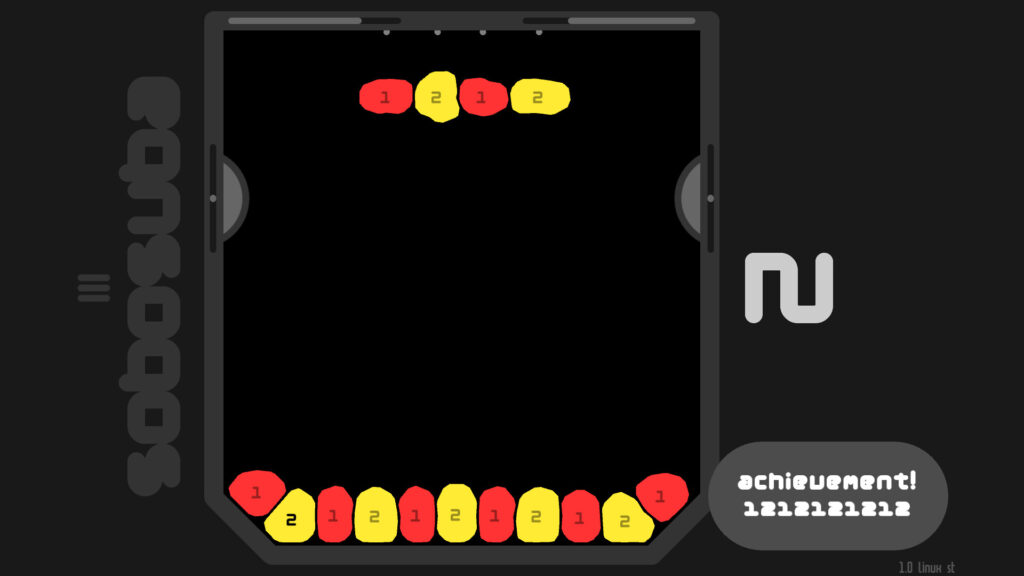
The “121212” achievement requires six blobs to remain in the stack for 10 seconds without merging anything above 2, while a harder variation increases the condition to 10 blobs. Challenges like these reverse the usual priority of combining matching pieces quickly. Full achievement completion may therefore require avoiding obvious merges, maintaining awkward arrangements or intentionally ending a run at a particular score.
The clean-stack objectives are best understood as arrangements rather than simple number milestones. A lone 1024 satisfies a different requirement from a 1024 surrounded by several small blobs. As a planning example, a player pursuing the clean 1024 challenge could pay attention to whether the remaining pieces can eventually combine into that target, rather than rushing to produce it while leaving unrelated pieces behind. Reaching the number too early is not necessarily the end of the attempt, but it does not resolve the separate requirement that the target be alone in the stack.
The endurance achievements create the opposite kind of problem. Their documented conditions include keeping three 1024 blobs, four 512 blobs, five 256 blobs or six 128 blobs for 10 seconds. Producing the requested group is only the first part; preserving it is the second. A useful tactical inference is to stop treating every matching contact as desirable once the required collection exists. For example, two of the requested 512 blobs combining would leave a different collection from the four separate 512 pieces the challenge asks for, even though the numerical value has been preserved.
Another achievement, “praise the suncle,” specifically concerns receiving a safety-spawn while both spawners are blocked. This adds a goal tied to the spawning system rather than to a larger number, a cleaner stack or an airborne merge. Together, these requirements make it sensible to choose an achievement target before committing to a run, because an arrangement that supports one objective can work against another.
An online Steam leaderboard provides asynchronous competition through submitted scores. Early reviews and player discussions indicate that the ranking system is active, with players sharing positions and strategies. However, Sobosuba remains a single-player game, with no announced cooperative mode, head-to-head matches or shared physics playfield. Competition comes from comparing completed runs rather than playing against others simultaneously.
Version 1.2 also introduced friend-score display during play and a friends filter in the scores screen. These features make comparison more personal without converting the underlying puzzle into a shared match.
Sobosuba PC System Requirements, Supported Platforms and Mobile Plans
The minimum Windows specifications listed on Steam are:
- Operating system: Windows 10, with a 64-bit processor and operating system
- Processor: AMD Ryzen 5 1600 or Intel Core i5-10400
- Memory: 2 GB of RAM
- Graphics: NVIDIA GTX 1050
- Storage: Approximately 200 MB of available space
Keepeetron describes these requirements as untested but safe estimates and states that the game will probably run on weaker processors and integrated graphics. They should therefore be treated as cautious guidance rather than a precisely benchmarked performance threshold. A native Linux build is also available through Steam, although the requirements section does not provide a separate detailed minimum Linux operating-system specification.
For someone assessing an older computer, the demo is a more useful practical check than assuming that the small download guarantees consistent performance. A sensible test would include a crowded playfield and several merges, not only the opening moments when few blobs are present. Watching whether aiming remains responsive and the moving stack stays readable can help establish whether the experience suits that particular machine. This is a testing suggestion, not an additional minimum specification, and it does not turn the developer’s estimates into a guarantee for every integrated GPU.
The official game information lists mouse and gamepad controls, while SteamDB identifies full controller support, including DualShock and DualSense compatibility. English is the only listed interface language. There is no confirmed native macOS version, and editions for PlayStation, Xbox or Nintendo Switch have not been announced. Windows and Linux remain the supported platforms for the complete paid release.
That English-only listing has been superseded by post-launch localization. Version 1.2 added Czech, German, Spanish, Italian, Japanese, Polish, Russian and Serbian on August 27. Version 1.2.2 added Simplified Chinese and Traditional Chinese on August 28. The earlier language summary therefore should not be treated as the full current language offering.
A free downloadable Steam demo lets players try the controls and physics before purchasing. A separate HTML5 browser demo is available through itch.io, but it is a limited demonstration rather than a replacement for the full game. Its page specifically states that it was not designed for mobile devices, so being able to open it on a phone or tablet should not be interpreted as official mobile support.
The browser demo’s own “In development” status should likewise not be confused with the release status of the paid Steam game. They are separate listings, serving different purposes. The browser version offers a way to sample the premise without installing the desktop release, while Steam is the relevant listing for the purchased game. A limitation or outdated description attached to the browser demonstration does not, by itself, establish that the full desktop version has the same limitation.
A dedicated mobile edition is planned, although no Android or iOS release date has been confirmed. The official website places mobile development after the desktop launch, and keepeetron said following the Steam release that work on a port would begin soon. Earlier comments also suggested that development could depend partly on the desktop version’s performance. Supported devices, storefront availability, whether Android and iOS would launch together, and the payment model remain unconfirmed.
A native mobile version would require suitable touch controls, interface adjustments and performance testing, particularly because each blob contains numerous interacting rigid bodies. Until official listings or supported-device information are published, mobile availability should be described as planned rather than available. Unrelated applications using the Sobosuba name should also be approached cautiously, as the developer identifies its official website, Steam page and itch.io page as the game’s official locations.
Session continuity has also improved since launch. In a September 12 response to a Steam review, keepeetron confirmed that an update allows players to close the game and resume the previous session after reopening it. The developer deliberately distinguished this from a full save system that would let players rewind mistakes, citing fairness to existing leaderboard results. It is therefore more accurate to describe the feature as a way to continue an interrupted attempt, rather than as unrestricted save slots or a means of repeatedly replaying a difficult shot.
That distinction is particularly useful when considering the game’s compact format. A single playfield does not mean every attempt must be completed in a few minutes, and a player who likes taking time over decisions may value the ability to stop without abandoning the current arrangement. The resume feature addresses that interruption problem while leaving the consequences of previous choices intact. It supports a more flexible session length without changing the basic purpose of the run: managing the space available and building toward a better result.
Frequently Asked Questions (FAQs)
- What is Sobosuba?
Sobosuba is a single-player merge puzzle game in which players launch deformable numbered blobs into a contained playfield. Matching values combine to create larger numbers, but the blobs also squash, stretch, bounce and push one another around. The goal is to keep producing efficient merges and increasing the score without allowing the growing pile to overfill the container. - When did Sobosuba launch on Steam?
Sobosuba was released on Steam on August 14, 2026. The launch included the complete paid version for Windows and Linux, along with Steam achievements, unlockable color styles and an online leaderboard. Players can also download a free demo before deciding whether to purchase the full game. - Who developed and published Sobosuba?
Sobosuba was developed and self-published by keepeetron, who also uses the name keepee on itch.io. The independent creator handled both development and publishing rather than working through a separate publisher. Keepeetron’s previous experience with experimental Godot projects helped shape the game’s unusual physics-based design. - Was Sobosuba made with Godot?
Yes. Sobosuba was developed with Godot and uses the engine’s built-in two-dimensional rigid-body physics in an unconventional way. Each blob is formed from several small rigid bodies held together by custom forces, creating the appearance and behavior of a soft object. This allows the blobs to compress, stretch, rebound and squeeze through narrow spaces during play. - Does Sobosuba have a free demo?
Yes. A free downloadable demo is available through Steam, while an HTML5 browser demo can be played through itch.io. Both versions introduce the core launching, merging and soft-body physics mechanics. The browser build is only a demonstration and is not designed as a complete replacement for the paid Windows or Linux release. - Does Sobosuba have a time limit?
No explicit countdown forces players to make immediate moves. Players can wait for the blobs to settle, inspect the stack and carefully choose an angle and launch strength before taking the next shot. However, the run still ends when the pile reaches the overfill area, so the absence of time pressure does not remove the need for careful space management. - How many achievements does Sobosuba have?
The Steam version includes 30 achievements covering numerical progression, aerial merges, continuous merge chains, float-bar manipulation, exact scores and unusual blob collections. Every achievement unlocks an additional color style, giving players a cosmetic reward for completing the challenge. Some achievements require strategies that differ significantly from an ordinary high-score attempt. - Does Sobosuba support online multiplayer?
No direct online multiplayer mode has been announced. Sobosuba remains a single-player game, with no cooperative play, head-to-head matches or shared physics playfield. Players can still compete indirectly through the online Steam leaderboard, which records and compares submitted high scores. - Can Sobosuba be played on Android or iOS?
A dedicated mobile version is planned, but official Android and iOS release dates, supported devices and storefronts have not been confirmed. The existing HTML5 browser demo is specifically described as not being designed for mobile devices. Windows and Linux therefore remain the only confirmed platforms for the complete game at present. - Is Sobosuba more like Suika Game or 2048?
It combines important elements from both games. Its power-of-two progression resembles 2048, while its crowded container and physical stacking are closer to Suika Game. Sobosuba distinguishes itself through adjustable launch strength and deformable blobs that can flatten, stretch, rebound and squeeze through gaps, making momentum and physical positioning as important as matching numbers.

Conclusion
The Sobosuba Steam launch demonstrates how a familiar puzzle structure can feel new when physics are treated as a core rule rather than a decorative effect. Keepeetron retained the accessible satisfaction of combining equal numbers but replaced the rigid certainty of a grid with a living stack of objects that bend, stretch, squeeze, and push against one another.
Its Godot implementation is particularly notable. The blobs are built from small rigid-body circles held together by skin and pressure forces, an approach that began as a temporary workaround but proved more robust than several attempts at fully custom soft-body physics. That technical decision directly shapes the design, allowing launch strength, compression, and momentum to become meaningful player choices.
Sobosuba is intentionally compact. It offers one main score-focused playfield rather than a long campaign, and it does not include multiplayer or an in-game soundtrack. Its replay value instead comes from mastering the physics, pursuing higher numerical values, earning 30 achievements, unlocking color styles, and competing through the online leaderboard.
The game’s early Steam reception indicates that this focused approach has worked. As of August 25, 2026, all 113 recorded Steam reviews were positive, with players repeatedly praising the satisfying deformation, surprising strategic depth, and balance between calm pacing and difficult high-score play.
For puzzle and physics fans, Sobosuba offers a distinctive interpretation of the merge genre. It is easy to understand, inexpensive to try, and difficult to control perfectly. That tension between clarity and chaos is what gives the ultra-squishy Godot game its identity.
Sources and Citations
- Steam Official Store Page: Confirms the August 14, 2026 release and identifies keepeetron as developer and publisher. Documents the soft-body merging gameplay, 30 achievements, online leaderboard, unlockable colour styles and Windows and Linux system requirements.
Citation: Sobosuba on Steam - Sobosuba Official Website: Explains how players launch blobs with different amounts of force to position, squeeze and merge them. Confirms Windows and Linux support, mouse and gamepad controls, free demos and plans for a mobile version.
Citation: Sobosuba Official Website - Reddit Developer Physics Breakdown: Keepeetron explains how the game uses Godot’s built-in 2D rigid-body physics to construct deformable blobs from small circles. Discusses the forces maintaining their shape, experiments with custom physics and how merging frees space on the board.
Citation: My Soft-Body Physics Merging Game on r/godot - Steam Community: Collects developer announcements, patch notes, player discussions and bug reports. Documents expanded language support, control adjustments, physics fixes and the September 8 update introducing the ability to save and resume an unfinished session.
Citation: Sobosuba Steam Community Hub - itch.io Developer Profile: Lists the browser-playable Sobosuba demo alongside keepee’s other games and Godot experiments. Provides a reference for the developer’s earlier work and access to the mouse-controlled demo.
Citation: Keepee’s itch.io Portfolio and Sobosuba Demo - SteamDB: Records the game’s release date, Godot engine metadata, supported operating systems, regional pricing and update history. Also provides player statistics and achievement information, but operates independently of Valve and Steam.
Citation: Sobosuba on SteamDB - 80 Level: Amber Rutherford’s August 12, 2026 feature introduces the game ahead of its Steam launch. Summarizes the developer’s physics explanation and highlights its strategic gameplay, achievements, online leaderboard and planned mobile version.
Citation: Godot-Powered Ultra-Squishy Merge Game You’ll Want to Play - Reddit IndieGaming Developer Discussion: Features keepeetron’s gameplay presentation and direct responses to players. Covers merging blobs before launching them, physics-development challenges, achievement strategies and the risks of forceful shots compared with careful placement.
Citation: My Soft-Body Physics Merging Game on r/IndieGaming
Recommendations
- Dead or Alive 6 Last Round Review: is the Definitive Edition Worth Buying in 2026?
- The Rocketeer: Infiltrator! Explained: IDW’s New Rocketeer Comic, Release Date, Story, and Creative Team
- Crashout Crew: Release Date, Gameplay, Co-Op Forklift Chaos, and Everything We Know
- Oblivion Remastered To Get Multiplayer Mods: ReadyM Co-Op, Servers, Release Window, and Wha
- Saudi Arabia Just Spent Over $6 Billion Buying Up More of the Video Game Industry: What the Moonton Deal Means
- Crazy Taxi World Tour Real-Life Shops List: Pizza Hut, Five Guys & New Brands Revealed
- Sony Has Reportedly Been Making the Transition to All-Digital for Some Time Now: What it Means for PlayStation’s Future
- After Nine Years, The Live-Action Hitman TV Show Is Dead What Happened to the Hulu Series?
- The Duskbloods: Everything We Know About FromSoftware’s Switch 2 Exclusive
- Darth Maul’s Story So Far: What to Know Before Watching Star Wars: Maul – Shadow Lord



































































































