








In This Article (8 sections)
Solidigm Dalian Equipment Licensing and the US Export-Control Dispute
Solidigm and parent company SK Hynix are seeking additional US government approval to ship American semiconductor-manufacturing equipment to their NAND flash operation in Dalian, China. Reuters reported on October 15, 2026 that Solidigm wants more tools for an underused section of the facility known as Mod B, while people familiar with the negotiations linked approval to a prospective Solidigm NAND factory in the United States. SK Hynix, however, has stressed that it is not seeking a formal expansion of Mod B capacity, saying the building was completed in 2023 and that equipment installation has been carried out in consultation with the US government.
That distinction is central because US export policy now separates continued operation of existing foreign-owned fabs in China from capacity expansion and technology upgrades. The Bureau of Industry and Security removed the previous Validated End-User arrangement in August 2025, requiring companies such as SK Hynix and Samsung to obtain licences for equipment shipments that had previously been covered by broader authorisations. BIS has said it intends to approve equipment needed to operate existing fabs but does not intend to approve licences for increasing capacity or upgrading technology.
Reuters reported that the Commerce Department granted SK Hynix and Samsung annual licences for 2026, but the Dalian authorisation limits how much equipment can be shipped. Solidigm is now seeking approval for additional tools beyond that amount, while a 2027 licence had not yet been issued as of October 15. This does not mean the Dalian plant is prohibited from operating. The unresolved issue is how much additional US-origin equipment Washington will permit and whether those tools are classified as supporting an existing facility or effectively expanding its production capability.
The Dalian site is strategically important because it is Solidigm’s NAND manufacturing base and originated from SK Hynix’s acquisition of Intel’s NAND and SSD operations. The first phase of that $9 billion transaction closed in December 2021, transferring Intel’s SSD business and Dalian NAND assets while establishing Solidigm as a standalone SK Hynix subsidiary. The plant manufactures NAND flash used in Solidigm’s enterprise SSD products for data-centre and AI workloads.
Modern NAND manufacturing depends on highly specialised equipment from companies including Lam Research, Applied Materials and KLA. Production requires repeated deposition, etching, cleaning, inspection and metrology steps, with increasingly difficult processes as 3D NAND stacks become taller and more complex. Mod B reportedly contains space that was completed during a weaker memory market but was never fully equipped. Installing additional machinery could allow more of that existing cleanroom area to be used productively, although output would still depend on equipment mix, process qualification, yields and wafer-start decisions.
For that reason, describing the request as either simple maintenance or straightforward capacity expansion can be misleading. SK Hynix maintains that the building already exists and is not being physically expanded, while US policy focuses on whether additional equipment increases manufacturing capacity or enables technological upgrading. How regulators classify the requested tools will determine whether they fit within the stated policy of supporting existing fab operations.

Solidigm’s Potential US NAND Factory and the Strategic Link to Dalian
Reuters reported that SK Hynix has linked additional Dalian equipment approvals with plans for Solidigm to build a NAND manufacturing facility in the United States. Sources said greater production from Dalian could help generate funds for the American investment while providing additional supply until a US facility becomes operational. This creates a complicated policy trade-off because Washington is simultaneously restricting semiconductor manufacturing growth in China and encouraging more production inside the United States.
SK Hynix disputes characterising the Dalian work as a capacity expansion, while the proposed US factory remains conditional. Reuters reported in September 2026 that upstate New York had emerged as a leading candidate for the Solidigm plant, but no final investment decision or confirmed site had been announced. Building NAND capacity in the United States would also generally be more expensive than manufacturing in established Asian semiconductor hubs.
A US fab would represent a major strategic shift because Dalian is currently described as Solidigm’s sole NAND manufacturing operation. Adding American production would diversify its manufacturing footprint and reduce exposure to export-control uncertainty surrounding a China-based facility. The October reporting also indicated that approval for additional Dalian equipment was connected to the prospective US investment, according to people familiar with the matter.
Financing remains another important factor. Reuters reported that Solidigm has considered a possible initial public offering, potentially as early as 2027, that could contribute funding for the American project. Site selection, government incentives, licensing outcomes, financing availability and NAND-market conditions could all influence whether the factory proceeds.
The broader strategic logic is that additional production from Dalian could provide near-term manufacturing support while Solidigm prepares a longer-term US footprint. However, neither side of that potential arrangement is complete. Additional Dalian equipment licences remain pending, and the US NAND factory has not received a final public investment commitment.
AI Data-Centre Demand, NAND Supply, and the Role of US Equipment Makers
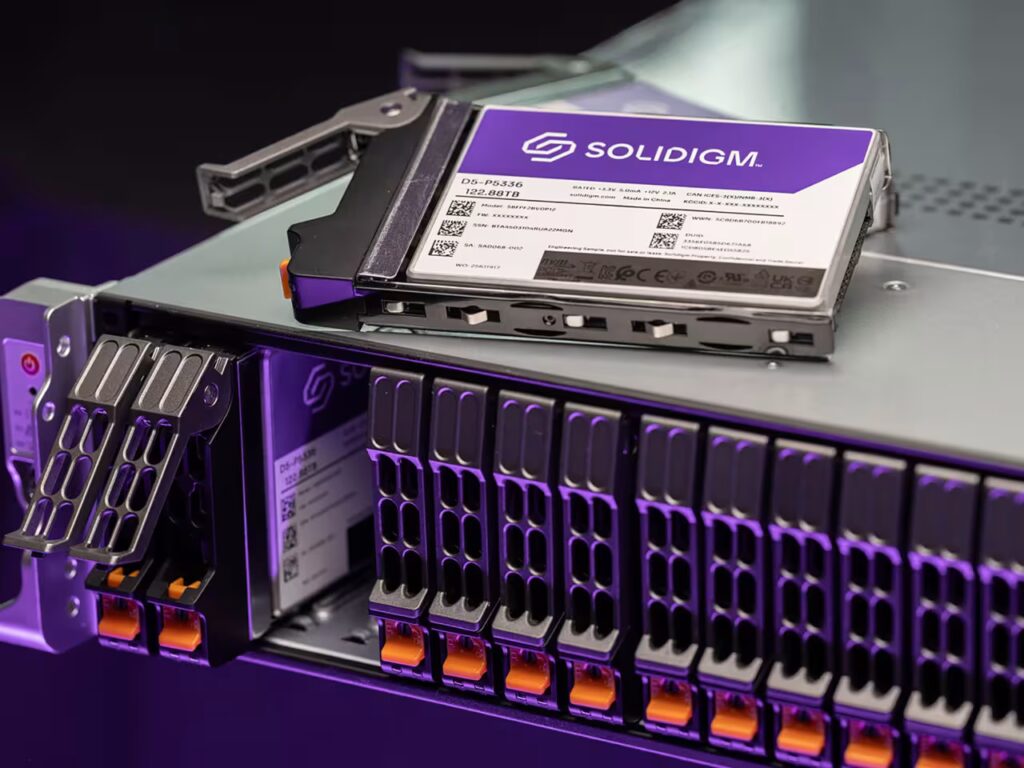
The licensing dispute is unfolding as NAND becomes increasingly important to AI infrastructure. AI systems require not only GPUs and high-bandwidth memory but also large amounts of persistent storage for training datasets, model checkpoints, vector databases, generated content and the broader data pipelines surrounding compute clusters. Solidigm specialises in this storage layer through high-capacity enterprise SSDs designed for data-centre and edge-AI applications.
NAND differs from DRAM and HBM in its basic role. NAND is non-volatile storage, meaning data remains when power is removed, which makes it suitable for SSDs and other persistent-storage products. DRAM is volatile working memory used for rapidly accessed temporary information, while HBM is a specialised form of stacked DRAM designed to provide extremely high bandwidth to processors such as AI accelerators. An AI server can therefore use NAND-based SSDs for large persistent datasets, conventional DRAM for system memory and HBM for high-speed data delivery to accelerators.
Reuters reported that the NAND market had tightened significantly as AI and cloud infrastructure demand increased. TechInsights analyst Walt Coon was cited as saying NAND pricing had risen sharply since mid-2023 and that tight market conditions could persist for several years. That change in demand helps explain why previously underused Dalian manufacturing space has become strategically valuable again.
The US equipment suppliers involved are critical because advanced NAND production depends on process technologies that are difficult to substitute quickly. Lam Research is particularly important in deposition and high-aspect-ratio etching as manufacturers build increasingly tall 3D NAND stacks. Applied Materials provides deposition, etch and other materials-engineering systems used to form and selectively remove complex layers. KLA supplies process-control, inspection and metrology systems needed to detect defects and measure deep three-dimensional structures accurately.
Because production processes are qualified around specific machines, materials and recipes, replacing a restricted tool is not always a simple procurement decision. Export licences can therefore directly affect how effectively the plant uses its physical footprint and how quickly additional wafer-processing capability comes online.
If additional tools are approved and more of Mod B becomes productive, Solidigm could eventually contribute more NAND to the global market. In a tight supply environment, additional output would generally work in the direction of easing pressure on NAND and enterprise-SSD availability. However, it would be inappropriate to predict an immediate or specific price decline from the Dalian approval alone. Prices also depend on production from other manufacturers, smartphone and PC demand, cloud investment, inventories, technology transitions, yields and manufacturers’ wafer-start decisions.
There would also be a delay between licence approval and saleable NAND. Equipment must be shipped, installed, qualified and integrated into the production process before it contributes materially to supply. Additional Dalian tools could therefore improve the medium-term outlook without providing an instant solution to global NAND tightness.
What Happens Next for Solidigm, Dalian, and US NAND Manufacturing
The immediate question is whether Washington approves Solidigm’s request for additional Dalian equipment beyond the quantity already authorised for 2026. SK Hynix also needs clarity on future licences, particularly for 2027. Because BIS has publicly stated that it supports continued operation of existing foreign-owned fabs while opposing capacity expansion and technology upgrading in China, the regulatory classification of the Mod B equipment will be decisive.
Solidigm must simultaneously decide whether to proceed with its proposed US NAND factory. Upstate New York remains a reported leading candidate, but no final site or investment commitment had been announced as of October 2026. Financing could involve corporate funds, government incentives or a possible Solidigm IPO, but the final structure remains unresolved.
Market conditions will also shape the decision. Strong AI and data-centre demand creates an incentive to make greater use of underutilised NAND capacity, but memory markets are historically cyclical. Equipment and fab investments that appear essential during a shortage can become expensive liabilities if supply later exceeds demand.
The situation therefore sits at the intersection of semiconductor economics, industrial policy and geopolitics. Solidigm wants greater access to specialised US manufacturing equipment for an existing Chinese facility while considering a new factory in the United States. Washington must decide whether the requested tools fit its policy of sustaining existing foreign-owned fabs or cross the line into prohibited capacity growth or technological upgrading.
As of October 15, 2026, Washington had not publicly announced a decision on the additional equipment request. The next phase will depend on licence negotiations, Dalian equipment planning, Solidigm’s US investment decision, potential financing arrangements and the continued strength of AI-driven enterprise-storage demand.

Frequently Asked Questions (FAQs)
- What approval is Solidigm seeking for its Dalian NAND factory?
Solidigm is seeking additional US export licences that would allow more American semiconductor-manufacturing equipment to be shipped to its Dalian NAND facility in China. Reuters reported that the plant already has a 2026 authorisation, but that licence limits the quantity of equipment that can be imported. The new request therefore concerns additional tools beyond the amount already approved. - Why does Solidigm need US permission to buy equipment for a factory in China?
Many advanced semiconductor manufacturing tools and technologies are supplied by US companies and fall under American export-control rules. In 2025, the Bureau of Industry and Security ended a system that had allowed selected foreign-owned semiconductor plants in China to receive many controlled items without individual licences. Companies such as SK Hynix must now obtain specific US government approval for covered equipment shipments. - Is Solidigm expanding its Dalian plant?
That depends on how the equipment request is characterised. Reuters sources said additional tools could allow more production from currently underused Mod B space, but SK Hynix explicitly stated that it is not seeking a formal capacity expansion. The company says Mod B was already completed in 2023 and that equipment installation has been conducted in consultation with US authorities. This distinction matters because US policy allows licences for existing fab operations while restricting capacity expansion and technology upgrades. - What does Solidigm manufacture in Dalian?
The Dalian facility manufactures NAND flash memory, a type of non-volatile semiconductor storage that retains data without continuous power. NAND is the core storage technology used in solid-state drives. Solidigm focuses heavily on enterprise and AI data-centre SSDs, so continued access to NAND production is strategically important to its ability to supply high-capacity storage products. - Which US equipment companies supply tools used at Dalian?
Reuters identified Lam Research, Applied Materials and KLA as US semiconductor-equipment companies whose technologies are used at the Dalian operation. Their equipment supports essential manufacturing processes including etching, deposition, inspection and metrology. These processes become increasingly demanding as manufacturers build more complex and higher-layer 3D NAND structures. - Has the US already approved chipmaking equipment for Dalian in 2026?
Yes. Reuters reported that the United States granted annual 2026 licences covering equipment shipments to SK Hynix and Samsung facilities in China. For Dalian specifically, however, the authorisation limits the quantity of equipment that can be shipped. Solidigm is therefore seeking additional licences so it can bring in more tools than the existing approval permits. - Has a Dalian licence for 2027 been approved?
No 2027 licence had been issued for the Dalian facility as of Reuters’ October 15, 2026 report. That leaves Solidigm and SK Hynix facing uncertainty not only over their request for additional 2026 equipment but also over what equipment shipments will be authorised during the following year. - Is Solidigm definitely building a NAND factory in the United States?
No. Solidigm is considering a US NAND manufacturing facility, with upstate New York reported as a leading possible location, but no final investment decision had been publicly announced. Reuters also reported that approval for additional Dalian equipment has been linked to the prospective US investment during discussions involving SK Hynix and Washington, making both projects connected but still unresolved. - Why is AI increasing demand for NAND flash?
AI infrastructure requires enormous amounts of persistent storage in addition to GPUs, HBM and system memory. NAND-based enterprise SSDs can store training datasets, model checkpoints, vector databases, generated content and other information that must remain available even when systems are powered down. As AI data centres expand, demand for high-capacity storage can therefore increase alongside demand for compute hardware. - Would more production from Dalian make SSDs cheaper?
Additional NAND output could ease some supply pressure and potentially reduce upward pricing pressure compared with a situation where production remains constrained. However, lower SSD prices are not guaranteed because pricing also depends on global production levels, customer demand, inventories, manufacturing yields, technology transitions and supplier production decisions. There is also a delay between licence approval and additional supply because equipment must first be shipped, installed, qualified and integrated into the manufacturing process.

Conclusion
Solidigm’s effort to secure additional US approval for chipmaking equipment at its Dalian NAND plant illustrates the increasingly complex intersection between the AI infrastructure boom, semiconductor supply chains and US-China technology controls.
Operationally, the case is straightforward: Solidigm has underused manufacturing space at Dalian and wants additional semiconductor tools. Strong demand for NAND-based enterprise storage gives the company a commercial incentive to make fuller use of that manufacturing footprint. Modern 3D NAND production depends on highly specialised etch, deposition, inspection and metrology equipment, including technologies supplied by US companies Lam Research, Applied Materials and KLA.
Regulatorily, the issue is much more difficult. The Bureau of Industry and Security ended special licence-free treatment for selected foreign-owned Chinese fabs in 2025. It says it intends to license equipment necessary for existing operations while not approving capacity expansion or technology upgrades.
That makes terminology consequential. Reuters sources associate the additional equipment with increasing Dalian output, while SK Hynix says no capacity expansion is being sought for Mod B because the facility itself was completed in 2023.
The proposed US NAND factory adds another strategic dimension. Reuters reports that Solidigm is considering American manufacturing, with upstate New York among the leading options, and that SK Hynix has linked the investment to its request for additional Dalian equipment authorisation. Neither the US factory nor the requested additional Dalian licences were final as of 15 October 2026.
For the global NAND market, approval could eventually mean additional supply at a time when AI and cloud-storage demand have helped tighten conditions. Yet any impact on SSD prices would be gradual rather than automatic. Licences must be granted, tools shipped and qualified, production ramped and saleable NAND manufactured before new output reaches customers.
The next decisions from Washington will consequently matter well beyond one Chinese factory. They will test how the United States balances its stated restrictions on semiconductor expansion in China against supply-chain realities and the possibility of encouraging substantial new memory-manufacturing investment on American soil.
Sources and Citations
- Reuters, October 15, 2026 : Reports that SK Hynix linked a proposed US NAND factory to approval for additional American chipmaking equipment at its Dalian facility. Covers Solidigm’s licensing negotiations and the equipment buildout in Mod B, including SK Hynix’s statement that installation was authorized and that it was not seeking a capacity expansion. Reuters
Citation: SK Hynix conditions new US factory on more US chip equipment exports to China, sources say. (Reuters). - US Department of Commerce, Bureau of Industry and Security, August 29, 2025 : Explains the removal of export licensing exemptions for certain foreign semiconductor manufacturers operating in China and the 120 day transition period. Describes the department’s stated policy of allowing equipment exports needed to operate existing factories while declining licenses for capacity expansion or technology upgrades. media.bis.gov
Citation: Department of Commerce Closes Export Controls Loophole for Foreign-Owned Semiconductor Fabs in China. (Bureau of Industry and Security). - Federal Register, September 2, 2025 : Provides the official rule removing Intel Semiconductor (Dalian), Samsung China Semiconductor and SK hynix Semiconductor (China) from the Validated End User authorization list. Establishes December 31, 2025, as the effective date and documents the amendments to US export regulations governing these companies’ access to controlled equipment and technology. govinfo.gov
Citation: Revocation of Validated End-User Authorizations in the People’s Republic of China. (GovInfo). - Reuters, December 30, 2025 : Reports that Samsung and SK Hynix received annual US approval to bring chipmaking equipment into their Chinese facilities during 2026. Explains how the annual licensing arrangement followed the withdrawal of their previous exemptions, providing context for the companies’ continuing dependence on US export approvals. Reuters
Citation: US approves Samsung, SK Hynix chipmaking tool shipments to China for 2026, sources say. (Reuters). - Reuters, September 18, 2026 : Reports that Solidigm was considering a US NAND memory factory, with upstate New York identified as a leading potential location. Explains that the proposal remained undecided and was separate from SK Hynix’s discussions with Intel concerning its Ohio facility, providing background on Solidigm’s possible manufacturing expansion. Reuters
Citation: SK Hynix’s Solidigm unit is weighing NAND memory chip factory in US, sources say. (Reuters). - Solidigm, December 30, 2021 : Confirms completion of the first phase of SK hynix’s acquisition of Intel’s NAND and SSD business, including Intel’s SSD operations and the Dalian manufacturing facility. Explains the creation of Solidigm as the US subsidiary managing the acquired SSD business and outlines the assets and payment associated with the remaining acquisition phase. Solidigm Newsroom
Citation: SK hynix completes the First Phase of Intel NAND and SSD Business Acquisition. (Solidigm). - Solidigm, Official D5-P5336 Enterprise SSD Product Information : Provides product information for the D5-P5336, including storage capacities up to 122.88TB and its intended use in workloads involving frequent data reads. Explains applications across AI datasets, data centers, cloud storage and edge computing, supporting the discussion of Solidigm’s enterprise storage business. Solidigm
Citation: D5-P5336 High-Density PCIe 4.0 SSD for AI. (Solidigm). - Applied Materials, September 24, 2026 : Explains the manufacturing challenges involved in forming and separating molybdenum wordlines within increasingly tall 3D NAND structures. Describes how Selectra Mo Etch uses gas based selective removal to improve processing uniformity while protecting surrounding materials, providing technical background on the specialized equipment required for advanced memory production. appliedmaterials.com
Citation: Scaling Next-Generation 3D NAND with High-Precision Selective Removal. (Applied Materials). - Lam Research, Official Cryogenic Etching Technology Overview : Explains how low temperature etching helps create the deep, narrow structures required for advanced 3D NAND manufacturing. Describes Lam Cryo 3.0, its compatibility with existing equipment platforms and its intended role in producing devices with 400 layers and beyond, supporting the discussion of advanced semiconductor processing technology. lamresearch.com
Citation: Cryogenic Etching. (Lam Research).
Recommendations
- NORCO Game Guide: Story, Gameplay, Walkthrough, Endings, and Review
- Arc Raiders Event Timers and Trackers Guide (2026): Best Tools, Reset Times, and Live Event Schedules
- NBA 2K26 Official Season 8 Trailer Breakdown, Rewards, Release Date, and What Players Should Expect
- Final Fantasy 14 Is Finally Coming To Switch 2, But There’s a “Nintendo Tax”: What Yoshi-P Revealed, Pricing Details, and How the Port Runs in Limsa Lominsa
- Avatar Legends: The Fighting Game Xbox Series X|S Release Date, July Launch, and Gameplay Details
- Roblox Grow A Garden 2 Complete Crops Guide: Best Seeds, Crop Values, and Farming Tips
- S.T.A.L.K.E.R. 2 Xbox Exclusivity Deal Budget Claim Explained
- Law & Order: Organized Crime Cancelled After 5 Seasons
- PC Gamers Get Twilight Princess HD Before Switch 2 Thanks To Fan Port: What Happened and How It Works
- Everything We Know About Clair Obscur: Expedition 33 – Gameplay Mechanics and Character Insights



































































































