








In This Article (10 sections)
Splatoon Raiders’ Tactical Tank Brings Vampire Survivors-Style Combat to Nintendo Switch 2
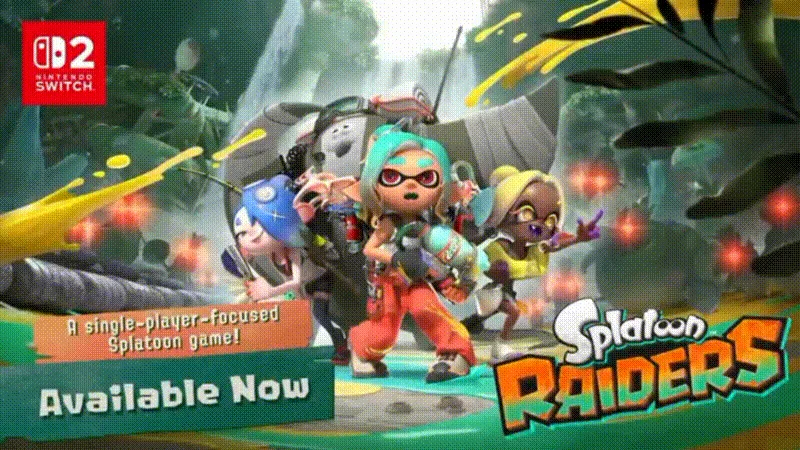
Splatoon Raiders is a new spin-off of Nintendo’s Splatoon series that radically changes the usual formula. It was officially announced as a Switch 2 exclusive and released on July 23, 2026. The game drops players onto the Spirhalite Islands as “The Mechanic,” who crashes there with the idol trio Deep Cut (Shiver, Frye and Big Man). Together, they hunt for treasure while fending off hordes of Salmonid enemies, much like the Salmon Run mode of previous Splatoon games.
Raiders mixes Splatoon’s ink-shooter core with a treasure-collecting looter-shooter structure. Players clear levels filled with enemies and obstacles, then gather materials (Power Eggs, Salmonid parts, Spirhalite Shards) to upgrade weapons and gadgets back at base. Stages vary from timed survival waves to platforming arenas. Nintendo has emphasized deep customization: you can tweak and evolve your Gadgets (replacing old sub-weapons) and even alter your Tank abilities.
Key features include three difficulty modes (Tourist, Raider, Survivalist) and the ability to play solo or with up to three friends online. In sum, Splatoon Raiders brings the series into a single-player/co-op treasure-hunting adventure, with a focus on experimentation, replayability, and strategic gadget use (even evoking comparisons to Vampire Survivors in how its Tactical Tank plays out).
Everything We Know About Splatoon Raiders Release Date and Gameplay Features
From official announcements and previews, here’s what’s confirmed about Splatoon Raiders so far. It is the first Splatoon spinoff game and is classified as a third-person shooter/action RPG. Developed by Nintendo EPD and published by Nintendo, the story begins after a hurricane flings Deep Cut onto the Spirhalite Islands, a tropical archipelago that has mysteriously resurfaced. Players take on the role of the Mechanic, the only person capable of building and repairing gadgets, and join Shiver, Frye, and Big Man on a treasure-hunting expedition across the islands. The primary enemies are Salmonids, including tougher new variants, which drop loot instead of relying on the traditional ink-based combat rewards.
Splatoon Raiders launched on July 23, 2026. Nintendo announced the release date as part of its marketing campaign alongside promotional events and store previews. The game is exclusive to the Nintendo Switch 2, making it the first entry in the Splatoon series released for the platform.
The gameplay retains Splatoon’s signature mechanics of shooting ink, swimming through it, and fast-paced movement while introducing several new systems. The biggest addition is Gadgets, which replace the series’ traditional sub-weapons. Gadgets are deployable tools that can be equipped with any main weapon and upgraded between missions to improve attributes such as power, range, cooldown, and effect radius. Examples include gadgets that create sticky goo puddles or deploy ink bombs, allowing players to experiment with different builds.
Another major addition is the Tank system, which functions as a class mechanic. Players can choose between three Tank types:
- Speed Tank – Focuses on mobility with rapid dashes and ranged attacks.
- Power Tank – Emphasizes heavy damage through explosive strikes and brute force.
- Tactical Tank – Specializes in area control using deployable turrets and traps.
Each Tank also features its own powerful Showstopper ultimate ability, similar to the special weapons from the main Splatoon games.
The game follows a quest-based progression loop where players complete island raids, collect treasure, return to base, upgrade their equipment, and head back out for increasingly difficult challenges. Loot earned from missions includes Power Eggs for charging Showstoppers, rare Salmonid parts used for crafting, and Spirhalite Shards, the game’s primary currency. The base hub allows players to switch weapons, equip two Gadgets, customize gear, and improve stats such as health and ink efficiency. New weapons, Gadget upgrades, and crafting options become available as players progress, creating a persistent RPG-style progression system that rewards experimentation with different loadouts.
An Exploration Bot (also called Bot Buddy) can be piloted by one member of Deep Cut to assist in combat and reach elevated areas during exploration. Players can also choose from three difficulty settings—Tourist, Raider, and Survivalist—which adjust enemy strength and the rewards earned from missions. For multiplayer, Splatoon Raiders supports co-op for up to four players through either local wireless or online play.
In terms of tone and design, previews describe Splatoon Raiders as a more casual loot shooter than the competitive multiplayer focus of previous entries. While it retains the series’ colorful style, its environments shift away from urban settings toward lush jungle landscapes with subtle voodoo-inspired themes and a slightly more mysterious atmosphere. Early impressions also highlight that success often comes from experimenting with Gadgets and Tank loadouts rather than relying solely on shooting skill.
Since its reveal, the game has frequently drawn comparisons to Vampire Survivors because of its balloon-trapping strategy, further emphasizing its mix of action, progression, and replayability. Overall, Splatoon Raiders combines the familiar ink-based combat of Splatoon with RPG progression, loot collection, crafting, and cooperative gameplay to create a fresh treasure-hunting adventure.

Splatoon Raiders Gameplay Changes and Tactical Tank Guide
Compared to classic Splatoon games, Splatoon Raiders introduces major gameplay changes by shifting almost entirely to PvE (player-versus-environment) instead of competitive PvP. Turf War is absent, with the focus instead placed on single-player and co-op missions. Level design is also very different, featuring more linear, island-themed environments such as jungle temples and sunken cities rather than open multiplayer arenas. Many missions revolve around timed objectives, exploration, and boss battles. While the weapon mechanics remain familiar, Sub Weapons and Special Weapons have been replaced by Gadgets and Tank skills, which can be swapped and upgraded between missions.
Raiders also adds RPG mechanics that are largely new to the series, including an upgrade shop, multiple difficulty settings, and an overworld base. The exploration bot expands traversal with vertical movement abilities, such as the “Bot Hop” jump, while Nintendo states that the Switch 2 hardware allows for larger enemy hordes and more dynamic environments than previous Splatoon titles. Storytelling also plays a much larger role, with cutscenes, character dialogue, and a treasure-hunt narrative involving Deep Cut and mysterious devices, making Raiders feel more like a story-driven action RPG than the arcade-style campaigns of Splatoon 2 and Splatoon 3.
One of the game’s three backpack loadouts, the Tactical Tank, is designed for players who prefer strategy over direct combat. Nintendo describes it as the ideal choice for the “thinking Inkling” because it focuses on controlling the battlefield with deployable gadgets. It begins with a basic sentry gun that automatically attacks nearby enemies, then unlocks additional tools such as Tether Wail, a tripwire-style gadget that lashes out at enemies, and Hi-Fiver, an angled laser grid that ricochets shots.
Its signature gadget is the Bombloons, explosive balloon bombs that attach to enemies and one another with toxic strands, creating devastating chain explosions. Instead of relying on mobility or raw firepower, the Tactical Tank excels at area denial by filling an area with turrets, lasers, and explosive traps that punish any enemy attempting to advance.
Creating an effective Tactical Tank build revolves around choosing and upgrading the gadgets that best complement one another. Early in the game, gadget choices are limited, but later you can equip two powerful gadgets at once. A popular approach is to heavily upgrade Bombloons and cluster several around chokepoints or alongside a sentry gun, creating an extremely dangerous defensive position.
Pairing Bombloons with the Hi-Fiver provides overlapping laser coverage that makes approaching your position very difficult. Every gadget can be upgraded using collected materials, allowing players to improve features such as sentry fire rate, Tether Wail’s range, Bombloon explosion size, or the number of Bombloons deployed. Players can also include one non-Tactical gadget for additional flexibility, making experimentation with different gadget combinations an important part of building the ideal loadout.
The best Tactical Tank strategy is to embrace a defensive playstyle by drawing enemies into carefully prepared kill zones. Place Bombloons around the edges of an area, deploy a sentry gun in the center, and allow advancing Salmonids to become trapped in toxic strands while being continuously attacked by turrets and lasers. Since Bombloons can connect to one another, chaining multiple together dramatically increases their explosive potential, while an upgraded Hi-Fiver can cut through large groups of enemies from a safe distance.
Although players can temporarily rely on the mobility or offensive strengths of the other Tank types when necessary, the Tactical Tank performs best by remaining patient and letting enemies come to its fortified position. Upgrading gadget damage and coverage early greatly improves its effectiveness, and cooperative play makes this strategy even stronger by combining multiple players’ gadgets into overlapping defensive networks. The result is a highly methodical playstyle that turns overwhelming enemy hordes into manageable encounters through careful planning and layered traps.
Splatoon Raiders Combat, Character Builds, and How It Differs From Splatoon
Splatoon Raiders is a major departure from the core Splatoon games, despite sharing the same characters and fundamental movement and shooting mechanics. Unlike the series’ traditional focus on competitive multiplayer through Turf War and Ranked Battles, Raiders is primarily a single-player and co-op PvE experience where players battle waves of Salmonids across exotic island environments. The familiar sub-weapon and special weapon system has been replaced by Gadgets and Tank abilities, while players are no longer restricted to specific weapon combinations, allowing any main weapon to be paired with any Gadget.
The game also introduces a hub base where players invest collected loot into upgrades, unlock higher difficulties, and strengthen their characters, creating a progression system that feels closer to a looter-shooter or RPG than a traditional Splatoon title. This persistent upgrade loop has even led some reviewers to describe it as Nintendo’s take on Borderlands. Although the core gameplay still revolves around shooting ink, swimming through your own ink, and maintaining mobility, the overall structure transforms Splatoon’s mechanics into a treasure-hunting adventure focused on long-term progression instead of territory control.
Combat remains fast-paced, colorful, and instantly recognizable to longtime Splatoon players. Players can choose from a wide arsenal of familiar ink weapons, including shooters like Splattershots, chargers, rollers, dualies, and many others, using them to splat Salmonids while swimming through their ink for quick repositioning and ink recovery. Raids typically feature large enemy waves, ranging from basic Smallfry to powerful Salmonid bosses with unique attack patterns and mechanics. Some enemies, such as Chum, aggressively rush players with melee attacks, forcing constant adaptation. Boss encounters introduce larger-scale set-piece battles that demand both movement and strategy. While direct weapon combat remains central, Gadgets and Tank abilities add another tactical layer, making encounters far more dynamic than previous entries.
The game’s progression system steadily increases combat depth over time. Every completed mission rewards resources that can be used to upgrade weapons, Gadgets, and the Ultimate ability known as the Showstopper. Rather than relying on fixed equipment, players constantly replace older gear with stronger versions, resulting in noticeable power spikes as their arsenal improves. This ongoing cycle of collecting materials, upgrading equipment, and preparing for tougher missions reinforces the game’s looter-shooter identity while encouraging experimentation with different combat strategies.
Customization is one of Splatoon Raiders’ biggest additions. Each raid begins by selecting a main weapon, two Gadgets, and one of three Tank classes—Speed, Power, or Tactical. Players can also equip up to three pieces of gear that improve attributes such as health, attack power, and other combat stats. Since Gadgets can be upgraded and freely combined, players are encouraged to create builds that match their preferred playstyle.
One setup might prioritize raw offense by pairing the Power Tank with explosive Gadgets and high-damage weapons, while another could focus on survival by using the Tactical Tank alongside defensive traps and rapid-fire weapons. The combination of weapon selection, Gadget upgrades, Tank specialization, and gear enhancements creates a flexible build system more commonly found in RPGs than previous Splatoon games.
The sheer number of available weapons and modifications encourages constant experimentation even after completing the main campaign. Some players may settle on a favorite weapon while swapping Gadgets to suit different missions, whereas others may keep certain Gadgets and regularly change weapon types to counter specific enemies. This freedom allows players to continually refine their loadouts and discover powerful combinations that best suit their preferred combat style, making character progression one of the defining features of Splatoon Raiders.

Vampire Survivors Inspiration in Splatoon Raiders
One of the strongest influences reviewers identified in Splatoon Raiders is its resemblance to Vampire Survivors. The comparison is especially evident with the Tactical Tank, whose abilities revolve around deploying drones, lasers, Bombloons, and other automated defenses that gradually turn the player into a moving fortress. Rather than relying solely on direct attacks, players steadily build an increasingly lethal defensive setup that destroys waves of enemies with minimal effort as battles continue.
Kotaku’s preview highlights the “divine satisfaction” of watching carefully placed gadgets wipe out large enemy groups, comparing the experience to reaching the powerful late-game builds in Vampire Survivors. In both games, surviving longer allows players to stack more offensive tools until their defenses become overwhelmingly effective. Although Splatoon Raiders still requires active movement, aiming, and shooting, the growing sense of power created by automated gadgets mirrors the weapon synergies that define Vampire Survivors. This combination of traditional Splatoon gameplay with increasingly destructive passive defenses is why many reviewers have described the game as feeling like Splatoon transformed into a Vampire Survivors-style experience.
Splatoon Raiders Preview, Best Weapons, Multiplayer Features, and Beginner Guide
Hands-on impressions of Splatoon Raiders have been overwhelmingly positive. Reviewers consistently praise how smooth and intuitive the gameplay feels, with the series’ signature shooting and swimming mechanics carrying over seamlessly. The Switch 2 version also receives compliments for its improved visuals, including sharper details and enhanced visual effects. Many previews highlight the addictive gameplay loop of completing raids, collecting upgrades, and immediately jumping back into another run. For example, Nintendo Life’s Jim Norman described feeling the familiar “one more go” urge, wanting to adjust his loadout and retry after every defeat.
Similarly, Game Informer noted that it was difficult to stop playing because each short raid felt rewarding, and the constant stream of upgrades encouraged continued progression. Critics also point to the enjoyable co-op experience, praising how naturally multiplayer fits into the gameplay. While a few reviewers mention that some mission objectives become repetitive toward the end of the campaign, the overall consensus is that Splatoon Raiders successfully builds on Splatoon’s fast-paced action with engaging roguelite mechanics, making it one of the franchise’s strongest and most anticipated entries.
Choosing the best weapons depends largely on your preferred playstyle, especially with more than a hundred weapons available. Familiar Splatoon weapon classes remain effective, with rapid-fire Shooters like the Splattershot series serving as reliable all-rounders thanks to their balanced damage and mobility. Dualies are another popular option because of their quick evasive movement, while Blasters excel at delivering powerful shots and Rollers dominate close-range encounters. Chargers remain valuable for eliminating distant threats with precision. Since every weapon can be upgraded throughout a run, even basic starting equipment can become extremely powerful, making upgrades more important than the weapon’s initial strength.
For newcomers, balanced Shooter weapons such as the Jet Squelcher or Splattershot Pro are frequently recommended because they are easy to learn while remaining effective in most situations. More aggressive players may prefer Blasters or Rollers paired with splash-based gadgets for maximum close-range impact. The game actively encourages experimentation by regularly rewarding players with new weapon variants and allowing them to swap equipment back at base.
A useful strategy is to maintain two different builds: one optimized for clearing large groups of enemies and another specialized for boss encounters. For example, a Roller can quickly eliminate standard Salmonids in confined spaces, while a combination of a Shooter and Charger performs better during open-area boss fights. Since the game’s competitive meta is still developing, experimenting with different loadouts is the best approach, but one consistent lesson is that fully upgrading your equipment has a greater impact than simply choosing a weapon with higher base stats.
Multiplayer is a major part of the experience, supporting up to four-player co-op through both online play and local wireless connections. Players can form teams with friends or match with random teammates, and the game automatically adjusts enemy difficulty based on the number of participants to keep encounters balanced. Early impressions suggest that the game strongly encourages cooperative play, with reviewers noting that coordinated teams make raids both more enjoyable and more rewarding.
Completing missions together can earn special loot, and players can even send a help beacon to request assistance during a run. Although Splatoon Raiders is fully playable solo, multiplayer expands the available strategies by allowing players to combine gadgets, coordinate weapon roles, and deploy multiple Tactical Tanks together. Progress made at the shared base, including unlocked gadgets and upgraded gear, benefits everyone participating in the group.
For beginners, the best approach is to experiment with every system the game offers while gradually specializing once you discover a preferred playstyle. Helpful tips include:
- Try each Tank to find the one that matches your style. The Speed Tank favors mobility, the Power Tank focuses on heavy damage, and the Tactical Tank rewards careful positioning and trap placement.
- Prioritize upgrading your gadgets between missions, since they have a major impact on combat effectiveness. Investing in a few favorites early allows you to understand their strengths as they become more powerful.
- Focus on mastering one weapon type before branching out. Fully upgrading a favorite Shooter, for example, helps build familiarity before experimenting with additional options.
- Make use of your Bot Buddy by allowing Shiver, Frye, or Big Man to pilot it during missions and distract enemies.
- Select the difficulty that matches your experience. Tourist mode offers extra assistance, Raider provides the standard experience, and Survivalist is intended for veteran players. Lowering the difficulty while learning the mechanics is perfectly reasonable, and missions can always be replayed later on higher settings.
- Don’t hesitate to team up with friends when facing difficult bosses. Cooperative play scales well and often makes challenging encounters much more manageable.
- Continue gathering resources throughout every run by rescuing fallen teammates and collecting loot whenever possible. If a boss proves too difficult, return to base, improve your equipment, and try again rather than repeatedly forcing the same encounter.
Ultimately, Splatoon Raiders is designed to reward experimentation. Continually testing new gadgets, adjusting weapon builds after each raid, and learning how different combinations complement one another are all central to mastering the game.

Frequently Asked Questions (FAQs)
- What is the Tactical Tank in Splatoon Raiders?
The Tactical Tank is a powerful combat vehicle introduced in Splatoon Raiders. It gives players greater offensive and defensive capabilities, making it easier to deal with large groups of enemies while supporting different combat strategies. Rather than functioning as a simple transportation tool, the Tactical Tank plays an important role in combat by helping players survive tougher encounters, control larger areas, and respond more effectively when enemy pressure increases. - Why are players comparing Splatoon Raiders to Vampire Survivors?
The comparison comes from the game’s large enemy swarms and the constant action created during Tactical Tank sequences. Players can find themselves dealing with increasingly intense waves of enemies while trying to maintain momentum and improve their effectiveness. That creates a gameplay rhythm that can resemble Vampire Survivors, where survival depends on handling overwhelming numbers of enemies. The two games are still very different overall, but the emphasis on crowd control and sustained survival explains why the comparison has become popular. - How does the Tactical Tank change gameplay?
The Tactical Tank changes the pace of combat by allowing players to push through dense enemy groups, control larger sections of the battlefield, and survive situations that would be much harder on foot. Instead of relying entirely on standard movement and weapon mechanics, players can use the vehicle to maintain pressure and deal with groups more aggressively. This creates a more action-heavy style of play and makes certain encounters feel larger and more chaotic than traditional Splatoon battles. - Is the Tactical Tank available throughout the game?
The Tactical Tank appears to be an important gameplay feature, but its exact availability and progression requirements have not been fully detailed. It is expected to play a meaningful role during the adventure, although Nintendo has not confirmed whether players can use it freely at all times or only during particular missions, regions, or combat encounters. Until more detailed gameplay information is available, it is safer to treat the Tactical Tank as a major feature rather than assume it is permanently accessible. - Does the Tactical Tank make the game easier?
The Tactical Tank provides clear combat advantages, but it does not remove the need for skill or strategy. Players still need to manage positioning, enemy pressure, mission objectives, and the timing of their attacks. Large groups of enemies can still become dangerous if players lose control of the battlefield or rely too heavily on the vehicle’s power. The Tactical Tank therefore gives players more tools for survival without automatically eliminating the challenge. - What type of combat does the Tactical Tank encourage?
The Tactical Tank encourages aggressive crowd control, continuous movement, and efficient elimination of large enemy groups. Rather than focusing only on carefully targeting one opponent at a time, players are encouraged to maintain momentum and manage entire waves of enemies. This creates faster and more chaotic encounters where positioning and battlefield awareness become especially important. The result is a style of combat that feels more focused on surviving and controlling large-scale encounters. - Can players still use their normal weapons with the Tactical Tank?
Yes. The Tactical Tank complements the broader combat system rather than replacing normal weapons and abilities entirely. Players can still rely on their usual combat tools depending on the situation, allowing them to switch between different approaches as encounters change. This gives the game more variety and prevents the Tactical Tank from becoming the only meaningful way to fight enemies. - What makes Splatoon Raiders different from previous Splatoon games?
Splatoon Raiders introduces several new ideas, including the Tactical Tank and larger enemy encounters that create a different style of action compared with earlier Splatoon games. These additions place more emphasis on surviving large battles and managing overwhelming enemy groups while still retaining the colorful presentation and weapon-focused identity associated with the series. The result appears to be a broader adventure that experiments with combat systems beyond the traditional multiplayer structure. - Why has the Tactical Tank attracted so much attention?
The Tactical Tank has attracted attention because it changes the scale and feel of combat in a noticeable way. Seeing players push through huge groups of enemies creates a very different impression from the more familiar Splatoon experience, making the vehicle one of the easiest new features to recognize. Its combination of mobility, offensive power, and crowd-control potential has also encouraged comparisons with other action games built around surviving large enemy swarms. - Is Splatoon Raiders focused only on vehicle combat?
No. Although the Tactical Tank is a major feature, it is only one part of the overall experience. Splatoon Raiders also includes exploration, traditional combat, mission-based progression, and other gameplay systems. Players are therefore expected to use a variety of mechanics rather than relying entirely on the Tactical Tank. The vehicle adds another layer to combat, but it does not replace the rest of the game’s structure.

Conclusion
The Tactical Tank stands out as one of the biggest additions to Splatoon Raiders, transforming battles into fast-paced encounters filled with large enemy swarms and constant action. Its ability to control crowds and withstand heavy pressure gives the game a survival-focused feel that has drawn comparisons to Vampire Survivors. Whether players are looking for chaotic combat or a fresh take on the Splatoon formula, the Tactical Tank appears to be a defining feature that reshapes the overall gameplay experience.
Sources and Citations
- Wikipedia, Splatoon Raiders: Provides background on the game’s development, release and gameplay.
https://en.wikipedia.org/wiki/Splatoon_Raiders - Nintendo Official Site, Splatoon Raiders: Confirms gameplay mechanics, tank types, gadgets and customization features.
https://www.nintendo.com/us/store/products/splatoon-raiders-switch-2/ - Kotaku, July 25, 2026, The Tactical Tank Turns Splatoon Raiders Into Vampire Survivors: Explains Tactical Tank abilities and battlefield control mechanics.
https://kotaku.com/the-tactical-tank-turns-splatoon-raiders-into-vampire-survivors-2000719331 - Nintendo Life, June 30, 2026, Preview: Splatoon Raiders Promises The Single-Player Splatting I Always Wanted: Examines combat, exploration and single-player gameplay.
https://www.nintendolife.com/previews/splatoon-raiders-promises-the-single-player-splatting-i-always-wanted - Game Informer, July 21, 2026, Splatoon Raiders Review: A Fresh Take: Reviews combat mechanics, weapon variety and progression systems.
https://gameinformer.com/review/splatoon-raiders/a-fresh-take
Recommendations
- How Baki-Dou: The Invincible Samurai Will Continue in a “Very Scary” Part 2 – Musashi Miyamoto’s Dark Evolution Explained
- Minors in Three States Sue xAI Over Grok Childhood Deepfakes
- Echoes of Aincrad: Weapons and Stats Explained — Best Builds, Scaling, and Upgrade Guide
- Avatar Legends: The Fighting Game Xbox Release Delayed at the Last Minute: New Date and What Happened
- NBA 2K27 MyCAREER Eras, Co-Op, Female MyPLAYER and HQ App Guide
- Bridgerton and Star Wars Stars Join The Last of Us Season 3 as Lev and Yara: Cast, Characters, and What It Means
- Stranger Things Star Millie Bobby Brown Loves GTA but Plays it Like a Law-Abiding Citizen
- Final Fantasy 14: How To Get The Alsvid Mount Twitch Drop
- Orbitals Train and Rec Locations: Find All 7 Mini-Games
- Dead Or Alive 6 Last Round DLC Controversy Explained



































































































