
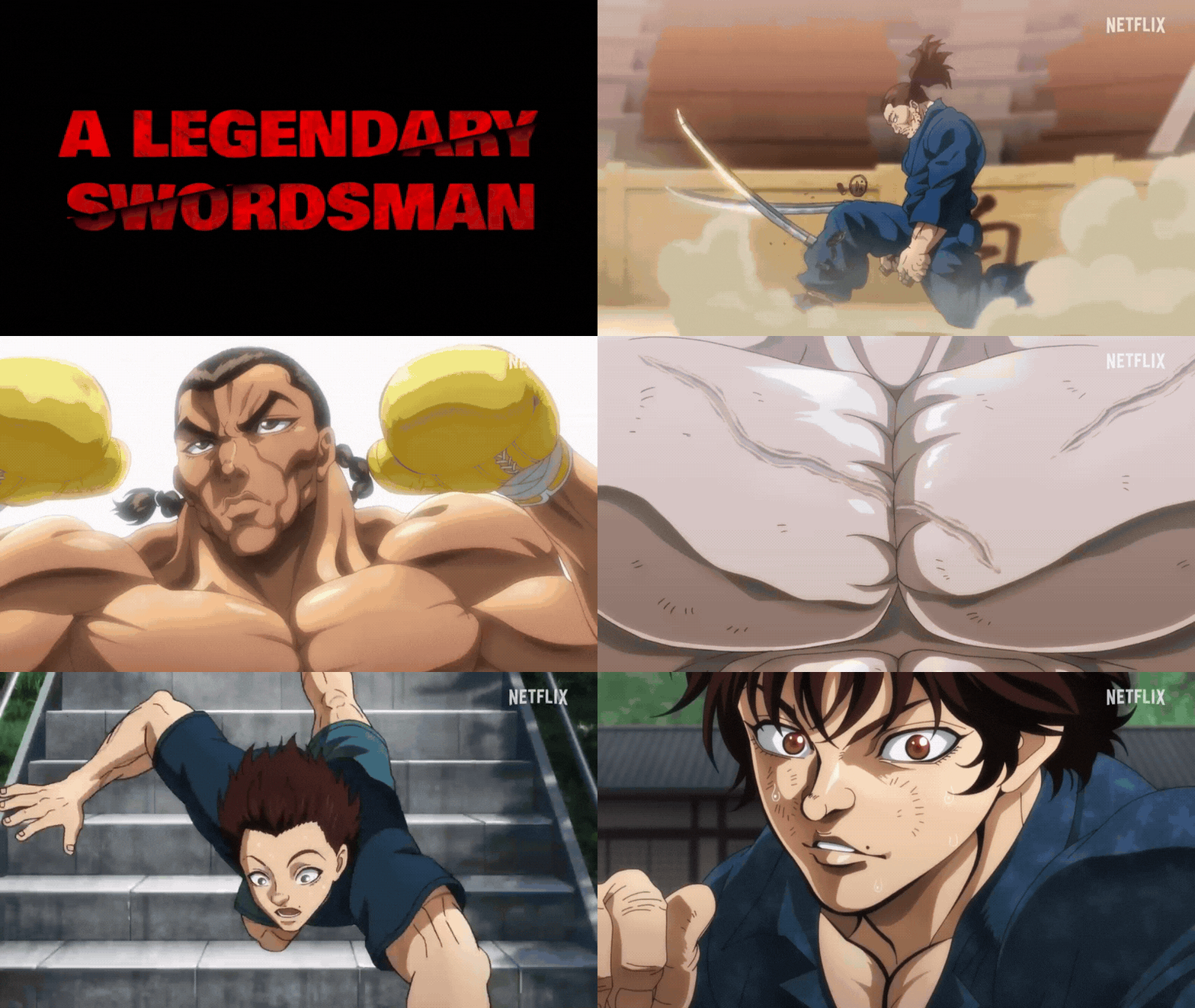
A 13-episode first part has already established the post–father-and-son-war era: an exhausted champion, a world hungry for “real” danger, and a cloned swordsman whose presence forces the Underground Arena to re-evaluate what “strength” even means. Part 2 is officially confirmed, with marketing framing it as a life-or-death escalation where weapons and fear—not just fists—drive the tension.
Series status and production context
Baki-Dou: The Invincible Samurai Part 2 Release Date and Latest Updates
Part 2 has been confirmed as the continuation of the current anime adaptation, and it has been publicly positioned as “on the way” with a trailer already released.
As of April 13, 2026, no specific calendar release date has been publicly stated by Netflix in the same way Part 1’s drop date was communicated; official messaging centres on the fact that Part 2 is coming, while third‑party news coverage describes it as “coming soon.”
What is concrete and verifiable is the launch status of Part 1: all 13 episodes were released on February 26, 2026, and multiple listings track the entire first batch as having aired that day.
Part 2 was also publicly tied to a major industry announcement cycle (AnimeJapan 2026 in press coverage), with reporting describing the reveal as including a teaser trailer and a key visual, and reiterating that streaming remains Netflix‑exclusive.

Why Part 2 of Baki-Dou Is Described as “Very Scary” by the Director
The “very scary” positioning is being attributed directly to series director Toshiki Hirano in syndicated press snippets, which quote him describing the second part’s version of the swordsman as frightening in a way that audiences will “experience.”
Even where the exact “very scary” phrasing is not reproduced, Netflix’s own editorial framing supports the same tonal intent: Part 2 is described as “life-or-death” combat, explicitly emphasising heightened intensity and the destabilising effect of blades and weapons on every encounter.
That tonal direction is reinforced by the director’s Netflix interview language describing an “almost supernatural” sense of Musashi’s “spirit,” an “eerie depth,” and matchups designed to feel distinct and tense—not simply loud or flashy.
Narrative setup and cloning
What Happens After Baki Hanma’s Fight with Yujiro Hanma?
The story’s starting condition is explicit: the “greatest father-son battle on earth” has concluded, and the champion’s reward is not peace but boredom—an emotional vacuum that becomes the narrative engine for the next crisis.
Within the show’s own language, the post-war world is defined by restlessness: Baki and other fighters question whether anything meaningful remains to be fought, and whether strength without challenge is simply stagnation.
This existential problem is not treated as pure philosophy; it is the doorway for science‑fantasy escalation. A “secret plan” and “unprecedented experiment” move forward beneath the surface of ordinary Tokyo, reframing the question from “Who is left?” to “What kind of opponent can even exist after the summit?”

How the Clone of Musashi Miyamoto Was Created in Baki-Dou
The show’s official description (as repeated in press coverage) frames the project plainly: a forbidden experiment uses advanced science to clone and resurrect the legendary swordsman from his remains, bringing him into the modern world.
Part 1’s episode synopses underline that this is not a throwaway plot device, but a procedural arc built over multiple episodes: the “cloning project” is shown entering its “final phase,” and the show presents tension between scientific reasoning and more arcane methods used to complete the resurrection.
The setting detail “deep beneath the Tokyo Skytree” is also repeatedly used in official-style descriptions, signalling the franchise’s trademark blend of grounded landmarks with exaggerated, almost mythic underground infrastructure.
Musashi Miyamoto’s Terrifying New Role in Baki-Dou Part 2 Explained
Musashi’s role is not merely that of a new challenger; Netflix’s own framing places him as a destabilising antagonist whose reappearance becomes a threat of “historical proportions.”
This antagonism is structurally different from many earlier Baki arcs because the entire world around combat is forced to change with him: the Underground Arena’s culture, its rules, and its implicit social contract (“prove strength without weapons”) are all stressed by a combatant whose identity is inseparable from blades.
Netflix’s own lore guide labels Musashi as the series’ “main antagonist” for this arc and presents his abilities as blending historical swordsmanship with near‑supernatural effects—especially the idea that he can cause real pain through the implication or visualisation of a cut.
That makes Part 2’s premise clear in thematic terms: fear does not come solely from the possibility of defeat. It comes from the possibility that the framework of “fighting” itself is being rewritten.

Power scaling and combat design
Baki vs Musashi Miyamoto: Who Is the Strongest Fighter in Part 2?
Official Netflix materials position Baki as the reigning Underground Arena champion at the start of this arc, and they position the father figure as “the strongest creature on earth,” a benchmark the franchise treats as almost geopolitical.
At the same time, the trailer framing and Part 2 preview language point toward the central question being less “Can Baki compete?” and more “What does competition mean when a sword is involved?”—a subtle but crucial shift that interrupts conventional power-scaling logic.
Part 1 has already demonstrated that Musashi can outpace Baki in direct exchanges (“the samurai is faster” in episode descriptions), and that he is treated as “peerless” enough to demand the country’s best fighters.
Netflix’s Part 2 write‑up then frames the continuation as the unfolding of a “life-or-death battle” between Baki and Musashi, implying that Part 2’s decisive fights will not be exhibition bouts but existential tests of the series’ hierarchy.
In research terms, the most defensible conclusion is that Part 2 is built to interrogate “strongest” as a moving target: strength in Baki has always mixed raw physical dominance, technique, psychology, and intimidation; Musashi adds a fifth element—lethality as a constant presence, not an optional outcome.
How Weapons Change the Fights in Baki-Dou Part 2 Compared to Season 1
Netflix’s own lore guide describes the Underground Arena’s key rule: weapons are not allowed—unless both fighters explicitly agree, which effectively turns “no weapons” into a negotiated boundary rather than a fixed law.
That rule exists because the Arena is designed as a place to test bodies and technique under extreme conditions without immediately collapsing into fatality; it is “near-life-and-death,” but not automatically lethal.
Part 2’s official preview language, however, is explicit that “the introduction of swords and weapons” creates a “distinctly different and heightened sense of tension,” and it describes the coming conflict as “life-or-death.”
In practical storytelling terms, this shifts three dimensions at once:
First, range and timing become decisive. A blade changes what “distance” means, and it shrinks reaction windows in a way even the fastest punches do not.
Second, defence becomes psychologically heavier. Blocking a strike is no longer just bruising; it risks maiming. Netflix’s own characterisation of Musashi includes the unsettling ability to make pain feel real even before or without a literal cut, which pushes fear directly into the combat rhythm.
Third, “winning” becomes morally and socially ambiguous. A decisive sword victory forces every other fighter to ask whether the arena’s honour system still functions—or whether it becomes theatre for sanctioned killings.

Is Musashi Miyamoto the Most Dangerous Villain in Baki History?
The case for Musashi as uniquely dangerous is grounded in two officially presented traits: he is introduced as a resurrected historical swordsman whose identity is inseparable from weapons, and he possesses abilities that edge into the supernatural (including techniques that can inflict pain through the implication of being cut).
Part 1’s public episode summaries also position Musashi’s arc as unusually lethal relative to typical Baki brutality. Multiple sources explicitly describe a “devastatingly brutal conclusion” to one of his fights, and interview coverage discusses the death of a prominent fighter as a turning point.
From a franchise-structure perspective, Musashi is also dangerous because he is not motivated by contemporary sports logic. He is framed as a warrior displaced into the present, curious about modern fighters yet operating with the instincts of a swordsman whose craft historically implied killing.
What cannot be stated as a verified fact (without relying on non-primary plot summaries) is a definitive ranking of “most dangerous” across all Baki antagonists; what can be stated reliably is that Part 2 is marketed specifically on the idea that Musashi’s presence changes the atmosphere from “violent” to “fearful,” with weapons as the delivery mechanism.
Will Baki Finally Face His Greatest Fear in Part 2?
The show’s own framing suggests that Baki’s “greatest fear” is not simple physical harm; it is the return to meaninglessness—being the strongest and feeling nothing.
Part 2 is therefore positioned as the collision between boredom and terror: Baki’s craving for challenge is answered by an opponent whose danger is not metaphorical. Netflix’s preview language repeatedly emphasises “life-or-death” stakes, and the director has described the coming battles as carrying “tension” and a “shocking conclusion.”
At the story-mechanics level, Musashi’s weapon‑based presence forces Baki into a psychological problem he cannot solve through toughness alone: whether to treat deadly intent and lethal tools as just another “challenge,” or as something that demands a different kind of response.
Plot roadmap and key marketing clues
Baki-Dou Part 2 Story Breakdown: The Ultimate Samurai Showdown
Part 1 lays out the arc’s spine in a sequence that is already public through official episode descriptions and major listing pages: after the father‑son war concludes, Baki falls into overwhelming boredom; Tokugawa’s group advances an unprecedented experiment; and the cloning project reaches completion, bringing Musashi into the present.
The early episodes then establish Musashi’s position through escalating confrontations, including a direct demonstration that Baki’s speed is not automatically decisive against him.
Mid-season, the story foregrounds the weapons problem through matchups explicitly discussed as sword-versus-martial-arts encounters, culminating in a fight described in listings as a “deathmatch” with a “devastatingly brutal conclusion.”
The final episodes of Part 1 (as publicly summarised in listing data) push Musashi into a broader collision with the top tier: he faces another master, then clashes with Yujiro at the Tokugawa estate, and the season ends with a contested path to “who fights Musashi next,” involving Motobe and Jack.
Part 2 is officially framed as the continuation and intensification of exactly those stakes: the “life-or-death” battles continue, weapons remain central, and marketing explicitly points to Baki finally challenging Musashi for “top honours.”
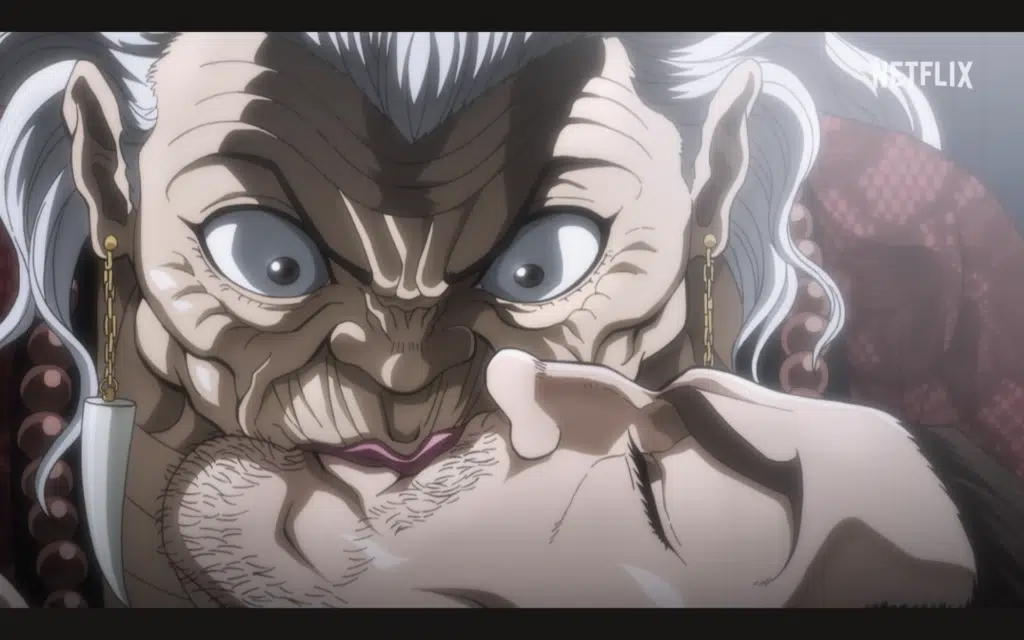
Baki-Dou Part 2 Trailer Analysis: Hidden Clues and Key Moments
The most reliable “trailer analysis” must be built from what official and reputable sources explicitly declare about the trailer, rather than unverified scene-by-scene claims.
Netflix’s own editorial description states that the Part 2 trailer centres on Baki finally challenging Musashi for top honours, signalling that Part 2’s narrative focus is the direct Baki–Musashi collision rather than only “Musashi versus everyone else.”
Press coverage of the Part 2 announcement also highlights a key visual featuring Baki, Musashi, and Motobe, a trio that strongly implies a triangle of conflict: the champion, the swordsman, and the “practical” tactician positioned around the question of how to survive a sword fight.
Another clue is embedded in Netflix’s own explanation of Part 2’s combat design: the producer explicitly frames swords and weapons as the new driver of tension, which indicates the trailer and marketing are selling not only “bigger fights,” but a different category of danger.
Finally, Netflix’s series page explicitly labels the marketing asset as a “Season 1 Part 2 Teaser,” reinforcing that Part 2 is being treated as a continuation of the same season package rather than a distant, rebranded new series.
Full Character List in Baki-Dou: The Invincible Samurai Part 2
A “full” list can only be made responsibly by combining (a) the Part 1 cast and episode summaries (which confirm who is currently active in the arc) and (b) official and near‑official promotional material for Part 2 (which indicates who remains central).
Core characters already positioned as central to Part 2 by official framing, Part 1 plot endpoints, and/or Part 2 promotional context include:
Baki Hanma (the Underground Arena champion and narrative centre of the trailer framing).
Musashi Miyamoto (the resurrected swordsman and arc’s primary antagonist).
Yujiro Hanma (framed as the “strongest creature on earth,” already drawn into Musashi’s orbit in Part 1’s closing stretch).
Mitsunari Tokugawa (the Underground Arena’s organiser and the narrative hinge connecting the fighter world to the cloning experiment).
Izo Motobe (increasingly foregrounded via Part 1 episode summaries and the Part 2 key-visual coverage).
Doppo Orochi, Kaoru Hanayama, and other Underground Arena fighters who are explicitly named by Netflix as part of the arc’s roster and are presented as preparing to return to the arena in response to Musashi.
From Netflix’s published English dub cast list for Part 2 coverage (which functions as a high-confidence indicator of characters continuing to matter), named roles include voice performers for Baki, Musashi, Yujiro, Tokugawa, Retsu, Motobe, Jack, Doppo, and Hanayama, among others.
From Netflix’s series page, the credited starring Japanese cast for the current season includes Nobunaga Shimazaki, Naoya Uchida, and Akio Otsuka.

Adaptation, violence, and thematic shift
What Makes Baki-Dou Part 2 Darker and More Violent Than Before
Even before Part 2 arrives, the arc’s tone has been publicly categorised as adult: major listings label the season TV‑MA, and reviewers explicitly describe the series as leaning heavily on being graphic and violent, with some parts experienced as unsettling or uncomfortable.
Part 2 is then marketed not as a tonal reset but as an escalation: Netflix’s own editorial framing describes “life-or-death battles” and highlights that the introduction of swords and weapons creates heightened tension compared with earlier fist-against-fist fights.
The violence is not only quantitative (more injuries) but categorical (different kinds of fear). Blades introduce immediate irreversibility—cuts, maiming, death—whereas the franchise’s fist violence often functions as a brutal endurance contest. Netflix’s lore framing of the Arena as “near-life-and-death” becomes more literal once weapons are normalised through Musashi’s presence.
Finally, the director’s own public language about an eerie “spirit” and the “shocking conclusion” positions Part 2 as darker not only because it is violent, but because the violence is meant to feel haunted and ominous.
Baki-Dou Part 2 Anime vs Manga Differences You Should Know
Netflix confirms the anime is an adaptation of the Baki-Dou manga, and the director explicitly urges audiences—especially those who have not read the manga—to experience the conclusion through the anime for maximum impact.
That alone signals a key difference in audience experience: manga readers know outcomes; anime-only viewers receive the story through voice, music, editing rhythm, and staging—tools the production can use to guide emotion and suspense in ways the page cannot.
A concrete, documented example of adaptation choice is the handling of a major character death. In an interview, the creators explain that the manga depicts the death in a comparatively “dry” way, whereas the animation deliberately made the moment more emotional and tear-jerking using music and staging.
The director also describes the general adaptation challenge as bridging differences between how manga “frames” function and how anime sequences must be paced and staged, implying ongoing structural differences in timing, composition, and portrayal—especially during fights.

10 Frequently Asked Questions (FAQs)
- Is there an official release date for Part 2?
Part 2 has been confirmed and is publicly described as “on the way,” but an exact release date is not stated in Netflix’s Part 2 editorial overview as of April 13, 2026. - When did Part 1 come out, and how many episodes are there?
Part 1 released on February 26, 2026, and it consists of 13 episodes. - Where will Part 2 stream?
Announcement coverage and Netflix framing indicate Part 2 will stream on Netflix and is described as Netflix‑exclusive in reporting. - Is Part 2 a new season or a continuation of the same season?
Netflix’s series page labels the marketing asset as a “Season 1 Part 2 Teaser,” and Netflix editorial coverage also treats it as Part 2 of the current series package. - What is the story premise going into Part 2?
After the father-son war ends, Baki is consumed by boredom until Tokugawa’s group resurrects a clone of Musashi, pushing the Underground Arena into weapon‑driven conflict and “life-or-death” stakes. - Why is weapons combat such a big deal in this arc?
The Underground Arena’s default rule prohibits weapons, but the rule can be bent by mutual consent; the arrival of Musashi makes swords central and reshapes fight tension into a more lethal, fear-driven mode. - Has Musashi already fought Baki in Part 1?
Part 1 episode summaries present early contact where Baki tests Musashi and is shown that the samurai can be faster, while Part 2 marketing frames the “finally” decisive challenge: Baki aiming for top honours against Musashi. - Is the series considered especially violent?
Major listings rate the season TV‑MA and critic summaries explicitly describe it as leaning heavily on graphic violence and being unsettling at points. - Is Part 2 expected to be darker than Part 1?
Netflix’s Part 2 messaging emphasises “life-or-death” battles and highlights weapons as a tension multiplier, and the director’s “very scary” positioning in syndicated interview snippets reinforces the intent for a darker continuation. - What is a concrete example of anime vs manga difference already seen in Part 1?
Creators have stated that a major death was depicted more “dryly” in the manga but was made more emotional in animation through music and staging.
Conclusion
How Baki-Dou Part 2 Sets Up the Future of the Baki Anime Series
Part 2’s narrative function appears twofold in official framing: it aims to complete the Musashi arc’s decisive confrontation (with the trailer emphasising Baki’s direct challenge), and it also deepens the franchise’s thematic territory by embedding weapons as a destabilising factor rather than a one-off gimmick.
Production interviews further emphasise continuity: the same long-running director is publicly presented as returning, and the writing around Part 2 stresses that each matchup has its own “distinct personality,” suggesting the series is using Musashi’s presence to broaden its fight language rather than merely raising the volume.
On the franchise side, public reporting reiterates that the anime is adapting the Baki-Dou manga (which ran from 2014 to 2018 in Weekly Shonen Champion, collected into 22 volumes), and it notes that the wider Baki manga franchise continues beyond this arc—meaning Part 2 can act as both a climax and a bridge for future adaptation decisions.
Sources and citation
- Netflix Tudum (official hub / articles index)
- https://www.netflix.com/tudum Netflix Tudum / Netflix AnimeJapan 2026 (Part 2 “life-or-death battles” with Musashi & underground fighters)
- https://about.netflix.com/news/anime-japan-2026 Netflix official anime page (series listings / descriptions / episodes context)
- https://www.netflix.com/browse/genre/6721 Anime Trending (AnimeJapan-style announcements context — use as supporting reference for event coverage framing)
- https://anitrendz.net/(main site; specific article not reliably indexed) Anime Corner (anime news + Part 2 announcements / staff / release confirmations)
- https://animecorner.me/(main site; specific article not reliably indexed) ComicBook.com (anime coverage, creator interviews, adaptation discussion context)
- https://comicbook.com/anime/feature/netflixs-most-action-packed-anime-needs-a-renewal/ Rotten Tomatoes (anime listings / ratings / release aggregation pages)
- https://www.rottentomatoes.com/browse/tv_series_browse/affiliates%3Anetflix~genres%3Aanime~sort%3Apopular
Recommended
- How to Add Realistic Dust, Hair, and Surface Imperfections in Blender to Increase Scene Realism
- Tamga Released: Minimalist 3D Sculpting App That’s Free on the Web (No Accounts or Subscriptions)
- Metahuman Facial Motion with Faceware: Complete Workflow for Realistic Face Animation in Unreal Engine 5
- The House of Hikmah Guide: Beginner Tips, Puzzle Mechanics, Story Themes, and How Long It Takes to Beat
- Assassin’s Creed TV Show: Here’s Who Will Star In And Direct (Netflix Cast & Director Update)
- Capcom Addresses The Street Fighter 6 Incest Storyline Fans Have Been Losing Their Minds Over
- Hasbro CEO Promises No Generative AI in Its Video Games as Chris Cocks Draws a Line on AI