










The House of Hikmah Guide for Beginners
The House of Hikmah is a narrative-driven 3D adventure/puzzle game starring Maya, a 14-year-old girl exploring a mystical version of Baghdad’s House of Wisdom after her father’s death. For beginners, note that this game has no combat – it focuses entirely on exploration, puzzles and story. Start by talking to every scholar in the Atrium hub and experimenting with Maya’s inherited Key device. The game’s gentle tone (about grief and legacy) makes it approachable: you can safely try and retry puzzle solutions without fear of dying. Early goals are simply to deliver letters for Fatima (the head of the House) and learn your first element powers.
What Is The House of Hikmah About
The game’s premise is that Maya enters an enchanted House of Wisdom after losing her father. Lunacy Studios describes it as “a narrative-driven 3D adventure game exploring grief, legacy and the search for answers after profound loss”. In practice, you follow Maya through a dreamlike library full of ancient knowledge. Her father left behind a mysterious Key device, and Maya must use it to solve puzzles crafted by historical scholars.
Each puzzle Maya solves uncovers part of her father’s past. As the developer site explains, “Each door she opens brings her closer to understanding her father’s legacy… but unveiling the past means unleashing the shadows within”. In short, the story blends personal grief with historical discovery: Maya learns about her father and about herself as she progresses.
The House of Hikmah Story Explained
The narrative begins with Maya already in mourning. Her father, a brilliant navigator, has recently died (off-screen) on a voyage, leaving Maya “lost and grieving”. One day Maya receives an invitation to the legendary House of Wisdom – the same place where her father used to deliver letters and study. Upon entering, Maya meets Fatima al-Fihri (the benevolent head of the House) who asks her to deliver letters to several “scholars” working in isolated domains. Each scholar’s realm is a surreal, puzzle-filled environment shaped by their expertise. As Maya helps them solve puzzles, she not only uncovers clues about her father’s travels and friendships, but also gradually comes to terms with her own loss.
A parallel thread involves a mysterious figure called the Dream Lady (or Widow), who embodies grief itself. This ethereal antagonist pulls Maya into distracting visions and tempts her to abandon the journey. The more doors Maya opens in the House, the closer she gets to her father’s hidden legacy – and also the more she must confront the “shadows” of her sorrow. By the end, Maya’s quest to unlock secrets about her father becomes a metaphor for healing: each scholar’s story and puzzle teaches Maya a lesson about grief. (Developers emphasize that the game is about “growth, understanding, and hope” in loss, aiming for a story players can deeply relate to.)

The House of Hikmah Gameplay and Puzzle Mechanics
Figure: A page from the Banū Mūsā’s Book of Ingenious Devices, a classic 9th-century text on mechanical inventions – an inspiration for the game’s wind-powered platforms and machinery.
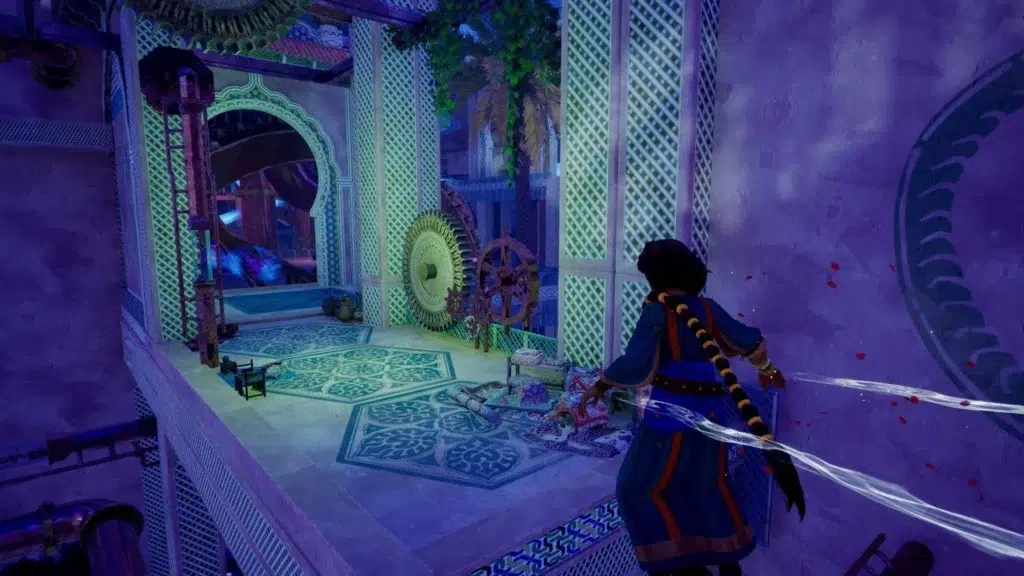
In gameplay terms, The House of Hikmah is a third-person puzzle-platformer set in a beautifully realized Arabic-accented world. Maya can run, jump and glide (using wind currents) through each scholar’s “dome,” and she must manipulate the environment to progress. Puzzles are all physics-based: for example, moving floating platforms with wind, balancing weighted objects on scales, redirecting light beams with mirrors, or activating mechanisms by changing object materials.
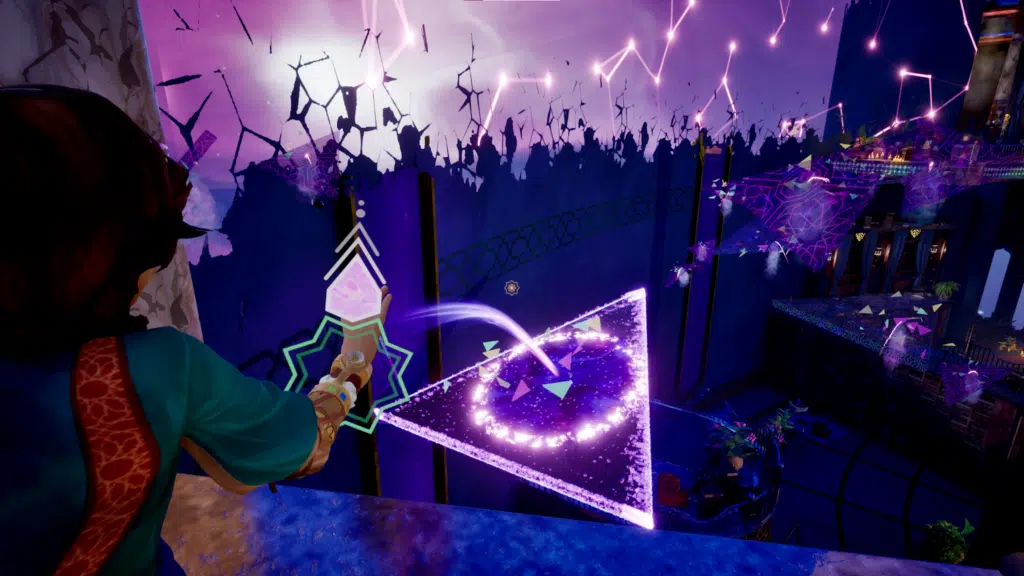
The central tool is Maya’s Key device, which can transform matter. Early on, Maya learns to make objects immaterial (transparent and weightless) so she can walk through them or float them away. Later abilities include metal transmutation (making objects solid metal so they become heavy, magnetic, or reflective) and glass transmutation (making objects clear and refractive). For instance, after getting metal power you might turn a platform solid so it stays as a counterweight on a balance scale; after getting glass power, you might bend a laser beam through a crystal.
In each scholar’s level, these transformations create a kind of “language of puzzles.” You apply the same simple ideas (weight, transparency, reflection) in ever more complex ways. Reviewers note that puzzles scale up in difficulty naturally and feel connected to each scholar’s theme. In short, the game’s mechanics encourage experimentation: change objects with your Key and observe how wind, light, and motion respond to solve each brain-teaser.
How Element Transformation Works in The House of Hikmah
Maya’s Key is a small gadget that changes the elemental properties of certain special objects in each puzzle area. Initially, the Key can make targeted objects weightless and invisible (effectively letting her phase through barriers). Soon she gains the ability to apply metal transmutation, converting things into solid metal. Metal objects become very heavy (ideal for weighing down scales) and can also reflect light. Finally she unlocks glass transmutation, turning objects transparent; these glass objects let light and lasers pass through and can bend beams.
Each transformation is tightly tied to the puzzles. For example, metal objects can activate pressure plates or reflect a beam into a sensor, while glass objects might let Maya see a hidden switch or redirect sunlight through prisms. These elements never disappear after use – once Maya gains an ability, she can keep applying it, and puzzles often require using multiple transformations in sequence. As reviewers describe, the Key “turns contact into authorship” by letting Maya rewrite the world’s properties. In summary, think of the Key as a switch for elements: switch an object to metal to use weight and reflection, or to glass to manipulate light, and the environment will respond in predictable (and solvable) ways.

How to Solve Puzzles in The House of Hikmah
Every puzzle in The House of Hikmah is designed with logic in mind. A good approach is to match each puzzle to the scholar’s specialty: for example, in Jabir ibn Hayyan’s alchemy-themed domain, puzzles involve balancing weights and mixing objects – so you’ll often need to make things heavy or light and use scales. In engineering or clockwork areas (like those for al-Jazari), expect wind currents, gears and reflective surfaces. Always look for clues in the scene: scales, lasers, walls with holes, vents blowing air, etc.
To solve them, don’t be afraid to experiment with Maya’s powers. Try metal transmutation on movable objects when you see a balance or a switch. Try glass transmutation on windows or prisms when light beams are in play. Because the game has no penalty for mistakes, you can freely attempt different transformations – the worst that happens is Maya has to reset the puzzle (she can’t “die” from a failed attempt).
Remember that as you progress, puzzles reward observation: later levels “award experimentation and synthesis instead of punishing with obscurity”. In practice, use a systematic approach: note what powers you have unlocked, scan the area for interactive objects (scales, light sources, barriers), and apply each mode until you see a chain reaction. Most later puzzles simply combine the basic powers in clever ways, so once you learn to use one element, the next puzzles with a new element become understandable.
The House of Hikmah Historical Scholars Explained
The game’s levels feature real Islamic Golden Age scholars as characters (albeit in stylized form). According to reviews and the developers, the list of scholars includes notable figures such as Fatima al-Fihri, Ibn Sina (Avicenna), Jabir ibn Hayyan, Maryam al-Astrulabi, and Ismail al-Jazari. Each scholar’s domain and personality reflect their historical contributions:
- Fatima al-Fihri – (c.800–880) Founder of the al-Qarawiyyin University (often called the world’s first university). In-game she appears as the wise Head of the House of Wisdom who guides Maya.
- Ismail al-Jazari – (1136–1206) A brilliant engineer and inventor. His level is a giant clockwork world with water pumps and gears, mirroring his famous mechanical devices.
- Jabir ibn Hayyan – (c.721–815) An early alchemist known as the “father of chemistry.” His realm features puzzles with balances, beakers and elemental mixtures. (For example, you might turn objects to metal to weigh them on scales.)
- Ibn Sina (Avicenna) – (980–1037) A Persian polymath in medicine and philosophy. He appears in the game (voiced by Fatih Çevikkollu) in a scholarly domain filled with books and light puzzles.
- Maryam al-Astrulabi – (10th c.) An astronomer famous for making astrolabes. Her observatory is one of the first realms Maya explores, full of star-themed instruments.
Each scholar character speaks to Maya about science, philosophy or faith, giving insights and progressing the story. Critics note that these historical figures are portrayed as “real people who lived and worked” in this dreamlike world.

The House of Hikmah Islamic Golden Age Setting Explained
The House of Hikmah is set in a stylized version of the Islamic Golden Age – broadly the 8th to 13th centuries – when the Abbasid Caliphate’s Baghdad was a center of learning. The real Bayt al-Ḥikma (“House of Wisdom”) was founded in 8th-century Baghdad under Caliph Harūn al-Rashīd and flourished under his son al-Ma’mūn. It was known as “Baghdad’s intellectual powerhouse,” a grand library and academy where scholars translated Greek and Persian works and made original advances. Fields like astronomy, mathematics, medicine and mechanics all thrived there.
The game draws heavily on this setting. Its environments are inspired by Islamic architecture and scholarly academies, and the story is interwoven with historical science themes. For example, the Steam description explicitly mentions navigating “nine distinct and thematic worlds inspired by the discoveries and inventions of great Scholars of the Islamic Golden Age”. In essence, Maya’s House of Wisdom is a fantastical recreation of Bayt al-Ḥikma, allowing players to roam through vaults of knowledge and meet legendary scientists as if they were alive.
The House of Hikmah House of Wisdom Inspiration
The title “Hikmah” is Arabic for “wisdom,” a direct nod to the historic House of Wisdom. The developers explicitly set the game in an “awe-inspiring House of Wisdom” during the Golden Age. They modeled the puzzles and architecture on real medieval science. As their blog notes, the scholars in-game are “inspired by historical figures who made incredible impacts in the fields of astronomy, chemistry, and robotics”.
This mirrors how the actual Bayt al-Ḥikma collected knowledge in every field. For instance, bending light and building astrolabes in the game evoke the work of astronomers, while wind tunnels and machines recall the mechanical inventions of the era. In short, the real House of Wisdom serves as a core influence: the game leverages its legacy to create a richly detailed, education-flavored adventure.
The House of Hikmah Main Character Maya Explained
Maya is the emotional heart of The House of Hikmah. She is a “curious, headstrong 14-year-old girl who enjoys learning and dreaming of adventures”. Having spent much of her childhood with her explorer father, Maya is suddenly orphaned by his death at sea. Early on, she is “searching for answers, feeling lost and alone”. That sets the stage for her journey: Maya enters the House of Wisdom seeking to understand what happened to him. Throughout the game, Maya is shown coming to terms with grief.
Within the House, Maya meets the scholars and delivers letters for Fatima. Each encounter teaches Maya a piece of her father’s story. Crucially, as she solves puzzles in each scholar’s domain, Maya is also learning to cope with her own emotions. The developers emphasize that her story – “one of loss, but also of growth, understanding, and hope” – was designed to resonate with anyone who has suffered a loss. By the end, Maya’s personal growth is symbolized by the symbolic challenges she overcomes. In short, Maya is portrayed as relatable and empathetic, embodying the game’s theme that grief has many forms but can be shared and eased by knowledge and community.

The House of Hikmah Voice Acting and Language Options
The House of Hikmah is fully voice-acted in English and Arabic. Every principal character and scholar speaks in one of those two languages during cutscenes. In practical terms, you can choose either English or Arabic audio tracks for dialogues, with subtitles always available. Additionally, the game supports multiple subtitle/interface languages: French, Latin American Spanish, and Simplified Chinese are available (along with English and Arabic). This multilingual approach reflects the developers’ goal to make the game accessible and authentic. In short, if you prefer Arabic-voiced characters you can have it, or stick to English – either way, the performance is professional.
How Long Is The House of Hikmah
The House of Hikmah is on the short side. Most players report that the main story and puzzles take roughly 4–5 hours to complete. Reviewers who have timed it agree with this estimate. For example, SmashPad’s review notes “around four to five hours per playthrough”. There are some hidden collectables and lore items that extend play slightly if you hunt them all, but there are no major side quests or new game modes. In practice, you can finish the game in one or two sittings. Keep in mind it does not have replayable scenarios – once the story is done, the experience is essentially complete.
The House of Hikmah Release Date and Platforms
The House of Hikmah launched on April 8, 2026. It is available for Windows PC via Steam. The Gematsu announcement confirms it “will launch for PC via Steam on April 8”, and the Steam store page lists “PC” as the platform. As of its release, there have been no announcements of console or mobile versions.
Is The House of Hikmah Worth Playing
Critics generally praise The House of Hikmah for its originality and themes. For instance, the Gamer Social Club (score 90) calls it “mesmeric, stirring, and engaging,” highlighting its creative puzzles, superb dialogue, and excellent music. Shacknews (score 70) also enjoyed the emotional journey, writing that it’s “a unique game” with “beautiful environments and crafty puzzles”. Reviewers emphasize that the authentic cultural setting and voice acting make it stand out (GameWatcher notes its “evocative settings and environmental puzzles, with a poetic tone”).
On the other hand, many mention its flaws. The most common criticisms are its short length (the ~4–5 hour runtime) and some technical issues. SmashPad summarizes: “There are elements of a good game here, especially its creative world and puzzles, but it struggles with mechanical issues”. Reviewers mention occasional glitches (e.g. save bugs and floaty platforming) that can break immersion. Overall, if you enjoy story-driven puzzle games and are interested in its unique setting, it’s generally considered worth trying. Most say it’s “beautiful but bug-riddled,” recommending it for its ideas and atmosphere.
The House of Hikmah Review Roundup
- Shacknews: Praised the narrative and puzzles, noting Maya’s journey through grief. Called it “a unique game… with beautiful environments and crafty puzzles”, though mentioned some awkward platforming.
- But Why Tho? (The Gamer Social Club): Gave a high score (90) and lauded the game as “mesmeric, stirring, and engaging,” specifically applauding its “creative, difficult puzzles” and “superb dialogue… excellent music”.
- NoobFeed: Highlighted the thoughtful puzzle design and representation of scholars. They note there is no combat or filler content, and praise how each puzzle domain reflects a scholar’s field. Some criticism was directed at minor performance hiccups, but overall they found the game rewarding.
- SmashPad: Described it as a “beautiful game” with an engaging plot, giving players “an enjoyable window into Islamic history”. However, their review also points out several bugs and glitches, even calling it “bug-riddled.”
- Metacritic/Aggregators: As of April 2026, critic reviews are mostly positive (e.g. Metacritic shows two positive and one mixed review). Quotes from multiple outlets emphasize that while the game isn’t perfect, its setting, story and puzzles make it stand out in the indie puzzle genre. Users on Steam echo these points, noting the “creative puzzles” and atmosphere but cautioning about its short playtime and occasional technical issues.
Best Tips for Exploring The House of Hikmah Efficiently
- Talk to all NPCs: Be sure to complete every conversation. For example, Fatima asks Maya to deliver letters; if you skip talking to her, you may not unlock the next tasks. (Reviewers note that skipping dialogue can even block puzzle progress.)
- Use wind tunnels smartly: Whenever you see swirling leaves or vents, jump up and hold the jump button. These wind currents will carry Maya upward or across gaps, granting access to otherwise unreachable areas.
- Experiment with each transformation: Apply every Key ability in different ways. Make objects metal to weigh down plates or reflect a beam, make them glass to redirect light or see hidden switches, and phase through barriers when immaterial. Each power has a logical use – if stuck on a puzzle, systematically try each power on nearby objects.
- Collect hidden items: Scholar domains often hide bonus pages and objects. These can extend your exploration or add lore. Thoroughly examine each area (corners of rooms, atop ledges, behind curtains, etc.) to find everything.
- No penalty for failure: Maya can’t die, and puzzles won’t reset all your progress. If you fall or fail a try, you can immediately retry without serious consequence. This means you can safely experiment; each failed attempt costs nothing but a brief restart.
- Think thematically: Each scholar’s domain is themed to their expertise. For example, an alchemist’s world focuses on weights and balances, while an engineer’s world involves machines and wind. Keeping the scholar’s field in mind will often hint at which element power to use.

Frequently Asked Questions (FAQs)
- What is The House of Hikmah?
It’s a narrative puzzle-adventure game. You play as Maya, a young girl exploring a mystical “House of Wisdom” to solve elemental puzzles and uncover her father’s past. The game combines storytelling about loss with environmental puzzles. - Who is Maya?
Maya is the 14-year-old protagonist. She is curious and headstrong. The story begins with her father’s recent death; Maya feels lost and enters the House of Wisdom seeking answers about him. - What is the Key device and how is it used?
The Key is Maya’s magical gadget that can transform objects. It lets Maya change certain items into different materials (like metal or glass). You use it on parts of the environment to solve puzzles – for example, making a platform metal to weigh it down, or making a panel glass to let light through. - How do the puzzles work?
Puzzles are based on physics and elements. You’ll encounter switches, scales, lasers, moving platforms, wind vents, etc. By toggling the Key’s powers (metal, glass, immaterial), you manipulate these elements. For instance, you might use metal mode to activate a heavy pressure plate, or glass mode to bend a light beam. The game encourages thinking – puzzles are solved by observing the scene and applying the right transformation, not by random guessing. - Which historical figures appear?
The game features characters based on real scholars from the Islamic Golden Age. These include Ibn Sina (Avicenna), Fatima al-Fihri, Jabir ibn Hayyan, Maryam al-Astrulabi, and Ismail al-Jazari. Each scholar’s area is themed to their work (e.g. alchemy, astronomy, mechanics). - What languages does the game support?
The game’s dialogue is fully voiced in English and Arabic. Subtitles and menus can be in English, Arabic, French, Latin American Spanish, or Simplified Chinese. - When was it released, and on what platforms?
The House of Hikmah was released on April 8, 2026. It launched for Windows PC (via Steam). No console versions have been announced. - How long does it take to beat?
It’s relatively short – most players finish it in about 4–5 hours. If you rush through the main story and puzzles, it can be done in a single extended session. - Does the game have combat?
No. House of Hikmah is entirely non-violent. There are no enemies or fighting mechanics. The challenge comes solely from puzzles and platforming, not combat. - Is The House of Hikmah historically accurate?
The game is inspired by history but is a work of fiction. The setting (Baghdad’s House of Wisdom) and many characters are based on real historical facts (e.g. the actual Bayt al-Ḥikma library and real scholars). However, the story, dialogue, and magical elements (like the Key’s powers) are creative inventions for gameplay. It blends fact with fantasy.
Conclusion
The House of Hikmah offers a unique blend of heartfelt storytelling and clever puzzles, all wrapped in a richly detailed homage to the Islamic Golden Age. Its setting and characters bring rare cultural authenticity to gaming, and its puzzle mechanics are both accessible to beginners and rewarding to puzzle fans. While the game is relatively short and has a few rough technical edges, most reviews agree that it’s worth playing for its creativity and emotional impact. Whether you’re new to puzzle-platformers or a veteran looking for something different, this guide should help you navigate and appreciate everything House of Hikmah has to offer.
Sources and Citations
Lunacy Studios — Introducing The House of Hikmah
https://lunacystudios.com/introducing-the-house-of-hikmah/ Steam — The House of Hikmah store page
https://store.steampowered.com/app/3451680/The_House_of_Hikmah/ Shacknews — The House of Hikmah review: Labyrinths of the mind & soul
https://www.shacknews.com/article/148600/the-hour-of-hikmah-review-score SmashPad — REVIEW – “The House of Hikmah” is a beautiful but bug-riddled cultural experience
https://smashpad.com/the-house-of-hikmah-review/ Lunacy Studios — The House of Hikmah official game page
https://lunacystudios.com/the-house-of-hikmah/ Lunacy Studios — Why We Chose the House of Wisdom
https://lunacystudios.com/tag/the-house-of-wisdom/ Britannica — Bayt al-Hikmah | House of Wisdom
https://www.britannica.com/place/Bayt-al-Hikmah
Recommeneded
- How Do I Track an Object With a Camera in Blender?
- How to Turn a 2D Concept into a 3D Character: Start-to-Finish Workflow Using Blender and ZBrush
- Boris Gertsovsky Got Rid of His Stake in GDEV: What the March 2026 Share Sale Means
- How to Export Metahuman to Maya and Back: Complete Workflow for Unreal Engine and Autodesk Maya
- PAYDAY: Aces High Release Date, Gameplay, Platforms, and Everything We Know About the New VR Co-Op Heist Game
- Scientists Make Breakthrough That Allows Lab-Grown Brain Cells To Play A Sort Of Video Game (UC Santa Cruz Cart-Pole Results Explained)
- Steam Machine (2026): Release Date, Price, Specs, and SteamOS Explained