



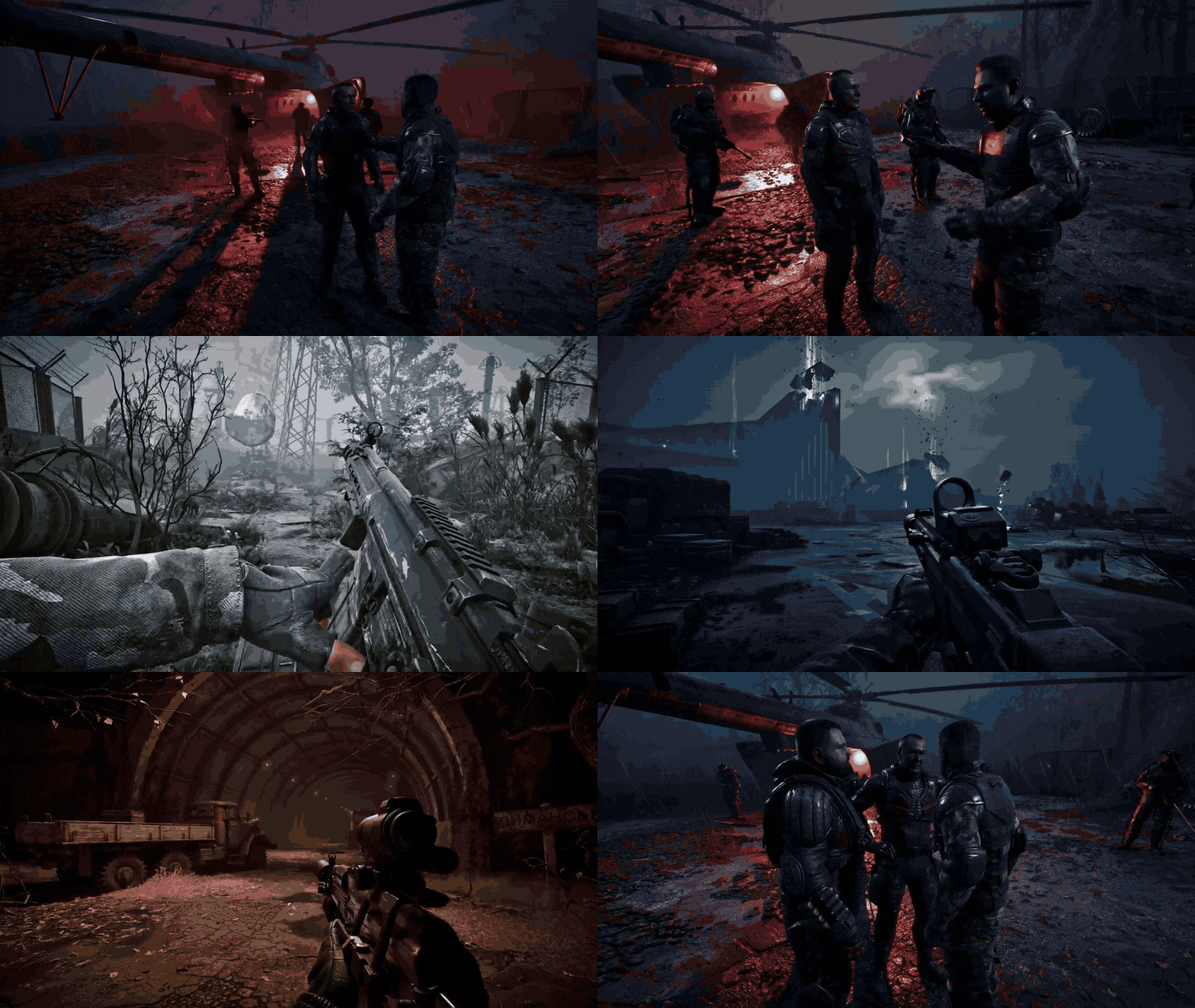
Cost of Hope is the first major story expansion announced for S.T.A.L.K.E.R. 2: Heart of Chornobyl by GSC Game World, revealed during an Xbox Partner Preview broadcast and supported by an official announcement trailer.
Officially, the expansion is positioned as a large, non-linear chapter that runs alongside the base game’s main storyline (instead of being set “after” the ending). It returns players to the role of Skif, reignites tensions between Duty and Freedom under the fragile D4 Treaty, and expands the playable Zone with two long-requested regions: the Iron Forest and the Chornobyl Nuclear Power Plant.
The core promise is scale plus consequence: “dozens of hours” of story for completionists, additional time for full exploration, new and returning characters, and player decisions that can reshape outcomes for the Zone—and potentially beyond it.
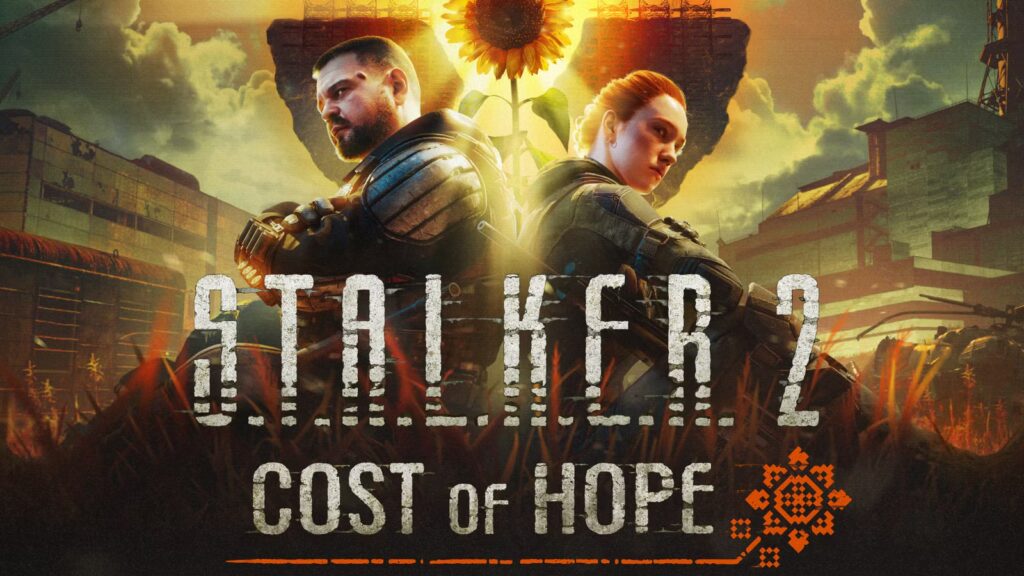
Stalker 2 Cost of Hope release date and Summer 2026 launch window
The only confirmed release timing for Cost of Hope is Summer 2026. Neither Xbox Wire nor GSC Game World has published a specific day-and-date release announcement at the time of writing (March 31, 2026).
Multiple official-facing storefront and announcement pages reinforce the same window (and notably avoid pinning a specific calendar date), which is a strong signal that Summer 2026 remains a launch window rather than a locked ship date.
That matters for planning because big expansions for open-world FPS RPG hybrids often involve late-stage tuning (quest flow, performance, and balance) that can shift release timing inside a window. In Cost of Hope’s case, the developer explicitly framed the expansion as a “large” release whose development began after the main game launched—suggesting post-launch iteration and progress that can naturally lead to “window first, date later.”
A practical way to track the shift from “window” to “date” is to monitor official store pages for changes; the Xbox store listing currently treats it as downloadable content that “requires a game” and does not provide a date in the visible description block.
Stalker 2 Cost of Hope platforms, Xbox Play Anywhere, and PC support
On the announcement side, the most complete platform statement is in the official Xbox Wire developer breakdown: Cost of Hope is planned for Xbox Series X|S, Xbox on PC, Xbox Cloud, PC storefronts (including Steam, Epic Games Store, and GOG.com), and PlayStation 5.
A second official Xbox Wire recap—focused on the March 2026 Partner Preview’s announcements—also frames the DLC’s arrival as “this Summer” and describes it as a “massive story” that can take more than 20 hours to explore, reinforcing both platform commitment and scope.
The expansion is also tied to Xbox Play Anywhere support. The developer breakdown states that both the base game and the expansion support Xbox Play Anywhere and uses the “buy once and play it on all supported platforms” framing.
Xbox’s own Play Anywhere explainer adds important technical and licensing context: Play Anywhere applies to digital purchases (not disc installs), and it’s intended to let eligible titles be played across Xbox console, Windows PC, and supported handhelds at no additional cost, with progress and add-ons carrying across devices.
Because Cost of Hope is officially described as a game add-on/DLC, the “DLC carries across Play Anywhere” question is especially relevant. Xbox’s Play Anywhere FAQ explicitly says DLC you buy or earn for Play Anywhere games is playable across Xbox console and Windows PC (including add-ons and season passes), provided that the underlying title is compatible and you’re using the same account ecosystem.
On PC—separately from Play Anywhere—the Epic Games Store listing provides system requirement targets that clarify the performance profile of the expansion’s technical footprint:
- OS targets include Windows 10 x64 and Windows 11 x64 (the same OS family but different major versions, which matters for driver support policies and platform features).
- Storage is listed at 160 GB and an SSD is required, with target profiles presented for 1080p/30 (LOW) and 1440p/60 (HIGH).
- The listing references multiple upscaling/temporal systems used for testing, including TSR and (for higher target configurations) DLSS, FSR, and XeSS. No specific versions are enumerated on the storefront page, so version-by-version behavior should be treated as dependent on the shipping build and GPU driver stack at launch.

Is Stalker 2 Cost of Hope a standalone game or DLC requirement explained
Cost of Hope is not positioned as a standalone release; it is presented as DLC that requires ownership of the base game. The Xbox store listing repeats that requirement directly: it marks the add-on as “Requires a game” and states “This content requires a game (sold separately).”
The GOG.com listing is similarly explicit in its requirement language, indicating “To play this game you also need … S.T.A.L.K.E.R. 2” (i.e., the base title). This “requires base game” framing is also consistent with the developer breakdown’s guidance on how the DLC integrates into a base-campaign playthrough—an approach that typically implies shared systems, shared world state, and shared savegame dependencies rather than standalone packaging.
How to start the Stalker 2 Cost of Hope DLC in the main campaign
The official “how do you start it?” instruction is concise and important: after installing Cost of Hope, you will receive a signal on your PDA during your playthrough of the main campaign, and that signal begins the expansion’s storyline.
That phrasing strongly suggests the expansion is designed to trigger in-campaign rather than requiring a separate menu mode or a separate save file, though the announcement text does not specify the exact campaign chapter, mission threshold, or location that must be reached for the PDA signal to appear.
Because the expansion is described as running in parallel with the base storyline, the most likely design implication is that the DLC will be accessible once your character reaches a point in the main campaign where branching off makes narrative sense—yet this remains an inference until GSC publishes precise unlock criteria.
For now, the safest operational guidance is:
- Install the DLC.
- Load into an active main campaign playthrough.
- Watch for the PDA signal that starts the expansion’s storyline.
Xbox Partner Preview Showcase 2026 Stalker 2 Cost of Hope reveal
The reveal context is unusually central to understanding Cost of Hope’s positioning: both the Xbox Wire recap and the developer breakdown explicitly frame the expansion as being announced during the March 2026 Partner Preview broadcast.
In the recap, Xbox’s editorial framing emphasizes (a) “something huge” happening in the Zone, (b) the conflict between Duty and Freedom as the core thematic hook, (c) major locations such as the Chornobyl Nuclear Power Plant and Iron Forest, and (d) a substantial story length (described as more than 20 hours to explore).
The developer breakdown then expands that into the “why” behind the content: development started after the main game shipped, the Team expects the expansion to be “pretty big,” and the DLC is designed to bring “more answers to the questions” raised in both Heart of Chornobyl and the original games—clarifying that Cost of Hope is meant to do narrative work, not just offer extra combat encounters.
This matters because Partner Preview showcases can include everything from minor cosmetic DLC to full expansions. Xbox Wire’s language (“first major expansion,” “huge new storyline”) and GSC’s own emphasis on questing, characters, and answers make it clear Cost of Hope is being positioned at the “expansion pack” level rather than a small mission pack.
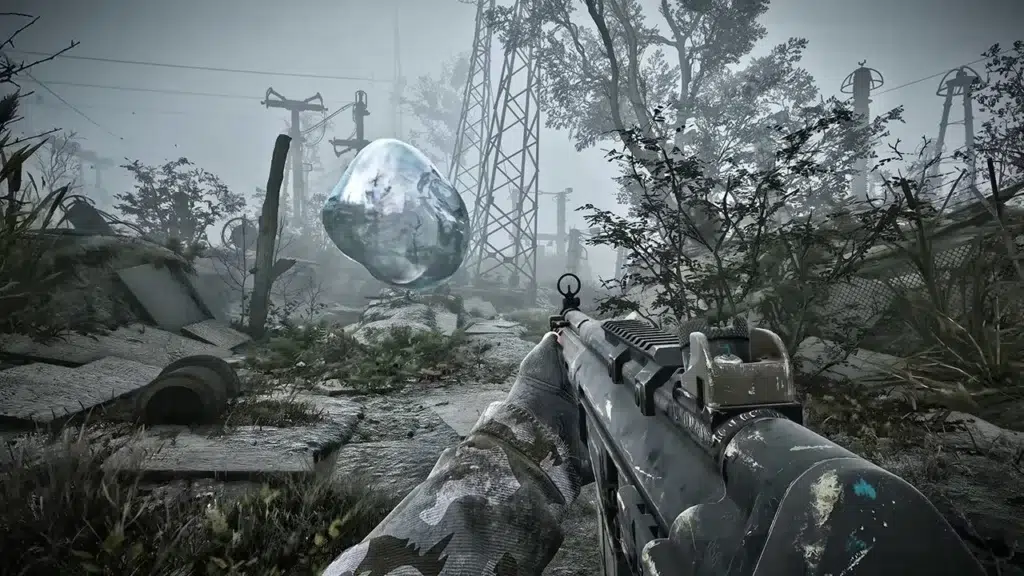
Stalker 2 Cost of Hope official announcement trailer breakdown
Because reveal trailers are deliberately selective, a good breakdown focuses on what is shown repeatedly or centered in official materials: factions, new regions, the sense of a brittle peace falling apart, and the Zone’s “wonders and horrors” loop.
- Key art communicates theme: hope vs. rot, people vs. place
The headline artwork featured by Xbox Wire places two armed figures back-to-back with a sunflower motif and ruined industrial silhouettes—imagery consistent with the franchise’s tension between human choices and a decaying environment. While key art is symbolic rather than literal, it serves as the trailer’s “thesis statement”: this is a human conflict inside a hostile landscape, not just “new map content.” - The trailer’s visual language returns to the Zone’s signature anomaly spectacle
One official screenshot shows a first-person view aimed at a looming structure under stormy skies, punctuated by bright vertical energy columns and debris-like particles—visual shorthand for the Zone’s dangerous, physics-defying anomalies. This aligns with the official promise that the expansion will deliver “lethal anomalies” and “new horrors and wonders.” - Human conflict is foregrounded: face-to-face confrontation imagery
Another screenshot centers heavily armored men arguing or confronting one another near a helicopter under rain and harsh red lighting. Even without explicit faction insignia being readable at this resolution, the shot reinforces what the text already tells us: Cost of Hope is not neutral sightseeing—it’s built around an escalating conflict between organized groups and the collapse of a peace arrangement. - The PDA is framed as the narrative “entry point” and a gameplay driver
A third screenshot shows a first-person hand holding what appears to be a PDA device with a radar-like screen, inside a damaged industrial interior with exposed wiring and heavy machinery. This visually supports the developer’s direct statement: the expansion begins when a new signal arrives on your PDA during the main campaign.
The PDA emphasis also functions as an onboarding signal for returning players: it suggests the expansion will be discoverable in-world and likely uses familiar UI language rather than a separate “DLC mode” menu—though, again, the exact unlock point is not specified yet. - The Chornobyl Nuclear Power Plant is shown as a physical destination, not just name-dropped
A fourth screenshot depicts a massive nuclear facility structure and surrounding industrial elements, consistent with how the franchise uses recognizable landmarks as both navigational anchors and narrative symbols. This aligns with official text describing the CNPP as a long-forbidden place now “calling stalkers” back in. - Trailer copy and store copy converge on a “choice under uncertainty” promise
Across official description blocks (Xbox store and Epic store), the language repeats a specific moral framing: choosing a side amid intrigue and half-truths, where no choice is clean. This is not incidental; it indicates that faction alignment (or at least faction-influenced decisions) is expected to be a central mechanic for how the expansion branches. - The trailer’s “expansion scale” promise is reinforced by developer commentary
A trailer can imply scale, but the developer breakdown states it directly: dozens of hours for the “whole story,” additional time for players who “want to see everything,” and an emphasis on more engaging quests, memorable characters, and answers to existing mysteries. The trailer visuals—anomalies, confrontations, and landmark locations—work as a highlight reel for those promises.
For an SEO-oriented audience, the key takeaway is simple: even without a full quest list or a systems deep dive, the trailer and official materials consistently direct attention to three pillars—faction conflict, new regions, and a meaningful, choice-driven story integrated into the existing campaign.

Stalker 2 Cost of Hope story details and where it fits in Heart of Chornobyl
Cost of Hope is explicitly designed as a parallel-running storyline: the developer states that its events unfold “in parallel with the story of Heart of Chornobyl.”
This placement is important for both first-time and returning players. A “parallel” expansion typically aims to accomplish three things at once:
- Give players a new narrative thread without forcing them to finish a full base-game campaign first.
- Re-contextualize events or factions already encountered in the base game.
- Create an alternate “cut” through the experience that can change how you interpret the main storyline.
While only the first point is strongly implied (due to the PDA-trigger mid-campaign), the developer statement about providing “more answers to the questions raised” in Heart of Chornobyl and “the original games” indicates that the expansion is written partly as a response to existing mysteries and unresolved lore threads.
Cost of Hope is also framed as “a massive non-linear expansion” in official store copy. That phrase matters more than it might seem, because “non-linear” can mean multiple things in modern open-world shooters:
- Non-linear mission order (multiple quest lines available at once).
- Branching outcomes (choices affecting endings and faction states).
- Non-linear exploration (regions structured to reward looping back, not corridor progression).
- Non-linear pacing (the ability to pause story missions to explore and scavenge).
In Cost of Hope’s case, GSC and Xbox emphasize all four indirectly: “dozens of hours,” “choices change everything,” “regions are large territories,” and “dozens of smaller locations filled with quests and activities.”
To understand why this fits the series, it helps to remember the base game’s top-level promise: a vast Zone full of anomalies, enemies, and valuable artifacts, where choices determine fate. The official Xbox product page for Heart of Chornobyl highlights that loop (dangerous enemies, deadly anomalies, powerful artifacts; choices determining fate), implying that Cost of Hope is meant to extend the same core structure rather than replacing it with a radically different mode.
Where the expansion likely differs (based on confirmed text, not guesswork) is in its focus: it is anchored on a familiar conflict between major factions and is built to provide additional “answers” and character-driven questing. That is a storytelling commitment beyond “new contracts in a new map.”
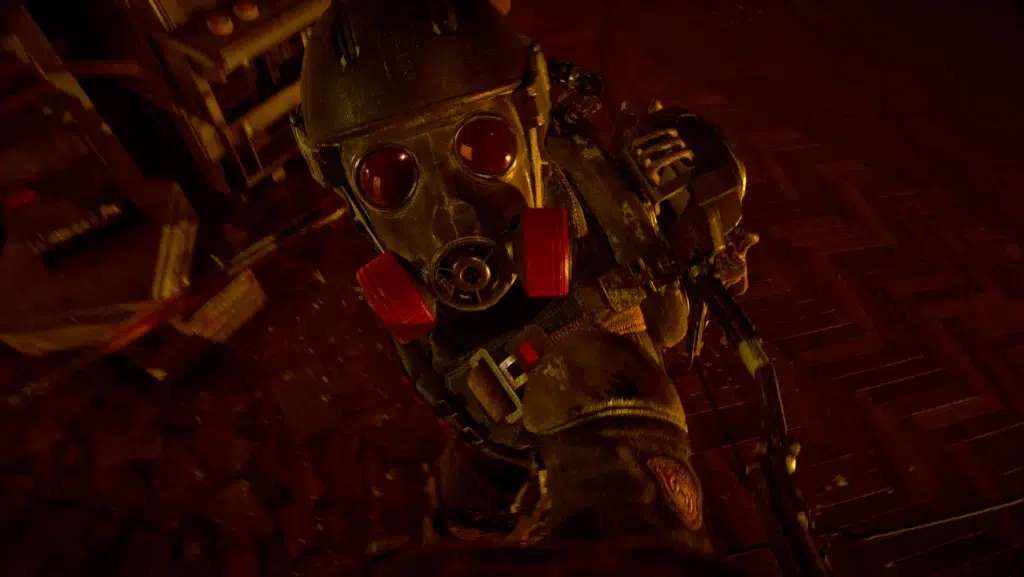
Stalker 2 Cost of Hope Duty vs Freedom faction conflict explained
Cost of Hope’s central conflict is framed as the continuation of a “well-known” faction struggle: Duty and Freedom, described as enemies in the past, are now tied together by the D4 Treaty, a pact signed by every group in the Zone prior to Heart of Chornobyl’s events.
The developer breakdown provides the cleanest official contrast of their ideologies:
- Duty sees the Zone as a danger to humanity and wants to destroy it to protect humankind from the unknown.
- Freedom sees the Zone as a gift—something humanity should explore, understand, and potentially use for the greater good.
This ideological dichotomy matters because it’s not just “red faction vs. blue faction.” These are rival philosophies about containment vs. exploitation, safety vs. discovery, and the legitimacy of the Zone’s continued existence.
Cost of Hope’s official store description escalates this into a moral-choice framing: the fragile peace is shattered, and the player must pick a side amid intrigue and half-truths where no decision is fully clean or fully right.
That framing suggests three practical consequences for gameplay and narrative design:
- Faction alignment is likely to shape mission availability and outcome logic, even if the game still allows you to interact with both groups. The official statement “your decisions will shape this chapter” is deliberately broad, but in a faction-centered story it typically implies that some decisions close doors while opening others.
- The story’s tension is partially built from ambiguity rather than strict morality. “Half-truths” implies misinformation, propaganda, compromises, or betrayals—narrative devices that make “choose a faction” more than a simple menu selection.
- The D4 Treaty’s presence implies that the expansion is not starting from a blank slate. The conflict is “new chapter,” but it is rooted in prior agreements, prior compromises, and prior wounds—meaning the expansion can explore why the treaty was necessary and why it may be failing.
It is also notable that the developer poses the treaty’s stability as a question (“agreements like that rarely keep conflicts of this scale in balance for long. Or do they?”). That rhetorical framing hints at the possibility that player choices can reinforce the treaty, shatter it, or reshape how its terms manifest in the Zone. This is an inference grounded in the “choices shape the chapter” promise; it is not (yet) a confirmed branching list.
Finally, the faction conflict is closely tied to the expansion’s title: “Cost of Hope” can reasonably be read as a question about whether survival, peace, and progress in the Zone require compromise—and whether compromise costs more than it saves. That interpretive layer is thematic rather than factual, but it fits the official marketing language that pairs decay with “a flicker of hope.”
Stalker 2 Cost of Hope Skif protagonist role in the DLC
The protagonist of the expansion is explicitly stated to be Skif, and the events run alongside Heart of Chornobyl’s story. That choice (returning to the same playable protagonist) has two major implications.
First, it signals continuity of progression and identity: Cost of Hope appears designed to feel like “more campaign,” not a disconnected character vignette. The official “receive a signal on your PDA during your playthrough” phrasing supports that. Second, it sets the stage for decisions with systemic weight. The developer states that, like in the original game, decisions will shape how the chapter ends, with consequences for the Zone and its inhabitants—and possibly “even the entire world.”
The “entire world” phrase should be interpreted carefully in a research context. It does not necessarily mean a literal expansion beyond the Zone’s map boundaries; in narrative marketing, it often signals stakes that extend beyond personal survival—political consequences, scientific consequences, information leakage, or chain reactions triggered by faction outcomes. What is confirmed is the promise of consequential choice; the exact scope of those consequences remains to be detailed.
Skif’s presence also ties into the expansion’s dual focus on “humans and their perceptions” (GSC’s phrasing) and the Zone’s continual growth. By using the same protagonist, the expansion can contrast Skif’s prior assumptions about the Zone with new information and new moral pressure—especially in a story explicitly centered on competing ideologies.
That human-centric emphasis is consistent with the base game’s own framing on Xbox’s store page: starting as a lone stalker, you decide who earns help and who earns a bullet, and choices can have non-obvious consequences. Cost of Hope is a continuation of that design philosophy, but refocused onto a defined conflict and two major regions.

Stalker 2 Cost of Hope Iron Forest region details
Officially, the Iron Forest is one of the two “long-awaited regions” that Cost of Hope will open up—areas described as having been cut off for years and dreamed of by stalkers in the Zone. The Iron Forest’s descriptive language is consistent across multiple official-facing pages: it is repeatedly characterized as maze-like or labyrinthine, and the store copy invites players to “cut your way” through its mazes and previously unseen locations.
From a game-design perspective, calling a region “maze-like” is a meaningful hint about what kind of traversal and encounter pacing to expect. Without inventing map details, the term strongly implies:
- Dense route interconnection (multiple ways to reach similar points).
- High likelihood of navigation pressure (line-of-sight breaks, ambush geometry, and environmental hazards).
- A structure that rewards exploration rather than “one road in, one road out.”
Those are inferences from the descriptor, not confirmed map layouts, but they are consistent with how open-world survival shooters use “forest labyrinth” zones to alter player rhythm—especially compared with more open, sightline-heavy spaces.
GSC’s key structural promise for regions also applies here: a region is not a single location but a large territory with its own hub and dozens of smaller discovery locations, filled with quests and activities. Iron Forest is explicitly one of those regions.
The biggest open question is what “hub” means in Iron Forest specifically. In prior Stalker design language, hubs often function as semi-safe settlements where the player can trade, accept quests, upgrade gear, and gather information. Cost of Hope’s announcement does not detail specific hub names or facilities, but it does confirm that each region will contain a hub and many smaller locations.
Stalker 2 Cost of Hope Chornobyl Nuclear Power Plant location explained
The Chornobyl Nuclear Power Plant (CNPP) is the second flagship region and is treated as an iconic destination: official text frames it as “forbidden” or locked away for decades and now calling stalkers back in. In the context of Stalker fiction, the CNPP is more than scenery; it is a symbol of origin, consequence, and the Zone’s relationship with human history. The official reveal leans into that symbolism, repeatedly presenting the CNPP as the place players have wanted to reach and as a region that has been inaccessible until now.
Official imagery supports the CNPP’s importance as a physical destination: Xbox Wire’s screenshot set includes a wide shot of a massive industrial complex consistent with a nuclear plant facility, reinforcing that this region is visually distinct and likely engineered as a landmark-heavy space. Mechanically, the CNPP is still described as a “region” in the formal sense—meaning it should have its own hub, quests, and activities, plus dozens of smaller locations to explore. That differentiates it from a single “dungeon mission” and instead suggests a broader open territory.
Because the expansion is described as “massive” and “non-linear,” it is reasonable to expect (as an inference) that CNPP exploration will not be limited to one linear push. Instead, it may act as a place the story returns to, or a region where multiple quest lines intersect—especially given the faction-driven narrative stakes. But until GSC details quest structure publicly, the only confirmed points are accessibility, status as a long-awaited region, and the hub/locations/quests promise shared across regions.

Stalker 2 Cost of Hope new regions, hubs, and side activities
Cost of Hope adds two new regions—Iron Forest and the CNPP—and sets them up as meaningful expansions of the Zone rather than isolated mission spaces. GSC’s most concrete structural claim is this: each region is a large territory with its own hub and dozens of smaller locations, all filled with quests and activities.
The phrase “quests and activities” is intentionally broad, but it gives enough to outline what players should expect at a systems level:
- Quests likely include main storyline missions tied to the Duty–Freedom conflict and faction dynamics. This is grounded in the official description that the expansion centers on that conflict and includes a “huge new storyline.”
- Activities in Stalker’s design language usually encompass exploration loops: risky travel through anomaly fields, scavenging resources, and taking contracts that may not be directly tied to the main plot. The base game’s Xbox description explicitly emphasizes scavenge-and-survive gameplay, hunting for artifacts, and navigating hostile anomalies.
What is not yet officially detailed is the specific set of “side activities” unique to Cost of Hope—such as named mini-games, new economic systems, or reputation subsystems—so any claim that the expansion introduces brand-new activity types beyond expanded questing would be speculative at this stage.
However, it is reasonable to infer (and useful for players planning their return) that the expansion’s activities will build on the base game’s established loops, since the official framing is continuity-focused (“more answers,” “same heavy atmosphere,” “choices,” and “the Zone keeps expanding”). Xbox Wire’s recap also adds one more important clue: it references “other new locations across the Zone” in addition to the CNPP and Iron Forest. That suggests the expansion doesn’t limit new spaces strictly to those two regions and may include additional points of interest, mission spaces, or expanded routes connecting regions.
For players who want a practical definition of “hub” in this context, the safest interpretation (without overreaching beyond sources) is: a central area designed to support quest flow and exploration pacing—a place that anchors many smaller locations and encourages repeated returns as the story evolves. The announcement confirms hubs exist; it does not confirm what services (trade, repair, quest boards) each hub will provide.
How long is Stalker 2 Cost of Hope and How Big is The Expansion
Cost of Hope is repeatedly described as large-scale, but the official messaging uses two different “time-language” phrases that are best interpreted as complementary rather than contradictory:
- Xbox Wire’s Partner Preview recap calls it a “massive story that can take more than 20 hours to explore.”
- The developer breakdown says “the whole story … will take dozens of hours to complete,” and that players who want to see everything will “easily add quite a few more on top.”
The cleanest research interpretation is: the expansion’s critical path may be 20+ hours, while full completion (including optional content and exploration) is framed as “dozens of hours,” with additional time for completionists. The exact number will vary based on playstyle, difficulty, and how much of the region content is pursued.
“Big” is also communicated through geography. GSC clarifies that a region is a large territory with a hub and dozens of smaller locations, and Cost of Hope adds two such regions. If the base game already frames itself as “one of the biggest open-worlds to date” on Xbox’s product page, then adding two major regions suggests a materially expanded playable footprint rather than a small set of instanced missions.
The developer breakdown further emphasizes content density: more engaging quests, more memorable characters and their stories, and more answers to ongoing questions. That combination suggests not only length, but also narrative breadth—more character arcs, more branching or layered quest design, and more lore revelations.
Finally, the “non-linear” claim is significant for length expectations. Non-linear expansions tend to extend playtime because decision pathways and exploration lead to content being discovered in different orders, and players may need to replay segments to see alternate outcomes. While replay value is not explicitly quantified, “choices change everything” strongly implies that the expansion will reward multiple playthroughs or save-branching for players who want to see all endings or resolutions.

Stalker 2 Cost of Hope new weapons, gear, anomalies, and enemies
The expansion is confirmed to introduce new weapons and gear and to feature new threats that include mutants (mutated nightmares), anomalies, and hostile human enemies.
This is one of the areas where it’s easiest for articles to overpromise by listing invented weapon names or mutant types. Officially, the announcement stays at the category level:
- “Brand-new weapons and gear” are explicitly promised.
- Threats are described as “new mutated nightmares,” “lethal anomalies,” and human threats.
The safest conclusion is: new equipment exists, but specific weapon models, suit sets, artifacts, anomaly types, or new mutant species have not been publicly enumerated in the announcement materials.
That said, the base game’s own store description gives context for what “new weapons and gear” likely plugs into: the Zone as a black market for weaponry, an arsenal of 30+ firearm models, and the ability to customize for tactical advantage. This is base-game context, not a DLC promise, but it helps explain why “new weapons and gear” matters in Stalker 2’s ecosystem—combat variety is a central pillar.
Similarly, “lethal anomalies” and artifact hunting are core to the base game’s identity per Xbox’s official game page (deadly anomalies and powerful artifacts). The expansion’s promise of new anomalies and dangers indicates the new regions are not mere reskins; they’re expected to introduce new hazard patterns and survival pressures that modify how players approach exploration.
On PC specifically, the Epic Games Store page indicates the expansion’s performance profiles were “tested” with temporal/upscaling systems (TSR, DLSS, FSR, XeSS) and that SSD is required—signaling that the expansion likely continues the base game’s heavy asset streaming and open-world performance assumptions. Again, this is technical framing, not a content list, but it matters for “gear and enemies” because performance affects how those encounters play in practice.
Stalker 2 Cost of Hope Second Trilogy Theory and Future DLC Roadmap
GSC’s public roadmap language is unusually direct: it frames the Stalker 2 post-launch story content as a three-part structure analogous to the original trilogy. In the developer breakdown, GSC references S.T.A.L.K.E.R.: Legends of the Zone Trilogy and explicitly states that, like the original trilogy (S.T.A.L.K.E.R.: Shadow of Chornobyl, S.T.A.L.K.E.R.: Clear Sky, and S.T.A.L.K.E.R.: Call of Prypiat), Stalker 2 will be comprised of three installments, with Cost of Hope forming the “middle chapter” of a “second trilogy.”
The same official statement confirms a future second story DLC that will be discussed later—meaning Cost of Hope is not the end of Stalker 2’s planned narrative expansions.
From a roadmap standpoint, there are two distinct layers:
Confirmed roadmap elements (official):
- Cost of Hope is the first major expansion, coming Summer 2026.
- It is explicitly the middle chapter of a three-installment “second trilogy.”
- Another story DLC is planned as the later chapter that completes that trilogy framing.
Commercial packaging signals (official store language):
- The Xbox store’s Ultimate Edition and upgrade descriptions reference a season pass that grants two expansions and future DLCs—consistent with the “more to come” narrative.
The phrase “second trilogy theory” is best handled carefully. You don’t need theory to establish the trilogy framing—it is already official. “Theory” becomes relevant when discussing what the trilogy structure implies:
- Inference 1: Cost of Hope may function as a middle-act escalation that reorients faction power structures, increases stakes, and reframes mysteries that the third DLC resolves. This inference is consistent with GSC’s “middle chapter” language and with the emphasis on decisions shaping the chapter with large consequences.
- Inference 2: The third story DLC is likely planned to address the “answers to questions” promise left open after Cost of Hope (since Cost of Hope itself is marketed as answering questions from both Heart of Chornobyl and the original games, but not necessarily “all questions”).
However, any attempt to name the next DLC, describe its map regions, or state its release window would exceed what has been officially published in the sources used here. The only confirmed future DLC detail is that it exists and will complete the trilogy framing.
A final roadmap detail that affects player planning: Xbox Play Anywhere’s official FAQ emphasizes that DLC purchased for Play Anywhere titles is playable across Xbox console and Windows PC (for eligible SKUs) and that Play Anywhere is digital-only. For players deciding where to buy and how to carry expansions forward, that policy is more actionable than any unconfirmed rumor about content timelines.

Frequently asked questions (FAQs)
- Will Stalker 2 Cost of Hope have a specific release date, or only a window?
Only a Summer 2026 release window is officially stated so far, with no specific date confirmed in the developer breakdown or the Partner Preview recap. - Is Cost of Hope the first DLC for Stalker 2, or just the first “major” one?
It is presented as the first major expansion for Heart of Chornobyl, with official messaging outlining another story DLC later as part of a three-installment “second trilogy.” - Does Cost of Hope require the base game to play?
Yes. Store listings explicitly indicate it “requires a game” / “requires a game (sold separately),” and GOG also states you need the base title to play. - How do you start Cost of Hope once it’s installed?
During a main campaign playthrough, you will receive a new signal on your PDA, which starts the expansion storyline. - Is Cost of Hope set after Heart of Chornobyl, or does it happen during the campaign?
Officially, the events unfold in parallel with Heart of Chornobyl’s story, and the expansion is triggered during a main-campaign playthrough. - How long is Cost of Hope expected to take?
The official recap describes a story that can take more than 20 hours to explore, while the developer breakdown describes the whole story as taking dozens of hours, with additional time for players who want to see everything. - Which new regions are confirmed?
Two regions are explicitly named: Iron Forest and the Chornobyl Nuclear Power Plant, each described as a large territory with its own hub and many smaller locations filled with quests and activities. - Will there be new weapons, gear, and enemies?
Yes—official store and developer descriptions confirm brand-new weapons and gear, plus threats including new mutants (“mutated nightmares”), lethal anomalies, and human threats. Specific item names have not been listed publicly in the announcement materials. - Will Cost of Hope support Xbox Play Anywhere?
Yes. The developer breakdown says both the base game and Cost of Hope support Xbox Play Anywhere. Xbox’s Play Anywhere FAQ also states that DLC for Play Anywhere games is playable across Xbox console and Windows PC (for eligible digital purchases). - Is Stalker 2 currently included with Xbox Game Pass, and will the DLC be included?
As of the available store-facing evidence used here, the base game is not labeled “Included with Game Pass” on Microsoft Store Game Pass category lists and is shown as a purchasable/discounted title, and reporting from Windows Central states it recently exited Game Pass. There is no official statement in the expansion announcement materials that Cost of Hope will be included in a Game Pass plan.

Conclusion
Cost of Hope is positioned as a substantial, choice-driven expansion that extends Heart of Chornobyl’s core identity—survival, exploration, anomalies, and consequential decisions—while centering a major ideological conflict between Duty and Freedom and delivering two major new regions (Iron Forest and the Chornobyl Nuclear Power Plant).
With a Summer 2026 release window (no exact date yet), a story scope described in “dozens of hours,” and explicit framing as the middle chapter of a new trilogy structure, Cost of Hope reads less like optional side content and more like a continuation of the series’ main narrative arc—one designed to answer existing questions while setting up the final story DLC to come.
Sources and Citation
- 1. Official Developer Breakdown & Reveal (Xbox Wire)
- This covers the “Developer Deep Dive” which detailed the “dozens of hours” of gameplay, the branch-based story positioning, and world mechanics.
- Link:S.T.A.L.K.E.R. 2: Heart of Chornobyl – Developer Deep Dive Recap
- 2. Official Partner Preview Recap (Xbox Wire)
- This focuses on the “Legends of the Zone Trilogy” announcement and the trailer framing for the expansion of the franchise to consoles.
- Link:S.T.A.L.K.E.R. Legends of the Zone Trilogy is Out Now on Xbox
- 3. Official Storefront Listings (Xbox)
- This contains the base game requirements for DLC and the official “add-on” language.
- Link:S.T.A.L.K.E.R. 2: Heart of Chornobyl – Xbox Store
- 4. Xbox Play Anywhere Policy
- The rules regarding digital cross-entitlement and cross-device progression.
- Link:Xbox Play Anywhere Official Page
- 5. PC Technical Requirements (Epic Games Store)
- Detailed specs including SSD requirements, GPU/CPU targets, and support for upscaling technologies like DLSS, FSR, and XeSS.
- Link:S.T.A.L.K.E.R. 2: Heart of Chornobyl – Epic Games Store
- 6. Base-Game Requirement Confirmation (GOG)
- Confirmation of the DRM-free version and base-game requirements.
- Link:S.T.A.L.K.E.R. 2: Heart of Chornobyl – GOG.com
- 7. Gameplay Loop & Heart of Chornobyl Framing
- Official Xbox product page detailing anomalies, artifacts, and choice-driven narrative.
- Link:Xbox Games Catalog: S.T.A.L.K.E.R. 2
- 8. Corroborating Press Coverage (Narrative & Synopsis)
- Consistent reporting on the length and narrative structure from major outlets.
- PC Gamer:Everything we know about S.T.A.L.K.E.R. 2
- TechRadar:S.T.A.L.K.E.R. 2 Guide
- Video Games Chronicle (VGC):S.T.A.L.K.E.R. 2 Interview – Narrative Depth
- 9. Game Pass Status & FAQ Context (Windows Central)
- Reporting on Day One availability and subscription tier requirements.
- Link:Windows Central: Is S.T.A.L.K.E.R. 2 on Game Pass?
Recommended
- Bluey and “Bluey’s Best Day Ever!” Have Arrived at Disneyland – Everything You Need to Know About the New Interactive Experience
- Why PixelHair is the Best Asset Pack for Blender Hair Grooming
- Understanding PixelHair: A Comprehensive Guide to Realistic 3D Hair Assets
- TexturingXYZ’s SKAP Now Available: Generate 16K Skin Displacement, Cavity, and Advanced Maps From Your Input
- Warner Bros. Discovery Is Rebuilding Its Video Game Pipeline After a Significant 2025
- How do I set a camera to render in orthographic mode in Blender?
- Resident Evil Requiem Leads the US Monthly Charts for February 2026, With Launch Sales 60% Higher Than Resident Evil Village
- How to Make Anything a LEGO in Blender with Geometry Nodes: A Step-by-Step Guide
- Can you have multiple cameras in one Blender scene?
- The Best Nioh 3 Skills for Samurai and Ninja: Must-Have Unlocks, Combos, and Builds (2026 Guide)