










In This Article (7 sections)
Tencent Youtu Parsing Omni 5B Model, Features, and Benchmark Results
Tencent has released Youtu Parsing Omni, a five billion parameter multimodal model designed to extract structured information from documents, images, audio, and video. According to the results published with its release, the model achieved an Overall score of 96.96 on OmniDocBench v1.6, placing it at the top of Tencent’s reported comparison. The model combines document extraction and audiovisual parsing within a single checkpoint, addressing the challenge of converting different types of media into information that software can search, inspect, and reuse. Its research paper was submitted to arXiv on October 29, 2026. The release represents an attempt to unify several tasks traditionally handled by separate systems.
A document parser must recognize text, understand page organization, and preserve relationships between elements. Audio processing requires transcription and temporal information, while video analysis must interpret visual events and connect them to particular moments in a recording. Youtu Parsing Omni brings these capabilities together through a shared architecture and structured output framework.
The distinction between recognition and evidence is central to the model’s practical value. Extracting text from a scanned document is useful, but preserving its position makes verification easier. Similarly, transcribing speech provides information, while timestamps allow users to locate the original statement. A unified parser can provide this contextual information across different media types, potentially simplifying workflows involving document search, recording analysis, and automated information retrieval.
Unlike a conventional conversational assistant, a parsing model primarily focuses on representing source material accurately. Its output can support search engines, document management systems, review interfaces, and other applications requiring structured information. A system processing scanned manuals and recorded demonstrations, for example, would need readable document text, page locations, speech transcripts, and recording timestamps. A shared parsing framework can make these records easier to organize without eliminating the need for storage, retrieval, validation, or answer generation.
Tencent’s public GitHub repository contains a dedicated directory for Youtu Parsing Omni alongside the earlier Youtu Parsing project. Developers should distinguish the new multimodal model from its predecessor because different architectures, checkpoints, dependencies, and inference instructions may exist within the same repository. Installing the general project does not automatically establish that every component has been configured correctly.
Public access to the code and weights allows developers to inspect implementation details, evaluate prompts, and test compatibility with their infrastructure. However, the release uses a custom license containing a European Union territorial limitation. Although the model is publicly downloadable, open weight release is a more precise description than unrestricted open source. Commercial deployment requires reviewing the actual license conditions rather than assuming that public availability permits every use.
Tencent’s published OmniDocBench v1.6 comparison reports an Overall score of 96.96 for Youtu Parsing Omni, compared with 96.91 for TeleOCR. The difference is 0.05 points, placing Tencent’s model narrowly ahead in the reported evaluation. These results come from the developer’s release materials and should not be interpreted as independently reproduced measurements or guarantees that the same ranking will remain unchanged. An Overall benchmark score does not mean that 96.96 percent of every real document will be extracted perfectly. Aggregate results combine different categories and can conceal errors involving tables, formulas, reading order, captions, and other elements. A document may contain accurately recognized paragraphs while still including a consequential numerical mistake or incorrectly reconstructed table.
The narrow difference between the leading entries also requires careful interpretation. It demonstrates competitive performance within the published evaluation, but without repeated measurements or uncertainty estimates, the practical significance of a 0.05 point advantage remains difficult to establish. Organizations should therefore assess whether the model performs reliably on the kinds of files they actually process rather than relying exclusively on its overall ranking.
Tencent’s OmniParsingBench comparison provides another perspective. The published results assign Youtu Parsing Omni an average of 75.08, while Gemini 3 Pro records 77.44, a difference of 2.36 points in Gemini’s favor. Tencent describes its model as the strongest open weight entry in that comparison, while Gemini leads overall. However, Youtu’s reported chart and audio results exceed Gemini’s corresponding scores, demonstrating that aggregate rankings do not necessarily identify the strongest model for every category.
This difference matters because organizations have different processing requirements. A company extracting information from financial charts may prioritize numerical accuracy, legends, and relationships between data points. A business indexing recorded lectures may care more about transcription, speaker separation, and timestamps, while a scientific publisher may place greater emphasis on formula recognition and correct document structure. The most relevant evaluation should therefore reflect the intended workload, with important considerations including:
- Document accuracy: Correct recognition of text, reading order, tables, formulas, and page structure.
- Chart extraction: Preservation of labels, numerical values, legends, and relationships.
- Audio processing: Transcription accuracy, speaker separation, and temporal alignment.
- Video understanding: Correct identification of events, visible text, and timestamps.
- Structured output: Valid records that preserve relationships with the original source.
- Operational performance: Inference speed, memory requirements, processing costs, and reliability.
The benchmark comparison also does not settle deployment decisions. A locally operated model may appeal to organizations seeking direct control over processing, while a hosted alternative may reduce infrastructure maintenance. These considerations extend beyond accuracy and must be evaluated alongside licensing, workload size, and operating costs. Tencent’s reported results establish a competitive position across document and multimodal parsing benchmarks, but the strongest evidence of operational value will come from testing representative documents, recordings, and videos under consistent evaluation conditions.
Youtu Parsing Omni Architecture, OmniSchema, and Multimodal Extraction
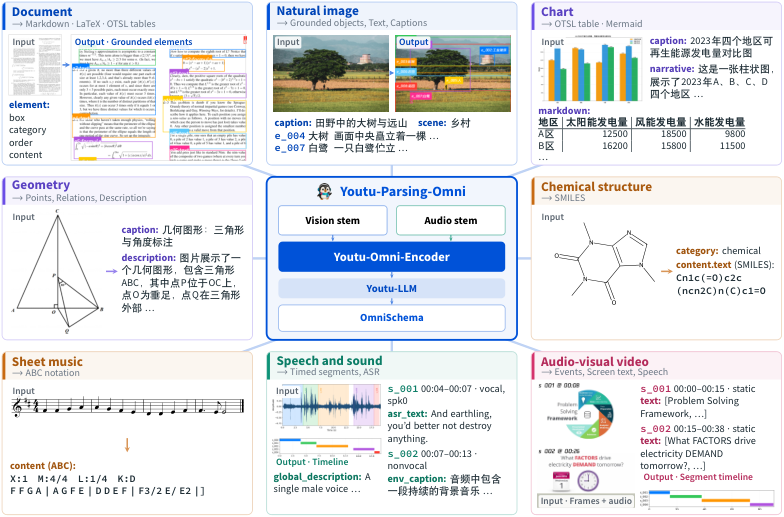
Youtu Parsing Omni uses a shared encoder and a common structured output framework to process different media types. The research paper describes an architecture intended to represent content with spatial and temporal grounding, allowing extracted information to retain connections to locations within documents, images, audio recordings, and video. The processing system has three broad responsibilities: converting source media into an internal representation, identifying relevant information and relationships, and expressing the results through a structured format that other software can interpret.
Each stage affects the quality of the final output because information may be lost during preprocessing, misunderstood during recognition, or incorrectly represented during generation. For example, a scanned page may contain text that becomes difficult to recognize after resizing, a table may be read correctly at the character level while losing relationships between cells, and an audio transcript may contain accurate words but incorrect speaker assignments. These failures require different corrections, making it important to evaluate recognition and structured representation separately.
The official document parsing prompt specifies different output representations according to the type of content being extracted. Textual elements use text fields, tables use OTSL, and mathematical formulas use LaTeX. Element locations are also included to preserve the relationship between extracted content and its original position. These distinctions reflect the different requirements of document understanding. Optical character recognition identifies the characters appearing on a page, but table extraction must also preserve rows, columns, and relationships between cells.
Formula recognition must preserve mathematical structure because the position of a symbol can change the meaning of an expression. A row of numbers without its corresponding headings may remain readable while becoming misleading, while recognizing the correct mathematical symbols is insufficient if a fraction loses the relationship between its numerator and denominator. Accurate extraction therefore requires preserving organization alongside individual characters.
The model also supports structured interpretation of charts, flowcharts, and geometric figures. Its task definitions use Markdown oriented representations for charts, Mermaid oriented content for flowcharts, and descriptions of components and relationships for geometry. These categories introduce different evaluation challenges because charts communicate numerical relationships, flowcharts represent connections between actions and decisions, and geometric diagrams describe spatial and mathematical properties. The important requirements include:
- Charts: Axis units, labels, legends, numerical values, and category alignment must remain correct.
- Flowcharts: Connections between boxes and decisions must be preserved, not merely the text inside each element.
- Geometry: Components and relationships must reflect the source without inventing unsupported mathematical properties.
- Tables: Cell relationships, headings, and numerical placement must remain intact.
- Formulas: Mathematical notation must preserve structural relationships and produce valid representations.
For practical verification, developers can reconstruct extracted tables and compare them with the original pages. Formulas can be rendered from their generated LaTeX, while flowcharts can be recreated from Mermaid output to check whether the connections remain accurate. These checks reveal problems that may not be obvious when inspecting raw text alone. Input preparation also matters because page rotation, compression, image resolution, and document quality influence the information available to the model. Retaining the original document alongside its extracted representation makes errors easier to investigate and correct.
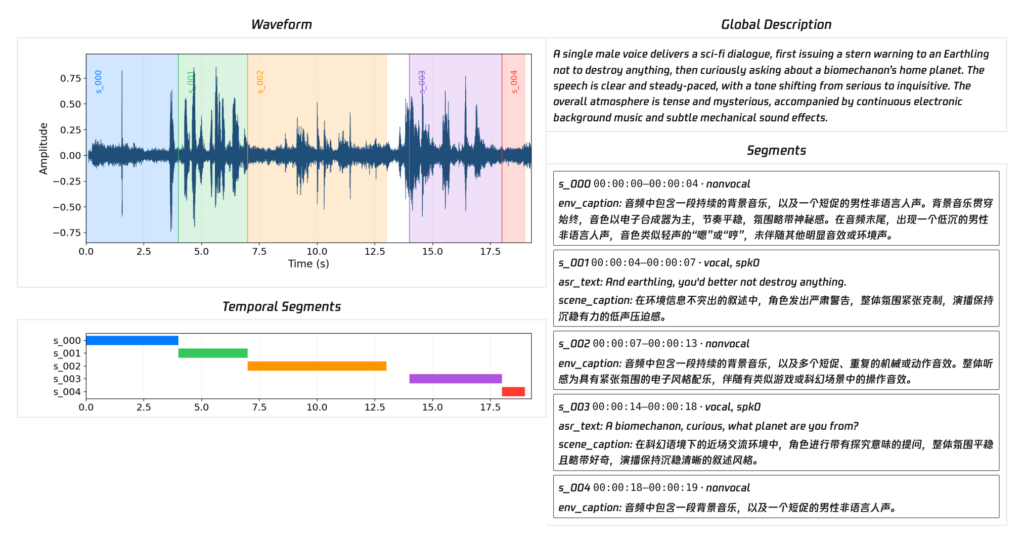
Tencent’s audio prompt requests consecutive temporal segments and distinguishes vocal material from nonvocal audio. Speech segments include transcriptions, speaker identifiers, and descriptive audio information, while nonvocal segments can contain descriptions of environmental sounds and other acoustic events. Speaker identification must be interpreted carefully because assigning different labels to voices does not establish the real identities of the people speaking. A model may distinguish Speaker 1 from Speaker 2 without knowing their names, and applications that associate those labels with known individuals should preserve the distinction between the original model output and any identity assigned through additional evidence.
Transcription accuracy involves more than recognizing ordinary speech. Names, numbers, technical terms, interruptions, and overlapping conversations can introduce errors. Speaker separation may fail independently of word recognition, meaning that a transcript can contain accurate wording while attributing it to the wrong person. For meeting records, interviews, and publication workflows, important quotations should be checked against the source recording. Timestamps make this verification easier by allowing reviewers to locate the relevant passage, but they do not eliminate the possibility of transcription mistakes.
Youtu Parsing Omni also distinguishes between natural video and text rich video. This allows the system to approach footage dominated by visual events differently from presentations, demonstrations, and recordings containing substantial written information. The documented vLLM plugin samples no more than one video frame per second, with a configurable maximum frame count and a documented default maximum of 64 frames. This sampling approach has important consequences because rapidly changing text, brief warnings, and events occurring between selected frames may not be included in the input. Frame sampling can still be effective for lectures, presentations, and demonstrations where important visual content changes relatively slowly, but it should not be confused with exhaustive inspection of every frame.
Applications requiring precise coverage of brief events need evaluation procedures designed around that requirement. Timestamp accuracy must also be assessed separately from content recognition because a model may describe an event correctly while assigning a time range too broad for precise retrieval. Search applications may tolerate some imprecision, while editing and archival workflows may require tighter alignment. Long recordings can also be divided into segments before inference, provided their original timing offsets are preserved so that extracted information continues to reference the correct position in the complete recording.
OmniSchema is the common structured output framework described in Tencent’s research paper. Its purpose is to give different parsing tasks a shared representation while preserving information appropriate to each modality. Without a common framework, a document parser might return plain text, an audio system might produce a transcript file, and a video processor might generate a separate event format. Combining their outputs would require additional transformations and consistency checks. OmniSchema attempts to simplify that process by establishing a shared structural foundation that can reduce the need for unrelated conversion layers when building applications that process documents, audio, and video together.
However, valid JSON does not automatically guarantee interoperability or accurate extraction. Two records can satisfy JSON syntax while using incompatible field meanings, and a structurally valid record can still contain incorrect text, numbers, coordinates, or timestamps. Applications therefore need clear rules for identifiers, optional fields, spatial coordinates, and time formats, alongside validation of the extracted information itself. For evidence retrieval, retaining the original asset identifier, extraction revision, and relevant source location can make results easier to trace. These are application design considerations rather than benchmark achievements, but they become important when processing systems are updated or extraction mistakes require investigation.
The architecture also includes Youtu Omni Encoder, which the paper describes as initialized from a pretrained language model. It shares perception weights across modalities and uses a unified space and time coordinate system. Selected fusion layers allow video frames to attend to concurrent audio, supporting the interpretation of related information from different sources. This design can help connect speech with corresponding visual events, but architectural integration does not automatically prove superior results across every modality. Applications should test situations where information channels agree and situations where they conflict.
For example, a recorded presentation might display an outdated price while the speaker announces a correction. A reliable parsing workflow should preserve the visible information and the spoken update with their respective origins rather than silently combining them into an unsupported conclusion. Preprocessing remains important even with a shared encoder because image resizing, audio preparation, and video frame selection determine which evidence reaches the model. Changing those settings can alter results without modifying the checkpoint itself, making the complete input pathway part of reproducible evaluation.
Tencent’s research report also introduces OmniSchema Aware On Policy Distillation (OSAD) as a post training method for improving structured parsing behavior. Under this approach, the student model generates its own parsing attempts, while a reference conditioned teacher provides token level supervision. The teacher is refreshed across training rounds, allowing the supervision and parser to develop together. The motivation concerns the difference between training on ideal examples and generating complete structured outputs. During generation, a model must continue from its own previous decisions, meaning an early mistake can influence subsequent tokens and potentially damage the structure of an entire response.
Training on model generated attempts exposes the learning process to those situations. This can be particularly relevant for structured extraction because an incorrect field or relationship may affect how later content is represented. However, the method should not be interpreted as autonomous improvement without supervision. The reference conditioned teacher still relies on reference information during training, and the approach does not guarantee that every generated record will be accurate or structurally valid. Determining the contribution of OSAD requires controlled comparisons that separate the effects of architecture, training data, and post training. Its significance lies in providing a method for improving structured parsing behavior, while the quality of the resulting model must still be established through reproducible evaluation.
Youtu Parsing Omni Download, Installation, Licensing, and Deployment
Tencent provides Youtu Parsing Omni through its official Hugging Face model repository under the identifier tencent/Youtu-Parsing-Omni, with implementation files hosted in the TencentCloudADP/youtu-parsing GitHub repository. The relevant implementation is located within the dedicated Omni directory rather than a completely separate top level project. Developers should begin with the specific checkpoint and its matching implementation because the broader repository also contains earlier Youtu Parsing components. Different models may require different dependencies, prompts, architectures, and inference configurations. Using instructions intended for the predecessor could therefore lead to incorrect installation or evaluation results.
Downloading the model should be treated as acquiring a versioned software dependency. Recording the exact checkpoint revision, code revision, and inference settings makes results easier to reproduce. Configuration files, tokenizers, and processing code may also be necessary, meaning that obtaining only the model weights may not produce a complete working environment. The first local evaluation should use a small representative asset with a known expected result. Developers can confirm that the model loads correctly, produces structured output, and generates records that the receiving application can interpret. Once that initial pathway works, testing can expand to more varied documents, recordings, and videos.
Tencent’s model documentation describes separate environments for vLLM serving and direct Transformers inference. The published setup specifies Transformers 5.2.0 for the vLLM pathway and Transformers 5.10.2 for direct inference. The reported benchmark results were obtained using the documented vLLM configuration. The implementation relies on the supplied vllm plugin vita omni, whose documentation identifies vLLM 0.19.0 as the tested version. Audiovisual processing also requires additional media dependencies, including an ffmpeg binary. The documentation provides a local file pathway for decoding audio from video, making request construction important when both the soundtrack and visual content must be processed.
These requirements make Tencent’s specific installation instructions more reliable than a generic inference example. Successfully launching a server does not establish that all modalities are being processed correctly. A video request might produce visual output while failing to include audio information if its media pathway is incorrectly configured. Separate development environments are advisable because Tencent specifies different Transformers versions for the two inference paths. Keeping dependencies isolated and pinned reduces the likelihood of compatibility problems unrelated to model quality.
A practical validation process should include:
- Document testing: Confirm that text, tables, formulas, and locations are extracted correctly.
- Audio testing: Check transcription, speaker labels, sound descriptions, and timestamps.
- Video testing: Verify that visual information is recognized and that the audio pathway is active when required.
- Schema validation: Confirm that outputs follow the expected structure and contain usable fields.
- Source verification: Compare extracted information with the original documents and recordings.
- Reproducibility: Record checkpoint versions, dependencies, prompts, and preprocessing settings.
For audiovisual testing, including information available only through speech can help reveal whether the audio pathway is functioning. Developers should also inspect raw model output before applying cleanup or conversion processes because downstream transformations may conceal the original source of an error. Validating each modality separately makes it easier to identify whether a problem originates in preprocessing, recognition, structured generation, or the application consuming the results.
The Youtu Parsing Omni release includes publicly available code and model weights, but its custom license contains conditions governing use, modification, and redistribution. These include a European Union territorial limitation, redistribution obligations, and requirements relating to notices and modified files. Consequently, commercial use should not be described as unrestricted simply because the model can be downloaded publicly. Organizations considering deployment need to review the applicable terms against their intended operating locations, redistribution arrangements, and commercial activities.
Hardware planning also requires more information than the model’s parameter count. A five billion parameter model does not have one guaranteed memory requirement across all configurations. Numerical precision, input resolution, context length, generated output, concurrency, and media preprocessing can all affect resource consumption. Different workloads may create different demands, with large scanned pages, short audio recordings, and lengthy audiovisual inputs requiring substantially different processing resources. Capacity planning should therefore measure the actual files an organization expects to handle rather than rely exclusively on theoretical estimates.
Operational cost extends beyond model inference. Preprocessing, storage, retries, manual corrections, and output conversion can influence the total expense of a parsing workflow. A model that performs well on a benchmark may offer less practical value if its outputs frequently require expensive repair or if the surrounding infrastructure is difficult to maintain. Self hosting also creates responsibilities involving failed request monitoring, malformed record detection, reproducible environments, and updates. These requirements become especially important when structured output is used as part of a larger information system.
The most useful deployment decision combines licensing, extraction quality, processing speed, infrastructure requirements, and the cost of verifying results. None of these factors independently establishes whether the model is suitable for a particular organization. Youtu Parsing Omni’s broader significance lies in its attempt to make different forms of source material accessible through a unified parsing system.
Its reported benchmark results suggest strong performance, particularly in document parsing, while its multimodal architecture provides a foundation for applications requiring spatial and temporal evidence. The practical value will depend on how consistently the model preserves source relationships, produces accurate structured records, and integrates with existing workflows. Public weights and code make those questions easier to investigate, but reliable deployment still requires representative testing, careful configuration, and verification of the resulting information.
Frequently Asked Questions (FAQs)
- What is Youtu-Parsing-Omni?
Youtu Parsing Omni is Tencent’s approximately five billion parameter multimodal parsing model designed to convert documents, images, audio, and video into structured records. It supports tasks such as text extraction, table recognition, transcription, speaker separation, and video analysis. Its main purpose is to make information easier for software to search, retrieve, and verify while preserving relevant source locations and timestamps. - How large is Youtu-Parsing-Omni?
Tencent describes Youtu Parsing Omni as a 5B model, meaning it contains approximately five billion parameters. This identifies the model’s general scale but does not independently determine its inference speed, memory requirements, or extraction accuracy. Actual hardware demands also depend on numerical precision, input size, generated output, and the number of requests processed simultaneously. - What does the 96.96 OmniDocBench result mean?
The 96.96 figure is the Overall score reported for Youtu Parsing Omni in Tencent’s OmniDocBench v1.6 comparison. It places the model narrowly ahead of TeleOCR’s reported 96.91 score within that evaluation. However, it does not mean that 96.96 percent of every document will be extracted perfectly. Real performance depends on document quality, content type, and the specific errors that matter to an application. - Does Youtu-Parsing-Omni beat Gemini 3 Pro?
The answer depends on the benchmark and task. Tencent’s published results place Youtu Parsing Omni at the top of its cited OmniDocBench comparison, while Gemini 3 Pro records a higher OmniParsingBench average of 77.44 compared with Youtu’s 75.08. Youtu performs better in certain reported categories, including charts and audio. Organizations should therefore compare the models using representative workloads rather than assume one is universally superior. - Can the model identify the real names of speakers?
The model can assign speaker identifiers to distinguish voices within a recording, but those labels should not be treated as verified personal identities. Separating speakers is different from establishing who they are. Applications may associate labels with known participants using additional information, but that identification should remain separate from the model’s original transcription and speaker separation output. - Does video parsing inspect every frame?
No. The documented vLLM plugin samples video frames rather than examining every frame individually. Its processing uses no more than one frame per second, with a configurable maximum number of frames and a documented default of 64. Consequently, brief visual events or rapidly changing text may be missed. Applications requiring detailed coverage of every frame need additional evaluation or processing arrangements. - Does valid JSON guarantee accurate extraction?
No. Valid JSON only establishes that the output follows the required syntax, while schema validation checks whether its fields and structure meet an expected format. Neither confirms that extracted words, numbers, coordinates, or timestamps match the original source. Reliable workflows must validate the structure and compare important information with the documents, recordings, or videos from which it was extracted. - Where should developers obtain the model?
Developers should obtain Youtu Parsing Omni from Tencent’s official Hugging Face model repository and use the matching implementation in the TencentCloudADP GitHub project. Recording the checkpoint and code revisions helps make evaluations reproducible. Configuration files, processing components, and documented dependencies should also be included to avoid incomplete installations or mismatched inference settings. - Can vLLM and Transformers use the same environment?
Tencent’s published configuration specifies different Transformers versions for the two inference paths. The vLLM setup uses Transformers 5.2.0, while direct Transformers inference uses version 5.10.2. Separate environments are therefore the recommended starting point when following the official instructions. This helps prevent dependency conflicts and makes troubleshooting easier when testing different inference methods. - Is commercial use unrestricted?
No. Although Youtu Parsing Omni’s code and weights are publicly available, the release uses a custom license containing conditions, including a European Union territorial limitation and redistribution requirements. Organizations considering commercial deployment must examine those terms in relation to their intended usage, operating locations, and distribution arrangements. Public download access should not be interpreted as permission for unrestricted commercial use.
Conclusion
Youtu Parsing Omni brings document, audio, and video extraction into a unified model and structured output framework. Its reported benchmark results demonstrate strong potential, particularly in document parsing, while broader multimodal comparisons show why performance claims must remain specific to each evaluation. The main advantage is the possibility of improving information retrieval while preserving enough source context for verification. However, reliable deployment requires testing representative materials, validating structured outputs, maintaining reproducible configurations, and considering operating costs and licensing restrictions. Publicly available weights and strong benchmark performance provide a foundation, but practical value depends on consistent accuracy within the intended workflow.
Sources and Citations
- Tencent Researchers, October 29, 2026: Youtu-Parsing-Omni research paper detailing the 5-billion-parameter multimodal architecture, unified Youtu-Omni-Encoder, OmniSchema, OmniSchema-Aware On-Policy Distillation (OSAD), ten parsing tasks and benchmark results of 96.96 on OmniDocBench v1.6 and 75.08 on OmniParsingBench.
https://arxiv.org/abs/2610.39301 - Tencent, Hugging Face Youtu-Parsing-Omni Model: Official model weights, architecture documentation, structured JSON outputs, performance comparisons, supported modalities, installation instructions and inference examples for document, image, audio and video parsing.
https://huggingface.co/tencent/Youtu-Parsing-Omni - TencentCloudADP, Official GitHub Repository: Youtu-Parsing-Omni implementation, source code, model integration files, inference scripts, evaluation utilities, installation requirements and technical documentation for multimodal processing.
https://github.com/TencentCloudADP/youtu-parsing - TencentCloudADP, Youtu-Parsing-Omni Task Prompts: Official task configurations for document extraction, natural image analysis, charts, flowcharts, geometric figures, audio transcription, audiovisual understanding and structured graphics output.
https://github.com/TencentCloudADP/youtu-parsing/blob/main/youtu_parsing_omni/prompts/youtu_parsing_omni.json - TencentCloudADP, vLLM Plugin Documentation: Multimodal inference setup, supported dependencies, image and audio processing, video frame sampling, audiovisual synchronization, model serving configurations and plugin installation requirements.
https://github.com/TencentCloudADP/youtu-parsing/blob/main/youtu_parsing_omni/vllm-plugin-vita-omni/README.md - Tencent, Youtu-Parsing-Omni Model License: Official licensing conditions covering model usage, reproduction, modification, redistribution, copyright notices, third-party dependencies and restrictions on use within the European Union.
https://huggingface.co/tencent/Youtu-Parsing-Omni/blob/main/LICENSE
Recommendations
- PEAK: How to Ring 5 Belltowers in the GLOOM in a Single Expedition
- Smooth Obstacle Avoidance System Set Up in Unreal Engine: RVO vs Detour Crowd, NavMesh Settings, and Best Practices
- Why Kingdom Hearts III Still Costs $59.99 Digitally While Physical Copies Sell for Under $20
- How Many Dudes? Achievement Guide: How to Unlock Every Achievement
- Best Weapon and Combat Ability to Choose First in Control Resonant
- Crimson Desert Global Release Time Confirmed as Preload Goes Live — Full Launch & Preload Schedule
- The Witness Review: Puzzle Masterpiece Explained, Gameplay Breakdown, and Island Mystery Analysis
- The 7th Tie in Oscars History Just Happened for Best Live Action Short Film: What Happened, Who Won, and Why It Matters
- Now Yu-Gi-Oh! Is Upset With the White House After It Used Anime Footage Without Permission
- Capcom Responds to Onimusha Demo Criticism as Way of the Sword Promises a Harder Challenge



































































































