






In This Article (7 sections)
Terence Tao Maths 2.0 Vision, AI in Mathematics and the Future of Mathematical Research
Terence Tao’s Maths 2.0 describes a future in which artificial intelligence helps mathematics develop stronger explanations, better tools and more connected knowledge. Its central concern is how mathematical progress should be understood when machines can increasingly assist with producing proofs. Tao presented his “Math 2.0” lecture at Caltech on October 9, 2026, and discussed it on his blog the following day. He framed the proposal around supporting the mathematical community and strengthening the relationship between mathematical understanding and practical applications.
The implications extend beyond whether an AI system can solve a difficult problem. They concern how researchers evaluate discoveries, how students develop expertise, how mathematical knowledge is maintained and who takes responsibility for machine assisted results. Understanding this proposal requires distinguishing several activities that headlines often combine. Generating a possible proof, checking its correctness, explaining its ideas and establishing its significance are different tasks. AI could contribute to each, but success in one does not automatically establish success in the others.
Maths 2.0 is Tao’s proposed direction for mathematical practice as AI becomes more capable. It is a framework for deciding what the field should value and how its institutions should adapt. It is not a software release, a replacement for existing mathematical foundations or a declaration that human research has become unnecessary. His October announcement places the health of the mathematical community alongside the usefulness of mathematical understanding, making the proposal broader than an effort to automate theorem proving.
A useful way to interpret the idea is to ask what happens after a result is obtained. Can another researcher understand it? Can its methods answer a different question? Can a student learn from it? Can someone identify the assumptions that limit its use? These questions reveal why the quantity of proofs cannot be the only measure of progress. A new theorem might settle an isolated issue, while a clearer explanation of an existing theorem could help many researchers. Under this interpretation, Maths 2.0 would expand the kinds of contributions that receive attention. Proof production would remain valuable, but so would the work that makes results understandable, reusable and connected to a wider theory.
Rivka Galchen’s “The Year Math Changed Forever,” published by The New Yorker on November 1, 2026, examines Tao’s response to AI’s growing mathematical capabilities. It explores the tension between faster proof production and the human practices that sustain research, including explanation, collaboration and graduate training. That framing invites a broader question about mathematical achievement. A research community does more than collect statements that have been established as true. It also develops people who can recognize fruitful questions and understand why particular techniques work.
Consider a hypothetical research group that receives a correct but difficult proof. The immediate problem may be settled, yet substantial work remains. Researchers must identify the central idea, explain unfamiliar steps and determine whether the argument can be simplified or extended. This example helps distinguish mathematical output from the process that keeps research productive. An increase in completed arguments can create opportunities, but those opportunities depend on people and institutions being able to absorb the work. The New Yorker profile provides a human perspective on that transition, while the technical and institutional proposals require separate examination through Tao’s own writing and the documentation of the tools involved.
Tao uses Maths 1.0 to describe a traditional research environment shaped by the difficulty of obtaining proofs. When solving a significant open problem requires scarce expertise and sustained effort, the resulting proof becomes a natural basis for recognition. His lecture contrasts this historical condition with growing access to automated mathematical problem solving. Maths 2.0 would use AI to strengthen human understanding across the research process rather than treating completed solutions as its only valuable output.
The distinction concerns incentives as much as technology. Imagine two contributions to the same subject. One establishes a narrow extension of a theorem, while another reorganizes several difficult arguments into an accessible framework that enables other researchers to make progress. A system focused heavily on counting new results could undervalue the second contribution. An institution applying Maths 2.0 principles might assess how much each contribution improves the field’s ability to reason, communicate and develop.
This does not require abandoning traditional papers or prizes. It suggests broadening the evidence used to judge achievement. Nor should the terminology imply that earlier mathematicians neglected explanation. Exposition, teaching and collaboration have always mattered. The proposed change is to give these activities greater institutional weight as automated proof production expands.
AI also changes the economics of attempting mathematical arguments. A researcher can ask a system to explore several approaches, search for relevant results or generate candidate intermediate steps. Some attempts will fail, but the cost of producing another attempt can be much lower than organizing an entirely new human investigation. In his October 22, 2026, Nature commentary, Tao describes a situation in which AI assisted results can arrive faster than mathematicians can adequately assess and understand them. He also raises concerns about presentation quality and attribution.
However, candidate abundance and verified proof abundance must be distinguished. Producing many pages of mathematical text is not equivalent to establishing many theorems. Incorrect arguments can consume expert attention without adding reliable knowledge. The practical pressure comes from the relationship between production and evaluation. If submissions multiply while the number of qualified reviewers remains similar, researchers must spend more effort deciding which claims deserve detailed examination.
This suggests that mathematical scarcity may shift. The difficult resource could become expert interpretation, careful verification or the ability to identify results with lasting significance. That possibility does not establish that every important problem is becoming easy. It means that institutions designed around expensive proof production may need to accommodate a different balance between generating arguments and evaluating their value.
The underlying challenge is not simply making mathematics faster. It is determining whether faster discovery produces knowledge that researchers can understand, verify, communicate and build upon. Maths 2.0 therefore presents a broader vision of mathematical progress in which the quality of understanding and the health of the research community become increasingly important alongside the production of new results.
AI Generated Mathematical Proofs, Formal Verification, Conjectures and Living Knowledge Systems
An AI assisted mathematical research workflow could begin before anyone attempts a complete proof. A system might help organize definitions, locate potentially relevant literature or compare formulations of a problem. Researchers would still need to inspect the original sources and confirm that the statements actually apply. During exploration, AI could propose lemmas, produce computational examples or suggest alternative representations. These outputs would function as candidates for investigation, with their usefulness depending on whether they survive mathematical scrutiny.
A concrete precedent comes from the AlphaProof research published in Nature in 2025. The system combined reinforcement learning with the Lean proof environment, allowing proposed proof steps to receive feedback from a formal system. Its reported competition performance also involved substantial computation, illustrating why working conditions matter when interpreting results.
A practical research workflow could alternate between human decisions and machine assistance. A mathematician identifies a promising subproblem, a system explores possibilities, and the researcher evaluates the resulting evidence before choosing the next step. The process should preserve the difference between an experiment, a conjecture and a verified conclusion. Keeping records of unsuccessful approaches can also help prevent repeated work. The strongest workflow improvements would reduce the total effort required to reach dependable understanding, including correction and explanation, rather than merely shortening the time needed to generate an initial draft.
A proof establishes a conclusion from assumptions through valid reasoning. Understanding includes recognizing why the argument works, which features are essential and how its ideas might be adapted. These achievements overlap, but neither can be reduced to the other. Someone may check individual steps without seeing the argument’s larger structure. Conversely, a researcher may possess a strong intuition about a statement while still lacking a complete proof.
Tao’s concern about the growing gap between produced results and absorbed knowledge makes this distinction central to the discussion. A field can accumulate arguments while struggling to integrate their consequences. For example, suppose an automated system establishes an inequality through a long sequence of transformations. A later explanation might show that the same inequality follows from a simple symmetry. Both arguments could be correct, but the explanation based on symmetry may suggest immediate generalizations.
The additional understanding has practical value because it helps researchers recognize related problems and notice when an assumption has changed. AI could also assist with explanatory work. Researchers could request alternative proofs, simpler examples or an account of where each hypothesis enters. Those explanations would require checking, especially when a system presents an appealing interpretation that is not actually supported by the proof.
Mathematical verification determines whether a claimed argument establishes the stated result. Its importance increases when producing plausible arguments becomes easier. An error can appear in the statement, the reasoning or the connection between them. A proof might silently assume a quantity is positive, apply a theorem outside its permitted conditions or establish only a special case of the original problem.
Formal checking provides a powerful response, but its guarantees must be described accurately. Lean’s documentation explains that an accepted proof establishes the encoded statement relative to its definitions, imported results and axioms. Reviewers must also examine whether that encoded statement represents the intended claim.
Consider a hypothetical theorem about every integer. If the formal statement accidentally concerns only positive integers, successful checking does not repair the mismatch. The software has verified a different proposition. Verification therefore involves both logical checking and careful specification. Human reviewers need to inspect what was asked, what was encoded and what was actually established.
This also explains why asking a second chatbot to approve an argument is insufficient by itself. Agreement can be useful evidence during exploration, but it does not supply the same guarantee as a complete checked derivation or a rigorous independent mathematical review.
Formal proof assistants allow mathematical definitions, statements and arguments to be expressed in a language that supports detailed logical checking. Lean is one example, while other systems include Isabelle, HOL Light and Rocq. Thomas Hales’s October 9, 2026, guest post on Tao’s blog explains formalization as checking mathematical reasoning at the level of foundations and logical rules. This provides context for understanding why proof assistants are relevant to AI generated arguments.
AI and proof assistants perform different roles. An AI system can suggest a proof or generate formal code, while the proof assistant checks the resulting formal argument within its logical environment. Shared libraries make this work more practical. Mathlib is a community developed collection of mathematics formalized in Lean, allowing later arguments to reuse existing definitions and theorems.
Nevertheless, apparently successful code requires inspection. Lean supports unfinished proof placeholders, and its documentation explains how their underlying axiom dependencies can be detected. A finished verification claim should disclose the assumptions on which it relies. For research communication, formal verification and readable exposition can complement each other. The formal artifact supports precise checking, while the accompanying explanation helps readers understand the strategy. Maintaining both creates additional work, but it also makes a result easier to audit, teach and reuse.
AI can also support mathematical research by helping researchers generate and test conjectures. A conjecture proposes a mathematical relationship that has not yet been established. AI can contribute to conjecture formation by identifying patterns in collections of examples or helping researchers decide which quantities deserve attention.
A 2021 Nature paper by Alex Davies and colleagues demonstrated this approach in knot theory and representation theory. Machine learning helped guide researchers toward useful relationships and conjectures. The work included a proved connection involving knot invariants and a proposed approach to a representation theory conjecture, which should not be confused with a proof of that conjecture.
A hypothetical investigation might begin with a dataset of mathematical objects and measurements. A model identifies a relationship, after which researchers test whether it survives changes in the examples. Counterexample searches are especially valuable because one counterexample can refute a universal conjecture, while thousands of successful examples generally cannot prove it.
A failed conjecture can still be informative. It may reveal that an additional assumption is necessary or that a different quantity captures the relevant structure. The productive cycle is therefore broader than asking AI to make predictions. It includes constructing examples, challenging patterns, refining statements and finding reasons that apply beyond the tested cases. A conjecture becomes valuable when it organizes mathematical thought and supports further investigation, not simply because a model assigns it high confidence.
These applications illustrate several distinct ways AI can contribute to mathematical research:
- Literature exploration: Organizing existing mathematical knowledge and identifying potentially relevant theorems, definitions and research methods.
- Proof exploration: Suggesting intermediate results, alternative strategies and possible approaches to difficult problems.
- Conjecture generation: Identifying patterns in mathematical examples and proposing relationships that researchers can investigate.
- Counterexample searching: Testing conjectures against examples that may reveal incorrect assumptions or necessary restrictions.
- Formal verification: Working alongside proof assistants to develop arguments that can be checked through explicit logical rules.
- Mathematical explanation: Producing candidate explanations, simplified examples and alternative presentations that researchers can verify.
- Knowledge organization: Connecting established results with their assumptions, dependencies and supporting evidence.
Beyond individual proofs and conjectures, Tao’s vision also raises the possibility of developing living mathematical knowledge systems. Such a system would represent results together with their relationships, assumptions and supporting evidence. Its value would come from making those connections easier to inspect and maintain.
A concrete project associated with Tao is the Integrated Explicit Analytic Number Theory Network, or IEANTN. In January 2026, he described a plan to formalize interconnected results and develop an interactive structure in which changes to numerical estimates could propagate through dependent calculations.
The motivation is practical. If a later theorem relies on an earlier numerical bound, improving that bound may improve the later result. Tracking these consequences across many papers can require substantial specialist effort. The project’s repository also makes an important distinction between conditional relationships and the evidence supporting individual claims. Its documentation separates what the formal network establishes from the broader question of how each component is justified.
This remains an ongoing effort rather than a completed database containing all mathematics. More generally, a trustworthy mathematical knowledge system would need visible source attribution, version history and clear status labels. Readers should be able to distinguish a fully verified theorem from a conjecture or a result currently supported by a literature citation.
Updating mathematical knowledge responsibly requires preserving those differences rather than presenting every connected statement as equally established. The broader promise of this approach is that mathematical results could become easier to maintain and reuse, allowing improvements to established knowledge to benefit related work without requiring researchers to reconstruct every connection manually.

Human AI Collaboration, Mathematical Education, Research Credit and the Future of Maths 2.0
Human and AI collaboration in mathematics can involve many different arrangements. A researcher may use AI for a single calculation, ask it to explore a family of examples, or organize a project around repeated interaction with formal tools. Tao’s living account of his views describes constructive uses that include improving exposition, examining variations of established results, and building mathematical resources. The emphasis is on making AI useful across a wider range of mathematical activities.
A productive collaboration could assign the system a clearly bounded question. For example, it might search for a counterexample under specified conditions. A human researcher would then check any proposed example and decide how it changes the investigation. Responsibilities should remain explicit throughout. The person presenting the result needs to understand what was checked and what remains uncertain. If an argument depends on an external theorem, someone must verify the reference and its assumptions.
Teams can also benefit from preserving intermediate work. A discarded approach might explain why a tempting strategy fails, while a record of model suggestions can clarify how the final argument developed. Collaboration becomes more useful when its output remains inspectable after the conversation ends. A durable research contribution should be understandable to colleagues who were not present during the interaction.
These changes also have implications for mathematical education. AI creates a distinction between completing an assignment and acquiring the ability the assignment was designed to develop. A student can obtain a polished solution without learning how to identify the relevant assumptions or construct the argument. Gireeja Ranade’s October 29, 2026, guest essay on Tao’s blog addresses student motivation and the wider support system needed to train future mathematicians. Its concerns include the conditions that allow a broad population of learners to develop mathematical expertise.
One educational response would be to assess reasoning more directly. Students could explain why a proof step is valid, repair an incomplete argument, or show what fails when a hypothesis is removed. These are possible approaches rather than evidence that a single new curriculum has been established. Their usefulness would depend on the subject, the students, and the learning objectives. AI could support teaching through hints, examples, and alternative explanations. However, a system that supplies the complete solution immediately may interfere with an exercise intended to develop independent reasoning. Courses could therefore distinguish between activities that welcome AI assistance and activities intended to establish unaided competence. Both can serve legitimate educational purposes.
Students also need practice checking machine output. Recognizing an unsupported claim is increasingly useful, but that judgment requires mathematical knowledge built through sustained engagement with the subject. Mathematical education must therefore balance the practical advantages of AI assistance with the continued development of independent reasoning, proof construction, and critical evaluation.
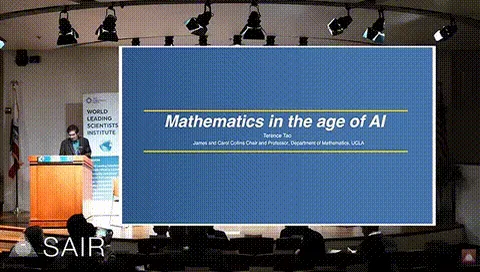
Mathematics assisted by AI also raises questions about how research contributions should be described and credited. A completed project may depend on the person who formulated the question, researchers whose earlier ideas supplied the method, people who checked the argument, and contributors who produced the formalization. Tao’s essay “Mathematics in the age of AI” examines the goals and values of mathematical research under the assumption that AI can perform tasks at a research level. Its focus supports examining how mathematical work should be assessed beyond debates over technical capability alone.
A practical publication approach would make the research process transparent. Authors could explain which systems were used, what those systems contributed, and how the resulting claims were checked. Such reporting should distinguish the origin of a suggestion from responsibility for the submitted work. An argument generated by a model still needs identifiable people who can respond to questions and corrections. Credit should also recognize the literature on which the result depends.
Rediscovering an existing theorem through AI does not erase the original contribution. These are proposed standards for responsible communication, not a claim that every mathematics journal currently applies identical rules. Clear contribution statements would help readers evaluate originality and accountability. They could also make essential work such as verification, library maintenance, and exposition more visible when institutions assess research achievement.
However, the capabilities of current AI systems remain uneven across mathematical tasks. Strong performance on a particular collection of problems does not establish equal strength in unfamiliar definitions, long research projects, or deciding which questions matter. Tao’s lecture explicitly warns against interpreting advances as the exhaustion of mathematics. It states that most frontier problems remain unsolved and emphasizes the unevenness of AI performance. Evaluation conditions also matter. The AlphaProof paper describes performance achieved with computation extending beyond the time available to human competition participants. That result demonstrates capability under specified conditions, but it should not be presented as an identical contest between a machine and students.
For research use, several questions remain essential. Was the problem already represented in accessible material? How many attempts were made? Were failures reported? How much human intervention was needed to obtain the final result? Tao’s published interview criticizes announcements that do not adequately report both successful and unsuccessful outcomes. Another limitation concerns interpretation. Even a correct answer may not provide a useful explanation of the method or identify its wider significance. Progress should therefore be assessed across reliability, novelty, cost, verification effort, and explanatory value. A single headline result cannot establish all these properties.
The practical requirements of Maths 2.0 extend across software, research culture, and education. Better models alone cannot determine how mathematical contributions are credited or how students develop expertise. Existing formal libraries provide part of the foundation. Mathlib’s documented coverage spans many areas, including algebra, number theory, linear algebra, and topology. Such resources demonstrate the value of shared definitions and reusable results.
Further progress would benefit from tools that connect formal statements with readable explanations and original sources. Researchers should be able to inspect both an argument’s logical dependencies and the intellectual history behind it. Institutions would also need to support maintenance. A mathematical database becomes less useful if its software stops working, references disappear, or corrections are not incorporated. Evaluation methods should recognize these contributions. Tao’s living summary describes the need to reconsider educational, publication, and career incentives while giving greater value to exposition and community development. Important priorities for building Maths 2.0 include:
- Reliable mathematical verification: Developing tools and practices that distinguish valid arguments from plausible but incorrect reasoning.
- Accessible mathematical explanations: Making results understandable to researchers and students rather than focusing exclusively on completed proofs.
- Reusable mathematical knowledge: Building interconnected libraries that preserve definitions, assumptions, dependencies, and supporting evidence.
- Responsible AI collaboration: Establishing clear expectations for human oversight, attribution, and the verification of contributions made with machine assistance.
- Mathematical education: Helping students develop independent reasoning while learning to use increasingly capable AI tools effectively.
- Research evaluation: Recognizing contributions to exposition, verification, collaboration, and knowledge maintenance alongside traditional discoveries.
- Sustainable research infrastructure: Supporting the development and maintenance of formal libraries, mathematical databases, and educational resources over the long term.
A practical measure of success would be whether researchers can understand and reuse results more effectively. Another would be whether students acquire stronger judgment while using increasingly capable tools. Building Maths 2.0 would therefore involve deliberate choices about what to automate, what to explain, and what forms of work the mathematical community rewards. The central issue is not whether AI can participate in mathematics, since existing research already demonstrates several ways it can contribute.
The deeper question is how mathematical institutions can use those capabilities without weakening the practices that make mathematical knowledge reliable and meaningful. Tao’s proposal places human understanding, verification, education, and community development at the center of that transition, suggesting that the future of mathematics will depend as much on how discoveries are interpreted and shared as on how quickly new proofs can be produced.
Frequently Asked Questions (FAQs)
- What is Terence Tao’s Maths 2.0?
Maths 2.0 is Terence Tao’s proposed approach to mathematical research and education in an era of increasingly capable artificial intelligence. It emphasizes using AI to improve mathematical understanding, verification, collaboration and knowledge organization rather than focusing exclusively on producing new proofs. The proposal also encourages reconsidering how mathematical contributions are evaluated and how the research community can remain productive as automated problem solving becomes more common. - When did Tao present his Math 2.0 lecture?
Terence Tao delivered his Math 2.0 lecture at Caltech on October 9, 2026, and discussed the proposal on his blog the following day. The American Institute of Mathematics subsequently published an account of the event. The lecture was originally planned under the title “Machine Assisted Proof” before developing into a broader discussion about how AI could transform mathematical research, education and institutional priorities. - Does Maths 2.0 mean AI has solved all important mathematical problems?
No. Maths 2.0 does not suggest that artificial intelligence has solved every major mathematical problem or that human mathematicians are becoming unnecessary. Many frontier problems remain unsolved, and AI capabilities vary considerably across mathematical subjects and research tasks. The proposal instead considers how researchers should adapt as machines become more useful for generating arguments, exploring conjectures and assisting with mathematical verification. - Can an AI generated proof be mathematically valid?
Yes. A proof generated with AI assistance can be mathematically valid if its reasoning correctly establishes the stated conclusion from the relevant assumptions. Its validity depends on the argument itself rather than whether a human or machine produced it. However, AI generated proofs must still undergo careful verification because language models can produce convincing arguments containing logical errors, unsupported assumptions or incorrect applications of existing theorems. - What is the difference between AI and a proof assistant?
An AI system can generate mathematical suggestions, propose arguments, identify patterns and help researchers explore possible solutions. A formal proof assistant, such as Lean, checks whether a formally expressed argument follows the logical rules and assumptions of its system. AI can help construct a proof, while a proof assistant can verify the resulting formal derivation. Combining both approaches allows researchers to explore mathematical ideas while maintaining stronger standards of logical verification. - Does formal verification guarantee that the intended problem was solved?
Not automatically. Formal verification establishes that a proof correctly demonstrates the statement encoded within the proof assistant, subject to the system’s definitions and assumptions. If the formal statement does not accurately represent the original mathematical problem, the verified result may establish something different from what the researcher intended. Human review remains necessary to confirm that the definitions, assumptions and final statement correctly capture the intended claim. - Can AI help mathematicians develop new conjectures?
Yes. AI can analyze mathematical examples, identify patterns and suggest relationships that researchers may not have previously considered. These suggestions can become conjectures that mathematicians investigate through additional examples, counterexample searches and theoretical reasoning. However, identifying a pattern does not establish that it holds universally. A conjecture generally requires a rigorous mathematical proof before it can be accepted as an established theorem. - What is the IEANTN project?
The Integrated Explicit Analytic Number Theory Network, or IEANTN, is an ongoing project associated with Terence Tao that aims to organize interconnected mathematical results in explicit analytic number theory. Its purpose is to make relationships between theorems, numerical estimates and supporting assumptions easier to inspect and maintain. One proposed benefit is that improvements to an existing estimate could be traced through other results that depend on it, helping researchers update related mathematical knowledge more efficiently. - Will mathematics students still need to learn proofs?
Yes. Learning to construct, understand and evaluate mathematical proofs remains essential, even when AI systems can generate solutions. Students need to recognize assumptions, follow logical arguments and identify errors or unsupported conclusions. AI can support education by providing explanations, examples and hints, but receiving a correct answer does not demonstrate understanding. Developing independent mathematical reasoning remains necessary for using AI generated results responsibly and conducting meaningful research. - How should AI assisted mathematical research be evaluated?
AI assisted mathematical research should be evaluated according to the correctness, originality, significance, clarity and reproducibility of its results. Researchers should also explain how AI tools were used, what human involvement was required and how the final arguments were verified. The evaluation should consider whether the work contributes meaningful mathematical understanding and whether other researchers can inspect, explain and build upon its findings. Successful mathematical research involves more than obtaining a correct answer; it also requires establishing why the result matters and how it advances existing knowledge.

Conclusion
Terence Tao’s Maths 2.0 raises a practical question about the future of mathematics: what should the field build and reward when producing certain kinds of mathematical arguments becomes substantially easier? The proposal highlights the need to reconsider how mathematical progress is measured as AI becomes increasingly capable of assisting with research, generating proofs and exploring complex problems. Rather than focusing exclusively on the speed or quantity of discoveries, Maths 2.0 emphasizes the importance of producing mathematical knowledge that researchers can understand, verify and build upon.
Achieving this requires several connected efforts. Mathematical results need rigorous verification, explanations must communicate the reasoning behind discoveries, original contributions must receive appropriate recognition, and students need opportunities to develop independent judgment. Shared mathematical libraries and living knowledge systems could help organize existing research and make relationships between results easier to explore, provided their assumptions, dependencies and verification status remain transparent.
AI’s contribution should therefore be assessed through the quality and usefulness of the mathematical work it enables. Faster discovery can be valuable, but so can a clearer proof, a dependable formalization or a carefully maintained network of interconnected results. These contributions can strengthen mathematical research by improving accessibility, supporting collaboration and making established knowledge easier to reuse.
A successful transition toward Maths 2.0 would make mathematical knowledge easier to trust, understand and extend while preserving the people and institutions responsible for developing that knowledge. Ultimately, the significance of AI in mathematics will depend not only on what machines can prove, but also on how effectively their capabilities strengthen human understanding, mathematical education and the long term development of the field.
Sources and Citations
- Terence Tao, October 10, 2026 — “Math 2.0”
Tao’s official blog post announcing the slides from his October 9 Caltech public lecture. He explains the transition from a traditional “Math 1.0” environment toward a “Math 2.0” vision in which AI supports the mathematical community and strengthens human understanding rather than simply maximizing automated solutions. What’s new
Terence Tao: Math 2.0 - Terence Tao, October 2026 — “Math 2.0” Lecture Slides
Tao’s October 10 post is the primary source linking to the lecture slides and confirms that the talk was delivered at Caltech on October 9, 2026. The slides develop his discussion of Math 1.0, proof scarcity, automated problem solving, mathematical understanding, incentives, and the proposed Math 2.0 model. What’s new
Math 2.0 post and official slide access - Rivka Galchen, The New Yorker, November 1, 2026 — “The Year Math Changed Forever”
Galchen’s profile examines the rapid impact of AI on mathematics, including Tao’s concerns about machine-generated proofs, verification bottlenecks, graduate training, mathematical explanation, collaboration, and the possibility that faster proof production could disrupt the practices through which mathematicians develop understanding. The New Yorker
The New Yorker: The Year Math Changed Forever - Terence Tao, Nature, October 22, 2026 — “Can maths survive AI? Fields medallist Terence Tao calls for a ‘Maths 2.0’ world”
Tao argues that AI-assisted proofs are arriving faster than mathematicians can fully absorb them and calls for a Maths 2.0 era that places greater value on human understanding, exposition, attribution, and the health of the mathematical research community. Nature
Nature: Can maths survive AI? - Terence Tao, August 17, 2026 — “Mathematics in the age of AI”
Tao’s original essay was submitted to arXiv on August 17, 2026. Based on his ICM 2026 public lecture, it examines how mathematics should respond if AI systems become capable of research-level mathematical work, shifting attention from capability alone toward the goals, values, incentives, and practices of mathematical research. arXiv
Terence Tao: Mathematics in the age of AI on arXiv - Terence Tao — Living Summary of His Views on AI
Tao also maintains an AI-assisted and personally reviewed living summary of his views on AI and mathematics. It identifies “Mathematics in the age of AI” as his most substantial written synthesis and connects it with later Math 2.0 talks, interviews, and commentary. Teorth
Terence Tao on AI — A Living Summary - American Institute of Mathematics, October 19, 2026 — “Terence Tao Presents ‘Math 2.0’ at the 2026 AIM Public Lecture”
AIM confirms that Tao delivered the Math 2.0 lecture to a sold-out audience at Caltech’s Beckman Auditorium on October 9. It also confirms that the event was originally planned under the title “Machine Assisted Proof” before being substantially revised in response to recent developments in AI and mathematics. aimath.org
AIM: Terence Tao Presents Math 2.0 at the 2026 AIM Public Lecture - Lean Language Reference — “Validating a Lean Proof”
Lean’s official documentation explains how formal proofs should be validated, including checks for incomplete proofs,sorry, axiom dependencies, background checking, and potentially misleading or unreviewed AI-generated proof code. It also emphasizes that verification depends on the formal statement accurately representing the intended mathematical claim. Lean Language
Lean: Validating a Lean Proof - Lean Language Reference — “Axioms”
Lean’s official Axioms documentation explains that proofs can depend on explicit assumptions, that Lean tracks those dependencies, and that#print axiomscan be used to audit them. It also explains the risks of custom or inconsistent axioms and the special role ofsorryAxin unfinished proofs. Lean Language
Lean Language Reference: Axioms
Recommendations
- Vivian Kubrick Debunks Eyes Wide Shut Deleted Scenes Theory
- Battlefield 6 2026 Roadmap: More Maps, “Legendary” Battlefield 4 & Battlefield 3 Remakes, and Wake Island’s Return
- Apple TV’s Widow’s Bay is the First Breakout TV Hit of 2026: Why Everyone is Talking About the Horror Comedy
- Pitchify Launches New Service to Connect Developers and Publishers: How Pitch Direct Works
- Pokémon Pokopia Bubbly Basin DLC Release: Date, New Pokémon, and Everything You Need to Know
- Nordic Game 2026 (NG26 Spring): Dates, Venue, Passes, Speakers, Expo & Awards in Malmö
- Subnautica 2 Early Access Roadmap: Co-Op Updates, Sprinting, and More
- Virtua Fighter 6 Leak Explained
- The Future of 3D Modeling: Insights on AI Advancements
- GTA 6 is Already Outselling Everything Else: Why Pre-Orders Are Dominating Gaming



































































































