




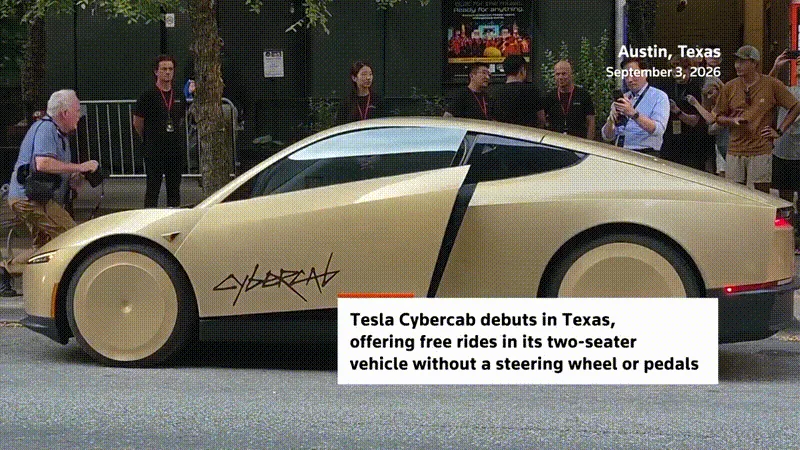
Tesla Cybercab has moved from a futuristic demonstration vehicle into limited commercial robotaxi service in Austin, Texas.
Tesla has moved its purpose-built Cybercab from a futuristic demonstration vehicle into limited commercial robotaxi service in Austin, Texas. The two-seat autonomous vehiclTesla Cybercab Austin Launch and Driverless Robotaxi Deployment
Tesla began carrying riders in Austin on September 3, 2026, without a conventional steering wheel or accelerator and brake pedals, extending its Robotaxi operation beyond the Model Y vehicles on which the service initially relied. The launch is technically and strategically significant because the Cybercab was designed around autonomous operation from the beginning rather than being an existing passenger vehicle adapted for robotaxi duty. Tesla describes it as a fully autonomous vehicle using camera based vision and other sensors, with two passenger bench seating, butterfly style doors, a central touchscreen and no traditional driving controls.
Tesla commercially deployed its driverless Cybercab in Austin on September 3, 2026, bringing the production oriented two passenger vehicle into the company’s existing Robotaxi service. Reuters reported that the Austin deployment initially involved a relatively small Cybercab fleet and followed Tesla’s earlier Austin Robotaxi launch using Model Y vehicles. The rollout is therefore an important expansion of Tesla’s autonomous ride hailing program, but it should not be confused with unrestricted nationwide deployment.
Tesla’s own support material states that Cybercab rides are currently available only in limited areas of Austin, even though the broader Robotaxi network using Model Y vehicles now operates in several U.S. cities. Riders in supported areas can download the Robotaxi app and request a trip, but being assigned a Cybercab depends on vehicle availability, party size and whether the requested journey falls within the Cybercab’s limited Austin operating area.
The distinction between Cybercab and the earlier Model Y robotaxis is significant. Tesla’s Model Y vehicles are conventional passenger cars that retain ordinary driving controls, while Cybercab is a purpose built autonomous mobility vehicle designed without a traditional steering wheel or pedals and with seating for only two passengers. Its Austin launch therefore represents more than simply adding another vehicle type to the fleet. It begins testing Tesla’s broader idea that commercial ride hailing can eventually rely on vehicles designed specifically for autonomous transportation rather than conventional cars operating autonomous software.
The launch is also occurring under regulatory scrutiny. The National Highway Traffic Safety Administration has opened an investigation into Tesla’s self certification that the Cybercab complies with applicable federal vehicle safety standards. This makes the Austin deployment an important real world test not only of Tesla’s autonomous driving technology, but also of the U.S. regulatory framework for vehicles built without the traditional controls associated with a human driver.
For now, the Cybercab rollout remains limited in scale and geography. Its presence in Austin demonstrates that Tesla has moved the vehicle from concept toward commercial operation, but the restricted service area and ongoing federal scrutiny mean the launch should be understood as an early deployment rather than proof of broad nationwide availability.

In This Article (8 sections)
Tesla Cybercab Robotaxi Rides, App Controls and Federal Scrutiny
The Cybercab’s most distinctive feature is what it removes. Tesla’s official Robotaxi material describes the vehicle as designed for full autonomy without a steering wheel or pedals, meaning its autonomous system handles driving rather than handing control to a conventional human driver. Inside, the traditional division between driver and passenger largely disappears. Two occupants sit in a bench style seating area and interact with a central touchscreen, which provides controls for starting the trip, viewing route progress, adjusting the cabin and requesting assistance.
A Cybercab journey begins through Tesla’s Robotaxi app. Riders enter a destination inside the supported service area, review the estimated fare and waiting time, and confirm the trip. The app then notifies the passenger when the assigned vehicle is approaching. At pickup, Tesla instructs riders to verify that the Cybercab’s licence plate matches the vehicle shown in the app. Exterior lighting helps passengers identify the car, while the door can automatically open when the vehicle detects the phone belonging to the person who requested the trip. The door can also be controlled through the app or the vehicle interface.
After entering, passengers must fasten their seat belts and start the journey through the interface. During the ride, the central touchscreen displays route progress and estimated arrival time while also providing entertainment and climate controls. The Robotaxi app can be used to change the destination during the trip, and passengers who need help can select support options. Tesla’s rider documentation also describes a pull over function that allows occupants to request a safe stop before reaching the planned destination.
The Robotaxi app therefore replaces several interactions that would normally involve a human driver. Users sign in with Tesla Account credentials, select a supported destination, review the trip estimate, confirm the ride, identify the assigned vehicle and manage pickup from their phone. Tesla also says climate and media preferences can be saved in a user profile and carried across rides.
The service is available through iOS and Android, with screen reader support and multiple languages included among its accessibility features. This combination of the app and in car touchscreen reflects Cybercab’s purpose built driverless design. Navigation requests, ride initiation, comfort settings, destination changes and assistance functions all need to be handled through software because there is no driver available to perform those tasks. The absence of traditional controls is therefore not only a design choice but also the reason the vehicle depends heavily on its digital interfaces.
That same absence of conventional controls has attracted federal scrutiny. NHTSA’s Federal Motor Vehicle Safety Standards were largely developed around vehicles equipped for human operation. The agency said on September 4 that existing requirements remain in effect while it works on updates covering areas that include brake pedals, lighting, wipers and rear view systems. NHTSA has opened an Audit Query into the technical basis Tesla used to self certify Cybercab as compliant with applicable federal standards. The inquiry should not be treated as a finding that Cybercab has already violated federal law. It is an investigation into whether Tesla’s certification is valid.
Tesla Cybercab Texas Registration, Austin Fleet Size and Gigafactory Testing
Putting Cybercab into Tesla’s Austin fleet involves more than activating autonomous driving software. Vehicles operating on public roads must comply with state registration and autonomous vehicle requirements as well as applicable federal safety rules. Texas has increasingly formalized autonomous vehicle oversight, and legislation that took effect in 2025 created authorization and safety related requirements for autonomous vehicle operations as commercial driverless services expanded.
Registration records have provided one of the clearest independent ways to estimate the size of Tesla’s autonomous fleet in Texas. Reuters reported that state records showed 420 Tesla autonomous vehicles around the September 3, 2026 commercial launch, including 45 Cybercabs. That makes 45 registered Cybercabs in Texas the clearest documented launch period figure. The number should always be connected to its date because registration totals can change as Tesla manufactures and deploys more vehicles. It also should not be treated as the number of Cybercabs guaranteed to be available for passenger rides at any given moment. A registered vehicle might be used for testing, validation, maintenance, fleet staging or gradual commercial deployment rather than continuously carrying paying riders.
The figure does, however, help place the Austin rollout in context. Cybercab entered service as a minority of Tesla’s registered autonomous fleet instead of immediately replacing Model Y robotaxis. That is consistent with a gradual transition in which Tesla can gather operational data while increasing production of its purpose built autonomous vehicle. NHTSA’s September investigation also referred to Tesla’s Cybercab certification and broader deployment quantities, showing that regulatory questions extend beyond the relatively small number initially appearing in public service.
Gigafactory Texas also plays an important role in the Cybercab story because the vehicle moved through manufacturing and validation in Texas before its commercial Austin launch. Factory demonstrations, development testing and public Robotaxi service should not be treated as the same milestone. Tesla’s production ramp progressed from prototype demonstrations to manufacturing validation and then to commercial passenger use, with Reuters reporting that Cybercab production had begun during 2026 and that the initial ramp was expected to be gradual.
Demonstration rides associated with Tesla facilities serve a different purpose from public robotaxi operations. They allow engineers, employees and invited participants to experience or validate the vehicle under comparatively controlled conditions. Commercial service in Austin introduces a broader set of variables, including ordinary passengers, public streets, changing traffic, pickup and drop off behaviour, customer support and regulatory obligations. That distinction matters when evaluating autonomy claims because a successful demonstration on or near a controlled Tesla property does not by itself establish readiness for unrestricted nationwide operation.
The September Austin launch is therefore the more consequential milestone because members of the public can request Cybercab trips through Tesla’s Robotaxi system within the supported area. Even then, the documented 45 vehicle registration figure should be understood as a launch period reference point rather than a permanent fleet size or a guarantee of immediate ride availability.

Tesla Cybercab vs Model Y Robotaxi, Passenger Rules, Interior, and Availability
Tesla’s Cybercab and Model Y can both carry passengers through the Robotaxi platform, but they are fundamentally different vehicles with different capacities, interiors, and roles within the service. Cybercab is a purpose built two seater designed for autonomous operation without conventional steering controls or pedals, while Model Y is a standard Tesla passenger vehicle adapted for Robotaxi service. Cybercab uses bench style seating, butterfly style doors, and a large central touchscreen, whereas Model Y retains the layout of a conventional passenger car and can carry up to four people. Tesla’s Robotaxi material also notes that Model Y provides front and rear touchscreens, while Cybercab is designed around a simpler two passenger autonomous cabin.
Capacity directly affects which vehicle a rider receives. Tesla says customers cannot initially insist on Cybercab or Model Y when booking because vehicle assignment depends on availability, the number of passengers, and the service area. Since Cybercab holds only two people, a group larger than two cannot be accommodated in a single Cybercab and would instead require another suitable option. This makes Cybercab better suited to one or two person trips, while Model Y remains important for passengers who need additional seating.
Geographic availability also differs between the two vehicles. Tesla’s Cybercab FAQ says purpose built Cybercab rides are currently limited to selected areas of Austin, while the wider Robotaxi network using Model Y vehicles operates across a broader group of markets. Tesla’s main Robotaxi page currently lists autonomous ride availability in Austin, Dallas, Houston, Miami, Orlando, and Tampa. Cybercab therefore represents the more specialized vehicle Tesla is moving toward, while Model Y remains essential to the larger service footprint currently available to riders.
In Austin, passengers can request Cybercab rides through the Robotaxi app when their pickup and destination fall within the supported area and a vehicle is available. Tesla says users can book only for themselves rather than requesting a Cybercab for another person. Passenger age rules are also specific. Minors aged 13 to 17 may ride when accompanied by an adult, while children younger than 13 are not permitted in Cybercab.
Tesla also describes several accessibility features intended to support disabled passengers. Service animals are allowed, while non service animals are not permitted. The cabin includes bench seating positioned around wheelchair transfer height, Braille on doors and overhead controls, audio and visual supplemental functions, space for service animals, and cargo capacity that can accommodate some mobility equipment. Actual ride availability still depends on the limited Austin service geography shown in the Robotaxi app.
The interior reflects the fact that Cybercab was designed around passengers rather than a driver. Tesla lists headroom of 38.3 inches, legroom of 43.4 inches, shoulder room of 51.9 inches, and hip room of 50.4 inches. Rear cargo capacity is listed at 20.2 cubic feet, which Tesla says can accommodate two standard check in suitcases and two carry on suitcases. Step in height is 16.5 inches, while ground clearance is 5.8 inches.
The central touchscreen serves as the primary cabin interface, displaying trip information and route progress while providing climate and entertainment controls, door management, and the option to begin the journey after passengers enter and fasten their seat belts. Together with the two seat bench arrangement and absence of traditional driver controls, the touchscreen reinforces Cybercab’s purpose built autonomous design. The tradeoff is reduced passenger capacity compared with Model Y, making Cybercab particularly suited to smaller parties while larger groups require a different vehicle.
Tesla Cybercab Autonomous Technology, Safety Rules, Regulation, and Testing Locations
Tesla describes Cybercab as fully autonomous and says it uses camera vision and sensors to navigate city streets, highways, intersections, parking environments, and other parts of a trip. The Robotaxi service is built around Tesla’s Full Self Driving technology according to the company’s rider documentation, while Tesla has continued to emphasize a vision centered approach to autonomy rather than the more visibly sensor heavy designs associated with some competing autonomous vehicle programs.
For Cybercab, however, autonomy involves more than simply allowing software to steer. Because the vehicle has no conventional driver position, the system must manage the entire driving task, including route following, intersections, surrounding road users, pickup and drop off locations, parking decisions, and unexpected situations. Passengers also need ways to respond when something unusual happens, which is why Tesla’s rider guide includes functions such as Pull Over and Support.
Tesla’s use of the phrase “fully autonomous” should be distinguished from an independent regulatory conclusion that Cybercab can operate without limits under every possible condition. Public Cybercab rides are currently confined to a defined operating area, and federal regulators are examining the vehicle’s certification rather than treating unrestricted operation as already established.
That regulatory review became especially important on September 4, 2026, when NHTSA announced an Audit Query into Tesla’s self certification that Cybercab complies with applicable Federal Motor Vehicle Safety Standards. The agency said it would examine the technical data and processes supporting certification of a vehicle built without traditional human driving controls.
NHTSA has also emphasized that existing federal safety standards remain legally effective while the agency develops updated rules for automated vehicles. Relevant areas include equipment historically designed around human operated vehicles, such as pedals, mirrors, lighting, wipers, and related systems. Reuters later reported that regulators asked Tesla whether Cybercabs could temporarily be equipped with human controls and whether such configurations played a role in the certification process.
The investigation does not by itself establish that Cybercab is unsafe or unlawfully certified. It means the federal regulator is examining whether Tesla’s technical basis for self certification satisfies the standards that currently apply. Passenger facing protections documented by Tesla include mandatory seat belt use, support functions, the ability to request that the vehicle pull over, and emergency procedures for opening the doors.
The most important geographic distinction is between Cybercab itself and Tesla’s wider Robotaxi network. Tesla’s official Cybercab FAQ identifies limited areas of Austin, Texas, as the confirmed location for public Cybercab rides as of September 18, 2026. Tesla’s broader Robotaxi network extends farther through Model Y vehicles, with the company listing Austin, Dallas, Houston, Miami, Orlando, and Tampa among its autonomous ride markets.
Robotaxi availability in one of those additional cities should therefore not automatically be interpreted as evidence that purpose built Cybercabs are carrying ordinary passengers there. Tesla separates its wider Model Y service from the more limited Cybercab program in Austin. Cybercab vehicles may also be used elsewhere for manufacturing validation, engineering evaluation, or other testing, but Tesla has not published an equally clear consumer list covering every engineering test location.
For passengers, the practical distinction is simple: Austin is currently the confirmed public market for purpose built Cybercab rides, while Tesla’s broader autonomous ride hailing operation reaches several additional U.S. cities primarily through Model Y vehicles.

Frequently Asked Questions[FAQs]
- When did Tesla launch Cybercab rides in Austin?
Tesla commercially deployed Cybercab in Austin on September 3, 2026. The purpose built two seat autonomous vehicles joined Tesla’s existing Robotaxi operation, which had previously relied mainly on Model Y vehicles. The launch marked the first public commercial use of Cybercab in Tesla’s ride hailing network rather than a factory demonstration or engineering test. - Does Tesla Cybercab really have no steering wheel or pedals?
Yes. Tesla’s consumer material describes Cybercab as designed for full autonomy without a conventional steering wheel or pedals. Because there is no traditional driver position, passengers use the Robotaxi app and the central touchscreen to manage functions such as starting the ride, viewing trip progress, adjusting climate settings, controlling doors, and requesting assistance. - Can anyone ride a Cybercab in Austin?
Eligible users in supported areas can request Robotaxi rides through Tesla’s app, but that does not guarantee they will receive a Cybercab. Assignment depends on whether the trip falls within the limited Cybercab operating area, whether a Cybercab is available, and how many people are travelling. Tesla’s public Robotaxi communications have encouraged Austin users to download the app and request rides where service is available. - How many passengers fit inside Tesla Cybercab?
Cybercab can carry a maximum of two passengers. Its cabin uses bench style seating and is designed specifically around one or two person autonomous trips. This makes it different from Tesla’s Model Y Robotaxi, which can accommodate up to four passengers and remains more suitable for larger groups. - How many Cybercabs were registered in Texas at launch?
Texas records cited by Reuters showed 45 Cybercabs among Tesla’s 420 registered autonomous vehicles around the September 3, 2026 launch. That figure represents a dated snapshot of the registered fleet and should not be treated as the permanent number of Cybercabs in Texas. It also does not mean all 45 vehicles were carrying paying passengers at the same time. - Can riders choose Cybercab instead of a Model Y?
Not initially. Tesla says the Robotaxi platform assigns a vehicle based on factors such as availability and party size rather than allowing riders to guarantee a specific model. Since Cybercab carries only two passengers, groups larger than two will need a different vehicle configuration, making Model Y more appropriate for some trips. - Are children allowed in Tesla Cybercab?
Yes, but there are age restrictions. Tesla says passengers aged 13 to 17 may ride only when accompanied by an adult, while children younger than 13 are not currently permitted in Cybercab. These rules are specific to the purpose built vehicle and should be checked again if Tesla changes its rider policies as the service expands. - Is Tesla Cybercab being investigated by NHTSA?
Yes. NHTSA opened an Audit Query on September 4, 2026 to examine Tesla’s self certification that Cybercab complies with all applicable Federal Motor Vehicle Safety Standards despite lacking traditional human driving controls. The investigation focuses on the technical basis for that certification. Its existence does not mean NHTSA has already concluded that Cybercab is unsafe or noncompliant. - Where can people currently ride a Tesla Cybercab?
Tesla’s current Cybercab support page identifies limited areas of Austin, Texas as the public Cybercab service area. Tesla’s wider Robotaxi network operates in additional cities, but those services primarily use Model Y vehicles. Robotaxi availability in another city therefore should not automatically be interpreted as proof that Cybercab itself is operating there. - When will Cybercab launch in other cities?
Tesla has not published a firm city by city schedule for expanding Cybercab beyond Austin. The company allows customers to register for notifications, while its broader Robotaxi network continues expanding through Model Y vehicles. Future Cybercab deployment could depend on factors such as production capacity, regulatory requirements, federal certification scrutiny, and Tesla’s readiness to open additional service areas.

Conclusion
The Tesla Cybercab launch in Austin is a more consequential milestone than another routine expansion of Tesla’s ride-hailing fleet. It marks the beginning of commercial passenger use for a vehicle deliberately designed without the steering wheel and pedals that have defined automobiles for more than a century.
Cybercab packages Tesla’s autonomy strategy into a specialised two-passenger platform. Riders request trips through the Robotaxi app, identify and enter the vehicle without interacting with a driver, use digital interfaces to start and manage their journey, and rely on Tesla’s autonomous-driving system to navigate the route. Tesla has also integrated passenger-support, pull-over and accessibility features into the vehicle and app experience.
The deployment remains limited. Tesla’s own documentation says Cybercab passenger rides are currently restricted to parts of Austin, even though the broader Model Y Robotaxi service now reaches Austin, Dallas, Houston, Miami, Orlando and Tampa.
The most important unanswered issue is regulation. NHTSA opened an investigation immediately after commercial deployment to determine whether Tesla properly self-certified a vehicle lacking traditional human controls under existing federal safety standards. Those standards remain in force while regulators work on rules better adapted to purpose-built autonomous vehicles.
For Tesla, Cybercab’s success will therefore be determined by more than whether the vehicle can navigate Austin streets. The company must demonstrate that its autonomous system is dependable at growing scale, that its fleet can support passengers without conventional drivers, that production can ramp economically and that the design can satisfy regulators as deployment expands.
As of September 18, 2026, Cybercab has crossed an important threshold: it is no longer solely a prototype or future product. It is carrying passengers in a limited Austin robotaxi service. The larger question now is whether Tesla can turn that tightly controlled beginning into the broad, scalable autonomous-transport network Cybercab was designed to support.
Sources and Citations
- Tesla, Cybercab Frequently Asked Questions : Official FAQ covering availability in limited areas of Austin, the two passenger limit and age requirements. It also explains automatic vehicle assignment, accessibility provisions, luggage capacity and app controls, providing a direct reference for distinguishing Cybercab’s passenger policies and advertised features from those of Model Y Robotaxi vehicles. Tesla
Citation: Cybercab Frequently Asked Questions. (Tesla Support) - Tesla, Cybercab Rider Guide, September 22, 2026 : Official North American rider manual organised into sections covering rides, vehicle entry, luggage access, seats, seat belts and cabin comfort. It also includes emergency guidance, dimensions and support information. The current linked edition carries a September 22, 2026 publication date, replacing the September 4 date in the supplied citation. Tesla
Citation: Cybercab Rider Guide. (Tesla) - Tesla, Robotaxi Official Website and Support : Official service overview and support resources explaining the iOS and Android apps, booking process and availability of Model Y and Cybercab vehicles. The support page also covers vehicle assignment, age restrictions, screen reader compatibility, assistance during rides and accessibility options, helping distinguish general Robotaxi policies from guidance specific to Cybercab. Tesla
Citation: Robotaxi Official Website and Robotaxi Support. (Tesla) - NHTSA, Cybercab Certification Investigation, September 4, 2026 : Official announcement opening an Audit Query into the basis for Tesla’s certification that Cybercab complies with Federal Motor Vehicle Safety Standards. It identifies the absence of conventional human controls as a focus of the inquiry and explains that existing requirements remain in force while proposed regulatory changes are being developed. NHTSA
Citation: NHTSA Opens Investigation into Tesla Cybercab Self-Certification Following Austin Deployment. (NHTSA) - Reuters, Austin Launch Report, September 3, 2026 : Reports the start of Cybercab rides in Austin and the federal safety agency’s initial response. It cites Texas records showing 420 registered Tesla autonomous vehicles, including 45 Cybercabs, at the time of the launch, while placing the new vehicle within Tesla’s existing Model Y service and broader deployment plans. Reuters
Citation: Tesla Starts Cybercab Rides in Austin, Drawing US Safety Agency Interest. (Reuters) - Reuters, Regulatory Analysis, September 4, 2026 : Examines the rollout’s regulatory context, including the manufacturer certification system and safety standards written for vehicles with human controls. It includes comments from vehicle safety specialists about possible interpretations of those requirements, providing context for the compliance questions raised by the deployment and the investigation that followed. Reuters
Citation: Musk Pushes Regulatory Limits with Tesla’s Cybercab Robotaxi Service. (Reuters) - Reuters, Federal Information Request, September 15, 2026 : Follow up report on NHTSA’s request for Tesla to explain its certification process, with a September 30, 2026 response deadline. It details questions about temporary human driving controls, touchscreen functions, maximum speeds and operating restrictions, documenting a later stage of the inquiry rather than repeating the original investigation announcement. Reuters
Citation: US Agency Orders Tesla to Answer Questions on Cybercab Certification. (Reuters) - The Verge, Federal Investigation Coverage, September 4, 2026 : Independent reporting on the inquiry into Cybercab’s lack of conventional steering controls, pedals and mirrors. It explains the certification issue and distinguishes the estimated number of vehicles covered by the investigation from the smaller number registered in Texas at the time, complementing Tesla’s product information with coverage of the regulator’s concerns. The Verge
Citation: Tesla Cybercab Is Barely on the Road and It’s Already Under Investigation. (The Verge)
Recommended
- 007 First Light Becomes May’s Highest-Grossing Game in the US: Sales Success, Rankings, and Market Impact Explained
- Servant Of The Lake: Day 1 Complete Walkthrough Guide
- How to Add Colored Shadow Penumbra in Unreal Engine 5 (UE5 Guide)
- After Nine Years, The Live-Action Hitman TV Show Is Dead What Happened to the Hulu Series?
- Final Fantasy 7 Modder Brings OG Polygon Character Designs to Final Fantasy VII Rebirth: “Them Polygons Got That Aura”
- Blender Smooth Hair Curves Geometry Nodes Preset
- ONTOS Gameplay Reveals Frictional Games’ New Sci-Fi Horror
- How do I adjust the camera’s sensor size in Blender?
- Russian Survival Game Polyaris Passes 100,000 Steam Wishlists: Why Players Are Watching This Arctic Survival Game
- Persona 6 Images Leak Before Sega Removal: What the Screenshots Reveal
- What’s New in Blender 4.4: A Comprehensive Overview of Features and Improvements
- V-Ray for Blender 2026 Guide: Installation, Supported Versions, Render Settings, and Workflow Tips



































































































