





In This Article (7 sections)
Tomb Raider: Legacy of Atlantis Focus Meter, Skill Tree and Combat Progression
Tomb Raider: Legacy of Atlantis is a ground up reimagining of the original 1996 Tomb Raider, rebuilding Lara Croft’s first adventure with modern exploration, combat, puzzles and progression systems. Crystal Dynamics and Flying Wild Hog are developing the game, with Amazon Game Studios publishing it and Alix Wilton Regan portraying Lara. The story again follows Lara’s search for the scattered pieces of the Scion across Peru, Greece, Egypt and a mysterious Mediterranean island, but familiar locations can now contain revised routes, expanded spaces and different challenges. The September 2026 Greece overview demonstrates that philosophy by allowing players to approach four tombs in different orders while redesigning St. Francis’ Folly around greater verticality and interconnected traversal.
One of the largest combat additions is the Focus meter, a resource Lara builds while fighting. Game director Raul Siqueira identifies dealing damage, taking damage and successfully dodging attacks as ways to increase Focus, while the broader combat presentation emphasizes stronger rewards for effective evasive actions. Focus should not be confused with skill points. Focus is accumulated and spent during encounters, whereas skill points provide persistent character improvements across the adventure.
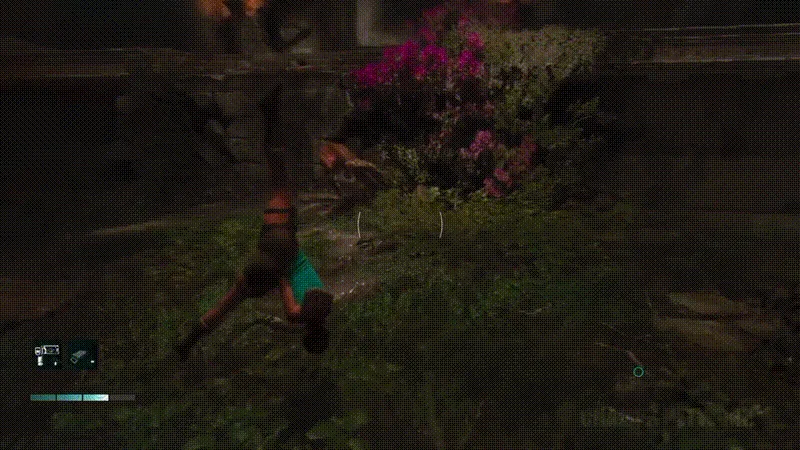
When Focus is activated, the surrounding action slows and Lara can perform more elaborate acrobatic attacks. A PlayStation preview showed R1 being used to activate accumulated Focus, sending Lara into a gymnastic flip while slowing time and allowing her to continue shooting. That control description applies to the demonstrated PlayStation build rather than every platform. The system allows Lara’s classic acrobatics to function as useful combat actions instead of lengthy animations that leave her exposed.
Ordinary evasion does not require a full Focus meter. Lara’s acrobatics respond to context, allowing quick directional dodges while aiming and rapid repositioning during movement. Focus enhances these abilities by creating a stronger offensive opportunity. Its use therefore introduces a timing decision: players can activate it immediately when an opening appears or preserve it for a more dangerous situation.
The published material does not establish exact final charge rates, duration values or every interaction with upgrades. Taking damage can build Focus, for example, but that does not mean deliberately losing health will be an efficient strategy. A more sensible interpretation is to maintain pressure on an enemy, evade incoming attacks when possible and use Focus when it provides a useful opportunity to combine offense with movement.
The skill tree introduces longer term progression. Revealed improvements include upgrades connected with firing rate, falling and healing, while the demonstrated interface contains multiple progression tiers, locked entries and a Reset All Skills option. The presence of that reset control confirms that some form of respecialization existed in the preview build, but it does not establish its final cost or limitations.
Skill points are earned through artifact collection, giving exploration a direct connection to Lara’s development. The interface shows progress toward the next skill point, meaning players should not assume that every artifact individually awards one point. The system instead encourages discovering hidden areas and investigating alternate routes while gradually progressing toward new improvements.
This approach separates player skill from character progression. Timing jumps, reading attacks and positioning Lara correctly remain actions performed by the player, while purchased skills improve Lara’s capabilities within those systems. The addition of progression therefore does not automatically turn Legacy of Atlantis into a traditional role playing game. Its effect will depend on how strongly individual upgrades influence encounters and whether they complement rather than replace mastery of movement and exploration.
Weapon progression works alongside the skill tree. Lara has four revealed weapon choices: her dual pistols, shotgun, submachine guns and assault rifle. These weapons serve different ranges and combat situations. The shotgun emphasizes close range power, while the assault rifle provides a longer range option. One displayed skill increases the firing rate of all weapons by 10 percent, although that number comes from prerelease footage and should not automatically be treated as a guaranteed launch value.
A higher firing rate is also different from higher damage per bullet. The practical benefit depends on accuracy, target exposure and how long Lara can continue firing without interruption. Weapon choice and character upgrades are therefore separate decisions, with one determining the tool used in a fight and the other modifying how effectively Lara performs certain actions.
The dual pistols remain particularly important. Creative director Michał Kuk confirmed that players can complete the entire game using them, although doing so may make fights more difficult or time consuming. Their ammunition is unlimited, maintaining a familiar element from the classic games. However, a pistols only playthrough does not automatically mean ignoring Focus, crafting or every skill upgrade. The developer statement guarantees weapon viability, not the ability to discard every other new mechanic.
Legacy of Atlantis also introduces herb gathering, crafting and healing preparations. Lara can collect resources and combine them into items such as bandages and preparations that restore health, reduce incoming damage or increase damage output. These serve different purposes. Healing addresses damage already taken, defensive preparations affect future attacks and offensive effects can help end encounters more quickly.
The system should not be mistaken for a full survival simulation. No confirmed hunger meter, thirst mechanic, weapon degradation system or elaborate cooking process has been announced. Crafting is presented primarily as a supporting layer for combat preparation and recovery.
These ideas have some connection to the Survivor trilogy, which made resource gathering, skill development and equipment improvement major parts of Lara’s progression. Design director Jason Epps has discussed appreciating the feeling of shaping Lara’s growing capabilities in those games. Legacy of Atlantis draws from that philosophy without simply copying the Survivor trilogy’s exact experience point, salvage or camp systems.
The key difference is Lara herself. The Survivor games frequently portrayed a heroine developing from a less experienced starting point, whereas Legacy of Atlantis presents an already capable adventurer. Its progression therefore needs to feel like Lara refining existing expertise rather than inexplicably learning fundamental abilities she should already possess.

How Legacy of Atlantis Modernizes Exploration, Enemies and Classic Tomb Raider Gameplay
The modernization extends well beyond the Focus meter and skill tree. The original 1996 Tomb Raider relied heavily on grid based environments, tank controls and deliberate positioning. Players learned distances, aligned Lara carefully and mastered a movement system closely tied to level geometry. Legacy of Atlantis retains exploration, platforming and puzzles while rebuilding their surrounding structure with more fluid controls, larger spaces and semi connected environments.
Recognizing a location from the original game will therefore not necessarily reveal its solution. Previously self contained rooms can connect differently, familiar environments can contain expanded routes and puzzles may be reworked around the remake’s movement system. This means knowledge of the original provides context without functioning as a complete walkthrough.
The game’s puzzle design emphasizes curiosity, environmental clues and observation. Some challenges involve locating components, examining the environment from useful viewpoints or understanding how different spaces connect. Tying artifact progression to exploration complements that philosophy because hidden discoveries now contribute both to completion and Lara’s development.
Combat has received similar structural changes. Developers describe enemies as having readable attacks so players can learn their patterns and respond fairly. Wildlife and human mercenaries are also designed to behave differently rather than simply functioning as targets with different amounts of health.
Leopards can approach from concealed positions, while groups of predators may alter their behavior as their numbers fall. Human opponents can apply ranged pressure, use cover and occupy different combat roles. These encounters place greater emphasis on managing space, identifying where threats are coming from and deciding when Lara has enough room to attack or evade.
Focus, weapon choice and upgrades only become meaningful if encounters support those decisions. A fast animal crossing open ground creates a different problem from an armed enemy controlling a distant sightline. Lara’s movement therefore remains central to combat even as additional statistics and resources are introduced.
The developers’ explanation of Focus illustrates this relationship. Large acrobatic moves are visually appropriate for Lara but can take longer than a short dodge, potentially creating a disadvantage during real time combat. Slowing the surrounding action while Lara performs them allows those classic flourishes to remain useful rather than decorative liabilities.
The mechanic has some historical precedent without being identical to earlier systems. Tomb Raider: Anniversary used the Adrenaline Dodge, where enraged enemies charged Lara and a correctly timed dodge slowed time to create a precision shooting opportunity. Legacy of Atlantis instead lets players build and activate Focus through several combat actions. Both systems connect slow motion with evasion and shooting, but their triggers and resource structures are different.
Tomb Raider: Underworld also introduced its own adrenaline meter for special shooting opportunities, showing that meter assisted combat existed before the Survivor trilogy. Legacy of Atlantis combines that older idea with artifact driven progression, crafting and a broader range of selectable improvements.
This combination has divided some fans. Criticism documented in community discussions questions whether skill trees and resource crafting belong in a remake of Lara’s first adventure. The concern is often less about modernization itself and more about pacing. Players who enjoy studying ruins and mastering environmental movement may not want those activities regularly interrupted by resource management or statistical menus.
Supporters of the changes can point to the opposite possibility. Exploration based skill points can provide practical rewards for discovering secrets, while Focus can make Lara’s recognizable acrobatics mechanically useful. Customization may also allow players to emphasize different combat preferences without altering the central story.
Preview coverage reflects both perspectives. Some impressions have praised the remake for modernizing the experience without overwhelming players with guidance, while others remain cautious about how newer progression systems will affect the character of the original adventure. The finished campaign will determine whether those systems remain supportive or become effectively mandatory.
Difficulty settings may help address that concern. Preview material indicates that puzzle and combat difficulty can be adjusted separately, with additional guidance available when needed. This allows modernization without necessarily requiring every player to experience the same amount of combat pressure or puzzle assistance.
The major design difference between the original and the remake therefore concerns how players improve. The 1996 game strongly emphasized learning fixed physical rules, understanding spaces and becoming better through familiarity with its controls. Legacy of Atlantis retains those demands while also allowing Lara herself to develop through artifacts, skills, weapons and preparations.
The comparison with Anniversary is similarly broader than control changes. Anniversary already transformed the original adventure with fluid movement, assisted platforming and automatic ledge interactions. Legacy of Atlantis goes further by adding persistent progression, crafting and a player controlled Focus resource while again restructuring locations.
None of these additions can substitute for satisfying tomb design. More combat systems will matter little if traversal loses its sense of danger or puzzles become less rewarding. The standard for judging the remake is therefore whether its modern options deepen meaningful choices without weakening the exploration and environmental problem solving that define Tomb Raider.

Tomb Raider: Legacy of Atlantis Release Date, Platforms and What the Remake Changes
Tomb Raider: Legacy of Atlantis is scheduled to release on February 12, 2027, for PlayStation 5, Xbox Series X|S, Windows PC through Steam and Nintendo Switch 2. The game was previously associated with a 2026 window, but that earlier target has been replaced by the confirmed February 2027 date.
Steam also lists a two day advance access period beginning February 10, 2027 for the Deluxe Edition. This should not be confused with the standard release date. February 10 applies to the specific advance access arrangement, while February 12 remains the announced general launch.
The official platform list does not include PlayStation 4, Xbox One or the original Nintendo Switch. Nintendo Switch 2 should therefore not be shortened to Switch in a way that suggests an announced release for the older system.
The remake uses Unreal Engine 5 and is designed as a broader reinterpretation of Lara’s debut rather than a visual restoration. Familiar locations and story concepts remain, but the developers are revisiting traversal, puzzles, combat, progression and the structure of environments. The Scion remains at the center of Lara’s journey through Peru, Greece, Egypt and the Mediterranean, while the spaces surrounding those familiar objectives can operate differently.
The redesigned Greece section provides a useful example of the larger approach. Players can determine the order in which they tackle four tombs, while St. Francis’ Folly emphasizes interconnected vertical exploration. Such changes affect how players plan routes and understand spaces rather than merely improving textures and lighting.
Combat similarly expands Lara’s options while retaining classic elements. The dual pistols remain viable for the entire game and preserve infinite ammunition, but players can also use the shotgun, submachine guns and assault rifle. Focus adds slow motion acrobatic opportunities, while persistent skills can improve aspects of Lara’s capabilities.
Crafting adds another form of preparation through herbs and other resources that can become healing or combat supporting items. Exploration feeds progression through artifacts, and enemies are designed with more varied behavior and clearer attack cues.
The combination means Legacy of Atlantis sits somewhere between several eras of Tomb Raider rather than reproducing one of them exactly. It retains the locations and central premise of the 1996 game, recalls Anniversary through acrobatic combat and slow motion opportunities, and draws progression ideas from the Survivor trilogy.
That mixture does not guarantee a particular balance. A skill tree could reward optional exploration without becoming intrusive, or it could affect encounter design strongly enough that upgrades feel necessary. Crafting could support occasional preparation or become an unnecessary interruption. Focus could strengthen Lara’s identity as an acrobatic fighter or make combat feel overly dependent on a meter.
The announced systems alone cannot answer those questions. What they do establish is that Legacy of Atlantis is being designed as a substantial reinterpretation rather than a preservation project. Lara’s first adventure remains recognizable, but players are being given more ways to fight, develop her capabilities and approach rebuilt environments.
For fans of the original, familiarity should therefore be treated as an advantage rather than a complete solution. Locations, enemies and story elements may be recognizable while routes, puzzles and combat expectations differ. For players coming from the Survivor trilogy, the presence of upgrades and crafting provides familiar concepts, but the developers are placing them within a game built around the structure and atmosphere of Lara’s earliest adventure.
The success of the remake will ultimately depend on how those systems work together. Focus, weapon variety and upgrades can make combat more expressive, while artifact based progression can strengthen the incentive to explore. Their value will depend on whether Tomb Raider’s central pleasures remain intact: navigating dangerous spaces, interpreting environmental clues, discovering hidden areas and feeling that progress comes from understanding the world as much as improving Lara’s statistics.

Frequently Asked Questions (FAQs)
- Is Tomb Raider: Legacy of Atlantis a remake or a completely new adventure?
It is a ground up reimagining of Lara Croft’s original 1996 adventure. The Scion remains at the center of the story, and familiar settings such as Peru, Greece, Egypt, and the Mediterranean return, but the environments, traversal, puzzles, and combat are being rebuilt around modern design. It is therefore much more extensive than simply increasing the resolution or replacing old textures. - What does the Focus meter do in Legacy of Atlantis?
Focus gives Lara a temporary slow motion combat opportunity that works with her acrobatic movement. In the demonstrated version, activating Focus allows her to perform a gymnastic evasive maneuver while continuing to shoot, helping her avoid danger without completely stopping her attack. Focus is an encounter based resource and should not be confused with skill points, which are used for permanent progression. - Does Lara have to take damage to charge Focus?
No. Taking damage is only one of several ways to build the meter. Lara can also gain Focus by damaging enemies and successfully dodging incoming attacks, with effective evasive actions receiving particular emphasis in the combat explanation. This means players do not need to intentionally lose health, and avoiding attacks can contribute to Focus while also keeping Lara safer. - How are skill points earned in Legacy of Atlantis?
The revealed progression system ties skill points to collecting artifacts during exploration. Finding these collectibles contributes toward earning points that can then be spent on upgrades to Lara’s abilities. The interface suggests progress toward the next point rather than guaranteeing one skill point for every artifact, so the exact conversion rate across the complete campaign has not yet been fully detailed. - Can the entire game be completed with the dual pistols?
Yes, according to the developers. Lara’s signature dual pistols have infinite ammunition and are intended to remain viable throughout the entire adventure. However, completing the game with only those weapons may make certain encounters more difficult or take longer. This confirmation applies specifically to weapon choice and does not mean players must also avoid Focus, healing, crafting, or skill upgrades. - What is the purpose of herb brewing?
Herb brewing and crafting let Lara turn collected resources into useful preparations for combat and recovery. Revealed examples include items that restore health, reduce incoming damage, or improve offensive effectiveness. This gives players some control over how they prepare for difficult encounters, although the complete recipe list, ingredient requirements, and exact duration of every effect have not yet been fully explained. - Can skill choices be reset?
A Reset All Skills option is visible in the demonstrated skill tree interface, showing that some form of skill reset was available in the preview build. This could allow players to reconsider how they distribute their upgrades instead of being permanently locked into an early choice. However, the footage does not confirm whether resetting will cost resources, have restrictions, or remain available under exactly the same conditions in the final game. - Is Focus the same as Anniversary’s Adrenaline Dodge?
No. The two systems share slow motion and acrobatic combat elements, but they work differently. In Tomb Raider: Anniversary, the Adrenaline Dodge is triggered in response to an enraged enemy charging Lara and requires correctly timed evasion and shooting. Legacy of Atlantis instead lets players build Focus through several combat actions and activate the accumulated resource when they choose. - Will Legacy of Atlantis still emphasize puzzles?
Yes. Puzzles remain an important part of the adventure, with redesigned mechanisms and challenges built around exploration, environmental clues, observation, and finding ways through expanded locations. Optional scanner hints are also available for players who want assistance. Because those hints can be avoided, players who prefer solving puzzles through their own observation can still approach them without that extra guidance. - When does Tomb Raider: Legacy of Atlantis release, and is Nintendo Switch 2 confirmed?
The standard release date is February 12, 2027, and Nintendo Switch 2 is officially confirmed alongside PlayStation 5, Xbox Series X|S, and PC through Steam. The older 2026 release window has been superseded by this date. February 10, 2027 refers specifically to the advertised two day advance access period for the Deluxe Edition, not the standard launch date.

Conclusion
The Tomb Raider: Legacy of Atlantis remake adds a focus meter and skill tree as part of a broader effort to reinterpret Lara Croft’s first adventure. The announced design combines acrobatic combat, artifact linked progression, weapon choices, and crafting rather than relying on visual reconstruction alone.
The most important distinction is between what those systems enable and what the finished game will demand. Focus can create expressive combat opportunities without replacing ordinary evasion. A skill tree can reward exploration without necessarily making statistics more important than player ability. Supporting multiple weapons does not mean abandoning the dual pistols.
Whether the combination succeeds will depend on balance, pacing, and encounter design. The strongest version of this approach would make Lara more satisfying to control while preserving the uncertainty of entering an unfamiliar ruin and working out its secrets.
The available evidence supports a substantial reimagining with recognizable roots. It does not yet justify declaring either that modern progression has ruined the classic formula or that every new mechanic will improve it.
Sources and Citations
- Crystal Dynamics / Tomb Raider Official Development Articles – Combat Reimagined, Puzzles Reimagined, and Reimagining Greece: These official development articles provide primary-source insight into the developers’ design intentions for combat, puzzle design and the game’s setting.
Citation: Tomb Raider Official Website - Tomb Raider: Legacy of Atlantis – Combat Documentary: Official gameplay and development footage offering additional insight into the combat system and its intended mechanics.
Citation: Tomb Raider Official YouTube Channel - PlayStation Blog, Tomb Raider: Legacy of Atlantis Hands-On Preview: PlayStation Blog’s hands-on coverage provides observations from preview gameplay, helping distinguish firsthand preview behavior from the developers’ stated intentions.
Citation: PlayStation Blog - Tomb Raider: Legacy of Atlantis Official Pre-Order Announcement: Official release and preorder information for the upcoming game.
Citation: Tomb Raider Official Website - Steam, Tomb Raider: Legacy of Atlantis: Steam’s official store listing provides PC release and store information for the game.
Citation: Tomb Raider: Legacy of Atlantis on Steam - Feral Interactive, Tomb Raider: Anniversary Manual: The official manual documents the original Adrenaline Dodge mechanics, including enemy Rage Attacks, evasive timing, slow-motion targeting and the headshot mechanic, making it a useful reference for historical comparisons.
Citation: Tomb Raider: Anniversary – Feral Interactive Manual manual - Square Enix, Tomb Raider: Anniversary Xbox 360 Manual: Official game manual detailing the Adrenaline Dodge system, including the timing of evasive moves and headshots during Rage Attacks.
Citation: Tomb Raider: Anniversary – Xbox 360 Manual (PDF) support.na.square-enix.com - Tomb Raider Chronicles, Tomb Raider: Anniversary Gameplay Controls and Guide: Detailed walkthrough reference describing how the Adrenaline Dodge and headshot system works during combat.
Citation: Tomb Raider: Anniversary – Game Controls Game Controls - GamesRadar+, Tomb Raider: Legacy of Atlantis Preview: GamesRadar’s preview discusses how Legacy of Atlantis balances classic Lara Croft exploration with modern gameplay design, particularly its approach to avoiding excessive player hand-holding.
Citation: Tomb Raider: Legacy of Atlantis Isn’t Classic Lara Croft, but It Manages to Dodge the Worst Excesses of Modern Action Game Hand-Holding - Creative Bloq, Tomb Raider: Legacy of Atlantis Preview: Preview coverage examining the game’s Unreal Engine 5 visuals and concerns about modern design influences in its reimagining of the original.
Citation: Tomb Raider: Legacy of Atlantis’s Unreal Engine Reimagining Looks Breathtaking but I’m Concerned by Some Modern Design Creep
Recommendations
- Microsoft Should Leave Gaming Before More Damage is Done: the Future of Xbox Studios, Undead Labs, and Game Development in Question
- Only Nintendo Can Save Physical Games
- Zero Parades: For Dead Spies The New Game from the Disco Elysium Studio (ZA/UM)
- How to Create a Trailer in Unreal Engine 5: Step-by-Step Guide for Cinematic Results
- Final Fantasy XIV Comes to Nintendo Switch 2 on August 4, 2026
- Golden Joystick Awards host Alix Wilton Regan pays tribute to the closed BioWare studio
- Clinical AI Sandboxes: Why FDA, CMS and State Rules Are Colliding
- Toy Story 5 Producer Says Live-Action Toy Story Remake Isn’t Happening
- LEGO Set Leaks Reveal First Pokémon Minifigures, Including Professor Oak and Red, Plus Pikachu and Eevee
- DOJ Reportedly Halts Meta Drug Probe as Zuckerberg Shapes Trump’s AI Policy



































































































