








In This Article (9 sections)
Miris’ WebXR Car Configurator, Real-Time 3D Streaming, and HDR-Grade Browser Fidelity
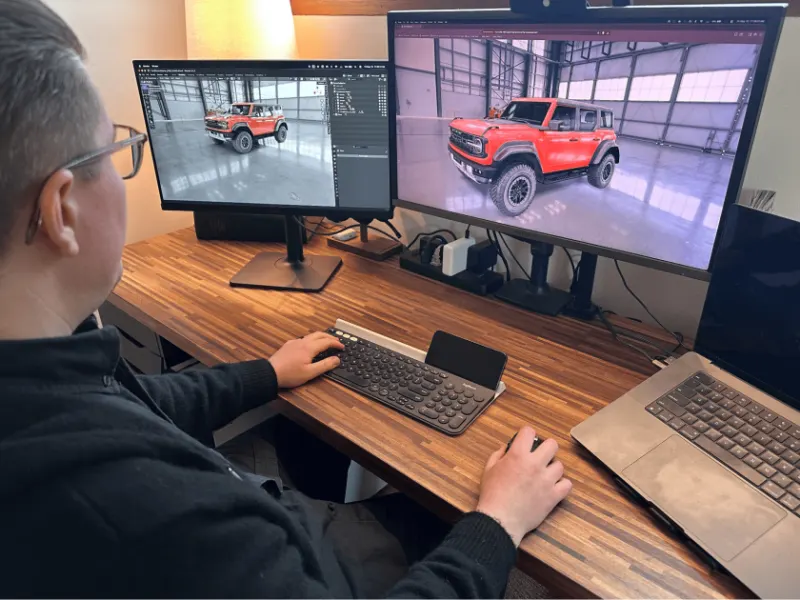
Miris’ WebXR car configurator represents a significant evolution in how high-fidelity automotive visualization is delivered across digital platforms. Rather than relying on traditional pre-rendered media or heavy cloud-based GPU rendering for every user session, the system streams a unified 3D asset directly into the browser environment. This allows users to interact with highly detailed car models across desktop browsers, tablets, and immersive XR headsets without requiring specialized server-side hardware for each individual viewer.
The importance of this approach lies in how it combines visual quality, scalability, and accessibility within a single workflow. Traditional automotive configurators often reduce visual quality on lower-end devices or require separate pipelines for different platforms. Miris avoids that fragmentation by using one source asset that maintains a consistent visual identity across device classes, helping automotive brands preserve premium presentation for global audiences.
The system also changes how real-time 3D experiences are architected. Instead of treating rendering primarily as a server-side problem, Miris moves significant portions of the fidelity workload into adaptive client-side streaming. This creates a more distributed and efficient rendering pipeline while still supporting the level of detail expected in premium automotive visualization.
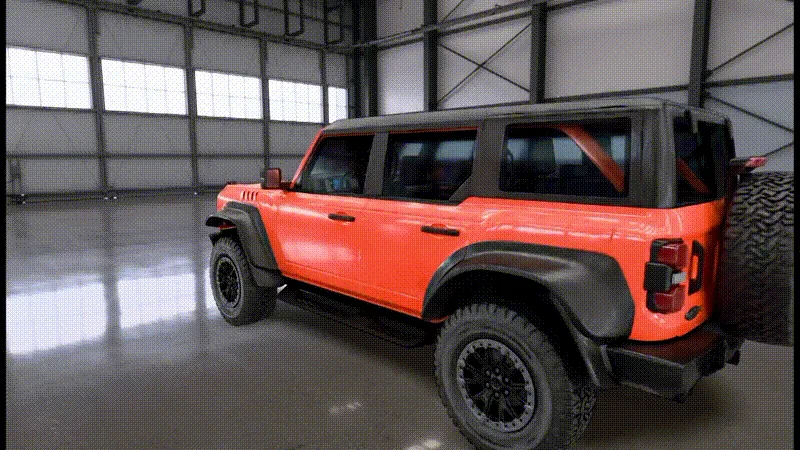
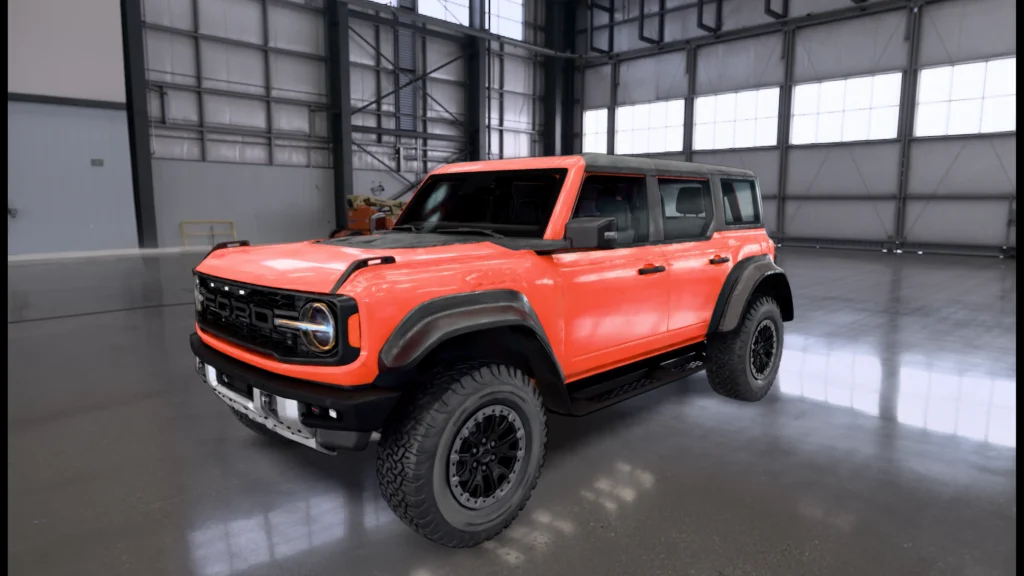
HDR-grade material fidelity is especially important in this context because automotive surfaces depend heavily on lighting nuance, reflections, and micro-surface detail. Miris addresses the usual browser limitations by combining physically based rendering principles with advanced material compression and adaptive streaming techniques. Metallic paint layers, reflective glass, gloss surfaces, and clear coat effects are encoded with high dynamic range texture data so that the vehicle retains its visual depth during real-time interaction.
The material system is structured so highlights, reflections, and surface details remain consistent as users manipulate lighting or change viewing angles. This matters because paint curvature and specular reflection strongly affect perceived automotive quality. By dynamically adjusting texture resolution and shader complexity based on device capability, Miris preserves an HDR-level appearance without overwhelming browser performance.
Streaming Large 3D Assets Across Devices With WebXR and Spatial Reconstruction
One of the most technically impressive aspects of the Miris system is its ability to stream a single 1.2GB 3D asset across desktop, tablet, and Apple Vision Pro environments without relying on per-viewer cloud GPUs. Instead of rendering frames remotely and transmitting video streams, Miris streams structured 3D data that is reconstructed and rendered locally in the browser or XR environment. This reduces operational costs while improving responsiveness because each user’s device handles rendering directly.
The system sends only the data each device needs in a progressive manner. Initial loading remains lightweight, while additional fidelity is refined over time as more asset data becomes available. Desktop systems can receive higher resolution geometry and textures more quickly, while tablets and XR headsets receive optimized versions that preserve visual coherence. Apple Vision Pro support is particularly notable because it requires spatial accuracy and low-latency interaction, which Miris addresses by prioritizing spatial coherence as new data streams into the immersive environment.
WebXR serves as the foundation that enables Miris to deliver immersive automotive configurators across multiple device categories. By extending standard web technologies into spatial computing environments, WebXR allows 3D content to work in traditional screen-based contexts and fully immersive head-mounted displays. Miris uses WebXR’s session abstraction to maintain a consistent interaction model, whether a user is rotating a car on a tablet or walking around it in virtual space.
The spatial streaming architecture is built around progressive 3D reconstruction. Rather than sending fully rendered frames or static assets, Miris streams spatial data chunks that are assembled dynamically inside the client environment. Geometry, material, lighting, and environment data are separated into modular streams, then prioritized based on user interaction. Visible objects and active viewing areas are refined first, helping preserve detail where the user is focusing.
Predictive preloading also supports continuity during interaction. When a user begins rotating a vehicle, adjacent viewpoints can be prepared in advance so the visual experience remains stable as the perspective changes. This combination of WebXR, progressive reconstruction, and interaction-aware streaming allows Miris to deliver immersive, browser-based car visualization without requiring users to install specialized applications.
Client-Side Rendering, Adaptive HDR Reflections, and OpenUSD’s Unified Asset Pipeline
Traditional high-end 3D rendering systems often depend on cloud GPUs to generate frames in real time for each active user session. That approach becomes expensive and difficult to scale when large audiences need access to interactive content. Miris removes this dependency by shifting rendering responsibility to the client device and transmitting optimized 3D data instead of rendered images.
Modern GPUs in desktops, tablets, and XR headsets can handle this workload when paired with an optimized streaming pipeline. Because rendering happens locally, the system avoids round-trip delays to remote servers and improves responsiveness during rotation, zooming, lighting changes, and spatial interaction. The absence of per-viewer GPU allocation also significantly reduces operational costs.
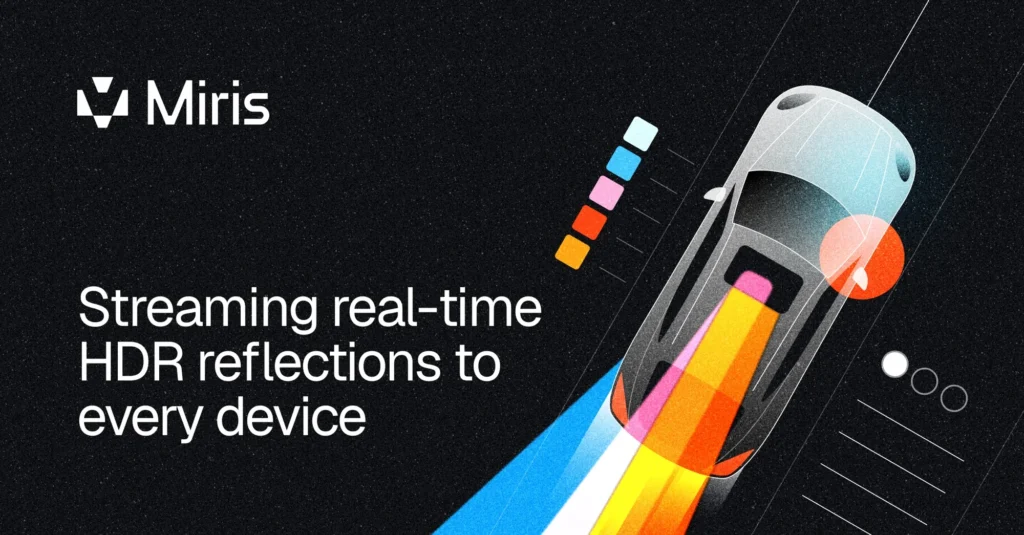
Adaptive streaming is central to preserving real-time HDR reflections on automotive paint. Car paint is one of the most complex materials to render because its realism depends on accurate reflections, lighting variation, metallic flake behavior, gloss layers, and clear coat response. Miris prioritizes reflection maps and environment lighting data so that the core visual integrity of the vehicle remains intact even under varying bandwidth conditions.
As users move around the car, reflection probes are dynamically updated according to viewing angle and lighting context. This allows highlights and reflections to remain physically plausible as the user changes position. In lower bandwidth scenarios, the system does not simply remove essential detail. Instead, it prioritizes lighting data and defers secondary texture enhancements so the vehicle still appears coherent and premium.
OpenUSD plays a central role in maintaining a unified asset structure across devices. By using a standardized scene description framework, Miris can encode geometry, materials, animations, and lighting into a single coherent asset pipeline. This removes the need for platform-specific asset versions and helps ensure that desktop, mobile, and XR users experience consistent design, lighting, and material behavior.
Pixel Streaming, View-Dependent Lighting, and the Shift Toward Browser-Based Car Configurators
Pixel streaming and Miris spatial streaming differ fundamentally in how they deliver interactive 3D experiences. Pixel streaming transmits rendered video frames from a server to the client, which requires significant GPU resources for every active user. This creates high operational costs and scalability limitations, particularly when supporting large audiences.
Miris spatial streaming sends structured 3D data instead of rendered pixels. The client device reconstructs and renders the experience locally, using its own GPU rather than centralized rendering infrastructure. This improves interactivity because user inputs such as rotation, zoom, and environment changes can be reflected immediately without waiting for server-side processing.
View-dependent lighting is essential for realistic automotive visualization because vehicle surfaces respond differently depending on the observer’s position. Miris recalculates lighting vectors in real time based on user perspective, allowing reflections and highlights to shift naturally as the user moves. Materials are structured to respond dynamically to environmental light sources, helping simulate showroom-quality lighting within a browser environment.
Real-time material rendering is also optimized through shader simplification techniques that preserve visual fidelity while reducing computational load. This balance is important because browser-based environments must support a wide range of hardware while still presenting vehicles with premium surface quality. Automotive paint, glass, and reflective trim all depend on lighting behavior that feels consistent and physically plausible.
Automotive brands are increasingly moving toward browser-based 3D configurators because they reduce installation barriers and improve global accessibility. Users can interact with high-end vehicle models instantly, which lowers friction in the sales process and supports stronger engagement. Centralized model and configuration updates also ensure that every user sees the latest product version, while consistent visual quality across devices strengthens brand perception and reduces discrepancies between marketing visuals and real-world products.
Apple Vision Pro Support, Single Source Assets, and the Future of WebXR Product Visualization
Apple Vision Pro introduces a new level of spatial computing capability, and Miris integrates with WebXR support to deliver immersive automotive configurators that feel native to the device environment. The system focuses on precise spatial alignment, low-latency interaction, and high-resolution rendering optimized for the headset’s display capabilities. Users can explore vehicles at true scale, walking around them and inspecting details in a spatially accurate environment.
This kind of experience extends the idea of a digital showroom beyond a flat screen. Instead of simply rotating a vehicle model, users can engage with the car as a spatial object and examine its form, materials, and proportions more naturally. For automotive marketing and design visualization, that creates a showroom-like experience without requiring physical presence.
A major production advantage comes from Miris’ use of a single 1.2GB source asset that contains all necessary fidelity levels within a unified structure. Maintaining separate asset versions for mobile, desktop, and XR has traditionally been a major bottleneck in 3D content production. Miris eliminates redundant optimization workflows by dynamically adapting the same asset at runtime according to device capability.
This single source asset approach helps preserve consistency in design, lighting, and material behavior across all platforms. Instead of managing disconnected pipelines that can introduce visual inconsistencies, teams can work from one structured asset that supports multiple viewing contexts. That makes the production workflow more efficient while maintaining a coherent visual identity.
The combination of HDR streaming and WebXR points toward a broader shift in digital product visualization. Systems like Miris show how high-fidelity 3D experiences can become accessible directly through the browser without specialized hardware or heavy backend infrastructure. As streaming technologies mature, the gap between offline rendering and real-time interactive visualization will continue to narrow, with potential applications in automotive, consumer electronics, architecture, and industrial design.
Frequently Asked Questions (FAQs)
- What is the main advantage of Miris’ WebXR car configurator?
The main advantage is that it delivers HDR-grade 3D automotive visualization across multiple devices using a single streaming asset. It avoids the need for per-user cloud GPU rendering, which improves scalability, reduces operating costs, and keeps the experience accessible through supported browser environments. - How does Miris stream a 1.2GB asset efficiently?
Miris uses progressive spatial streaming, meaning the system sends the most necessary portions of the asset first and then refines the experience with additional detail layers. The streamed data is prioritized based on user interaction, viewing position, and device capability, so users can begin interacting without waiting for the full asset to load at once. - Does Miris require a powerful device to run?
No, Miris is designed to adapt across a range of devices, including desktops, tablets, and XR headsets. It dynamically adjusts rendering complexity, texture resolution, and shader workload so that each device receives an experience suited to its capabilities while preserving visual coherence. - What role does WebXR play in Miris’ system?
WebXR enables Miris to deliver immersive 3D experiences directly through the browser. It allows users to interact with car models in standard screen-based environments and spatial computing environments, supporting a unified interaction model across devices without requiring separate native applications. - Why is no cloud GPU needed per viewer?
No cloud GPU is needed per viewer because rendering happens locally on the user’s device. Miris sends optimized 3D data rather than rendered video frames, allowing the client hardware to generate the final visuals and eliminating the need for server-side frame rendering for each session. - How does Miris maintain HDR visual quality?
Miris maintains HDR visual quality by combining physically based rendering with adaptive streaming of high dynamic range textures, lighting data, reflection maps, and material information. The system prioritizes essential visual components, such as reflections and lighting behavior, so automotive surfaces retain depth and realism during interaction. - What makes Apple Vision Pro integration significant?
Apple Vision Pro integration is significant because it allows users to experience high-fidelity car visualization in a spatially accurate immersive environment. Miris supports precise alignment, low-latency interaction, and high-resolution rendering so users can inspect vehicles at true scale with a native-like XR feel. - What is OpenUSD’s role in the system?
OpenUSD provides a unified scene description framework for structuring geometry, materials, animations, and lighting within a single interoperable pipeline. This lets Miris manage one coherent source asset that can be selectively streamed and adapted across desktop, mobile, and XR environments. - How does Miris differ from pixel streaming?
Miris differs from pixel streaming because it sends structured 3D data instead of rendered video frames. Pixel streaming depends on server-side GPUs to render each user’s view, while Miris uses local rendering on the user’s device, reducing latency, infrastructure costs, and per-viewer GPU requirements. - What industries can benefit from this technology?
Beyond automotive, industries such as architecture, product design, consumer electronics, and industrial manufacturing can benefit from similar high-fidelity WebXR streaming systems. Any field that needs interactive, visually accurate product visualization across devices can use this type of browser-based 3D pipeline.

Conclusion
The Miris WebXR car configurator represents a fundamental shift in real-time 3D visualization by combining high dynamic range material fidelity, spatial streaming architecture, and cross-device compatibility within a unified browser-based system. By eliminating the need for per-viewer cloud GPUs and leveraging a single optimized 1.2GB asset, the system demonstrates how scalable immersive experiences can be delivered without sacrificing visual quality or performance.
This approach redefines how interactive automotive configurators are built and deployed, moving the industry toward more efficient, accessible, and visually consistent digital experiences. As WebXR, OpenUSD, and adaptive streaming technologies continue to evolve, systems like Miris are positioned to become the foundation for next-generation immersive product visualization.
Sources and Citations
- Khronos Group OpenXR Official Specification
https://www.khronos.org/openxr/ - Immersive Web Working Group WebXR Device API
https://www.w3.org/TR/webxr/ - MDN WebXR Device API Documentation
https://developer.mozilla.org/en-US/docs/Web/API/WebXR_Device_API - Khronos Group glTF Runtime 3D Asset Delivery Format
https://www.khronos.org/gltf/ - Alliance for OpenUSD Official OpenUSD Documentation
https://openusd.org/ - NVIDIA OpenUSD Development and Workflow Resources
https://developer.nvidia.com/usd - Epic Games Physically Based Materials Documentation
https://dev.epicgames.com/documentation/en-us/unreal-engine/physically-based-materials-in-unreal-engine - Unity Physically Based Rendering and Materials Documentation
https://docs.unity3d.com/Manual/StandardShaderMaterialParameters.html - Google WebXR Immersive Experiences Documentation
https://developers.google.com/ar/develop/webxr - Babylon.js WebXR Documentation
https://doc.babylonjs.com/features/featuresDeepDive/webXR/ - Three.js WebXR Documentation
https://threejs.org/docs/#manual/en/introduction/How-to-create-VR-content - Khronos Group 3D Commerce Real Time Asset Guidelines
https://www.khronos.org/3dcommerce/ - OpenUSD Asset Structure and Composition Documentation
https://openusd.org/release/intro.html
Recommendations
- Alabaster Dawn Reverently Builds on Classic Action-RPGs but Feels Thoroughly Modern
- GTA Online: Get Independence Day Freebies, Bonuses, and More in 20268
- Andy Serkis Suggests Ms. Marvel Appears in Avengers: Doomsday – What We Know So Far
- Amazon Introduces New DDoS Protection for Devs Using AWS GameLift Servers (How It Works + Setup)
- Everything Coming to Netflix in July 2026: Complete Release Schedule for Movies, TV Shows & Originals
- Palworld 1.0 Refined Ingots Guide: How to Craft Them and Farm Ore and Coal Fast
- gamescom dev Announces Opening Keynote & First Program Highlights: Everything Revealed for the 2026 Developer Conference
- Sales of Subnautica 2 Have Exceeded 4 Million Copies: Why the Survival Sequel is Dominating Steam and Console Charts
- New Xbox CEO Reportedly Considering Lower-Priced Game Pass Tiers After Recent Price Hikes
- Marvel Rivals “Daredevil’s Shadowed Start” Costume Trailer Explained: Release Date, Event Details, Skin Rewards, and Everything We Know



































































































