




In This Article (13 sections)
Wētā FX Moana VFX Live-Action Reel, Te Kā Design, and the Ocean-Parting Climax
Wētā FX’s October 2026 VFX highlights reel for Disney’s live-action Moana focuses on three major areas of the studio’s work: the opening prologue, the storm at sea, and the third-act encounter involving Te Kā and Te Fiti. The footage moves from tropical environments and playful water animation to large-scale ocean effects and volcanic destruction, ending with brief views of the smoke, steam, and lava simulations used for Te Kā.
The reel is primarily a showcase of finished imagery rather than a full technical explanation, but a separate narrated breakdown addresses the challenge of building an animation rig for a character composed of simulated lava. Production visual effects supervisor Bill Westenhofer adds further context by explaining how the filmmakers planned the confrontation, photographed live-action elements, and preserved Te Kā’s facial performance through the surrounding volcanic activity. Together, those sources show that the climax depended on careful control of both animation and effects, even when the finished creature appears to be breaking apart.
The ocean plays a different dramatic role in each of Wētā FX’s featured sequences. In the prologue, it behaves with curiosity and personality around baby Moana. During the storm, the same element becomes dangerous, unstable, and physically threatening to the canoe and performers. In the finale, it acts almost like a stage mechanism by opening a passage between Moana and Te Kā so the two characters can face one another. Each role requires different priorities because a chaotic mass of spray may help sell a storm, while a clear and readable corridor is more important when the audience needs to understand exactly where Moana is standing and what is approaching her.
Ocean-Parting Sequence and Te Kā Encounter
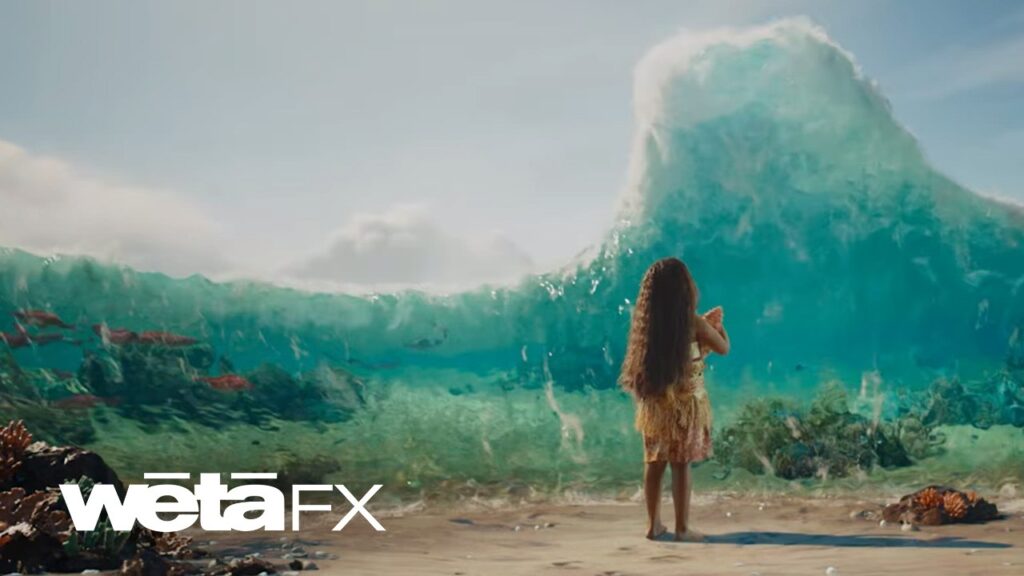
The ocean-parting scene turns a wide body of water into a path that guides the viewer directly toward Te Kā. The broad shape of the corridor must remain readable even while waves, foam, falling water, and mist continue moving along its edges. Westenhofer said Wētā FX handled almost all of the third act and created its own previs for the sequence, giving the filmmakers a common staging reference for practical photography, digital environments, tanks, motion rigs, and fully computer-generated shots.
Small practical pieces of volcanic terrain were built using geometry from Wētā FX’s previs so that the photographed surfaces would line up with the digital landscape planned around them. That planning helps preserve geography as the sequence moves from large-scale shots showing Te Kā’s size to closer reaction shots centered on Moana.
The face-to-face encounter is where the spectacle has to slow down enough for character performance to take over. Westenhofer identified Te Kā’s eyes and mouth as the most important features for communicating a progression of emotions without dialogue. Wētā FX also controlled the apparent temperature and brightness of structures around the face so that smoke, fire, and lava would not overwhelm those expressions. A slight head movement, pause, or change around the eyes has to remain visible despite the constant motion of molten material. The scene works only if the audience can connect Te Kā’s reaction directly to Moana standing her ground and recognizing who is in front of her.
Te Kā Lava, Smoke, Steam, and the Simulation Workflow Behind Her Performance
Te Kā is difficult to build because she must function both as an animated character and as an unstable volcanic phenomenon. Her face, shoulders, and arms need recognizable structure so the audience can understand the direction and intention of a movement, yet large parts of her body can also break apart into molten material during the same action.
Westenhofer described a system that allowed an effects animator to vary how tightly the lava followed the underlying animated form, both across different parts of the body and over time. An attacking arm could retain enough structure for the audience to read the sweep, then shed molten material as the gesture continued. Once that lava left Te Kā’s hotter core, it could cool as it moved through the environment.
That control links animation and simulation rather than treating them as separate visual layers. The underlying pose establishes where Te Kā is looking, reaching, or attacking, while the simulated lava extends the action beyond the limits of the animated body. If the silhouette disappears too early, the audience may see an impressive eruption but lose the gesture that caused it. If the silhouette remains completely intact, Te Kā risks feeling like a solid creature with lava painted on top rather than a being formed from volcanic material. The finished effect depends on choosing when the body should hold together and when it should visibly come apart.
The surrounding landscape reinforces the same concept because Te Kā and Te Fiti were treated as expressions of the island itself. Te Kā’s movement can trigger lava breaking through nearby terrain, extending the force of a gesture into the environment around her. The viewer can first read the character’s motion and then see the landscape react to it, making her scale feel larger than the body occupying the frame. The public sources describe these artistic controls broadly but do not identify the exact solvers, simulation resolutions, material settings, or technical coupling between individual passes. The available information therefore supports analysis of how the effects are choreographed without revealing enough detail to reproduce Wētā FX’s production setup.
Smoke, Steam, and Visibility Challenges
Smoke adds another layer because it can alternately reveal and obscure Te Kā’s form. ILM senior art director Aaron McBride said early design exploration considered a version of Te Kā more heavily hidden within volcanic ash, inspired partly by nighttime eruption footage where lava illuminates the surrounding clouds. The final design remained closer to the animated character while adapting that idea to a more photoreal visual language.
A large plume can make Te Kā feel unstable and enormous in a wide shot, but the same smoke can become a problem when the story depends on the audience reading her eyes and mouth. The effects therefore have to preserve enough atmospheric complexity to sell the volcanic environment while leaving a clear visual route to the character’s face during emotional beats.
Steam serves a different function because it visually marks the meeting between the ocean and Te Kā’s heat. Pale mist can help the audience understand the contact zone between water and volcanic material while also softening the enormous distance between Moana and the creature. A thin layer adds depth and scale, while a denser cloud can temporarily hide the corridor and increase suspense. At the point of recognition, however, another heavy plume would compete with the story rather than support it. The placement and timing of steam therefore matter as much as the physical reason for it to exist.
The reel and accompanying breakdown also show why observable results should be separated from undocumented technical assumptions. A viewer can clearly see molten breakup, glowing surfaces, cooling material, smoke, steam, and shifting visibility around Te Kā. Those effects may have been coordinated across several departments or passes rather than calculated within one unified simulation. Public documentation confirms broad artistic controls over lava adherence and character readability but leaves the exact internal workflow undisclosed. That distinction allows the finished work to be described accurately without assigning production methods that Wētā FX has not publicly confirmed.

Te Kā’s Transformation into Te Fiti, ILM Collaboration, and the Film’s Other Water Effects
The climax shifts from destruction to restoration when Moana returns the Heart of Te Fiti. The image moves away from lava, smoke, and exposed rock toward vegetation, flowers, and a figure that feels connected to the renewed island. Westenhofer described Wētā FX developing patterns for how foliage spreads across Te Fiti and how the character’s body connects with the surrounding terrain. He also highlighted a burst of red and white flowers moving outward in a spiral after the heart is restored. These changes allow the transformation to spread beyond the character herself and into the environment, making the restoration feel like a change to the entire landscape rather than a simple model swap.
Movement helps differentiate Te Fiti from Te Kā just as much as color does. Te Kā’s body can fragment during a gesture, making her appear unstable and difficult to contain. Te Fiti’s slower movements and periods of stillness help communicate weight and solidity after the transformation. The audience first has to recognize that there is someone behind Te Kā’s threat, and the visual change then confirms Moana’s understanding. A gradual progression across the body and island gives the viewer time to connect the two forms, which is more meaningful to the scene than any individual flower, plume, or patch of vegetation.
The public record supports Wētā FX as the principal studio responsible for the third-act Te Kā and Te Fiti work. Westenhofer directly attributes the volcanic body effects and vegetation work to Wētā FX. VFXwire reports broader asset and transformation sharing between ILM and Wētā FX depending on which studio handled surrounding shots, but the underlying production interview specifically discusses that kind of division while addressing Maui’s animal transformations.
ILM’s own documented contribution to Te Kā includes concept development led by Aaron McBride, who explored how the character could retain her animated identity while fitting into a photographic environment. The available evidence therefore supports crediting ILM for design exploration and Wētā FX for the documented climax effects and animation work without assigning individual Te Fiti transformation shots to ILM where the sources do not confirm them.
Opening Wave Character and Storm Water Integration
The opening baby Moana sequence provides a clearer example of ILM and Wētā FX directly sharing work within the same water sequence. Westenhofer said ILM handled the initial retreat of the water that reveals the first shell. Wētā FX took over once baby Moana stood in front of the water wall and the animated wave began to display its personality. The studios used their own water tools but shared development renders to keep the wave visually consistent through the handoff. Reference from standing waves in white-water rapids helped the filmmakers design a shape that could remain upright while still looking like moving water.
The wave’s personality depends on making the larger shape readable as a character while keeping enough internal motion to prevent it from appearing solid. A curl near the top creates an area the viewer can interpret almost like a face, while water spilling around the structure keeps the form alive. Small gestures such as a playful flick or spin help make the ocean feel responsive to baby Moana. The prologue and finale use the same character at very different scales, but both rely on a clear story-driven action that the audience can understand immediately. Internal fluid detail supports those gestures rather than replacing them.
The storm sequence uses water differently again by combining practical photography with digital extension. The filmmakers shot storm material in a 75-foot-diameter tank at Trilith Studios in Atlanta with roughly eight feet of water, wave-making equipment, surface chop, and a dump tank for selected shots. A smaller tank was used for less demanding water interaction, while a gimbal supported more controlled canoe movements. Practical water gave the performers and canoe real physical interaction, while Wētā FX extended the ocean, horizon, waves, and overall sense of scale digitally. The integration works best when the motion of the canoe, nearby spray, and distant ocean all appear to belong to the same weather system.

Live-Action Te Kā Compared with the Animated Film, VFX Credits, and What the Reel Reveals About Wētā FX’s Process
Disney’s 2026 live-action Moana preserves the broad dramatic identity of Te Kā from the 2016 animated film while translating the character into a more photographic visual language. Catherine Lagaʻaia plays Moana, with Dwayne Johnson returning as Maui, while Te Kā remains the volcanic figure whose true identity becomes central to the climax. ILM’s concept-development account shows that artists explored more heavily obscured versions of Te Kā before returning toward the recognizable animated silhouette. That choice preserves the visual information the audience needs to understand the character while allowing smoke, lava, rock, and atmospheric lighting to make the result feel more naturalistic. The adaptation therefore changes the surface treatment substantially without altering the core dramatic function of the encounter.
The comparison between the two versions is most useful when focused on what the audience has to read rather than simply on graphical detail. Te Kā still needs a recognizable outline in wide shots so the threat is clear from a distance. Her face still has to communicate anger, surprise, and recognition in closer views. The live-action version adds more detailed molten surfaces, volcanic rock, smoke depth, and photographic lighting, but those additions only help if they preserve the basic performance. The design succeeds when spectacle supports the emotional beat rather than overwhelming it.
Visual Effects Credits and Vendor Scope
The film’s visual effects work involved several vendors under the production team led by Bill Westenhofer. Wētā FX credits Stephen Unterfranz and Simon Jung as visual effects supervisors, Anneka Fris as animation supervisor, and Jonny Doig as visual effects producer. Westenhofer served as production visual effects supervisor, Leslie Lerman as production visual effects producer, and J.D. Schwalm supervised practical special effects involved in areas such as water photography. These roles distinguish the studio supervisors responsible for Wētā FX’s contribution from the production supervisors coordinating work across photography, special effects, and multiple vendors.
Industrial Light & Magic credits Jason Snell, Nelson Sepulveda-Fauser, and Kabir Verma as visual effects supervisors, with Maia Kayser and Kim Ooi as animation supervisors. Other contributors reported for the film include UPP, Framestore, Digital Domain, Vitality Visual Effects, Lola VFX, and Clear Angle Studios. VFXwire reports a total of 2,183 visual effects shots across the finished movie. Wētā FX’s highlights reel is therefore not a summary of every visual effect in Moana, but a focused selection representing the studio’s own major sequences. Its strongest contribution lies in showing how character animation, fluids, volcanic material, environments, practical photography, and compositing were brought together in the sequences it handled.
The Te Kā workflow is particularly revealing because the character could not be treated as either a conventional animated creature or a completely uncontrolled fluid simulation. Artists needed to specify a performance first, decide where molten material should follow that performance, and then determine when lava should detach, cool, and interact with the environment. The underlying animation provided continuity from one shot to the next even as the visible surface changed constantly. A hand could break apart during an attack while still following a clear path, and the same pose could remain recognizable across changes in camera angle. That relationship between stable performance and unstable material is the central technical idea behind the character.
The reel also demonstrates the limits of what a public VFX breakdown can establish. Finished images can reveal smoke, steam, breakup, cooling lava, wave motion, and environmental responses, while production interviews explain some of the artistic controls used to achieve those results. They do not necessarily disclose which solvers generated each effect, how departments exchanged data, what simulation resolutions were used, or how individual passes were combined.
Controlled Performance Under Chaos
The most accurate reading of Wētā FX’s work therefore stays close to the documented controls and visible results. What the reel makes clear is that the apparent chaos of Te Kā’s volcanic body was built around a carefully controlled performance, allowing the film’s largest effects sequence to remain focused on the moment when Moana recognizes the person hidden inside the threat.

Frequently Asked Questions (FAQs)
- What film is featured in Wētā FX’s Moana VFX highlights reel?
The reel showcases Wētā FX’s visual effects work on Disney’s 2026 live-action Moana. The film was directed by Thomas Kail and stars Catherine Lagaʻaia as Moana. Wētā FX’s reel focuses on selected sequences from the live-action production, including the opening water scene, the storm, and the third-act confrontation with Te Kā and Te Fiti. It is separate from Walt Disney Animation Studios’ original animated Moana, which was released in 2016. The reel is therefore a look at how the 2026 film translated familiar characters and environments into a live-action visual effects setting. - Where can I watch the official Wētā FX Moana VFX reel?
Wētā FX published the reel on YouTube under the title Moana VFX Highlights | Moana | Wētā FX. It is the studio’s own showcase of selected work from the film rather than a full behind-the-scenes documentary. CG Channel and VFXwire both featured the reel in their coverage and used it to discuss Wētā FX’s contribution to the prologue, storm, and climax. Watching the studio upload gives the clearest view of the finished imagery and short simulation glimpses. The full movie is still needed for the complete dramatic context around those shots. - Is there a separate narrated breakdown of Te Kā’s effects?
Yes. In addition to the shorter highlights reel, CG Channel’s updated coverage links to a separate Wētā FX breakdown focused more directly on Te Kā’s creation. That video discusses the challenge of building a character who had to remain animatable even though her body is made from lava and other simulated material. The breakdown explains how manual character animation and effects simulation worked together rather than treating Te Kā as an uncontrolled fluid effect. This is useful because the highlights reel mainly shows the final result, while the narrated video gives more context about the production problem the team was solving. - How did Wētā FX control the lava on Te Kā’s body?
Wētā FX developed controls that allowed effects artists to vary how closely the simulated lava followed Te Kā’s animated body. That adherence could change from one part of her body to another and could also shift over the course of a shot. For example, an arm could remain structured enough for the audience to understand the direction of an attack and then shed molten material as the movement continued. This approach helped preserve a readable performance while still making the character feel unstable and volcanic. Material that broke away from the hotter core could then cool as it moved into the surrounding environment. - What do smoke and steam contribute to the Te Kā sequence?
Smoke and steam help the audience read both Te Kā’s scale and the physical relationship between the volcanic character and the ocean around her. Darker smoke can partially hide her body, make the silhouette feel unstable, and reveal depth when illuminated by the glow of molten material. Steam serves a different purpose by marking the meeting point between water and intense heat, especially around the ocean-parting sequence. Both effects can also influence where the viewer looks, so they have to be controlled carefully during close emotional shots. Too much smoke or steam could obscure Te Kā’s eyes and mouth at the very moment the audience needs to read her reaction to Moana. - Who handled the Moana ocean-parting climax?
Bill Westenhofer said Wētā FX handled almost all of the film’s third act, including the major work around Te Kā, Te Fiti, and the ocean-parting confrontation. Wētā FX also created its own previs for the sequence, which helped the filmmakers plan camera positions, performer staging, practical set pieces, and digital environments before final photography. The ocean corridor had to remain visually clear while still behaving like moving water. That clarity was essential because the scene shifts from a large-scale chase and threat into a close emotional exchange between Moana and Te Kā. Wētā FX’s highlights reel includes this sequence as one of the studio’s central contributions. - Did Wētā FX and ILM share the baby Moana water scene?
Yes. According to Westenhofer, Industrial Light & Magic handled the first part of the sequence in which the ocean retreats and reveals the shell. Wētā FX took over once baby Moana was standing in front of the water wall and the more expressive animated wave emerged. The two studios used different internal tools but shared development renders so the water character would remain visually consistent across the handoff. Reference from standing waves in white-water rapids helped the filmmakers design a shape that could rise vertically while still looking like flowing water. The sequence is therefore a clear example of multiple vendors contributing to one continuous scene. - How does Te Kā become Te Fiti in live-action Moana?
The transformation begins when Moana returns the Heart of Te Fiti. The volcanic form associated with lava, smoke, and rock gives way to a restored figure covered in vegetation and connected visually to the surrounding island. Wētā FX developed patterns for how foliage spreads across Te Fiti and how her body connects with the landscape geometry. Westenhofer also described a burst of red and white flowers moving outward in a spiral after the heart is restored. The effect is designed as a gradual environmental transformation rather than simply switching from one finished character model to another. - How was the storm in live-action Moana filmed?
The production photographed storm material in a large water tank at Trilith Studios in Atlanta. The main tank was about 75 feet in diameter and contained roughly eight feet of water, with equipment used to generate waves, surface chop, and specific large water effects. Practical photography gave the canoe and performers real physical interaction with water, including spray and movement across the deck. Wētā FX then extended the surrounding ocean digitally and adjusted the horizon and wave scale to make the storm feel much larger than the tank itself. The final sequence therefore combines practical water interaction with digital environment work rather than relying entirely on one method. - Does the Moana VFX reel identify the software used for Te Kā’s simulations?
No. Public coverage explains the artistic and technical problem at a high level, including the combination of animation, lava adherence controls, smoke, steam, cooling material, and environmental effects. It does not identify the exact solver setup, simulation software, shot-specific parameters, or the detailed data flow between departments. The reel and interviews are enough to understand how Wētā FX balanced character readability with unstable volcanic material. They are not detailed enough to reproduce the studio’s production pipeline. Any claim about a specific solver or exact simulation configuration would therefore go beyond the information that has been publicly documented.

Conclusion
Wētā FX’s Moana highlights reel is most revealing when Te Kā has to stop reading as pure volcanic destruction and start reading as a character. The studio’s documented lava controls allowed parts of her body to hold their form long enough for the audience to understand a gesture, then break apart as molten material once that action was clear.
Smoke and steam add scale, atmosphere, and depth, but they also have to stay out of the way when the story depends on Te Kā’s eyes and mouth. As the ocean opens a corridor between Moana and the giant, the visual geography becomes simple and legible, giving the audience a clear path from spectacle to recognition. That shift is what makes the climax work: the effects do not merely make Te Kā look powerful, they make her performance readable.
The prologue and storm show how differently the same production could use water depending on the story. In the opening, the ocean behaves with enough precision to perform a small, playful gesture for a child. In the storm, practical tank photography and digital extensions make its force register through the canoe, the performer, and the surrounding horizon. At the climax, the ocean becomes a compositional tool that creates space for Moana and Te Kā to face one another. The transformation into Te Fiti then carries that change outward through calmer movement, spreading vegetation, and a landscape that appears to recover along with the character.
Across all three sequences, the strongest visual effects choices are the ones that make intention and geography easier to understand. Te Kā’s unstable body still has to communicate where she is looking and how she is moving. The storm still has to make the canoe’s motion feel connected to the larger ocean. The transformation still has to show that Te Kā and Te Fiti are two states of the same being rather than unrelated visual designs. Wētā FX’s work succeeds because the spectacle remains tied to those story requirements, allowing lava, smoke, steam, water, and vegetation to support the characters instead of overwhelming them.
Sources and Citations
- Wētā FX, Moana VFX Highlights: Wētā FX’s official reel showcases the studio’s work on the opening prologue, the storm sequence, and the third act involving Te Kā and Te Fiti. CG Channel specifically notes that the reel includes glimpses of smoke, steam, and lava simulation for Te Kā, including the ocean-parting confrontation. CG Channel
Watch Moana VFX Highlights by Wētā FX - Wētā FX, Moana Filmography: Wētā FX’s official project page lists Stephen Unterfranz and Simon Jung as Visual Effects Supervisors, Anneka Fris as Animation Supervisor, and Jonny Doig as Visual Effects Producer for the 2026 live-action film. Wētā FX
Wētā FX Moana Filmography - The Art of VFX, Bill Westenhofer Interview: Production VFX Supervisor Bill Westenhofer explains that Wētā FX was assigned the opening prologue, storm sequence, and third act with Te Kā and Te Fiti. The interview also discusses practical and digital ocean work, vendor responsibilities, the staging of the climax, Te Kā’s animation/effects balance, and Te Fiti’s transformation. The Art of VFX
Moana: Bill Westenhofer – Production VFX Supervisor - The Art of VFX, October 30, 2026: Vincent Frei’s coverage of Wētā FX’s reel highlights the studio’s work on tropical environments, turbulent ocean effects, Te Kā’s volcanic imagery, Te Fiti, and the climactic third act. The Art of VFX
Wētā FX Brings Te Kā and Te Fiti to Life - The Art of VFX, November 3, 2026, Te Kā and Te Fiti Making-Of: A later breakdown identifies Wētā FX artists including Lead FX TD Stefanie Blatt, VFX Producer Jonny Doig, FX Supervisor Alex Nowosad, and Animation Supervisor Anneka Fris discussing the animation and FX challenges behind Te Kā and Te Fiti. The Art of VFX
Wētā FX Explores the Animation and FX Challenges of Te Kā and Te Fiti - CG Channel, October 30, 2026: Jim Thacker identifies the reel’s brief technical glimpses of Te Kā smoke, steam, and lava simulation, including the sequence where the ocean parts so Moana and Te Kā can meet face-to-face. CG Channel
Check Out Wētā FX’s VFX Highlights Reel for Moana - VFXwire, October 30, 2026: Allan Torp Jensen reports that Wētā FX’s reel covers the prologue, storm, and third-act Te Kā/Te Fiti transformation, and places the work within a film containing 2,183 visual-effects shots overall. VFXwire
Wētā FX Shows Its Te Kā and Te Fiti Work on Moana - Industrial Light & Magic, September 3, 2026, Inside the ILM Art Department: Senior Art Director Aaron McBride explains the concept-development process for Te Kā. ILM explored a version more heavily obscured by volcanic ash and referenced nighttime eruptions with lava illuminating pyroclastic clouds before moving back toward the animated character’s recognizable silhouette with a more photoreal treatment. Industrial Light & Magic
Inside the ILM Art Department: Moana - Industrial Light & Magic, Moana Project Page: ILM’s official credits page identifies Jason Snell, Nelson Sepulveda-Fauser, and Kabir Verma as VFX Supervisors, with Maia Kayser and Kim Ooi as Animation Supervisors, confirming ILM’s production leadership on the film. Industrial Light & Magic
ILM – Moana - Disney+, Moana Live-Action Reimagining: Disney confirms that the 2026 live-action film stars Catherine Lagaʻaia as Moana and Dwayne Johnson as Maui, was directed by Thomas Kail, opened theatrically on July 10, 2026, and is now streaming on Disney+. Disney+
Moana Live-Action Reimagining on Disney+ - Disney Movies, Moana 2026: Disney’s official movie page independently confirms the July 10, 2026 release date, live-action format, Catherine Lagaʻaia and Dwayne Johnson, Thomas Kail as director, and the film’s core story. Disney Movies
Disney’s Official Moana 2026 Page - Walt Disney Animation Studios, Moana: The official animation-studio page documents the original animated feature, directed by Ron Clements, John Musker, Don Hall, and Chris Williams, with a November 23, 2016 release date. This is the best primary source for distinguishing the 2016 animated film from the 2026 live-action adaptation. disneyanimation.com
Walt Disney Animation Studios – Moana
Recommendations
- Paramount Closes $111B to Warner Bros. Deal: WB Games Uncertain
- Final Fantasy X/X-2 HD Remaster Switch 2 Release Guide and New Features
- Blender DLSS (2026 Guide): Enable DLSS Ray Reconstruction for Faster Cycles Viewport Denoising
- Steam Controller Hidden Easter Egg Explained: Why It Screams When Dropped and What It Means
- ANBERNIC RG DDS: 3DS-Inspired Handheld Starts at $299.99
- Anthropic’s $660M Charity Match Bill Could Reach Billions After IPO
- Ghostly Whiskers Faces Haunted Paws Copycat Allegations on Nintendo eShop
- Chaos releases V-Ray 7.4 for Houdini
- Marvel Rivals “Daredevil’s Shadowed Start” Costume Trailer Explained: Release Date, Event Details, Skin Rewards, and Everything We Know
- Horror Romance Visual Novel This Game Is Not Real Gets Rejected By Steam For “Not Meeting Platform Criteria”



































































































