











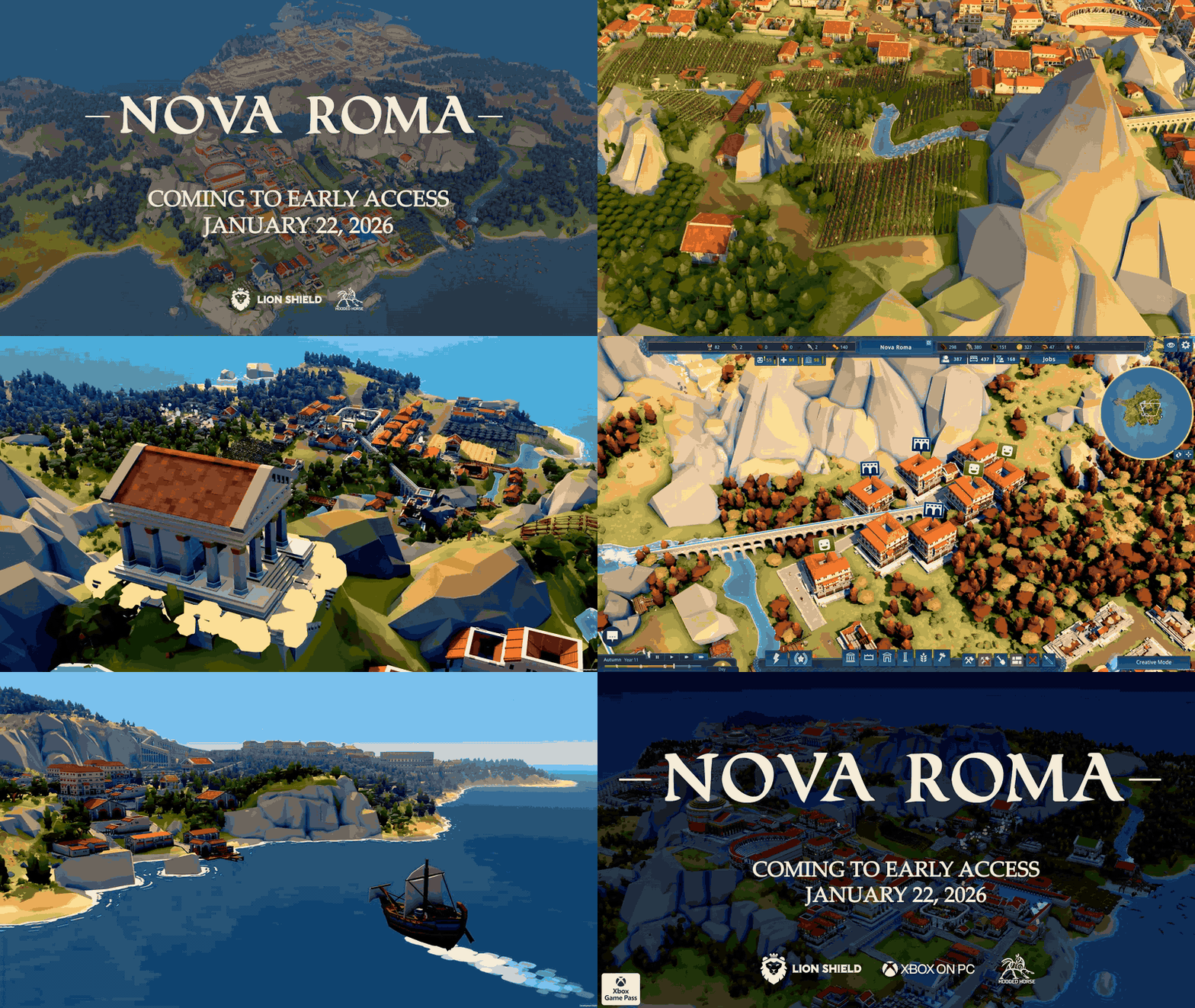
The official Early Access launch materials for Nova Roma position it as a Roman-themed city builder built around three pillars: (1) a physics-driven water-and-terrain simulation where aqueducts, dams, and earthworks materially change the map; (2) a “favor” progression layer tied to Roman gods, temples, and divine tasks; and (3) a management loop that blends sprawling supply chains, citizen needs (from basic food to cultural amenities), and escalating external threats such as raids and (eventually) larger military pressures.

Nova Roma Official Early Access Launch Trailer Breakdown
The launch trailer is surfaced directly through the game’s Steam/SteamDB asset set as “Launch Trailer,” timestamped as part of the March 26, 2026 release-day asset update. Even without treating the trailer as a pure “cinematic,” the surrounding official copy (storefront descriptions and developer notes) clarifies what the trailer is meant to communicate: the Roman city-builder fantasy is inseparable from simulated infrastructure and systemic risk. In other words, you aren’t just placing buildings—your terrain edits, dams, aqueduct routing, seasonal rain, and flood exposure are intended to create visible downstream consequences for fertility, production, and safety.
A notable design signal, reinforced during pre-release coverage and in developer-facing commentary, is the intent to keep “busywork” down while letting the world simulation itself carry the complexity—so the player feels the systems (water flow, logistics, disasters, gods) through what happens in the city, not just through spreadsheets.
Nova Roma Early Access Release Date and Launch Details
The Steam release date (and Early Access release date) is listed as March 26, 2026. On the Epic Games Store listing, the release date is likewise shown as 03/26/26, with platform availability including Windows and Mac. On Xbox storefront listings, the title is presented as Nova Roma (Game Preview) with a listed price of $29.99 (U.S. storefront view) and a “work in progress” warning consistent with Game Preview labeling.
For Xbox Game Pass, official Xbox Wire communication for March 2026 lists Nova Roma (Game Preview) (PC) – March 26, and explicitly frames it as “available day one with Xbox Game Pass.” Launch-window discounting is clearly advertised on Steam as an introductory offer with a stated end date of April 9 (Steam storefront display).
What Is Nova Roma About in Early Access
The core premise is established consistently across official store copy: Rome is collapsing into decadence and decay, and the player leads a band of citizens to new lands to build a “New Rome,” balancing citizen needs and divine expectations from the start.
Importantly, Nova Roma is framed less as a pure sandbox “city painter” and more as a management-and-survival builder where expansion itself is risky. Storefront language emphasizes that reshaping land and controlling water are central to avoiding floods and maintaining fertility, particularly across seasons and weather swings.
Another distinctive thematic layer is that “the gods come with you”—player progress and stability are influenced by temple dedication choices, divine tasks, and the consequences of neglect, which can include disasters such as lightning, destructive fires, and floods (with some tuning via difficulty settings, per preview/interview coverage).
Nova Roma Roman City Builder Gameplay Features
Across official descriptions and preview coverage, the “feature identity” of Nova Roma clusters into several interlocking systems:
- The city-building baseline includes residences, warehouses, farms, foresters, clay pits, quarries, and similar staples, but with quality-of-life intent: buildings do not necessarily require strict road adjacency as long as the road passes through the area.
- Population growth is not presented as a classic “manual citizen tier promotion” system. Instead, preview/interview coverage describes all citizens as part of a general population, with immigrants arriving by ship each season—an approach meant to reduce repetitive promotion micromanagement while keeping needs and logistics meaningful.
- Progression is closely linked to religion and “Favor,” where temple dedication, task completion, and offerings generate Favor that can be used to unlock technologies and new buildings.
- Military pressure exists as a gameplay axis: early defenses include wooden walls, guard towers, and militia; later development aims toward barracks-based legionaries and a more persistent military layer as threats intensify.
From a simulation perspective, the headline differentiator is the water/terrain system: water sources, flow direction, and altered terrain geometry are intended to behave physically (e.g., water running downhill), while fertility is tied to proximity to water, enabling irrigation projects but also creating genuine flood risk.
Nova Roma Official Trailer Highlights and Key Moments
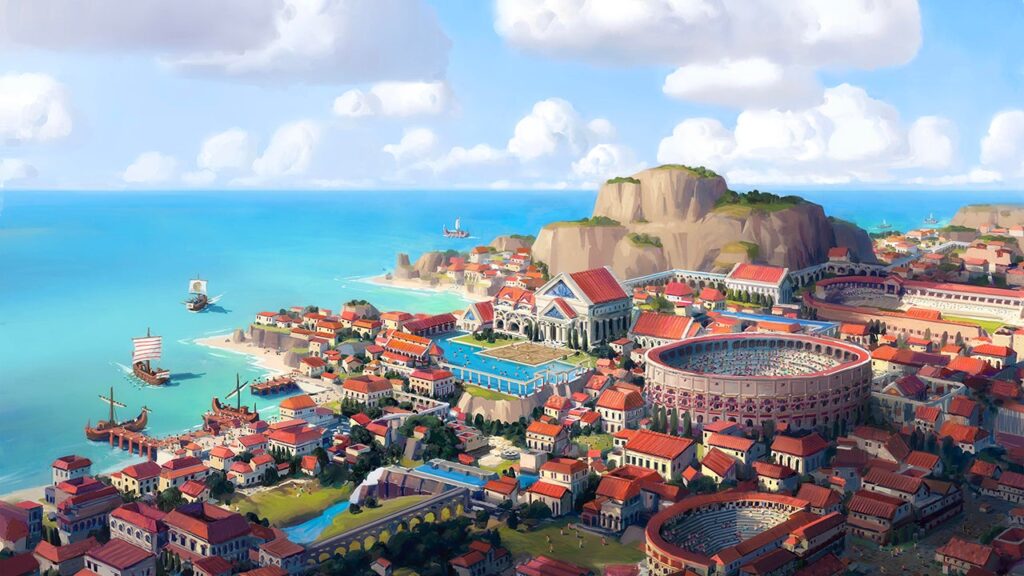
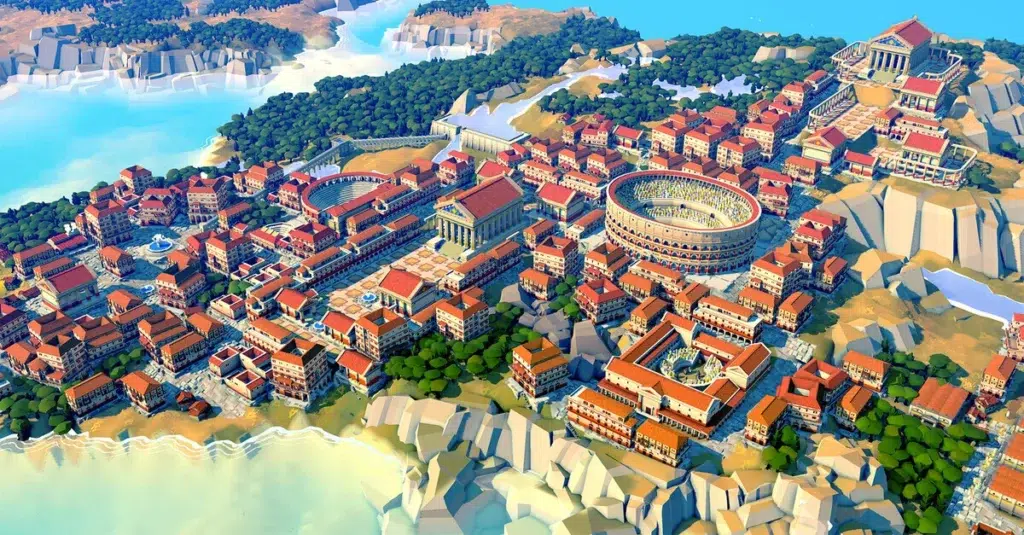
The Steam-distributed “Launch Trailer” thumbnail art foregrounds some of the trailer’s intended “aspirational skyline”: a dense coastal Roman city, monumental civic architecture, and large arena-scale entertainment structures (amphitheater/colosseum-style builds), reinforcing that the game’s Late-Roman fantasy is about a full metropolis rather than only a survival village.
What the official copy repeatedly emphasizes—and what the launch trailer is positioned to underline—is that infrastructure is not decorative. Aqueducts, dams, reservoirs, and terrain edits are framed as the backbone of the city’s success, affecting fertility, water services, and disaster exposure, including flooding during rainy seasons.
A key tonal signature in coverage is the tension between citizen demands and god demands: citizen comfort expands from basic shelter and food access toward breadth of diet and entertainment, while gods offer buffs and tech acceleration but impose tasks and punishments if ignored.

Nova Roma Early Access Content and Playable Features
On Steam, the developers state the Early Access version is “fully playable” and contains all content and features described on the store page.
From the Steam Early Access framing, the development intent is explicit: the team plans to use community suggestions, bug reports, and feedback to expand and refine the game, and expects (as of the store description) an Early Access period around one year, with flexibility depending on how development evolves.
Early Access is already demonstrably patch-active. Post-launch updates shared via SteamDB show rapid hotfixing and tuning across both usability and systems balance. For example, an early post-launch build added a Creative Mode technology-tree unlock button and addressed issues like gods escalating demands too quickly, settler-ship arrival failures, and terrain-project save corruption.
Shortly thereafter, additional updates targeted friction points raised by players, including “sleepiness” tuning and pathing improvements, plus practical UI additions like a demolition tooltip showing recovered resources.
Accessibility and usability-category metadata associated with the Steam ecosystem also points to expected Early Access realities: adjustable difficulty and adjustable text size are explicitly enumerated in the listing metadata captured by SteamDB.
Nova Roma Gods, Temples, and Citizen Needs Explained
Religion in Nova Roma is not a side-system—it is directly linked to progression and survival planning.
A detailed Epic Games Store guide describes the early religious on-ramp: building a Small Temple (with a listed cost of wood and stone), dedicating it to a god, and receiving +2 Favor, with Favor serving as a key resource for unlocking technologies in the tech tree.
As of late March 2026 coverage, the same guide describes five available gods and documents temple-aura benefits (activated via “Favor of the Gods”) that are localized within a temple radius and cost Favor. Examples given include citizen happiness (Jupiter), farm/vineyard/orchard output (Ceres), fishing yield (Neptune), fire-industry output (Vulcan), and defense-tower damage (Mars), which collectively implies that temple placement is an optimization problem tied to district planning, not just aesthetics.
Divine Tasks are framed as ongoing objectives that reward Favor when completed and can include population growth requirements, defense-related structures, resource offerings (food or materials), and gold donations—explicitly connecting religion to taxation systems such as the Tax Office or higher-tier housing that generates taxes.
Neglect escalates into “divine punishment.” Preview/interview coverage references disasters such as thunderbolts, destructive fires, and floods tied to angering gods, and notes that disasters can be tuned via difficulty settings (implying players can choose a more punishing or more relaxed experience).
Citizen needs, meanwhile, are repeatedly described as expanding over time. PC Gamer’s hands-on framing highlights a familiar city-builder pattern—shelter leads to marketplace convenience, which leads to multi-food variety demands, and flooding can create mortality and disposal concerns—illustrating how the needs layer coexists with environmental risk.
Nova Roma Building, Farming, and Production Systems
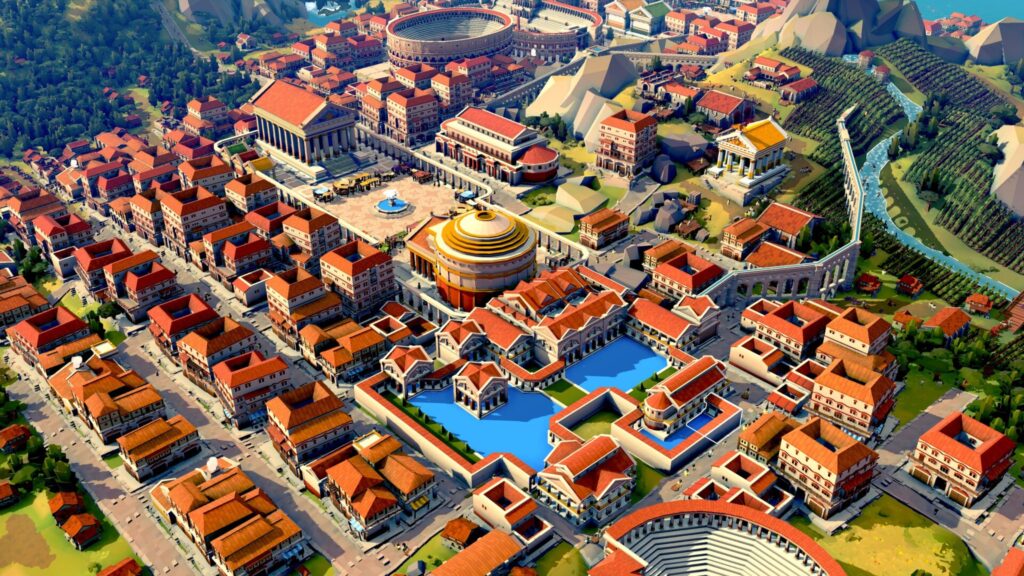
At its foundation, Nova Roma supports standard city-builder production categories—housing, food, industry—but the distinctive element is how tightly they are bound to terrain, water, and logistics.
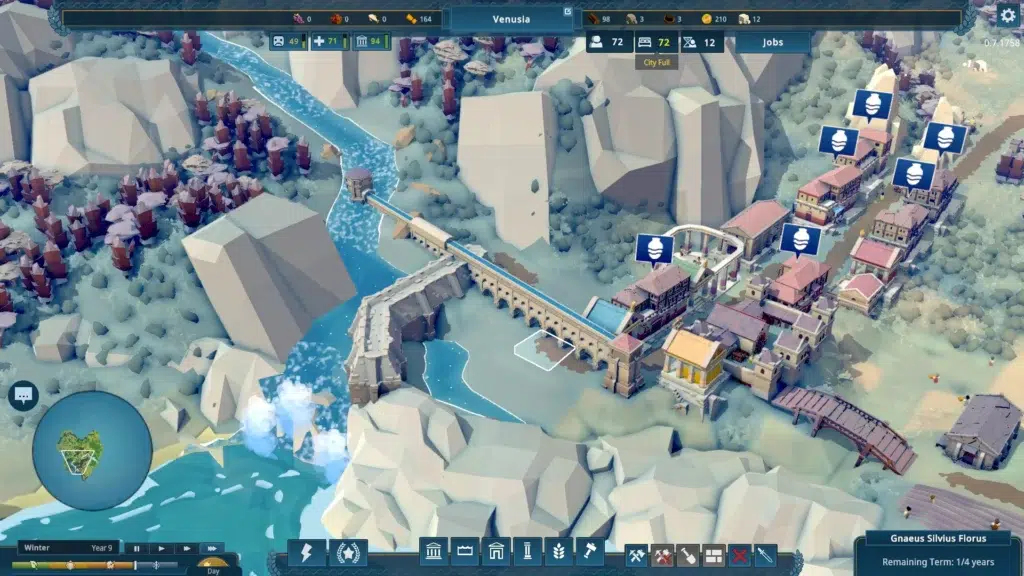
The Epic preview/interview describes a job-priority approach: workforce management can be performed by reordering job types in a job menu rather than micromanaging individual assignments, enabling broad “push/pull” control over builders, farmers, and service roles.
Farming and food production are presented as multi-channel: farms (including wheat), vineyards, orchards, and fishing are repeatedly referenced as key early-scale systems—particularly because gods can demand offerings like bread, and because temple bonuses can hinge on specific food industries (e.g., Neptune for fishing yields, Ceres for agricultural output).
The Epic guide’s tech-tree discussion provides a practical look at production-chain thinking: it explicitly connects clay pits and charcoal makers to pottery workshops; links charcoal and wheat to bread production; and emphasizes that “utilities” and “finance” (e.g., wells/fire brigades/tax offices) should come online early to prevent avoidable collapses.
Logistics is treated as its own system tier rather than an invisible background. The same guide points players from basic stockpiles/warehouses into transport carts (for moving goods between storage points), and then into docks/trading agreements for automated buying/selling—implying that the city’s “shape” must be planned around flows of goods, not merely around zoning aesthetics.
Nova Roma Water System, Aqueducts, Dams, and Reservoirs
The water system is consistently presented as the cornerstone differentiator.
A Lion Shield development update on 3D terrain explains the technical intention: the team reworked map generation to support 3D terrain (hills, mountains, cliffs) and paired it with a fluid simulation that interacts physically with that terrain. Water is described as originating near mountains and flowing down toward the ocean, with players able to affect flow by changing terrain shape via editing tools.
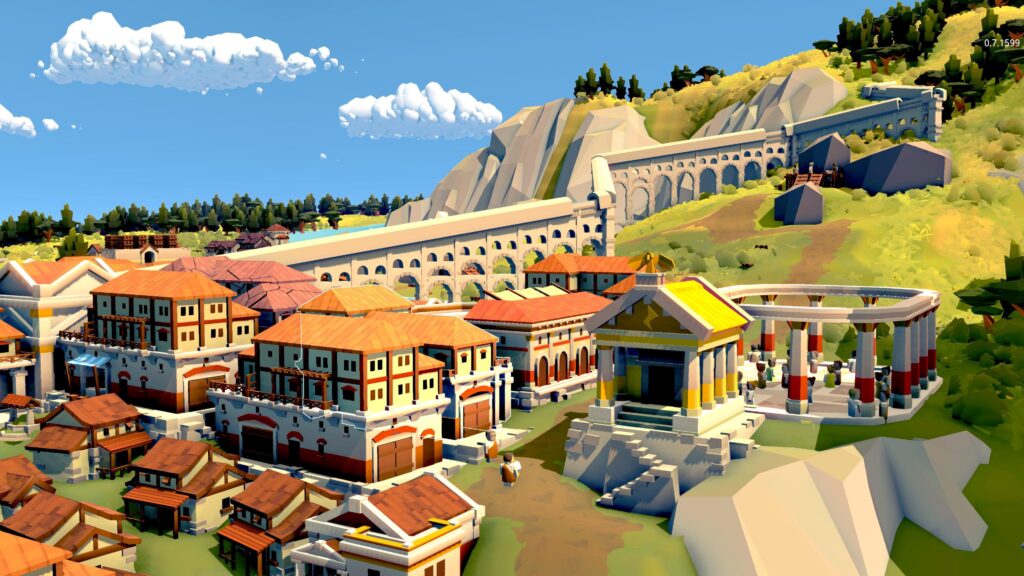
That same update frames the gameplay consequence: citizens can be commanded to undertake major terrain projects to alter river courses, build reservoirs and dams, and supply water to the city via aqueducts—connecting labor, engineering, and long-horizon planning.
Preview/interview coverage reinforces the “physics over abstraction” approach: the water mechanics are described as physics-based (not voxel-based), so channels and diversions behave as expected downhill, and soil fertility is tied to proximity to water—including the ability to preview terrain change impact in a simulated world before executing large earthworks.
The Steam/Epic storefront description similarly foregrounds dams, aqueducts, watersheds, and reservoirs, explicitly warning that weather variance (such as a rainy season) can flood the city if water control and expansion pace are mishandled.
The Epic religion/tech guide supplies additional concrete infrastructure specifics: aqueducts funnel water from higher elevations down to water towers, and players can build bath reservoirs and multiple bath structures to form a bath complex—implying that water is simultaneously an agricultural input, a city-service pipeline, and a disaster vector.

Nova Roma Combat, Defense, and Upcoming Gladiator Fights
While the game’s marketing centers on city-building, official and preview coverage treats defense as a meaningful progression axis.
In Epic’s preview/interview, early defensive options include wooden walls and guard towers, plus a militia drawn from workers; later, the player can field legionaries from barracks to maintain a standing army. Threats are described as including bandits and pirates, and eventually a resurgent Roman Empire seeking to reconquer the player’s territory, with plagues and invasions intensifying across a campaign.
PC Gamer’s hands-on narrative underscores how defense systems intersect with god systems: Mars can appear at an opportune time, and Favor can unlock guard towers in response to an imminent invasion—illustrating that military readiness is both a “tech tree” and “timing” problem, not only a late-game add-on.
The Epic guide also treats defense as a tech and build-order priority: guard towers can be sufficient against early raiders, while later technologies (e.g., infantry barracks) reduce the need for manual militia recruitment.
Gladiator fights, specifically, are framed as a near-term Early Access expansion target rather than a fully delivered launch mechanic. In the Early Access launch announcement mirrored via SteamDB, the developers state that what’s next includes new colosseum mechanics enabling players to set up gladiator fights, and that they are also working to restore a chariot race track concept that was cut at the last minute due to game rating sensitivities.
Nova Roma Early Access Roadmap and Future Updates
The clearest “roadmap” commitments come from official Early Access statements rather than a rigid feature calendar.
On Steam, the team’s Early Access Q&A states an estimated ~one year Early Access timeline (with flexibility), and explains that the full version is planned to expand content influenced by community feedback, adding more buildings, technologies, and gods, plus additional mechanics related to war, politics, and culture.
Developer notes published at launch (via SteamDB) add near-term specificity: colosseum/gladiator fight mechanics are explicitly named as next work, and the chariot race track content is identified as work they aim to bring back after being cut for rating reasons.
The pre-launch history also signals that the team has already used public feedback to change schedule and scope. A Steam news post about the release-date shift (as indexed in search results) describes moving the launch date to March 26, 2026 after demo feedback, and mentions demo updates including tuning and systems additions such as rain, flooding, and droughts—suggesting that the demo period functioned as “proto–Early Access.”
Finally, the first week of Early Access demonstrates a rapid iteration cycle. Patch notes show frequent hotfixes addressing production balance, god system satisfaction edge cases, terrain-tool issues, and late-game honor/task behavior.
Nova Roma Community Feedback and Developer Plans
The official Early Access positioning is explicitly collaborative: the developers highlight using Early Access to consider and implement player ideas, and state they plan to incorporate suggestions and bug reports through community spaces such as Discord and the Steam forums.
Developer communications immediately after launch reinforce that posture in practice. Update notes reference fixes and improvements prompted by feedback (e.g., addressing gods becoming “too demanding too soon,” improving sleepiness behavior using player-submitted save files, and tuning movement/pathing and logistics issues).
The same patch posts repeatedly encourage players to leave reviews and feedback during Early Access, framing review writing and bug reporting as direct inputs into prioritization.
From a planning perspective, the most reliable expectation-setting is therefore not “a locked roadmap date,” but “a system of steady iteration,” where short-cycle hotfixes remove friction and mid-cycle updates add named mechanics (starting with colosseum support and gladiator fights).
Nova Roma Steam Early Access Page Details
On the Steam store listing, the developer is Lion Shield and the publisher is Hooded Horse, and the release date is presented as March 26, 2026.
Steam’s visible metadata highlights the game’s genre framing (strategy/simulation/city builder) and tags such as “Sandbox,” “Survival,” “Resource Management,” and “Moddable,” which signals intended playstyles even if mod tooling depth can vary by game and over time.
The store page’s Early Access Q&A includes several critical buyer-facing statements:
- Early Access is intended to incorporate player ideas and feedback.
- The expected Early Access period is roughly one year (with flexibility).
- The team may increase price during Early Access as content is added.
- The Early Access build is described as fully playable with store-page-described content.
Language support on Steam is listed as English plus 17 more (18 total), with interface/subtitles and (as listed) full audio support denoted on the page.
Steam system requirements list Windows and macOS, with minimum specs including Windows 10 (64-bit), 4 GB RAM, and a GTX 1050 / Radeon R9 285 class GPU; recommended specs list 8 GB RAM and higher-end GPUs, and DirectX 11 (minimum) vs DirectX 12 (recommended).
SteamDB’s captured metadata adds additional technical and compatibility signals: the title is listed as supporting Windows and macOS and is detected as using Unity Engine (among other SDKs), and Steam Deck compatibility is categorized as “Playable,” with caveats such as small text, occasional non-Deck glyphs, and manual graphics tuning for performance.
Nova Roma Trailer Reactions and First Impressions
The Steam store page itself includes curated press pull-quotes that frame early impressions around the water system and the gods layer, including humor about drowning Romans and “pesky gods,” and comparisons to prior city builders and dam-focused games.
PC Gamer’s pre-launch hands-on emphasizes that the gods layer meaningfully changes the feel of the city-builder loop: initial temple dedication provides practical buffs, but other gods can pressure the player with threats and demands, creating tense timing moments (e.g., invasion threat coinciding with unlocking guard towers).
A separate Early Access review from Boss Rush Network frames the launch build as closer to “already excellent, will get even better” than “promising seed,” highlighting satisfaction in city-building, logistics, and the interplay of Roman attacks, natural disasters, and keeping gods happy.
Perhaps the most actionable “first impression” signal is the combination of very positive user-review sentiment and extremely rapid hotfixing in the first days after release, including immediate system tuning (sleepiness/pathing/god demand pacing) based on player reports—suggesting a responsive development loop rather than a slow cadence.
Is Nova Roma Worth Playing in Early Access
The official messaging suggests Early Access is appropriate for players who actively want to shape a developing strategy game, tolerate structural changes, and value frequent optimization/tuning updates. Steam and Xbox storefronts explicitly warn that Early Access/Game Preview products may change significantly over time, and purchasing should be based on comfort with the current state.
From a systems standpoint, the “worth it” decision largely hinges on whether the game’s core differentiators already match what you want:
- If you want a Roman city builder where aqueduct routing, flood management, and terraforming materially shape outcomes, that pillar is heavily emphasized as a launch identity and is repeatedly documented as physics-based and gameplay-relevant.
- If you want a city builder where religion is not flavor but progression, and where gods can reward or punish depending on task compliance, that system is documented in detail (Favor, Divine Tasks, temples, festivals, and divine interventions).
- If you want defense and raids as meaningful pressure (and eventually deeper war/politics/culture), preview and Early Access plans support that direction, with explicit commitments to expand mechanics beyond what is currently in place.
If, instead, the preference is for a “finished-feeling” feature set with fully mature late-game combat/entertainment systems (especially colosseum-driven gladiator fights), the developers have explicitly identified those as upcoming mechanical work during Early Access, which is a strong signal to wait if those are must-have features on day one.
Frequently Asked Question (FAQs)
- Is Nova Roma actually available right now in Early Access?
Nova Roma is listed on Steam with a March 26, 2026 release date (and Early Access release date). Xbox Wire also lists Nova Roma (Game Preview) for PC Game Pass on March 26. - How long is Nova Roma expected to remain in Early Access?
The developers state they plan to remain in Early Access for about a year, though that may change depending on how the design develops with player feedback. - Does Early Access include everything, or is it missing major systems?
The Steam Early Access Q&A states the Early Access version is fully playable and contains all content and features described on the store page; however, the developers also outline planned expansions (more buildings/technologies/gods and new mechanics for war/politics/culture). - Are gladiator fights playable at launch, or are they planned for later?
Developer launch messaging indicates that “what’s next” includes new colosseum mechanics and the ability to set up gladiator fights, implying that this systems layer is being actively developed as a post-launch Early Access addition. - How does Favor work, and why does it matter?
Favor is described as a resource earned through temple dedication and divine tasks; it is used to unlock features in the technology tree, tying religion directly to progression. - How “real” is the water simulation, and can it actually flood your city?
Official descriptions and development updates describe a physics-based water simulation interacting with 3D terrain; storefront language explicitly references rainy seasons flooding cities and the need to manage dams/aqueducts/watersheds and reservoirs. - Does Nova Roma have combat and external threats (raids/invasions)?
Preview/interview coverage describes early wooden walls and guard towers, militia defense, and later legionaries from barracks, with threats including bandits and pirates; the Epic guide also frames guard towers as early anti-raider defense. - Is Nova Roma on Game Pass?
Xbox Wire’s March 2026 Game Pass announcements list Nova Roma (Game Preview) (PC) arriving March 26 for Game Pass Ultimate and PC Game Pass. - Does Nova Roma support macOS?
Both Steam and Epic storefront information list macOS support, and Steam system requirements include macOS 12 Monterey. - Will the price change during Early Access?
The Steam Early Access Q&A states the developers might increase the price during Early Access as additional content and features are added.

Conclusion
Nova Roma’s Early Access launch messaging and early patch cadence indicate a city builder that is already playable and system-forward, with its most defensible differentiators being (1) a physics-driven water/terrain model that makes infrastructure an engineering problem and a disaster risk, and (2) a Favor-based gods layer that turns religion into a progression-and-stability mechanic. The clearest near-term expansion targets named by the developers are colosseum upgrades that enable gladiator fights and the reintroduction of a chariot-racing feature that was cut for rating reasons—making Early Access especially attractive to players who enjoy participating in a game’s refinement cycle rather than waiting for a fully finalized feature set.
Sources and citation
- Steam Store (Early Access FAQ), https://help.steampowered.com/en/faqs/view/6554-ED29-FBDB-1612
- SteamDB Patch Notes, https://steamdb.info/patchnotes/
- Epic Games Store Distribution Requirements, https://dev.epicgames.com/docs/epic-games-store/requirements-guidelines/distribution-requirements/requirements-overview
- Epic Games Store (overview), https://en.wikipedia.org/wiki/Epic_Games_Store
- Steam Store (platform overview), https://en.wikipedia.org/wiki/Steam_(service)
Recommended
- How to Make Blender Hair Work with Unreal Engine’s Groom System
- How do I parent a camera to an object in Blender?
- How to Use Physics-Based Hair in Blender
- Hair20K vs PixelHair: Comparing High-Fidelity 3D Hair Datasets for Machine Learning, Simulation, and Production Use
- Star Trek: Starfleet Academy Season 1 Review (2026) — Cast, Story, Ending, and Where It Fits in the Star Trek Timeline
- Canceled Star Wars FPS Is Playable Again – Why “First Assault” Feels Amazing and Sad at the Same Time
- How to Sculpt in Blender: The Ultimate Beginner‑to‑Pro Guide for 3D Sculpting
- Riot Games Downsizing the 2XKO Development Team: February 2026 Layoffs, Official Update, and What’s Next
- Canva Just Bought Cavalry & MangoAI: What the 2026 Acquisitions Mean for Motion Design and AI Video Ads
- How do I create a bird’s-eye camera view in Blender?