



Marvel’s late-1990s collapse is one of the most studied turnarounds in entertainment business history: a legacy IP catalogue, an over-leveraged balance sheet, a collapsing collectibles market, and a bruising bankruptcy battle over control.
The turnaround is often simplified into a single-hero narrative, but the reality is a sequence: a Chapter 11 filing in December 1996; a court-approved reorganisation and merger structure that allowed the company to exit bankruptcy in October 1998; and then an operating and monetisation overhaul led by new leadership, culminating in the shift to a licensing-led “IP company” model and, later, the move into self-financed film production that set up the modern era.
Context and root causes
When did Marvel file for bankruptcy and why?
Marvel and related holding companies filed voluntary petitions for relief under Chapter 11 on December 27, 1996.
Contemporary reporting tied the filing to a hard revenue shock in the core comics-and-collectibles ecosystem (“comic and card collectors lost their appetite”), alongside capital-structure stress and contentious negotiations with bondholders over a reorganisation plan.
A crucial structural contributor was leverage and financial engineering during the prior ownership regime. A federal court record describes how, in 1993 and 1994, Marvel holding companies issued notes secured by subsidiary stock and used $550 million in proceeds to pay dividends “upstream” to parent corporations—leaving less resilience when cash flows weakened.
Ron Perelman Marvel era and what went wrong
The period under Ronald O. Perelman is inseparable from two interlocking issues: (1) balance-sheet fragility, and (2) strategic drift away from sustainable, repeatable monetisation of characters.
On the balance-sheet side, the same federal court record summarises the “upstreaming” dynamic: note proceeds paid out as dividends to parent corporations, followed by a bankruptcy filing less than three years later.
On the strategic side, the “save Marvel” proposal immediately preceding the bankruptcy illustrates how severe the dilution and creditor conflict had become: in November 1996, reporting described a plan involving a large new share issuance priced at $0.85 per share, which would sharply dilute existing equity while the stock served as collateral for hundreds of millions in bonds.
Marvel bankruptcy 1996 timeline explained
The bankruptcy was not a single-day event; it was a cascade of financing decisions, market contraction, and governance conflict that crystallised in late 1996 and played out through 1998.
Key milestones widely supported by court records, SEC filings, and contemporaneous reporting include:
- November 1996: a recapitalisation proposal to avoid bankruptcy is publicly described as highly dilutive to existing shareholders.
- December 27–28, 1996: Chapter 11 filing is reported; plans are discussed to use financing and character-driven media expansion ideas to rebuild revenues.
- 1997: creditor control conflict intensifies; reporting notes a court-ordered move to appoint a trustee to run the company rather than competing boards associated with creditor factions.
- July 1998: a consent order confirms a Toy Biz/secured lenders plan framework, enabling share distribution and implementation.
- September–October 1998: shareholders approve key steps; the company emerges from bankruptcy as part of Toy Biz, which changes its name to Marvel Enterprises.
(Where broader industry factors such as distribution disruptions and the comics market downturn are discussed in secondary sources, the timeline above is anchored to court and SEC records for maximum hard-date reliability.)

Bankruptcy exit and corporate restructuring
How Marvel exited bankruptcy and rebuilt the company
The legal mechanism of emergence hinged on a plan sponsored by Toy Biz and secured lenders. A U.S. District Court opinion states that, on July 31, 1998, the court entered a consent order confirming a fourth amended joint plan, under which Marvel Entertainment would be merged into a holding company controlled by Toy Biz.
The same record states that on October 1, 1998, Toy Biz and the secured lenders consummated the plan, and Toy Biz changed its name to Marvel Enterprises, Inc.
Immediately after emergence, the operational rebuild centred on stabilising cash flows and repositioning the business as an IP exploitation platform—driving revenue via licensing, entertainment tie-ins, and a leaner publishing base, rather than relying primarily on comics unit sales or capital-intensive acquisitions.
Toy Biz and Marvel merger explained
Reporting and court documents converge on three essentials:
First, the merger was not simply a friendly acquisition; it was the core structure of the reorganisation plan that enabled emergence from Chapter 11.
Second, court coverage in mid-1998 described an order that allowed Marvel to distribute shares in the newly formed company to Toy Biz shareholders and Marvel’s secured creditors—highlighting that the merger’s economics were tightly tied to creditor settlements.
Third, SEC disclosure later summarised the result plainly: upon consummation of the merger, the company changed its name from “Toy Biz, Inc.” to “Marvel Enterprises, Inc.”, and the merger was part of the Fourth Amended Joint Plan of Reorganisation for MEG, whose Chapter 11 case began with the December 1996 filing.
Marvel leadership changes after bankruptcy
The bankruptcy period triggered extraordinary governance intervention. A trustee was ordered to be appointed during the 1997 control battles, replacing competing boards associated with creditor factions.
The post-emergence entity then moved into a more conventional public-company governance structure, with leadership roles explicitly separating (a) corporate management, (b) licensing/character monetisation, and (c) film/television licensing and development.
SEC disclosure for the post-bankruptcy company describes a structure in which the Marvel Studios division handled motion picture and television licensing and development under a chief creative officer, while the corporate CEO role changed hands in 1999 as the turnaround entered its operational phase.
Who deserves credit and what the playbook actually was
Who saved Marvel from bankruptcy?
Legally, the company exited Chapter 11 through a court-confirmed, consummated plan built around Toy Biz and secured lenders, culminating in the October 1, 1998 emergence and name change to Marvel Enterprises.
Operationally, the “saved Marvel” narrative shifts from the bankruptcy courtroom to the post-bankruptcy turnaround: the new leadership team rebuilt the model around licensing-led monetisation and later film-finance innovation, moving from a distressed publisher to a scalable character-based entertainment business.
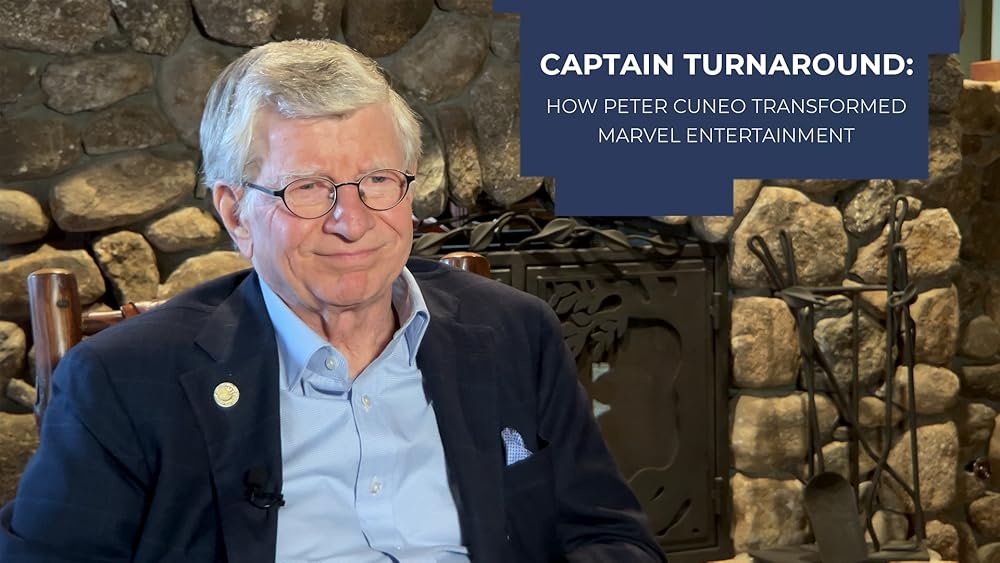
In that second phase, the CEO most commonly credited with executing the turnaround playbook was Peter Cuneo, who took the CEO role in July 1999 and led the strategic focus and operating clean-up that converted IP strength into durable cash flows.

Ike Perlmutter and Avi Arad role in Marvel’s recovery
Two roles are especially clear in SEC disclosures.
First, Avi Arad served as Chief Creative Officer of the company and President and CEO of the Marvel Studios division (responsible for motion picture and television licensing and development) beginning in October 1998—positioning film/TV licensing and creative development at the centre of the post-bankruptcy model.
Second, filings reflect governance and control influence: Isaac Perlmutter is listed among directors in post-bankruptcy disclosures, and later public records (including the 2009 acquisition announcement) identify him as Marvel’s Chief Executive Officer at the time of the sale to Disney—indicating his long-running role in the company’s strategic governance across the recovery arc.
CREATIVE + COMMERCIAL division of labour mattered: Arad’s mandate focused on development and licensing of screen projects, while the broader corporate strategy increasingly treated character exposure (films, television, promotions) as the flywheel that drives merchandise licensing and toy economics.
Peter Cuneo Marvel turnaround story
SEC filings state that F. Peter Cuneo served as President and Chief Executive Officer beginning in July 1999.
The turnaround problem was fundamentally one of business model conversion: turning a volatile publishing-and-toys mix into a high-margin licensing engine, while reducing financial fragility and dependency on any single product cycle. SEC narrative in later annual reporting explicitly frames Marvel’s strategy as increasing exposure of characters through media and promotional licensing, because that exposure expands revenue opportunities across toys and other licensed merchandise.
Even the company’s own risk disclosures in the early 2000s underline the operational logic: the business becomes partially dependent on the successful release of major entertainment programming (films and television), which drives demand for licensed products, publishing, and toys based on featured characters.

Post-bankruptcy monetisation engine
How Marvel made money after bankruptcy (licensing strategy)
The post-bankruptcy strategy can be summarised as: monetise characters through licensing first, invest selectively later.
SEC disclosures describe the licensing segment as responsible for merchandising, licensing, and promotion worldwide, and explicitly note a strategy emphasis on concentrating relationships with high-quality licensees and negotiating higher guaranteed royalty amounts.
The same SEC filing describes the business logic at the heart of the turnaround: increasing character exposure via third-party licensing (especially film and television) creates downstream revenue opportunities, including toys and other licensed merchandise.
Financial disclosures reinforce licensing’s centrality. In the mid-2000s, Marvel reported segment net sales where licensing represented the majority share of total net sales in some years (e.g., 2005 licensing net sales $230.1m out of total $390.5m, with licensing comprising 58.9% of sales mix in that year).
Marvel’s early movie licensing deals before the MCU
Before the MCU era, Marvel’s model relied heavily on licensing film rights to major studios rather than producing films itself.
A 2005-era SEC annual report states plainly that the company had licensed various characters to major motion picture studios for use in movies, citing licences with Twentieth Century Fox for properties including X-Men and Fantastic Four, and noting outstanding licences for other characters including Spider-Man and The Punisher.
The same SEC disclosure explains a deal structure that is critical to understanding the “turnaround economics”: Marvel generally retained control over merchandising rights and received more than 50% of merchandising-based royalty revenue under these film licences—capturing the lucrative consumer-products upside even when studios controlled box-office revenues.
Litigation disclosure in Marvel’s 2003 annual report provides additional hard evidence of early licensing architecture, including reference to a 1999 Spider-Man licence agreement between Marvel Characters, Inc. and Sony Pictures Entertainment, and reference to a 1993 X-Men movie licence in disputes involving other parties and Fox.

How Marvel set the stage for the MCU
The bridge from “film rights licensing” to “MCU-style studio platform” runs through two steps: (1) institutionalising character monetisation as a licensing flywheel, and (2) securing a scalable financing mechanism to self-produce films.
By 2005, Marvel publicly framed its growth strategy as increasing exposure of characters by licensing them to third parties, explicitly connecting that exposure to toy and merchandise revenue opportunities.
The pivotal shift came with the 2005 announcement of a $525 million non-recourse credit facility designed to finance production of up to ten films based on Marvel characters, alongside a name change from Marvel Enterprises to Marvel Entertainment to reflect the move into film production.
According to the SEC press release, the financing structure aimed to give Marvel creative control, the ability to build a film library, and higher profit potential than it had received from licensing to other studios, with distribution arranged through Paramount Pictures (then described as a unit of Viacom, Inc.).
In short: licensing built the brand and cash-flow logic; film-slate financing built the production capability. Together, those two steps created the conditions for a connected in-house film universe to become strategically feasible.
Results, stock recovery, and the Disney exit
Marvel stock turnaround: from pennies to major growth
Marvel’s stock recovery is best explained with split-aware, SEC-grounded price points.
In its FY2000 annual report, Marvel disclosed that the low closing price for its common stock in the fourth quarter of 2000 was $1 7/16 (i.e., $1.4375), based on NYSE composite closing prices.
In its FY2003 annual report, Marvel disclosed that it approved a 3-for-2 common stock split (implemented as a stock dividend) in February 2004, and explicitly noted that the disclosed historical stock prices in that table had not been adjusted for the announced split.
On a split-adjusted basis, the FY2000 low closing price of $1.4375 becomes approximately $0.96 (because a 3-for-2 split increases shares by 1.5, reducing per-share price by the same factor), which explains why many popular stock-history datasets and retrospective narratives describe a “$0.96” low.
The “major growth” endpoint has a precise public marker: Disney’s 2009 acquisition announcement valued the transaction at approximately $50 per Marvel share (based on the August 28, 2009 Disney closing price), consisting of $30 cash plus approximately 0.745 Disney shares per Marvel share.
Marvel’s sale to Disney and why it happened
Disney announced the agreement to acquire Marvel on August 31, 2009, explicitly positioning the deal as a way to combine Marvel’s globally recognised character library with Disney’s platform for cross-media exploitation (films, consumer products, and international distribution).
The stated economic rationale in the announcement focused on maximising the value of creative properties “across multiple platforms and territories,” and Disney identified Marvel’s character library as the core asset.
The deal closed on December 31, 2009, with Disney reiterating the per-share consideration structure (cash plus Disney shares).
From an internal Marvel trajectory standpoint, the acquisition is consistent with the post-bankruptcy evolution documented in SEC filings: once the company’s identity shifted toward licensing and film/entertainment (including Marvel Studios) rather than just publishing, it became structurally similar to a larger entertainment conglomerate’s “franchise IP” vertical—making it a strategically coherent target for a company designed to monetise characters across theme parks, consumer products, and global media.
Leadership principles and implementation lessons
Peter Cuneo leadership lessons from Marvel
The “Cuneo playbook” is most usefully understood as a set of disciplined choices that align capital structure, operating model, and monetisation strategy.
Make governance and roles match the revenue engine. SEC disclosures show a structure in which Marvel Studios (film/TV licensing and development) operated under a dedicated executive mandate while the corporate CEO focused on overall strategic and operational turnaround—an organisational separation that fits a licensing-led model.
Shift the centre of gravity from low-margin volatility to high-margin IP royalties. Marvel’s strategy is explicitly described in SEC filings as increasing exposure of characters through licensing because exposure itself creates revenue opportunities across licensed goods. This is a “flywheel” lens: films/TV as marketing plus brand-building, consumer products as monetisation.
Use deal structure to keep the best economics. The company disclosed that, even when licensing characters to major studios for films, it generally retained control over merchandising rights and kept more than half of merchandising-based royalty revenue—capturing a large share of the downstream value.
Invest only when the financing architecture de-risks the bet. The 2005 film-slate financing was structured as non-recourse debt at the film-finance subsidiary level, pledging film rights as collateral; Marvel framed the arrangement as a way to gain control and upside while containing corporate-level downside.
Treat profitability as a consequence of IP discipline, not publishing volume. Company reporting in the early 2000s repeatedly ties operating results to major entertainment releases and associated licensing; this reflects a strategic shift away from comics as the sole profit driver and toward comics as IP incubation plus brand maintenance.
Frequently Asked Questions (FAQs)
- Was Peter Cuneo the person who legally pulled Marvel out of Chapter 11?
The bankruptcy exit itself was executed through a court-confirmed plan culminating in the October 1, 1998 consummation of a Toy Biz/secured-lenders plan and Toy Biz’s name change to Marvel Enterprises. - When did Marvel file for bankruptcy protection?
The Chapter 11 filing date is documented as December 27, 1996. - Why did Marvel go bankrupt in 1996?
Reporting at the time emphasised collapsing demand in comics and trading cards, while court records show a fragile capital structure shaped by significant debt and upstream dividend payments from note proceeds earlier in the decade. - When did Peter Cuneo become Marvel’s CEO?
SEC disclosure states he served as President and CEO beginning in July 1999. - What did the Toy Biz merger actually do?
It provided the reorganisation structure that merged Marvel into a holding company controlled by Toy Biz and enabled emergence from bankruptcy, with Toy Biz becoming Marvel Enterprises. - How did Marvel make money after bankruptcy if comics sales were unstable?
SEC filings describe a licensing-led model: licensing characters for consumer products, promotions, and media (including films and television) to create royalty revenue and amplify demand for toys and other merchandise. - Did Marvel license film rights before the MCU era?
Yes. SEC filings state Marvel licensed characters to major studios for films, and litigation disclosures reference a 1999 Spider-Man licence agreement and a 1993 X-Men movie licence context. - What changed with the $525 million film financing in 2005?
The facility was designed to finance production of up to ten films on a non-recourse basis, with Marvel framing it as enabling creative control, library-building, and greater profit potential than third-party licensing alone. - How low did Marvel’s stock go during the turnaround years?
Marvel disclosed a low closing price of $1 7/16 in Q4 2000; after a later 3-for-2 stock split (stock dividend), that equates to roughly $0.96 on a split-adjusted basis. - Why did Disney buy Marvel?
Disney’s announcement framed the deal as combining Marvel’s global brand and character library with Disney’s platform for monetising creative properties across multiple businesses and territories, valuing Marvel at about $4 billion (about $50 per share based on the reference date).
Conclusion
Marvel’s recovery was not a single moment of rescue; it was a chain of decisions: exiting Chapter 11 through a court-approved plan that merged Marvel into a Toy Biz-controlled structure, then executing an operating turnaround and business-model conversion that elevated licensing, film/TV exposure, and merchandise economics as the core engine.
Peter Cuneo’s role sits in the critical “second act”: arriving as CEO in July 1999 and driving the disciplined shift toward IP monetisation and strategy-company thinking—an approach later amplified by the 2005 non-recourse film-slate financing and ultimately validated by Disney’s acquisition.
Sources and citation
Primary, high-reliability sources used throughout include U.S. District Court opinions on the bankruptcy and merger plan, SEC filings and press releases, and contemporaneous major-media reporting.
- U.S. District Court records and bankruptcy opinions documenting Marvel’s Chapter 11 case, trustee-appointment context, plan-confirmation proceedings, and consummation-related orders tied to the October 1, 1998 emergence date.
https://law.justia.com/cases/federal/district-courts/BR/222/243/2018929/ - SEC annual report disclosure establishing Marvel’s leadership, licensing-led strategy, and revenue model.
https://www.sec.gov/Archives/edgar/data/933730/000111667906000702/marv10k.htm - SEC filing and press-release materials on Marvel’s 2005 $525 million film-slate financing, including the non-recourse structure and strategic intent to fund up to ten films.
https://www.sec.gov/Archives/edgar/data/933730/000111667905002263/ex99-1.htm - Los Angeles Times reporting on Marvel’s emergence from bankruptcy on October 2, 1998.
https://www.latimes.com/archives/la-xpm-1998-oct-02-fi-28533-story.html - Washington Post reporting on Marvel’s December 27, 1996 Chapter 11 filing.
https://www.washingtonpost.com/archive/business/1996/12/28/marvel-entertainment-files-for-bankruptcy-protection/73bb4597-3076-48eb-a113-1b5f8e654a6a/ - Variety reporting on the July 1998 court action that enabled steps toward the Toy Biz merger.
https://variety.com/1998/biz/news/court-backs-marvel-on-toy-biz-merger-1117478431/ - Disney/Marvel SEC joint press release on the 2009 acquisition terms, valuation framework, approvals, and closing conditions.
https://www.sec.gov/Archives/edgar/data/933730/000119312509184676/dex991.htm
Recommended
- Marvel Heroes Omega 1.0: What It Is, How It Works, and How Players Are Bringing the Game Back
- Venom Animated Movie From Final Destination: What Fans Mean, Rumors Explained, and What Could Actually Happen
- Sony May Be Drastically Shifting Its PC Strategy – Report: What It Means for PlayStation PC Ports
- Can you zoom the camera in Blender?
- Project Hail Mary Review: A Spoiler-Free Guide to the New Sci-Fi Event
- The Most Efficient Way to Create 3D Ponytails in Blender
- Adobe Releases Photoshop 27.5: What’s New, Firefly Boards Integration, and How to Update
- Actor Says “Let Them Cook”: Why Fans Should Give ’s TV Show a Chance
- How to Transfer Daz 3D Hair to Unreal Engine: Groom Workflow for Metahuman Integration
- Can You Change the Focal Length of a Camera in Blender?