









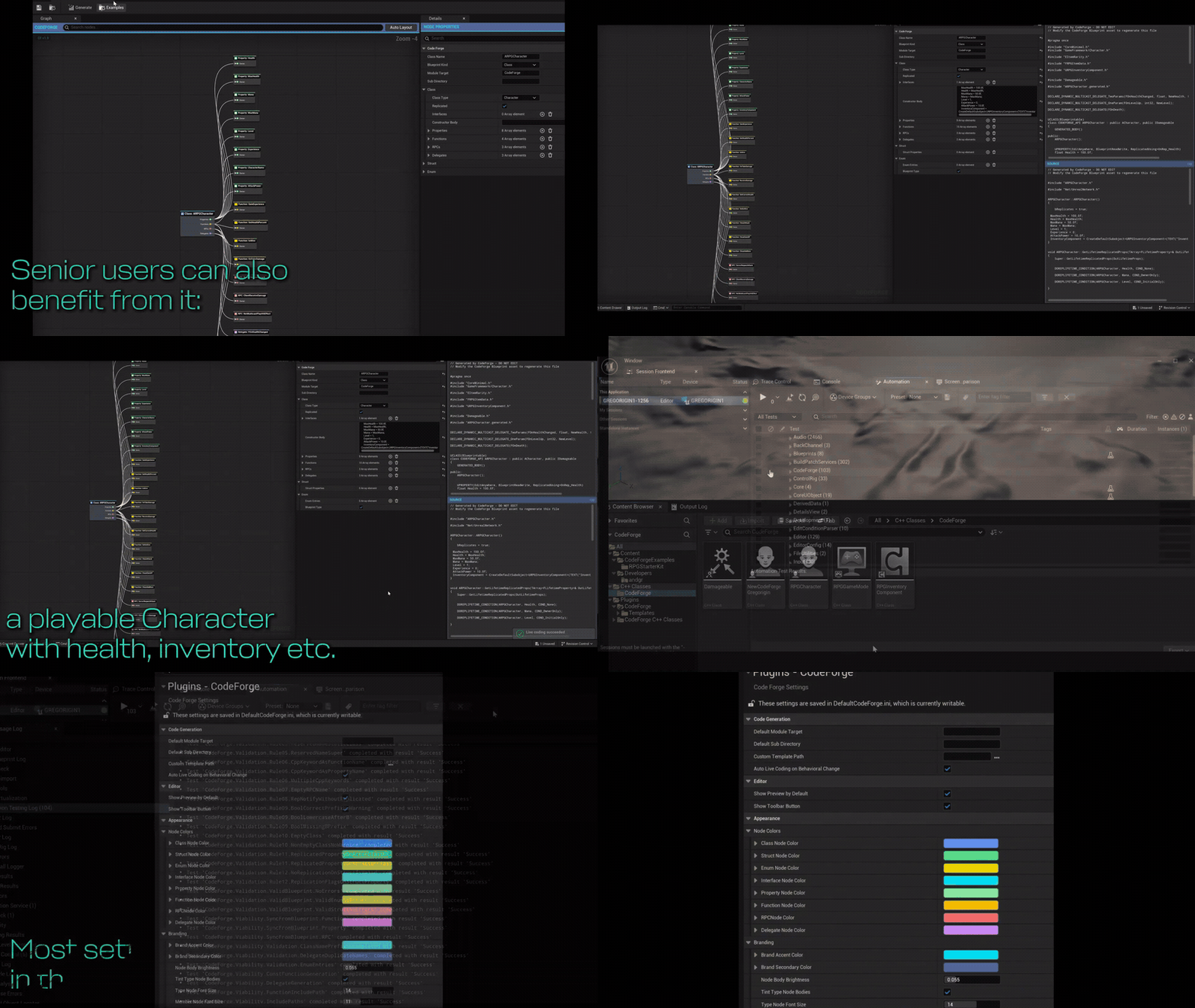
CodeForge is a native, node-based, offline visual C++ programming plugin for Unreal Engine designed to remove repetitive boilerplate from Unreal Engine C++ development while keeping the final output as real, editable .h and .cpp source files on disk. It provides a visual graph editor for defining UE5 classes, structs, enums, and interfaces, then generates UHT-compliant code you can compile normally—no cloud services, no AI dependency, and no runtime scripting layer required.
What is CodeForge for Unreal Engine C++ development?
CodeForge is an Unreal Editor plugin that lets you model Unreal C++ types visually—then generates complete, compile-ready header/source files. Instead of hand-writing UCLASS, USTRUCT, UENUM, UINTERFACE, UPROPERTY, and UFUNCTION boilerplate (plus includes, prefixes, and networking scaffolding), you configure those elements via a graph and details panel, and CodeForge outputs the correct C++ instantly.
Two practical goals define the tool’s core value:
- Deterministic, offline code generation: CodeForge’s generation is template-driven and self-contained, aiming to produce consistent output that matches Unreal’s build pipeline expectations.
- High-leverage scaffolding: It focuses on the parts of Unreal C++ that are slow and error-prone to type repeatedly—reflection macros, naming rules, replication setup, and RPC stubs.

Node-based visual C++ programming in Unreal Engine: how it works
CodeForge’s workflow centers on a dedicated data asset (“CodeForge Blueprint”) that stores a type definition and exposes a custom graph editor for wiring members (properties, functions, RPCs, delegates) into a single type node (class/struct/enum/interface). You edit structure in the graph, configure details through the standard Details panel, validate continuously, and generate code when ready.
Under the hood, the system is organized in layers so the editor UI stays decoupled from the schema model and from the template-driven generator. The manual describes a four-layer split (data model → template engine → generator → UI), with a runtime module holding the data definitions and an editor module handling generation and tooling.
This “visual-first, code-on-disk” model intentionally differs from Blueprints: the graph is not meant to run gameplay logic as nodes at runtime. Instead, the graph is a structured UI for defining C++ artifacts that are compiled and maintained like ordinary Unreal C++ source.
Visual graph to C++ files: generating UHT-compliant .h and .cpp in UE5
Unreal’s reflection system relies on the Unreal Header Tool (UHT) scanning annotated headers and generating glue code (e.g., *.generated.h, plus generated reflection and helper code) during builds. This is why Unreal code has strict conventions like including FileName.generated.h, placing reflection macros correctly, and using specific naming/prefix rules for types.
CodeForge’s generation pipeline converts the graph into a structured context (a dictionary/model of your type), then renders that context into C++ strings via .cft templates, producing .h and .cpp files meant to be UHT-compliant and compile-ready.
A key implication: CodeForge must be careful about exactly the kinds of details UHT and Unreal coding standards enforce—class prefixes (A, U, F, E, I), correct placement of GENERATED_BODY(), and avoiding reserved names that collide with Unreal’s macro/reflection ecosystem.
CodeForge node types explained: Class, Struct, Enum, Interface, Property, Function, RPC, Delegate
CodeForge exposes eight primary node types corresponding to common UE5 code constructs:
- Class: Defines a
UCLASS-based type, with a selectable base class family and support for properties, functions, RPCs, delegates, and replication when applicable. - Struct: Defines
USTRUCT(BlueprintType)-style structs, with validation preventing invalid replication flags on struct members. - Enum: Defines
UENUM(BlueprintType)enums (the manual describes auint8backing type and optionalUMETA(DisplayName)metadata). - Interface: Generates Unreal’s dual-pattern interface form (a
UINTERFACE+ anI-prefixed abstract interface class) and supports Blueprint-callable/native event patterns as described in the manual. - Property: Generates
UPROPERTY(...)declarations with specifiers derived from checkbox/config UI; can optionally generate RepNotify wiring when enabled. - Function: Generates
UFUNCTION(...)declarations with appropriate specifier strings and can accept raw C++ bodies in supported workflows (e.g., “FunctionBody”, “ConstructorBody” mentioned in the repository description). - RPC: Visual configuration for networking functions (Server/Client/NetMulticast) with stubs emitted into header/source output.
- Delegate: Generates Unreal delegate boilerplate for event-style dispatch; the repository positions this as a key “scaffolding” win for senior developers as well.
The editor enforces schema correctness: for example, the product description notes that typed pins constrain what can connect to what, and that RPC nodes are restricted to actor-derived contexts.

Unreal Engine replication scaffolding generator (GetLifetimeReplicatedProps, DOREPLIFETIME, OnRep)
Unreal’s canonical replication setup typically includes:
- Marking a property as replicated in the header (e.g.,
UPROPERTY(Replicated)). - Overriding
GetLifetimeReplicatedPropsin the.cpp. - Registering fields with
DOREPLIFETIMEorDOREPLIFETIME_CONDITION. - Enabling replication on the actor (commonly
bReplicates = true).
CodeForge’s replication scaffolding is designed to generate that entire pattern from UI configuration: constructor replication flags, GetLifetimeReplicatedProps() overrides, conditional replication macros, and RepNotify callbacks (OnRep_...) for properties configured to use ReplicatedUsing.
A concrete baseline example (illustrative of what CodeForge targets) looks like this:
// Header
UPROPERTY(ReplicatedUsing=OnRep_Health)
float Health;UFUNCTION()
void OnRep_Health();// Source
void AMyActor::GetLifetimeReplicatedProps(TArray<FLifetimeProperty>& OutLifetimeProps) const
{
    Super::GetLifetimeReplicatedProps(OutLifetimeProps);
    DOREPLIFETIME(AMyActor, Health);
}
This aligns with Epic’s documented replication fundamentals: GetLifetimeReplicatedProps plus DOREPLIFETIME (or DOREPLIFETIME_CONDITION) as the mechanism for property replication registration.
CodeForge also advertises broad coverage of replication conditions and “advanced replication” improvements in its changelog, including RepNotify support and template updates that populate GetLifetimeReplicatedProps automatically.
Visual RPC creation in Unreal Engine: Server, Client, and NetMulticast stubs
RPCs in Unreal typically require a precise set of declaration and definition patterns—especially when generating _Implementation (and, where used, _Validate) functions. CodeForge supports visual configuration of Server, Client, and NetMulticast RPCs and generates the corresponding stubs into header/source outputs.
The 0.2.0 changelog explicitly calls out new RPC definition data types and node support (“UCodeForgeRPCDef” and “CodeForgeNode_RPC”), along with generation of Server/Client/NetMulticast functions through the visual UI.
The manual also describes generation of “full client/server/multicast RPCs complete with _Implementation and _Validate stubs,” framing this as a first-class output pattern rather than a placeholder.

Live code preview inside Unreal Editor for generated C++
A key usability feature is live code preview: a split-pane or tabbed panel that shows the generated .h and .cpp updating as you edit the graph and details. This reduces “generator guesswork” by making the exact output visible before you write files to disk.
Practically, live preview supports higher confidence when working with Unreal’s strict macro conventions—especially around include ordering, specifier strings, and the presence of required macros like GENERATED_BODY(). The manual describes the preview as updating in real time and presenting separate header/source tabs.
Structural change detection vs Live Coding: faster iteration in Unreal Engine
Unreal’s “compile while editor is open” workflows are powerful but historically constrained. Community guidance emphasizes that changes affecting UHT-scanned headers and “U-macro” structures often require closing the editor and performing a full rebuild to avoid inconsistent states or asset issues, whereas many .cpp implementation changes can be iterated more safely with Live Coding.
CodeForge formalizes this into a generator-level decision system:
- Structural changes: additions/renames that alter class layout or signature (new properties, changed function signatures).
- Behavioral changes: “minor logic tweaks” or function-body edits.
The plugin describes maintaining a generation manifest and classifying regenerations so it can choose smarter compilation paths. The 0.2.0 changelog notes JSON generation manifests and a change detector that differentiates structural vs behavioral changes for hot-reload/compilation strategy.
This matters because it targets the real bottleneck in Unreal C++ iteration: you want fast compiles when only behavior changes, but you need safer rebuild/restart paths when reflection-scanned structure changes.
Custom template engine for Unreal C++ code generation (.cft templates)
CodeForge’s code generation is driven by .cft template files using a Handlebars-like syntax. The manual documents template location under the plugin’s Content/Templates directory and describes common syntax patterns ({{Var}}, conditionals, loops, partials).
The template system is not an external scripting dependency: the repository describes a bespoke, string-based template engine (implemented in C++) that parses .cft and outputs Unreal Build Tool–compliant code.
From a production standpoint, the most important capability is override support: you can point “Custom Template Path” in project settings to your own templates, allowing teams to enforce house style (copyright blocks, include order, naming rules), add standardized comment blocks, or restructure generated output without rewriting plugin code.
Auto-validation and naming convention fixes for Unreal C++ (b-prefix, type names, keywords)
Unreal C++ is rigid about naming and prefixes. Epic’s coding standard explicitly states that boolean variables must be prefixed with b, and that type names use distinguishing prefixes (A, U, F, E, I, etc.), with UHT often requiring correct prefixes “in most cases.”
CodeForge integrates real-time validation into the graph UI to catch common failure modes before compilation—duplicate member names, conflicting specifiers, reserved/keyword collisions, missing type prefixes, and incorrect type spellings/capitalization (e.g., Float → float, String → FString, Vector → FVector).
Beyond flagging problems, CodeForge includes one-click auto-fixes for specific rule classes—renaming bool properties to include b, applying correct class prefixes without double-prefixing, and stripping invalid replication flags from struct contexts. The manual documents an “Auto-Fix System” and enumerates example fix patterns such as FixBoolPrefix and FixType.

Drag-and-drop Struct and Enum type assignment from Content Browser to properties
Type wiring in Unreal C++ can be deceptively tedious: even if you know the correct type name, you still need the correct include path and prefix rules to keep UHT happy.
CodeForge supports drag-and-drop assignment: you can drag a CodeForge struct or enum asset from the Content Browser onto a Property node, and the plugin auto-fills the property type and include path, minimizing manual typing and include hunting.
This feature is particularly aligned with a “schema-first” workflow where structs/enums are modeled as reusable assets and referenced across multiple generated classes—helping prevent mismatched names and missing includes.
Supported UE5 base classes in CodeForge (AActor, APawn, UActorComponent, UObject, and more)
CodeForge ships with predefined support for common gameplay base classes. The product listing and manual describe coverage for 11 UE base class families, including:
AActor, APawn, ACharacter, UActorComponent, USceneComponent, UObject, AGameModeBase, AGameStateBase, APlayerController, APlayerState, AHUD—plus USTRUCT, UENUM, and UINTERFACE generation for data and contracts.
In practice, this selection aims to cover the majority of standard gameplay architecture patterns (actors and pawns for world entities, components for composition, and UObject-derived types for subsystems and data-oriented code).
How to install and use CodeForge in Unreal Engine projects (UE5.6+ / UE5.7+)
CodeForge is distributed in two primary channels:
- A functional open-source “Core” version (GitHub), described as supporting Unreal Engine 5.6+.
- A Pro version on Fab, described as the “fully featured, updated and supported” release line.
For installation, the manual’s baseline workflow is:
- Place the plugin in your project’s
Plugins/directory (expected structure:Plugins/CodeForge/CodeForge.uplugin, withContent/andSource/inside). - Regenerate project files (e.g., right-click the
.uproject→ “Generate Visual Studio project files”). - Compile and open the editor, then verify the plugin is enabled under Edit → Plugins.
The manual notes that its documented build targets Unreal Engine 5.7 and that the plugin descriptor sets an engine version accordingly.
For usage inside a project:
- In the Content Browser, create a CodeForge Blueprint asset (via context menu).
- Open the asset to access the graph editor.
- Choose the blueprint kind (
Class,Struct,Enum,Interface), set names and class type/base, then add member nodes (properties/functions/RPCs/delegates) and connect them. - Use validation feedback, inspect live code preview, then click Generate Code to write
.h/.cppto disk for compilation.

CodeForge vs Blueprints vs hand-written C++: when to use each approach
Epic’s own guidance emphasizes that there is rarely a single “correct” answer; many projects benefit from a mix of Blueprints and C++, depending on the needs of iteration speed, performance constraints, and maintainability.
A practical division of labor that CodeForge complements well looks like this:
- Blueprints: Best for rapid prototyping, designer-friendly iteration, and shipping gameplay interactions without touching an IDE—especially early in development or for content-heavy logic.
- Hand-written C++: Best for engine-level control, performance-critical systems, low-level gameplay frameworks, and complex refactors where a developer wants direct, explicit code ownership.
- CodeForge-generated C++: Best when the primary cost is boilerplate and correctness, not algorithm invention—e.g., standing up a replicated actor/component with multiple properties, RepNotify hooks, and RPC stubs, or standardizing large amounts of “shape-of-code” across a team.
The key differentiator: CodeForge outputs real C++ files. That means you can start with generated scaffolding and then extend/optimize in hand-authored code, while still leveraging the generator for repetitive patterns and consistent conventions.
CodeForge open-source version vs Pro version on Fab: feature differences and workflow
The Fab listing explicitly describes the open-source version as a “functional core” available on GitHub, while positioning the Fab product as the fully featured, updated, and supported Pro version.
Based on the public product discussion changelog (0.2.0, April 9, 2026), the Pro release line highlights several concrete areas of expansion and hardening:
- RPC & advanced replication system: Dedicated RPC definitions and node support for Server/Client/NetMulticast configuration, plus RepNotify improvements and templates that populate
GetLifetimeReplicatedProps. - Structural change detection: A change detector and JSON generation manifests to classify structural vs behavioral changes for smarter compile workflows.
- Template engine v2 updates: Expanded template capabilities for additional includes, more complex loops for replication/RPCs, and modularized template components.
- RPG Starter Kit and documentation: A maintained example project showcasing replicated stats, inventory component logic, and console commands for testing.
- UI/UX enhancements and rebuild verification: Validation badges on nodes and rebuild verification noted for Unreal Engine 5.7.0 in the update notes.
Workflow-wise, both versions share the same core loop (design → validate → preview → generate → compile), but the Pro positioning is centered on faster production iteration, more advanced networking scaffolding, and an actively updated template/feature surface.

Frequently Asked Questions (FAQs)
- Is CodeForge the same thing as Unreal Engine Blueprints?
No. CodeForge uses a node graph UI, but its output is generated C++ source files (.h/.cpp) intended for normal Unreal builds, not runtime node execution. - Does CodeForge work offline?
Yes. The product positioning emphasizes deterministic, offline operation with no external dependency requirement for code generation. - What Unreal Engine versions are supported?
The open-source core is described as UE 5.6+, while the manual documents a UE 5.7 target for the described release line and notes rebuild verification in the 0.2.0 update notes. - Can CodeForge generate replication boilerplate automatically?
Yes. It advertises generation of constructor replication flags, GetLifetimeReplicatedProps, conditional replication macros, and RepNotify (OnRep_) scaffolding. - Can CodeForge generate RPCs (Server/Client/NetMulticast)?
Yes. The manual and changelog describe visual RPC configuration and generation of stubs, including _Implementation and (where used) _Validate. - Where do templates live, and can they be customized?
Templates live under the plugin’s Content/Templates/ and can be overridden by specifying a custom template path in project settings. - Does CodeForge help enforce Unreal naming conventions (like the b prefix for bools)?
Yes. CodeForge includes validation plus one-click auto-fixes, and Epic’s coding standard explicitly requires b-prefixed boolean variables and correct type prefixes that UHT often depends on. - Can I drag structs/enums from the Content Browser onto properties?
Yes. CodeForge supports drag-and-drop struct/enum assignment that auto-fills the type and include path. - Why does “structural vs behavioral” change detection matter?
Because Unreal workflows often require different compile/reload strategies: UHT-related header/structure changes can require editor restarts or safer rebuilds, while many .cpp behavior changes can iterate faster. CodeForge formalizes this split using generation manifests and classification. - Who is CodeForge for?
It targets developers who understand Blueprints but want a guided bridge to best-practice Unreal C++ structure, and it also targets experienced developers who want to reduce repetitive scaffolding time.
Conclusion
CodeForge is positioned as a native, node-based, offline visual C++ programming plugin for Unreal Engine that turns visual type design into UHT-compliant .h/.cpp output—particularly valuable for standardizing Unreal C++ structure, eliminating replication/RPC boilerplate, and improving iteration through validation, templates, and structural change detection.
Sources and citation
- CodeForge — product overview and core features (nodes, templates, generation workflow)
https://codeforge.dev - CodeForge — user manual / documentation (installation, architecture, templates, validation pipeline)
https://docs.codeforge.dev - CodeForge — open-source repository (UE integration, deterministic/offline generation, scaffolding focus)
https://github.com/codeforge-dev/codeforge - CodeForge Pro — changelog (v0.2.0 features: replication/RPCs, template engine v2, change detection)
https://codeforge.dev/changelog - Unreal Engine — reflection system overview (UHT, generated headers, macros)
https://docs.unrealengine.com/5.0/en-US/unreal-engine-reflection-system/ - Epic Games — Network Tips and Tricks (replication fundamentals, DOREPLIFETIME usage)
https://www.unrealengine.com/en-US/blog/network-tips-and-tricks - Epic Games — C++ Coding Standard (prefixes, bool “b” naming, UHT requirements)
https://docs.unrealengine.com/5.0/en-US/epic-cplusplus-coding-standard-for-unreal-engine/ - Unreal Engine community wiki — Hot Reload vs Live Coding limitations (UHT header changes context)
https://unrealcommunity.wiki/live-compiling-in-unreal-projects-tp14jcgs - Epic Games Tech Blog — balancing Blueprint and C++
https://www.unrealengine.com/en-US/tech-blog/balancing-blueprint-and-c
Recommended
- Can I Improve My Metahuman in Blender? A Comprehensive Guide
- MetaHuman Creatures: Crafting Non-Human Characters with Unreal Engine’s MetaHuman Framework
- How to Make Blender Hair Work with Unreal Engine’s Groom System
- Scientists Make Breakthrough That Allows Lab-Grown Brain Cells To Play A Sort Of Video Game (UC Santa Cruz Cart-Pole Results Explained)
- How do I simulate a GoPro-style camera in Blender?
- Skin Texturing in Substance Painter: How to Create Realistic Digital Skin Step by Step
- How to Integrate Metahuman with ALSV4 in Unreal Engine 5: Complete Setup Guide
- Hit Manga Chainsaw Man Will End Soon, Viz Media Confirms
- Intergalactic: The Heretic Prophet Controversy – Exploring the Backlash and Public Discourse
- Daredevil: Born Again Season 2 Review – A Darker, Grittier Marvel Comeback That Surpasses Season 1