




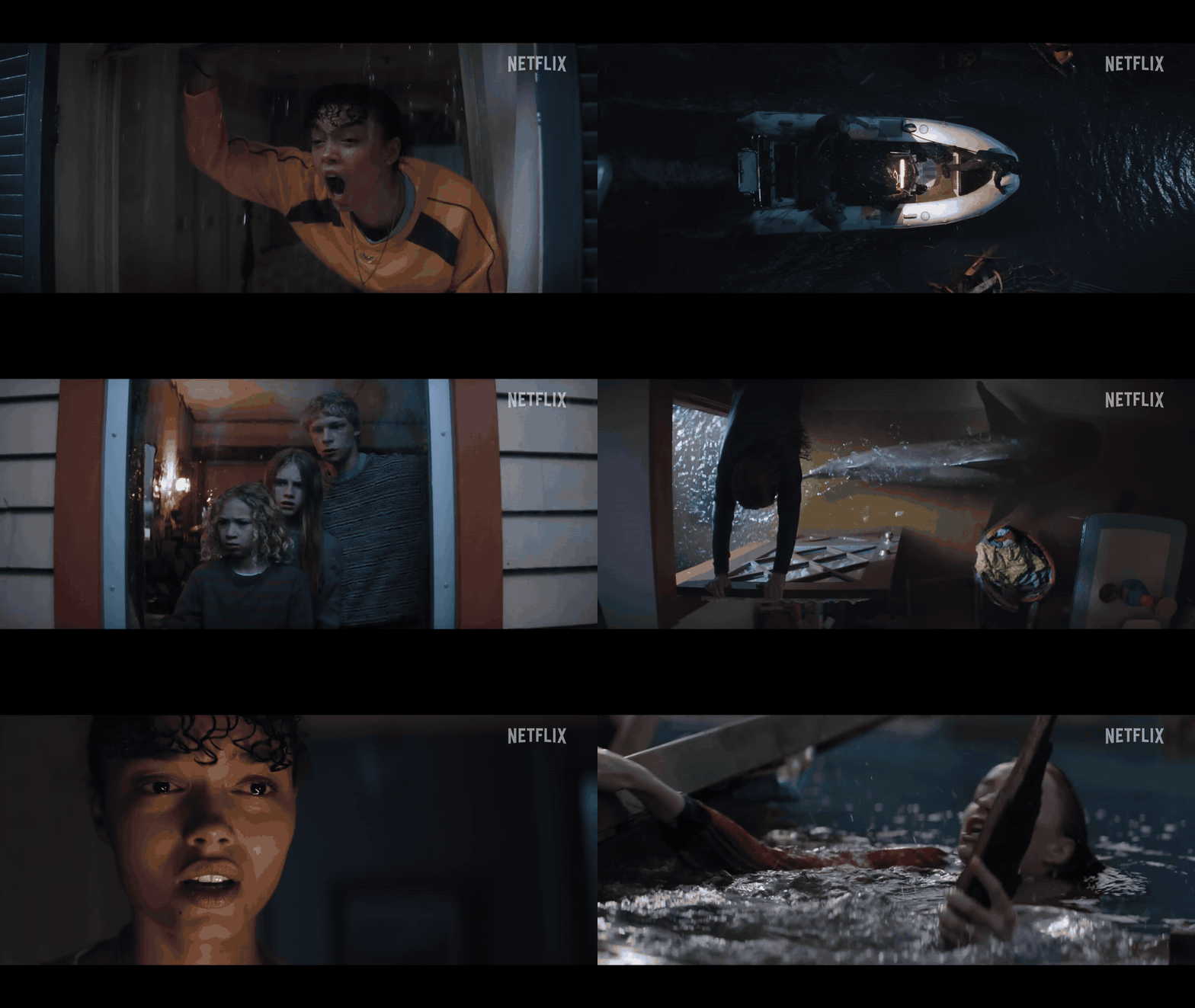
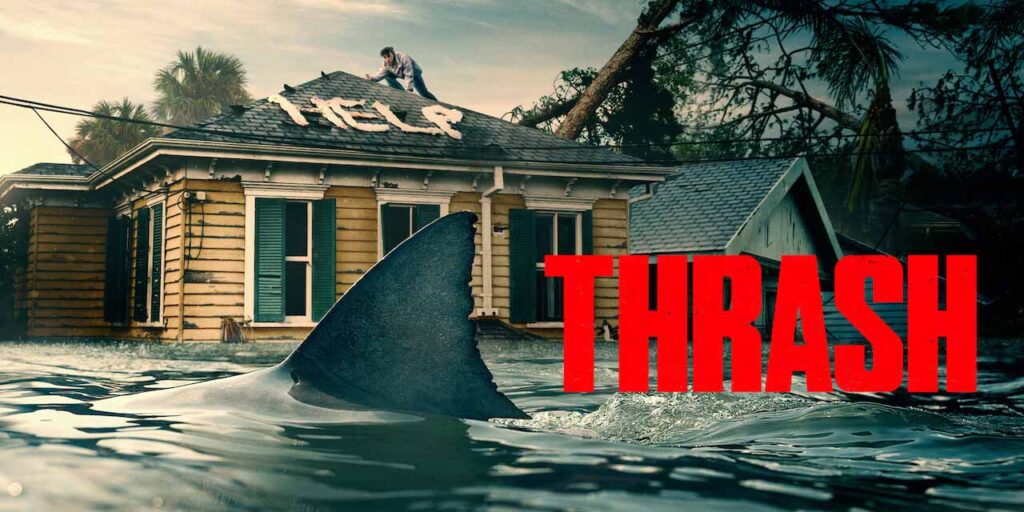
Netflix’s new shark horror movie Thrash is the kind of streaming release that critics can argue over while audiences still click play in huge numbers. Released on April 10, 2026, the 86-minute survival thriller throws a pregnant lead character, a Category 5 hurricane, floodwater survival, and inland sharks into one brisk B-movie package.
As of April 23, 2026, it has a 43% Tomatometer and 24% Popcornmeter on Rotten Tomatoes, plus a 48 Metascore on Metacritic, yet it still opened at No. 1 on Netflix’s English film list with 37.7 million views and held that top spot for a second week with 34.5 million views. That gap between critical caution and viewer curiosity is exactly why Thrash has become such a talking point.
What Is Thrash on Netflix? Plot, Cast, and Shark Horror Premise Explained
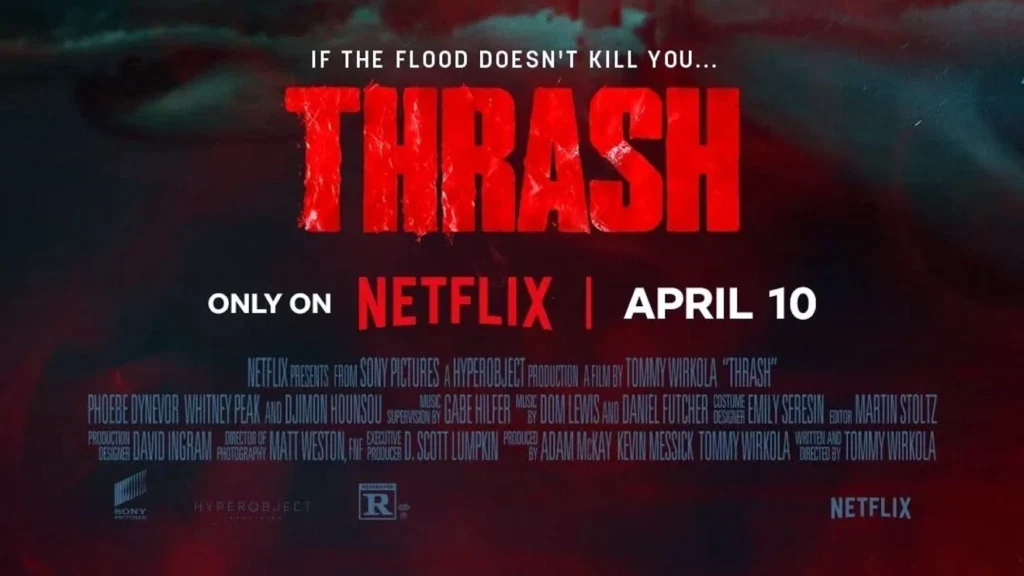
Thrash is a 2026 survival thriller written and directed by Tommy Wirkola. Official Netflix materials describe it simply: when a catastrophic hurricane slams a coastal town, stranded residents must survive rapidly rising waters full of ravenous sharks. The film runs 1 hour and 26 minutes, stars Phoebe Dynevor, Whitney Peak, and Djimon Hounsou, and is framed by Netflix as a creature feature crossed with an action-thriller rather than a prestige horror drama.
It is also a hybrid by design. Tudum reports that producer Adam McKay and Kevin Messick backed the idea because Wirkola’s taste for “fun, over-the-top” filmmaking fit a movie that needed to work as both a natural-disaster thriller and a shark-attack movie. That hybrid identity is central to understanding why Thrash feels both messy and oddly clickable: it is not trying to be restrained.
Why Thrash Is Trending on Netflix Right Now
The most important reason Thrash is trending is the simplest one: it performed immediately. In Netflix’s official weekly Top 10 report for the week of April 6, 2026, the film debuted at No. 1 on the English film list with 37.7 million views. In the next weekly report, published April 21, it stayed at No. 1 with 34.5 million views. Official Netflix coverage also notes that viral marketing helped its second-week staying power.
There is also a regional popularity angle. On Netflix’s Nigeria Top 10 page for April 13–19, 2026, Thrash ranked No. 1 in Movies. That matters because it suggests the film’s appeal is not limited to one market; it is traveling as a high-concept, low-friction streamer with a premise viewers can understand in seconds. Shark movie, hurricane movie, survival movie, Phoebe Dynevor vehicle: all of those hooks are instantly legible.
The Wild Plot of Thrash: Sharks, Floodwaters, and Survival Explained
The story takes place in a fictional coastal town in South Carolina as Hurricane Henry bears down. Lisa Fields is nine months pregnant and trapped in her car when the flooding begins. Dakota Edwards, an agoraphobic young woman, becomes one of her main lifelines, while Dakota’s uncle Dale Edwards, a marine researcher, tries to reach her through the storm. At the same time, three foster siblings are trapped with abusive guardians in a house slowly filling with water and sharks. The movie escalates the shark threat with a deliberately pulpy flourish: a truck carrying animal blood worsens the feeding frenzy in the floodwaters.
That structure explains both the film’s appeal and one of the major criticisms against it. It is constantly moving, always cutting to another perilous location, and always looking for a nastier or sillier survival beat. But the split focus also means the film sacrifices the clean, escalating tension that defines stronger single-location creature features.
Who Stars in Thrash? Full Cast and Characters Guide
The core cast is straightforward and unusually well-billed for this kind of movie. Phoebe Dynevor plays Lisa Fields, the heavily pregnant lead; Whitney Peak plays Dakota Edwards, the agoraphobic local who becomes crucial to the rescue effort; and Djimon Hounsou plays Dr. Dale Edwards, Dakota’s uncle and the film’s shark expert. Supporting players include Matt Nable as Billy Olson, Andrew Lees as Joe Sprinkle, Alyla Browne as Dee, Stacy Clausen as Ron, Dante Ubaldi as Will, Sami Afuni as Doug the Camera Guy, Chai Hansen as Brian, Amy Mathews as Rachel Olson, Adam Dunn as Harbor Master Greg Wilson, and Annabel Mullion as Claire Fields.
Netflix’s own cast guide emphasizes the main survival triangle of Lisa, Dakota, and Dale, which is the emotional center the movie keeps returning to even as it jumps across multiple disaster threads. That helps Dynevor’s character stay central, but it also means the ensemble around her ranges from decently sketched to glorified shark bait.
Is Thrash Worth Watching? Critics and Audience Reactions Breakdown
Whether Thrash is worth watching depends on what kind of shark movie you want. If you want a disciplined suspense machine, the scores are a warning sign: as of April 23, 2026, Rotten Tomatoes shows 43% from 56 critic reviews and 24% from 500+ audience ratings, while Metacritic gives it a 48 from 14 critic reviews and a 4.5 user score from 29 ratings. Those numbers point to a broadly mixed-to-negative reception, especially among viewers.
If, however, you want an easy-streaming creature feature with a fast pace and a committed lead performance, the source material suggests a more forgiving verdict. Metacritic’s critic spread is notably more mixed than disastrous, with 3 positive, 9 mixed, and 2 negative reviews, and several cited notices praise the movie’s energy even while criticizing its execution. That makes Thrash feel less like a total washout than like a disposable but functional genre programmer.
Thrash Rotten Tomatoes Score and What It Really Means
The Thrash Rotten Tomatoes score means something more specific than many casual readers assume. According to Rotten Tomatoes’ own explanation page, the Tomatometer represents the percentage of professional reviews judged positive, not a weighted average score out of 100. So Thrash at 43% does not mean every critic thought it was a 4.3/10 movie; it means fewer than half of the counted reviews were positive overall.
That distinction matters here because Thrash clearly splits critics between “this is junk” and “this is at least watchable junk.” The 48 Metascore reinforces that reading. It places the film in mixed territory rather than in outright critical collapse, which is why you can find both harsh takedowns and reluctant endorsements in the same review ecosystem.
What Critics Are Saying About Netflix’s New Shark Movie Thrash
The negative case against Thrash is consistent. The Guardian called it a suspense-free dud and argued that the ensemble structure drains momentum rather than builds it, while RogerEbert.com said the film feels lazy and fails to locate either real tension or satisfying B-movie thrills. The A.V. Club’s review summary likewise suggests the film keeps winking at its audience without ever fully committing to either serious horror or full-throttle camp.
The more positive or mixed case is also easy to trace. On Rotten Tomatoes, blurbs from major reviews show a softer view: The Hollywood Reporter’s line suggests the film stays afloat as a bloody dumb shark thriller, while Variety frames it as familiar but competent and helped by its compact runtime. On Metacritic, Collider’s 80 and Polygon’s 63 both point to a movie that may not maximize its premise but still throws itself into the chaos with enough enthusiasm to entertain.
Why Some Reviews Say Thrash Is Fun but Flawed
This is probably the most accurate one-line summary of the film. Reviewers who respond to Thrash tend to like the same things: its short runtime, its shameless premise, its flood-survival mechanics, and its willingness to pile on absurdity. CinemaBlend explicitly describes it as fun if chaotic, and The Playlist calls it an easy watch even while concluding that it lands in a middling space between proper thriller and full schlockfest.
The flaws are just as stable across reviews. Critics repeatedly object to implausible character behavior, thin emotional development, scattered structure, and shark effects that do not consistently sell danger. Guardian and RogerEbert both argue that the film’s set pieces should generate more dread than they do, while CinemaBlend’s harsher pieces point to cartoonish logic and especially notorious baby-related scenes as examples of how fast the movie tips from tense to ridiculous.
Phoebe Dynevor’s Performance in Thrash: From Bridgerton to Shark Horror
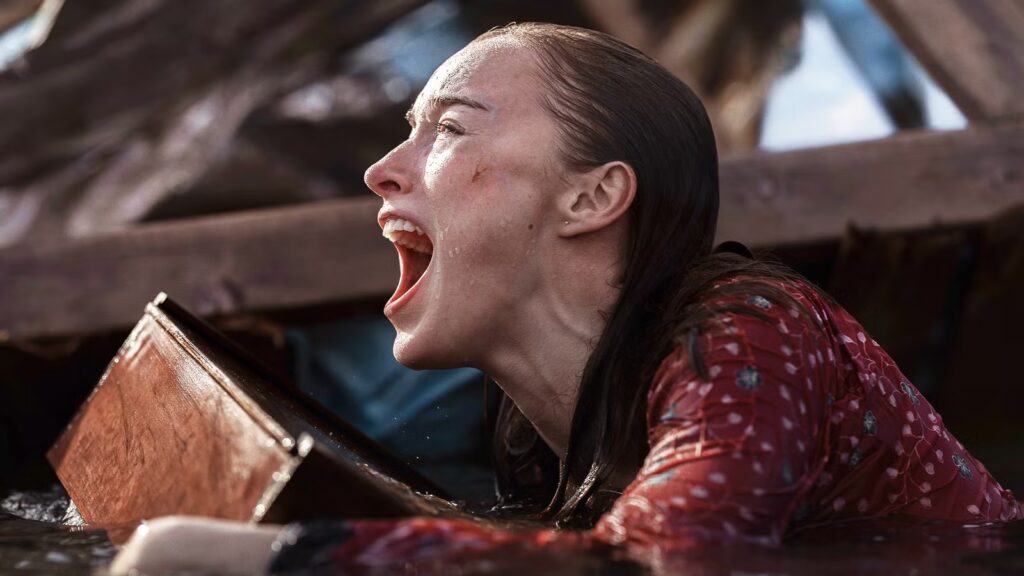
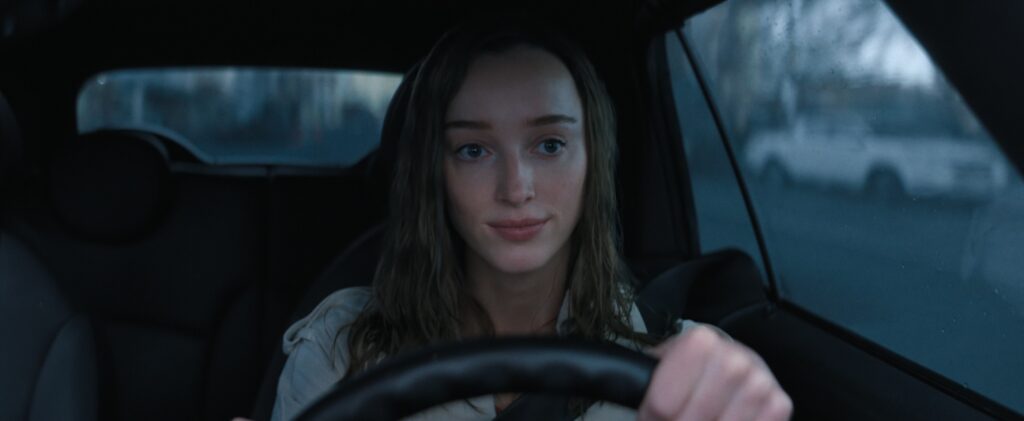
Phoebe Dynevor’s role in Thrash is a clear genre pivot from the romantic image many viewers still associate with Bridgerton. In Netflix’s own materials, she described Lisa’s ordeal as the “longest day ever,” which is the right way to understand the part: the performance is built around sustained physical panic, exhaustion, labor pain, and survival instinct rather than dialogue-driven character psychology.
That physicality was real behind the scenes too. A Hollywood Reporter interview summary notes that Dynevor wore three wetsuits under a pregnancy belly while filming in cold water, and even negative RogerEbert commentary still singled her out as an actor capable of selling the predicament. Peter Travers’ pull-quote on Metacritic similarly suggests the movie lets her down more than she lets the movie down.
How Thrash Combines Hurricane Disaster and Shark Attack Horror
The central idea of Thrash is not “sharks during a storm” as a throwaway gimmick; it is a deliberate fusion of disaster cinema and creature-feature mechanics. Tudum reports that McKay and Messick were attracted to the concept because real-world climate volatility made what once sounded extreme feel more plausible. The production even consulted National Weather Service meteorologist Joe Merchant and climate scientist Chris Gloninger to ground the storm logic and coastal setting.
That grounding shows up in three key story choices: Annieville’s estuary-heavy location, the use of bull sharks that can move in shallow and brackish waters, and the emphasis on rapidly intensifying flooding rather than open-ocean attack scenes. The film then heightens the scenario with exploitation flourishes, especially the blood contamination angle and the idea of a storm so extreme that characters talk about a hypothetical Category 6. It is a ridiculous premise, but it is a ridiculous premise built on real disaster anxieties.

What Makes Thrash Different from Other Netflix Horror Movies
Compared with Under Paris, which centers on a giant shark in the Seine and a grieving scientist trying to prevent a massacre, Thrash is less an urban-monster thriller than a full siege-disaster picture. It spreads the danger across flooded homes, roads, rooftops, and rescue boats, and it keeps cutting between parallel survival arcs rather than narrowing in on one protagonist and one threat corridor.
It also stands out because of how much practical flood staging went into the production. Tudum explains that the filmmakers used interlocking sets and literally removed building levels as the water “rose,” and they built a bedroom set that could be lowered into a tank so Lisa’s labor sequence would feel physically real. That tactile flood engineering gives Thrash a different flavor from many CGI-heavy Netflix horror films: even when the shark imagery wobbles, the rising-water spaces often feel convincingly miserable.
Does Thrash Deliver Real Scares or Just B-Movie Entertainment?
Mostly, Thrash delivers B-movie entertainment with intermittent bursts of suspense. The consensus among harsher reviewers is that the movie does not generate sustained fear; The Guardian says the set pieces keep falling flat, and the A.V. Club argues that the tone never commits hard enough to either real terror or full camp. That is why the film often plays better as a “can you believe this?” watch than as a nerve-shredding horror experience.
That said, there are clearly effective ingredients. Review excerpts on Rotten Tomatoes and Metacritic praise the pace, the recurring action set-pieces, and the filmmakers’ enthusiasm, while even detractors tend to acknowledge the hook is strong. The claustrophobic car material, the floating-bedroom labor sequence, and the floodwater stalking all work better than the movie’s broadest nonsense. So the honest answer is that Thrash is more pulpy than terrifying, but not totally scare-free.
Is Thrash a Good Shark Movie Compared to The Shallows and Jaws?
Measured against the classics, no. Compared with Jaws, Thrash is nowhere near the same tier. Rotten Tomatoes currently lists Jaws at 97% from critics and 91% from audiences, while The Shallows sits at 79% and 59%. Thrash, at 43% and 24%, is significantly weaker by both critical and audience standards.
The better comparison point is probably Crawl, which is another storm-driven creature siege with a much tighter survival design. Rotten Tomatoes lists Crawl at 84% from critics and 75% from audiences, and many reviews of Thrash explicitly invoke it as the cleaner version of what this movie is trying to do. So Thrash is not a great shark movie in the lineage of Jaws or even a lean modern thriller like The Shallows; it is a rowdy lower-tier cousin that survives on excess rather than craft.
Ending Explained: What Happens in Thrash and Is a Sequel Coming?
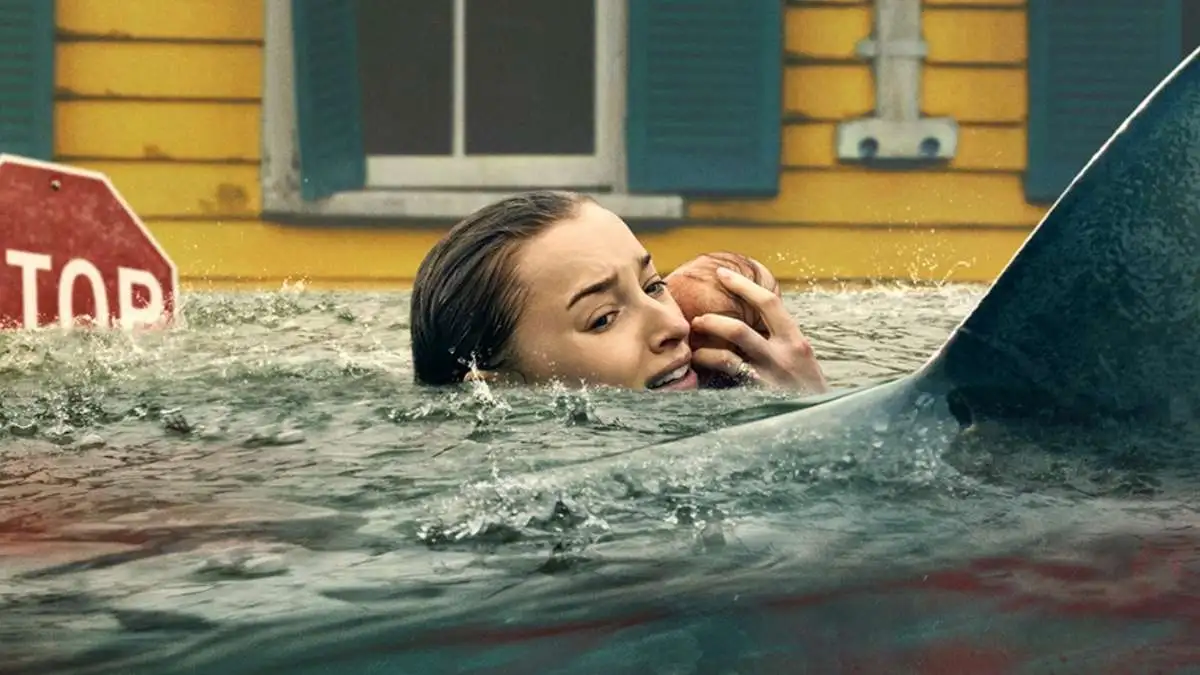
The ending is openly absurd and fully spoiler-driven. Lisa and her newborn survive. Dakota reaches her with a boat, and just as a bull shark is closing in for the kill, Nellie, the pregnant great white Dale has been tracking, attacks the bull shark and effectively saves Lisa, Dakota, and the baby. Elsewhere, the foster siblings survive by luring a shark with meat-wrapped dynamite and then escaping town after Billy Olson is finally killed. The movie ends with another major storm appearing on radar, which is a very obvious sequel stinger.
As of April 23, 2026, there is no official sequel announcement from Netflix. The ending absolutely leaves the door open, and outside reporting says Adam McKay has acknowledged the possibility, but Decider reports that no sequel is currently in development. So the correct read is that Thrash ends like sequel bait, not that Thrash 2 is confirmed.
Should You Stream Thrash on Netflix or Skip It? Final Verdict
You should stream Thrash if you enjoy creature features, accept genre nonsense as part of the appeal, and want a short, chaotic survival movie anchored by a fully committed lead. The evidence from its viewership and from its more generous reviews suggests that the film works best when treated as glossy junk food: not good enough to canonize, but entertaining enough to justify 86 minutes on the couch.
You should skip it if you want airtight suspense, polished shark effects, or a new benchmark for shark horror. The critical record is too consistent on those weaknesses to ignore, and the comparison with Jaws, The Shallows, and Crawl makes the gap obvious. The fairest bottom line is this: Thrash is surprisingly watchable despite mixed reviews, but it is watchable as disposable pulp, not as top-shelf shark cinema.

FAQ
- Is Thrash streaming on Netflix now?
- Yes. Netflix’s official pages say Thrash began streaming on April 10, 2026, and is available now.
- What is Thrash about?
- It is about a catastrophic hurricane that floods a coastal South Carolina town and leaves trapped survivors fighting both rising water and shark attacks, with Lisa, Dakota, and Dale as the main connective characters.
- Who stars in Thrash?
- The main cast is Phoebe Dynevor, Whitney Peak, and Djimon Hounsou, with Matt Nable, Andrew Lees, Alyla Browne, Stacy Clausen, and Dante Ubaldi among the key supporting players.
- Is Thrash based on a true story?
- No. Tudum presents the film as fiction, but says the producers and consultants grounded the premise in real storm intensification, coastal flooding realities, and bull shark behavior in shallow waters.
- What is the Thrash Rotten Tomatoes score?
- As of April 23, 2026, Thrash has 43% on the Tomatometer from 56 critic reviews and 24% on the Popcornmeter from 500+ audience ratings.
- Is Thrash actually scary?
- Not consistently. Most reviews treat it as more pulpy and campy than terrifying, though some critics and viewers still found its pace and flood-survival situations entertaining.
- How long is Thrash?
- The runtime is 1 hour and 26 minutes.
- Does Lisa survive in Thrash?
- Yes. Lisa and her baby both survive the climax.
- Is there going to be a Thrash 2?
- There is no official sequel announcement yet. The ending teases one, but reporting says no sequel is currently in development.
- If I liked The Shallows or Crawl, should I watch Thrash?
- Probably yes, but with lower expectations. Thrash has the same survival-creature appeal, yet its review scores are much weaker than those of The Shallows and Crawl.
Conclusion
The research points to a clear verdict. Thrash is not a misunderstood masterpiece, and the mixed reviews are grounded in real flaws: uneven tension, scattered plotting, and effects or decisions that frequently tip into silliness. But it is also not the total disaster that low scores alone might suggest. The movie has a star who commits, a premise that never needs explaining twice, a runtime that does not overstay its welcome, and enough flood-and-shark chaos to make it highly streamable. That combination explains why critics were divided, audiences were harsher, and Netflix viewers still pushed it to the top of the charts.
Sources and citation
- Netflix official title page
- Tudum homepage/search hub
- Rotten Tomatoes
- Metacritic
- The Guardian review
- RogerEbert.com review
- The A.V. Club review
- CinemaBlend article
- People ending explainer
- Under Paris official Netflix page
Recommended
- Can you render a 360-degree view using Blender cameras?
- What Is Camera Focal Length in Blender?
- Why Hair Grooming Takes So Long and How to Speed It Up
- How to Transfer Daz 3D Hair to Unreal Engine: Groom Workflow for Metahuman Integration
- TMNT: Empire City Preview Hanging with Your Turtle Bros in VR Is a Shell of a Time (Gameplay, Co-Op, Release Details)
- Daredevil: Born Again Returns for Season 2 on Disney+
- Assassin’s Creed 4: Black Flag Almost Had an Entirely Different Version of Blackbeard’s Dying Words (Original Line, Cut Dialogue, and Why It Changed)
- Why Tomodachi Life Doesn’t Support Switch 2 Handheld Mode Boost Despite 1080p Handheld Resolution
- Boris Gertsovsky Got Rid of His Stake in GDEV: What the March 2026 Share Sale Means
- How do I align the camera to an object’s surface in Blender?