






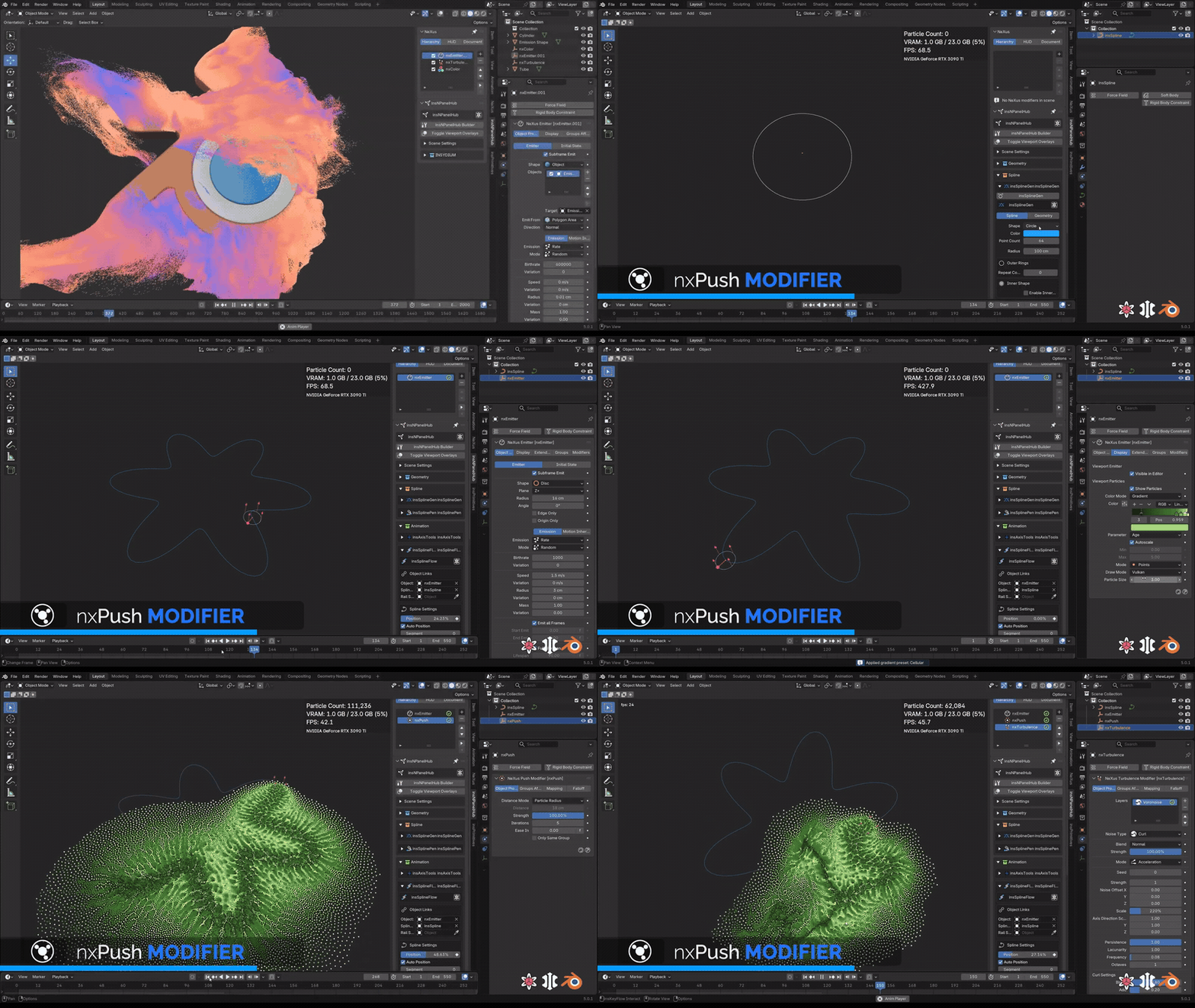
NeXus for Blender is an upcoming Blender edition of NeXus from INSYDIUM, the company behind X-Particles and the broader Fused toolset. Based on Insydium’s current official pages and the first public previews posted in April 2026, the Blender build is being positioned as a rebuilt, GPU-driven simulation system for particles, liquids, smoke, fire, constraints, and layered modifiers, with a planned release window of Summer 2026 rather than a published day and date launch.
What is NeXus for Blender and what does it do?
At its core, NeXus is Insydium’s GPU particle and simulation framework. The official NeXus product page describes it as a cross-platform system built around Vulkan, designed to move fluids, grains, constraints, and particle modifiers onto the GPU while staying integrated with the X-Particles ecosystem. In practical terms, that means NeXus is not just a particle emitter for simple motion graphics streaks or instancing tricks; it is meant to be a broader simulation environment for liquid, gaseous, granular, and constraint-based work.
For Blender specifically, the current public framing is that this is not a quick host port but a Blender-focused rebuild with real-time feedback and rapid iteration as the headline value proposition. That makes NeXus for Blender especially relevant to artists who want the feel of a dedicated simulation plugin inside Blender instead of building every behavior from scratch in Geometry Nodes or relying only on Blender’s older particle and fluid systems.
NeXus for Blender release date: when is it coming out?
As of April 23, 2026, the only official release window published by Insydium is Summer 2026. The company’s homepage states that NeXus is “coming to Blender in Summer 2026,” and also notes that active Fused licenses that include NeXus will receive Blender NeXus when it ships. No official product page, press release, or shop page currently names a specific launch day.
The timeline matters because this Blender edition has a long runway behind it. CG Channel’s April 2026 preview roundup notes that Insydium first announced Blender, Maya, and 3ds Max editions back in 2022 with an original 2023 target, but the Blender version only resurfaced publicly in April 2026 through a new wave of preview videos. That means the current public status is best described as real, active, and publicly previewed, but still not yet released.
NeXus for Blender features explained: particles, fluids, smoke, and more
The official NeXus feature set is already extensive, and it is the best guide to what Blender users should expect because Insydium has said the Blender build is intended to carry over the existing NeXus functionality. On the fluid side, the product page lists nxFluids with FLIP and APIC solvers, variable viscosity, liquid sheeting, and surface-tension-like tendrils; nxMesher for GPU liquid meshing with color, velocity, and emitter-ID outputs; and nxFoam for spray, foam, and bubbles driven by motion-derived detection such as turbulence and wave curvature.
On the pyro side, nxExplosiaFX is the smoke-and-fire toolset. Insydium says it can emit from objects, splines, vertex maps, shaders, and particles, and that it supports particle advection, data-channel mapping, and a layered system for emitters, collisions, and forces. That positions NeXus as more than a particle-only package; it is clearly intended to cover volumetric VFX work as well.
On the particlebehavior side, NeXus includes modifier layers, GPU falloffs, data mapping, nxQuestion logic, nxConstraints, nxUpres, nxInfectio, nxWave, nxTurbulence, and a wider family of GPU modifiers. Insydium’s 2025.4 release notes also show where the design is heading: multiple modifiers now use a layer-based workflow, and tools like nxDirection and nxFollowGeo were updated around that same system. The through-line is clear: NeXus is being built as an artist-friendly, stackable, layered GPU workflow rather than a node graph that expects users to wire every behavior manually.
NeXus for Blender vs X-Particles: what is the difference?
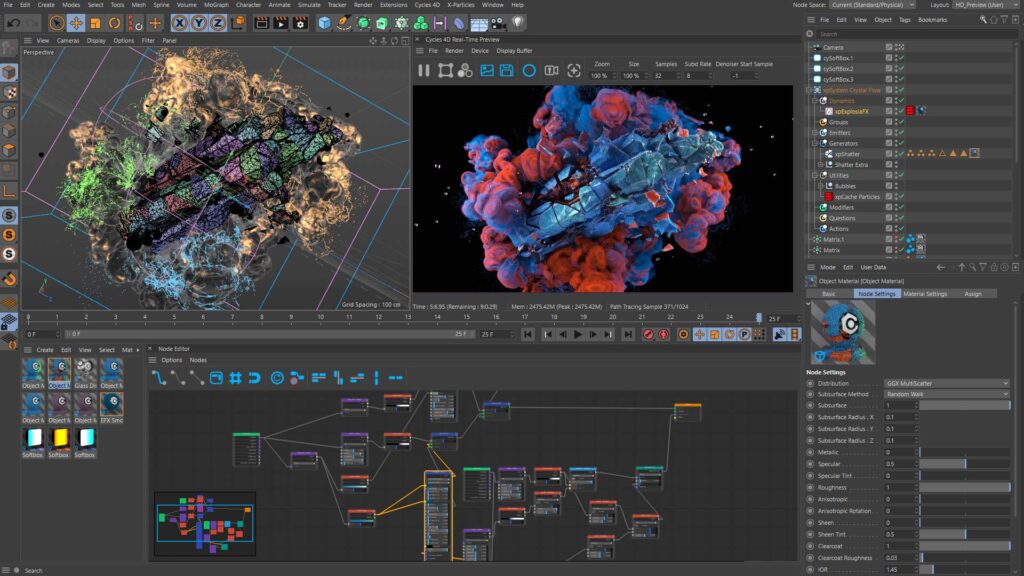
The clearest difference is architectural. Insydium’s own Fused Create page describes X-Particles as its CPU-based particle and VFX system for Cinema 4D, while NeXus is framed as the GPU-accelerated option for “lightning-fast particle simulations” with real-time feedback and accelerated render-time workflows. In other words, X-Particles is the mature CPU multiphysics toolkit; NeXus is the newer GPU simulation framework.
The second difference is emphasis. X-Particles’ official page foregrounds a broad Cinema 4D-native toolkit covering cloth, smoke, fire, fluids, grains, dynamics, scattering, caching, and deep MoGraph integration. NeXus, by contrast, foregrounds Vulkan-based GPU simulation, layered modifiers, GPU falloffs, liquid meshing, foam, and GPU smoke and fire. Both are related, and NeXus integrates with the X-Particles ecosystem, but they are not identical products wearing different labels.
There is also a licensing relationship between them. Insydium’s shop says that choosing NeXus inside Fused Create includes X-Particles, which is why the store warns buyers not to add both separately. That matters for Blender users because it suggests Insydium still sees the two systems as complementary rather than mutually exclusive, even while NeXus takes the lead on GPU-heavy simulation workflows.

NeXus for Blender vs Geometry Nodes for particle effects
Geometry Nodes remains Blender’s strongest native procedural alternative because Blender’s official documentation says simulation zones let the result of one frame influence the next, enabling custom physics-style setups directly in node graphs. Blender’s Bake node can also cache intermediate geometry for performance, which makes Geometry Nodes increasingly viable for repeatable simulation-style workflows inside stock Blender.
The difference is that Geometry Nodes is a general system, while NeXus is a specialized simulation product. NeXus ships with purpose-built emitters, liquid solvers, smoke and fire tools, meshing, foam generation, up-res workflows, constraints, and layered falloffs. Geometry Nodes can absolutely produce sophisticated motion and simulation behavior, but it usually asks the artist to design the logic more explicitly. NeXus is aiming to provide ready-made VFX building blocks with a faster path from idea to viewport playback. That is the key workflow distinction.
There is also an interoperability angle. Blender’s Bake node documentation explicitly says baked geometry is not intended as a general import/export format, except that volume objects are stored as OpenVDB. By contrast, current preview reporting says Insydium intends NeXus for Blender to export to native Blender particles and Geometry Nodes, plus cache export. If that ships as described, NeXus would sit upstream of native Blender tools rather than trying to replace them outright.
NeXus for Blender GPU simulation performance and hardware support
Performance is one of the main reasons NeXus exists. The official product page repeatedly frames the system around GPU execution through Vulkan, and the current Blender messaging uses phrases like real-time performance, instant feedback, and rapid iteration. The official NeXus page also publishes a practical hardware baseline for current builds: a modern NVIDIA, AMD, Intel, or Apple M-series GPU with at least 4 GB of VRAM, Vulkan support, adequate compute capability, and current stable drivers.
For Blender specifically, the strongest public performance claims so far come from CG Channel’s April 2026 report summarizing Insydium’s replies around the previews. That report says the Blender add-on keeps more work on the GPU, reduces overhead, improves scaling, and uses 64-bit VRAM addressing, all of which could make it faster than the Cinema 4D edition on the right hardware. Just as important, there are still no public benchmark charts from Insydium showing a repeatable side-by-side test matrix, so the current state of knowledge is promising but qualitative, not benchmark-verified.
NeXus for Blender system requirements for Windows, macOS, and Linux
The most accurate answer is that Insydium has not yet published a Blender-specific system requirements page. What is public today is a combination of current NeXus/Fused requirements for Cinema 4D builds and the platform cues shown in the Blender previews. For current Fused/NeXus builds, Insydium lists Windows 7 or later and macOS Monterey or later, online licensing, AVX-capable CPUs, and a modern GPU with at least 4 GB of VRAM and Vulkan support. Separately, CG Channel reports that the Blender previews show Windows, macOS, and Linux logos, which strongly suggests three-platform intent for the Blender edition even though a final native requirements sheet has not been posted yet.
Because this is a Blender add-on, the host application’s requirements also matter. Blender’s current official requirements page lists a baseline of 8 GB RAM, 2 GB VRAM minimum, and a GPU supporting OpenGL 4.3 or Vulkan 1.3, with 32 GB RAM and 8 GB VRAM recommended. The same page also lists Linux distributions with glibc 2.28 or newer. On macOS, Blender’s official requirements page for 4.5 LTS says Metal 2.2 is required, while the current Apple Silicon 5.1.1 download page requires macOS 13 Ventura or newer. In practice, that means the safest assumption for NeXus for Blender is: meet Blender’s own current GPU/OS requirements first, then add Insydium’s GPU/Vulkan expectations on top.
NeXus for Blender pricing: subscription, perpetual license, and Fused bundle
As of April 23, 2026, Insydium has not announced a standalone price for NeXus for Blender. What is confirmed is the commercial model around it. Insydium’s homepage says that active Fused licenses that include NeXus will get Blender NeXus at release, and CG Channel reports that Insydium intends the Blender edition to be sold separately and as a perpetual license rather than only through subscription. That is a significant point for Blender users who want ownership options instead of a rental-only model.
The current official Fused pricing gives the clearest picture of the surrounding ecosystem. Insydium’s shop lists Fused Complete at £590 ex VAT as a perpetual collection license, while subscriptions are listed at £390/year, £250 every 6 months, £160 every 3 months, and £60 per month. Inside Fused Create, the shop currently lists NeXus at £250 and says it includes X-Particles. Those are current shop prices for the Fused ecosystem, not a published standalone Blender SKU, but they set a realistic frame for where Blender buyers should expect the product family to sit.
There is also a time-sensitive promotional wrinkle. On April 23, 2026, Insydium’s site was running a NAB30 coupon advertised as 30% off through midnight UK time on that date. Because that is a temporary promotion rather than a stable list price, it should be treated as a short-lived checkout discount, not the long-term reference price for NeXus for Blender.
Is NeXus for Blender faster than the Cinema 4D version?
The best public answer right now is possibly yes, but not yet proven with public benchmark tables. CG Channel’s April 2026 coverage says Insydium has indicated the Blender edition keeps more work on the GPU, reduces overhead, improves scaling, and uses 64-bit VRAM addressing, all of which point toward a potentially faster implementation than the Cinema 4D host version.
The limitation is evidence quality. What is public today consists of preview footage, official product messaging about GPU execution, and qualitative reporting from early coverage. That is enough to say the Blender edition is being built with performance as a headline advantage, but not enough to declare a universal win across NVIDIA, AMD, Apple Silicon, and Intel hardware without official benchmark data.
How NeXus for Blender fits into VFX and motion graphics workflows
NeXus is clearly aimed at the overlap between motion design speed and VFX complexity. X-Particles has long been marketed as a unified Cinema 4D toolkit spanning cloth, smoke, fire, fluids, grains, and dynamics for both motion graphics and VFX, and NeXus takes that same cross-discipline ambition into a GPU-first framework. Its combination of emitters, layered modifiers, constraints, foam, liquid meshing, up-res tools, and pyro-style solvers makes it suitable for abstract motion design, liquid product shots, debris-style particle work, and more traditional VFX smoke/fire setups.
For Blender users, the practical workflow appeal is straightforward: block motion with emitters and layered modifiers, iterate in real time, escalate to fluids or smoke when needed, mesh liquids inside the same system, then cache or export the results into the broader Blender pipeline. If Insydium ships the promised export route into native Blender particles and Geometry Nodes, NeXus could become a fast-lookdev simulation layer that hands off finished data to native Blender rendering and scene assembly.
Can NeXus for Blender export to native Blender particles and Geometry Nodes?
The strongest public indication so far is yes, but with an important caveat: this information currently comes from preview coverage rather than from a published Blender manual. CG Channel reports that, according to Insydium’s replies around the preview videos, NeXus for Blender will be able to export to native Blender particles and Geometry Nodes, along with cache export. That is the best public information available as of April 23, 2026.
Why this matters is easy to see inside Blender’s own documentation. Blender still maintains a native particle system and a Geometry Nodes simulation framework, but the legacy hair particle docs are explicitly marked as end-of-life in favor of newer Hair Nodes, and simulation work in modern Blender is increasingly centered around Geometry Nodes and baking. If NeXus can export cleanly into those systems, it becomes much easier to treat it as a simulation authoring layer rather than a closed island.
Why Blender artists are interested in NeXus after Cinema 4D
One reason is simple demand: Blender has a large procedural and motion-graphics user base, but it does not currently have a native, fully mature, widely adopted equivalent to the old X-Particles-and-NeXus experience inside Cinema 4D. CG Channel’s reporting explicitly ties interest in the Blender edition to artists who moved some work from Cinema 4D into Blender and felt the absence of Insydium’s simulation tools in that new environment.
Another reason is credibility. Insydium is not new to Blender-adjacent technology. Its now end-of-life Cycles 4D bridge was built around Blender’s Cycles renderer and openly credited Blender technology on the official product page. That history does not guarantee NeXus for Blender will launch flawlessly, but it does show that Insydium has already spent years building products at the boundary between Cinema 4D workflows and Blender-based technology.
NeXus for Blender preview videos: what Insydium has shown so far
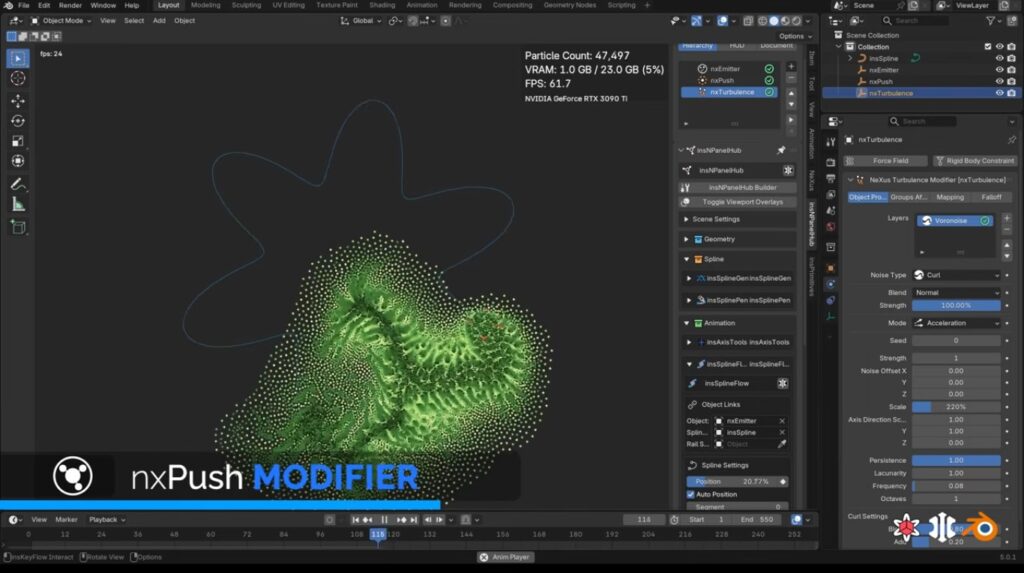
So far, the public preview set is small but useful. Official YouTube search results show an initial “INSYDIUM NeXus Blender Preview”, followed by “INSYDIUM NeXus Blender Preview Emitter Shapes & Displays”, and “INSYDIUM NeXus Blender Preview nxPush.” The playlist result publicly confirms those three videos as the first wave of Blender-focused previews.
Third-party coverage clarifies what those videos contain. 80 Level says the first preview introduces the overall Blender direction, the second focuses on emission shapes and display options, and the third demonstrates the Push modifier together with nxTurbulence and Blender scene tools. CG Channel adds an important qualifier: public previews so far have mostly shown the core emitter and modifier workflow, not the entire NeXus feature catalog in Blender yet. That is why the preview material is encouraging, but still not the same thing as a full feature walkthrough.
Is NeXus for Blender worth waiting for in 2026?
Based on what is public today, NeXus for Blender looks worth waiting for if the need is specifically a turnkey GPU simulation system inside Blender. The combination of Summer 2026 timing, the promise of Blender-native export pathways, the existing NeXus feature stack, and the possibility of a perpetual Blender license gives it a strong value case for motion designers, FX artists, and former Cinema 4D users who want a faster path than fully custom Geometry Nodes setups.
At the same time, it is not yet rational to make it the single point of dependency for deadline-critical 2026 production work. The exact release date is still unpublished, the standalone Blender price is still unpublished, the Blender-specific system requirements sheet is still unpublished, and public benchmark data is still absent. The balanced conclusion is that NeXus for Blender is highly promising for evaluation, testing, and pipeline planning in 2026, but it is still a wait-and-verify product until Insydium publishes the final docs and launch details.
Best alternatives to NeXus for Blender for GPU particle simulation
The closest native-Blender, GPU-first multiphysics alternative currently marketed is Doriflow. Its official site describes it as a GPU-accelerated multiphysics engine for Blender covering fluids, particles, and solids in one workflow, and publishes concrete Blender-focused requirements including Blender 4.0 to 5.0 support, Windows/macOS compatibility, and NVIDIA CUDA or Apple Metal-class GPUs. For artists who specifically want a dedicated Blender add-on rather than an external app, Doriflow is the nearest conceptual match to what NeXus promises.
For artists whose needs are narrower and more effect-specific, the best external GPU alternatives are usually EmberGen and LiquiGen from JangaFX. EmberGen is an official GPU-based real-time fire, smoke, and explosion package with VDB export and mesh/camera import; LiquiGen is JangaFX’s real-time liquid tool with real-time meshing, foam, spray, bubbles, and Alembic export support in its product ecosystem. These are not Blender-native all-in-one particle frameworks, but they are strong GPU simulation companions when the priority is speed in smoke/fire or liquids specifically.
The zero-cost native alternative remains Geometry Nodes. It is not a dedicated GPU multiphysics solver in the NeXus sense, but Blender’s simulation zones and baking tools make it the most practical built-in route for procedural particle and simulation logic when licensing cost matters more than turnkey solvers. At the high end, the deeper external alternative is Houdini FX from SideFX, whose official pages cover particles, FLIP fluids, Pyro FX, and broader VFX simulation tooling, with OpenCL-based acceleration available in parts of the stack. That makes Houdini the most capable alternative overall, but usually not the fastest route for artists who specifically want a Blender-native motion-graphics-friendly workflow.
Frequently Asked Questions (FAQs)
- Is NeXus for Blender already released? No. The official public release window is Summer 2026, and no exact launch day has been posted by Insydium as of April 23, 2026.
- Will existing Fused users get NeXus for Blender? Active Fused licenses that include NeXus are slated to receive Blender NeXus at release, according to Insydium’s homepage.
- Will there be a perpetual license for the Blender version? Current public reporting says yes, and that the Blender edition should also be sold separately, but Insydium has not yet published the standalone Blender price page.
- Does NeXus replace Geometry Nodes? No. The current public picture is that NeXus is a specialized GPU simulation layer, while Geometry Nodes remains Blender’s native procedural framework; the two look more complementary than mutually exclusive.
- What effects is NeXus best suited for? Based on the official feature pages, the strongest use cases are particle effects, fluids, smoke, fire, granular work, constraints, liquid meshing, foam, and layered modifier-driven motion design.
- What hardware will matter most? GPU choice matters most. Insydium’s current NeXus requirements emphasize a modern Vulkan-capable GPU with at least 4 GB VRAM and up-to-date drivers.
- Is Linux support confirmed? A final Blender requirements sheet is not out yet, but preview reporting says the current public materials show Windows, macOS, and Linux logos.
- Will NeXus for Blender be faster than Geometry Nodes? That depends on the task. For ready-made GPU solvers and heavy simulation-style work, NeXus is being marketed around speed and instant feedback; for custom procedural logic, Geometry Nodes remains the more flexible native system. Public benchmark tables do not exist yet.
- Does NeXus include X-Particles? In the current Fused Create shop configuration, NeXus includes X-Particles, which is why the store warns buyers not to add both products separately.
- What is still unknown before launch? The biggest open items are the exact release date, the standalone Blender price, the final Blender-specific system requirements page, and public benchmark data across multiple GPU vendors.
Conclusion
NeXus for Blender is shaping up to be one of the most potentially important Blender simulation releases of 2026 because it promises something Blender still lacks in a polished, mainstream form: an artist-friendly, GPU-first, multipurpose particle-and-simulation system with liquids, smoke, fire, meshing, foam, constraints, and layered motion tools in one package. The public evidence supports real momentum, real previews, and a real Summer 2026 target. It does not yet support claims of a finished launch, a final price, or benchmark-proven superiority across all hardware. The strongest conclusion today is that NeXus for Blender looks like a serious product worth monitoring closely, testing early, and comparing against Geometry Nodes, Doriflow, EmberGen, LiquiGen, and Houdini according to actual production needs.
Sources and citation
- Official Insydium NeXus product page
- Official Insydium homepage
- Insydium Fused Complete shop page
- Insydium Fused Create shop page
- Insydium Fused Annual Subscription shop page
- Insydium FAQ: Fused licensing and subscriptions
- Official X-Particles product page
- X-Particles key features
- Blender Simulation Zone documentation
- Blender Baking documentation
- Blender Bake Node documentation
- Blender system requirements
- CG Channel: Sneak peek NeXus for Blender
- 80 Level: Insydium Teases NeXus For Blender
- Official Insydium NeXus in Blender YouTube playlist
- Doriflow official site
- JangaFX EmberGen official page
- JangaFX LiquiGen official page
- SideFX Houdini Fluid FX official page
- SideFX Houdini particle fluids documentation
Recommended
- Canceled Star Wars FPS Is Playable Again – Why “First Assault” Feels Amazing and Sad at the Same Time
- How to Create Your Alter Ego with Metahuman for the Metaverse: A Guide to Building Digital Identity in Unreal Engine 5
- Hollywood Is Trying Again To Make A Metal Gear Solid Movie – Everything We Know About The New Film Adaptation
- Blender Add-Ons for Customizable Procedural Clouds: Best Tools for Volumetric Sky, Cloudscapes, and Fast Art Direction
- Lucid Blocks Surreal Minecraft-Style Game About Exploring Liminal Spaces: Release Date, Gameplay, and Apotheosis Crafting
- The Best Video Games of 2026 (So Far): 15 Top Games You Need to Play
- Bluey and “Bluey’s Best Day Ever!” Have Arrived at Disneyland – Everything You Need to Know About the New Interactive Experience
- Flow Made With Blender Wins Oscar: Latvia’s Indie Animated Feature Film Making History
- Super Mario Galaxy Movie Composer Brian Tyler Worked on the Movie While in the Hospital: What Happened and How the Score Was Made
- Teenage Mutant Ninja Turtles Fans Can Score Hundreds Of Comic Issues in This Massive $25 Bundle (What You Get + How to Redeem)