






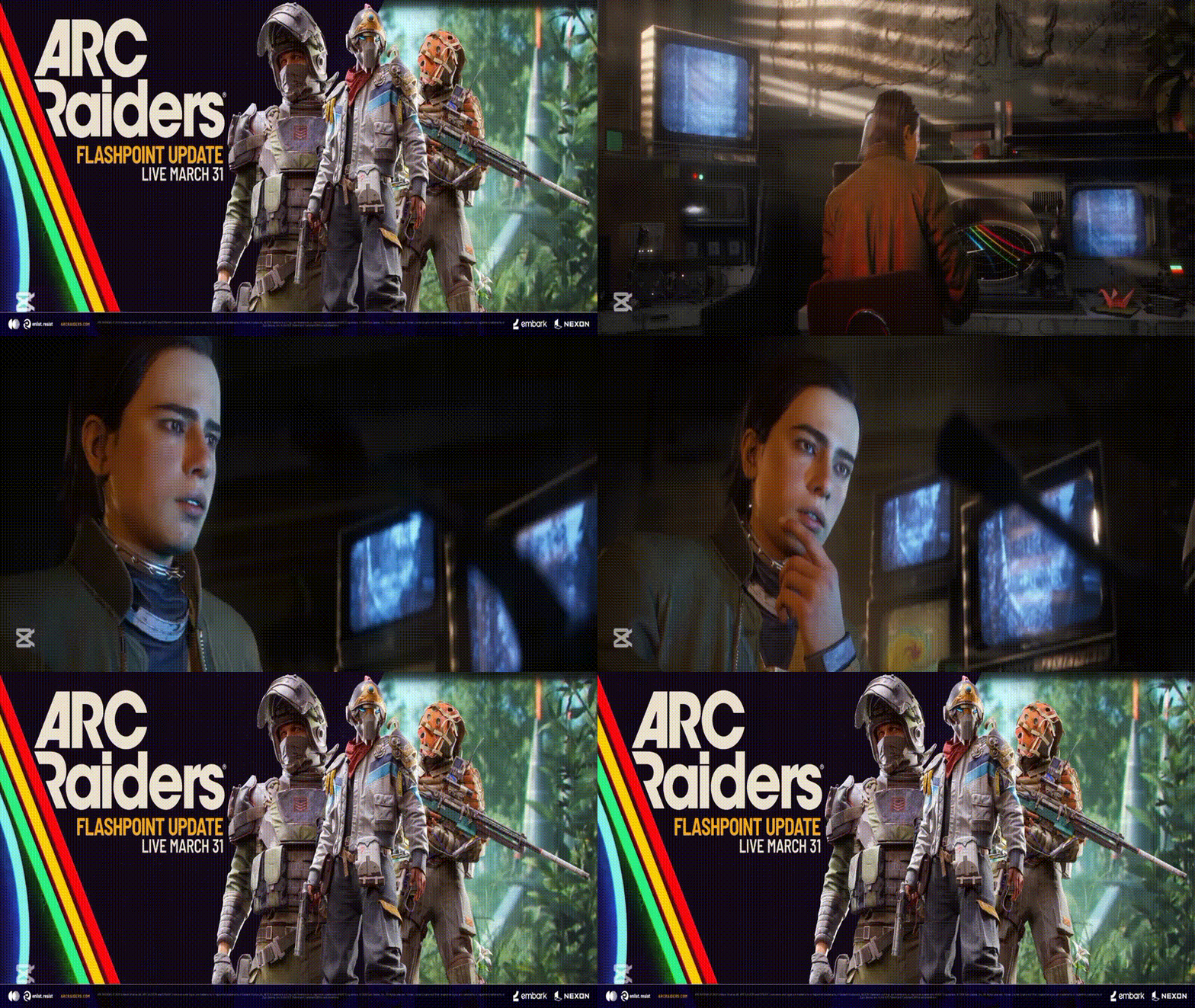
ARC Raiders Players Are Choosing Cooperation over Conflict because the game’s risk structure makes temporary trust more rational than constant aggression. As of April 24, 2026, the strongest public evidence comes from a convergence of official live-service updates, developer interviews, and independent reporting: the game launched on October 30, 2025; it remains in active monthly support; public behavior data shared by the developer shows an even split between PvE-first and PvP-first players, with a large mixed middle; more than 95% of players use proximity chat; about one in five players have never knocked out another raider; and roughly half have fewer than 10 KOs.
The analytical conclusion is not that ARC Raiders has “become PvE,” or that conflict no longer matters. Rather, its design makes PvP optional, situational, and tension-generating, while AI enemies, environmental hazards, progression incentives, squad-size matchmaking, free loadouts, and proximity chat all lower the opportunity cost of cooperation. Official events such as Shared Watch explicitly awarded progress for fighting ARC, not other players, and later updates removed PvP Feats altogether. That is a meaningful live-service signal: the studio is not eliminating conflict, but it is repeatedly legitimizing non-hostile play.
Two limitations matter. First, some public community observations are anecdotal and should not be treated as population-wide measurements. Second, exact per-match telemetry such as average human kill rates, extraction rates by playstyle, and the full matchmaking formula have not been publicly disclosed as of April 24, 2026, so any finer-grained PvE-vs-PvP estimate beyond Embark’s public percentages should be treated as unspecified.
Why ARC Raiders Players Are Choosing Cooperation Instead of PvP Combat
The simplest explanation is incentive alignment. ARC Raiders is officially framed by Embark Studios as a “multiplayer extraction adventure,” not a pure deathmatch: players go Topside to scavenge, craft, finish quests, and extract alive, while machines and rival raiders both remain threats. In practice, shooting first often creates extra noise, extra AI pressure, ammo loss, and extraction risk. The developer’s own design leadership has said the game “never asks you to fight other players”; PvP exists primarily to create tension.
That framing matters because cooperative behavior in ARC Raiders is not a moral overlay on top of the system; it is often the optimal survival choice inside the system. If a stranger is also trying to survive a Snitch call, a Leaper push, a Queen or Matriarch event, a storm condition, or a tight extraction window, avoiding a firefight can preserve more value than forcing one. That logic matches broader research on the “common enemy effect,” which finds that external threats can increase group cohesion even among weakly aligned actors.
How ARC Raiders Gameplay Encourages Teamwork and Player Alliances
ARC Raiders gives players a toolkit for cooperation without hard-forcing alliances. Official materials confirm squads of up to three, prioritization of squads versus squads and solos versus solos, duo-prioritized matchmaking after launch, open parties, squad invites, revives, armor repair interactions, and emotes that communicate non-hostility. The game also supports “forge alliances” play language in its own marketing copy.
The result is a soft-social design. Instead of a formal “friend contract,” players use proximity chat, pings, movement, and emotes to negotiate intent in real time. That makes alliances cheap to start and easy to dissolve, which is exactly why so many of them form. From a design standpoint, temporary trust is easier to create when systems only require low-commitment signals.

ARC Raiders PvE vs PvP: Why More Players Prefer Cooperative Playstyles
Publicly shared 2026 behavior data shows that about 30% of players are mostly interested in the cooperative side, another 30% focus on PvP, and about 40% move between both depending on context. That means the center of gravity is not “pure PvP dominance,” but a mixed ecology in which cooperative and reactive players together outnumber strictly PvP-first players.
Live-service decisions also nudged progression toward non-PvP incentives. Shared Watch rewarded destroying, assisting, and damaging ARC while explicitly stating that no merits would be earned from PvP. Then, in February 2026, Embark removed PvP Feats. Those changes did not remove PvP from the world, but they made progression less dependent on human conflict and more compatible with co-op or coexistence.
What Makes ARC Raiders Different from Other Extraction Shooters
ARC Raiders differs from many genre peers by being structurally approachable without becoming low-stakes. Review coverage repeatedly describes it as more user-friendly than genre “military simulation” stalwarts, and official systems back that up: free loadouts act as an economic safety net, expeditions are opt-in resets rather than blanket wipes, and the game repeatedly tries to keep players in meaningful action rather than menu friction.
The contrast is clear when placed beside other extraction games:
| Game | Official or public framing | Cooperation lever | What usually remains central |
|---|---|---|---|
| ARC Raiders | “Multiplayer extraction adventure” | Proximity chat, matchmaking by play tendency, free loadouts, PvE events, removed PvP Feats | Suspicion and loss, but not mandatory PvP |
| Hunt: Showdown 1896 | “Risk everything” and kill anyone who stops the bounty | Team play against bosses | Rival hunters and lethal extraction pressure |
| Marathon | Officially a sci-fi PvP extraction shooter | Proximity chat, uneasy alliances, Mercy Kit | Competitive runner-vs-runner tension |
| Call of Duty: Warzone 2.0 DMZ | Proximity chat plus explicit squad assimilation | Formal squad joining | Tactical advantage in a shooter-first space |
The table’s pattern is the key finding: ARC Raiders is unusual not because it alone allows cooperation, but because it combines cooperation tools with progression, economy, and world pressure in ways that make cooperation feel productive instead of ornamental.
The cooperation shift can also be read through update history. The timeline below highlights the updates most relevant to friendly or mixed-intent play.
2025-10-30Full launch2025-11-12Duo prioritizedmatchmaking2025-11-20Raider Voice andsurrender fixes2026-02-10Shared Watch eventgives no merits forPvP2026-02-24PvP Feats removed2026-03-31Proximity voice chatstability and clearerplayer audioimproved2026-04-15Public behaviormetrics reported30/30/40 split, 95%+prox chatCooperation-related ARC Raiders milestonesShow code
How Proximity Chat Is Changing Player Behavior in ARC Raiders
Proximity chat is the single clearest social mechanic behind ARC Raiders’ cooperative turn. Aleksander Grøndal said more than 95% of players use it, and public reporting describes common phrases such as “I’m friendly” and “Peaceful! Peaceful!” as part of the game’s emergent vocabulary. The studio also kept improving the feature after launch, including voice connection fixes, stability improvements, and clearer positional audio for other players.
What matters is that proximity chat converts uncertainty into negotiation. Instead of a silent silhouette becoming an instant threat, a nearby player can become a problem to solve with speech: share a quest, announce an extract, explain that you are solo, or propose a temporary truce against ARC. A separate interview with design leadership also notes that “Raider Voice” was added partly as an affordance for players who are shy about speaking as themselves, lowering the friction of first contact even further.

ARC Raiders Player Behavior Explained: Why Gamers Are Avoiding Conflict
From a behavioral perspective, ARC Raiders layers several pro-cooperation conditions at once: scarce resources, incomplete information, repeated exposure to strangers, environmental danger, and easy communication. Contemporary media and academic literature both point the same way. Research published in late 2025 and 2026 indicates that voice chat and cooperativeness can shape prosocial versus antisocial norms in multiplayer games, while older experimental work found cooperative violent play can increase subsequent cooperative behavior. Broader multiplayer research also finds that online games can strengthen social connection among distant players.
ARC Raiders then adds a common enemy on top of that social architecture. Giant robots, tactically active AI, weather hazards, and timed extraction pressure all reward coordination. Under those conditions, avoiding conflict is not simply “being nice”; it is often an economically rational form of uncertainty management.
The Rise of Friendly Encounters in ARC Raiders Multiplayer Matches
The rise in friendly encounters is visible in both reporting and player communities, though the qualitative evidence should be treated as anecdotal unless backed by official figures. The Guardian documented spontaneous rave parties, music played through microphones, and wide use of friendly callouts. Games journalism also documented extraction doors being held open for strangers, battered squads sharing cover, and random rescues of downed raiders. Community threads on the game’s subreddit describe repeated solo runs ending with negotiated truces rather than firefights.
The important analytical point is not that “everyone is friendly.” It is that friendliness is common enough to become culturally legible. Players now enter encounters expecting that “talk first” is a viable branch of the decision tree. That is an unusually powerful norm shift for an extraction shooter.
How ARC Raiders’ Design Promotes Cooperation Over Competition
Design director Virgil Watkins has explicitly said the team resisted over-prescribing human interaction. In his account, the studio chose to give players tools for friendly behavior rather than enforce cooperation. That matters because it preserves suspense: trust is possible, but never guaranteed. The design therefore promotes cooperation by making it easy, not compulsory.
Several systems reinforce that philosophy. Free loadouts reduce economic desperation. Optional expeditions make long-term progression less punitive than forced wipes. “Don’t shoot” signaling survived internal skepticism. Shared Watch and later feat changes recognized PvE and non-lethal play as first-class ways to progress. Together, those systems encourage a broader social contract than “kill on sight unless punished.”

ARC Raiders Community Trends: Are Players Becoming More Social?
The best-supported answer is yes, but unevenly. Embark’s public data says solo players are generally friendlier, while three-person squads lean harder into firefights. Press coverage and community posts also suggest that players increasingly treat the game as a place for stories, roleplay, mutual aid, or at least negotiated coexistence. That does not mean PvP has faded away; it means the community’s range of accepted playstyles has widened.
Scale matters here, too. Official patch notes stated on January 13, 2026 that the game had passed 12 million copies sold, and the current Steam page shows 186,420 user reviews overall with 85% positive, indicating that these social norms are emerging inside a very large player population rather than a tiny niche enclave.
Why Some ARC Raiders Players Never Attack Other Players
The direct population answer is already public: about 20% of players have never knocked out another raider, and nearly 50% have fewer than 10 KOs. That is not a rumor; it is the strongest public telemetry Embark has shared to date.
The reasons appear to be mixed. Some players prioritize quests, loot, and extraction efficiency. Some are risk-averse because human fights attract AI and deplete resources. Some dislike betrayal on principle. Some simply prefer the game’s world as a cooperative adventure. Community comments repeatedly describe solo players saying they “never attack first” unless fired upon, which fits the broader official picture even though such posts remain anecdotal.
The social logic of cooperation in ARC Raiders can be summarized like this:
YesNoYesNoEncounter another raiderVoice or emote contact?Signal intent and compare goalsHigh suspicion and stealthAI or weather pressure high?Temporary alliance against ARCDisengage, share route, or shadow each otherShared loot window or safer extractEvade or pre-emptive fightTrust may hold or break at extractShow code
ARC Raiders Co-op Strategies: How Players Work Together to Survive
The most effective cooperative strategies are practical rather than idealistic: announce yourself early, use proximity chat before line-of-sight panic escalates, state your objective, keep weapons lowered when possible, use the “don’t shoot” emote, bring revives, and separate loot disputes from extraction timing. Community reports consistently say that speaking first lowers the odds of unnecessary fights, especially in solo play.
Players also cooperate tactically by splitting aggro, reviving strangers, repairing armor, sharing cover, luring ARC into hostile squads, and synchronizing during world events or boss conditions. These are not scripted raid mechanics; they are emergent adaptations to a world where the AI is dangerous enough that human conflict is often the second problem, not the first.

How AI Enemies in ARC Raiders Push Players Toward Teamwork
This is the deepest mechanical driver of cooperation. Official materials describe a large enemy roster with distinct roles: Snitches call reinforcements, Bombardiers coordinate indirect fire, Ticks immobilize players, Leapers create burst pressure, and large enemies such as the Queen and Matriarch reshape entire engagements. Later updates added Firefly and Comet, while official documentary materials say the team used machine-learning techniques to simulate tactical ARC behavior.
When the studio introduced the Matriarch, Grøndal expected opportunistic squads to let others spend ammo and then strike. Instead, players reportedly stopped shooting each other almost immediately and focused the larger threat together. That is textbook common-enemy behavior, but in live game telemetry rather than in a lab. Later patch notes even adjusted ARC target selection so they would “zero in” less on the first target, which may further distribute pressure across encounters rather than allowing simple isolation and farming.
ARC Raiders Player Statistics: PvE vs PvP Participation Breakdown
The table below separates publicly confirmed behavior data from what remains unspecified.
| Public metric | Best-available figure | Interpretation | Confidence |
|---|---|---|---|
| Mostly PvE / co-op players | ~30% | A large, first-class cooperative segment | High |
| Mostly PvP players | ~30% | PvP is important, but not dominant | High |
| Mixed / reactive players | ~40% | Most of the ecosystem is situational, not ideological | High |
| Players with zero KOs | ~20% | A meaningful pacifist or non-lethal segment exists | High |
| Players with fewer than 10 KOs | ~50% | Human kills are not the main loop for many players | High |
| Players using proximity chat | 95%+ | Verbal negotiation is a mainstream behavior, not a niche one | High |
| Public per-match kill rate, extract rate, and platform-split PvE/PvP telemetry | Unspecified | Not publicly disclosed as of Apr. 24, 2026 | High |
These figures come from Embark data shared through reputable reporting in April 2026. What is not public is just as important: Embark has not published a full telemetry dashboard with match-level PvE/PvP rates, exact aggression-weighting, or platform-specific behavioral splits. Any article that reports those finer numbers without sourcing should be treated cautiously.
What Developers Say About Cooperation in ARC Raiders Gameplay
The developer statements are unusually consistent. Grøndal has said the game surprised the team with how many players embraced peaceful play and that the studio wants to “instil hope” in the player. Watkins has said internal tests before launch were “hyper, hyper aggressive” and that players “never worked together,” which makes the live community’s friendliness an actual design surprise rather than a planned marketing pose. CEO Patrick Söderlund also confirmed that matchmaking considers how prone players are to PvP or PvE, while stressing that the game is not fundamentally about shooting other players.
That does not mean the studio is anti-PvP. Developers also keep rebalancing weapons, tightening exploits, preserving tension, and warning that players should never feel entirely safe. The official position is better described as PvP as tension, PvE as glue, and player choice as the final arbiter.

Is ARC Raiders Becoming a Social Sandbox Instead of a PvP Shooter?
Not fully, but partially—and that partial shift is the real story. ARC Raiders is still an extraction shooter with real gear loss, betrayal risk, late-round murders, encounter balance, and ongoing PvP tuning. It is not a safe social hub. Yet the combination of spontaneous alliances, bards, rescue runs, extraction etiquette, open-mic negotiations, community unlock events, and system updates that legitimize peaceful progress means the game now behaves partly like a social sandbox.
The strongest neutral conclusion is this: in 2026, ARC Raiders is best understood as a socially enabled extraction shooter. It has not stopped being a PvPvE game; instead, it has demonstrated that a PvPvE game can sustain fear, loss, and betrayal without making permanent hostility the dominant norm. That is why it stands out in the genre.
Frequently Asked Questions (FAQs)
- Is ARC Raiders mostly a PvE game now?
No. Public 2026 data suggests about 30% are mostly PvE/co-op, 30% mostly PvP, and 40% mix both depending on the situation. - Does proximity chat really matter?
Yes. More than 95% of players reportedly use it, and multiple patches improved its stability and clarity. - Are friendly players a tiny niche?
No. About 20% of players have never knocked out another raider, and roughly half have fewer than 10 KOs. - Is there a PvE-only mode?
Not as of April 24, 2026. The game remains PvPvE, though some events and progression changes strongly support co-op against ARC. - Do solo players behave differently?
Usually yes. Embark said solo players are generally friendlier, while trios skew more toward firefights. - Do developers actively reward cooperation?
In some cases, yes. Shared Watch gave merits for damaging ARC and explicitly gave none for PvP; PvP Feats were later removed. - Is aggression-based matchmaking confirmed?
Yes, in broad terms. Embark leadership said matchmaking considers how prone players are to PvP or PvE, though the exact formula is not public. - Why do AI enemies encourage teamwork?
Large ARC threats, reinforcement mechanics, weather hazards, and boss events raise the cost of fighting humans and often make pooled firepower more efficient. - Is ARC Raiders becoming more like a social sandbox?
Partly. It still has high-stakes extraction rules, but it now clearly supports music, rescuing strangers, negotiated truces, and other emergent social play. - What data is still missing?
Public sources still do not disclose exact per-match kill rates, extraction rates by playstyle, or the full matchmaking weighting system.

Conclusion
The evidence supports a clear 2026 answer: ARC Raiders players are choosing cooperation over conflict not because PvP disappeared, but because the game’s design makes cooperation a smart, emotionally satisfying, and progression-compatible response to shared danger. Public telemetry shows a large peaceful or mixed-intent population; official updates repeatedly legitimize fighting ARC over farming raiders; proximity chat is nearly universal; and the AI ecosystem is dangerous enough to make strangers useful before they become targets.
That makes ARC Raiders one of the strongest genre case studies in how extraction shooters can preserve suspense while broadening acceptable player behavior. Its lesson is not that conflict is obsolete. Its lesson is that if players are given voice, readable incentives, survivable economics, and a credible common enemy, many of them will prefer conditional trust over automatic violence. The remaining open questions are narrower: whether that balance will hold at larger scale over time, whether late-game metas pull players back toward harder PvP norms, and whether Embark will publish deeper telemetry than the public 30/30/40 split. As of April 24, 2026, those finer points remain unresolved.
Sources and Citations
- Amazon MGM Studios official April 2026 film explainer and CinemaCon slate recap
https://press.amazonmgmstudios.com - Official CinemaCon 2026 schedule and event listings
https://cinemacon.com - ABC News June 2025 announcement and September 2025 production update
https://abcnews.go.com - Associated Press coverage of the April 15, 2026 CinemaCon reveal
https://apnews.com - Los Angeles Times reporting from the April 2026 CinemaCon reveal
https://www.latimes.com - People interviews with Josh Gad in 2024 and 2025 about the sequel’s status
https://people.com - SYFY Wire production timing report
https://www.syfy.com - Trade reporting on new character names and casting details
https://variety.com - American Film Institute catalog entry for the 1987 original
https://catalog.afi.com
Recommended
- Devil May Cry Showrunner Says Season 2 Is Like The Dark Knight Leap From Batman Begins
- WoW Classic Kills Dungeon Boosting in Burning Crusade Expansion Because, Oh No, the Economy Is Breaking
- Some PC Gaming RAM Actually Got Cheaper For The First Time In Months — DDR5 Price Drop, Best Deals, and Why It Might Not Last
- 30 Years Later, Steamed Hams Is Still One Of Gaming’s Biggest Meme Crossovers (And Why It Keeps Getting Remixed)
- Super Meat Boy 3D Release Date Trailer: Everything Revealed at Xbox Partner Preview Showcase 2026
- Plasticity 2026.1 Adds New Commands & Improves Old Ones: PolySplines, Slot, and Hidden Line Export
- Nintendo Switch Is More Popular Among Japanese Teens Than Disney, Pokémon and Nintendo Itself, Survey Finds – Full Breakdown of Brand Japan 2026 Results
- Avatar Aang Movie Footage Leak: What We Know About the Alleged Paramount+ Leak Before Release
- Blender CEO On Anthropic Funding: “This Is Not AI Takeover” — What the Sponsorship Means for Blender, Claude, and the Community
- Resident Evil Requiem Includes A Surprising Homage To The Lord Of The Rings Movies — Fans Spot Hidden Shelob-Inspired Scene