








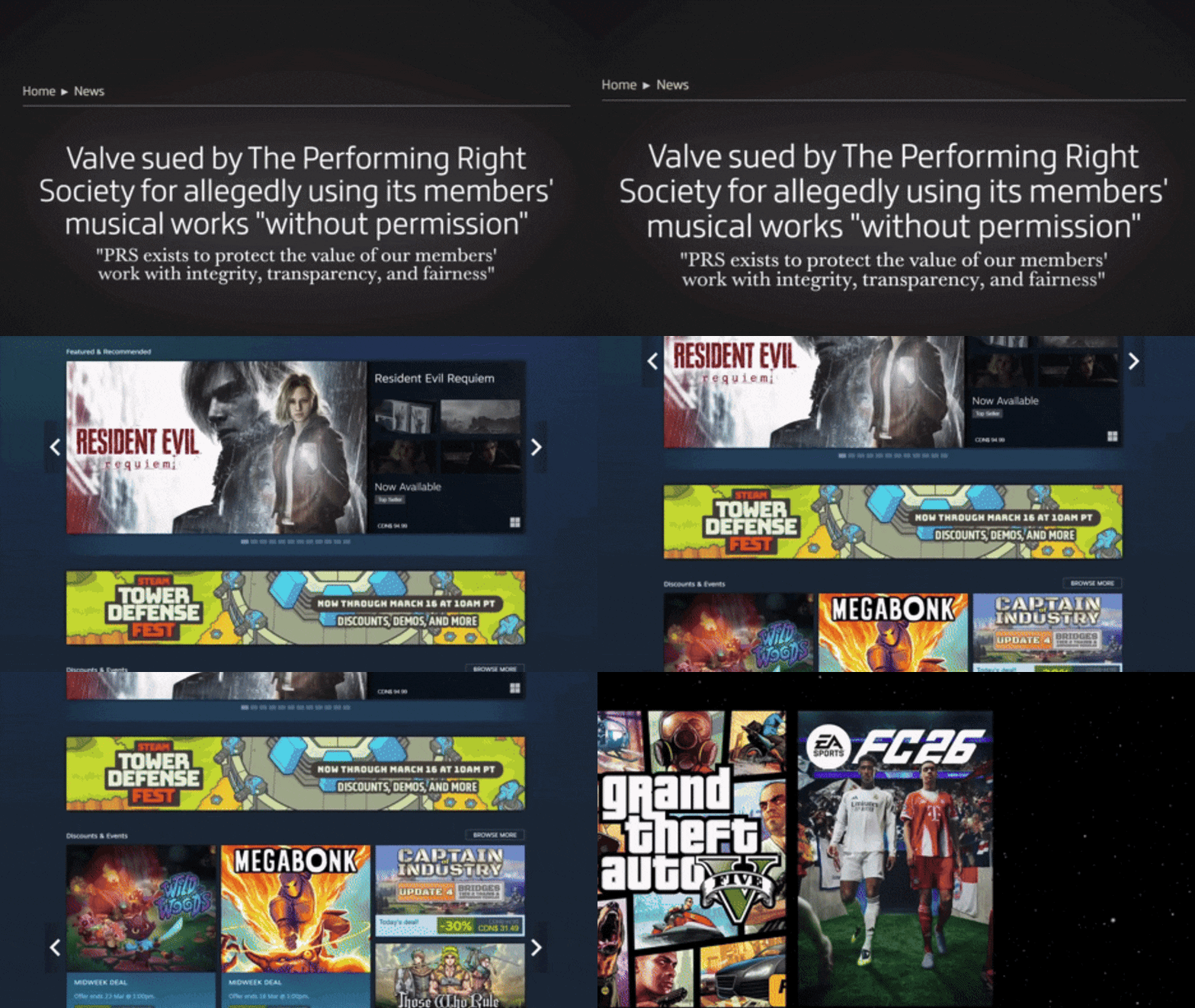
Valve Corporation is facing two new lawsuits in early 2026 – one targeting its use of loot boxes in games like Counter-Strike 2 and another alleging unlicensed use of music on Steam. These legal challenges arrive on both sides of the Atlantic, adding to Valve’s growing list of courtroom battles. The first case, filed by the New York Attorney General, claims Valve’s Steam loot box system amounts to illegal gambling that can harm young players. The second comes from the UK’s PRS for Music, accusing Valve of using copyrighted music in games on Steam without proper licenses. Below we break down each lawsuit, what the plaintiffs allege, and what it all means for Valve, game developers, and gamers alike.
Valve loot box lawsuit explained: what plaintiffs are alleging
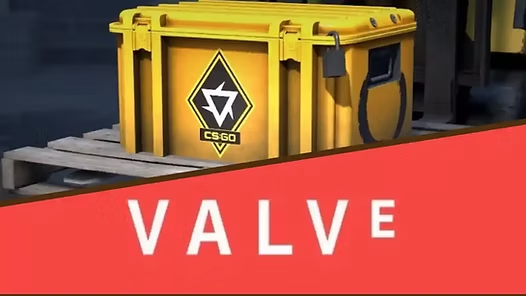
Plaintiffs allege that Valve’s loot box mechanics in games like Counter-Strike 2, Team Fortress 2, and Dota 2 constitute illegal gambling. The complaints describe the system as a “carefully engineered” scheme using psychological hooks similar to slot machines to entice players, including minors, to spend money on chance-based outcomes. Key allegations include:
- Chance-based rewards: Players pay approximately $2.50 for keys to open crates with randomized results determined by software, often resulting in low-value items despite the pursuit of rare prizes.
- Real-world value: Digital rewards carry monetary value through a secondary market Valve encourages, with some items selling for over $1,000,000.
- Targeting of minors: The suits claim Valve exposes children to addictive gambling behaviors without robust age verification.
- Revenue: Valve allegedly earns billions by selling keys and taking a commission from marketplace transactions.
New York Attorney General lawsuit against Valve over “loot boxes” and gambling laws
In February 2026, NY Attorney General Letitia James filed a lawsuit claiming Valve’s loot boxes violate state gambling laws and the constitution. The AG argues the system meets the criteria for gambling: a stake (money for keys), chance (random outcomes), and a prize (valuable virtual items). The suit highlights that items are purely cosmetic but hold massive real-world value. Seeking injunctive relief and penalties, the AG wants to ban these features in New York, force Valve to disgorge profits, and pay triple damages as restitution to players. Valve has not officially commented but is expected to defend its model as voluntary entertainment.
Counter-Strike 2 cases lawsuit: how CS2 skins and keys factor into the claims
Counter-Strike 2 (CS2) is central to the litigation due to its “roulette-style” unboxing animations and extreme prize disparity. While most items are worth pennies, rare “jackpot” items can fetch six or seven figures, such as a specific AK-47 skin that sold for over $1 million in 2024. The plaintiffs argue the $2.49 key is a wager on a random number generator for a potential financial gain. Although Valve previously cracked down on third-party gambling sites, these lawsuits focus on Valve’s own first-party loot box system as the primary gambling enterprise.

Steam Community Market lawsuit questions: resale value and “real money” arguments
The Steam Community Market is cited as proof that loot box rewards are “things of value.” Plaintiffs argue that because items can be sold for Steam Wallet funds (to buy games/hardware) or traded on third-party sites for cash, they function as liquid assets. Valve’s 15% commission on market trades is framed as a “house cut,” giving the company a financial interest in the high resale value of items. The lawsuits counter the “always get something” defense by noting that receiving an item worth significantly less than the $2.50 entry fee constitutes a financial loss in a gambling context.
Are loot boxes gambling in the US: Washington state law and legal definitions
There is no federal law defining loot boxes as gambling, so the cases rely on state-level interpretations of “consideration, chance, and prize.” Washington state, where Valve is headquartered, has a broad definition of “thing of value” that includes virtual credits or objects that extend entertainment. Following the Kater v. Churchill Downs precedent, plaintiffs argue that Valve’s items meet this threshold. While some courts in other states have dismissed similar cases against other developers, the Washington and New York suits represent a significant challenge to the industry, especially following a 2025 FTC fine against another developer for similar practices.
Class action laClass action lawsuit against Valve over loot boxes: who filed and what they want
On March 9, 2026, a nationwide class-action lawsuit was filed against Valve in the U.S. District Court for the Western District of Washington.
- Who filed it: The case is led by plaintiffs Alexander Flauto and Jackson Meyer, represented by the law firm Hagens Berman. Managing partner Steve Berman has characterized Valve’s loot box system as a “gambling platform.”
- Class members: The suit seeks to represent all U.S. consumers who purchased loot box keys in Counter-Strike, Dota 2, or Team Fortress 2 and received items worth less than the purchase price.
- Legal claims: The lawsuit alleges violations of Washington’s gambling laws and Consumer Protection Act, as well as unjust enrichment. It claims Valve uses “casino-style tactics,” such as flashy audio-visual effects and near-miss illusions, to exploit players.
- Demands: Plaintiffs are seeking treble damages (tripling the billions spent on keys), the disgorgement of Valve’s profits from the system, and an injunction to stop the alleged unlawful gambling operations.
- Valve’s likely defense: Valve is expected to argue that loot boxes are not gambling, that users agreed to EULAs stating virtual items have no real-world value, and may attempt to move the case to individual arbitration.
How loot box lawsuits could affect Steam and in-game monetization
Successful litigation could fundamentally alter video game economies:
- System changes: Valve may be forced to remove randomness, as seen with the “X-Ray Scanner” in France and Germany which reveals box contents before purchase.
- Regulations: Expected changes include stricter age verification, parental controls, and transparent drop rates.
- Financial impact: Valve could face massive restitution requirements, potentially distributed as Steam Wallet credits.
- Industry shift: Other publishers may pivot away from RNG loot boxes toward battle passes, direct cosmetic sales, or “pity timers” that guarantee rewards after a set number of attempts.
- Marketplace restrictions: Valve might restrict third-party site integrations or trade capabilities to decouple virtual items from real-world monetary value.

What is PRS for Music and why it is suing Valve
In March 2026, the UK-based Performing Right Society for Music (PRS) sued Valve for copyright infringement.
- What is PRS? PRS collects royalties for songwriters and publishers whenever music is performed or communicated to the public.
- The Allegation: PRS claims Valve has never obtained a license for the music contained within games sold on Steam (such as EA SPORTS FC, Forza Horizon, and Grand Theft Auto) since the platform launched in 2003.
- The Dispute: PRS argues that by distributing games containing music, Valve is “making available” that music to the public. Despite years of attempted negotiations, PRS claims Valve remained unresponsive, leading to legal action to ensure creators are fairly compensated for the emotional and immersive value music adds to games.
PRS for Music vs Valve lawsuit: Steam “music licensing” allegations in the UK
The lawsuit centers on Section 20 of the UK Copyright, Designs and Patents Act 1988 regarding “communication to the public.”
- Communication to the Public: PRS asserts that the electronic transmission of games for download or streaming constitutes an act of communication that requires a specific license.
- Retrospective Liability: The suit seeks royalties dating back to 2003, which could result in a substantial financial penalty for Valve.
- Valve’s Potential Defense: Valve is likely to argue that music rights are “cleared upstream” by the game developers and publishers, and that as a distributor, it should not be liable for the music embedded within a third-party product.
- Precedent and Outcome: The case mirrors past disputes between PRS and platforms like YouTube. If PRS wins, Valve may be forced to sign a platform-wide license for the UK, geoblock certain content, or seek indemnification from game publishers. This case could establish whether digital storefronts share direct liability for music licensing in the media they sell.

Do game platforms need music licenses: “communication to the public” explained
The PRS lawsuit hinges on the “communication to the public” or “making available” right, which covers the broadcasting or electronic transmission of copyrighted works.
- The Core Issue: Historically, game developers obtain “sync licenses” to include music in games. However, PRS argues that because Valve transmits these games via download servers, it is performing a separate act of “making available” that requires its own license.
- Platform vs. Developer: While platforms like Steam traditionally rely on developers to clear all rights (similar to a bookstore not licensing the text in books), UK and European law increasingly view the digital transmission of content as a service requiring direct licensing.
- Precedent: PRS points to similar shifts for platforms like YouTube and Twitch. If the court agrees, Steam might be viewed as a service facilitating the public performance of music, necessitating a blanket license fee based on revenue or usage.
- Potential Impact: A PRS victory could force all digital distributors (consoles, mobile app stores) to secure music licenses. Valve might pass these costs to publishers or consumers, or argue that playing a game at home is a “private performance” that does not trigger Valve’s liability for “public communication.”
How music rights disputes impact games on Steam (GTA, FIFA, Forza and more)
Music licensing is a recurring issue in gaming that often results in tangible changes for players:
- Content Alteration: Expired licenses have historically led to games being pulled from stores or having soundtracks patched out, as seen with Grand Theft Auto IV.
- Regional Differences: Disputes could lead to geoblocking or the removal of specific tracks in certain countries to avoid infringement, potentially degrading the user experience in titles like Forza Horizon.
- Streamer Tools: Increased legal pressure often leads to “streamer modes” that mute licensed music to prevent copyright strikes on platforms like Twitch.
- Costs: While major publishers like EA (EA Sports FC) may absorb higher licensing costs, these expenses could eventually influence game pricing or lead to fewer licensed songs in smaller titles.
- Artist Benefits: Conversely, a PRS win could provide composers and artists with new, ongoing royalty streams from platform distributions, similar to radio play.

What damages PRS could seek from Valve in a music rights lawsuit
PRS is seeking both financial recovery and future compliance:
- Retroactive Royalties: PRS wants payment for unlicensed use dating back to 2003. This could reach tens of millions of pounds based on the volume of UK game downloads containing PRS-member music.
- Injunctive Relief: PRS could seek a court order to stop Valve from distributing games with their music in the UK until a license is signed, providing significant leverage in negotiations.
- Additional Damages: Under UK law, “flagrant” infringement can lead to higher payouts if it is proven that Valve knowingly ignored licensing requirements for years.
- Reporting Requirements: Valve may be forced to disclose specific download data to ensure royalties are accurately distributed to composers.
Valve legal strategy history: how prior loot box challenges have played out
Valve’s history suggests a pragmatic and defensive legal strategy:
- Pragmatic Compliance: During the 2016 CS:GO skin gambling scandal, Valve shut down third-party trading bots after regulatory pressure and lawsuits, effectively defusing the situation without admitting guilt.
- Regional Adaptation: When Belgium and the Netherlands banned loot boxes in 2018, Valve geoblocked those features rather than fighting the governments. They also implemented “X-Ray Scanners” in France and Germany to comply with local chance-based regulations.
- Contractual Defense: Valve frequently uses the Steam Subscriber Agreement to push U.S. consumer lawsuits into individual arbitration, avoiding public class-action trials.
- Settlement over Precedent: Valve generally avoids trials that could set a negative industry-wide precedent, often preferring to settle or adjust features quietly.
- Current Approach: For the 2026 lawsuits, Valve is expected to seek dismissals or arbitration for the class action and likely enter license negotiations with PRS if an unfavorable court ruling appears imminent.
What this means for gamers: potential refunds, policy changes, and market restrictions
The legal challenges against Valve could result in several practical shifts for Steam users:
- Possible refunds or compensation: A successful class-action suit could lead to partial refunds or Steam Wallet credits for past loot box purchases, particularly for minors.
- Changes to loot box systems: Valve might expand the “X-Ray Scanner” globally, provide clearer odds disclosures, or introduce direct-purchase item shops to provide non-random alternatives.
- Age verification and parental controls: Steam may implement stricter ID-based age verification and more robust “Steam Family” settings to allow parents to disable in-game spending.
- Steam Community Market restrictions: To decouple items from gambling, Valve might extend trade locks or prevent minors from selling items to ensure they cannot profit from “winning” rare skins.
- Continued availability of games: It is unlikely that games like GTA or Forza will be removed due to the PRS suit; Valve will likely settle via licensing fees behind the scenes.
- Higher costs: While Valve’s scale makes major price hikes unlikely, minor shifts in game pricing or sale generosity could occur to offset new royalty costs.
- Industry-wide precedent: Outcomes against Valve often set the standard for PlayStation, Xbox, and mobile platforms.
Steam lawsuits timeline 2026: key dates and what happens next
- Late 2025: UK tribunal allows a £656 million price-overcharging case against Valve to proceed.
- January 2025: FTC fines the maker of Genshin Impact, signaling increased regulatory focus on loot boxes.
- February 25, 2026: NY AG Letitia James files a lawsuit alleging illegal gambling via loot boxes.
- March 4, 2026: PRS for Music files its copyright infringement claim in the UK High Court.
- March 6, 2026: Valve proactively announces X-Ray Scanners for German Counter-Strike 2 users.
- March 9, 2026: Hagens Berman files a nationwide consumer class-action suit in Washington.
- April–May 2026: Deadlines for Valve to file motions to dismiss or compel arbitration in the U.S. cases.
- Late 2026 and Beyond: Possible settlement announcements or the beginning of the discovery phase for trials that may not occur until 2027.
Frequently Asked Questions (FAQs)
- What are loot boxes in video games, and why are they controversial?
Loot boxes are virtual containers with randomized rewards. They are controversial because the chance-based outcome mimics slot machines, potentially fostering addiction in minors. The controversy is heightened when items have real-world monetary value, as seen in Valve’s “skins” economy. - Why does the New York lawsuit say Valve’s loot boxes are illegal gambling?
The AG argues the system meets all three legal pillars of gambling: consideration (paying for keys), chance (randomized outcomes), and a prize of value (virtual items that can be resold for money). - How is the Washington State class-action lawsuit different from the New York case?
The NY case is a state-led enforcement action seeking an injunction and fines. The Washington case is a private class-action seeking direct monetary damages (refunds) for all U.S. consumers under Washington’s broad consumer protection laws. - What games and items are involved in Valve’s loot box controversy?
The focus is on Counter-Strike 2, Dota 2, and Team Fortress 2. Rare items like “Blue Gem” AK-47 skins can sell for over $1 million, proving the rewards have significant financial value. - Have any countries actually banned loot boxes, and how did companies respond?
Belgium and the Netherlands declared them illegal, leading Valve to geoblock openings there. China requires odds disclosure and purchase limits. In France, Valve implemented X-Ray Scanners to remove the “blind” element of the gamble. - What could Valve do to resolve the loot box lawsuits – will they remove loot boxes from Steam games?
Valve could modify the systems to be non-random (X-Ray Scanners), implement strict age gates, or settle with a refund program. It is unlikely they will remove crates entirely, but the mechanics will likely change. - What is PRS for Music, and what does it have to do with Steam and games?
PRS is a UK rights organization representing music creators. They are suing Valve because Steam distributes games containing their members’ music without a platform-level “communication to the public” license. - Could Steam really be required to have music licenses for games?
Yes. Under UK and EU law, the electronic transmission (download/stream) of music-containing content can be viewed as a service requiring a separate performance license, even if the developer already cleared the music for the game itself. - Will my games on Steam lose their music or be affected by the PRS lawsuit?
Likely not. Most such disputes are settled with a licensing fee. In extreme cases, a developer might patch a song out, but Valve would prefer to pay a royalty than lose sales or face an injunction. - What are PixelHair and The View Keeper, and how do they relate to game development?
These are independent software tools for 3D creators. PixelHair provides professional 3D hair grooms for Blender and Unreal Engine, while The View Keeper is a Blender plugin that streamlines managing multiple camera angles within a single scene.

Conclusion
Valve’s 2026 legal challenges represent a pivotal industry moment. The loot box suits push for transparent monetization and protection for minors, while the PRS suit highlights the need for fair compensation for music creators. Valve is likely to adapt through technological shifts—like the X-Ray Scanner—and licensing agreements rather than protracted public trials. For gamers, this suggests a move toward a more regulated, transparent environment where consumer well-being and creative rights are better respected.
Sources
- New York Attorney General press release, “Valve’s Counter-Strike, Team Fortress, and Dota Games Have Slot Machine-Like Features…”, Feb 25, 2026.
- Reuters – “New York sues Valve, says its ‘loot boxes’ are gambling”, Feb 25, 2026.
- Hagens Berman press release – “Consumers Sue Valve… gambling enterprise in loot boxes”, Mar 9, 2026.
- GamingOnLinux – “Another new lawsuit against Valve in Washington… lootboxes”, Mar 10, 2026.
- Wccftech – “Valve Is Hit by Another Lawsuit – It’s the Performing Rights Society”, Mar 10, 2026.
- Record of the Day – “Video gaming platform Steam faces legal proceedings”, Mar 10, 2026.
- TechnetBooks – “PRS for Music… Lawsuit Over Steam Music Licensing”, Mar 4, 2026.
Recommended
- Netflix On Why It Gave Up On Buying Warner Bros: The Real Reasons the Deal Collapsed
- The Best Bearded Video Game Characters: Iconic Facial Hair and Their Impact on Gaming
- How do I set up a VR camera in Blender?
- How do I create a handheld camera effect in Blender?
- Blender Restore Curve Segment Length Geometry Nodes Preset: Complete Guide
- Animating 2D Illustrations in Blender: A Comprehensive Guide for Vocaloid and J-Pop Themed Characters
- Blender Trim Hair Curves Geometry Nodes Preset: Comprehensive Guide for 3D Hair Grooming
- The Best Hair Grooming Tools for Unreal Engine
- How to Replace the Mannequin with a Metahuman in Unreal Engine 5: Step-by-Step Guide
- Managing Camera Settings and Reducing Scene Clutter in Blender Projects with The View Keeper