








The Pitt camera tricks behind the scenes are not built on one flashy gimmick. They come from a tightly integrated system: exclusively handheld photography, a large-format camera package built around the ARRI Alexa Mini LF, a lens strategy centered on intimacy rather than spectacle, a 360-degree emergency-room set with embedded lighting, and practical effects staged so convincingly that the camera often captures them with very little visible post-production alteration. At the center of that system are cinematographer Johanna Coelho, creator/showrunner R. Scott Gemmill, executive producer/director John Wells, production designer Nina Ruscio, and star-producer Noah Wyle.
What makes the series feel different from many other medical dramas is not just realism in scripts or performance. It is the way camera, set, lighting, blocking, editing, and prosthetics are all designed to preserve the illusion that the viewer is inside one uninterrupted shift, moving through the ER at the same pace as the doctors. That is the real answer to the search intent behind “The Pitt camera tricks behind the scenes.”
Core visual strategy
The Pitt Camera Tricks Behind the Scenes Explained
The most important behind-the-scenes trick in The Pitt is invisibility. Coelho has repeatedly described the goal as making the viewer feel present inside the hospital without noticing the machinery required to create that feeling. Public interviews show the method clearly: the series is shot handheld, the set is designed for 360-degree filming, the lighting is built into the world, the editing protects geography and continuity, and the practical medical effects are prepared so the camera can stay close without the image falling apart.
Just as important, the show’s “master shots” are not conventional wide establishing frames. In season 2 interviews, Coelho explained that a master is usually designed around the perspective of the scene’s key character, with the camera following that person through the entire dramatic beat and only later collecting reverses, cleanup, or extra details. That is why The Pitt feels both immersive and narratively precise: the camera is not merely recording activity, it is attached to emotional point of view.
The Pitt Cinematography Style Breakdown: Documentary Meets Drama
The Pitt’s cinematography sits between observational documentary and classical dramatic filmmaking. Coelho told interviewers that the team went “full handheld” to place viewers in the middle of the action, but she did not want that energy to devolve into chaotic, unpleasant shake. Instead, the camera was meant to feel like an alert human observer moving through the ward, seeing what the characters see and feeling what they feel.
What keeps the style from looking merely reportage-like is the show’s cinematic control over depth, framing, and perspective. Coelho cited 1917 as an influence because of its immersive forward momentum, and she paired the handheld method with a large-format camera and lensing choices that direct the eye toward emotion. The result is a hybrid: the movement feels immediate and documentary-inspired, while the image retains the selective focus, skin-tone rendering, and compositional intention of prestige drama.
The Pitt Filming Secrets: How Directors Capture High-Stress Medical Action
The directors on The Pitt are not trying to impose a heavily marked, floor-taped television style on the actors. Wells explained that the series uses handheld rigs and does not rely on traditional marks; actors fall organically into the scene, and the mobile camera figures out where to be. That approach is especially useful with younger performers, because it keeps them from looking down for marks and reduces the stiffness that can make fast medical scenes feel staged.
Directorial control, then, comes less from locking people into pre-cut coverage and more from choosing perspective, shaping rehearsals, and deciding which emotional beats the camera will stay with. Wells also stressed that the series avoids manipulative sweetening, including music, because the creative team wants viewers to experience the same pressure and uncertainty the doctors feel. In practice, that means high-stress action is captured through blocking, mobile framing, and performance rhythm rather than by cutting the scene into pieces to manufacture urgency later.
Camera package and optics
What Cameras Are Used in The Pitt? (ARRI Alexa Mini LF Explained)
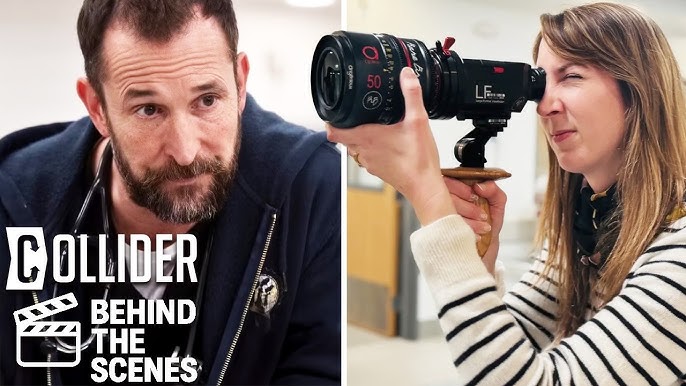
The Pitt is built around the ARRI Alexa Mini LF, which Coelho chose as the show’s full-format camera. According to ARRI’s official specifications, the Alexa Mini LF uses a 4.5K ALEV III large-format sensor measuring 36.70 x 25.54 mm, records up to 14+ stops of dynamic range, offers built-in motorized ND filtration, and weighs about 2.6 kg for the camera body with lens mount. Those characteristics matter on a show like The Pitt because they combine image quality with a body small enough for crowded rooms, hallways, and body-mounted support rigs.
The creative advantage of that camera choice is easy to see. The large-format sensor helps the show preserve a cinematic, shallow-focus image even while operating in a bright, clinically lit hospital environment. The compact body helps the camera move close to actors, gurneys, counters, and doorways without turning the set into a crane-and-dolly exercise. The camera is not the whole trick, but it is the technical base that allows the show’s other tricks to work.
The Pitt Lens Choices and How They Shape the Viewing Experience
Coelho’s lens package is unusually disciplined. In interviews, she said the show largely lives on 50mm and 75mm focal lengths, using Angenieux Optimo Primes on A-camera and an Optimo Ultra Compact 37-102mm zoom on B-camera. She also explained why: 50mm on large-format gives the audience something close to a natural, human perspective, while 75mm isolates a character when the story needs emotional concentration or the sensation that the world is falling away around them.
The B-camera zoom serves a different purpose. Rather than changing the overall look of the show, it lets the operator “steal” details and reactive moments while A-camera executes the long, perspective-driven move. Coelho has emphasized that the zoom is not used for visible zoom effects in the final frame; it is a flexibility tool that lets the team reframe quickly inside cramped spaces without stopping the scene’s momentum. That is why the viewing experience feels fluid rather than overdesigned: the optics serve the choreography, not the other way around.
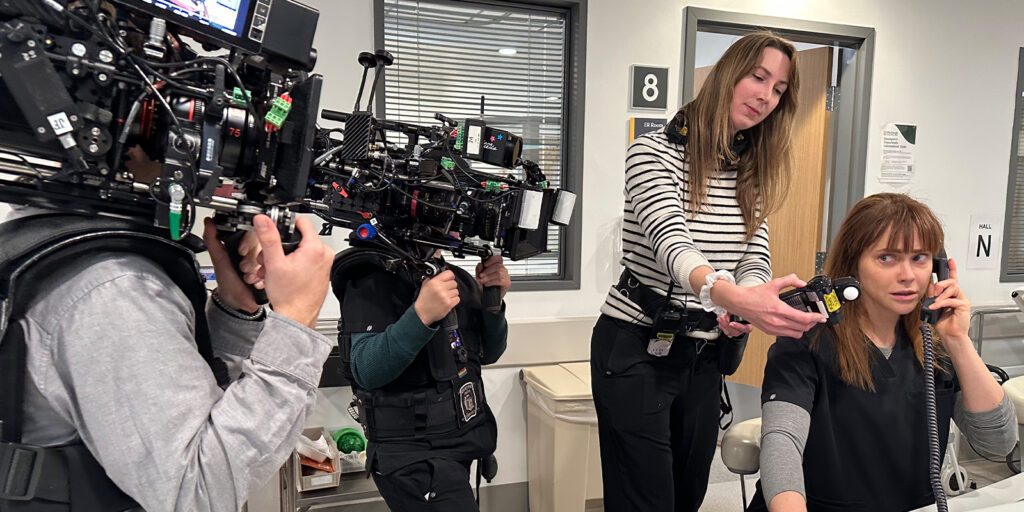
How The Pitt Uses Handheld Cameras for Realistic Medical Drama
Coelho has been explicit about this point: the whole show is handheld. That decision gives The Pitt its documentary pulse, but the execution is more controlled than the phrase might suggest. Interviews describing the camera language repeatedly stress that motion is carefully choreographed so viewers sense physical presence without becoming overly aware of operator movement. In other words, the show wants the urgency of handheld without the fatigue of uncontrolled shake.
That choice also changes how actors perform. Wells explained that the operator is effectively “dancing” with the actor, maintaining frame and focus as performers move naturally through space. Coelho has similarly described the camera as almost another person in the hospital. The payoff is realism: doctors can pivot, rush, turn, and stop in ways that feel lived-in, and the camera can stay with them instead of forcing the scene into static television blocking.
How the “Z-Rig” Camera System Creates Smooth ER Tracking Shots
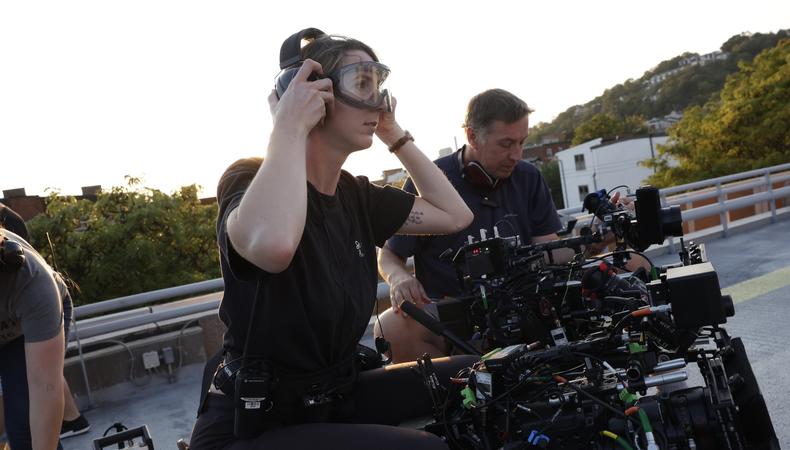
Trade interviews around The Pitt refer to the show’s support rig as the “Z-rig,” while Coelho’s own interviews identify the working setup as a ZeeGee rig. However it is labeled, the principle is the same: it is a body-supported camera system that preserves handheld organic movement while removing much of the operator fatigue and unwanted footstep bounce that pure shoulder operation can introduce.
On the official ZeeGee site, the rig is described as a three-axis cradle with free motion in pan, tilt, and roll, mounted to a body-supported arm-and-vest system that transfers weight off the operator and allows substantial vertical boom. The company says the rig can act almost like a three-dimensional slider, pushing over desks, flying over chairs, and maintaining a shoulder-camera feel while reducing footstep artifacts and allowing longer focal lengths without excessive shake. That maps almost perfectly onto what The Pitt needs in its crowded ER: tracking backward down hallways, drifting sideways past beds, and changing height as characters move from standing to seated positions without turning the image into conventional stabilized glide-cam language.

The ER as a moving stage
Why The Pitt Feels So Real: Inside Its 360-Degree Hospital Set
The set is one of the show’s most important camera tricks because it is not really a “trick” at all. Ruscio and her team built an entire ER on the backlot at Warner Bros. Studios, drawing on real emergency-department ergonomics and designing a 25-bed environment over a 10-week build with roughly 125 craftspeople. Ruscio explained that she delivered a ground plan before scripts were written so the writers could build the show’s movement and continuity around an actual spatial blueprint rather than an abstract idea of “hospital geography.”
That early design choice matters enormously for camera realism. Because the set was conceived as a complete environment rather than facings on a stage, the audience can see through one layer of action into another, with foreground stories and peripheral stories unfolding at the same time. Ruscio described the architecture as a “cup and curve” design meant to create continuous motion with no obvious visual dead end, and she stressed that there is virtually no unused stage space. In practical terms, that allows long handheld travel and deep background storytelling without the image collapsing into fake-TV geography.
The Pitt Behind the Scenes: How Camera Movement Follows the Chaos
The camera movement in The Pitt is not random “find it in the moment” operating. Coelho has said it is completely choreographed, but choreographed to feel unnoticed. That distinction is essential. The actors, camera operators, gurney movement, and background performers are coordinated so the frame can glide from one dramatic thread to another without announcing the technique. Coelho has also noted that significant story information is often hidden in passing background action rather than isolated in inserts, which gives the whole ER the feeling of being alive beyond the principal scene.
Two cameras do most of the work. In season 2 interviews, Coelho explained that A-camera usually carries the long, character-centered move, while B-camera gathers elements that cannot fit naturally into that move. During takes, she stays beside the director and communicates with operators over comms when a key beat or reaction needs to be grabbed. This is one reason the show feels chaotic but readable: the camera follows the chaos, but the team is constantly steering where the audience’s attention lands.
How The Pitt Films Long Continuous Scenes Without Breaking Immersion
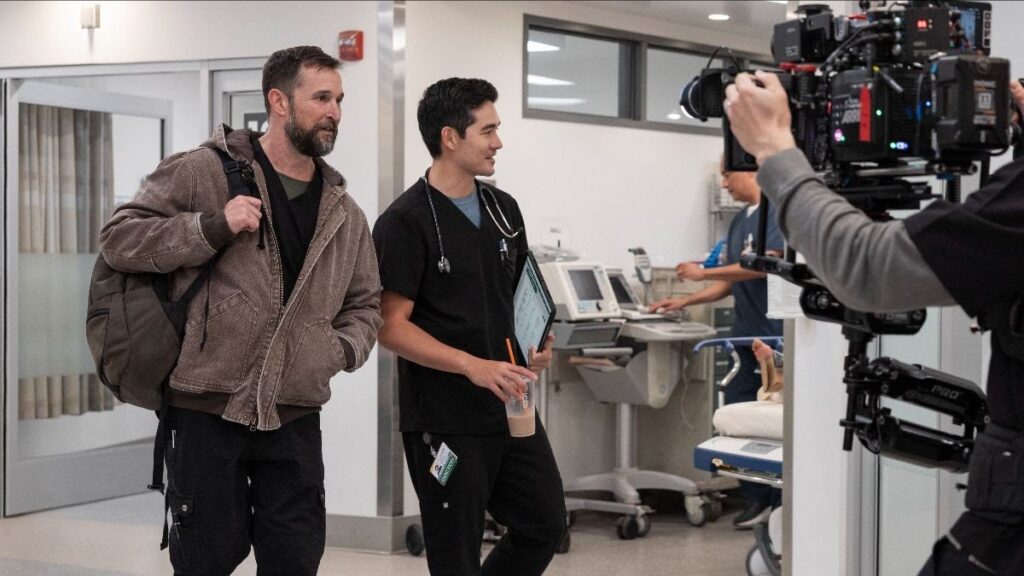
The Pitt is full of scenes that feel like long, unbroken passages through the ER, but the craft is more nuanced than simply shooting endless one-takes. Coelho explained that the team designs a main “master” as a continuous perspective shot following one character through the whole dramatic beat, then supplements it with reverse masters, reaction cleanup, and pickups when necessary. The goal is not formal purity; it is editorial continuity that preserves immersion.
Editor Mark Strand’s comments make the philosophy even clearer. He said the series must honor physical space so rigorously that the cutting room cannot simply jump a character down the hall to save time. Coverage exists, but it is staged “much like a play,” with the company often resetting the entire scene and replaying a similar move on a wider or tighter lens rather than shredding the action into disconnected pieces. That is a major reason The Pitt rarely feels like it is cheating geography: cuts are hidden by continuity of movement and perspective, not by pretending there are no cuts.
Lighting and real-time continuity
The Pitt Lighting Techniques That Make Scenes Look Natural
The lighting on The Pitt is engineered to disappear. During stage construction, Coelho, Ruscio, and the lighting team integrated illumination into the architecture itself, replacing standard ceiling internals with custom LED solutions and choosing the orientation, density, and color behavior of the practical fixtures before principal photography began. Interviews with Coelho describe a ceiling system built around controlled troffers, headboard lights, practical cans, and computer-programmed cues that let the set remain shootable from virtually any direction.
The “natural” look is not soft romantic realism. It is bright, almost white-balanced institutional realism. Coelho has explained that the show intentionally follows actual hospital lighting logic, including the fact that indoor lighting tends to stay essentially the same at night for safety reasons. The crew then adds finesse through magnetic diffusion frames, small battery-powered eye lights on poles, and custom onboard lights mounted near the matte box that can be brought up or killed during a shot depending on reflections and angle changes. Naturalism, here, is the result of intense hidden control.
How Real-Time Filming Impacts Camera Work in The Pitt
Real-time storytelling changes everything about the camera plan. Gemmill told the Television Academy that the writers tracked doctors and patients like pieces on a game board, and that the show shoots in continuity because there are too many visible layers of background action to fake later out of order. Coelho has said the production shoots in story and scene order, and that this continuous approach actually helps camera and lighting planning because the team can track the passage of time across the shift rather than constantly resetting the world.
The camera therefore works less like a conventional episodic TV unit and more like a real-time theater machine. Background performers often remain embedded in the environment for long stretches, and Wells noted that patient actors and extras spend months inhabiting the set, which deepens behavioral continuity. Because the show does not rely on marks and because the script’s temporality is linear, the camera department adapts to medicine, blocking, and traffic in the environment instead of forcing scenes into a pre-fabricated shot grid.
Crowds, practical effects, and season 2
The Pitt Camera Tricks for Capturing Crowded Emergency Room Scenes
Crowded ER scenes are where The Pitt’s system is stress-tested. In Backstage, Coelho described how the late-season mass-casualty material required a different camera strategy because the floor space became too dense for the show’s usual sweeping long moves. Instead of insisting on the same grammar everywhere, she adapted by adding a third camera to catch reactions and fragmentary beats amid the crush of patients and staff. That flexibility is important: the show’s realism comes from adjusting the method to the emergency, not from forcing every emergency into the same method.
The crew also solved practical problems that could have broken those scenes. Fake blood on the floor was applied over plastic so operators would not slip, and the crew wore scrubs so accidental reflections inside the 360 set would not immediately destroy the illusion. Ruscio’s set design further helped by allowing multiple visible layers of action at once, which meant a crowded room could register as a real emergency ecosystem rather than as a single foreground tableau.

How The Pitt Blends Practical Effects with Cinematic Camera Work
The Pitt’s practical effects are designed for close, unforgiving photography. Coelho has said that in trauma scenes the camera department coordinates carefully with prosthetics teams about what can be seen, what might be damaged during the action, and which close details must be photographed first. That collaboration lets the cinematography stay intimate without exposing the seams of the effects work.
A vivid example is the season 1 childbirth sequence. Reporting from People and Vulture described a custom gurney-based rig with a silicone pregnant belly, legs, and vaginal canal, hidden puppeteers managing blood and fluid action, and a shooting plan that allowed the birth to be captured without breaking the visual connection between baby and mother. The scene is a perfect expression of The Pitt’s method: practical fabrication first, camera choreography second, and emotional authenticity as the final goal.
Behind the Scenes of The Pitt Season 2 Visual Effects and Camera Magic
The publicly documented season 2 material points in a very specific direction: the “magic” remains primarily in-camera. In her February 2026 interview with the Motion Picture Association’s The Credits, Coelho said the show still depends on exclusively handheld shooting, character-perspective design, disciplined choreography, and a 360-degree set with no floor stands. She also described season 2 sequences built from multiple mini-scenes inside a single larger camera move, with background actors, gurneys, and camera timing all coordinated to feel spontaneous.
Season 2 interviews also stress how little obvious digital augmentation viewers are meant to notice. Coelho said the prosthetic work on the show often needs “very few changes in visuals,” and in her later /Film interview she explained that the team still relies on long perspective masters, custom lighting choreography, controlled onboard fill, and restrained pickup coverage to maintain continuity. The safest conclusion from the available 2026 reporting is that season 2’s visual effects are meant to disappear into cleanup and support work, while the visible realism still comes overwhelmingly from staging, camera choreography, and practical prosthetics. That last point is an inference from the available interviews, but it is a strongly supported one.

FAQs
Is The Pitt shot entirely handheld?
Yes. Coelho has explicitly said the whole show is handheld, and both her interviews and Wells’s comments confirm that the production avoids conventional dolly-based visual grammar in favor of mobile rigs and operator-led movement.
What camera does The Pitt use?
The core camera is the ARRI Alexa Mini LF, a large-format 4.5K camera with 14+ stops of dynamic range and a compact body that suits tight handheld work inside a 360-degree set.
Which lenses does The Pitt use most often?
Coelho has said the show mostly works with 50mm and 75mm focal lengths on A-camera, plus an Angenieux Optimo Ultra Compact 37-102mm zoom on B-camera for fast reframing and “stolen” coverage.
What is the “Z-rig” on The Pitt?
In public interviews, the term refers to a body-supported handheld rig associated with the ZeeGee system. Its purpose is to preserve organic handheld energy while reducing footstep bounce, operator fatigue, and unwanted instability.
Is The Pitt filmed on a real hospital location?
Most of the show is not filmed in a functioning hospital. The production built a detailed ER environment on the Warner Bros. soundstages, with real equipment and sightlines engineered for 360-degree movement. Coelho has said about 90% of the show is shot on the main stage.
How does the show light scenes when the camera can see in every direction?
The lighting is built into the set through ceiling fixtures, programmable cues, practical lamps, diffusion tools, and small mobile fill sources. That allows the camera to rotate and travel without constant relighting.
Does The Pitt shoot scenes in chronological order?
Yes, the production has repeatedly said it shoots in continuity or in story-and-scene order. That helps preserve background action, patient journeys, and the visible passage of time across the shift.
Why do the long scenes feel seamless even when they are not true one-takes?
Because the show protects geography and emotional point of view. The master shots are character-based, and the editing avoids impossible jumps through space, so cuts feel like continuous observation rather than coverage assembly.
Does The Pitt rely heavily on CGI?
Not in the way many viewers might assume. The public reporting emphasizes practical prosthetics, physical rigs, and in-camera solutions, with Coelho saying some prosthetic work requires very few visual changes after capture.
Why does The Pitt feel more immersive than many other medical dramas?
Because its whole system is aligned toward immersion: handheld perspective, real-time continuity, minimal marking, embedded lighting, deep background action, and editorial respect for physical space. Very little of the show’s tension is outsourced to flashy postproduction tricks.

Conclusion
The real secret behind The Pitt’s ultra-realistic ER chaos is that its camera tricks are designed not to look like tricks. The series blends a handheld documentary pulse with the precision of high-end dramatic cinematography; it uses a compact large-format camera, disciplined lens choices, a body-supported rig for fluid movement, a purpose-built 360-degree set, integrated lighting, continuity-first editing, and practical effects that can withstand unforgiving close-ups. When those parts lock together, the viewer stops noticing technique and starts feeling proximity, fatigue, urgency, and emotional overload in something close to real time.
That is why “The Pitt camera tricks behind the scenes” is the wrong question if it is looking for one secret. The right answer is that the show has built an entire visual operating system for realism, and each piece of that system exists to make the audience forget the camera while trusting every frame.
Sources and citation
This research prioritizes first-hand technical interviews and primary documentation: Coelho interviews in No Film School, The Credits, Backstage, and /Film; Ruscio and Wells interviews via the Motion Picture Association and the Television Academy; Mark Strand’s editing breakdown with Boris FX; ARRI’s official Alexa Mini LF specification page; the official ZeeGee product documentation; and reporting on the birth rig from People. These sources collectively document the show’s handheld method, lens package, support rig, embedded lighting system, continuity workflow, editorial rules, and practical-effects process.
Where the public sources use different numerical descriptions for the lighting system, such as “246 separate zones” versus “300 lighting cues,” this article preserves the most defensible common denominator and describes the setup as a set-wide, computer-controlled embedded lighting network with hundreds of programmable zones or cues, rather than flattening different production terms into a single unsupported number.