





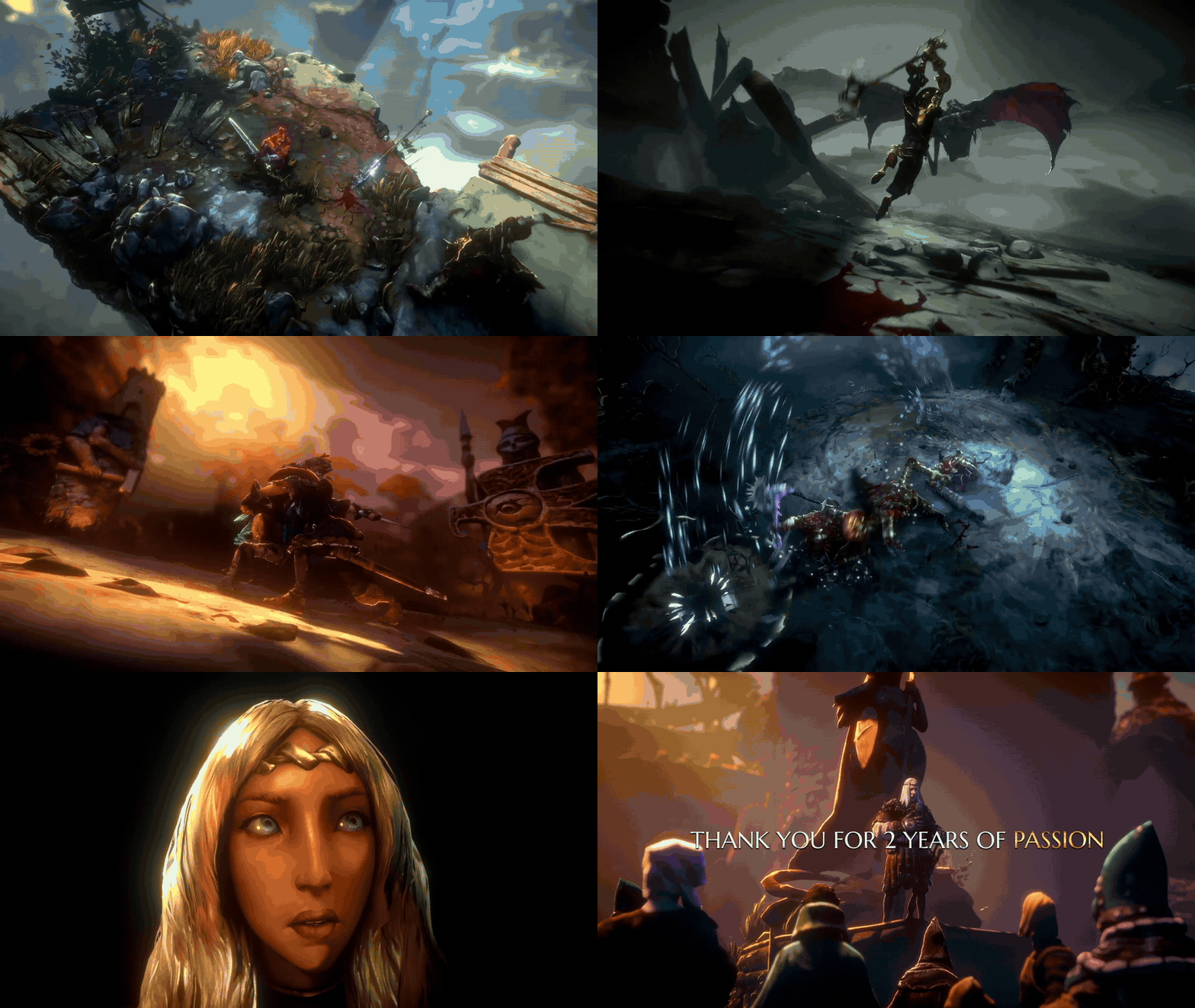
Moon Studios’ upcoming action RPG No Rest for the Wicked combines a unique painterly art style with bespoke technology. The developers deliberately avoided generic 3D graphics: Moon’s CEO Thomas Mahler wanted “painting comes to life” as the core principle. Drawing on classical art, the team cites Caravaggio for dramatic light-and-shadow and 19th-century landscape painters (Shishkin, Kuindzhi, Levitan) for rich environmental color.
Characters are stylized (large hands, distinct features) to be readable from the isometric view, and the game explicitly avoids photorealistic PBR graphics in favor of expressive lighting (e.g. heavy rim lighting inspired by Vagrant Story cutscenes). Even Ori’s aesthetic rubbed off on the project Ori and the Will of the Wisps ran in parallel with No Rest’s pitch and “had a significant influence on the look” of this game. In short, every scene is composed like a living oil painting, using light itself to “define the atmosphere”.
What Inspired the Art Style of No Rest for the Wicked by Moon Studios
The art direction was driven by a love of classic painting. Mahler and his team studied Old Masters to guide the visuals. For example, Caravaggio’s dramatic chiaroscuro and tight composition became a reference for scene lighting. Environment artists also looked at late-19th-century painters (Ivan Shishkin, Arkhip Kuindzhi, Isaac Levitan) to shape terrain and mood with rich colors and atmospheric landscapes. Characters were designed with bold stylization: Mahler insisted on larger-than-life proportions (big hands, pronounced facial features) so animations read clearly on screen.
The team deliberately went “in the opposite direction of PBR realistic graphics”, focusing instead on artistic expression and dramatic lighting. For example, they reference the Vagrant Story cutscene style pronounced rim lighting that makes even aged graphics look beautiful and apply similar rim lighting extensively in No Rest. Combined with Ori’s influence (their previous game), the result is a dark fantasy world that feels like playing within a series of masterful paintings.

How Moon Studios Created a Hand-Painted World in No Rest for the Wicked
Moon Studios built every asset by hand, using traditional artistic pipelines adapted for 3D. The team “value handcrafted and painted assets” and employs a very traditional workflow. Artists freely use tools like Blender (for environments) and 3DCoat (for textures). The process typically starts with detailed concept art, often aided directly by concept artists even during modeling. Models are created with emphasis on silhouette and detail, then hand-painted: textures begin by projecting the concept art onto the 3D model and painting over it, then polishing both geometry and texture with the in-game camera framing in mind.
The result is brush-stroke rich textures that read as painted surfaces, not flat materials. A lead artist explains: “3DCoat is pretty much the go-to software for painting textures. In the end, the custom rendering and lighting we do in Unity mostly tie the assets together to produce the look we are after.”. In practice, every tree, rock, and wall is individually authored and lit, ensuring a cohesive hand-painted aesthetic rather than a patchwork of generic or procedurally tinted assets.
Behind the Scenes: The Technology Powering No Rest for the Wicked
Under the hood, No Rest for the Wicked runs on a heavily modified Unity engine (internally called “Moonity”) that has been extended with custom systems. The team added deterministic multiplayer via Photon Quantum, allowing up to four players to explore the world in sync. They also built a chunk-based streaming system to handle the large world: the game world is split into many small “nuggets” and “chunks,” and each chunk loads or unloads dynamically based on the player’s position and quest state.
This means the engine only processes parts of the map that matter at any moment, which is essential for performance. Throughout development the team created extensive internal tools: an in-game debug console lets developers spawn players, enemies, items or simulate lag on the fly, speeding up testing and iteration. Crucially, the fixed isometric camera enables powerful optimizations.
Because Moon controls exactly what the player sees, they can aggressively cull off-screen objects and pre-bake lighting for each angle, giving artists confidence that every scene looks polished. Together, these systems (custom engine, network, streaming, and tooling) form the technological foundation that brings the team’s artistry to life.
Why No Rest for the Wicked Uses a Custom Game Engine Instead of Unity or Unreal
Moon Studios chose to build the game on an in-house engine tailored to their needs. An official tech site explains that “instead of using commercial engines, the team builds the game on internal and proprietary technology, designed to realize their artistic vision without compromises.”. In practice this means a highly customized version of Unity with full source access (Moonity) essentially their own engine. This lets the team implement unique visual features directly. For example, their renderer was built as a “digital brush” optimized for an animated oil-painting look. The custom engine also handles the isometric ARPG demands: it was explicitly designed to prioritize environmental detail and lighting effects specific to No Rest’s aesthetic.
In short, owning the engine gives Moon absolute control. They can adjust every graphical parameter for the “gloomy atmosphere and unique visual identity” of the world.
The trade-off is extra work (the devs must debug and maintain all systems themselves), but for Moon this was worth it to ensure complete artistic freedom. As one interview notes, Ori 2 itself used a “heavily modified” Unity (“Moonity”) so building on that foundation felt natural.

The Artistic Evolution from Ori to No Rest for the Wicked Explained
Moving from the 2D world of Ori to the 3D world of No Rest for the Wicked was a major transition. In Ori, levels were meticulously hand-painted 2D Metroidvania maps, but No Rest is a fully 3D fixed-camera ARPG.
Many of Moon’s 2D artists learned new 3D workflows when the project began. Game design also shifted: mechanics and navigation had to be completely rethought for a top-down view. Technically, they couldn’t reuse Ori’s codebase at all, so No Rest was built from scratch on the new engine. Artistically, however, there is continuity. Elements of Ori’s style carry over: the colorful, painterly vibe of Ori and the Will of the Wisps “had a significant influence” on No Rest.
Both games favor crafted visuals over realism, but No Rest aims for a darker, grittier fantasy tone. In short, Ori provided Moon Studios with a foundation in hand-painted worldbuilding; for No Rest, they scaled up that artistry into three dimensions, blending it with richer lighting and more complex geometry for an isometric action RPG experience.
How Soulslike Combat Influenced the Design of No Rest for the Wicked
Combat in No Rest for the Wicked takes cues from Soulslike games but with unique twists. The developers wanted players to feel powerful for example, Thomas Mahler notes that in this game “you can do all these crazy moves…like a player character with the cool boss moves from Dark Souls,” allowing dashes and attacks that normally only boss enemies get. Thus, while combat retains a weighty, precision-oriented feel (with dodging, stamina management, etc.), Moon flips the script by letting the player perform the flashy maneuvers. However, they emphasize No Rest is not a pure Souls clone.
Moon Studios’ tech lead points out the team is combining elements from many genres: “We’re not purely a Dark Souls-style game…we pull elements from different genres rather than copying one.”
This leads to a hybrid: a Soulslike combat framework infused with other systems (even town-building and co-op ideas from games like Valheim). In practice, fights feel challenging and tactical like a souls game, but with more variety in weapon skills and the satisfaction of chaining moves that feel cinematic. In sum, No Rest was influenced by Souls in combat philosophy, but reimagined it in a broader ARPG context.
Is No Rest for the Wicked Inspired by Diablo and Dark Souls? Full Breakdown
While No Rest for the Wicked naturally draws comparisons to Diablo and Dark Souls, Moon Studios sees it as its own unique blend. Thomas Mahler was “a huge fan of Diablo 2” growing up, and the game includes loot-based progression and RPG systems reminiscent of classic ARPGs. However, Mahler felt many modern ARPGs simply aped Diablo’s formula without innovation, so he aimed to reinvent core systems (weapon crafting, classes, etc.) rather than copy-pasting. From Dark Souls, the team took inspiration for tight combat and atmosphere, but again with a twist letting players execute boss-style combos.
Notably, Moon Studios explicitly downplays being a clone: “No Rest…is neither a souls-like nor a Diablo-like it’s No Rest for the Wicked,” the devs insist. Instead of mimicking either franchise’s business model, for instance, they refuse any microtransactions or passes (unlike Diablo 4).
The game’s innovations include an isometric camera (so you never have to spin the camera manually), a dynamic randomization of loot mod effects, and even social elements. In short, No Rest acknowledges the DNA of Diablo and Souls but recombines those DNA parts into a new “recipe,” as Mahler puts it, so players should experience something familiar yet fresh.

The Role of Lighting and Environmental Design in No Rest for the Wicked
Lighting is arguably a character of its own in No Rest for the Wicked. The team treats lights as narrative tools: rays and shadows sculpt each scene like brushstrokes. The proprietary engine uses “fundamental lighting” light “not only illuminates, but defines the atmosphere”. Environments are composed with strong contrasts and carefully placed highlights, giving depth and focus to each area.
For example, cavernous ruins might be lit by flickering torches that carve out dramatic silhouettes, while forest glades might glow with golden filtered light. The devs cite artists like Caravaggio and the famous Vagrant Story cinematics to emphasize moody chiaroscuro and rim lighting (glowing edges) as key stylistic pillars. Because the camera is fixed, lighting can be hand-tuned: certain viewpoints have baking or effects that wouldn’t work from arbitrary angles. Overall, the result is that light itself tells the story: every tavern or temple has a unified visual identity through its color palette and shadows. By “painting” with light, Moon Studios turns each in-game scene into an immersive, cohesive artwork rather than a generic video game map.
How Moon Studios Blends Art and Technology in Modern ARPG Development
Moon Studios exemplifies the synergy of art and tech. On the art side, they empower a global remote team of creatives: environment artists freely use Blender (with custom exporter tools) and character artists paint in 3DCoat, all collaborating via cloud systems. On the tech side, engineers built the Moonity engine to serve the artists’ needs for instance, enabling real-time rim lighting and maintaining visual fidelity even in multiplayer. The development pipeline is tightly integrated: concept artists often iterate on assets, and a dedicated “tools” team constantly adds features (like the custom timeline editor for cutscenes and in-game debug tools) to speed iteration.
A Unity developer at Moon explains: “We build a lot of our own render pipelines, timeline systems…just whatever we need.” This means new gameplay ideas can be quickly prototyped without waiting for off-the-shelf tech to catch up. At the same time, fixed-camera streaming lets the art and level design teams create sprawling hub areas and dungeons that load seamlessly. In short, No Rest was only possible because artists and coders worked hand-in-hand: the engine was effectively written to let the art shine, and the art style was designed with the tech capabilities in mind.
Why No Rest for the Wicked Features a Fully Handcrafted World Instead of Procedural Generation
Moon Studios chose full handcrafting over procedural generation to maintain complete artistic control. The Steam store even calls it a “hand-crafted world”. Every town, dungeon, and landscape was manually laid out and textured by artists. Procedural tools are great for generic repetition, but here they would break the painterly aesthetic. By placing and painting each object individually, designers ensure that every scene has intentional composition and visual clarity. As one developer said, Moon’s pipeline is very “traditional” no automatic dirt/grass overlays or procedural meshes because they value handcrafted and painted assets.
Technically, they support this with their custom streaming (“nuggets” and “chunks” to load only what’s needed) so artists can fill areas with dense detail without killing performance. The tradeoff is that development is more labor-intensive, but it makes the final world more coherent: players explore an environment that feels curated and stylistically unified, rather than a random assortment of prefab pieces.

The Creative Process Behind Character Design in No Rest for the Wicked
Designing characters is a tightly coordinated, multi-disciplinary process. It begins with a design document and high-level art direction. Concept artists then create detailed concept sketches based on these specs. These drawings are painstaking, with every aspect (silhouette, armor details, color highlights) worked out on paper or digital sketch.
Once approved, a 3D modeler sculpts the character in 3D, adhering strictly to the concept’s proportions (for example, ensuring the hero’s iconic cloak flows properly). The model is then textured by hand: artists project the concept artwork onto the model and paint over it to capture the exact colors and brushwork style. After the mesh and textures are polished, the character is rigged for animation and imported into the engine. Animators craft a full move-set of actions (attacks, dodges, etc.), while combat designers implement those moves into gameplay.
VFX and sound teams add particle effects and audio to each ability. Throughout, devs iterate constantly: if an animation looks off or a texture reads poorly in-game, they loop back and refine it. In the end, as described by Moon’s art director, it’s a “highly intricate and iterative process” one where concept artists, texture painters, modelers, and engineers all collaborate to ensure each monster and hero looks and moves exactly as envisioned.
How Moon Studios Achieved a Painterly Look in a 3D Isometric RPG
The painterly effect in No Rest comes from both art technique and technical craft. Artists literally paint on their 3D models. By using software like 3DCoat and Blender, they add brushstroke-like textures and rich color variation to every surface. They avoid flat, photoreal shaders in favor of a style that “emulates an animated oil painting”.
Under the hood, custom shaders and lighting amplify this style: materials are lit with warm tones and high contrast so textures have depth and color harmony. The engine supports effects like vignettes or grain that reinforce a “living painting” feel. Design choices also help: the fixed top-down camera means artists can purposely exaggerate foreground elements (like rust on an armor plate) so it reads as an intentional brush detail.
Studio lead Thomas Mahler summarizes the goal: great art endures longer than tech. As he notes, paintings by Caravaggio still look stunning centuries later, whereas cutting-edge graphics date themselves. So Moon’s approach is to keep the world looking timeless “living paintings” animated by modern gameplay. The result is a 3D isometric RPG that looks nothing like a typical polygonal game; it feels hand-painted frame by frame.
The Technical Challenges of Building a Dense, Living World in No Rest for the Wicked
Creating a richly detailed, living world posed several challenges. First, performance in multiplayer: their deterministic engine must simulate all players and enemies on each client. As the tech lead recounts, “Quantum simulates everything at the same time across all players… when you have four players doing different things… it becomes much more demanding.”.
The team solved this with aggressive culling (ignoring off-screen activity) and by optimizing enemy spawns. Second, streaming large areas: To avoid loading huge maps at once, they implemented a chunk system. Patrick Williams explains the world is split into many small pieces (called “nuggets”), loading only those needed for the player’s location and quest. This dynamic streaming reduces memory use and lets designers pack each area with detail.
Third, visual density and lighting: The custom engine was built to handle heavy scenes, but Moon still had to balance fidelity and speed. They leveraged the fixed camera to precompute or bake lighting where possible. Despite that, adding more enemies or expanding a room for four players could drop frame rates, so the devs created specialized debug tools and level-of-detail tricks to maintain smooth action. In short, by using a bespoke engine and smart streaming, the team met the technical demands of a dense isometric ARPG, but it required constant engineering effort from fine-tuning off-screen simulation to splitting the world into manageable chunks – to make the world both detailed and playable.

What Makes No Rest for the Wicked Visually Different from Other Action RPGs
No Rest for the Wicked stands out because it looks like nothing else on the market. Rather than photorealism or simple cell-shading, it adopts a fully hand-painted aesthetic. Every asset feels crafted: from the carved stone textures to the weathered armor paint, you can see brushstrokes and artistic color blending up close. Characters have intentionally exaggerated proportions (oversized weapons, stylized faces) so they feel larger-than-life. The strong chiaroscuro lighting deep shadows punctuated by bright highlights gives scenes a dramatic, almost mystical look. Importantly, the game is rendered from a fixed isometric view, allowing each screen to be composed like a diorama. The Steam tagline even calls it a “hand-crafted world,” emphasizing that every corner is tuned by an artist.
Combined with its soulslike combat and social features, these visuals set No Rest apart. It really feels like exploring a living painting, not just another typical fantasy RPG – a distinction Moon Studios crafted intentionally.
Behind the Scenes Insights: Moon Studios’ Approach to Artistic Innovation in Gaming
Moon Studios approaches game art as a form of innovation and expression. CEO Thomas Mahler explains that rather than chase trends, the team looks at genres that lack innovation and tries to reinvent them. For example, they saw a tired ARPG market and aimed to “revolutionize the genre” by mixing elements in novel ways.
This vision extends to visuals: they didn’t want just prettier graphics, but a timeless style. Mahler notes that while tech quickly becomes dated, “a painting… made hundreds of years ago… never gets old.” So Moon built the game to “look like paintings come to life,” focusing on enduring artistry. Practically, this means a highly iterative process – the team wrote full novels for the lore, held extended Early Access, and constantly refined art and gameplay together.
They embraced community feedback and never rushed the final polish. Behind the scenes, this translates to day-to-day practices: artists collaborate remotely with minimal restrictions (using Blender, Maya, etc. as they wish); coders extend Unity at will (Moonity) to support unique features; and everyone has a voice in shaping the game’s look. The result is an artistic culture where innovation isn’t about new filters or effects, but about treating the entire game as a unified piece of art, made by artisans who “craft something out of love and passion”.

Frequently Asked Questions (FAQs)
- What is the art style inspiration behind No Rest for the Wicked?
Moon Studios aimed for a classic painting aesthetic. The directors cite Old Masters like Caravaggio for dramatic light-and-shadow, and 19th-century landscape artists for mood. Characters are intentionally stylized (e.g. oversized hands) and textures are hand painted to look like brushstrokes. Overall, the game is designed to feel like a living, animated oil painting. - What engine powers No Rest for the Wicked?
It uses a heavily customized Unity engine (nicknamed Moonity). Moon Studios has full source code access and built bespoke render pipelines and tools in Unity. In effect, it’s their own in-house engine, tailored for the game’s needs (lighting, multiplayer, streaming) rather than a vanilla Unity or Unreal setup. - Is No Rest for the Wicked similar to Dark Souls or Diablo?
It borrows elements from both but is neither one. There are loot and RPG systems reminiscent of Diablo II (Mahler is a fan of that game), and the combat has a Soulslike weight and difficulty. However, developers emphasize the game is unique Mahler says “No Rest for the Wicked is neither a souls-like nor a Diablo-like it’s No Rest for the Wicked”. Notably, they allow players to perform flashy boss-style moves (unlike Dark Souls), and they refuse any live-service features (no microtransactions like Diablo IV). - Does No Rest for the Wicked support multiplayer co-op?
Yes. From the start the team intended up to 4-player online co-op. They implemented a deterministic multiplayer system (using Photon Quantum) so that all players’ actions stay in sync. Early Access launched in single-player, but the final release will fully support friends playing together. The design even includes town-building and social features inspired by co-op games like Valheim and Animal Crossing. - Why is the world described as “hand-crafted”?
The developers manually created every area and asset rather than using procedural generation. The Steam page calls it a “hand-crafted world”. Moon’s artists placed and painted each object and texture by hand for style consistency. This ensures a unified artistic vision in every corner, at the cost of a lot of manual work. Streaming technology handles loading all these handcrafted pieces efficiently. - What tools do Moon Studios artists use?
The environment artists primarily use Blender (the team even built custom Blender-to-Unity tools). Other modelers use Maya or 3ds Max, but 3DCoat is the main software for painting textures by hand. Essentially, artists use whatever tools they prefer, and then import assets into the custom Unity engine. - How did Ori influence No Rest for the Wicked?
While No Rest is very different from the 2D Ori games, Ori’s hand-painted aesthetic and storytelling approach carried over. Ori’s development ran in parallel with early No Rest planning, so stylistic lessons (like color composition and character emotion) did “have a significant influence”. Additionally, some of the same artists and animators worked on both, lending a certain lineage. But the gameplay, camera, and world structure are completely new for No Rest. - When was No Rest for the Wicked released?
It entered Steam Early Access on April 18, 2024. Moon Studios has continued updating it and plans a full 1.0 release after polishing (with player feedback) in the coming months. - Does No Rest for the Wicked have microtransactions or DLC?
No. Moon Studios explicitly rejected that model. Thomas Mahler has stated they are “not aiming for Diablo 4’s business model” – there will be no microtransactions, battle passes, or expensive cosmetic sales. The focus is on delivering a complete, premium experience built out of community-driven development. - Why is No Rest for the Wicked played from a top-down fixed camera?
The top-down isometric view is a deliberate design choice. It lets the developers “craft the camera algorithm to really perfectly frame everything,” says Mahler. In contrast to Dark Souls (where you rotate freely), this means players always see action clearly without fiddling with the camera. It also lets the art team control exactly how every scene looks. The fixed perspective simplifies multiplayer play (everyone sees the same camera angle) and lets lighting and composition be optimized for that view.

Conclusion
No Rest for the Wicked represents Moon Studios’ bold leap into a new genre with a distinctive aesthetic. By marrying custom technology (a modified Unity engine with Photon networking and chunk-based streaming) to traditional artistry (hand-painted textures, classical lighting inspirations), the game achieves an experience unlike any other ARPG. The visual style a cohesive “living painting” sets it apart, while the gameplay blends soulslike challenge, Diablo-style looting, and novel multiplayer features. Throughout development, the team has iterated closely with players and stayed true to Mahler’s vision of “revolutionizing the genre”.
When No Rest for the Wicked fully releases, it should stand as an example of how a clear artistic vision, backed by custom tech, can craft a world that feels hand-crafted in every sense of the word.
Sources and Citations
- 80.lv technical interview
https://80.lv/articles/interview-inside-the-tech-and-artistic-inspirations-of-no-rest-for-the-wicked-from-moon-studios - 80.lv Thomas Mahler interview
https://80.lv/articles/moon-studios-thomas-mahler-talks-no-rest-for-the-wicked-handling-online-haters - GamesRadar+ hands-on feature
https://www.gamesradar.com/no-rest-for-the-wicked-preview-hands-on-march-2024/ - Official Steam page
https://store.steampowered.com/app/1371980/No_Rest_for_the_Wicked/ - Official No Rest for the Wicked website
https://www.norestforthewicked.com/
Recommended
- The Best Beards in Video Games: Iconic Characters and Their Legendary Facial Hair
- The Sims 4 Will Open an Official Marketplace to Let Content Creators Sell Mods: Release Date, “Moola” Currency, and Maker Program Explained
- The Hunger Games: Sunrise on the Reaping – Official Trailer Breakdown, Hidden Details & Fan Reactions Explained
- MASTERS OF THE UNIVERSE Official Trailer Breakdown and Everything We Know So Far About the 2026 He-Man Movie
- How Riot Created Animation for Come Home Short Film Using
- Bravely Default: Flying Fairy HD Remaster Gets Surprise Launch and 20% Discount on PC
- Pokopia Metacritic Score Explained: Why It’s 2026’s Highest-Rated Pokémon Game and the Best Pokémon Title of All Time
- How do I toggle between camera views in Blender?
- How to Create a Metahuman of Yourself: Turn Your Likeness Into a Digital Character in Unreal Engine 5
- Why Blender Artists Love The View Keeper for Camera Management