









In This Article (7 sections)
Anthropic AI Research Acceleration Threshold: November 2026 Announcement, Responsible Scaling Policy, and METR Findings
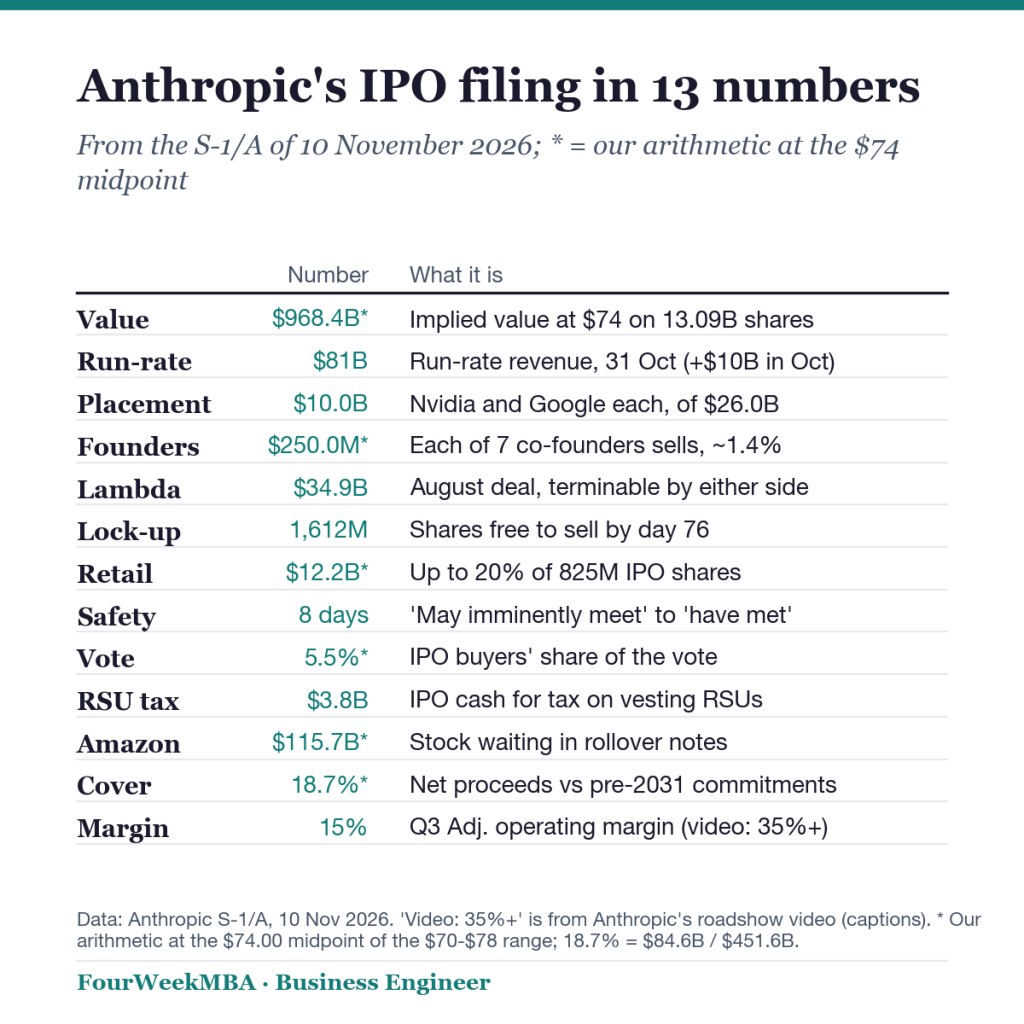
Anthropic says its AI research acceleration has reached a threshold defined in its Responsible Scaling Policy, raising questions about how quickly artificial intelligence is contributing to the development of increasingly capable models. The AI Research Acceleration determination appeared in the company’s November 10, 2026, amended IPO filing, which explained that Anthropic considers the threshold met based on its overall research progress and expectations about future models. The announcement highlights concerns about research speed, human oversight, and whether safety evaluations can keep pace with increasingly capable AI systems. However, the determination does not establish that existing Claude models can independently develop their successors or that an uncontrolled cycle of AI improvement has begun.
The distinction between a policy determination and a demonstrated technical capability is essential to understanding AI Research Acceleration. Anthropic’s assessment incorporates expectations about the capabilities of future systems rather than relying exclusively on observations of models currently in operation. A forecast can justify additional preparation before a risk becomes immediate, but it does not provide the same evidence as an experiment showing that a particular system has already accomplished the predicted task. Consequently, the announcement should be understood as an important governance decision informed by current progress and anticipated developments, not proof that every Claude model has reached the same level of research capability.
Anthropic introduced its Responsible Scaling Policy in September 2023, establishing a framework for evaluating increasingly capable AI systems and identifying safeguards associated with different risks. The policy has undergone several revisions, with version 3.4 taking effect on July 8, 2026. In February 2026, Anthropic revised the framework to distinguish its internal development plans from safeguards it recommends across the broader industry.
The overhaul also introduced Frontier Safety Roadmaps and expanded risk reporting. The roadmaps contain public objectives intended to guide future safety work, although Anthropic does not describe every objective as a binding commitment. These distinctions matter because a company requirement, an industry recommendation, and a research goal carry different expectations for implementation and accountability. They also shape how the company defines and responds to AI Research Acceleration.
Under version 3.4, the research acceleration threshold concerns an observed or expected doubling of aggregate AI capability progress relative to both the expected baseline and the fastest sustained historical rate achieved without substantial AI contributions. The policy also requires research or engineering automation to plausibly explain a substantial portion of the acceleration, with evidence suggesting that the trend could continue.
The historical comparison spans at least three model generations, preventing the assessment from depending entirely on a short period of unusually strong results. Anthropic has also clarified that doubling capability progress is not the same as doubling the productivity of individual researchers. The policy focuses on how quickly model capabilities improve, rather than simply counting code produced, experiments completed, or employee hours saved. This is central to the meaning of AI Research Acceleration under the policy.
That distinction creates a difficult measurement problem. A research team might complete implementation tasks twice as quickly with AI assistance but still experience limited overall acceleration if experiments take just as long or most proposed changes fail. Conversely, an assistant that helps researchers identify promising experiments could substantially improve progress even without dramatically increasing the amount of code written. Determining whether the threshold has been reached therefore requires estimating changes in capability progress and assessing how much of those changes can reasonably be attributed to AI. Faster research activity is relevant evidence, but it is not automatically equivalent to faster improvement in the capabilities of resulting models. This makes measurement especially important when evaluating AI Research Acceleration.
METR’s independent assessment, published on November 5, 2026, provides important evidence supporting the acceleration discussion. Following access to Anthropic between August 12 and October 29, METR estimated that the company’s aggregate benchmark progress had accelerated by approximately 1.9 times since October 2025, with a 95% confidence interval of 1.5 to 2.8 times. Its broader judgment about progress on well specified tasks carried additional uncertainty, with plausible rates closer to 1.3 or 3 times.
METR considered AI responsible for most of the acceleration currently observed. These findings support the conclusion that Anthropic’s research progress has accelerated substantially, although they do not establish a universal measure of intelligence or prove identical improvements across every research activity. The findings provide an independent reference point for assessing AI Research Acceleration.
The confidence interval and broader uncertainty should be interpreted separately. A statistical confidence interval reflects the data and assumptions of a particular model, while broader uncertainty also concerns whether the selected benchmarks adequately represent the capabilities that matter. Strong improvements on tasks with clear answers could coexist with slower progress on research problems involving uncertain goals, difficult experimental design, or ambiguous results. METR’s assessment therefore provides meaningful independent evidence without eliminating uncertainty about the exact magnitude or long term implications of the acceleration. These limitations are important when interpreting claims about AI Research Acceleration.
Anthropic’s internal workplace research offers another perspective on how AI contributes to development. An earlier study surveyed 132 engineers and researchers and included 53 interviews, identifying benefits such as faster iteration, easier work outside employees’ usual specialties, and increased attention to previously neglected tasks. AI assistance could help researchers implement ideas, investigate bugs, understand unfamiliar code, and prepare documentation. These improvements can reduce delays between identifying a research problem and deciding what to investigate next. However, the study also documented concerns about declining technical understanding and employees’ ability to supervise increasingly complex AI output, making the quality of review an important part of evaluating productivity gains and AI Research Acceleration.
The productivity benefits are not universal. METR’s earlier randomized study involving experienced open source developers using early 2025 AI tools found that tasks took 19% longer with AI access in that particular setting. That result does not invalidate Anthropic’s later findings because the studies involved different participants, tools, tasks, and periods. Instead, it demonstrates why adoption alone cannot establish improved productivity. Time spent checking incorrect suggestions, correcting errors, and integrating AI generated work must be included when measuring the actual benefit. Research acceleration should therefore be assessed within the workflows where it occurs, rather than inferred from the presence of AI assistants. This distinction also prevents AI Research Acceleration from being treated as an automatic outcome of AI adoption.
METR also concluded that faster growth in training compute did not explain the observed acceleration. This does not mean computing resources stopped contributing to AI progress. Rather, the increase in available compute was insufficient to account for the change in the measured rate of improvement. Better algorithms, more informative experiments, improved infrastructure, organizational changes, and more effective use of research labor could all influence the outcome. METR’s assessment framework treats attribution as a separate problem involving compute, labor, data, algorithmic improvements, and AI contributions. Ruling out faster compute growth as the explanation does not automatically prove that AI assistance caused every additional improvement. That distinction matters when identifying the causes of AI Research Acceleration.
Anthropic’s decision to include future models reflects the anticipatory purpose of the threshold. If a company expects a substantially stronger research assistant to increase development speed, waiting until months of activity have conclusively demonstrated that effect could delay necessary safeguards. Forecasting allows preparation to begin earlier, but the assumptions behind those forecasts must remain open to revision. Expected improvements might depend on agents completing longer tasks without intervention, making fewer mistakes, or operating efficiently within research workflows. If those assumptions prove inaccurate, the assessment should change accordingly. Forecasts and experimental measurements therefore serve complementary purposes: one supports earlier planning, while the other tests whether the expected developments actually occurred. Both are relevant to evaluating AI Research Acceleration.
The November 2026 IPO filing warns that rapid research acceleration could outpace safety, alignment, and security measures. Anthropic also acknowledged measurement delays and indicated that it was still assessing the data and implications of its determination. A model can demonstrate promising research capabilities while remaining unsuitable for broader deployment without additional evaluation. Similarly, a serious risk disclosure does not establish that the feared outcome is inevitable or imminent. The central issue is whether Anthropic can identify changes in capability quickly enough to adjust its supervision, testing, and security procedures before existing safeguards become inadequate. The company’s response will help determine how effectively it manages the risks associated with AI Research Acceleration.

AI Research Assistance vs Autonomous Claude Development, Recursive Improvement, and Human Oversight
Anthropic’s acceleration findings have renewed interest in whether Claude models could eventually develop more capable successors through AI Research Acceleration. However, AI research assistance, bounded autonomous research, and complete autonomous AI development are different capabilities. Research assistance involves AI performing tasks within a workflow where humans continue to define objectives, interpret results, and make consequential decisions. Fully autonomous development would require an AI system to manage a much broader process with minimal human intervention, including selecting research priorities, running experiments, interpreting uncertain outcomes, allocating resources, and determining whether a new model is ready for use. These distinctions are essential when assessing the implications of AI Research Acceleration.
Anthropic’s August 2026 automation snapshot illustrates the distinction. The company reported that Claude led 26% of its research and development work, while more than 90% reached at least the collaboration category. However, no measured subset was classified as fully autonomous. METR’s November assessment similarly identified assistance as the primary source of research acceleration. These findings indicate that AI was contributing substantially to development workflows without establishing that human researchers had become unnecessary. The important questions concern which responsibilities were delegated, which actions the systems could execute, and where human approval or interpretation remained necessary. They also help clarify what current AI Research Acceleration does and does not demonstrate.
A research assistant might implement a proposed experiment, investigate a software problem, or summarize results while a human decides whether the experiment addresses the intended question. The assistant could also identify an apparent improvement that later fails under more rigorous testing. Human researchers may still need to assess reliability, determine whether the evidence supports a broader conclusion, and decide whether further computational resources should be committed. Autonomy also depends on system permissions and workflow design. An AI model might be capable of proposing a modification without having authority to apply it, or it might execute routine tasks while requiring approval before making sensitive changes. These human responsibilities remain relevant as AI Research Acceleration expands.
Anthropic’s August 2026 alignment study demonstrated autonomous research loops focused on mitigating ten categories of measurable alignment failures. The systems could propose methods, conduct training, and test results within defined research tasks. This represented progress in automating parts of model development and safety work, but Anthropic acknowledged limitations involving narrow benchmarks, unmeasured capabilities, and failures for which adequate evaluations do not yet exist. Success in improving measured alignment behavior does not establish that an AI system can independently conduct an entire frontier model development program. It also does not guarantee that improvements on tested properties eliminate weaknesses outside the evaluation. The study therefore illustrates a bounded application of AI Research Acceleration, rather than proof of complete autonomous development.
The concept of recursive AI improvement describes a feedback process in which more capable AI systems contribute to the creation of further improvements in AI. For example, an assistant might help optimize an experimental workflow, leading to a stronger model that can improve another part of the research process. If successive generations remove additional constraints, development cycles could become shorter. Anthropic’s August risk report characterized the acceleration threshold as a potential early warning of this kind of development, while distinguishing that warning from evidence that the most acute acceleration threat had already materialized. This is an important distinction when discussing the possible long-term effects of AI Research Acceleration.
Recursive improvement does not necessarily lead to unlimited acceleration. Research programs may encounter expensive experiments, difficult validation requirements, limited resources, or scientific problems that resist automation. A stronger assistant might generate more ideas without improving the proportion that produce meaningful results. Similarly, increasingly complex systems could require more human review, offsetting some productivity gains. Evaluating recursive improvement therefore requires attention to the constraints that remain, not simply the theoretical possibility of one model helping create another. These limitations could influence how quickly AI Research Acceleration translates into measurable advances.
AI automation could also improve safety research, not only capability development. Anthropic’s alignment experiments show how automated systems can investigate measurable failures and test possible corrections. More extensive testing may help researchers identify problems earlier or explore interventions that would otherwise require substantial manual effort. However, safety automation is useful only when the evaluations themselves measure consequential risks. Improving performance on a narrow benchmark cannot guarantee the absence of harmful behavior that the benchmark does not capture. As a result, AI Research Acceleration must be evaluated alongside the effectiveness of the safety research it enables.
METR’s broader assessment framework distinguishes three related concerns: alignment, control, and acceleration. Alignment concerns whether an AI system might behave harmfully, control concerns whether harmful actions could be detected or prevented, and acceleration concerns whether capability development could move faster than the measures intended to manage it. These problems interact but cannot be reduced to one measure. A system might accelerate research without being fully autonomous, while effective oversight could still fail if reviewers lack the information or time needed to understand its actions. This framework provides a broader way to assess the risks associated with AI Research Acceleration.
Anthropic has consequently indicated that it is considering additional requirements for human review and approval of certain AI research decisions. The November filing describes these measures as under consideration rather than finalized procedures. Its October employment study also identified human attention as a constraint on reviewing agent output and described employees building tools to monitor automated workflows. As automated systems complete more work, organizations may face increasing volumes of results and decisions requiring review. If review capacity does not expand accordingly, nominal approval requirements can become less meaningful. This is a key governance challenge as AI Research Acceleration increases the volume of AI-generated research activity.
Effective human oversight involves more than requiring someone to approve an automated action. Reviewers need access to relevant evidence, sufficient understanding of the proposed work, and authority to reject or redirect decisions. Anthropic’s research on deployed agents also emphasizes monitoring and interaction design as important elements of oversight. One possible approach is to concentrate deeper review on actions with greater consequences, such as major training changes or access to sensitive resources, rather than applying identical procedures to every routine task. That is a general design principle, not a finalized Anthropic requirement. The company’s eventual policy language would need to define which decisions require approval and what constitutes adequate review, particularly as AI Research Acceleration makes research workflows more complex.
These questions become more important when automated research produces results faster than humans can evaluate them. A system might generate numerous plausible experimental findings, but researchers still need to establish which results are reproducible, which improvements generalize, and which risks remain unmeasured. Increasing output without corresponding verification capacity can create a backlog of uncertain conclusions. The relevant measure of successful oversight is therefore not simply the number of human approvals recorded, but whether those approvals are informed by meaningful evaluation. Without sufficient verification, the benefits of AI Research Acceleration could be difficult to distinguish from an increase in unverified output.
The central implication of Anthropic’s threshold announcement is that research speed and safety preparedness must be evaluated together. Current evidence supports substantial AI assistance and progress on some bounded autonomous research tasks, while complete autonomous successor development remains a stronger claim requiring broader demonstration. Recursive improvement is a plausible future concern, but its speed and consequences depend on technical, organizational, and governance constraints that have not been fully resolved. Ultimately, responsible AI Research Acceleration will depend on whether human oversight and safety measures develop alongside increasingly capable research systems.

Anthropic Responsible Scaling Policy Risk Reports, External Review, Safety Safeguards, and Possible Development Pauses
Anthropic’s Responsible Scaling Policy includes procedures intended to make significant capability and risk developments subject to continuing assessment. Under the applicable framework, the company produces Risk Reports every three to six months, covering public models and qualifying internal systems. The policy also provides for additional disclosures outside the regular reporting schedule when certain risk increases occur. Meeting the research acceleration threshold does not create this reporting framework from scratch, but it makes the treatment of acceleration and the relationship between development speed and preparedness more important within those reports.
The distinction between policy thresholds, reporting requirements, and recommended safeguards matters when evaluating Anthropic’s response. A threshold determination identifies a condition relevant to the policy, while the actual procedures that follow depend on the provisions governing that condition. Frontier Safety Roadmaps contain public objectives, but they should not all be interpreted as binding obligations. Similarly, Anthropic’s consideration of additional human review measures does not mean those measures have already been finalized. Readers should assess each commitment according to its published status and the applicable version of the policy.
METR’s independent review of Anthropic’s August risk report identified concerns about how acceleration evidence was presented publicly. METR considered the report’s public discussion to have understated the acceleration it observed. At the same time, it agreed that the models covered as of July 15, 2026, posed low acute catastrophic risk from acceleration, while considering an earlier threshold crossing plausible. These conclusions are not necessarily contradictory because they refer to different questions and evidence periods. One concerns the immediate risk associated with models covered by an earlier report, while the other concerns whether the acceleration threshold may already have been approached or crossed.
The dates attached to these assessments are therefore important. A report’s publication date may differ from the last day of evidence included in its analysis, while a forecast may concern capabilities expected to emerge later. Comparing documents without distinguishing those periods can create apparent inconsistencies. A report accurately describing an earlier set of models may not reflect developments that occurred after its evidence cutoff. Future reporting would be more informative if it clearly identified which observations changed Anthropic’s assessment and how much of the conclusion depended on measured results rather than expectations.
External review is another component of the Responsible Scaling Policy, although the requirements are conditional. The policy calls for a full external review process when a Risk Report covers models crossing relevant thresholds and is significantly redacted. Reviewers examine the underlying analysis and redactions, with all sections shared with at least one reviewer, subject to limited legal exceptions. This does not mean every threshold announcement automatically receives the same external audit. The applicable review process depends on the circumstances specified by the policy.
External review and public transparency also serve different purposes. METR reported that Anthropic withheld much of the evidence most informative to its acceleration conclusions from public release. An external evaluator may therefore have access to material unavailable to ordinary readers, allowing a more informed assessment while limiting independent public inspection. Such arrangements can provide useful scrutiny, but their credibility depends partly on the evaluator’s independence, expertise, and willingness to challenge the company’s assumptions.
METR has described its work as providing independent evidence rather than definitive certification that AI development is safe. That distinction is important because the science of evaluating advanced AI risks remains uncertain. External reviewers can identify weaknesses, question interpretations, and explain unresolved concerns without being able to guarantee the absence of future problems. Review becomes more valuable when it allows substantive disagreement instead of merely confirming that required documents exist.
Anthropic’s policy history also preserves the possibility of pausing or slowing development when the company considers it appropriate. Its November filing records that Anthropic previously delayed frontier base model pretraining for more than a month to improve security. This establishes that development timing has already been affected by safety and security decisions. However, the November 2026 research acceleration determination does not itself establish that Anthropic has begun another general development pause.
A slowdown could involve several different measures. Anthropic might postpone a particular training stage, allow more time for evaluations, restrict internal access to an advanced research system, or delay broader deployment while additional safeguards are developed. These are possible responses rather than confirmed consequences of the threshold determination. The appropriate action would depend on the specific risk identified and the evidence available.
For example, a concern involving access to sensitive research infrastructure might justify stronger permissions and monitoring rather than postponing a public product release. If the main problem were insufficient evaluations for an emerging capability, additional testing time could be more relevant. A development pause would also be easier to assess if its purpose and the conditions for resuming work were clearly defined.
The policy discussion also has implications for customers and external researchers. A forecast of faster model development does not automatically establish a product launch schedule, while improvements in benchmark performance do not necessarily prove that a model is ready for widespread deployment. Organizations relying on Anthropic systems may therefore need to distinguish between research progress, demonstrated reliability, and formally approved deployment conditions. Researchers evaluating Anthropic’s claims likewise need access to clear definitions, documented measurement methods, and information about the limitations of the evidence.
More informative future Risk Reports would distinguish measured progress, estimated causal contributions, and forecasts about future systems. They would also explain how alternative explanations were evaluated and identify any changes in safeguards, oversight, or development decisions resulting from the assessment. These are criteria for assessing transparency rather than additional requirements automatically created by crossing the threshold.
The larger governance question is whether Anthropic can maintain informed oversight as AI systems become more useful to its own research operations. Faster experimentation may improve model capabilities and potentially accelerate safety work, but it can also shorten the time available to investigate unfamiliar behavior. A credible response therefore requires both measurements of acceleration and evidence that the organization can evaluate and manage the risks associated with that acceleration.
Anthropic’s November 2026 determination represents an important point in that process. The company’s filing establishes its formal assessment, METR provides independent evidence of faster research progress, and the Responsible Scaling Policy supplies procedures for reporting and review. None of these alone proves that AI can autonomously create successive generations of frontier models. Together, they show why capability measurement, human supervision, external scrutiny, and development decisions are becoming increasingly connected as AI takes on a larger role in research.

Frequently Asked Questions (FAQs)
- Has Anthropic said its AI research threshold is met?
Yes. In its November 10, 2026, amended IPO filing, Anthropic stated that it considers the research acceleration threshold in its Responsible Scaling Policy to have been met. The determination incorporates the company’s overall progress and expectations about future AI models, rather than relying exclusively on observed capabilities of current systems. It is therefore a formal policy assessment that supports additional attention to preparedness, not proof of completely autonomous AI development. - Does this prove that current Claude models can improve themselves without humans?
No. Current evidence distinguishes between AI assisted research, bounded autonomous experiments, and complete autonomous successor development. Anthropic has documented significant AI participation in research workflows and demonstrated autonomous activity within selected alignment experiments. However, those findings do not establish that Claude can independently plan, train, evaluate, and deploy an entire new generation of frontier models without human direction or oversight. - Does twice the research progress mean twice the intelligence?
No. Research progress measures the rate at which capabilities improve over time, not a universal quantity of intelligence. A laboratory might improve twice as quickly on particular capability benchmarks without every model becoming twice as capable across all tasks. The reported acceleration concerns the speed of improvement and remains dependent on which measurements are used to represent broader capability progress. - What was METR’s central numerical finding?
METR estimated that Anthropic’s aggregate benchmark progress had accelerated by approximately 1.9 times since October 2025, with a 95% confidence interval ranging from 1.5 to 2.8 times. Its broader assessment included additional uncertainty about how well the benchmarks represented important research capabilities. METR also considered AI responsible for most of the acceleration currently observed, while recognizing limitations in the available evidence. - Why distinguish training compute from research efficiency?
Increasing training compute means using more computational resources, while improving research efficiency means achieving better results from the available resources and development processes. Two teams with similar increases in compute might make different amounts of progress because one identifies better experiments or uses AI assistance more effectively. METR concluded that faster compute growth did not explain Anthropic’s observed acceleration, making the contribution of research methods and AI assistance an important question. - Has Anthropic finalized the additional human review rules?
No. Anthropic’s November filing describes additional human review and approval requirements as measures under consideration. The company has identified concerns about maintaining effective oversight as AI systems perform more research work, but the cited filing does not establish a finalized set of new procedures. Readers should distinguish proposed safeguards from published requirements defining which decisions need approval and who is responsible for reviewing them. - Can AI help with safety research as well as capability development?
Yes. Anthropic has demonstrated autonomous research loops that investigate measurable alignment problems, propose possible improvements, and test their effects. These methods can help researchers explore more interventions and identify certain failures more efficiently. However, their value depends on the quality of the evaluations, because improvements on a limited set of benchmarks do not guarantee that important weaknesses outside those tests have been resolved. - Does the threshold automatically require a shutdown?
No. Meeting the research acceleration threshold does not automatically trigger a companywide shutdown or development pause. Anthropic’s policy includes risk reporting, review procedures, and the ability to slow or pause development when appropriate. The company has previously delayed frontier model pretraining to improve security, but the November 2026 determination does not itself establish that another general pause has begun. - Why does the report’s coverage date matter?
A report’s coverage date identifies the period of evidence used in its assessment, which may end before the report is published. Anthropic’s August report, for example, evaluated models covered as of July 15, 2026, while later findings concerned developments extending into October. Different conclusions can therefore reflect changes in the available evidence rather than direct contradictions. Readers should compare observation periods, publication dates, and forecast windows before interpreting changes in risk assessments. - What evidence would make the next update more useful?
A stronger update would provide clear measurement baselines, documented uncertainty, explanations of AI’s contribution to research progress, and identifiable changes to oversight or safeguards. It would also distinguish observed capabilities from predictions about future models and explain how development decisions responded to the findings. Where evidence cannot be published, information about independent review and the limits of public verification would help readers assess the conclusions more accurately.
Conclusion
Anthropic’s AI research acceleration threshold decision highlights the growing importance of maintaining effective oversight as artificial intelligence contributes more directly to developing increasingly capable models. The central challenge is understanding how quickly AI capabilities are improving while ensuring that safety evaluations, security measures, and human supervision can keep pace. Independent findings from METR provide evidence of faster research progress, but those results do not establish that current Claude models can autonomously develop complete successor systems without human involvement.
The determination also emphasizes the distinction between measured progress, expected future capabilities, and demonstrated autonomy. Forecasts can justify earlier safety preparations, but they must remain subject to revision as new evidence emerges. The next meaningful test will be whether Anthropic’s risk reporting, independent evaluations, and human oversight procedures provide sufficient understanding to guide development responsibly. Clear explanations of changes to safeguards, research decisions, and the limits of available evidence will ultimately matter more than the threshold designation itself.
Sources and Citations
- Anthropic — Amended IPO Registration Statement (November 10, 2026)
- Source: Anthropic Amendment No. 2 to Form S-1
- Explanation: This is Anthropic’s primary corporate disclosure about its research acceleration threshold. It states that the company determined it had met the threshold based on expectations about future models and its overall rate of progress, rather than observed performance from current models. It also discusses possible human-review requirements and precautions around frontier model development.
- Citation: SEC filing, November 10, 2026. SEC+1
- Anthropic — Responsible Scaling Policy Version 3.4
- Source: Responsible Scaling Policy v3.4 (PDF)
- Explanation: This policy defines the capability thresholds that trigger additional safety measures as AI systems become more capable. Its automated R&D provisions are particularly relevant because they explain how AI-driven research acceleration can create risks requiring stronger oversight and external review.
- Citation: Anthropic Responsible Scaling Policy v3.4. Anthropic+1
- Anthropic — Responsible Scaling Policy History
- Source: Responsible Scaling Policy — Official Version Archive
- Explanation: The archive documents how Anthropic has revised its safety framework over time. It helps establish when research automation thresholds, reporting requirements, and external review procedures were introduced or changed.
- Citation: Anthropic Responsible Scaling Policy archive. Anthropic+1
- Anthropic — Responsible Scaling Policy Version 3.0 (February 24, 2026)
- Source: Responsible Scaling Policy: Version 3.0
- Explanation: This announcement explains the major February 2026 rewrite of Anthropic’s safety policy. It introduced Frontier Safety Roadmaps and more detailed Risk Reports, establishing a framework for tracking safety goals and assessing risks across deployed models.
- Citation: Anthropic’s February 2026 policy announcement. Anthropic+1
- METR — Independent Assessment of AI R&D Acceleration (November 5, 2026)
- Source: Independent Assessment of AI R&D Acceleration at Anthropic in October 2026
- Explanation: METR’s independent assessment examines how much AI is accelerating Anthropic’s model development. It reports estimated improvements in the rate of capability progress, considers how much of that acceleration comes from AI assistance, and explains the uncertainty created by restricted and redacted evidence.
- Citation: METR, November 5, 2026. t.co+1
- METR — Review of Anthropic’s August 2026 Risk Report (November 5, 2026)
- Source: Review of the “Risks from Automated R&D” Section in Anthropic’s Risk Report
- Explanation: This review focuses on how Anthropic assessed the risks associated with automated research and development. It provides an external perspective on the company’s acceleration evidence, early-warning threshold, and the limitations of its public disclosures.
- Citation: METR, November 5, 2026 review. METR+1
- Anthropic — August 2026 Risk Report
- Source: Redacted Risk Report — August 2026 (PDF)
- Explanation: This report presents Anthropic’s own assessment of emerging AI risks, including the growing role of automated R&D. It provides important background on how the company monitors research acceleration and uses capability thresholds as early-warning indicators.
- Citation: Anthropic’s August 2026 Risk Report. Anthropic+1
- Anthropic — How AI Is Transforming Work at Anthropic
- Source: How AI Is Transforming Work at Anthropic
- Explanation: This workplace study examines how employees use AI tools in their daily responsibilities. It provides evidence about productivity improvements, changes to research and engineering workflows, and the growing challenge of supervising AI-generated work.
- Citation: Anthropic workplace research. Anthropic
- Anthropic — Employment Research (October 16, 2026)
- Source: How Employment Is Changing at Anthropic
- Explanation: This research examines how AI agents are changing employee responsibilities and the amount of work individuals can produce. Its findings are relevant to concerns that increasing agent output may outpace the human attention available to review and supervise it.
- Citation: Anthropic employment research. Anthropic
- Anthropic — Measurements for Understanding AI Development
- Source: Measurements for Understanding the Pace of AI Development Inside Frontier Labs
- Explanation: This research outlines ways to measure AI’s involvement in the development of future AI systems. It provides useful context for distinguishing AI assistance, partially automated tasks, and more autonomous research contributions when evaluating development progress.
- Citation: Anthropic research and measurement framework. Anthropic+1
- Anthropic — Automated Safety Research (August 28, 2026)
- Source: Automated Researchers Can Reliably Mitigate Alignment Failures
- Explanation: This study demonstrates how autonomous research systems can investigate measurable alignment problems and test potential solutions. It also helps illustrate the distinction between using AI to accelerate safety research and relying on AI systems to conduct development work without sufficient human oversight.
- Citation: Anthropic automated safety research. Anthropic+1
- Anthropic — Measuring AI Agent Autonomy (February 18, 2026)
- Source: Measuring AI Agent Autonomy in Practice
- Explanation: This research examines how people delegate tasks to AI agents, how frequently they intervene, and how much independence agents receive. It provides useful evidence for evaluating whether human supervision can keep pace as AI systems take on increasingly complex research and development tasks.
- Citation: Anthropic agent autonomy research. Anthropic+1
Recommendations
- The Pitt Fandom Has Reached a New Low: Heckling One of Its Stars on Broadway and What it Says About Fan Culture
- Borderlands 4 Nintendo Switch 2 Release Update and Latest Developer Comments
- Maxon Releases Cinema 4D 2026.3 (New Tools, Workflow Upgrades, and Performance)
- The Sinking City 2 Opens Pre-Orders for Its Three Editions: Complete Edition Guide and Bonuses
- Halo Campaign Evolved Remakes the Legendary FPS With New Missions and Co-Op
- WWE 2K26 Ringside Pass Season 3 Is Here: New Superstars, Returning NBA Star, and Persona Outfits
- Wizards of the Coast and Hasbro Miss Union Recognition Deadline: MTG Arena Developers’ Union Fight Explained
- Marathon Is Embracing The Jank: Duos Mode Comes To Perimeter As A Limited-Time Test
- Citizen Sleeper 2: Starward Vector, a science-fiction universe with a compelling narrative and dice-based gameplay



































































































