









In This Article (7 sections)
AMD EPYC Venice 2026 Benchmarks: EPYC 9996, EPYC 9686F, and the 93% Integer Throughput Gain,
AMD’s sixth generation EPYC Venice processors demonstrated substantial performance improvements in November 2026 benchmarks, particularly in workloads requiring high parallel throughput. Tom’s Hardware reported that a server equipped with two 256 core AMD EPYC 9996 processors delivered 93% higher integer throughput than a comparable system using two previous generation EPYC 9965 processors. In separate tests, the frequency optimized EPYC 9686F completed the CloverLeaf scientific benchmark more than twice as fast as Nvidia Vera and achieved a 92% advantage in the Java SciMark composite score. These results illustrate two different strengths of AMD’s Zen 6 architecture: the EPYC 9996 increases the amount of work a server can process simultaneously, while the EPYC 9686F emphasizes stronger performance from individual cores.
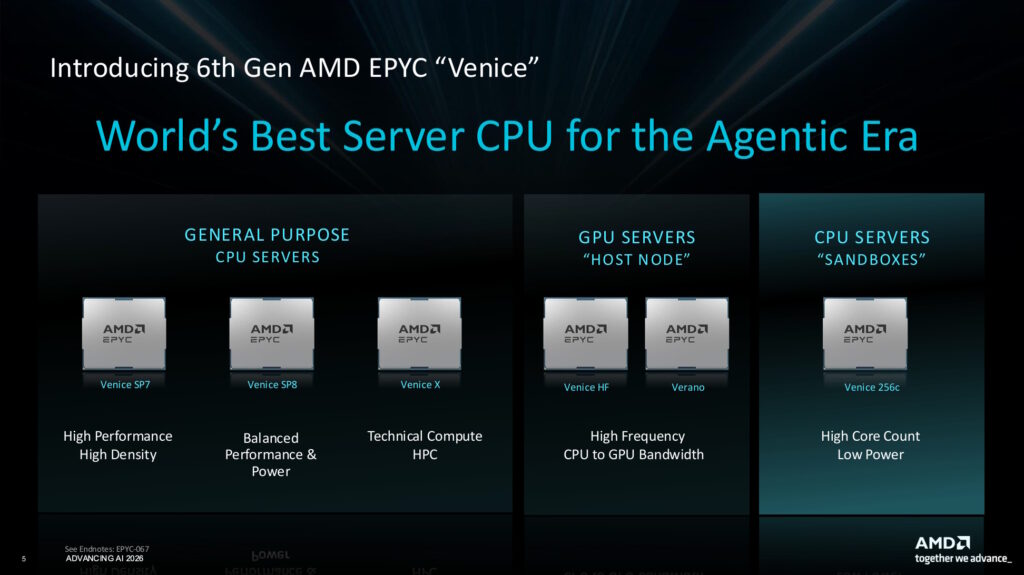
The two Venice processors serve different computing requirements. The EPYC 9996 contains 256 density optimized Zen 6c cores per socket, while the EPYC 9686F provides 96 higher frequency Zen 6 cores. Both belong to AMD’s EPYC 9006 family and support dual socket SP7 servers. A dual EPYC 9996 configuration therefore contains 512 physical cores and 1,024 hardware threads, compared with 192 physical cores and 384 threads for dual EPYC 9686F. The difference makes the 9996 particularly attractive for highly parallel workloads, while the 9686F targets applications that benefit from faster individual cores and greater memory bandwidth availability per core.
The benchmark platforms also differed in important ways. Tom’s Hardware tested Venice processors using AMD’s Nigeria reference platform with 2 TB of memory distributed across 32 modules. The previous generation Turin systems used AMD’s Volcano platform with 1.5 TB across 24 modules, while Nvidia’s dual Vera reference system also contained 1.5 TB across 16 modules. Venice used DDR5 12800 MRDIMMs, compared with DDR5 6000 registered DIMMs in the tested Turin systems. These differences matter because the reported improvements reflect complete platform configurations rather than isolated processor architecture changes. Faster memory, additional cache, and different hardware configurations can contribute to benchmark results.
The 93% generational improvement came from the integer rate portion of SPEC CPU 2026. Tom’s Hardware launched one independent benchmark copy per available hardware thread, resulting in 1,024 simultaneous copies on the dual EPYC 9996 server and 768 on the dual EPYC 9965 system. The publication described its results as estimates because the measurements had not been submitted to SPEC for official validation. Nevertheless, the comparison identifies a clear workload, baseline, and testing method.
A 93% increase means the newer server achieved approximately 1.93 times the previous system’s throughput. If an older machine completed 100 independent jobs per hour and the workload scaled exactly like the benchmark, its replacement could theoretically complete 193. However, this improvement does not mean every individual task finishes 93% faster. Workloads that depend on one thread, storage performance, or synchronization between processes may experience considerably smaller gains.
SPEC’s rate methodology measures the amount of work a machine completes over time by running independent copies of benchmark applications. Each copy uses one thread, and the elapsed time extends from the beginning of the first copy until the final copy finishes. Results are calculated against reference runtimes and combined using a geometric mean. The suite includes workloads associated with SQLite, CPython, compilers, compression, and the Stockfish chess engine. This diversity makes the aggregate useful for evaluating general server throughput, although administrators should examine individual application results when their production workloads are more specialized.
An independent ServeTheHome comparison also showed substantial generational progress. Using LLVM 22.1.4, it recorded an estimated integer rate score of 832.4 for one EPYC 9996 running 512 copies, approximately 71% above the EPYC 9965 in that test. The results support the conclusion that Venice significantly improves aggregate throughput, although the exact percentages differ because the laboratories used different socket configurations, compilers, and test conditions. Dell also published a SPEC integer base rate score of 1,270 for a PowerEdge R9825 equipped with EPYC 9686F processors, including detailed information about benchmark copies, runtimes, and processor affinity.
Core counts help explain the scale of the improvement. One EPYC 9996 has 256 physical cores and 512 hardware threads, while one EPYC 9965 has 192 cores and 384 threads. Moving to a dual EPYC 9996 configuration increases physical cores and hardware threads by approximately one third. Dividing the 1.93 fold throughput improvement by the 1.33 fold core increase suggests roughly 45% more benchmark throughput per installed core under full load. However, this calculation includes memory, cache, clocks, and scheduling effects. It should not be interpreted as a direct measurement of instructions executed per clock.
Cache capacity also increased considerably. AMD lists 1,024 MB of L3 cache for the EPYC 9996, compared with 384 MB for the EPYC 9965. Dividing by physical core count gives package wide averages of 4 MB and 2 MB per core, respectively. The additional cache can benefit applications with frequently reused data, although actual performance depends on cache organization, thread placement, and where information resides within the processor.
The practical value of 1,024 hardware threads depends on how workloads use them. Build farms can compile independent files, scientific laboratories can run numerous parameter combinations, and hosting providers can distribute unrelated requests across the server. Simultaneous multithreading allows two threads to share one physical core’s execution resources, but the benefit varies with the workload.
Phoronix tested this effect by enabling and disabling simultaneous multithreading on the same Venice systems. Its QuantLib financial computing benchmark showed an improvement of approximately 32% for dual EPYC 9996 and 20% for dual EPYC 9686F when the feature was enabled. However, StorageReview found that a dual EPYC 9996 Dell server completed a Linux kernel build in 99.4 seconds with simultaneous multithreading disabled, compared with 103.1 seconds when enabled. The difference demonstrates why organizations should evaluate both individual job completion times and total throughput across multiple simultaneous jobs.
The EPYC 9686F takes a different approach by prioritizing higher operating frequencies. AMD specifies a 4.05 GHz base clock and maximum boost of 5.3 GHz for its 96 cores. The EPYC 9996 has a 2.55 GHz base clock and maximum boost of 4.1 GHz. Both processors provide 16 memory channels per socket, meaning the 9686F offers the same channel count to substantially fewer cores. This can benefit workloads whose active threads require considerable memory bandwidth or whose performance depends on faster individual calculations.

AMD EPYC 9686F vs Nvidia Vera: Scientific Computing, Java, Memory, and Database Performance
The comparison between AMD EPYC Venice and Nvidia Vera reveals substantial differences across scientific computing and enterprise workloads. While the EPYC 9996 emphasizes aggregate throughput, the EPYC 9686F competes more directly with Vera in applications requiring strong individual core performance. Two EPYC 9686F processors provide 192 physical cores, compared with 176 cores for a dual Vera system. Although the core counts are relatively close, the benchmark results vary considerably depending on the software, memory configuration, and computational workload.
CloverLeaf produced one of AMD’s clearest victories. In Tom’s Hardware testing, the EPYC 9686F completed the scientific benchmark more than twice as fast as Nvidia Vera. AMD also achieved nearly twice Vera’s performance in FFTE, a separate fast Fourier transform benchmark. However, Vera recorded a narrow advantage in GNU Octave, showing that performance differences remain application specific even within scientific computing.
Phoronix reported more moderate improvements across a broader collection of predominantly high performance computing applications. Its dual EPYC 9686F system achieved a 13% geometric mean advantage over dual Vera, while dual EPYC 9996 finished 18% ahead. Both Venice configurations also reduced runtime in the Weather Research and Forecasting model. For organizations operating weather simulations, shorter execution times can be valuable when forecasts must finish before scheduled publication. However, results can change with model configuration, grid resolution, and the physical processes being simulated.
Java SciMark provided another major AMD victory. The EPYC 9686F achieved a 92% higher composite score than Vera, although Nvidia won the benchmark’s fast Fourier transform component. SciMark evaluates five numerical operations: Fourier transforms, iterative grid calculations, Monte Carlo integration, sparse matrix multiplication, and dense LU factorization. These operations exercise different combinations of processor execution resources, memory access patterns, and Java runtime behavior. The results demonstrate why a processor can win an overall benchmark while losing an individual component that may be important to a particular application.
For Java applications, performance should also be evaluated after the virtual machine has warmed up. A numerical calculation may become significantly faster without producing an equivalent improvement in the complete service request if serialization, memory allocation, or database access consumes most of the elapsed time. Developers should therefore compare both the computational kernel and the full application.
Memory benchmarks revealed how strongly processor placement policies affect results. In Tom’s Hardware STREAM testing, AMD led Vera by approximately 11% to 19% when OpenMP thread binding was enabled. Changing the placement policy to spread workers more widely across available processing locations reversed the ranking and gave Vera the advantage. The hardware remained unchanged, demonstrating that thread placement alone could determine which platform performed better.
STREAM measures sustained memory bandwidth while processing arrays, but other scientific workloads involve more complicated memory access. HPCG, for example, includes sparse matrix operations and communication patterns that differ from simple streaming access. Phoronix found that Venice equipped with DDR5 12800 MRDIMMs outperformed Vera in HPCG, even though Vera could lead in certain STREAM configurations.
Memory speed also affected individual Venice workloads differently. In Phoronix comparisons between 8,800 and 12,800 MT/s MRDIMMs, average performance improved by approximately 2% across dozens of tests, while HPCG improved by as much as 26%. This means organizations purchasing Venice servers should evaluate whether their applications benefit from faster memory before paying for a higher bandwidth configuration.
Database benchmarks demonstrated that the performance ranking changes with the database engine, cache state, and concurrency. In ClickHouse testing, Tom’s Hardware found Vera competitive with cold caches, while the EPYC 9686F performed better once the cache was warm. StorageReview recorded a particularly close result on a 100 million row analytical dataset. Across 43 warm ClickBench queries with simultaneous multithreading disabled, the 9686F completed the workload in 2.07 seconds, compared with 2.09 seconds for Vera. That difference fell within the laboratory’s comparison threshold, making the systems effectively comparable for that particular test.
Transaction processing showed greater variation. StorageReview’s HammerDB testing used one active processor socket and measured new orders per minute across several database engines.
| Database or workload | AMD EPYC Venice result | Nvidia Vera result |
|---|---|---|
| MySQL | EPYC 9996: 2.39 million orders/minute | 2.10 million orders/minute |
| PostgreSQL | EPYC 9686F: 3.03 million orders/minute | 2.90 million orders/minute |
| PostgreSQL with EPYC 9996 | 2.61 million orders/minute | 2.90 million orders/minute |
| ClickBench warm cache | EPYC 9686F: 2.07 seconds | 2.09 seconds |
Vera led the EPYC 9996 in MariaDB and PostgreSQL peak transaction throughput, while the EPYC 9686F achieved the highest PostgreSQL result among the three processors. The test also scaled database size according to available logical CPUs, so each result reflects its respective configuration rather than identical database sizes and concurrency settings.
Peak transaction rates do not reveal everything about database responsiveness. At a matched load of 144 virtual users, StorageReview found that the EPYC 9996 delivered lower 99th percentile payment latency than Vera across all four tested database engines. In PostgreSQL, the figures were 1.48 milliseconds for the 9996 and 2.34 milliseconds for Vera. An operator prioritizing maximum transaction volume might therefore reach a different purchasing decision from one focused on limiting slow customer responses.
Single thread and aggregate throughput measurements produced additional contrasts. In StorageReview’s pinned 7 Zip compression testing, the EPYC 9686F and 9996 performed similarly, both approximately 16% ahead of Vera. Decompression favored the 9686F, which achieved 6,816 MIPS compared with Vera’s 6,016 and the 9996’s 5,334. However, when all hardware threads were used, dual EPYC 9996 delivered approximately 2.3 times Vera’s aggregate decompression throughput. The distinction matters because extracting one archive and processing hundreds of independent archives are fundamentally different workloads.
These results reinforce the importance of evaluating the actual application rather than relying on a single overall benchmark. A scientific solver, Java service, database, and archive processor may benefit from different combinations of core count, frequency, cache, memory bandwidth, and threading behavior. Even within the same application, changing the workload size or concurrency can alter the ranking.

EPYC Venice vs Nvidia Vera: Architecture Differences, Power Efficiency, and Server Buying Decisions
AMD EPYC Venice and Nvidia Vera also differ in processor architecture and software compatibility. Venice uses x86 64, while Vera uses Nvidia’s Arm compatible Olympus cores. Both platforms can run supported Linux environments, but applications and their native dependencies must be available for the correct architecture. Container deployments may use separate Linux AMD64 and ARM64 images under the same image name. However, an application containing an x86 specific native component may require additional development before it can run correctly on Vera.
Compiler configuration also influences benchmark comparisons. Tom’s Hardware used GCC 16 for Venice, taking advantage of its specific Zen 6 support, while other processors were tested using GCC 15.2. Additional checks using GCC 15 reportedly produced only small differences and preserved the overall rankings. Phoronix used GCC 15 and Ubuntu 26.04 LTS for additional Venice measurements to match the software environment of its earlier Vera tests. These differences matter when organizations plan to deploy applications using established compiler versions rather than the newest available optimization tools.
Cross platform comparisons also require equivalent workloads. StorageReview excluded Vera from its Linux kernel build ranking because compiling an Arm kernel involves a different collection of drivers and modules from compiling an x86 kernel. Both processors could complete valid builds, but the workloads would not represent identical amounts of work. For organizations evaluating build infrastructure, compiling the same portable application with comparable settings provides a more meaningful measurement.
Clock frequency is another important consideration, particularly for scientific applications that cannot efficiently use hundreds of cores. During Phoronix’s QuantLib testing, the EPYC 9686F reached its advertised 5.3 GHz boost frequency, with sampled peak frequencies averaging approximately 4.0 GHz. The EPYC 9996 reached 4.1 GHz, with sampled peak frequencies averaging around 2.78 GHz. These values describe observed peak frequencies during testing rather than the sustained operating speed of every core.
The importance of frequency also depends on problem size. In Phoronix’s LIBXSMM matrix library tests, Vera performed better with small matrix dimensions of 32 and 64, while the EPYC 9686F led at dimension 128. A scientific application may repeatedly call a matrix library using different sizes, so understanding which dimensions dominate the workload can be more useful than comparing advertised boost frequencies.
Power consumption requires similar care. Phoronix observed higher CPU power usage on Venice systems than on Vera in several tests, although Venice also achieved performance per watt advantages in some workloads. A processor consuming more power can still use less total energy per completed job if it finishes sufficiently faster. Organizations constrained by rack power or energy budgets should measure complete server consumption, including memory and cooling, across their actual applications rather than relying only on processor power figures.
The 93% integer throughput improvement also needs to be interpreted according to the work being performed. The SPEC integer rate suite benefits from hundreds of independent tasks running simultaneously. A database or other synchronized workload may behave differently because additional cores can spend time waiting for shared resources. StorageReview observed that its PostgreSQL workload reached peak throughput on the EPYC 9996 while the active socket was only 18% busy, demonstrating that CPU utilization alone does not determine performance.
A simple example illustrates the effect of workload limitations. Suppose half of an application’s execution time consists of CPU work that becomes 1.93 times faster, while the remaining half depends on storage or serial processing that does not improve. A task originally taking 100 seconds would finish in approximately 76 seconds. That represents a reduction of about 24% in total execution time despite the much larger gain in the accelerated portion.
Independent compression measurements show the same principle. Relative to dual EPYC 9965, StorageReview found that dual EPYC 9996 improved all thread 7 Zip compression by approximately 33% and decompression by 63%. Both improvements were substantial, but neither matched the 93% SPEC integer rate result. Organizations should therefore evaluate the proportion of time their applications spend on each operation before estimating the practical benefits of an upgrade.
The most useful benchmark depends on the intended server workload:
- Server consolidation: SPEC integer rate results provide a starting point for estimating how many independent workloads a machine can process.
- Scientific computing: Representative simulations should be timed from beginning to completion using production input sizes and appropriate memory configurations.
- Database services: Evaluate transaction throughput, response latency, cache conditions, and the database engine actually deployed.
- Software compilation: Measure equivalent builds and distinguish individual build time from aggregate build farm throughput.
- Memory intensive applications: Compare bandwidth and memory access behavior using the same thread placement policies.
- GPU accelerated infrastructure: Measure the CPU and accelerator together rather than relying exclusively on standalone processor scores.
The final category is particularly relevant to Nvidia Vera because of its relationship with the Vera Rubin platform. Nvidia specifies up to 1.8 TB/s of coherent CPU to GPU bandwidth through NVLink C2C. A conventional CPU benchmark cannot determine how efficiently a complete accelerated system supplies work to its GPUs. Organizations considering Vera for AI infrastructure should therefore examine the performance of the full CPU and GPU configuration.
For server buyers, the November 2026 comparisons establish that AMD EPYC Venice offers substantial generational throughput gains and strong performance across several scientific and enterprise workloads. However, Vera remains competitive or faster in selected numerical calculations, memory configurations, and database environments. The EPYC 9996 is particularly effective when large numbers of independent tasks can run concurrently, while the EPYC 9686F provides higher frequencies and strong performance in workloads that benefit from faster individual cores.
The most reliable purchasing decision comes from matching benchmark conditions to the actual service being deployed. Core counts, compiler settings, memory configurations, transaction concurrency, and power requirements can all influence the outcome. Rather than assuming that a 93% headline improvement applies to every workload, organizations should measure the time, throughput, and operating cost of the tasks their servers must perform.
Frequently Asked Questions (FAQs)
- Which processor recorded the 93% integer throughput gain?
The AMD EPYC 9996 recorded the 93% improvement when Tom’s Hardware compared a dual processor Venice server against a dual EPYC 9965 system from the previous Turin generation. Both configurations ran one SPEC CPU 2026 integer benchmark copy per hardware thread. The result measures aggregate throughput under those conditions rather than the speed improvement of one individual task. - How far ahead of Nvidia Vera was the EPYC 9686F in integer throughput?
Tom’s Hardware reported that dual EPYC 9686F processors achieved approximately 17% higher integer rate throughput than dual Nvidia Vera processors. This is a separate comparison from the 93% generational improvement, which involved the higher core count EPYC 9996 and the previous generation AMD EPYC 9965. - How many physical cores are in a 1,024-thread Venice server?
A dual EPYC 9996 server contains 512 physical cores, with each processor contributing 256 cores. When simultaneous multithreading is enabled, every core exposes two hardware threads, producing 1,024 logical processing threads. This configuration is particularly useful for handling large numbers of independent jobs simultaneously. - How many cores does a comparable dual-socket Vera server have?
Two Nvidia Vera processors provide 176 physical Olympus cores and 352 hardware threads. Vera uses Nvidia’s Spatial Multithreading technology, which partitions core resources between threads to improve predictability under concurrent workloads. Its lower core count means that performance comparisons must account for architectural differences rather than treating the processors as identical designs. - Which Venice processor was faster in Java SciMark?
The frequency optimized EPYC 9686F delivered the strongest Java SciMark composite result, scoring approximately 92% above Nvidia Vera in Tom’s Hardware testing. However, Vera led the fast Fourier transform component. Applications dominated by FFT calculations may therefore behave differently from the overall benchmark ranking. - Did either Venice processor win every scientific computing test?
No. Performance varied by application and problem size. Venice achieved strong results in CloverLeaf, weather forecasting, and HPCG when configured with high speed MRDIMMs. Vera performed better in GNU Octave and selected small matrix operations. The results demonstrate why scientific computing comparisons should use representative applications rather than one aggregate benchmark. - Why can two STREAM tests rank the same servers differently?
STREAM performance depends partly on how software threads are assigned to processor cores and memory locations. Tom’s Hardware found that changing the OpenMP thread placement policy altered the balance between Venice and Vera enough to reverse the ranking. A meaningful comparison therefore requires consistent thread binding and memory configuration settings. - Which processor led the PostgreSQL transaction benchmark?
In StorageReview’s HammerDB testing, one active EPYC 9686F socket achieved 3.03 million new orders per minute. Nvidia Vera followed at 2.90 million, while the EPYC 9996 recorded 2.61 million. These were peak measurements under the respective database sizes and concurrency settings used in the test, so results may differ in production environments. - Is a SPECspeed score a single thread result?
Not necessarily. SPECspeed measures the time required to complete one copy of a benchmark workload, but that copy may use multiple threads where the test allows parallel execution. To establish actual single thread performance, the benchmark must specify that only one hardware thread was used or that execution was explicitly pinned to one thread. - How large was Venice’s advantage across the wider HPC comparison?
Phoronix reported that dual EPYC 9686F processors achieved a 13% geometric mean performance advantage over dual Nvidia Vera across its selected high performance computing workloads. Dual EPYC 9996 processors finished approximately 18% ahead. These averages summarize the tested applications, although individual results varied substantially, with Vera winning certain workloads and AMD showing larger gains in others.

Conclusion
AMD EPYC Venice delivered its 93% integer throughput improvement in a benchmark designed to use the full processing capacity of the new server. Two EPYC 9996 processors ran 1,024 independent benchmark copies, compared with 768 on the previous generation EPYC 9965 system. The EPYC 9686F demonstrated a different advantage by combining 96 faster cores per socket with strong scientific and database performance. It outperformed Nvidia Vera in CloverLeaf and the Java SciMark composite benchmark while achieving the highest PostgreSQL transaction rate in StorageReview’s November 2026 comparison. These results demonstrate why organizations may benefit from choosing the frequency optimized EPYC 9686F rather than automatically selecting the 256 core EPYC 9996.
The most important consideration for server buyers is what improved performance allows their organization to accomplish. A rendering farm or batch processing service may prioritize completing more jobs overnight, while a forecasting center may need simulations to finish before a scheduled deadline. Database operators may place greater value on reducing response times for their slowest transactions than on achieving the highest possible throughput. The Venice and Vera benchmarks demonstrate that processor rankings change according to workload characteristics, memory configurations, and performance objectives. Choosing between them therefore requires evaluating the applications an organization actually runs rather than relying exclusively on headline benchmark percentages.
Sources and Citations
- Tom’s Hardware, November 10, 2026: Original dual socket Venice benchmark review. It reports that dual EPYC 9996 delivered up to a 93% generational gain in SPEC CPU 2026 integer rate testing and that EPYC 9686F outperformed Nvidia Vera in several scientific, Java, and memory sensitive workloads. Tom’s Hardware
Tom’s Hardware: AMD Zen 6 EPYC Venice Deep Dive and Benchmarks - AMD, EPYC 9006 Series Specifications: AMD’s official server processor specifications confirm EPYC 9686F’s 96 cores, 192 threads, 5.3 GHz maximum boost, 384 MB L3 cache, SP7 socket support, 16 DDR5 memory channels, and support for DDR5 RDIMM and MRDIMM configurations. AMD
AMD: Server Processor Specifications - Nvidia, Vera CPU Architecture: Nvidia’s official Vera Rubin documentation confirms Vera uses 88 custom Olympus cores, 176 threads through Spatial Multithreading, up to 1.2 TB/s memory bandwidth, up to 1.5 TB LPDDR5X capacity, and up to 1.8 TB/s NVLink C2C bandwidth. NVIDIA Developer
Nvidia: Inside the Vera Rubin Platform
Nvidia: Vera CPU Performance Tuning Guide - SPEC CPU 2026: Official SPEC documentation explains the distinction between SPECspeed and SPECrate. SPECrate runs multiple concurrent copies using one thread per copy and measures aggregate throughput, while SPECspeed measures time to complete a benchmark copy. spec.org
SPEC: CPU 2026 Overview
SPEC: CPU 2026 Result Fields - Dell, PowerEdge R9825 SPEC CPU 2026 Results: Dell’s official InfoHub material documents a PowerEdge R9825 with dual EPYC 9996 processors scoring 2,490 in SPECrate2026_int_base, compared with 1,230 for a dual EPYC 9965 PowerEdge R7725, along with detailed discussion of core counts, memory channels, MRDIMM support, and throughput gains. Dell
Dell: PowerEdge R9825 SPEC CPU 2026 Throughput Results - ServeTheHome, November 10, 2026: Independent SPEC CPU 2026 testing reports an estimated 832.4 integer rate score for one EPYC 9996 running 512 copies, approximately 71% above EPYC 9965 in the same testing methodology. ServeTheHome used LLVM 22.1.4 and explicitly notes that its numbers were estimates rather than official SPEC submissions. ServeTheHome
ServeTheHome: AMD EPYC 9006 Benchmark Results - Phoronix, November 10, 2026, EPYC 9996: Independent Linux testing covers the 256 core Zen 6c EPYC 9996, dual socket scaling, throughput, scientific applications, rendering, AI workloads, and the effects of AMD’s higher core counts and MRDIMM memory support. Phoronix
Phoronix: AMD EPYC 9996 Benchmarks - Phoronix, November 10, 2026, EPYC 9686F: Covers the 96 core EPYC 9686F, its 5.3 GHz boost frequency, Linux performance, high performance computing workloads, and comparisons with competing server processors. Phoronix
Phoronix: AMD EPYC 9686F Linux Benchmarks - Phoronix, November 11, 2026, Venice vs Nvidia Vera: Phoronix’s archive confirms a dedicated comparison titled “AMD EPYC 9006 Venice vs. NVIDIA Vera Benchmarks For HPC Performance”, covering the broader HPC comparison used in your article. Phoronix
Phoronix: EPYC Article Archive - Phoronix, November 16, 2026, MRDIMM Memory Testing: Compares MRDIMM 8800 and 12800 MT/s configurations on EPYC Venice and documents how memory speed affects workloads differently, supporting the article’s discussion that some tests gain little while others such as HPC workloads can improve substantially. Phoronix
Phoronix: MRDIMM 8800 vs 12800 on EPYC Venice - StorageReview, AMD EPYC Venice SP7 Review: Detailed independent testing covers ClickBench, HammerDB, PostgreSQL, MySQL, MariaDB, payment tail latency, compression, and comparisons with Nvidia Vera. StorageReview reports the EPYC 9686F at 2.07 seconds versus Vera at 2.09 seconds in hot ClickBench testing and the 9686F at 3.03 million PostgreSQL new orders per minute. StorageReview.com
StorageReview: AMD EPYC Venice SP7 Review - NIST, Java SciMark 2.0: NIST’s SciMark documentation describes the Java numerical benchmark and its component workloads, including FFT, sparse matrix multiplication, Monte Carlo integration, successive over relaxation, and LU factorization. It reports both individual kernel results and a composite numerical score. math.nist.gov
NIST: Java SciMark 2.0
NIST: Java Numerics and SciMark - HPCG Benchmark: The official HPCG project explains that the benchmark exercises sparse matrix vector multiplication, vector updates, dot products, Gauss Seidel smoothing, sparse triangular solves, and multigrid preconditioned conjugate gradients, making it useful for evaluating HPC memory and computation behavior beyond LINPACK. hpcg-benchmark.org
HPCG Benchmark Official Site - Docker, Multiplatform Build Documentation: Docker’s official documentation explains the compatibility distinction between
linux/amd64andlinux/arm64, why containers still need code compatible with the host CPU architecture, and how multi architecture images, emulation, native nodes, and cross compilation can support x86 and Arm deployments. Docker Documentation
Docker Docs: Multi-platform Builds
Recommendations
- Paramount Closes $111B to Warner Bros. Deal: WB Games Uncertain
- Final Fantasy X/X-2 HD Remaster Switch 2 Release Guide and New Features
- Blender DLSS (2026 Guide): Enable DLSS Ray Reconstruction for Faster Cycles Viewport Denoising
- Steam Controller Hidden Easter Egg Explained: Why It Screams When Dropped and What It Means
- ANBERNIC RG DDS: 3DS-Inspired Handheld Starts at $299.99
- Anthropic’s $660M Charity Match Bill Could Reach Billions After IPO
- Ghostly Whiskers Faces Haunted Paws Copycat Allegations on Nintendo eShop
- Chaos releases V-Ray 7.4 for Houdini
- Marvel Rivals “Daredevil’s Shadowed Start” Costume Trailer Explained: Release Date, Event Details, Skin Rewards, and Everything We Know
- Horror Romance Visual Novel This Game Is Not Real Gets Rejected By Steam For “Not Meeting Platform Criteria”



































































































