










In This Article (8 sections)
Anthropic vs OpenAI Revenue: Run Rates, Reporting Dates, and 2026 Growth
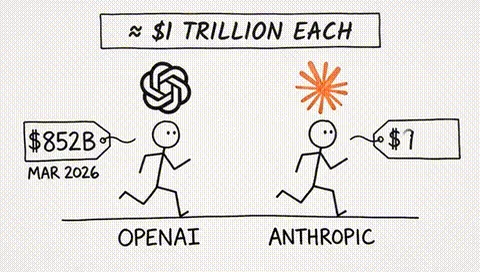
The comparison between Anthropic’s reported $65 billion annualised revenue run rate and OpenAI’s almost $50 billion figure is not a straightforward measure of which company has the larger business. Reuters reported that Anthropic crossed the $65 billion threshold in July 2026, while OpenAI’s figure reflected its September revenue pace. The measurements therefore relate to different months in a rapidly changing market.
Both are annualised figures rather than audited full-year revenue, and their treatment of certain cloud-partner sales differs. Reporting indicates that Anthropic includes qualifying partner-channel customer payments more broadly, while OpenAI records only its share of some comparable sales. These distinctions mean the apparent $15 billion gap does not establish that Anthropic generates that much more revenue on an economically equivalent basis.
Annualised revenue describes the yearly revenue a business would produce if a recent rate of activity continued. It can help explain the current scale of a rapidly growing company when the previous year’s results no longer reflect its operations. For illustration, a $65 billion annualised figure implies approximately $5.4 billion in monthly revenue if calculated by multiplying one month’s sales by 12. That does not establish Anthropic’s exact methodology, since private companies may use different recent periods or adjustments when constructing run-rate metrics.
Nor does it mean Anthropic had already earned $65 billion during 2026. Annualisation also assumes that recent performance can continue, even though large contracts, product launches, capacity constraints, changing usage and price reductions can affect subsequent results. Recognised revenue for completed periods, trailing-12-month revenue and the current annualised pace consequently provide different but complementary views of performance.
The reporting around OpenAI’s previously circulated figure approaching $70 billion illustrates how presentation can complicate those comparisons. Reuters reported on October 8, 2026, that OpenAI had told investors its September annualised revenue was almost $50 billion, after a higher number had been discussed in another context. Reuters linked much of that discrepancy to an attempt to make OpenAI’s figures comparable with Anthropic’s. Axios similarly reported that the higher figure had been adjusted upward to resemble Anthropic’s treatment of partner-channel revenue.
The change therefore did not necessarily represent a sudden disappearance of almost $20 billion in underlying annualised customer demand. Bloomberg’s earlier reporting established Anthropic’s widely cited milestone, while subsequent coverage from Reuters, the Financial Times and Axios drew attention to the accounting differences. The episode demonstrates why a run-rate figure needs a clear definition before it can support a meaningful comparison.
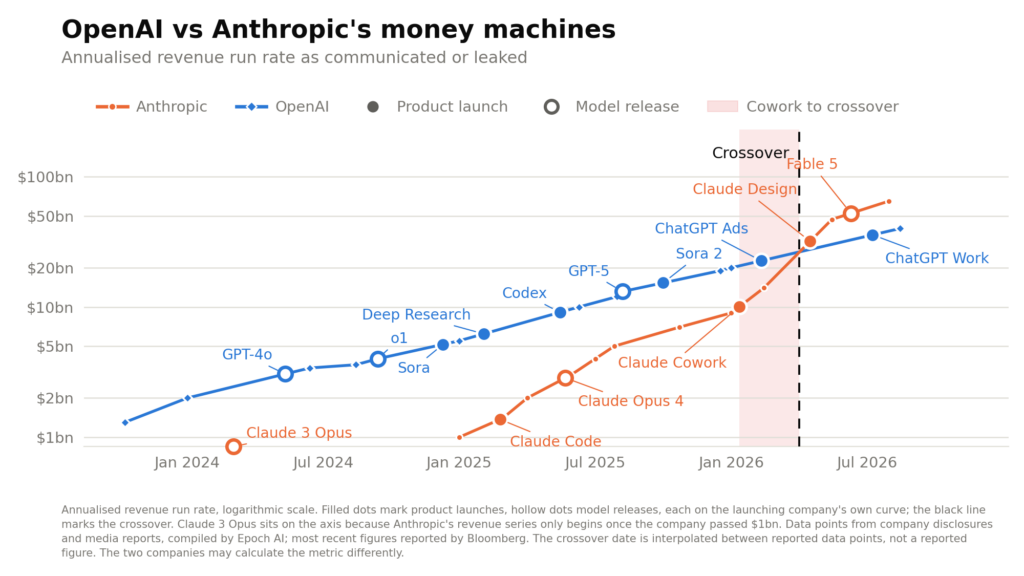
Both companies nevertheless showed substantial commercial growth during 2026. Reuters reported that OpenAI began the year at roughly $20 billion in annualised revenue before approaching $50 billion by September under its reported methodology. Anthropic’s run rate exceeded $65 billion by July after starting from a much lower level at the end of 2025. Reuters also reported second-quarter revenue of approximately $11.5 billion for Anthropic and $6.7 billion for OpenAI, describing the first quarter in which Anthropic’s reported revenue exceeded its rival’s.
Those results indicate significant gains for Anthropic, including expansion around Claude, Claude Code, developer usage and enterprise deployments. However, a quarterly comparison still requires attention to accounting presentation and does not establish a permanent lead in profitability or overall economic strength. Market leadership can look different depending on whether it is measured through consumer usage, API activity, enterprise sales, gross billings, recognised revenue or cash generation.

Gross vs Net Revenue: Why Cloud Partnerships Change the Comparison
Gross-versus-net revenue presentation is central to understanding the reported figures. Under principal-versus-agent accounting principles, a business that controls a specified good or service before transferring it to the customer generally recognises the associated gross consideration. A business acting as an agent generally recognises the fee, commission or other amount it is entitled to receive for arranging another party’s service. The appropriate treatment depends on the substance of the contractual relationship, not simply on a preference for reporting a larger or smaller top line. Consider a hypothetical customer paying $100 through a cloud marketplace, with the AI developer retaining $84 and the cloud provider receiving $16.
Where the contractual arrangement supports gross recognition, the developer might report $100 of revenue and $16 of partner-related cost; under an arrangement requiring net presentation, it might report only its $84 entitlement. The larger revenue figure does not automatically produce more profit or cash from that transaction. Net revenue presentation must also be distinguished from net income, which measures profit after applicable expenses, taxes and other costs.
Reporting indicates that Anthropic includes qualifying cloud-partner customer sales in revenue and subsequently recognises the partner’s share as a cost. Reuters reported that these channels represented approximately half of Anthropic’s revenue in the previous year and that the company paid partners about 16% of each dollar earned through them. Those historical figures show why distribution arrangements matter, but they do not support simply subtracting a fixed percentage from the $65 billion run rate. The current proportion of partner sales, individual contract terms and accounting treatment across different relationships have not been disclosed in enough detail to construct a reliable “OpenAI-equivalent” total.
Axios reported that OpenAI instead recognises only its own share of certain partner sales, which can produce a smaller top line even where end-customer spending is similar. That description should not be extended to every OpenAI partnership without examining the relevant contracts. Both approaches can potentially comply with accounting requirements when they accurately reflect the company’s role in the transaction.
Cloud marketplaces are commercially important because enterprise customers can purchase models through existing procurement, billing and security arrangements. This can reduce the need to establish an entirely separate buying relationship with an AI developer. Anthropic has used that route alongside direct products and API access, including distribution through Amazon Bedrock and Google Cloud. However, cloud companies are not merely sales intermediaries: they can also be investors and suppliers of the computing capacity needed to train and operate models. A relationship may therefore contribute to an AI company’s revenue while simultaneously accounting for substantial infrastructure or distribution expenditure. Understanding those overlapping roles requires looking beyond the name of the partner to the services, commitments and financial arrangements involved.
- Amazon and Anthropic:
AWS became Anthropic’s primary cloud provider, while Amazon invested billions of dollars in the company. Anthropic also expanded its use of AWS infrastructure and Trainium accelerators, making the relationship relevant to both computing supply and model distribution. - Google and Anthropic:
Anthropic expanded its use of Google infrastructure as well as distributing Claude through Google Cloud. Reuters reported that the expanded relationship involved access to as many as one million TPUs and more than one gigawatt of capacity beginning in 2026. - Microsoft and OpenAI:
Microsoft announced a multiyear, multibillion-dollar extension of its OpenAI partnership in 2023, following earlier investments. OpenAI’s commercial ecosystem subsequently broadened, and Reuters’ October 2026 reporting also referred to partner sales involving AWS and Google Cloud.
These relationships affect customer acquisition, infrastructure strategy and the amount of revenue retained after delivery and distribution costs. A marketplace can expand enterprise access while requiring the model developer to share the transaction’s economics. Infrastructure agreements can provide the capacity needed for growth while creating substantial ongoing financial commitments. The same partner may therefore influence both the sales opportunity and the cost of serving it. For a meaningful comparison, analysts need to separate direct sales from partner-distributed sales and distinguish gross presentation from retained economic value. Treating every cloud relationship as merely another revenue channel misses that broader effect on the business.
Claude, ChatGPT and the Economics of Enterprise and API Sales
Anthropic and OpenAI both combine subscriptions, enterprise agreements and consumption-based developer access, but their product and customer mixes are not identical. Anthropic’s Claude offering includes Free, Pro, Max, Team and Enterprise plans, alongside Claude Code and its developer platform. Its described Enterprise structure combines per-seat access with usage charged at API rates, creating both recurring seat revenue and variable consumption revenue. Claude can also reach enterprise customers through cloud marketplaces, giving organisations several ways to adopt the same underlying models.
OpenAI similarly combines ChatGPT-based organisational offerings with a separate API business that charges for model and tool consumption. These channels can have different pricing, usage intensity, retention patterns and delivery costs. The total revenue figure therefore provides only a partial picture unless analysts understand how much comes from each type of customer relationship.
API revenue generally increases when developers and enterprise applications send more requests or consume more model resources. Token-based pricing commonly distinguishes between input and output processing, while particular tools or specialised capabilities may carry additional charges. OpenAI’s API platform publishes model-specific usage prices, illustrating the consumption-based nature of this business. Enterprise subscriptions can instead involve seat licences, annual commitments, negotiated usage, administrative controls and security features, sometimes alongside additional consumption fees. Subscription and contractual commitments can improve predictability, while API usage can expand quickly as customers deploy larger workloads.
Cloud distribution adds another dimension by broadening access while allocating part of the economics to an intermediary. These differences help explain why Claude’s enterprise and developer revenue cannot automatically be compared with ChatGPT subscriptions or OpenAI API sales as though every dollar has the same characteristics.
Revenue growth also has to be evaluated against the cost of serving customers. Every model request, generated token or agent action requires computational work, so increased demand can bring substantial additional inference expenditure. Fixed-price agreements may provide visibility but create pressure on margins if customers use considerably more computing than anticipated. Consumption-sensitive pricing aligns revenue more closely with activity, although it can make spending and revenue less predictable.
Falling prices, shifts towards cheaper models and improvements in inference efficiency can all change the economics of a growing workload. The strongest growth is therefore not simply more usage, but usage whose revenue exceeds its marginal delivery cost and contributes towards training, research, staffing and infrastructure. Two companies with similar annualised revenue can consequently have very different gross profits, capital requirements and paths to sustainable cash generation.
Comparing Anthropic and OpenAI Valuations and Financial Performance
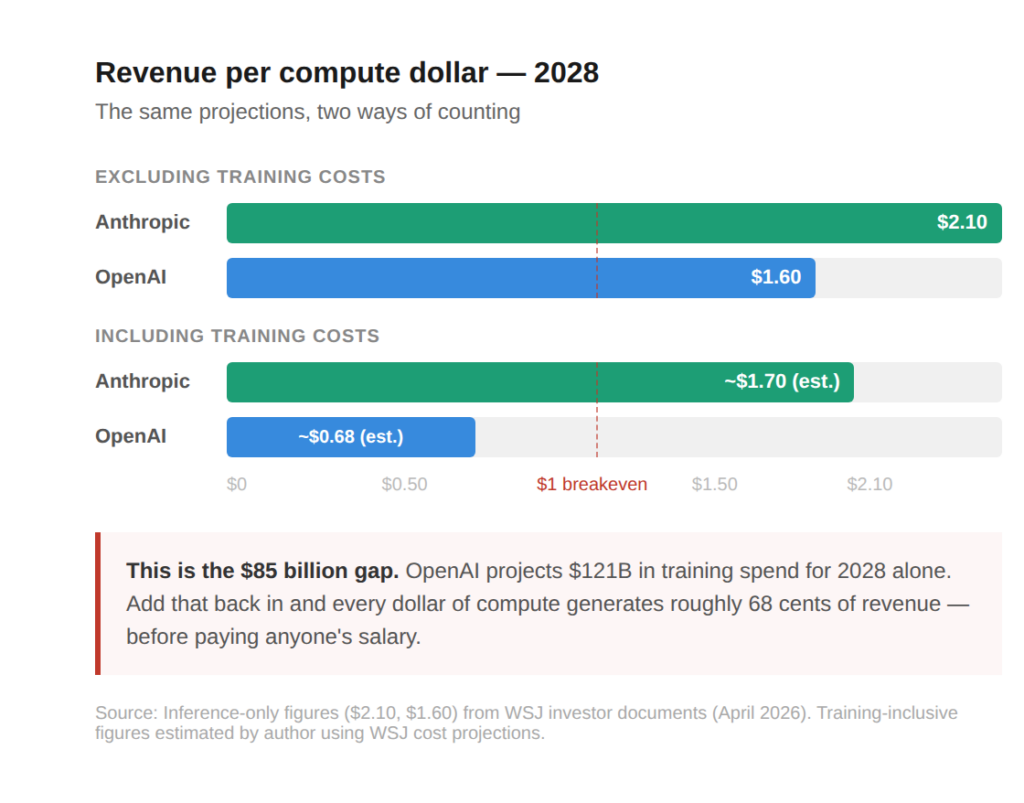
Accounting presentation can materially change how an AI company’s valuation appears. In a simplified illustration, a company valued at $500 billion against $50 billion of comparable revenue has a revenue multiple of 10 times. If a different presentation makes broadly similar underlying economics appear as $65 billion of revenue, the apparent multiple falls to approximately 7.7 times. That difference can make one business look less expensive without demonstrating that it generates more retained value.
The comparison becomes especially misleading when one denominator is an annualised run rate and another represents completed-year revenue. Accounting standards determine the appropriate treatment of transactions; they do not make competing companies’ headline metrics automatically comparable. Analysts therefore need to establish a consistent revenue definition and measurement period before using those figures to assess relative valuation.
Gross profit and cash generation can provide additional insight, particularly in businesses with substantial computing costs. A fast-growing AI laboratory may attract exceptional demand while still requiring large amounts of external capital if delivery and operating expenses rise nearly as quickly as sales. Gross-versus-net presentation also needs to be considered when interpreting reported margins, rather than assuming a percentage has the same meaning across differently presented revenue bases. Retained revenue after partner payments, inference costs and other delivery expenses helps clarify the economics that the headline top line can obscure. Operating expenses, model competitiveness and future infrastructure commitments then determine how much of that value can support long-term profitability. A more complete comparison should examine several connected areas:
- Revenue definition and reporting period:
Establish whether the figure represents recognised revenue, trailing-12-month sales or an annualised run rate. Identify which partner transactions are included, whether they are presented gross or net, and whether unusually large or one-time sales affected the measurement. - Customer demand and retention:
Examine enterprise retention, customer concentration, API consumption growth and the balance between subscriptions and variable usage. Contracted backlog and remaining performance obligations, where disclosed, can help distinguish current activity from committed future demand. - Channel concentration and partner economics:
Assess how much business depends on particular cloud marketplaces, what share of sales the developer retains and how changes in contract terms could affect growth or margins. Anthropic’s historically substantial partner-channel revenue illustrates why this deserves separate attention. - Delivery efficiency and pricing:
Compare inference costs, model usage patterns, price reductions and improvements in computing efficiency. Revenue growth is more economically valuable when the cost of delivering additional usage does not absorb most of the incremental sales. - Operating costs and capital requirements:
Consider research and staffing expenditure, stock-based compensation, capital spending and external compute commitments. Gross profit and free cash flow, where available, help connect reported demand with the resources required to sustain it.
The appropriate conclusion is not that either company’s reported figure must be wrong. Anthropic’s run rate describes its business under one treatment of revenue, while OpenAI’s almost $50 billion figure uses a different treatment of certain partner-channel activity and refers to a later month. The earlier OpenAI number approaching $70 billion shows how an adjustment intended to improve comparability can itself create confusion when its basis is not clearly understood. Available reporting does not provide enough current contract and channel information to construct a definitive normalised total for both companies.
Their strong 2026 growth is evident in the reported figures, but a simple $65 billion versus $50 billion scoreboard cannot establish which has the stronger underlying business. A meaningful assessment must first align the accounting and measurement periods, then compare growth, customer durability, retained economics, profitability and valuation.

Frequently Asked Questions (FAQs)
- Is Anthropic really making more revenue than OpenAI in 2026?
The reporting discussed here places Anthropic ahead on reported second-quarter revenue and the headline annualized run rate. However, Anthropic’s $65 billion figure relates to July, while OpenAI’s almost $50 billion figure relates to September. Their treatment of certain cloud-partner sales also differs, affecting how much customer spending appears as revenue. These differences prevent the headline figures from establishing an equivalent $15 billion lead. They indicate strong commercial growth, but not necessarily an advantage in comparable revenue, profitability or cash generation. - Why is Anthropic’s $65 billion revenue figure higher than OpenAI’s $50 billion figure?
The difference reflects both business growth and the way certain transactions are presented. Anthropic reportedly includes the full customer payment for qualifying cloud-partner sales, then records the partner’s share as a cost. OpenAI reportedly recognises only its own entitlement from certain partner transactions. This can produce a smaller revenue figure even when the amount retained before other expenses is similar. Public information does not provide enough current contractual and sales-channel detail to calculate precisely how much of the headline gap comes from accounting rather than underlying demand. - Does Anthropic’s $65 billion figure mean it earned $65 billion during 2026?
No, the figure describes an annualized revenue run rate rather than sales already earned during the year. It projects a recent revenue pace across a 12-month period. For example, multiplying one month’s revenue by 12 produces a run rate, although that illustration does not establish Anthropic’s exact calculation method. The metric helps communicate current business scale when growth is rapid. It neither replaces recognised revenue for completed periods nor guarantees that the same pace will continue throughout the year. - Is OpenAI’s $50 billion figure a full-year revenue forecast?
No, the figure reported in October 2026 described OpenAI’s annualized revenue pace for September. It indicates the yearly scale implied by recent activity under the company’s reporting methodology. A full-year forecast would instead estimate total revenue across the entire year, accounting for earlier performance and expectations for the remaining period. The reported run rate is also different from audited annual results. It should therefore be used as an indicator of current momentum, not as confirmation of what OpenAI will recognise over the full calendar year. - Why had OpenAI previously been associated with a $70 billion revenue figure?
Reporting indicated that the figure approaching $70 billion was adjusted upward to make OpenAI more comparable with Anthropic’s treatment of partner-channel sales. That presentation included amounts beyond those captured by OpenAI’s narrower revenue methodology. Its September annualized figure was subsequently reported at almost $50 billion. The difference therefore did not necessarily represent a sudden collapse in customer demand or revenue-generating activity. It illustrates why an adjusted comparison figure must be distinguished from the company’s own reported revenue measure. - Does gross revenue recognition mean Anthropic is using improper accounting?
No, recognising revenue gross is not inherently improper or evidence that sales have been artificially inflated. A company acting as the principal in supplying a service generally recognises the full consideration, while an agent generally recognises its fee or entitlement. The appropriate treatment depends on control of the service and the substance of the contractual arrangement. Companies cannot simply choose whichever presentation produces the most attractive headline. Axios reported that both companies’ different approaches can comply with generally accepted accounting principles, even though their resulting revenue totals require adjustment before comparison. - What role do AWS and Google Cloud play in Anthropic’s revenue?
AWS and Google Cloud can support both the delivery and distribution of Anthropic’s services. AWS provides infrastructure that Anthropic has used extensively, while the Google relationship supplies substantial computing capacity through TPUs. Their cloud platforms also allow enterprise customers to purchase Claude through existing procurement and billing arrangements. These channels can expand Anthropic’s reach without requiring every customer to establish a separate direct purchasing relationship. However, the partnerships also involve computing expenses and potentially shared sales economics, so their contribution must be assessed through costs and retained revenue as well as customer access. - How does OpenAI make money?
The revenue streams described include ChatGPT offerings for organisations and a consumption-based API platform. Organisational offerings provide managed access to AI products through commercial subscription or enterprise arrangements. The API allows developers and businesses to integrate models and tools into their own applications. Customers pay according to usage, so revenue can increase as they run more workloads or consume additional model resources. These streams have different spending patterns and delivery costs, making the balance between subscriptions, enterprise agreements and API consumption important when evaluating the business. - Which metric is better than annualized revenue for comparing AI companies?
No single metric captures every aspect of business performance. Recognised quarterly or trailing-12-month revenue shows sales over completed periods, while gross profit and operating cash flow help explain how much economic value remains after relevant costs. Computing expenses reveal the resources needed to serve demand, and customer retention indicates whether that demand is durable. Contracted commitments can add visibility into future business, although they are not interchangeable with revenue already recognised. Annualized revenue remains useful for current momentum, but it is strongest when considered alongside these measures on a consistent accounting basis. - What is the biggest takeaway from the Anthropic vs OpenAI revenue debate?
The $65 billion and almost $50 billion figures are not directly comparable measures of business scale. They refer to different months and apply different treatment to certain partner-channel transactions. A meaningful comparison must first align the reporting periods, revenue definitions and gross-versus-net presentation. It should then examine growth, retained revenue, computing costs and profitability rather than treating the larger headline as an automatic victory. Without that groundwork, the numbers reveal commercial momentum but cannot establish which company has the stronger underlying business.
Conclusion
Anthropic’s reported $65 billion annualized revenue run rate and OpenAI’s approximately $50 billion figure are not directly comparable because they reflect different months and accounting treatment of cloud-partner sales. Anthropic’s figure represents its July revenue pace and includes partner activity more broadly, while OpenAI’s September figure excludes or nets certain partner-distributed sales. Both describe annualized revenue rather than completed full-year sales. These differences do not inherently make either figure misleading, since gross or net reporting can legitimately depend on whether a company acts as a principal or agent in a transaction.
A meaningful comparison therefore requires consistent accounting definitions and measurement periods before drawing conclusions about relative business scale. Investors also need to examine partner economics, gross profit, infrastructure costs, API and subscription revenue, customer retention, cash burn and capital requirements. Microsoft, Amazon and Google’s overlapping roles as infrastructure providers, investors and distributors further complicate the relationship between customer spending and the value AI companies retain. The strongest assessment consequently looks beyond the $65 billion versus $50 billion headline and focuses on comparable revenue, margins and cash generation.
Sources and Citations
- Reuters — October 11, 2026: US reverses course on Britain’s testing of AI models
Read the Reuters report
Reports the Trump administration’s reversal of its earlier position discouraging US AI developers from sharing new models with Britain’s AI Security Institute for pre-release testing. - Reuters — September 24, 2026: White House asks OpenAI and Anthropic to hold models from British testers
Read the Reuters report
Reports that the White House asked OpenAI and Anthropic to delay sharing their latest models with British testers pending a US security review. - UK AI Security Institute — Official evaluation programme
About the AI Security Institute
AI Safety Institute approach to evaluations — GOV.UK
Official information on pre- and post-deployment testing, cyber misuse, safeguards, alignment, control, autonomy and human influence. - OpenAI — May 28, 2026: Frontier Governance Framework
OpenAI’s Frontier Governance Framework announcement
OpenAI’s Preparedness Framework
OpenAI identifies its Preparedness Framework as the foundation of its approach to managing severe risks from advanced AI systems. - Anthropic — Responsible Scaling Policy
Read Anthropic’s official policy and version history
Includes the 2026 policy versions, risk reports, capability thresholds, risk-reporting arrangements and external review provisions. - Google DeepMind — Frontier Safety Framework, version 3.1
Frontier Safety — Google DeepMind
Strengthening the Frontier Safety Framework
Official materials on frontier-model risk assessment, capability evaluations, mitigation measures and external participation. Version 3.1 is dated April 17, 2026. - Financial Times — October 12, 2026: UK AI safety legislation and mandatory reporting proposals
Read the Financial Times report
Covers proposals for compulsory AI safety reporting and potential mandatory access for the AI Security Institute to evaluate models before public release. - Reuters — October 12, 2026: Microsoft president calls for stronger global AI safety rules
Read the Reuters report
Reports Microsoft President Brad Smith’s call for stronger international AI safety rules, mandatory incident reporting and independent evaluations. Smith also identifies the UK as a leader in assessing AI systems before deployment.
Recommendations
- Capcom Addresses The Street Fighter 6 Incest Storyline Fans Have Been Losing Their Minds Over
- Crunchyroll Game Vault Adds 6 Major Games for Mega and Ultimate Fans
- New Star Wars Book Reveals Andor Almost Had Far More Aliens Than Fans Saw
- MW4 Multiplayer in Action Reveals Crazy Kill Block Map with 500+ Combinations
- Chris Pratt Responds To Fan Theories About Wario And Waluigi Being In Mario Galaxy Movie: What His Tease Could Mean
- Scopely Invests in Studio AuKnow, New Studio from Final Fantasy VII Rebirth and Umamusume Veterans
- Final Fantasy 14 Is Taking Its Next Giant Step With the Evercold Expansion: Release Date, New Jobs, Weekly Progression, and the Big Gameplay Overhaul
- ONTOS Has Been Delayed Until 2027: Release Window, Platforms, and Why Frictional Games Needs More Time
- Human: Fall Flat Veterans Launch Pretty Cool Games With Hypergryph Funding for New Physics-Based AA Game
- Kitman: New Job Simulator Where You Play as a Soccer Team’s Equipment Manager Announced for PC



































































































