








In This Article (9 sections)
Big Walk: Gameplay, Setting, Release Date, Platforms, and Price
Big Walk is a first-person cooperative adventure from House House, the Melbourne-based independent studio behind Push Me Pull You and Untitled Goose Game. It is the studio’s third major game and represents a significant expansion in scale. The project began around the end of 2020, when lockdown conditions prevented the developers from spending time together normally. The team began using an early version of the game as a virtual space where they could meet, walk around, talk, and experiment. That social prototype eventually developed into a complete commercial game.
The central experience revolves around walking through a large open environment with friends, communicating under changing conditions, completing collaborative challenges, collecting unusual rewards, unlocking new parts of the island, and gradually working toward the game’s conclusion. The objective is not to defeat enemies or survive a sequence of dangerous runs. Instead, the game is built around cooperation and the situations that naturally develop when several players are exploring the same space.
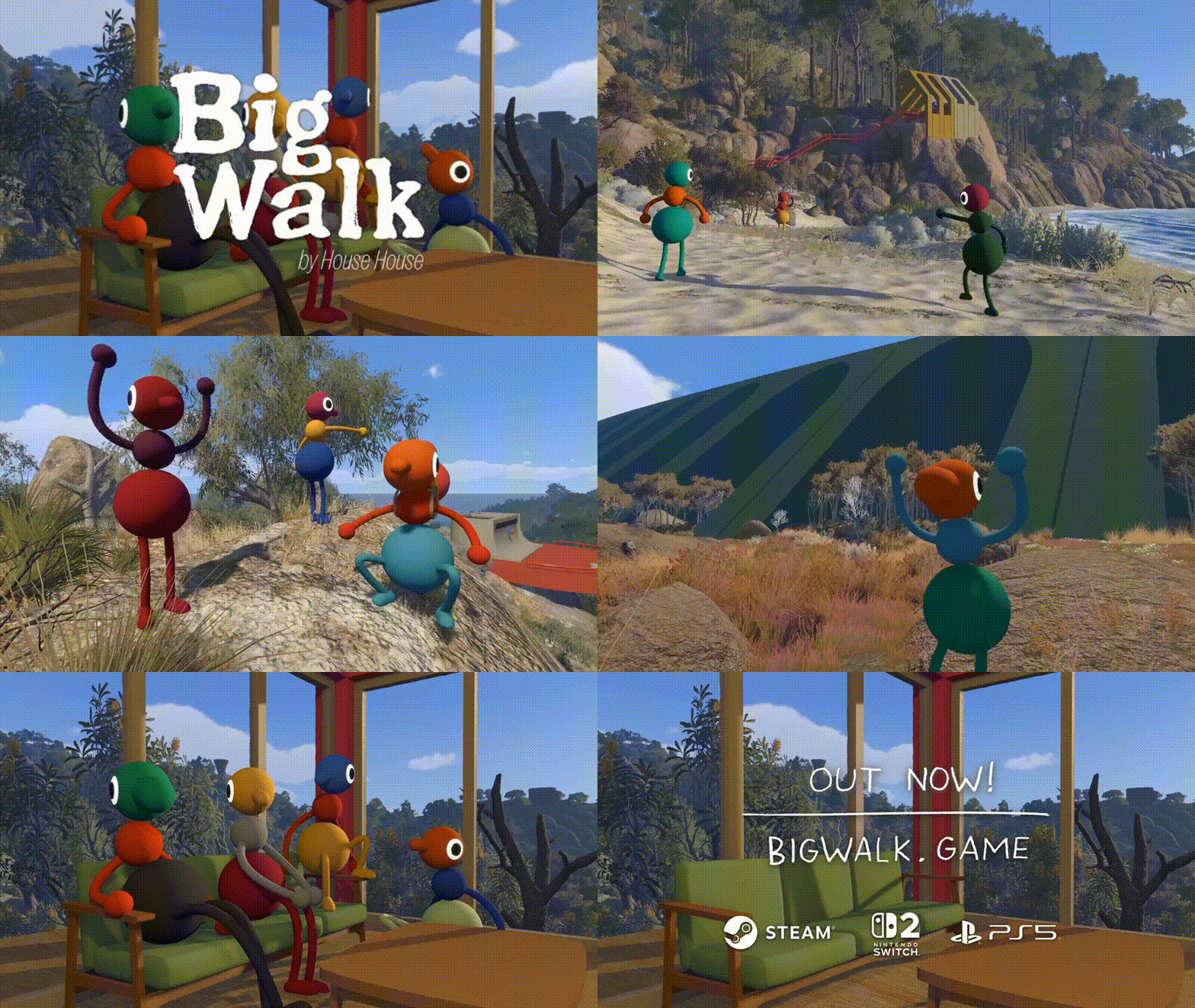
The setting takes inspiration from Wilsons Promontory, a national park at the southern end of mainland Australia. House House recreated the broad shape of the location at approximately one-twentieth scale using lidar information, photographs, and observations gathered during research trips. The result is not intended to be an exact tourism simulator, but its granite formations, coastal spaces, vegetation, steep paths, beaches, valleys, and distant landmarks give the game a recognizably Australian identity.
Into this natural-looking landscape, House House places brightly colored buildings, unusual machines, communication devices, puzzle rooms, radio equipment, towers, and deliberately ambiguous objects. Players control simple birdlike or orb-shaped creatures with thin limbs and large expressive features. Their designs are easy to read from a distance, which is important when a challenge requires players to point, wave, imitate a pose, or communicate without sound.
Big Walk can consequently be understood as two connected experiences. It is a designed cooperative campaign in which teams solve challenges and unlock infrastructure, but it is also an open social space where the journey between objectives is deliberately meaningful. House House does not treat travel as empty time.
Walking gives players opportunities to talk, become distracted, split into smaller groups, lose one another, discover landmarks, or return with stories about places the rest of the party has not visited. The puzzles give friends reasons to gather and cooperate, while the open world gives conversations room to develop naturally. Big Walk is therefore less concerned with testing mechanical mastery than with creating circumstances in which a group must pay attention to one another.
Big Walk was released worldwide on August 4, 2026. The launch versions are available for Windows and Mac through Steam, for Mac through the Mac App Store, for PlayStation 5, and for Nintendo Switch 2. House House’s official FAQ states that no additional platforms are currently planned, meaning there are no announced Xbox Series X or Series S, PlayStation 4, original Nintendo Switch, or mobile versions.
The standard US price is $19.99, as shown on the PlayStation Store. Prices vary by country, platform, taxation system, and storefront. Steam launched the game with a 25 percent introductory discount scheduled to end on August 18, 2026. At the time of research, the European Steam listing showed a regular price of €18.99 and a discounted price of €14.24. The US Mac App Store showed Big Walk at $14.99 shortly after launch, with a listed download size of 3.4 GB, while Nintendo’s US listing reports a 3.9 GB file size for the Nintendo Switch 2 edition. Store prices and temporary offers can change, so the relevant platform page should be checked before purchasing.
PlayStation 5 players received an additional option because Big Walk joined the PlayStation Plus Monthly Games lineup on release day. Sony’s announcement listed it as available to members from August 4 through August 31, while the US store page displayed a precise offer cutoff of September 1, 2026, at 4:00 PM UTC. Differences of this kind normally reflect storefront timing and regional display conventions.
Big Walk is sold as a complete game rather than an early-access project. It contains a handcrafted campaign with a defined ending, although groups can continue using the island as a social space and search for additional discoveries after reaching the main conclusion.

Big Walk Gameplay, Co-Op, and Communication Explained
Big Walk is a first-person cooperative adventure built around movement, communication, and teamwork rather than combat or conventional failure loops. Characters can walk, run, jump, crouch, sit, slide down slopes, pick up objects, kick loose items, and move their arms independently enough to point, wave, pose, or mime ideas. These movements are intentionally playful rather than highly precise, allowing ordinary actions to become sources of physical comedy.
Walking is also a major part of the gameplay rather than simply a way to travel between puzzles. The island is large enough for players to spread out, lose sight of one another, become separated by darkness or terrain, or accidentally wander away with an important object. A player who moves too far ahead may gradually stop hearing the conversation behind them, while someone carrying a useful item may force the rest of the group to track them down.
Communication is closely tied to this movement. Big Walk uses spatial chat, meaning voices exist within the game world rather than entering a universal channel at equal volume. Voices become quieter with distance, walls can interfere with speech, enclosed areas produce different acoustic effects, and communication equipment can extend a player’s voice beyond its normal range. Players therefore have to decide when to stay together, when to split up, and which tools can help them remain connected. The built-in text chat follows similar spatial restrictions, so players without microphones can still participate without completely bypassing the communication challenges. Text can become unreadable over long distances or through soundproof barriers, while compatible communication devices can extend it.
Teamwork connects these systems. Many challenges divide information or responsibilities between participants, with one player seeing a clue that another must use, directing a teammate through an unseen route, reproducing a pose, describing an abstract symbol, operating an object at the right moment, or communicating across a barrier. The challenge is often less about solving a complicated mathematical puzzle and more about translating information clearly between people.
Players can use gestures, visual signals, radios, megaphones, whiteboards, and other tools when ordinary speech is unavailable. House House recommends using the built-in communication system rather than Discord, console party chat, telephone calls, or other unrestricted channels because external communication continues working when the game intentionally separates players, potentially making some challenges trivial.
Big Walk supports two to 12 players. When the host starts a campaign, they select a two-player, three-player, or four-plus-player version of the world, with certain activities adjusting to that selection. The chosen version should generally reflect the minimum number of players expected to remain available. A six-player group can use the four-plus version, for example, while a group expecting participants to leave may be better served by choosing a smaller configuration. Two players create a more concentrated experience in which both people frequently carry essential information and responsibilities, while three or four players provide more flexibility. Larger groups can become considerably noisier and less predictable, with smaller subgroups forming and multiple conversations developing at once.
There is no public matchmaking system. House House designed Big Walk as a longer cooperative journey for an organized group that can continue the same campaign across multiple sessions. One player serves as the host and owns the campaign save, entering the world first before the others connect. When the host closes the session, everyone else is disconnected, and the same host must open the saved world when the group wants to continue.
Progress is saved automatically, so players can complete several challenges, explore for a while, stop for the day, and return later without losing their campaign. Friends on the same platform can generally find an active hosted session through the relevant friends list, while a short join code can be used to connect other players. The Mac App Store edition does not integrate a Game Center friends list, so its players must use join codes.
Big Walk supports full cross-platform online play between Windows, Mac, PlayStation 5, and Nintendo Switch 2. A Steam player can therefore join friends on PS5, Switch 2, or Mac, with the join-code system providing the simplest option for mixed-platform groups. House House states that only the first two sections of the game’s three-part version number need to match for crossplay, meaning a small revision affecting only the final section should not necessarily prevent players from connecting, although larger updates may require everyone to install compatible versions. Crossplay does not remove platform-specific online requirements: PS5 players need PlayStation Plus, while Nintendo Switch 2 players need Nintendo Switch Online. PC and Mac users do not need an equivalent console subscription.
Big Walk does not have a single-player campaign. One person can technically enter the world and explore a limited area, but meaningful progression requires cooperation, and House House warns that a lone player will not get far. Two players, however, can complete the entire adventure using the dedicated two-player world configuration. A two-person campaign can feel more intimate but also more demanding because there is no third participant to relay information, watch equipment, or help when one player becomes separated. Players can also enable challenge skipping when beginning a session if particular activities involving hearing, reading, speaking, typing, reaction speed, or fine motor control are unsuitable for one or both participants.
The game does not use the run-based structure associated with some cooperative games. There is no repeating quota, conventional death loop, escalating combat ladder, or failure state that erases an entire session. Instead, cooperative activities produce strange red rewards that can be delivered to important structures, with completed sets leading to keys, facilities, transportation options, navigation aids, and access to additional areas.
The island gradually changes as the group progresses, giving players new ways to travel and explore. The pace remains deliberately uneven: a focused team can move from challenge to challenge, while a chaotic group may spend considerable time playing with radios, sliding down hills, throwing objects, changing direction, or searching for someone who disappeared. Consequently, the game’s rhythm and total length depend as much on the personalities and habits of the players as on its designed content.
Proximity voice chat is particularly important to this structure. Voices fade as players move apart, can be muffled by walls and other structures, and can change when players enter different environments. Walkie-talkies extend communication across longer distances, while binoculars, laser pointers, megaphones, whiteboards, flares, flashlights, cowbells, and other objects provide different ways to communicate, navigate, or simply experiment.
These objects are deliberately treated as tools and toys rather than a conventional inventory of weapons and consumables. Players initially carry only one object in their hands, so taking a flashlight can mean leaving binoculars behind, while carrying a progression reward may prevent someone from carrying a walkie-talkie. Objects can also be dropped, misplaced, kicked, thrown, or carried away by another player, creating consequences without conventional punishment.
The communication system did have an early technical issue. Some launch players reported that nearby friends sounded much quieter than intended, and House House released Steam version 1.4.8 on August 7, 2026, to correct the excessively quiet voices. That update addressed unintended low volume rather than removing the deliberate distance-based drop-off, and House House indicated that equivalent console updates would require additional processing time. Big Walk also does not offer conventional split-screen or couch co-op. Friends in the same home can play on separate devices, but sitting together and communicating outside the game can bypass the intended spatial restrictions.
Big Walk Challenges, Exploration, Map System, and Progression
Big Walk’s island is filled with collaborative challenges involving description, coordination, memory, timing, observation, movement, and nonverbal communication. House House reportedly prefers the term “challenges” because many activities resemble social games that could be played during a real group outing. Examples include guiding a player through an obstacle course when they cannot see the correct path, communicating abstract symbols across a barrier, matching poses, operating timed mechanisms, completing mazes, moving objects between separated stations, coordinating lights, and reproducing visual information through imperfect descriptions.
The objects involved often do not have obvious names, encouraging players to invent their own vocabulary. A shape may look like several different things depending on who sees it, so one group might call an object a baby, another a bean, and another a gourd. House House deliberately avoids forcing every object into a clear official category because negotiating names becomes part of the communication game. Challenges are also comparatively permissive, meaning there is not always one perfectly elegant solution. Players can stumble into an answer, develop an unusual but functional system, or solve a communication problem in a way the developers did not explicitly prescribe. The important part is often that the group creates and executes a shared plan.
Successful challenges award red collectible objects that can be delivered to important structures. Supplying enough rewards produces keys or activates systems that open more of the island, including navigation facilities, transportation routes, additional spaces, and other exploration opportunities. Big Walk still has a complete handcrafted campaign with a beginning, middle, and ending, rather than functioning only as a sandbox.
However, the open environment constantly provides reasons to become distracted, and hidden discoveries add another layer beyond the main progression. The island contains optional objects, secluded areas, unusual interactions, visual jokes, equipment, and post-campaign activities. Game Informer reported a larger post-credits puzzle sequence for groups that continue after the main finale, showing that reaching the ending does not exhaust everything available.
The island is not initially navigated through a conventional open-world map, minimap, waypoint trail, or objective arrow. Players begin by observing their surroundings, following visible structures, remembering routes, and discussing landmarks. Towers, rail lines, coastlines, mountains, colorful buildings, lights, tunnels, beaches, and unusual structures act as reference points. Instead of following a marker that gives an exact direction, players may describe a route using a red light above the trees, a path beside a railway, or a building visible from a ridge.
This lack of immediate certainty is intentional because getting lost creates opportunities for communication and decision-making. A group may choose to stay together, send someone to scout from high ground, divide into pairs, leave visual signals, or carry communication equipment in case players become separated. Map-related tools eventually become available through campaign progression.
Completing the relevant tower objectives opens a map room containing a large environmental map and a portable map, but reaching it requires solving challenges and obtaining the associated key. Even afterward, navigation remains physical rather than fully automated because the map acts as a reference tool rather than a complete quest-tracking system. Carrying it can also compete with other equipment, forcing the group to consider which objects are most useful for its next expedition.
Night further changes exploration because paths and landmarks become harder to see. Flashlights, flares, lit structures, and communication devices become more valuable, while familiar areas can become difficult to navigate and make it easier for a distracted player to lose the group. The island itself is handcrafted rather than procedurally regenerated for each campaign, so groups explore the same designed environment, but their experiences can be dramatically different. One party may remain organized and move efficiently, while another may spend an hour searching for a friend who wandered away carrying the binoculars.
The amount of content experienced in a playthrough depends heavily on the group. A three-person team reached the ending in approximately nine hours in one published experience, while The Verge spent more than 13 hours in a two-person campaign without finishing. These are not official completion-time guarantees, but they demonstrate how puzzle-solving speed, exploration habits, group size, and distractions can substantially change the journey. Big Walk’s intentionally uneven pace means the campaign can be approached efficiently or treated as a social expedition where progress regularly gives way to experimentation and conversation.

Big Walk Gameplay, Co-op, Puzzles, Communication, and Exploration
Big Walk is a first-person cooperative adventure built around walking through a large open environment, communicating with friends, and completing collaborative challenges. Players can walk, run, jump, crouch, sit, slide down slopes, pick up objects, kick loose items, and move their arms independently enough to point, wave, pose, or mime an idea.
These movements are intentionally playful rather than precise, allowing ordinary actions to become sources of physical comedy. Walking is also more than a way to travel between objectives. The island is large enough for players to spread out, lose sight of one another, become divided by terrain or darkness, or wander away while carrying an important object. These situations are part of the intended gameplay rather than distractions from it.
Communication is one of the game’s central systems. Big Walk uses spatial voice chat, meaning voices behave as though they exist physically within the environment. Volume decreases with distance, walls can interfere with speech, enclosed spaces produce different acoustic effects, and communication equipment can extend a voice beyond its normal range. Players therefore have to decide when to remain together, when to separate, and which tools will help them maintain contact. Text chat follows similar spatial rules, allowing players who cannot or prefer not to speak to participate without completely bypassing the communication challenges.
Teamwork connects movement and communication. Many challenges divide information or responsibilities between participants. One player may see a clue that another must use, direct a teammate through an unseen route, reproduce a pose, operate an object at the correct moment, describe an abstract symbol, or communicate across a barrier. House House reportedly prefers to call these activities challenges rather than traditional puzzles because many resemble social games that could be played during a real group outing. Examples include obstacle courses, mazes, timed mechanisms, matching poses, coordinating lights, moving objects between separated stations, and reproducing visual information through imperfect descriptions.
The objects involved often lack obvious names, so players can develop their own vocabulary for them. A progression object might look like a baby, bean, or gourd depending on who is describing it. That private language can continue throughout a campaign, making the process of agreeing on what something means part of the challenge itself. The design is also relatively permissive, so there is not always one perfectly elegant solution. Players can stumble into an answer, invent an unusual system, or solve a communication problem in a way that was not explicitly prescribed. What matters is that the group creates and executes a shared plan.
Big Walk supports two to 12 players, with the host selecting a two-player, three-player, or four-plus-player version of the world when starting a session. The selected version should generally represent the minimum number of people expected to remain available. A group of six can use the four-plus version, for example, but a group expecting participants to leave early may be better served by selecting the smaller configuration. Two players produce a more concentrated experience in which both people frequently carry essential information, while larger groups allow responsibilities to be divided and create more opportunities for subgroups and separate conversations.
There is no public matchmaking system. House House designed Big Walk as a longer cooperative journey intended to be completed by a consistent group across multiple sessions, so players must organize their own group through friends, communities, or other arrangements. One participant acts as the host and owns the campaign save. The host must enter the world first, and everyone else connects afterward. When the host closes the session, the other players are disconnected, and continuing that campaign later requires the same host to reopen the saved world. Progress is saved automatically, so a group can complete several challenges, explore for a while, stop playing, and resume later.
The game supports full cross-platform online play across Windows, Mac, PlayStation 5, and Nintendo Switch 2. A Steam player can therefore play with friends on PS5, Switch 2, or Mac. The join-code system is particularly useful for mixed-platform groups because the host can share a generated code instead of relying on platform-specific friends lists. House House also states that only the first two sections of the version number need to match, meaning a small revision affecting only the final section should not necessarily prevent players from connecting. Larger updates may still require compatible versions.
Crossplay does not remove platform-specific online requirements. PS5 players need PlayStation Plus for online multiplayer, while Nintendo Switch 2 players need Nintendo Switch Online. PC and Mac players do not require an equivalent console subscription, although every participant needs internet access and a supported copy or platform entitlement. Big Walk does not offer conventional split-screen, couch co-op, or an offline campaign. Friends in the same home can use separate devices, but unrestricted real-world conversation can bypass the game’s intended spatial communication mechanics.
Proximity voice chat is particularly important when players suddenly lose the ability to hear one another. Distance gradually reduces voice volume, while terrain and architecture can further interfere with communication. Some challenges deliberately place players behind soundproof glass, walls, or at distances where ordinary speech no longer carries. When that happens, players can use gestures, visual signals, spatial text, radios, walkie-talkies, or other equipment. House House recommends using the built-in communication system instead of Discord, console party chat, or another unrestricted service because external communication can make challenges based on distance and incomplete information much easier.
Not every voice problem is intentional. Players who find nearby friends almost inaudible, experience repeated dropouts, or cannot hear game chat at all may be dealing with a technical issue. House House’s Steam version 1.4.8, released on August 7, 2026, corrected excessively quiet voices reported by some launch players. That fix addressed unintended low volume and did not remove the deliberate distance-based reduction in voice volume. Equivalent console updates could require additional processing time.
The island initially avoids the conventional navigation systems common in modern open-world games. Players do not begin with a constantly visible map, minimap, waypoint trail, or objective arrow. Instead, they use landmarks such as towers, rail lines, coastlines, mountains, beaches, lights, tunnels, colorful buildings, and unusual structures to orient themselves. A player might describe a destination by referring to a red light above the trees or a path beside the railway rather than giving a precise GPS direction. This uncertainty is intentional because getting lost creates conversations and decisions that would disappear if everyone simply followed an objective marker.
Map-related tools can eventually be unlocked through campaign progression. Completing the relevant tower objectives opens a map room containing a large environmental map and a portable map, but players must solve the associated challenges and obtain the necessary key first. Even then, the map functions more as a physical reference than an automated quest-tracking system. Carrying it can also compete with other equipment, reinforcing the importance of deciding which tools the group needs.
The island also contains hidden discoveries, optional objects, secluded areas, unusual interactions, visual jokes, equipment, and activities that continue beyond the main conclusion. Successful challenges award strange red collectibles that can be delivered to important structures, eventually producing keys or activating systems that unlock navigation facilities, transportation routes, new areas, and further exploration. House House describes the campaign as having a beginning, middle, and ending, but reaching the finale does not exhaust everything available on the island.
Big Walk’s equipment is similarly designed around communication and experimentation rather than traditional combat. The official selection includes walkie-talkies, laser pointers, binoculars, megaphones, flares, whiteboards, cowbells, and a large golden head, alongside other objects discovered during the campaign. Walkie-talkies allow separated players to communicate across distances that would normally silence them. Binoculars help identify distant landmarks or watch companions, laser pointers direct attention, megaphones alter how voices are projected, whiteboards provide visual communication, and flares and flashlights become increasingly useful in darkness.
Equipment is intentionally physical. Players initially carry only one object in their hands, so taking a flashlight can mean leaving binoculars behind, while carrying a progression reward can prevent someone from transporting a walkie-talkie. Objects can also be dropped, kicked, thrown down slopes, misplaced, or carried away by another player. These limitations encourage players to distribute responsibilities and can create consequences without relying on combat or conventional punishment. A lost pair of binoculars may not end the campaign, but recovering them can become an unexpected part of the group’s next plan.
The equipment also reinforces Big Walk’s broader philosophy. Tools do not eliminate the need for human communication; they change how communication works. A walkie-talkie matters because ordinary voices have limited range, a flare matters because darkness obscures companions, and a whiteboard matters because some spaces interfere with speech. Players with accessibility concerns can also enable challenge skipping when a particular activity involves hearing, reading, speaking, typing, reaction speed, or fine motor control that is unsuitable for someone in the group.
The campaign’s pace varies substantially depending on the players. A focused group can move directly between challenges, while a chaotic party may spend considerable time playing with radios, sliding down hills, throwing objects, changing direction, searching for missing teammates, or exploring optional areas. Published playthroughs demonstrate that difference: Game Informer’s three-person group reached the ending in approximately nine hours, while The Verge reported spending more than 13 hours in a two-person campaign without finishing. These are not official completion-time guarantees, but they illustrate how group size, exploration habits, puzzle-solving speed, and distractions can change the experience.
Big Walk Release Details, Online Requirements, PC and Mac Specs, and Its Differences From Untitled Goose Game
Big Walk was released worldwide on August 4, 2026, for Windows and Mac through Steam, Mac through the Mac App Store, PlayStation 5, and Nintendo Switch 2. House House’s official FAQ states that no additional platforms are currently planned, so there are no announced Xbox Series X|S, PlayStation 4, original Nintendo Switch, or mobile versions. The standard US price is $19.99 on PlayStation, while prices vary between countries and storefronts. Steam launched with a 25 percent introductory discount scheduled to end on August 18, 2026, and the European Steam listing showed a regular price of €18.99 and a discounted price of €14.24 at the time of research.
The Mac App Store listed the game at $14.99 shortly after launch with a 3.4 GB download, while Nintendo’s US listing reported a 3.9 GB file size for the Switch 2 version. Store prices and promotional offers can change, so the relevant storefront should be checked before purchase. Big Walk is sold as a complete game rather than an early-access project, with a handcrafted campaign and defined ending, although groups can continue exploring the island and searching for additional discoveries afterward.
PS5 players received an additional launch option because Big Walk joined the PlayStation Plus Monthly Games lineup on release day. Sony announced availability from August 4 through August 31, while the US PlayStation Store displayed an offer cutoff of September 1, 2026, at 4:00 PM UTC. PlayStation Plus access remains dependent on maintaining an eligible active subscription under Sony’s service terms, and players who miss the monthly claim period can purchase the game separately. A PlayStation Plus subscription is also required for online multiplayer on PS5, while the PlayStation Store lists the game as online-only, supporting up to 12 online players and PS5 and PlayStation Portal cloud streaming as a Premium-tier feature.
Nintendo Switch 2 has a similar online requirement. Nintendo’s listing supports two to 12 online players and requires Nintendo Switch Online for online play. Windows and Mac players need internet connectivity because the meaningful campaign is cooperative, but they do not need a console-style online membership. There is no single-player campaign, although one person can technically enter the world and explore a limited area. Meaningful progression requires cooperation, while two players can complete the full adventure using the dedicated two-player world configuration.
The minimum Windows requirements call for 64-bit Windows 10, an Intel Core i7-7700K or AMD Ryzen 5 1600X, 12 GB of RAM, and an Nvidia GeForce GTX 750 Ti with 2 GB, AMD Radeon R7 370 with 2 GB, or Intel Arc A380 with 6 GB of graphics memory.
The recommended specification uses Windows 11, an Intel Core i5-10600K or AMD Ryzen 7 3700X, 16 GB of RAM, and an Nvidia GeForce GTX 1070 with 8 GB, AMD Radeon RX 5600 XT with 8 GB, or Intel Arc A750 with 8 GB. Steam does not list an official PC storage requirement in the displayed specifications, so the Mac and Switch 2 download sizes should not be treated as guaranteed Windows installation sizes.
For Steam on Mac, the minimum listing requires macOS 15, an Apple Silicon M1 processor or newer, and 16 GB of RAM. The recommended configuration uses macOS 15 with an M3 processor or newer and 16 GB of RAM. The separate Mac App Store version instead lists macOS 12.0 or later and a 3.4 GB download. Because the two storefronts provide different requirements, Mac users should follow the specifications shown by the exact version they intend to purchase.
Big Walk supports mouse and keyboard controls and most computer game controllers, with rebindable controls. Nintendo Switch 2 mouse mode is also supported. House House has documented potential issues with Xbox wireless controllers on Mac through Steam and recommends Bluetooth, Steam Input, controller profiles, and appropriate macOS permissions when troubleshooting that setup. Accessibility options include adjustable field of view, motion-reduction overlays, remappable controls, multiple crosshair styles, hold-or-toggle choices, interactive-object highlighting, and challenge skipping. Characters can also carry one another when necessary.
For players experiencing poor performance, House House recommends lowering render scale first, then reducing overall quality and gradually increasing render scale until an acceptable balance is found. Host performance can affect other players because poor performance or network conditions may contribute to lag and erratic movement.
Big Walk is recognizably made by House House, the Melbourne-based independent studio behind Push Me Pull You and Untitled Goose Game, but it is not a direct sequel or a larger version of the goose game. The biggest change is perspective. Untitled Goose Game uses an elevated third-person view, while Big Walk places each participant inside the world through a first-person camera. The protagonists are also different: Untitled Goose Game centers on a disruptive goose whose stealing, honking, and manipulation of objects create problems for villagers, while Big Walk uses abstract birdlike creatures whose primary relationships are with other player-controlled characters.
The structure has changed just as substantially. Untitled Goose Game organizes much of its progression around compact areas and written task lists, with players studying non-player character routines and engineering situations that satisfy particular goals. Big Walk removes the constant checklist, opens a much larger natural environment, and asks groups to discover challenges through exploration. Its setting is an Australian-inspired coastal wilderness based partly on Wilsons Promontory, created using lidar information and photographic research and then filled with colorful puzzle structures, unusual technology, and other interruptions to the natural landscape.
The multiplayer philosophy is another major departure. Untitled Goose Game received a two-player local cooperative update in 2020, but its original design was built around a compact goose adventure. Big Walk was conceived specifically around online social interaction and supports two to 12 players through adaptable versions of its world. Voice communication consequently becomes a major gameplay system. Instead of controlling how non-player characters react to stolen objects, players must manage how human participants hear and understand one another through distance, barriers, equipment, gestures, and invented vocabulary.
Despite the differences, House House’s design identity remains recognizable. Both games create comedy through simple movement, physical objects, readable animation, permissive experimentation, and situations that become funnier when a plan goes wrong. The major difference is where the comedy comes from. In Untitled Goose Game, players laugh at the trouble caused by the goose. In Big Walk, the humor emerges from players misunderstanding one another, giving poor directions, losing equipment, taking unnecessary detours, and improvising solutions. The wacky behavior is no longer primarily produced by a scripted protagonist; it emerges naturally from the group.

Frequently Asked Questions (FAQs)
- Who owns the Big Walk save file?
The host owns the campaign save, and progress is saved automatically as the group advances. The host must enter the world first when starting a session, and the other players connect to that hosted campaign afterward. When the host ends the session, everyone else is disconnected, and continuing that particular campaign requires the same host to open the saved world again, making the choice of host important for groups planning to play across multiple sessions. - Is Big Walk available now?
Yes. Big Walk was released on August 4, 2026, for Windows, Mac, PlayStation 5, and Nintendo Switch 2. The game launched as a complete cooperative adventure rather than an early-access title, with its handcrafted campaign, island exploration, challenges, and ending available from release. Players can also continue exploring and discovering optional content after completing the main journey. - How many players are required for Big Walk?
A minimum of two players is required for meaningful progression, while a single lobby can contain up to 12 players. When starting the campaign, the host chooses a two-player, three-player, or four-plus-player version of the world, with certain challenges adapting to the selected group size. Larger groups can make communication more chaotic and allow players to split into smaller teams, while two-player sessions create a more focused experience where both participants have greater responsibility. - Does Big Walk have online matchmaking?
No. Big Walk does not have a public matchmaking system that places strangers together. House House designed the game around organized groups that can continue the same campaign across multiple sessions, so players are expected to arrange their own group through friends or other private communities. This also fits the game’s design because many challenges depend on building communication and cooperation with people who are consistently playing together. - Can Big Walk be played without a microphone?
Yes. Players can use the built-in text chat instead of speaking through a microphone, and the text system follows many of the same spatial restrictions as voice communication. Messages can become difficult or impossible to read when players move too far apart or are separated by certain barriers, while communication devices such as walkie-talkies can extend how players communicate. This means players without microphones can still participate in the intended communication-based challenges rather than simply receiving unrestricted global text chat. - Does Big Walk have crossplay?
Yes. Big Walk supports crossplay between Windows, Mac, PlayStation 5, and Nintendo Switch 2, allowing players on different supported platforms to join the same campaign. The simplest way to connect a mixed-platform group is through the host-generated join code, which avoids relying entirely on platform-specific friends lists. Players still need compatible versions of the game and the appropriate online services required by their platform. - Is Big Walk available on Xbox or the original Nintendo Switch?
No. There is currently no announced version for Xbox Series X|S, Xbox One, PlayStation 4, or the original Nintendo Switch. The confirmed launch platforms are Windows, Mac, PlayStation 5, and Nintendo Switch 2. House House has stated that no additional platforms are currently planned, so players on unsupported hardware cannot join the game’s crossplay sessions unless they use one of the supported platforms. - Does Big Walk have local split-screen or couch co-op?
No. Big Walk is designed as an online cooperative game and does not include traditional split-screen or couch co-op. Friends living in the same home can still play together using separate compatible devices, but sitting beside one another and communicating normally would bypass the game’s proximity-based voice system. Since distance, silence, and restricted communication are important parts of many challenges, House House recommends experiencing the game through its intended online setup. - How long does Big Walk take to complete?
There is no fixed completion time because the game’s pace depends heavily on how each group approaches the island. One published three-player playthrough reached the ending in approximately nine hours, while a two-player review session lasted more than 13 hours without reaching the conclusion. Groups that solve challenges quickly and stay focused can progress faster, while players who explore, become distracted, lose one another, or experiment with the game’s tools can spend considerably longer. - Does Big Walk have a proper ending?
Yes. Big Walk has a structured campaign with a beginning, middle, and ending, so it is more than an open-ended social sandbox. Players gradually complete challenges, unlock systems, and gain access to more of the island before reaching the main conclusion. However, finishing the campaign does not mean there is nothing left to do, as optional discoveries and post-credits activities give groups reasons to continue exploring afterward.

Conclusion
Big Walk: Untitled Goose Game Creators Return With a Wacky Co-Op Adventure marks a bold change of direction for House House. The developer has exchanged a compact village, a troublesome goose, and a list of mischievous objectives for a first-person wilderness built around human communication.
Its most important mechanic is not walking by itself. It is the fragile connection between people as they walk. Friends must remain close enough to hear one another, choose when to separate, carry the right communication equipment, interpret incomplete directions, and find alternatives when ordinary speech disappears. The open world gives those systems enough space to produce genuine uncertainty and spontaneous stories.
Crossplay across Windows, Mac, PS5, and Nintendo Switch 2 makes the game accessible to mixed-platform groups, while support for two to 12 players allows both intimate partnerships and chaotic expeditions. The absence of matchmaking, single-player content, and unrestricted communication is restrictive, but those decisions protect the carefully designed social experience.
Big Walk will not suit someone seeking a conventional solo open-world campaign, combat-driven progression, or constant objective markers. It is instead designed for people who can gather trusted companions, accept the possibility of becoming lost, and treat mistakes as part of the entertainment.
House House’s greatest achievement is making ordinary friendship mechanically important. A conversation interrupted by distance, a poorly described symbol, a missing pair of binoculars, or the unexpected return of a wandering companion can become as memorable as a scripted set piece. Big Walk is therefore more than the next game from the creators of Untitled Goose Game. It is an unusual cooperative adventure in which the people sharing the journey are the real content.
Sources and Citations
- Big Walk Official FAQ
https://bigwalk.game/faq/ - Big Walk Official Press Kit
https://bigwalk.game/presskit/ - Big Walk Official Website
https://bigwalk.game/ - Big Walk Steam Store Page
https://store.steampowered.com/app/1478500/Big_Walk/ - Big Walk PlayStation Store Page
https://store.playstation.com/en-us/concept/10017189/ - Big Walk PlayStation Official Game Page
https://www.playstation.com/en-us/games/big-walk/ - Big Walk Nintendo Switch 2 Store Page
https://www.nintendo.com/us/store/products/big-walk-switch-2/ - Big Walk Mac App Store Page
https://apps.apple.com/us/app/big-walk/id6773484032 - PlayStation Blog Big Walk Hands On Report
https://blog.playstation.com/2026/03/09/big-walk-hands-on-report-cooperative-chaos-exploring-a-puzzle-filled-open-world/ - PlayStation Blog August 2026 PlayStation Plus Monthly Games
https://blog.playstation.com/2026/07/28/playstation-plus-monthly-games-for-august-dying-light-2-stay-human-reloaded-edition-big-walk-signalis/ - PlayStation Plus Usage Terms
https://www.playstation.com/en-us/legal/ps-plus-usage-terms/ - PlayStation Plus Games Information
https://www.playstation.com/en-us/ps-plus/games/ - Big Walk Nintendo Switch Online Product Information
https://www.nintendo.com/en-gb/Games/Nintendo-Switch-2-games/Big-Walk-3132961.html - Game Informer Big Walk Review
https://gameinformer.com/review/big-walk/a-walk-to-remember - Game Informer Big Walk Preview
https://gameinformer.com/preview/2026/03/09/a-walk-well-wasted - The Verge Big Walk Review
https://www.theverge.com/games/973166/big-walk-review - The Verge Big Walk Development Coverage
https://www.theverge.com/games/890010/panic-gaming-big-walk-portland-house-house - GamesRadar+ Big Walk Game of the Week
https://www.gamesradar.com/games/co-op/game-of-the-week-august-3-7-big-walk/ - GamesRadar+ Big Walk Development Interview
https://www.gamesradar.com/games/6-years-after-untitled-goose-games-viral-success-its-devs-seek-solace-in-a-chill-co-op-puzzler-we-were-building-the-game-around-ourselves-as-we-went/ - PC Gamer Big Walk Review
https://www.pcgamer.com/games/puzzle/big-walk-review/ - PC Gamer Big Walk Voice Chat Coverage
https://www.pcgamer.com/games/puzzle/big-walk-patch-addresses-voice-volume-complaints-with-restraint-we-consider-it-an-important-part-of-the-games-design-that-you-can-only-hear-players-who-are-close-to-you/ - The Guardian Big Walk Review
https://www.theguardian.com/games/2026/aug/04/big-walk-review-larking-around-with-mates-elevated-to-an-artform
Recommendations
- Detroit: Become Human Dev Quantic Dream Kills Live Service Game 3 Months After Early Access Launch, Insists Star Wars Eclipse ‘Continues as Planned’
- Content Creator Brian Menard Gives More Details on State of Decay 3 After New Gameplay Reveal
- CD PROJEKT Quest Development Costs: Why Main and Side Quests Have Nearly Equal Production Budgets Explained
- Epic Games Has Resolved Its Conflict with Hayden Cohen, Former Fortnite Collaboration Leaker
- Crimson Desert: How to Get and Tame a Tiger Mount Before it Disappears Forever
- Yakuza Creator’s Gang Of Dragon Game Reportedly In Danger As NetEase Cuts Funding To Nagoshi Studio
- All Pokemon Pokopia Mosslax Flavors And Effects: Full Food List, Buffs, And Best Offerings
- Tokyo Game Show 2026 Exhibitors: Sony, Square Enix, Capcom & More Confirmed
- Outrange Strike: Gameplay, Demo, Release Date & PC Guide
- The Blood of Dawnwalker Director Adopted AI to “Avoid” Pressure on Staff: What Rebel Wolves Used AI for (and What Won’t Ship)



































































































