





In This Article (8 sections)
Why Boston Dynamics Put Scooter Wheels on Atlas and What the Experiment Tests
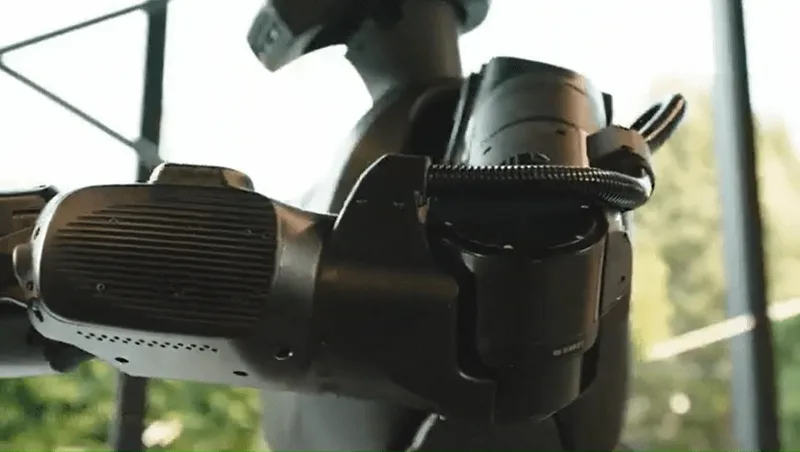
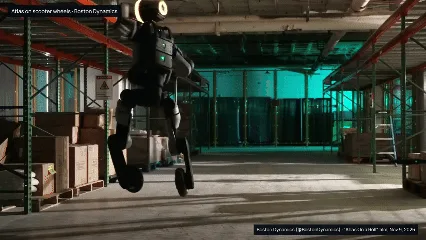
Boston Dynamics’ scooter-wheel Atlas experiment is best understood as an actuator and control test rather than a preview of a new commercial product. The company replaced Atlas’s feet with off-the-shelf scooter wheels using custom adapters connected to the robot’s existing ankle actuators, changing how the machine interacts with the ground while preserving much of its underlying hardware. This creates an unusual but useful test condition because rolling places sustained and changing demands on the drive system as the robot accelerates, brakes, turns, and changes direction. The experiment therefore gives engineers a way to examine how well the robot’s motors and control system behave under a different kind of continuous load.
The wheel conversion matters because an actuator does more than generate peak force. Engineers also need to understand response speed, sustained output, heat, torque, rotational speed, and how closely commanded movement matches what the hardware actually produces. A motor that can briefly generate high torque may still behave differently when asked to maintain force while rotating quickly. Rolling exposes those transitions repeatedly, making it useful for identifying control problems that might remain hidden in steadier demonstrations. A robot that starts smoothly but struggles during rapid braking, for example, may reveal a mismatch between the controller’s assumptions and the actuator’s actual behavior.
The hardware arrangement also highlights Atlas’s mechanical flexibility. The wheel acts as a continuously rotating ankle, which is possible because Boston Dynamics has described Atlas’s body actuators as supporting unlimited rotation without cables crossing the joints. Continuous rotation is essential for sustained rolling because a conventional limited-angle joint would eventually reach a mechanical stop. The custom adapter changes the ground-contact geometry while allowing the existing actuator to drive the wheel directly. This gives engineers an efficient way to test new locomotion ideas without rebuilding the entire lower body.
Changing from feet to wheels also changes several physical relationships that the control system must understand. Wheel radius affects the link between rotational speed and forward speed, wheel mass changes lower-leg dynamics, and traction determines how much torque can be converted into useful motion without slipping. The control problem therefore extends beyond simply commanding the ankle to rotate. Acceleration changes the forces acting through the legs and torso, while braking and turning alter the robot’s balance demands. The entire body has to remain coordinated while the contact points underneath it continue moving.
This is why the experiment is valuable even if scooter wheels never become part of a production Atlas. A research configuration can expose actuator limits, improve simulation models, and help engineers understand how the robot responds near difficult operating boundaries. An unusual movement can therefore have diagnostic value even when it has little direct relevance to warehouse or factory work. The main result is not that Atlas can roll on scooter wheels, but that the configuration gives Boston Dynamics another way to test how accurately software predicts what the physical machine can do.
How Atlas Learned the 360-Degree Jump, Sideways Dashes, and Wheeled Whole-Body Control
Boston Dynamics said Atlas landed a 360-degree spin jump on its first physical attempt after the motion had been developed through prior training. The policy tracked a recorded human jump, and engineer Xiaoyu “Andy” Wu described the maneuver as comparatively low risk. A successful first hardware execution therefore does not mean the robot invented the movement instantly. It means a movement prepared and tested through simulation transferred successfully to the physical machine on the first attempt under the conditions shown.
Motion capture provides the reference trajectory for this kind of behavior by recording how a person’s body changes position and orientation over time. Boston Dynamics has separately described using human demonstrations for Atlas research and then retargeting those motions to fit the robot’s body. Retargeting is necessary because human and robot proportions, joint structures, mass distributions, and movement limits are different. The goal is therefore not to copy a human joint angle by joint angle, but to preserve the useful structure of the motion while adapting it to what Atlas can physically execute.
Reinforcement learning then develops the control policy that produces the movement. A policy maps information about the robot and the task into actions, while training adjusts that policy based on the consequences of those actions. For the wheeled experiments, Boston Dynamics described modifying rewards, command ranges, and posture within existing policy frameworks. The exact reward terms have not been published, but the general challenge is balancing several goals at once, such as following a requested movement, maintaining stability, and avoiding excessive or impractical motion. A controller rewarded only for speed could become difficult to stop, while one rewarded too strongly for remaining stable could avoid useful movement entirely.
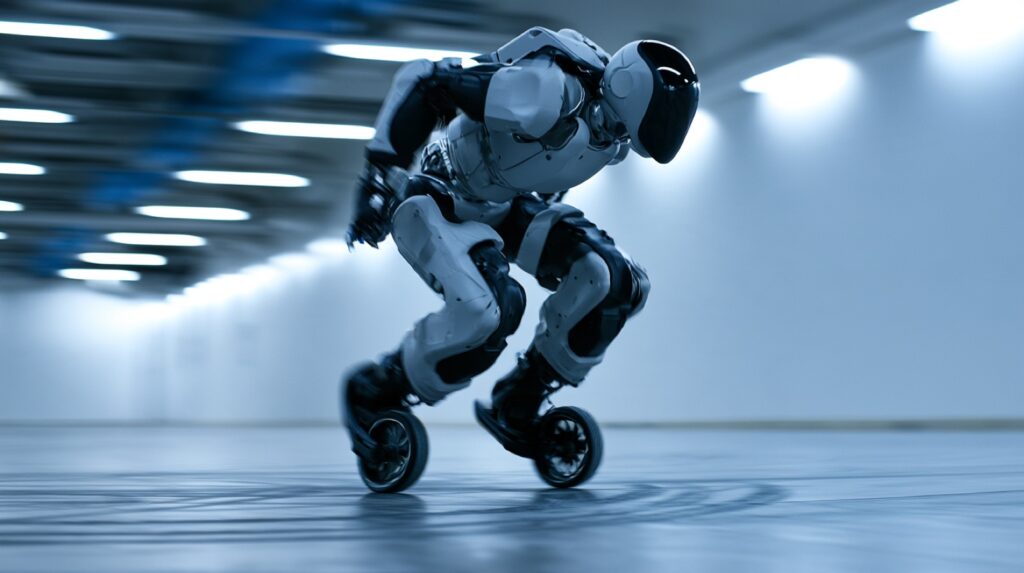
The sideways dash shows how the robot can preserve the intent of a human motion while using a different physical mechanism. A person may slide laterally across the ground, while Atlas can steer and roll the wheels to produce a similar overall body trajectory. The contact mechanics are different, but the movement can remain recognizable. This illustrates an important robotics principle: imitation does not always require reproducing every detail of the demonstrator’s motion. The controller can preserve the task-level result while choosing a mechanically appropriate solution for the robot’s own body.
That principle becomes even more important when a robot’s hardware differs substantially from a person’s. A human demonstration may show where the body should go, but the robot still needs to discover how to generate the necessary forces with its own joints and contact points. Requiring an exact copy of human movement could unnecessarily restrict the solution. Allowing the system to find physically valid alternatives can produce better results, especially when the robot has capabilities that humans do not, such as continuous ankle rotation.
Balancing while rolling also requires whole-body coordination. Increasing wheel speed changes more than travel velocity because the acceleration affects forces throughout the legs and torso. Turning redirects momentum, while braking requires the body to remain in a recoverable posture as forward motion is reduced. A controller focused only on the wheels would miss these coupled effects. Smooth movement therefore depends on coordinating the support points with the rest of the body rather than treating the wheel actuators as isolated drive motors.
A simple example shows why this matters. If Atlas carries a heavy object farther from its torso, the balance demands change even if wheel speed remains the same. The controller may need to adjust posture, joint torques, or acceleration to keep the system stable. This is why wheeled humanoid locomotion remains a full-body control problem rather than a simple conversion from walking to rolling. The wheel experiment tests how effectively Atlas can coordinate those effects under changing conditions.
The first successful 360-degree jump is meaningful because it demonstrates that the learned movement was physically achievable after transfer. It does not prove repeated reliability under every condition. Measuring reliability would require repeated trials, clear success criteria, and controlled changes to factors such as starting posture, floor surface, and loading. The strongest interpretation is therefore that the simulation and training process produced a difficult movement that successfully transferred to real hardware on its first attempt.
Why Accurate Motor Simulation and Sim-to-Real Transfer Matter for Atlas
The wheel experiment is closely tied to one of the hardest problems in robotics: making simulation behave enough like reality that a policy trained virtually still works on the physical machine. Wu described checking control settings, measuring hardware responses, and tuning simulated motors against those measurements. The goal is to make the same action command produce sufficiently similar consequences in both environments. If the simulation gives the robot capabilities that the real hardware does not have, the policy can succeed virtually for the wrong reason.
Actuator mismatch can come from several sources, including friction, transmission effects, saturation, timing delays, and differences in how quickly a motor produces the requested torque. A simulated controller might assume an immediate response and learn to rely on a last-second correction that physical hardware cannot perform quickly enough. The robot could therefore appear stable in simulation but lose balance when the real joint reacts more slowly. Accurate motor simulation is about matching the consequences of commands rather than merely making the virtual robot look similar to the real one.
Motor performance also cannot be summarized by one strength number. Torque describes rotational effort, angular velocity describes rotational speed, and mechanical power depends on both. Engineers need to understand how those quantities change across operating conditions and how long the hardware can sustain a demanding combination of speed and force. Useful evaluation would compare commanded and achieved motion, study acceleration response, and observe behavior as an actuator approaches its operating limits. These are general engineering criteria for this kind of test rather than a published Boston Dynamics measurement checklist.
The benefit of better simulation is that learned policies can be trained against more realistic expectations. If a motor consistently responds more slowly than the model predicts, correcting the simulation can prevent future policies from depending on unavailable performance. Engineers can also train across variations so the policy is less dependent on one perfectly matched set of parameters. Research on dynamics randomization has shown how changing simulated physical properties can help policies transfer to real hardware. Model accuracy and variation solve different problems: accuracy makes the nominal simulation relevant, while variation improves robustness when reality differs slightly from that nominal model.
This relationship becomes especially important for long, dynamic motions. A small mismatch at one moment can change posture enough to affect the next correction, which can then produce a larger divergence later. A jump, rapid turn, or hard stop therefore provides a useful stress test because it pushes the robot into conditions where inaccurate assumptions are more likely to matter. The wheel configuration creates many repeated transitions between acceleration, braking, and turning, making it a useful platform for studying these effects. Engineers can observe whether the controller behaves consistently across the full operating range rather than only in easy steady-state motion.
The same logic applies to comparing wheeled and footed locomotion. Wheels can move efficiently across suitable flat surfaces without repeated stepping, while feet can reposition contact points to handle obstacles and irregular terrain. A wheel-legged system can potentially combine both advantages, but the comparison depends on the actual task. Visual impressions alone cannot establish that one configuration is superior. A meaningful test would require both versions to perform the same work under comparable conditions while measuring completion time, energy consumption, intervention frequency, and recovery behavior.
For Atlas, the wheeled configuration is a research testbed rather than a commercial announcement. Boston Dynamics’ commercial Atlas materials focus on industrial material handling, customer evaluation, application training, and integration into operational workflows. A research experiment only needs to demonstrate that an idea is useful enough to study. A commercial product would also need clear operating conditions, maintenance requirements, stopping behavior, expected performance, and a specific customer problem that justifies the configuration. There is therefore no basis for assigning a release date to a wheeled Atlas or treating the demonstration as a new product launch.
How Wheeled Atlas Research Could Improve Reliability, Actuator Failure Handling, and Future Atlas Development
Boston Dynamics says lessons from the wheeled Atlas experiments are being applied to standard Atlas. The potential value comes from improving the company’s understanding of how actuators behave under difficult and changing loads. Better models can help engineers predict how the robot responds as temperature, load, speed, or operating conditions change. That knowledge can make training more realistic and help diagnose why a controller succeeds or fails. The useful outcome is a clearer operating boundary for the hardware rather than simply a more spectacular demonstration.
Reliability depends on repeatability. A movement becomes operationally valuable when engineers can predict how it behaves across many trials and understand how it changes under different conditions. If a simulation repeatedly overestimates an actuator’s response, correcting that error could stop future controllers from relying on forces or timing the physical machine cannot provide. This is an engineering implication of the research rather than a reported numerical reliability improvement. Establishing the actual benefit would require repeated comparative testing.
Actuator quality also matters beyond the laboratory. Hyundai Mobis has announced an actuator collaboration with Boston Dynamics focused on development, manufacturing scale, and dependable component supply. That separate effort provides context for why understanding actuator limits and behavior is relevant to commercial humanoid deployment. A robot may have an excellent policy, but production reliability still depends on whether its mechanical components can be manufactured consistently, serviced efficiently, and operated within known limits. Research, manufacturing, and maintenance therefore contribute to the same larger reliability problem.
Wu is also investigating learned responses to actuator failures, which introduces a different challenge from normal locomotion. A failed joint changes the set of actions the robot can still perform. A joint that loses torque is mechanically different from one that locks in place, while a weakened actuator creates yet another condition. There is no single recovery motion that solves every type of failure. The controller needs to recognize how the available physical capability has changed and respond in a way the damaged system can still execute.
A useful response may not always mean continuing the original task. Depending on the failure, the safest behavior could be reducing speed, shifting posture, changing the movement strategy, or reaching a controlled stop. This means fault-tolerant control should distinguish between task continuation and risk reduction. Successfully finishing the original action is not necessarily the best outcome if doing so increases the chance of falling or causing further damage. The broader research goal is to connect detection of changed physical behavior with an appropriate response that remains within the robot’s remaining capabilities.
The wheel experiment contributes to that larger objective by giving engineers another way to probe actuator behavior and model accuracy. Research hardware can influence a commercial platform even if the exact configuration never reaches customers. Improved motor models, better simulation-transfer methods, more informative stress tests, and learned responses near hardware limits can all feed into the standard Atlas program. The final measure of success will not be whether Atlas can perform an eye-catching jump or roll smoothly across a floor. It will be whether the robot can perform useful work more consistently, predictably, and safely under the conditions customers actually encounter.

Frequently Asked Questions (FAQs)
- What does the Atlas demonstration actually establish?
The demonstration shows that Atlas was able to perform the presented movement successfully on physical hardware under the conditions shown. That is meaningful because the controller had to transfer from training into the real robot well enough for the maneuver to work. However, one successful demonstration does not establish how often the same result would be repeated, how performance changes under different surfaces or loads, or how much energy the movement requires. Reliability, efficiency, and operating limits would need repeated testing across clearly defined conditions. The strongest conclusion is therefore that the behavior was physically achievable, not that every related performance question has already been answered. - Does “first try” mean there was no training?
No. “First try” refers to the first reported execution on the physical robot, not the amount of work that happened before deployment. A learned controller can be trained extensively in simulation before being transferred to hardware. Boston Dynamics has described this broader workflow in its Atlas research, where movements are developed and refined before they are attempted on the real machine. The first-attempt result is therefore evidence that the training transferred effectively for that run. It should not be interpreted as meaning the robot learned the maneuver instantly without preparation. - What is the difference between an actuator and a motor?
A motor is the component that produces mechanical rotation or movement from electrical energy. An actuator is the larger assembly that turns a control command into movement at the robot’s joint and can include the motor, transmission components, sensors, and control electronics. The distinction matters because the final joint behavior depends on more than the motor alone. Gearing, friction, sensing, delays, and control limits all influence how accurately and quickly the actuator responds. For robotics testing, the complete actuator assembly is usually the more relevant unit because that is what determines how commanded motion becomes physical motion. - Why does wheel size matter?
Wheel radius changes how rotational movement translates into linear travel. A larger wheel covers more ground for each revolution, while a smaller wheel requires more rotation to travel the same distance. Wheel size also affects the relationship between torque at the axle and force applied at the ground. These relationships influence acceleration, top speed, traction, and the demands placed on the actuator. A useful simulation therefore needs to represent the wheel dimensions accurately rather than treating every wheel as mechanically equivalent. - Is motion capture the same as remotely controlling the robot?
No. Motion capture records how a person moves and can provide reference data that is later adapted for robot training. Teleoperation, by contrast, involves a human actively directing the robot during operation. Boston Dynamics has discussed motion capture and teleoperation as different sources of demonstrations that can help train or guide robotic behaviors. A motion-capture clip does not directly control the robot in real time. Instead, it describes a desired movement that the robot’s control system must learn to execute with its own body. - Can a robot imitate a person without moving identically?
Yes. A robot can preserve the important outcome or recognizable structure of a human movement while using different joint motions or ground contacts that better suit its hardware. Human and robot bodies differ in proportions, mass distribution, joint limits, and available degrees of freedom, so exact copying is often neither possible nor desirable. The wheeled sideways dash is a good example because a human may slide while Atlas can roll to produce a similar body trajectory. Research such as DeepMimic demonstrates the broader idea of using motion references while allowing a physically simulated controller to find a viable execution. The important distinction is between copying the appearance of a task and reproducing every mechanical detail of how a person performs it. - Does reinforcement learning eliminate conventional motor control?
No. Reinforcement learning can help determine which actions the robot should take, but those actions still have to be executed by physical actuators and lower-level control systems. Motor control determines how command signals become torque, speed, and movement at the joints. If the actuator responds more slowly or less strongly than the learned policy expects, the behavior can fail even if the high-level decision was sensible. This is why accurate actuator modeling remains important when transferring learned policies from simulation to hardware. Learned control and conventional motor control therefore work together rather than replacing one another completely. - Would wheels always make a humanoid more useful?
No. Wheels can be efficient on smooth, level surfaces because they allow continuous travel without repeatedly lifting and placing the feet. However, obstacles, stairs, uneven terrain, and changing support conditions may favor footed or legged movement. A wheeled humanoid also introduces different control demands for braking, turning, and balance. Whether wheels are beneficial depends on the actual job and environment rather than on the visual smoothness of the demonstration. A fair comparison would require both configurations to perform the same task under comparable conditions. - How would engineers measure a reliability improvement?
Engineers would need repeated tests using clearly defined tasks and success criteria. Useful measurements could include completion rate, number of human interventions, recovery success, actuator faults, falls, and consistency across different loads or surfaces. Testing should also include variation in relevant operating conditions rather than repeating only the easiest setup. Comparing those results before and after a change would show whether reliability had actually improved. One successful demonstration can show feasibility, but repeated controlled trials are needed to establish dependable performance. - What would demonstrate effective actuator-failure recovery?
A convincing evaluation would begin by clearly defining the type of actuator failure and the conditions under which it occurs. Engineers would then need repeated trials showing that the robot detects or responds to the changed capability in a consistent and appropriate way. Depending on the failure, success might mean continuing the task with reduced motion, changing posture, redistributing load, or coming to a controlled stop. A locked joint, a weakened actuator, and a complete loss of torque create different mechanical problems, so the correct response will not always be the same. Effective failure recovery means the robot chooses an action that remains achievable and safe given the capability it still has.

Conclusion
Boston Dynamics’ Atlas experiment with scooter wheels makes a deeper engineering challenge visible: successful movement depends on how well the robot’s body, actuators, control policy, and simulation assumptions agree with one another. The 360-degree jump and wheeled maneuvers are attention-grabbing, but their real value comes from the questions they help engineers test. Can the actuators deliver the expected response under changing loads? Can a policy trained in simulation remain physically achievable on hardware? Can the controller adapt when the robot’s contact with the ground changes significantly?
Those questions matter because impressive motion alone does not establish reliability. A single successful attempt can demonstrate feasibility, but dependable robotics requires repeated evidence across different surfaces, loads, temperatures, starting conditions, and operating states. The same principle applies to actuator-failure research, where success depends not only on detecting that something has changed but also on choosing a response the remaining hardware can still execute safely. Better simulation, more accurate actuator models, and carefully designed stress tests can help reduce the gap between what a controller expects and what the physical robot can actually deliver.
The wheeled Atlas configuration is therefore most useful as a research tool rather than as a product prediction. It gives Boston Dynamics another way to probe motor behavior, whole-body control, sim-to-real transfer, and the limits of learned movement. Insights from those experiments can feed back into the standard Atlas program even if scooter wheels never become part of a commercial machine. Improvements in modeling, control, testing, and fault handling could all contribute to more predictable behavior during real industrial work.
The spinning jump is what attracts attention, but the engineering discipline behind it is what ultimately matters. More capable humanoid robots will need not only impressive demonstrations but also accurate models, repeatable performance, robust recovery behavior, and evidence that learned actions remain dependable under useful operating conditions. That is where experiments like this have their greatest value. They turn spectacle into data that can help make the wider Atlas platform more capable, reliable, and practical.
Sources and Citations
- Boston Dynamics, Atlas On a Roll, 2026: Primary engineering account explaining how Boston Dynamics modified its Atlas humanoid robot using scooter wheels attached to existing ankle actuators. Describes the hardware adaptation, reinforcement learning controller, simulation training, motor torque and speed requirements, and how the experiment demonstrated the flexibility of Atlas’s whole-body control system.
https://bostondynamics.com/blog/atlas-on-a-roll/ - Boston Dynamics, Training a Humanoid Robot for Hard Work: Official technical article examining Atlas’s hardware design, powerful actuators, reinforcement learning, and industrial manipulation capabilities. Explains how the robot learns complex movements through simulation, coordinates its arms and legs, and transfers trained behaviors to physical hardware while addressing the challenges of real-world motor performance.
https://bostondynamics.com/blog/training-a-humanoid-robot-for-hard-work/ - Boston Dynamics, Can Football Teach a Robot to Move?, 2026: Developer explanation of how Atlas learned advanced football movements using human demonstrations, motion capture, motion retargeting, and reinforcement learning. Discusses the robot’s Ghost Rabona demonstration, simulated training environments, balance control, and how athletic movements contribute to developing transferable industrial robotics skills.
https://bostondynamics.com/blog/can-football-teach-a-robot-to-move/ - Boston Dynamics, Atlas Humanoid Robot Official Product Page: Official information about the commercial Atlas platform, including its industrial applications, physical specifications, joint mobility, lifting capabilities, and autonomous operation. Provides technical context for understanding the robot’s continuous joint rotation, advanced actuators, interchangeable components, and design for manufacturing and material-handling environments.
https://bostondynamics.com/products/atlas/ - Google DeepMind, MuJoCo Modeling Documentation: Official physics simulation documentation explaining how MuJoCo represents robotic bodies, joints, actuators, contact surfaces, and mechanical constraints. Provides technical background on modeling robot dynamics, configuring actuator behavior, and creating simulated environments for reinforcement learning experiments involving humanoid and wheeled robots.
https://mujoco.readthedocs.io/en/stable/modeling.html - Google DeepMind, MuJoCo Computation Documentation: Technical reference describing the mathematical foundations of MuJoCo’s physics simulation engine, including forward dynamics, inverse dynamics, actuator forces, collision handling, and numerical integration. Explains how simulated robots respond to forces and constraints, providing background for understanding the simulation-based training methods used in advanced robotic control.
https://mujoco.readthedocs.io/en/stable/computation.html - Xue Bin Peng, Pieter Abbeel, Sergey Levine, and Michiel van de Panne, DeepMimic, 2018: Foundational research introducing reinforcement learning methods for teaching physically simulated characters to imitate reference movements. Explains how motion imitation, reward functions, and simulated training enable complex locomotion, acrobatics, and recovery behaviors, providing theoretical background for learning dynamic robot movements.
https://arxiv.org/abs/1804.02717 - Zipeng Fu, Xuxin Cheng, and Deepak Pathak, Deep Whole-Body Control, 2023: Peer-reviewed research introducing a unified reinforcement learning policy for coordinating robotic locomotion and manipulation. Explains how controlling multiple joints together improves movement stability, adaptability, and task performance compared with separate control systems for legs and arms.
https://proceedings.mlr.press/v205/fu23a.html - Satoshi Yamamori et al., Actuator Reality Shaping for Zero-Shot Sim-to-Real Robot Learning, July 2026: Research examining how physical robot actuators can be controlled to reproduce idealized simulation dynamics. Introduces a feedforward-feedback control approach designed to improve simulation-to-reality transfer, reduce tracking errors, and support reinforcement learning deployment on robotic arms, wheeled-legged platforms, and humanoid robots.
https://arxiv.org/abs/2607.02205 - OpenAI, Sim-to-Real Transfer of Robotic Control With Dynamics Randomization, October 18, 2017: Research demonstrating how randomizing physical properties during simulation training can improve the transfer of learned robotic behaviors to real hardware. Explains how variations in simulated dynamics help control policies remain effective despite differences in friction, calibration, and other real-world conditions.
https://openai.com/index/sim-to-real-transfer-of-robotic-control-with-dynamics-randomization/ - Deyun Dai, Tao Liu, and Tengfei Tang, Robust Locomotion Control of Quadrupedal Wheel-Legged Robots, May 20, 2026: Peer-reviewed research published in Machines investigating reinforcement learning for wheeled-legged robots operating across complex environments. Explains contrastive history-aware state estimation, terrain adaptation, domain randomization, and simulation-to-real transfer, with experimental results demonstrating stable locomotion across uneven surfaces.
https://www.mdpi.com/2075-1702/14/5/568 - Hyundai Mobis, Strategic Collaboration With Boston Dynamics, January 7, 2026: Official corporate announcement confirming Hyundai Mobis’s agreement to supply actuators for Boston Dynamics’ next-generation Atlas humanoid robot. Discusses component development, manufacturing expertise, planned production scaling, and Hyundai Motor Group’s broader investment in industrial robotics and automated manufacturing technologies.
https://bostondynamics.com/news/hyundai-mobis-forms-strategic-collaboration-framework-with-boston-dynamics/
Recommendations
- Elie Paquiet’s The Courtyard: Modular Environment Workflow in 3ds Max, Unreal Engine, ZBrush and Substance 3D
- Obsidian Was Originally Planning To Make Fallout: New Vegas 2 – What Happened and Why It Never Released
- Moonlight Peaks Achievement Guide: How to Unlock Every Achievement Fast
- Most Anticipated Games for 2026: GTA 6, Marvel’s Wolverine, Marathon, Saros, and More
- Mistfall Hunter: How to Unlock More Character Slots Guide
- Fire Emblem: Fortune’s Weave Sets Standard Physical Price at $80 (What You Get and Why It’s Priced That Way)
- Netflix Has Introduced a Standalone App Specifically Designed for Children’s Games: Everything to Know About Netflix Playground
- Roblox Q3 2026 Results Beat Guidance: Revenue Up 16%, Bookings Down 12%
- Huawei Atlas 950 SuperPoD vs Nvidia NVL144: Huawei Claims 6.7X More AI Compute
- Disney and Adobe Announce Multi-Year AI Alliance for Firefly Foundry Models



































































































