








In This Article (9 sections)
How CarX Technologies Created the Dynamic Weather System for CarX Street
How the Dynamic Weather System for CarX Street Was Created: CarX Technologies Column is a story about how a street-racing world became more reactive, more atmospheric, and more demanding to drive. In Update 1.12.0, CarX Technologies introduced dynamic weather to Sunset City, connecting visual atmosphere with gameplay physics instead of treating rain as only a cosmetic layer. The official Steam announcement for Update 1.12.0 confirms the addition of a dynamic weather system, weather transitions from sunny skies to overcast conditions, fog after rain, visible raindrops on car bodies, puddles on roads, neon reflections, reduced grip on wet asphalt, and an option to disable the updated wet-road physics in settings.
The importance of this system is that CarX Street is already built around tuning, drift control, mountain roads, highways, and urban racing. The official CarX Street page describes the game around mountain slopes, highways, city streets, detailed tuning, CarX Technology physics, realistic gameplay, and dynamic control. Dynamic weather therefore fits the game’s core identity: it gives the same car builds and the same roads new behavior when conditions change. Instead of asking players only to memorize dry racing lines, the system asks them to adapt braking, throttle input, corner entry, drift angle, and grip management.
Because CarX Technologies has not published a full engineering white paper on the internal code behind the feature, the most accurate way to explain how the dynamic weather system was created is to analyze what the official update states, what can be inferred from standard racing-game design, and how real tire-road friction research supports the wet-road handling choices. The result is a layered system that links environmental state, rendering, road materials, vehicle physics, and player settings.
The first layer is the weather-state layer, which decides whether Sunset City is sunny, cloudy, rainy, or foggy. The official update notes state that sunny weather now transitions into overcast skies and that fog settles over the city after rain, with these changes working alongside the changing time of day. The second layer is the visual-material layer.
When rain arrives, the world must look wet: roads need puddles, specular shine, and reflective surfaces that make neon lighting feel stronger, while car bodies need visible water droplets because players often see their cars from chase camera, photo mode, or close third-person angles. Official notes specifically mention raindrops on the car body and puddles that remain on roads while reflecting the city’s neon glow.
The third layer is the physics layer. Rain affects car handling because wet asphalt reduces grip and makes control more difficult. That is not just a dramatic racing-game choice; it reflects a real-world principle. The Federal Highway Administration defines pavement friction as the tire-pavement force that allows steering, braking, and acceleration, and explains that pavement texture influences the friction components that help a vehicle maneuver and stop. CarX Street uses this same basic idea in gameplay form: dry roads allow more confident acceleration and cornering, while wet asphalt reduces the margin for error.
How Rain Effects, Update 1.12.0, and Wet-Road Physics Work in CarX Street
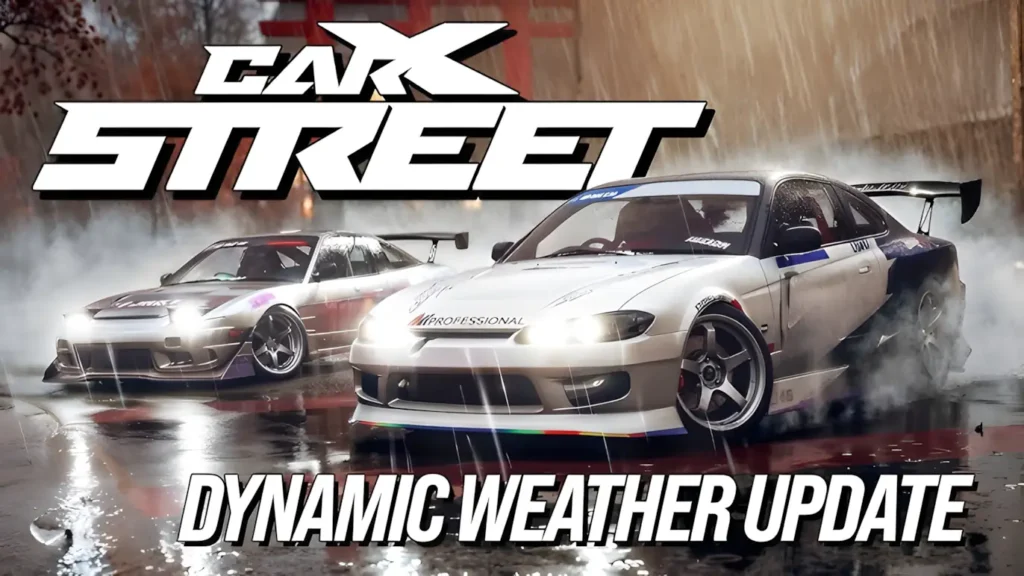
CarX Technologies appears to have built rain effects for CarX Street by combining visible precipitation, surface wetness, car-body droplets, road puddles, and modified grip into one coherent driving condition. In racing games, rain feels convincing only when several signals agree with each other. A wet sky without wet roads looks incomplete, shiny roads without handling changes feel superficial, and reduced grip without visible wetness feels unfair. Update 1.12.0 addresses all three expectations by changing atmosphere, road appearance, and vehicle behavior together.
The rain effects likely required a set of wet-surface material states. Dry asphalt, damp asphalt, puddled asphalt, and reflective road paint do not react to light in the same way. In Sunset City, this matters because the game’s identity depends heavily on night roads, neon lighting, urban reflections, and tuned cars. The update notes explicitly connect puddles with neon reflection, showing that the rain system is not only about weather but also about strengthening the city’s street-racing mood.
For cars, raindrops on the body create a close-range cue that tells players the weather has changed even before they notice the road surface. This is especially important in a game where players customize vehicles and often pay attention to paint, lighting, rims, and body kits. Rain has to respect the car as the visual centerpiece. A glossy hood, a roof panel, and a rear bumper can all become part of the weather effect because water droplets give the player a direct visual link between the environment and the machine.
CarX Street Update 1.12.0 introduced dynamic weather as the headline feature, but it was not the only addition. The official Steam announcement says the update brought dynamic weather, drift quests, new cars, and more content to Sunset City. It lists the dynamic weather system under major changes, then describes transitions from sunny weather to overcast skies, fog after rain, visual changes such as raindrops and puddles, wet asphalt grip reduction, and a settings option to disable the updated physics.
The update also added story-driven drift quests designed to deepen the atmosphere of CarX Street and give players new reasons to explore the city. In addition, new cars were added, including BM2R, SZC, and ARG, and new drag races were added to Time Attack mode. The same update introduced improvements such as drive requirements for Time Attack races, rival display on the minimap in Time Attack, custom car categories in the car list, and the ability to sell multiple cars at once.
This matters because dynamic weather works best when it enters a game as part of a larger content loop. Rain and fog can make the city feel fresh, but players also need events, cars, and progression systems that encourage them to keep driving through those conditions. Update 1.12.0 gave Sunset City both atmosphere and activity, which makes the weather system more valuable than a standalone graphics feature.
Rain changes driving physics in CarX Street by reducing grip on wet asphalt and making handling more difficult. The official update language is clear that rain affects car physics and that wet asphalt significantly reduces grip. In practical driving terms, this means the player has less traction available for acceleration, braking, and turning. A car that can take a corner aggressively in dry weather may understeer, oversteer, or slide more easily when the road is wet.
This design is consistent with real tire-road behavior. The FHWA explains that pavement friction supports steering, braking, and acceleration, and that microtexture and macrotexture influence how tires interact with pavement. Macrotexture is especially important on wet pavement because it helps water escape from the tire-road contact zone, improving contact and reducing hydroplaning risk at higher speeds. In CarX Street, those principles translate into gameplay through reduced grip rather than a full scientific tire model exposed to the player.
Drivers must brake earlier, apply throttle more carefully, and avoid sudden steering movements. Drift players may find that wet conditions make breakaway easier but recovery more delicate. Grip racers may need smoother racing lines, while time-attack drivers may need to decide whether weather physics improves immersion or creates too much variability for record-chasing.
CarX Street Wet Asphalt, Puddles, Neon Reflections, Fog, and Time-of-Day Changes
CarX Street wet asphalt grip is the key gameplay consequence of dynamic weather. On dry asphalt, a tuned car can transfer power to the road more efficiently. On wet asphalt, less grip means the same throttle input can produce wheelspin, the same braking point can become too late, and the same cornering speed can push the car beyond its available traction. This makes wet asphalt more than a visual surface. It becomes a new handling condition.
The handling challenge is especially important because CarX Street’s broader identity is connected to physics and tuning. CarX Technologies’ Steam developer page describes the studio as developing racing games and simulators with realistic physics, advanced graphics, and game modes. CarX Street’s official mobile listing also emphasizes physics, controls, tuning, dynamic day-night change, drifting, and racing through Sunset City. Wet asphalt strengthens that identity by making tuning choices and driver inputs matter under more than one condition.
A softer suspension setup, tire choice, differential behavior, and power delivery can all feel different when the road is slick. Even when the game does not expose every real-world variable, the player experiences the result through control. The car may rotate faster, slide longer, or demand more careful counter-steering. Good wet-road handling design does not simply make the game harder; it changes the rhythm of driving.
Puddles and neon reflections work in CarX Street as both environmental feedback and art direction. The official update confirms that puddles remain on the roads and reflect the city’s neon glow. This detail matters because Sunset City is not a rural rally environment. It is an urban racing space where artificial lighting, storefront glow, street lamps, and car lighting help define the scene.
From a design perspective, puddles tell the player that the rain has affected the road surface, and they help the city feel less static after a weather transition. When rain stops and fog begins to settle, puddles become evidence that the weather system has a timeline rather than a single on-off state. A dry city, a rainy city, and a post-rain foggy city can all feel different.
Neon reflections also improve readability and mood. A wet road can show a brighter line of reflected color, helping players sense surface wetness even at speed. Reflections can make corners, intersections, and highway sections look more cinematic. In an open-world racer, this is important because many players do not only race; they cruise, tune, take screenshots, explore districts, and test builds. Puddles and reflections support all of those behaviors.
CarX Street fog, rain, and time-of-day weather changes work together to make Sunset City feel less predictable. The official update states that sunny weather can transition into overcast skies, fog can settle after rain, and these changes combine with the changing time of day to make the city feel more alive, realistic, immersive, and varied. Fog is different from rain because it does not primarily change tire grip. It changes visibility, distance reading, and mood. In racing terms, fog can make the city feel narrower and more intense. Players may focus more on headlights, taillights, road edges, and nearby traffic. In open-world terms, fog softens the skyline, changes silhouettes, and makes familiar roads feel unfamiliar.
Time of day adds another variable because rain at noon, rain at sunset, and rain at night do not look or feel the same. Night rain emphasizes neon reflections. Daytime overcast conditions emphasize cloud cover and muted lighting. Fog after rain can make a post-storm morning feel different from a late-night sprint. By linking weather to time of day, CarX Street creates more scene variety without needing to rebuild the map.
Why Dynamic Weather Makes CarX Street More Realistic, Immersive, and Demanding
Dynamic weather makes Sunset City feel more realistic because real cities do not remain visually or physically constant. Roads get wet, visibility changes, reflections appear, and drivers adjust their behavior. A racing game that keeps every road permanently dry can still be fun, but it loses some of the unpredictability that gives real driving its texture. In CarX Street, realism is not limited to photorealistic graphics. It is the relationship between cause and effect. When the sky darkens, rain falls. When rain falls, cars collect water droplets. When roads get wet, puddles and reflections appear. When asphalt is wet, grip decreases. This chain gives players a reason to believe that the world is responding as a system.
The realism also helps Sunset City’s identity. Official descriptions of CarX Street emphasize open-world freedom, becoming a street-racing legend in Sunset City, realistic highway and city races, top-speed drift races, and tuning that unlocks CarX Technology car behavior. Dynamic weather supports that promise because a living street-racing city should have changing roads, not only changing events.
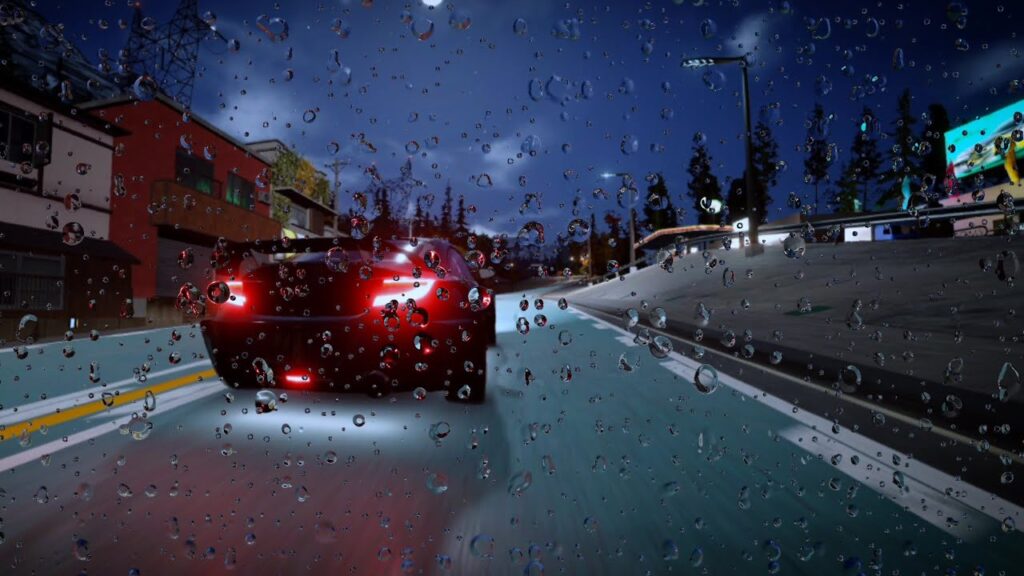
CarX Street rain effects operate across cars, roads, and city lighting. On cars, raindrops make the vehicle feel physically present in the world. This is important because the car is not just a tool; it is a personalized object shaped by tuning and visual customization. When the bodywork reacts to rain, the player’s own build becomes part of the weather scene. On roads, rain darkens the surface, creates puddles, increases reflectivity, and changes traction. This is where visual effects and physics meet.
A road that looks wet but drives dry breaks immersion. A road that drives wet but looks dry feels unfair. CarX Street avoids that disconnect by pairing wet asphalt grip reduction with visible puddles and reflections. The official update notes describe this exact combination: visual wet-road cues and a physics change tied to rain.
City lighting becomes more dramatic because wet surfaces reflect light differently. Neon glow on puddles gives Sunset City a stronger nighttime racing atmosphere. The same turn can feel more cinematic after rain because reflections add depth and contrast. For players who value screenshots, cruising, or cinematic replays, rain changes the visual personality of the city. For competitive players, it also changes the way the road must be driven.
CarX Street also has to balance visual weather effects and performance because dynamic weather adds rendering cost and simulation complexity. Rain, fog, reflective roads, puddles, droplets, and lighting changes can all increase the workload on hardware. The official PC page lists minimum and recommended system requirements, including a GTX 1050 Ti or Radeon RX 570 minimum GPU, an RTX 2060 Super or Radeon RX 5700 XT recommended GPU, 8 GB minimum RAM, 16 GB recommended RAM, and an SSD requirement.
The design challenge is to make rain visible without making the game unstable. Developers typically solve this by controlling effect density, reflection quality, puddle placement, fog volume, texture resolution, and physics update cost. In a high-speed racing game, performance is not optional. Frame pacing affects steering input, braking accuracy, drift correction, and player confidence.
This is why the weather system must be practical, not just beautiful. Reflections need to look convincing from a moving car, not necessarily behave like a full ray-traced mirror at every angle. Fog needs to create atmosphere without hiding the road unfairly. Raindrops need to communicate wetness without overwhelming the screen. Wet-road physics needs to be clear enough for immersion but stable enough for competitive driving.
CarX Technologies’ Realistic Weather Philosophy and Player Control in CarX Street
CarX Technologies’ approach to realistic weather in racing games appears to be rooted in the studio’s broader focus on physics, tuning, and accessible realism. The company describes itself on Steam as a developer of racing games and simulators with realistic physics, advanced graphics, and exciting game modes. CarX Street’s official pages also emphasize detailed tuning, realistic gameplay, dynamic control, and physics-based car behavior.
The dynamic weather system fits that philosophy because it does not stop at atmosphere. Rain affects handling. Wet asphalt reduces grip. Players can feel the change in the car rather than only see it in the sky. This is the key distinction between decorative weather and systemic weather. Decorative weather is a background effect. Systemic weather changes player decisions.
Dynamic weather improves immersion in CarX Street by making the city feel like it has continuity. A sunny drive can become overcast. Rain can leave wet roads behind. Fog can settle after the storm. Puddles can reflect neon. These details create a sense that time is passing and the world is reacting. Immersion also comes from changed behavior. When players adjust braking distance, reduce throttle aggression, and control slides more carefully, they are not just observing weather. They are participating in it. The road surface becomes part of the challenge. This is especially powerful in a game where the player may know a route well. Rain makes a familiar route feel new again.
Real driving research supports why wet surfaces should change behavior. The FHWA notes that friction affects vehicle interaction with the roadway and that maintaining pavement friction is especially important at locations where vehicles turn, slow, and stop. Continental’s tyre knowledge resource explains that wet conditions reduce tire grip and can make braking distances 1.5 to 2 times longer than on dry roads. CarX Street converts that real-world logic into a playable form by reducing grip on wet asphalt.
At the same time, CarX Technologies included a player option to disable the updated weather physics. The official Update 1.12.0 announcement states that rain affects car physics by significantly reducing wet-asphalt grip, but players have the option to disable this updated physics in the game settings. That choice suggests a balanced approach. The studio added realism for players who want changing grip and immersion, but it also protected players who prefer consistent handling.
This setting is important because not every player wants weather to influence handling. Some players want maximum immersion and enjoy adapting to rain. Others prefer stable physics for Time Attack, tuning comparisons, leaderboard practice, or casual cruising. By allowing players to disable the updated physics, CarX Street separates visual weather atmosphere from mandatory wet-road difficulty. The option also helps preserve fairness.
In racing games, changing grip can be exciting, but it can also frustrate players who are trying to repeat a route under identical conditions. A settings toggle lets players decide whether dynamic weather should be a full physics variable or mainly a visual and atmospheric feature. That flexibility is one of the smartest parts of the Update 1.12.0 implementation.
Frequently Asked Questions (FAQs)
- What is the main purpose of the CarX Street dynamic weather system?
The main purpose is to make Sunset City feel more alive while also changing the driving experience. Update 1.12.0 added weather transitions, rain visuals, fog after rain, puddles, neon reflections, and wet-road grip reduction, so weather now affects both atmosphere and handling. Instead of being only a background effect, the system makes the city respond visually and physically to changing conditions. - Does rain in CarX Street only change the graphics?
No. Rain changes the graphics and the physics. It adds visual effects such as raindrops on car bodies, puddles on roads, darker wet surfaces, and stronger reflections, but it also reduces grip on wet asphalt. That means rain is not just decorative; it changes how players brake, accelerate, corner, and control slides. - How does wet asphalt affect driving in CarX Street?
Wet asphalt reduces traction, so players need smoother inputs, earlier braking, and more careful throttle control. A car that feels stable on dry roads may slide more easily or become harder to control when the surface is wet. This is consistent with real driving principles, where pavement friction supports braking, steering, and acceleration. - Can players turn off wet-road physics in CarX Street?
Yes. The official Update 1.12.0 notes say players can disable the updated weather physics in the game settings. This allows players to keep the visual weather effects while avoiding wet-road handling changes if they prefer consistent physics for Time Attack, tuning comparisons, casual driving, or repeatable racing conditions. - What weather types are included in the dynamic weather system?
The update describes sunny weather transitioning to overcast skies, rain affecting the city and roads, and fog settling over Sunset City after rain. These changes also work with the game’s time-of-day system, so the same weather can feel different depending on whether the player is driving during the day, at sunset, or at night. - Why are neon reflections important in CarX Street?
Neon reflections are important because CarX Street is an urban street-racing game. Wet roads and puddles reflecting city lighting strengthen the nighttime atmosphere and make Sunset City look more cinematic after rain. They also help communicate that the road surface has changed, making the weather feel connected to the city rather than placed on top of it. - Does dynamic weather make CarX Street harder?
It can make the game harder when wet-road physics are enabled because reduced grip makes braking, cornering, drifting, and acceleration more demanding. Players may need to brake earlier, use smoother steering, and control throttle more carefully. However, the ability to disable updated weather physics gives players control over how much difficulty the weather adds. - Why does fog matter if it does not directly reduce grip?
Fog matters because it changes visibility, mood, and the way players read the road. It can make familiar routes feel different by softening the skyline, reducing long-distance visibility, and shifting attention toward headlights, taillights, road edges, and nearby traffic. When combined with time-of-day changes and post-rain road reflections, fog helps Sunset City feel less predictable. - Is CarX Street designed around realistic physics?
CarX Technologies describes its racing games and simulators as having realistic physics, advanced graphics, and exciting game modes. CarX Street’s official pages also emphasize detailed tuning, CarX Technology physics, realistic gameplay, and dynamic control. The dynamic weather system fits that identity because rain does not only change the sky; it changes how the car behaves on wet asphalt. - What does the dynamic weather system suggest about future CarX Street updates?
It suggests that CarX Technologies can continue expanding Sunset City through environmental variation, improved tire behavior, rainy-weather fixes, wet-road events, and more immersive race conditions. Later Steam news already shows continued attention to rainy-weather display issues and tire physics refinement, which means dynamic weather may remain part of the broader effort to improve realism and driving feel.

Conclusion
How the Dynamic Weather System for CarX Street Was Created: CarX Technologies Column is ultimately about a major step in making Sunset City feel more like a living racing environment. The system introduced in Update 1.12.0 does not treat weather as a static background. It links sky transitions, rain, fog, puddles, neon reflections, car-body droplets, wet asphalt, and vehicle grip into one experience.
The strongest part of the update is the connection between atmosphere and handling. Rain looks different, but it also drives differently. Wet asphalt reduces grip, which changes braking, cornering, acceleration, and drift control. At the same time, CarX Technologies gives players the option to disable updated weather physics, preserving accessibility and competitive consistency.
Dynamic weather also gives CarX Street a stronger future. Once a racing game has changing weather, it can build new event types, visual improvements, handling updates, and city moods around that system. For an open-world racer focused on tuning, drifting, highways, mountain roads, and urban racing identity, dynamic weather is more than a graphics upgrade. It is a framework for deeper immersion, more varied driving, and a more believable Sunset City.
Sources and Citations
- CarX Street — Steam Update 1.12.0: “Update 1.12.0 is now live!”
- Primary source for dynamic weather, rain, fog, puddles, neon reflections, reduced wet-asphalt grip, and the option to disable the updated weather physics.
- CarX Street — Update 1.12.0
- CarX Street — Official Steam Store Page
- Covers the game’s mountain roads, highways, city streets, detailed tuning, CarX Technology physics, realistic gameplay, dynamic driving, and PC system requirements.
- CarX Street on Steam
- CarX Technologies — Official Steam Developer Page
- Describes the studio’s focus on racing games and simulators, realistic physics, advanced graphics, and different game modes.
- CarX Technologies on Steam
- CarX Technologies — Official Website
- Official company/game information, including CarX Street’s mountain slopes, highways, city streets, tuning, CarX Technology physics, and realistic gameplay.
- CarX Technologies Official Website
- Google Play — CarX Street
- Covers Sunset City, open-world street racing, highway and city races, drift races, tuning, dynamic day/night changes, and the game’s physics and controls.
- CarX Street on Google Play
- Federal Highway Administration — “Driver, Vehicle, and Roadway Characteristics Related to Driving in Wet Weather”
- Useful for wet-road friction, water on pavement, tire-pavement interaction, drainage, and the reduction of friction caused by water films.
- FHWA — Driving in Wet Weather, Chapter 2
- Federal Highway Administration — “Surface Texture for Asphalt and Concrete Pavements”
- Covers pavement microtexture, macrotexture, wet-weather friction, and how pavement texture and drainage affect tire contact with wet surfaces.
- FHWA — Surface Texture for Asphalt and Concrete Pavements
- NHTSA — Hydroplaning / Tire-Pavement Interaction Interpretation
- Supports the explanation of adverse tire-pavement interactions on water-covered pavement and the possibility of complete loss of traction through hydroplaning.
- NHTSA — Hydroplaning and Tire-Pavement Interaction
- NHTSA — Tire Pressure Monitoring / Hydroplaning Technical Document
- Covers factors affecting hydroplaning, including speed, tire design, tread depth, water depth, vehicle load, and inflation pressure.
- NHTSA — Hydroplaning and Loss of Control
- Continental Tires — “Braking Distance”
- Covers how road conditions and weather affect braking distance, including reduced grip and longer stopping distances on wet roads.
- Continental — Braking Distance
- Continental Tires — “Aquaplaning”
- Covers water between the tire and road, loss of road contact, hydroplaning, traction loss, tread depth, and wet-road braking performance.
- Continental — Aquaplaning
- Continental Tires — “Testing Winter Tires”
- Provides additional technical support for reduced grip and increased braking distance on wet surfaces.
- Continental — Testing Winter Tires
Recommendations
- LEGO Donkey Kong Arcade Cabinet Leak: Everything We Know About Nintendo’s Next Retro Collectible
- EA Net Bookings Jump 38% to over $3bn Following Battlefield 6 Launch: Q3 FY26 Breakdown
- Hasbro CEO Promises No Generative AI in Its Video Games as Chris Cocks Draws a Line on AI
- Macrobit Interactive Releases Factory 95: A Windows 95 PowerPoint Automation Game
- House of the Dragon Showrunner Explains Helaena’s Reveal, Daemon’s Deception, and the Greens’ New Addition
- Magic: The Gathering – The Best Preconstructed Commander Decks Ranked for 2026
- Covenant: the Final Chapter Finally Wraps up the Beloved Supernatural Romance Comic
- Gothic 1 Remake How to Lockpick: Trainer Location, Lockpicks, and Puzzle Tips
- Beadle & Grimm’s Expands Star Trek Universe with New Games After 2025 Picard Murder Mystery Release
- Grand Theft Auto 6: Confirmed Car List (2026 Full Vehicle Breakdown, Leaks & Trailer Sightings Explained)



































































































