








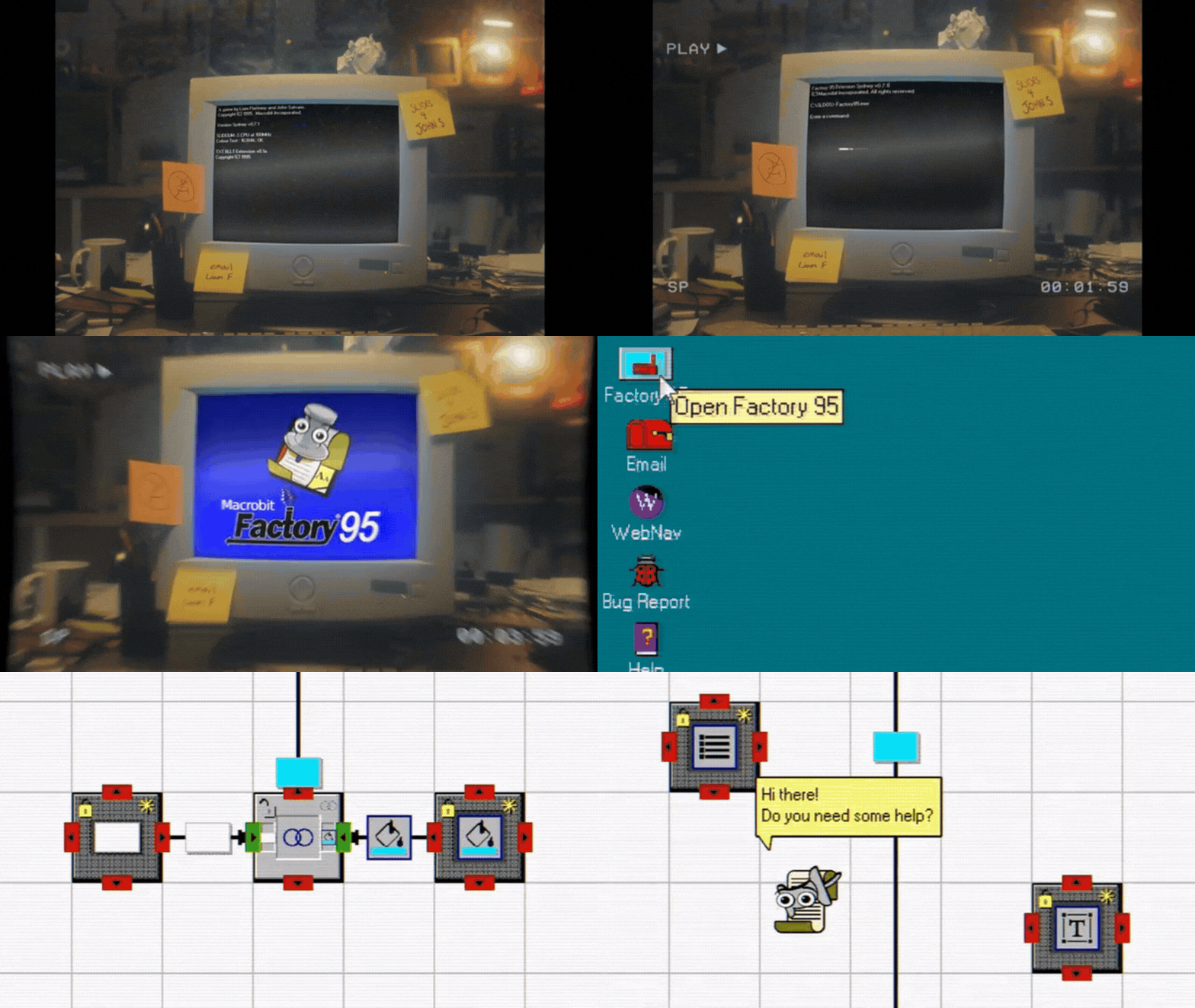
Factory 95 is one of the more distinct automation game launches of 2026 because it does not treat factories as giant industrial maps. Instead, it turns a faux Windows 95 desktop and slideshow software into the factory floor itself. The full game launched on April 22, 2026 on Steam, where it is listed as a single-player simulation from Macrobit Interactive with Windows, macOS, and SteamOS + Linux support. Steam’s official description centers on building “PowerPoint factories,” juggling emails, downloading tools from the World Wide Web, operating inside limited slide space, and working through multiple game modes with a 16-bit color aesthetic.
GamingOnLinux and 80 Level both highlighted the same unusual hook at launch, especially the fact that the game shipped with native Linux support.
In the early post-launch snapshot captured for this article, Steam showed 26 user reviews with a 92% positive rating, while a Steam Community announcement from April 23 said the game had already sold 500 copies. That is still too early for a full long-tail reception verdict, but it is enough to say Factory 95 arrived with immediate curiosity, a recognizable niche, and a clear identity in the automation and puzzle-simulation space.
What Is Factory 95 by Macrobit Interactive?
Factory 95 is best understood as a retro-styled puzzle-automation game that reframes factory design as slide production. Official descriptions consistently define it as a game about making a “slide show factory… in a slide show,” where the player manages limited space, builds increasingly complex slides, and works under the looming pressure of Y2K. That core idea matters because it places Factory 95 somewhere between a spatial factory builder, a logic puzzle game, and an office-software parody rather than a traditional capitalist management sim. MacGaming’s launch coverage captures the distinction well: the familiar automation loop is still there, but the “factory floor” is a finite slide canvas instead of an open industrial world.
What makes the concept more than a visual joke is how thoroughly the theme is integrated into the software fiction. The player is not simply placing machines on a grid. They are exploring a retro OS, receiving client requests, navigating email, and expanding capabilities by downloading late-1990s-style tools. The setting is not cosmetic wallpaper laid over automation mechanics; it is the frame through which those mechanics are introduced, paced, and interpreted.

Factory 95 Release Date, Platforms, and Availability
The full version of Factory 95 released on April 22, 2026. Before that, Macrobit Interactive released the official Factory 95 Demo on December 9, 2025. The full game’s Steam page lists Windows, macOS, and SteamOS + Linux support, while the demo page documents the earlier public build that introduced the concept before launch.
Availability is straightforward. The official commercial release is currently documented on Steam, where the full game is listed as single-player and the demo remains downloadable from the main store page. The full game supports English plus 12 additional languages for interface, full audio, and subtitles, while the demo page lists English support only. GamingOnLinux separately confirmed the launch as a native Linux release rather than a Windows-only title running through compatibility layers.
How Factory 95 Combines Windows 95 and PowerPoint Gameplay
Factory 95’s central design trick is merging three familiar things that do not usually belong together: the Windows 95 desktop metaphor, PowerPoint-style slide creation, and compact automation design. Steam’s official description says the player explores a retro operating system while completing client requests, juggling email, and downloading tools from the World Wide Web. At the same time, the actual factory systems are built “within a slideshow-making software,” meaning layout, routing, and page-to-page transfers become the equivalent of conveyor logic and production planning.
The screenshot descriptions on Playtester make the fusion even clearer. They identify a retro desktop with Pinny the assistant, an email client, WebNav browser windows, tool-download screens, and factory grids full of interconnected nodes. In other words, Factory 95 does not merely resemble Windows 95 while behaving like an automation game. It uses desktop windows, fake web browsing, email, and slide pages as the interface language for automation itself. That is why the game feels more like “office software turned into level design” than “factory game with a retro skin.”

Factory 95 Gameplay Explained: Building Slide Factories Step-by-Step
At a high level, the gameplay loop appears to work like this. First, the player receives a request through the game’s retro desktop tools, especially email and client-facing task screens. Second, they acquire or access the needed visual ingredients, colors, patterns, and production options through in-game systems including a slide marketplace and upgradeable buildings, which are explicitly documented on the demo page. Third, they place and connect tools on a slide-sized grid, routing resources through the correct processing chain. Fourth, when one page is not enough, they move work among multiple pages. Fifth, they submit the required result and use the revenue or progression gains to unlock more capable workflows.
That sequence is important for SEO readers looking for “Factory 95 gameplay” because it shows the game is not about designing decks by hand in a presentation editor. It is about automating the production of specific slide outputs. The achievement list reinforces that structure: one achievement tracks submitting every slide template, another covers placing every tool at least once, and several others point to finishing named careers. Those markers strongly suggest that the full game is organized around repeated brief-to-build-to-submit cycles rather than freeform sandboxing alone.
Factory 95 Automation Mechanics and Puzzle Systems Breakdown
The automation side of Factory 95 looks compact, but it is not loose. Official descriptions repeatedly stress limited space, increasingly complex slides, and a “challenging” factory-builder structure. The puzzle side becomes clearer in the game’s early patch notes and community discussions. On April 23, the Sydney v1.0.4 patch fixed recipe issues involving gradient direction and white background layers not showing correctly, which reveals that slide recipes track exact properties rather than just vague resemblance. A player discussion on the Steam Community page also complained about submissions that looked correct but still failed validation, further suggesting the game checks detailed output states under the hood.
That makes Factory 95 more exacting than many “soft” creative builders. It is not enough to make something that feels visually close. You have to satisfy the puzzle logic the game is actually testing. The existence of a “place every tool at least once” achievement also hints at a broad enough mechanical vocabulary that experimentation is part of the intended learning curve. This is one reason early players have compared it less to sprawling belt empires and more to compact engineering-puzzle games.

Managing Space and Resources in Factory 95’s Slideshow Interface
Space is the game’s main limiting resource. Steam’s official description says the factories are built inside slideshow software and that the player has only limited space to design systems and move resources. MacGaming’s analysis of the launch build reaches the same conclusion, arguing that Factory 95’s real twist is not just its Windows 95 presentation but the way it turns finite slide real estate into the primary design problem. As demands grow, the player must compress workflows, redesign layouts, and balance readability against density.
The second layer of resource management comes from multi-page logistics. Both Steam and MacGaming note that slides can be sent between pages, effectively making a deck function like a multi-room factory. Early patch notes also mention “Page Connection resources previews,” which confirms that page-to-page transfer is not a peripheral gimmick but a formal part of the interface and production model. In practice, that means Factory 95’s resource management is as much about where a process lives as about what the process does.
Factory 95 Y2K Theme and Retro Computing Nostalgia Explained
Factory 95’s Y2K theme works because it is functional, tonal, and historical all at once. Official descriptions explicitly say the player must “worry about Y2K,” while press coverage and screenshot descriptions show that concern embedded in a broader late-1990s office-computing culture built around email, early web browsing, and desktop-window multitasking. The game’s nostalgia is therefore not just about gray buttons and chunky borders. It is about a specific moment in computing when slideshow software, dial-up-flavored web culture, and millennium anxiety overlapped.
The early community response suggests that this nostalgia lands. One Steam review said the game took the player “right back” to using shared school computers, while another praised the retro sounds and treated the whole experience as a conveyor-belt game filtered through old office software. Playtester’s screenshots also show a character named Pinny serving in a help-assistant role, which reinforces the era-specific humor of turning productivity software conventions into part of the game’s fiction.

Factory 95 Game Modes and Progression System Overview
Macrobit Interactive’s Steam materials say the full game includes multiple game modes, but the most useful detail comes from the achievement list and community snippets. Steam achievements confirm a Creative Mode and also indicate progression through several named careers: Macrobit, Australian Factory League, Presentation of IT, and Factory Simulation Solutions. Another achievement references finishing the Rainbow Software tree, which implies at least one upgrade or specialization branch rather than a completely flat unlock ladder.
A Steam Community search snippet adds one more layer by referencing Virus Mode and Challenge Mode alongside Creative Mode. Because that mode language appears in official Steam-community indexing rather than in the lines visible on the store page, the safest interpretation is that Factory 95 is built around more than one play structure: a career-oriented progression path, a more open creative space, and at least one additional variant or ruleset designed to change the problem conditions. That is consistent with the game’s own pitch as both a strategy challenge and creative sandbox.
Factory 95 Tools, Upgrades, and Slide Creation Features
The clearest named tools visible in public materials are Merger, Deleter, Reverser, and Filter, all of which appear in Playtester’s screenshot descriptions. Steam’s store text also says the player can unlock “a wide range of tools” to build complex slides in compact space, while the demo page confirms a limited number of upgradeable buildings, selected colors and patterns from the full game, and a functioning in-game slide marketplace. Taken together, those sources suggest Factory 95 is not just a routing game. It is a transformation game, where slide ingredients are altered, combined, filtered, and forwarded through a tool chain.
This matters because it explains why the game can sustain both progression and creativity. New tools widen the transformation vocabulary. Upgrades deepen efficiency. More colors and patterns expand how many valid slide outputs can exist. The “place every tool at least once” achievement and the demo’s promise of upgradeable buildings support the reading that learning the toolset is a major part of mastery.
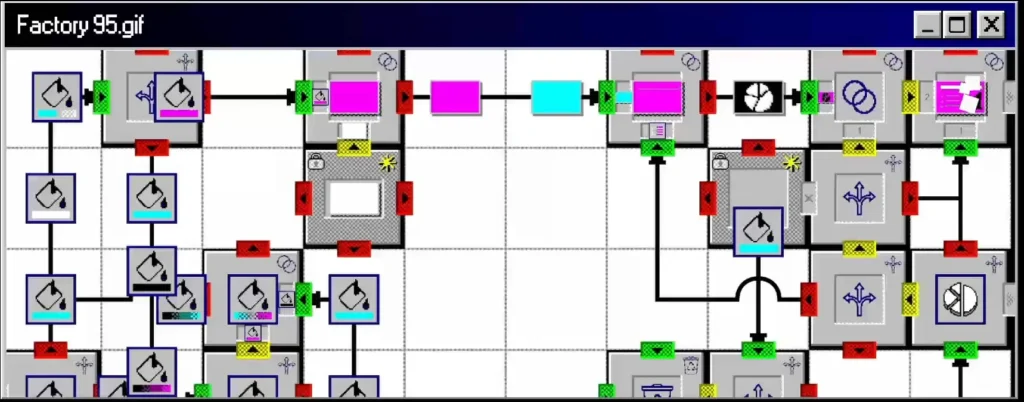
Factory 95 Graphics Style: 16-Bit Colors and Classic UI Design
Factory 95’s visual identity is built on deliberate constraint. Steam’s official description explicitly references “new advances in 16-bit colour,” and press coverage from 80 Level repeats that phrasing in a way that connects color depth to the game’s broader retro premise. Rather than chasing photorealism or even high-detail pixel art, Factory 95 uses limited palette logic, classic window chrome, and old-software iconography to make the interface itself feel like a period artifact.
The screenshots described on Playtester show the classic UI logic in practice: retro browser windows, email panes, progress bars, factory grids, and a desktop helper all living inside a faux operating system. There is even evidence that the developers treated that authenticity seriously. In a Reddit snippet indexed by web search, the developer said the team tried to be as accurate as possible with the layout and even visited a computer museum to use a Windows 98 machine for research. That does not make Factory 95 a museum reconstruction, but it does explain why the interface reads as studied nostalgia instead of vague retro shorthand.
Why Factory 95 Stands Out Among Automation and Simulation Games
Most automation games scale outward. Factory 95 scales inward. That is the single biggest reason it stands out. MacGaming summarized the contrast clearly by noting that factory builders normally focus on sprawling industrial campuses, while Factory 95 relocates the same optimization urge into slide-sized spaces. Steam’s description reinforces that the challenge comes from compact layouts, limited room, page connections, and tool unlocking rather than map-wide expansion or enemy defense.
It also stands out because its thematic wrapper changes how the player reads the same underlying design problems. A merger on a slide page feels different from a smelter on a planetary map. A client email feels different from a mission dispatcher. A downloadable filter from the World Wide Web feels different from a tech-tree unlock. These choices make Factory 95 distinct not only in aesthetics but also in tone. Even early community reactions point in that direction: one player wrote that it feels more like a Zachtronics-style engineering puzzle than a Factorio-like, and the developer has openly cited old Zachtronics games and shape-based factory games as inspirations.

Factory 95 Tips for Beginners: How to Build Efficient Slide Factories
The smartest beginner approach is to treat Factory 95 as a precision puzzle first and a creativity sandbox second. Official achievements show there is a tutorial and a help menu, and an early player review specifically praised the demo videos attached to items and tools as helpful onboarding. That means the game itself already points new players toward learning-by-reference, not by brute-force trial and error.
A practical way to improve early efficiency is to keep builds modular. Since the official materials repeatedly stress limited slide space and page-to-page movement, beginners do better when they create clean, reusable micro-workflows before spreading processes across multiple slides. It also helps to verify details that are easy to overlook, such as gradient direction, order, and hidden layer behavior, because the launch-week patch notes show those properties matter to recipe logic.
Finally, using every tool at least once is not just an achievement hunt. It is a good learning strategy, because Factory 95’s mechanical depth comes from understanding how transformations stack inside tight layouts. That guidance is partly an inference from the documented systems and early fixes, but it is a well-supported one.
Factory 95 System Requirements and Performance on PC and Linux
On Windows, the official minimum requirements are modest: Windows 7, 8, 10, or 11 x64, an Intel Core i3, 700 MB of RAM, an OpenGL 2.1 compatible graphics card, and 700 MB of storage. On macOS, Steam lists macOS 11 or later, any Intel or Apple Silicon processor, 700 MB of RAM, and 700 MB of storage. On Linux, the official minimums are Ubuntu 20.04 64-bit or equivalent, a dual-core 2.0 GHz processor, 700 MB of RAM, integrated graphics with Vulkan 1.0 support, 500 MB of storage, and Vulkan-compatible drivers.
For readers specifically searching “Factory 95 system requirements” or “Factory 95 Linux performance,” the safest conclusion is that the game is technically lightweight rather than graphically demanding. The requirements are extremely low by modern standards, and GamingOnLinux confirmed native Linux support at launch. What public first-week coverage does not yet provide is a serious benchmark culture around frame-time testing or platform-by-platform performance charts. SteamDB’s Steam Deck compatibility summary adds some useful context: the game is considered functionally accessible with the default controller configuration, but some keyboard/mouse icons may still appear, text entry may require the on-screen keyboard, and display resolution may need manual adjustment.
Best Automation Games Like Factory 95 You Should Try
If Factory 95 appeals to you, the best comparisons are not one-for-one clones. They are games that share its love of compact systems, learnable tools, and elegant optimization.
- shapez 2 is the closest match if you want pure production-chain design with no enemies and a heavy focus on processing shapes efficiently. It captures the clean, abstract side of Factory 95 without the retro-office wrapper.
- SpaceChem is a foundational recommendation for anyone who likes automation as exact problem-solving. Its official description is about constructing factories to transform raw materials into chemical products, and the precision of its puzzle logic is very much in Factory 95’s orbit.
- SHENZHEN I/O is ideal for players who respond to Factory 95’s overlap of software fiction and engineering puzzles. It asks you to build circuits, write code, and work through product-design problems using manuals and datasheets, which produces a similar “creative work as systems design” feeling.
- Infinifactory is a great next step if you want the same optimization instinct in a more spatially open 3D setting. Officially, it is about assembling products for alien overlords, but the core pleasure is still solving production layouts in an open-ended way.
- Opus Magnum is the most elegant recommendation if what you love in Factory 95 is the visual beauty of a working system. It is another machine-building puzzle game, but one built around alchemical assembly rather than slides or circuits, with a strong emphasis on elegance and optimization.
Several of the clearest comparison points here come from Zachtronics, which helps explain why early players keep reaching for that studio’s catalog when describing Factory 95. The connection is not that the games are identical. It is that they all treat design, logic, and constrained creativity as the real source of satisfaction.
How PixelHair and The View Keeper Fit Into Retro-Styled Creative Workflows (Optional Insight)
Factory 95 is fictional software work turned into play. PixelHair and The View Keeper, by contrast, are real production tools that make actual digital art workflows faster. According to Yelzkizi, PixelHair is a library of pre-groomed 3D hair assets built to save artists from creating realistic hair from scratch in Blender and Unreal Engine workflows. The View Keeper, as described by Yelzkizi and the Superhive listing, is a Blender add-on for storing multiple camera views, switching among them, assigning per-view render settings, and batch rendering multiple angles while reducing scene clutter.
The reason they fit this article, even as an optional insight, is conceptual. Factory 95 imagines digital creativity as a chain of tools, windows, and workflow constraints. PixelHair and The View Keeper show what that idea looks like in real 3D production: modular assets, reusable setups, camera-state management, and interface-driven efficiency. In that sense, all three are part of the same broader story about how artists and designers increasingly think through software systems, not just inside them.

Frequently Asked Questions (FAQs)
- Is Factory 95 out now?
Yes. The full game released on April 22, 2026 on Steam. - Was there a demo before release?
Yes. The official Factory 95 Demo released on December 9, 2025 and was used to showcase selected colors, patterns, upgradeable buildings, a limited slide marketplace, and content-limited gameplay. - What platforms does Factory 95 support?
Steam lists Windows, macOS, and SteamOS + Linux support for the full game. - Is Factory 95 single-player or multiplayer?
The Steam page lists Factory 95 as a single-player game. - Does Factory 95 support Linux natively?
Yes. Steam lists SteamOS + Linux support, and GamingOnLinux specifically described the release as having native Linux support. - Does Factory 95 include a Creative Mode?
Yes. Steam achievements include “MB Paint,” which is awarded for playing a level in Creative Mode. Steam Community search snippets also reference Creative Mode directly. - What kind of progression does the full game have?
Public materials point to several progression layers. Achievements reference named careers such as Macrobit, Australian Factory League, Presentation of IT, and Factory Simulation Solutions, plus a Rainbow Software tree and the broader “beat the game” milestone. - Why do players say Factory 95 feels different from most factory sims?
Because its core constraint is not giant industrial expansion. It is compact slide-space planning inside office-software windows. Official descriptions and early coverage both emphasize the finite canvas, page routing, client requests, and retro desktop wrapper as the defining differences. - What are the minimum PC and Linux requirements?
Windows minimum is an Intel Core i3, 700 MB RAM, OpenGL 2.1 compatible graphics, and 700 MB storage. Linux minimum is Ubuntu 20.04 64-bit or equivalent, dual-core 2.0 GHz, 700 MB RAM, Vulkan 1.0-capable integrated graphics, 500 MB storage, and Vulkan-compatible drivers. - Does Factory 95 offer beginner-friendly help?
Yes, at least in documented form. Steam achievements confirm a tutorial and a help menu, while an early review specifically praised the item demo videos for making onboarding easier.

Conclusion
Factory 95 succeeds because it commits fully to its premise. It is not merely an automation game with a Windows 95 coat of paint, and it is not merely a nostalgia game with conveyor-belt logic pasted on top. Its public materials, launch coverage, patch notes, and early progression markers all point to a carefully designed hybrid: a compact automation puzzler where slide pages replace factory floors, office software replaces generic menus, and Y2K-era desktop culture becomes the language of progression. That combination is why Factory 95 stands out in a crowded automation market and why it is already drawing comparisons to abstract factory sims and Zachtronics-style engineering puzzles rather than to conventional management games alone.
If the first week is any guide, Macrobit Interactive has found a niche worth watching. Steam’s early user response was positive, the developer publicly reported 500 copies sold within about a day of launch, and the official materials suggest enough depth in tools, modes, and careers to support a long tail beyond the initial retro-UI novelty. For players searching for a Windows 95 game, a PowerPoint automation game, or a fresh factory puzzle with real identity, Factory 95 is not a gimmick. It is a sharply framed idea executed with unusual discipline.
Sources and Citations
- Steam — Factory 95
https://store.steampowered.com/app/3987250/Factory_95/ - GamingOnLinux — Factory 95 launch coverage
https://www.gamingonlinux.com/2026/04/factory-95-is-a-clever-automation-sim-inspired-by-windows-95-and-powerpoint-out-now/ - 80 Level — Factory 95 release-day summary
https://80.lv/articles/windows-95-inspired-automation-game-where-you-build-powerpoint-factories - Playtester — Factory 95 Demo screenshots/features
https://playtester.io/factory-95 - MacGaming — Factory 95 analysis
https://www.macgaming.com/news/factory-95-for-mac-build-powerpoint-factories-in-windows-95-and-race-the-y2k-clock - Superhive — Yelzkizi storefront
https://superhivemarket.com/creators/yelzkizi - shapez 2 — official site
https://shapez2.com/ - Steam — shapez 2
https://store.steampowered.com/app/2162800/shapez_2__Factory/ - Zachtronics — SpaceChem
https://www.zachtronics.com/spacechem/
Recommended
- MASTERS OF THE UNIVERSE Official Trailer Breakdown and Everything We Know So Far About the 2026 He-Man Movie
- Dirty Hands Official Trailer: Everything We Know About the 2026 Crime Thriller
- Bloodmoored Announced for PC: First-Person Psychological Horror Game Set in an Abandoned Factory
- Tamga Released: Minimalist 3D Sculpting App That’s Free on the Web (No Accounts or Subscriptions)
- Academy Software Foundation adopts OpenPGL: What the new ASWF Sandbox project means for path guiding renderers
- Machine Learning That Powers Enemy AI in Arc Raiders: How Next-Gen Game AI Creates Smarter Enemies
- Battlefield 6 2026 Roadmap: More Maps, “Legendary” Battlefield 4 & Battlefield 3 Remakes, and Wake Island’s Return
- Gears Of War Actor’s Gears 6 Fanfic Involves Marcus Fighting His Zombie Son
- How to Create a 3D Environment Like Arcane: A Step-by-Step Guide