





Arc Raiders is a multiplayer extraction adventure set in a “lethal future earth” where players contend with both hostile ARC machines and other Raiders. Public developer-facing descriptions of its AI emphasise a hybrid approach: traditional game AI for decision-making and combat logic, combined with machine learning (ML)—especially reinforcement learning (RL)—to generate physically grounded enemy locomotion that looks and feels more lifelike under chaotic, player-driven conditions.
How Machine Learning Is Used in Arc Raiders Enemy AI
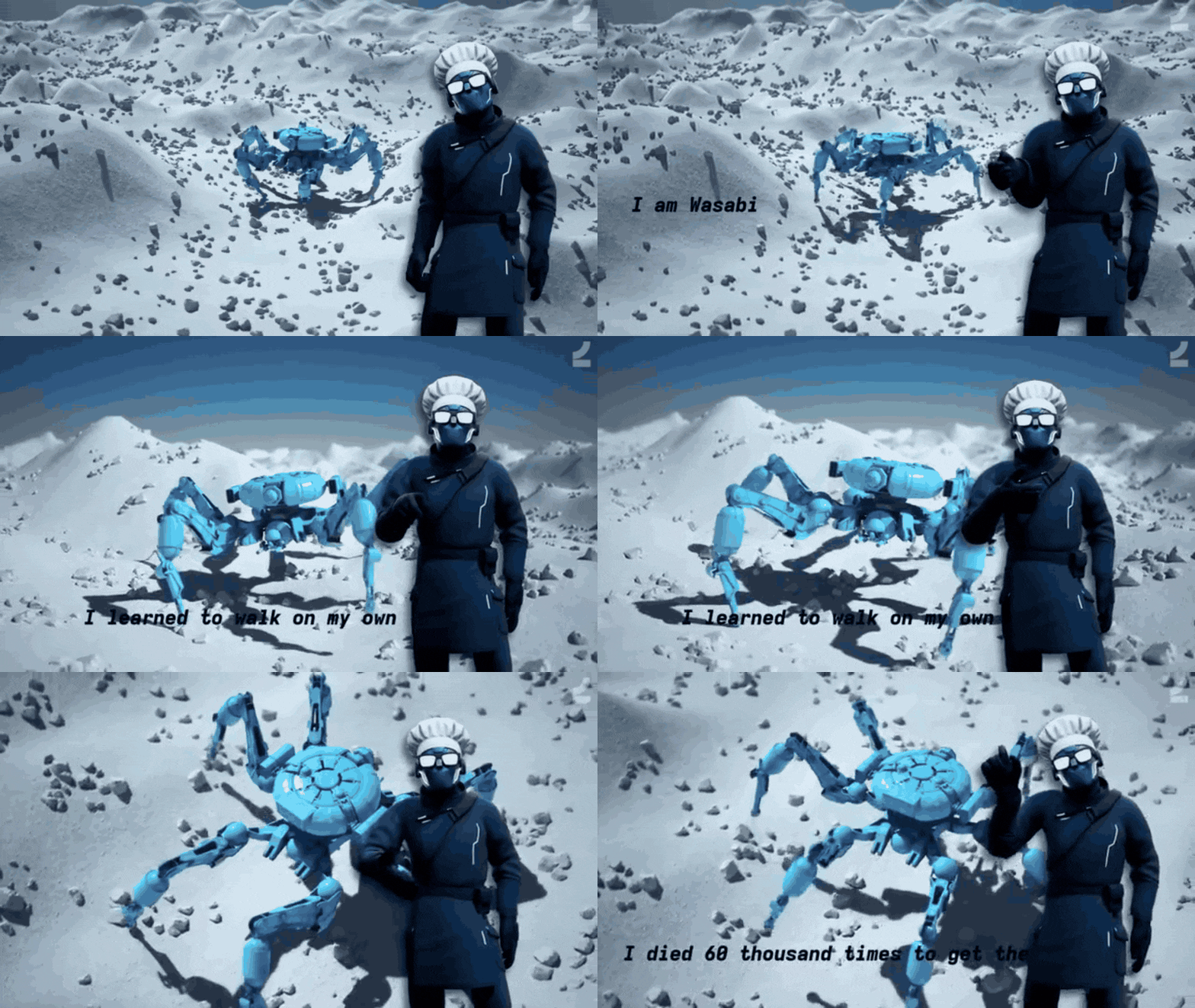
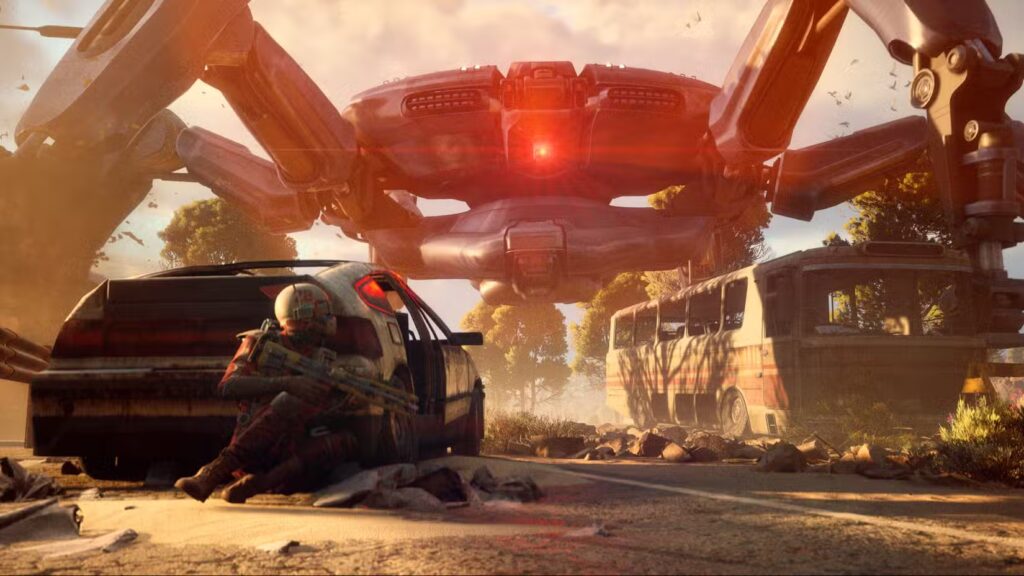
Public reporting and developer commentary indicate that Arc Raiders uses ML primarily to solve movement and navigation in a physics-driven world—particularly for multi-legged ARC units—rather than to “think” tactically in the human sense. In interviews and conference coverage, Embark’s AI stack is described as layered: ML controllers handle low-level locomotion (how to place feet, keep balance, recover from impacts, traverse uneven terrain), while higher-level behaviour selection (patrolling, attacking, prioritising targets, ability use) remains authored through conventional game AI systems.
A key “why” emerges from the game’s design pillars: if enemies are simulated “like physical entities,” then movement can’t rely on brittle animation scripts that assume ideal terrain, perfect footing, or predictable collisions. The moment players blow off limbs, topple a machine into debris, or create awkward edge cases, hand-authored locomotion can look wrong (sliding, snapping, ragdolling) and can also break gameplay readability. Embark’s ML-driven locomotion is positioned as a way to keep machines responsive and believable even when the world stops cooperating.

What Makes Arc Raiders Enemy AI Feel Realistic and Adaptive
The “realistic and adaptive” feeling reported by players appears to come less from enemies learning the meta-game and more from physics-consistent movement combined with reactive perception and authored combat behaviours. In the GDC session description for Arc Raiders’ locomotion system, Embark frames the goal as making machines “feel alive” by teaching them to “walk, run, stumble, and fight with intent,” with motion emerging from learning rather than hand-tuned scripts.
GamesRadar’s coverage of the same R&D line explains this “adaptiveness” in reward terms: ML “brains” are rewarded for staying upright, orienting towards targets, moving effectively, and preserving plausible motion—so they can improvise when terrain, damage, and player interactions create novel situations. Embark’s earlier technical write-up on RL animation (also produced in-engine) describes the core advantage in interactive settings: the agent observes its body and surroundings and chooses motor actions over the next frames, enabling immediate, situation-specific recovery when hit or perturbed.
A notable example of “game-feel realism” is a behind-the-scenes “magic torque” system described in GDC reporting: when pure physics-based locomotion fails (for instance, after multiple legs are severed), the system can subtly apply extra assistance so the enemy can still move in a way that looks correct to players, while penalising excessive “magic” so it remains a last resort rather than a constant cheat. This is a pragmatic takeaway from production ML: the benchmark is not scientific purity—it is credible motion that preserves gameplay pacing and threat.
Procedural AI vs Machine Learning in Arc Raiders Explained
In contemporary game development, “procedural” usually means algorithmic, rule-based generation (or rule-based control) that is deterministic or guided by handcrafted logic, while ML is data/experience-driven learning that generalises from examples, training, or reward signals. Arc Raiders is publicly characterised as a hybrid: ML is used to produce robust locomotion behaviours under physics, while game “brain” logic (combat patterns, authored tactics, and decision scaffolding) remains conventional.
This split reflects a production reality: procedural logic is typically easier to debug, tune, and guarantee—especially for combat behaviour in a live-service environment—while ML excels at high-dimensional control problems like locomotion, where hand-authoring all edge cases is expensive and fragile.

Machine Learning Techniques Behind Modern Game AI Systems
Modern game AI that uses ML tends to cluster into a few technique families, each with different production trade-offs:
Reinforcement learning is widely used for control tasks where the agent must learn sequences of actions to maximise reward over time—particularly in robotics and physics-based animation, where designers specify goals (“move forward,” “stay stable,” “track style”) and let learning discover robust motor strategies. Motion imitation + RL approaches (rather than “pure” RL) are especially relevant to games because they can preserve an animator-defined “style” while still gaining physical reactivity. DeepMimic is a central reference point in this space: it combines motion clip imitation objectives with RL so a physics character can recover from perturbations and operate interactively.
Adversarial imitation ideas (e.g., Adversarial Motion Priors, AMP) are an evolution of this: instead of painstakingly hand-designing imitation losses and clip-selection machinery, AMP trains an adversarial “motion prior” from motion data and uses it as a learned style reward during RL, improving realism while simplifying some reward engineering.
Finally, domain randomisation and scenario randomisation are commonly used to make learned controllers robust by exposing them to varied terrains, obstacles, and perturbations during training, helping them generalise to messy in-game conditions.
Reinforcement Learning in Enemy AI for Arc Raiders
The clearest publicly documented ML use in Arc Raiders is RL-driven locomotion for machine enemies, described explicitly in GDC scheduling materials and developer interviews. The GDC session description frames the work as “state of the art methods that combine animation, reinforcement learning and physics-based control,” deployed inside Unreal Engine, paired with a perception system built on point clouds so agents can “see and react to the world around them.”
GamesRadar’s conference reporting adds implementation flavour consistent with RL: multiple specialised ML “brains” (controllers) are rewarded for desirable locomotion outcomes—moving towards a target, keeping upright, facing the target, following a motion reference—and penalised for destabilising or implausible motion (e.g., “bizarre angles,” wasteful energy). This is recognisably RL-style shaping: define objective signals that make the agent prefer stable, purposeful, believable movement under physical constraints.
Embark’s earlier published ML workflow explains the underlying production bet: if locomotion is learned as a control policy and not played back as a fixed animation, the character can respond uniquely to collisions and perturbations in real time—supporting emergent combat moments that animators did not explicitly author.
The Role of Neural Networks in Game Enemy AI Systems
Neural networks typically enter game enemy AI in two ways: (1) as function approximators for ML policies (especially in deep RL), and (2) as perception models (turning sensor-like inputs into usable features). Arc Raiders’ public framing aligns with both: the GDC description references learned control and point-cloud perception, and GamesRadar reports multiple neural-network “brains” that take over under different motion contexts.
The robotics literature helps explain why this is plausible and powerful: legged locomotion is a high-dimensional control problem where neural policies can map state observations (joint angles, velocities, contact states, terrain cues) to motor actions, learning agile recovery behaviours that are difficult to hand-code. In short: neural networks make it feasible to learn “motor intelligence” that remains stable under perturbation—exactly the kind of robustness that sells the fantasy of heavy machines fighting through a dynamic sandbox.
Behavior Trees vs Machine Learning in Game Enemy AI
Behaviour Trees (BTs) are a widely used authoring structure for game agents because they are modular, readable, and scalable compared to finite state machines for complex NPCs. They also give designers and AI programmers a practical debugging surface: you can see why an enemy chose an action, and you can enforce guardrails (cooldowns, priority interrupts, failover behaviours).
In Arc Raiders, public sources describe a deliberate combination: learned locomotion at the bottom, BTs (and related decision systems, including utility AI) at the top. This is a common “best of both worlds” architecture: ML solves continuous control and ragged edge cases in motion, while BTs preserve authored intent, encounter readability, and predictable combat design—especially important in a multiplayer extraction context where balance, fairness, and exploit prevention matter.

Why Machine Learning Improves Enemy Decision Making in Arc Raiders
Public statements strongly suggest ML does not replace Arc Raiders’ high-level decision-making or combat behaviour. Arc Raiders’ design director, Virgil Watkins, is quoted explaining that the machine learning is used for teaching machines to walk and navigate, not for attacks or broader behaviours.
So why does ML still feel like it improves “decision making”? The answer is that locomotion quality changes what players interpret as intelligence. An enemy that can smoothly step over debris, reorient under fire, keep pursuing after partial destruction, and avoid obviously “broken” animation states will appear more tactical—even if the decision logic is still authored. In practice, ML upgrades the execution layer of decisions: when the BT says “pursue,” RL locomotion can find believable ways to pursue in a world full of irregular geometry, splash damage, and unpredictable player-made chaos.
This is consistent with Embark’s own narrative about emergent gameplay: when you don’t puppet every movement beat, you can get motion outcomes that even creators didn’t anticipate—creating the impression of dynamic agency.
How Arc Raiders Uses AI to Create Dynamic Combat Encounters
Arc Raiders’ official platform descriptions stress variability—weather, enemies, mechanics, and the constant risk posed by other Raiders—so “no two runs are the same.” While much of this variability is game-systems design rather than ML specifically, ML-driven locomotion can directly amplify encounter dynamism by making enemy traversal and recoveries less predictable than fixed animation systems.
A concrete example comes from coverage of the reward-driven locomotion loop: enemies are incentivised to orient, pursue, and stay stable; they can handle hard-to-predict situations such as navigating barricades and moving while damaged. This makes the micro-texture of combat less “scripted,” because the same encounter setup can play out differently depending on terrain irregularities, damage patterns, and player movement.
At the macro layer, Arc Raiders also deploys scenario-level difficulty and encounter modifiers (for example, high-risk map conditions that intensify threats and concentrate rewards). While that is not inherently ML, it is still part of the overall “AI-driven encounter” story because it changes the density and composition of PvE pressure that players must adapt to.
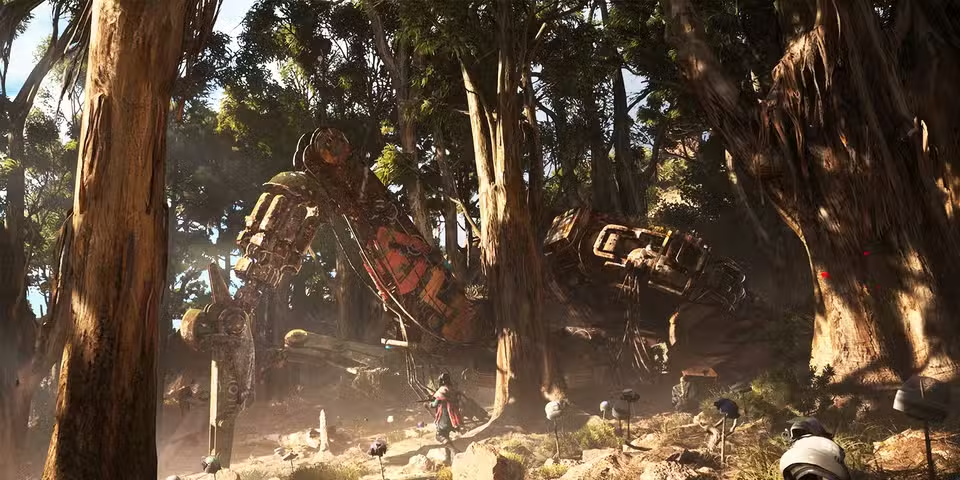
How Adaptive AI Difficulty Works in Arc Raiders
“Adaptive difficulty” can mean two very different things:
Dynamic Difficulty Adjustment (DDA) in game AI research refers to systems that adjust challenge based on player performance, aiming to avoid boredom (too easy) and frustration (too hard). Classic DDA work discusses computational and design requirements and proposes probabilistic methods that adjust game parameters “on the fly.”
Arc Raiders, however, should not be described as using ML to adapt enemy combat intelligence to individual players in real time. The clearest public guidance from Embark leadership is that ML is used for walking/navigation, not combat behaviours or attacks. This is consistent with live-service caution: letting enemies “learn” online can create unstable, difficult-to-debug outcomes.
Where Arc Raiders does appear to scale challenge is through designed systems: map conditions and operations that increase threat density and raise the risk-reward bar for experienced players. This is “adaptive” in the product sense (content and tuning evolve as players master threats), even if it is not per-player online ML.
How Arc Raiders Enemy AI Predicts Player Actions
There is no strong public evidence that Arc Raiders uses ML to predict player actions at the strategic level (e.g., learning player habits, dynamically countering individual playstyles). Embark leadership explicitly rejects that interpretation; perceived “smartness” is described as authored design rather than online learning.
That said, enemy systems can still appear predictive through two grounded mechanisms documented in public materials:
First, RL locomotion controllers are rewarded for orienting towards targets and moving efficiently to pursue them, which can look like “anticipation” because the enemy maintains purposeful alignment and pressure even through terrain clutter and partial damage. Second, conventional AI layers (BTs, targeting heuristics, threat evaluation, line-of-sight rules) can include short-horizon prediction such as leading shots or choosing intercept paths—without being ML.
The key analytical point is production clarity: in Arc Raiders’ public descriptions, ML improves how well enemies execute movement goals; it does not publicly claim to infer or model long-term player intent.

How Enemy AI in Arc Raiders Learns Player Behavior
Player theories that Arc Raiders’ machines are learning from live matches have been directly pushed back in Embark interviews. The published explanation is that machine learning is used for movement/navigation, not for evolving tactics based on player behaviour.
What does happen in ML-driven production pipelines is easy to confuse with “learning players”:
Offline improvement cycles: developers can observe gameplay, identify failure cases (odd terrain traps, destructed-limb locomotion breakdowns, exploit-ish edge cases), build training scenarios that reproduce them, and retrain or fine-tune controllers so future builds handle those situations better. In Arc Raiders coverage, this offline pipeline is described explicitly: learning is “not online learning,” and training is built around controlled scenarios (including environment randomisation) to generalise across many situations.
This distinction matters for accuracy: the game can improve over patches (because the model or authored behaviours are updated), but that is not the same as enemies learning the specifics of a player’s habits in real time.
Real-Time AI Learning vs Pre-Trained Models in Games
From a research standpoint, RL is often framed as “online learning”: an agent interacts with an environment and learns from reward feedback. In shipped games, however, “real-time learning” (models updating live) is rare because it can undermine predictability, balance, and reproducibility.
Arc Raiders’ publicly described approach aligns with the standard production pattern: train (or retrain) ML controllers offline, validate them under many simulated and in-engine conditions, then ship those pre-trained models as part of the game. The live runtime then uses those policies to drive locomotion, potentially with carefully bounded “assists” (like the described “magic torque”) to prevent edge-case failure modes that would otherwise make enemies look broken or harmless.
From an SEO angle, this is an important myth-buster: next-gen “ML enemies” do not have to be self-improving online to feel adaptive. Physical plausibility, robust recovery, and reactive perception can deliver that feeling with pre-trained models that remain under designer control.

Challenges of Using Machine Learning in Multiplayer AI Environments
Multiplayer games amplify ML constraints in ways single-player titles often do not:
Stability and convergence are non-trivial for multi-agent learning in game-like settings; research shows learning dynamics can be unstable and non-convergent, especially as the number of interacting agents grows. In a live-service extraction shooter, unpredictably shifting AI policies can create perceived unfairness, complicate QA, and make regression bugs extremely difficult to reproduce.
Server and performance budgets also set hard boundaries. Even when a feature is technically desirable (e.g., more advanced physics interactions like ropes/tripwires affecting giant machines), Embark’s ML leadership and press coverage note that anything added “eat[s] something server-side,” increasing overhead and narrowing what is feasible at scale. This matters because ML-driven physics enemies are not just an animation feature—they are an ongoing compute and network determinism problem in a game with many simultaneous players.
Finally, there is an authorial-control constraint: competitive and high-stakes multiplayer design typically demands bounded behaviours, clear telegraphs, and avoidable threats. Even when ML enables richer motion, teams may still choose to keep combat behaviours authored and separate from locomotion, precisely to avoid surprising players in ways that feel like “the game cheated.”
Future of Machine Learning in Enemy AI for Games Like Arc Raiders
Public Embark commentary suggests a credible near-term direction for ML in enemy AI: push ML beyond locomotion into richer perception and interaction, while keeping designer intent readable and controllable. The GDC session description already points to point-cloud perception integrated with learned movement—hinting at tighter coupling between “seeing” and “moving,” not just “moving well.”
Press coverage of Embark’s R&D also signals a broader aspiration: new physics capabilities and methodological breakthroughs can translate across multiple robots and potentially unlock new enemy interactions (tripwires, smoother gaits, and other physics-driven behaviours), though always constrained by server cost and game vision.
At an industry level, the research frontier that aligns best with Arc Raiders’ approach is the continued fusion of RL, imitation, and style priors to produce motion that is both physically stable and aesthetically consistent—exactly what AMP-like methods aim to support. The long-term “next-gen enemy AI” promise, then, is not simply smarter tactics—it is enemies that can physically cope with the complexity players generate, enabling encounter designs that would be too expensive or brittle to animate and script by hand.
Frequently Asked Questions (FAQs)
- Does Arc Raiders enemy AI learn from players in real time?
No. Public statements from Embark leadership describe ML as being used for walking/navigation, while combat behaviours and attacks are authored rather than learned from live player behaviour. - What kind of machine learning is actually used in Arc Raiders enemy AI?
Public materials point most directly to reinforcement learning for physics-based locomotion (especially multi-legged enemies), combined with animation references and a perception system described as point-cloud based. - Why does Arc Raiders AI feel adaptive if it isn’t learning online?
Because RL-driven locomotion can produce robust, context-sensitive movement—recovering from hits, navigating uneven terrain, and remaining credible under damage—so enemies respond fluidly to player-caused chaos without needing to learn the player. - Are Behavior Trees used in Arc Raiders?
Public coverage describes Arc Raiders as blending learned locomotion with behaviour trees, consistent with a layered AI stack (authored decision-making above ML movement). - What is reinforcement learning in simple terms?
Reinforcement learning is a machine learning approach where an agent learns to act by maximising reward while interacting with an environment under uncertainty. - What are “rewards” in Arc Raiders’ locomotion system?
Press coverage of Embark’s GDC talk describes reward signals tied to locomotion goals like staying upright, orienting towards targets, moving effectively, and mimicking reference animations—plus penalties for implausible or destabilising motion. - What is “magic torque” and why would a game use it?
“Magic torque” is described as a subtle assistance system used when pure physics locomotion fails (for example, after severe limb loss), with penalties discouraging obvious overuse so movement remains believable. - Does Arc Raiders use ML for enemy tactics and attacks?
Public reporting attributes tactics/attacks to authored game AI rather than machine learning; ML is described as limited to walking/navigation and locomotion. - Why don’t more multiplayer games use real-time learning AI enemies?
Online learning can create instability and unpredictable behaviour in multi-agent environments, complicating balance and QA; multi-agent learning research also highlights how convergence can be difficult as the number of agents increases. - What’s next for machine learning enemy AI in games like Arc Raiders?
The public direction implied by Embark’s AI discussions is deeper integration of learning-based movement, perception, and physics interactions—bounded by server budgets and the need to keep behaviours legible and fair.

Conclusion
Arc Raiders’ “smarter enemy AI” story, in the public record, is best understood as a production-ready hybrid: machine learning (especially reinforcement learning) drives physically grounded locomotion and recovery, while conventional game AI structures (notably behaviour trees and other authored systems) govern tactical intent and combat behaviour. This separation delivers two core benefits at once: the believability and adaptability of learned motion in a chaotic sandbox, and the stability, readability, and balance control required for a multiplayer live-service extraction game.
Sources and citation
- Embark Studios: ARC Raiders Official Site
https://www.arcraiders.com/ - Steam Store: ARC Raiders
https://store.steampowered.com/app/1808500/ARC_Raiders/ - PlayStation: ARC Raiders Official Product Page
https://www.playstation.com/en-us/games/arc-raiders/ - GDC Schedule: Learning to Move: Physics-Based Enemy Locomotion in ‘ARC Raiders’
https://schedule.gdconf.com/session/learning-to-move-physics-based-enemy-locomotion-in-arc-raiders/894982 - Technical Articles and Press Coverage
- 80 Level: Inside the Magic of Machine Learning That Powers Enemy AI in Arc Raiders
https://80.lv/articles/inside-the-magic-of-machine-learning-that-powers-enemy-ai-in-arc-raiders/ - PC Gamer: Congrats, you played yourself, Arc Raiders’ machines aren’t actually learning…
https://www.pcgamer.com/congrats-you-played-yourself-arc-raiders-machines-arent-actually-learning-mid-fight-theyre-just-good-at-navigating-physics/ - GamesRadar+: The Arc in Arc Raiders have multiple ‘brains’…
https://www.gamesradar.com/the-arc-in-arc-raiders-have-multiple-brains-making-decisions-about-where-to-step-to-chase-players-down/ - GamesRadar+: Arc Raiders has a hidden ‘magic’ system…
https://www.gamesradar.com/arc-raiders-has-a-hidden-magic-system-that-balances-physics-and-fun-but-breaking-a-machines-knees-will-still-bring-it-down/ - GamesRadar+: Arc Raiders devs would love to have machine takedowns…
https://www.gamesradar.com/arc-raiders-devs-would-love-to-have-machine-takedowns-similar-to-horizon-zero-dawn-if-we-just-had-better-rope-physics/ - Embark Studios (Medium): Transforming animation with machine learning
https://medium.com/embark-studios/transforming-animation-with-machine-learning-293630f7be52 - Academic Sources and Research Papers
- MIT Press: Reinforcement Learning: An Introduction (Sutton & Barto)
http://incompleteideas.net/book/the-book-2nd.html - arXiv: AMP: Adversarial Motion Priors for Stylized Physics-Based Character Control
https://arxiv.org/abs/2104.02180 - arXiv: DeepMimic: Example-Guided Deep Reinforcement Learning of Physics-Based Character Skills
https://arxiv.org/abs/1804.02717 - arXiv/Science Robotics: Learning agile and dynamic motor skills for legged robots
https://arxiv.org/abs/1901.08652 - arXiv: Behavior Trees in Robotics and AI: An Introduction (Colledanchise & Ögren)
https://arxiv.org/abs/1709.00084 - ScienceDirect (Robotics): A survey of Behavior Trees in robotics and AI
https://doi.org/10.1016/j.robot.2018.08.010 - Springer (Computer Games Journal): Behavior Trees for Modelling Artificial Intelligence in Games: A Tutorial
https://link.springer.com/article/10.1007/s40869-017-0033-3 - Northwestern University PDF: AI for Dynamic Difficulty Adjustment in Games (Hunicke & Chapman)
http://www.cs.northwestern.edu/~hunicke/pubs/DDA.pdf - arXiv: On the Stability of Learning in Network Games with Many Players
https://arxiv.org/abs/1810.10575
Recommended
- Oscars 2026: Everything You Should Know (98th Academy Awards Date, Host, Nominees, and How to Watch)
- Netflix Joins Blender: What Netflix Animation Studios Funding Means for Blender and the Community
- Donald Glover Is Playing Yoshi in The Super Mario Galaxy Movie: Cast, Trailer, Release Date, and Everything Confirmed
- Can I Improve My Metahuman in Blender? A Comprehensive Guide
- All characters and color variations in Mario Tennis Fever: Full roster, unlocks, and alternate colors
- The Steam Deck Is Out of Stock – What Does It Mean? (US, Canada & Asia Shortage Explained)
- The Original Final Fantasy 7 Gets a New Re-release for PC on Steam: New Features, Free Upgrade, and Known Issues
- How Do I Create a Cinematic Camera Shot in Blender?
- Facial Rigging in Blender: Comprehensive Guide for Beginners to Pros
- Hellblade 2 Trailer and Unreal Engine: How Ninja Theory Showcased Next-Gen Cinematics